Created on
1
/
15
/
2026
,
0
:
13
Updated on
1
/
15
/
2026
,
8
:
6
Location
Oakland, CA
New World (ii): Age of Discovery
新大陆(ii):大航海时代
前言:欧洲人很会用发明。本文和chatGPT合作完成。
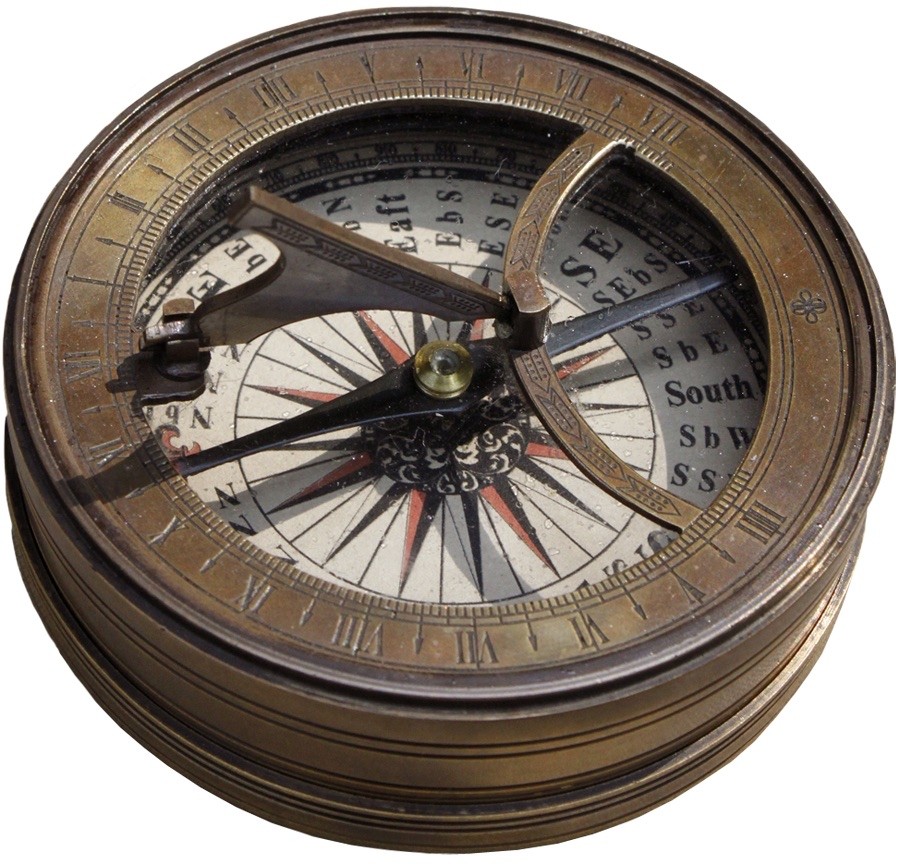
最早的磁性指向装置,出现在中国,时间大致可追溯至汉代,并在宋代得到进一步发展。最初使用的材料是天然磁石(磁铁矿,lodestone),其“自行指向”的特性很早就被观察到。但在最初的语境中,这种现象并不被理解为物理规律,而是被纳入宇宙秩序与象征体系之中。因此,早期罗盘的用途主要是占卜、风水与方位判定,例如“司南”——以磁石制成的勺状器物,放置在刻有方位的盘面上,用来确定南北。这种工具的目标不是在动态环境中持续导航,而是在相对静止的空间里完成一次性的方向判断。它并不是为航海而设计的。
随着陆路与海上贸易的发展,磁性指向工具经由阿拉伯世界逐渐传入地中海地区。真正的转折并不在于欧洲“重新发明”了罗盘,而在于用途的彻底改变:罗盘从象征性的定向器具,被转化为航海中的实用工具。这一转化,来自一系列看似简单、但后果深远的改造。
首先,欧洲水手将磁针固定在水平轴或悬挂装置上,使其能够在船只摇晃的环境中保持自由转动与相对稳定的指向。这一步解决的是“能不能在海上持续使用”的问题。其次,罗盘不再用于一次性的方向判断,而被当作连续指向的工具,在航行过程中随时提供方向参考,水手可以据此不断修正航向。更重要的是,罗盘被制度化地纳入航海流程,成为标准装备,与航线记录、风向判断和航海日志共同构成一整套操作体系,而不再是偶尔依赖的辅助器具。
从原理上看,罗盘并不神秘。地球本身是一个巨大的磁体,具有磁北极与磁南极。磁铁矿或被磁化的金属针在自由转动的状态下,会自动与地球磁场方向对齐。罗盘所做的,仅仅是为磁针提供一个低摩擦、低干扰的环境,使这种自然对齐过程能够被稳定地观察到。需要注意的是,罗盘指向的是磁北极而非地理北极,二者存在偏差。早期航海者并不理解这一差异的物理原因,但通过经验积累,逐渐学会在特定航线上进行修正。
而星盘(astrolabe)的理论基础,则可以追溯到古希腊天文学。希腊学者已经发展出球面几何和天球模型,理解天体在天空中的周期性运动,并尝试用几何方式将天空“投影”到平面上。星盘的核心思想——用一个二维装置来模拟三维天球——正源于这一传统。
真正让星盘变成可用工具的,是伊斯兰黄金时代。在这一时期,数学、天文学和仪器制造都达到了高度成熟的水平。学者不仅保存、翻译和扩展了希腊天文学,还将其转化为精密、耐用、可操作的仪器。大量黄铜星盘被制造出来,用于宗教时间计算、天文观测和导航。这一阶段,星盘完成了从“理论模型”到“工程工具”的转变。随后,星盘通过阿拉伯—西班牙—地中海的知识与贸易网络进入欧洲。欧洲并不是星盘的理论创新者,而是使用者与简化者。
其原理并不复杂。地球是一个球体,人所处的纬度不同,所看到的天空结构也随之发生变化。在北半球,这一关系尤其直观:北极星在天空中的高度,几乎等同于观测者所在的纬度。当人向北移动,北极星在地平线上升得更高;向南移动,则逐渐降低。这一稳定对应关系,使天空本身成为一种天然的测量参照。
星盘正是利用了这一几何关系。航行者通过星盘测量北极星在夜空中相对于地平线的角度,或在白天测量太阳的高度,然后将测得的角度与事先准备好的刻度或天文表格进行对照,从而得到一个大致的纬度数值。这一过程并不精细,误差也不小,但在当时的技术条件下已经足够可靠。
单独的纬度信息并不能完成导航,因此它必须与罗盘结合使用。星盘提供的是“我在南北方向上的位置”,罗盘提供的是“我正朝哪个方向前进”。两者配合,航行者便能够判断自己处于地球表面哪一条大致的“横向带”上,并据此维持航向的一致性。正是这种粗略却稳定的定位能力,使远洋航行第一次摆脱了完全依赖沿岸地形与记忆的状态,成为一种可以规划和重复的行动。
改良后的罗盘使航行不再完全依赖海岸线与目视判断;星盘与天文导航让水手可以通过太阳和恒星估算纬度,虽然经度问题尚未解决,但已经足以支撑长距离航行。与此同时,航海地图逐渐从象征性图像转向经验导向,洋流、风向与港口信息被系统记录并传承。
正是这种持续而可靠的方向感,改变了人类与海洋的关系。在罗盘出现之前,远洋航行高度依赖沿岸地形、天气记忆与星象条件,一旦进入陌生海域或遭遇阴天,航行便极度危险。罗盘并没有让航行变得安全,却让航行变得可规划、可修正、可重复。这种可重复性,才是后来跨洋航行、固定航线以及殖民扩张得以实现的最低技术前提。
最后,让大航海时代开启的关键,是卡拉维尔帆船(Caravel)的出现。卡拉维尔帆船的出现,并不是为了追求速度或规模,而是为了解决一个更根本的问题:在复杂风况下,船只是否仍然可控。在 15 世纪之前,许多船型在远洋航行中高度依赖顺风,一旦风向不利,船只几乎只能被动漂流。这种状态使探索行为本质上成为一次性冒险,而非可计划的行动。
卡拉维尔的背景,正是地中海与大西洋交汇区域长期航海实践的结果。它并非凭空诞生,而是融合了多种航海传统的技术结晶。来自北欧的造船经验提供了更为坚固、耐风浪的船体结构,使船只能够承受大西洋的复杂海况;地中海传统强调操控性与灵活转向,使船只在狭窄水域与近岸航行中保持机动;而关键性的突破,则来自阿拉伯世界的三角帆(lateen sail),这种帆型允许船只以“之”字形逆风前进,从而在风向不利时仍能保持航向。
正是这种融合带来了质变。船只第一次不再完全“听风行事”,而是能够在一定范围内修正自身航向。这看似只是操控层面的改进,却从根本上改变了航行的性质。航海不再是一次赌运气的顺风漂流,而是一个可以在途中调整、纠错和回撤的过程。这种可控性带来的后果极为深远。船只可以进行试探性的探索,而不必一去不返;航行失败后可以返回修正路线;成功的航线可以被重复使用并逐步固定下来。正是在这种条件下,远洋航行才从个人冒险转化为制度化行动。
因此,卡拉维尔帆船的历史意义,并不在于它让人类航行得更快,而在于它让航行变得可重复。而殖民与扩张真正需要的,从来不是勇气,而是这种可重复、可复制、可持续的能力。这种船体较轻、吃水浅、机动性强,配合三角帆后,具备逆风航行能力。这一变化的意义在于:航行不再只是“顺风漂流”,而是可以规划路线、修正方向、实现往返。
对历史而言,真正重要的不是“第一次到达”,而是是否能够回来,并再次前往。殖民与扩张依赖的,正是这种可重复性。
而技术成熟只是条件,真正推动欧洲向外的,是内部持续累积的压力。
首先发生变化的是欧洲赖以生存的贸易结构。随着奥斯曼帝国在 14—15 世纪逐步控制东地中海、巴尔干以及连接亚洲的关键陆上通道,传统的欧亚贸易网络被重新定价。香料、丝绸、药材等高利润商品并未消失,但它们必须经过更多中介、更高关税和更复杂的政治博弈才能进入欧洲市场。结果是价格持续攀升,而收益却大量被中间环节攫取。
对欧洲而言,这并不只是“奢侈品变贵”的问题,而是一个系统性瓶颈:贵族的消费模式、城市商人的利润空间、王权的财政来源,都高度依赖这些远程贸易品。一旦通道被卡住,整个经济上层结构都会感到窒息。正是在这种压力下,“绕开中间人、直接通往资源产地”的想法,逐渐从理论设想转变为迫切需求。
与此同时,欧洲内部的社会结构也在发生深刻转型。中世纪晚期,封建秩序开始松动,传统以土地和人身依附为基础的体系逐渐失去效率。骑士阶层随军事技术变化而衰落,城市与商业迅速崛起,一批不依附于封建领主的资产阶级开始成为重要的经济力量。王权则在这一过程中不断集中,试图削弱地方贵族、建立更直接的统治与征税体系。
问题在于,新兴的中央国家形态需要持续、可控且规模化的财政来源。仅依靠传统农业税和封建义务,已不足以支撑常备军、行政官僚体系和对内治理。海外探索在这一背景下显现出独特吸引力:它提供了一条绕开本土封建结构、直接由国家或王权控制财富流入的路径。黄金、白银、香料和新贸易品,意味着不必经过地方贵族的再分配,就能直接进入国家财政体系。
因此,航海探索逐渐脱离了个人冒险或商人投机的范畴,转化为一种国家层面的战略行为。王室出资、授予特许权、建立垄断公司,都是这一转变的体现。风险依然巨大,但在结构性压力之下,这种风险被视为一种可以接受、甚至必要的投资。
在这种语境中,大航海并非源于浪漫的探索冲动,而是一种被现实逼出的选择:用海洋的未知,去对冲陆地秩序已经无法承载的经济与政治需求。
Preface: Europeans are exceptionally good at using inventions. This essay was co-written with ChatGPT.
The earliest magnetic pointing devices appeared in China, with origins that can be traced back to the Han dynasty and further development during the Song dynasty. The materials initially used were natural lodestones (magnetite), whose self-aligning property was observed very early on. In its original context, however, this phenomenon was not understood as a physical law, but rather incorporated into cosmological and symbolic systems. As a result, early compasses were used primarily for divination, feng shui, and orientation. A typical example was the sinan—a spoon-shaped object made of lodestone, placed on a plate marked with directions to determine north and south. The purpose of such instruments was not continuous navigation in a dynamic environment, but one-time directional judgment in relatively static space. They were not designed for maritime use.
As overland and maritime trade expanded, magnetic pointing devices gradually reached the Mediterranean world via the Arab regions. The real turning point did not lie in Europe “reinventing” the compass, but in a fundamental shift in its function. The compass was transformed from a symbolic orientation device into a practical tool for navigation. This transformation resulted from a series of changes that appeared simple but had far-reaching consequences.
First, European sailors mounted the magnetic needle on a horizontal axis or suspension system, allowing it to rotate freely and maintain relative stability even as ships rolled at sea. This solved the problem of whether the compass could be used continuously aboard a moving vessel. Second, the compass ceased to be a tool for one-time directional checks and became a continuously pointing instrument, providing constant reference during navigation and allowing sailors to make ongoing course corrections. Most importantly, the compass was institutionalized within the navigation process. It became standard equipment, integrated with route records, wind assessments, and logbooks into a complete operational system, rather than an auxiliary device used only occasionally.
In principle, the compass is not mysterious. The Earth itself is a massive magnet with a magnetic north and south pole. Lodestones or magnetized metal needles, when free to rotate, naturally align with the Earth’s magnetic field. What the compass does is simply provide a low-friction, low-interference environment in which this natural alignment can be observed reliably. It is important to note that the compass points toward the magnetic north pole rather than the geographic north pole, and the two do not coincide. Early sailors did not understand the physical reason for this discrepancy, but through accumulated experience they gradually learned to correct for it along specific routes.
The theoretical foundations of the astrolabe can be traced back to ancient Greek astronomy. Greek scholars developed spherical geometry and celestial models, understood the periodic motion of celestial bodies, and attempted to project the heavens geometrically onto a plane. The core idea of the astrolabe—using a two-dimensional device to model the three-dimensional celestial sphere—emerged from this tradition.
What truly turned the astrolabe into a usable instrument was the Islamic Golden Age. During this period, mathematics, astronomy, and instrument-making reached a high level of sophistication. Scholars not only preserved, translated, and expanded Greek astronomy, but also transformed it into precise, durable, and operable instruments. Large numbers of brass astrolabes were produced for religious timekeeping, astronomical observation, and navigation. At this stage, the astrolabe completed its transition from a theoretical model to an engineered tool. It later entered Europe through networks of knowledge and trade connecting the Arab world, Spain, and the Mediterranean. Europeans were not the theoretical innovators of the astrolabe, but rather its users and simplifiers.
The principle behind the astrolabe is straightforward. The Earth is spherical, and observers at different latitudes see different structures of the sky. In the Northern Hemisphere, this relationship is especially intuitive: the altitude of Polaris above the horizon is almost equal to the observer’s latitude. As one moves north, Polaris rises higher above the horizon; moving south, it sinks lower. This stable correspondence makes the sky itself a natural measuring reference.
The astrolabe exploits this geometric relationship. Sailors measured the angle between Polaris and the horizon at night, or the altitude of the Sun during the day, and then compared the measured angle with pre-prepared scales or astronomical tables to obtain an approximate latitude. The process was not precise and involved significant error, but under the technological conditions of the time it was sufficiently reliable.
Latitude alone, however, was not enough for navigation, and therefore had to be combined with the compass. The astrolabe provided information about north–south position, while the compass indicated direction of travel. Together, they allowed sailors to determine which approximate “horizontal band” of the Earth’s surface they occupied and to maintain directional consistency. This rough but stable positioning capability allowed long-distance voyages to break free from total dependence on coastlines and memory, turning navigation into something that could be planned and repeated.
The improved compass meant that navigation no longer relied entirely on coastal visibility and visual judgment. The astrolabe and celestial navigation allowed sailors to estimate latitude using the Sun and stars. Although the problem of longitude remained unsolved, this was already sufficient to support long-distance travel. At the same time, nautical charts gradually shifted from symbolic representations to experience-based records, with currents, winds, and ports being systematically documented and passed on.
This sustained and reliable sense of direction fundamentally changed humanity’s relationship with the sea. Before the compass, long-distance sailing depended heavily on coastal features, remembered weather patterns, and visible celestial cues; entering unfamiliar waters or encountering overcast skies made navigation extremely dangerous. The compass did not make sailing safe, but it made it planable, correctable, and repeatable. This repeatability was the minimal technical prerequisite for transoceanic voyages, fixed sea routes, and ultimately colonial expansion.
Finally, the key innovation that truly opened the Age of Discovery was the emergence of the caravel. The caravel was not designed to maximize speed or size, but to solve a more fundamental problem: whether a ship could remain controllable under complex wind conditions. Before the fifteenth century, many vessels depended heavily on favorable winds in open-sea navigation; when winds turned against them, ships were often reduced to passive drifting. Under such conditions, exploration was essentially a one-time gamble rather than a planable endeavor.
The caravel emerged from long-term maritime practice in the regions where the Mediterranean met the Atlantic. It was not invented from nothing, but rather represented a synthesis of multiple seafaring traditions. Northern European shipbuilding contributed robust, storm-resistant hulls capable of withstanding Atlantic conditions; Mediterranean traditions emphasized maneuverability and flexible steering in narrow waters and coastal navigation; and the crucial breakthrough came from the Arab world in the form of the lateen sail, which allowed ships to tack against the wind and maintain a course even when winds were unfavorable.
This synthesis produced a qualitative shift. Ships were no longer entirely “at the mercy of the wind,” but could correct their course within certain limits. What appeared to be a modest improvement in handling fundamentally changed the nature of navigation. Sailing ceased to be a gamble on favorable winds and became a process that allowed adjustment, correction, and retreat. The consequences were profound: ships could conduct exploratory voyages without committing to a one-way journey, failed routes could be abandoned and revised, and successful routes could be reused and gradually standardized. Under these conditions, oceanic travel shifted from individual adventure to institutionalized practice.
The historical significance of the caravel, therefore, lies not in making ships faster, but in making navigation repeatable. Colonial expansion required not bravery, but this capacity for repetition, replication, and sustainability. With its light hull, shallow draft, and high maneuverability, combined with lateen sails, the caravel could sail against the wind. Navigation was no longer mere downwind drifting, but something that could be planned, corrected, and carried out as a round trip.
In historical terms, what truly mattered was not reaching a destination for the first time, but being able to return—and to go again. Colonial expansion depended precisely on this repeatability.
Technological maturity, however, was only the condition. What truly pushed Europe outward was the accumulation of internal pressures.
The first major shift occurred in the structure of trade on which Europe depended. As the Ottoman Empire gradually gained control over the eastern Mediterranean, the Balkans, and key overland routes connecting Asia during the fourteenth and fifteenth centuries, traditional Eurasian trade networks were effectively repriced. High-value goods such as spices, silk, and medicinal products did not disappear, but reaching European markets now required more intermediaries, higher tariffs, and increasingly complex political negotiations. Prices rose steadily, while profits were increasingly captured by middlemen.
For Europe, this was not merely a matter of luxury goods becoming more expensive, but a systemic bottleneck. Aristocratic consumption patterns, urban commercial profits, and royal finances all depended heavily on these long-distance trade goods. Once these routes were constrained, the entire upper economic structure began to suffocate. Under this pressure, the idea of bypassing intermediaries and reaching the sources of wealth directly shifted from a theoretical possibility to an urgent necessity.
At the same time, Europe’s internal social structure was undergoing profound transformation. In the late Middle Ages, the feudal order began to loosen, as systems based on landholding and personal dependency lost efficiency. The knightly class declined with changes in military technology, while cities and commerce expanded rapidly, giving rise to a bourgeois class increasingly independent of feudal lords. Meanwhile, royal authority became more centralized, seeking to weaken local nobility and establish more direct systems of rule and taxation.
The problem was that emerging centralized states required stable, controllable, and scalable sources of revenue. Traditional agricultural taxes and feudal obligations were no longer sufficient to sustain standing armies, administrative bureaucracies, and internal governance. Overseas exploration offered a uniquely attractive solution: a way to channel wealth directly into state or royal control, bypassing domestic feudal structures. Gold, silver, spices, and new trade goods could flow directly into royal treasuries without passing through the hands of local elites.
As a result, maritime exploration gradually moved beyond the realm of individual adventure or merchant speculation and became a state-level strategic endeavor. Royal sponsorship, chartered privileges, and monopoly companies all reflected this shift. The risks remained enormous, but under mounting structural pressure, these risks came to be seen as acceptable—甚至 necessary—investments.
In this context, the Age of Discovery did not arise from romantic impulses toward exploration, but from necessity. It was a choice forced by reality: using the unknown of the oceans to offset economic and political demands that the existing land-based order could no longer sustain.