Created on
1
/
15
/
2026
,
0
:
13
Updated on
1
/
18
/
2026
,
3
:
12
Location
Oakland, CA
The Old World(iv): Roman Calendar
旧世界(iv): 罗马历法
前言:本文和chatGPT合作完成。
在 Numa Pompilius 之前,罗马的宗教权威高度个人化:谁掌握仪式、谁能与神沟通,取决于个人威望、战功或神话叙事。这种结构在创始阶段有效,但不可复制、不可继承、也不可长期运转。
罗马的宗教并不是一个“系统”,而更像是一组并行存在的传统集合。宗教行为深度嵌入家族与氏族结构之中,每个家族都有自己的守护神、祭祀方式和口传禁忌。仪式的正确性来自“祖先一直这么做”,而不是来自一个可被检验的公共标准。因此,谁更“懂神”,往往取决于年龄、血统、经验或个人声望,而不是制度授权。神意的解释是分散的、情境化的,也是不稳定的:同一件事在不同家族、不同仪式传统中,可能得到完全不同的神学解释。换句话说,宗教在当时并不具备整合城市整体行动的能力,它更像是若干条并列的信仰路径。
Numa 的关键动作,是把“与神沟通”的能力去个人化,转化为一套稳定的制度分工。努马设立了最高祭司(Pontifex Maximus),这一举措的关键意义不在于“宗教权威变强了”,而在于解释权第一次被制度性地集中。最高祭司并不是神的代言人,而是宗教秩序的裁定者。什么仪式是正确的,什么做法是无效的,哪些偏差可以被纠正,哪些错误会导致整套仪式作废,这些判断不再由执行者本人或其家族决定,而由一个被公共承认的权威来裁定。这一步切断了“我感觉神接受了”这一主观路径,确立了“是否符合公共标准”这一客观判断。宗教行为由此第一次具备了可被审核的属性。
与此同时,最高祭司还承担着“管理记忆”的功能。宗教在此之前主要依靠口传与习惯维持,而努马将其转化为可被保存、积累和调用的制度性记忆。哪些日子是禁日,哪些行为在特定情境下被禁止,仪式的顺序、用词和动作应当如何执行,这些都不再只是“老人记得的东西”,而是被系统整理、持续维护的规范体系。通过对宗教档案、禁忌清单与仪式范本的集中管理,宗教不再依赖个别人的记忆寿命,而获得了跨世代的连续性。这一步本质上是在为城市建立一种“超个人的记忆结构”。
更重要的是,最高祭司成为宗教冲突的最终裁决者。在一个多家族、多传统并存的城市中,不同祭司或家族对同一征兆、同一仪式结果产生分歧是常态。如果这种分歧无法被裁定,就会直接转化为政治与社会冲突。努马通过设立一个被普遍承认的裁决中心,使“神的分歧”不再必然升级为“人的对抗”。当不同解释发生冲突时,问题不再是谁更虔诚、谁更古老,而是谁拥有制度授权来给出最终解释。由此,宗教第一次成为一种降低不确定性、而非制造不确定性的社会机制。
除此之外,还有下面把 Flamines,即祭司,和 Augures,即占卜官。 。
Flamen 的核心特征在于高度专职化。每一位 Flamen 只服务于一个特定神祇,例如 Jupiter、Mars 或 Quirinus。他不是“更虔诚的信徒”,而是某一位神在制度中的专用接口。这种一神一职的设计,本身就切断了“个人理解神”的空间。神不再是可以被自由解释的超自然力量,而是被明确绑定到一套固定职责与仪式之上的对象。
为了确保这种稳定性,Flamen 的仪式、服饰和禁忌被严格固定。什么时候献祭、如何行走、穿什么衣服、说哪些词、避免哪些动作,都不是个人选择,而是被精确规定的流程。哪怕是微小偏差,都可能导致仪式被判定为无效。这意味着,神是否“被正确对待”,不取决于执行者的情感强度,而取决于程序是否被准确复现。
Flamen 的个人生活本身被纳入制度控制之中。他的婚姻形式、出行方式、日常行为都受到限制,甚至在某些情况下不能骑马、不能远行、不能脱下特定服饰。这并不是对个人的道德要求,而是为了确保:这个人始终处在“可随时履行神职”的稳定状态。Flamen 本人不再是一个完整的私人主体,而是被改造为神—城市关系中的一个持续运转的部件。
如果说 Flamines 负责的是“如何正确地对待神”,那么 Augures 处理的则是另一个层面的问题:在此刻,此事是否被允许发生。他们通过观察鸟类飞行、雷电、风向等自然征兆,来判断某一行动是否得到了神意的许可。但这里有一个关键点:Augures 并不评价行动本身的内容,更不对结果负责。
他们不回答“这件事该不该做”,只回答“现在能不能做”。一项行动即便在政治上合理、军事上必要,只要占兆结果不利,就必须推迟或取消;反过来,只要程序上获得了许可,即便结果失败,行动在宗教与制度层面仍然是正当的。由此,罗马建立起一种极其冷静、也极其强硬的区分:正当性与成败是两件事。
这种结构性的区分,彻底改变了神在政治生活中的位置。神不再通过“让你赢或输”来表达意志,而是通过“是否允许你启动行动”来发挥作用。神意被前置到行动之前,而不是事后通过结果来解释。这使得责任可以被清晰地分配:如果程序正确、许可成立,那么失败不是对神的冒犯,也不是对合法性的否定。
当 Flamines 与 Augures 并置时,可以清楚地看到努马体系的核心逻辑。神被拆解成不同的制度功能:一部分神通过固定仪式被“持续维护”,另一部分神通过征兆被“阶段性咨询”。人与神的关系不再是整体性的、情绪化的依赖,而是被分割为若干清晰的操作环节。
在努马建立的宗教体系中,仪式(ritus)的意义并不在于表达情感或虔诚,而在于复制已经被承认的正确行为。仪式的每一个要素——顺序、用词、动作、对象与时间——都被明确规定,任何偏差都可能导致整套仪式被判定为无效。关键并不在于神是否被“感动”,而在于程序是否被完整、准确地执行。在这种结构下,宗教行为被彻底去主观化:一个人即便内心冷漠,只要遵循既定流程,仪式依然成立;反之,即便情感真诚,只要程序出错,也必须重来。神是否“接受”某一行为,不再由个人体验判断,而是由制度加以确认。仪式因此不再是人与神之间的心理互动,而成为一种可以被检查、被否决、被重复执行的操作流程。这一转变,使“正确性”脱离了个人品质,转而依附于可复制的形式,为后来罗马法中“程序优先于动机”的原则奠定了基础。
与仪式相配合的,是一整套禁忌体系(tabu)。禁忌在罗马宗教中并不是道德判断,而是一种风险管理工具,其目的不是区分善恶,而是提前标记哪些行为、哪些时刻、哪些领域不可触碰,以防人类行动误入神的领域,破坏城市与神之间的秩序关系。例如,某些日子不能开庭,某些时刻不能集会,某些行为在特定情境下必须暂停。这些禁令并不要求解释“为什么不道德”,只需要确认“是否被允许”。通过禁忌,社会运行中被提前划出一系列明确的红线,使人不必在不确定情境中反复试探神意。更重要的是,禁忌将责任从个人判断中移除。如果行动受阻,原因不在于执行者不够虔诚,而在于程序本身被禁止。宗教因此不再制造新的不确定性,而是吸收风险、缓冲冲突的一种机制。
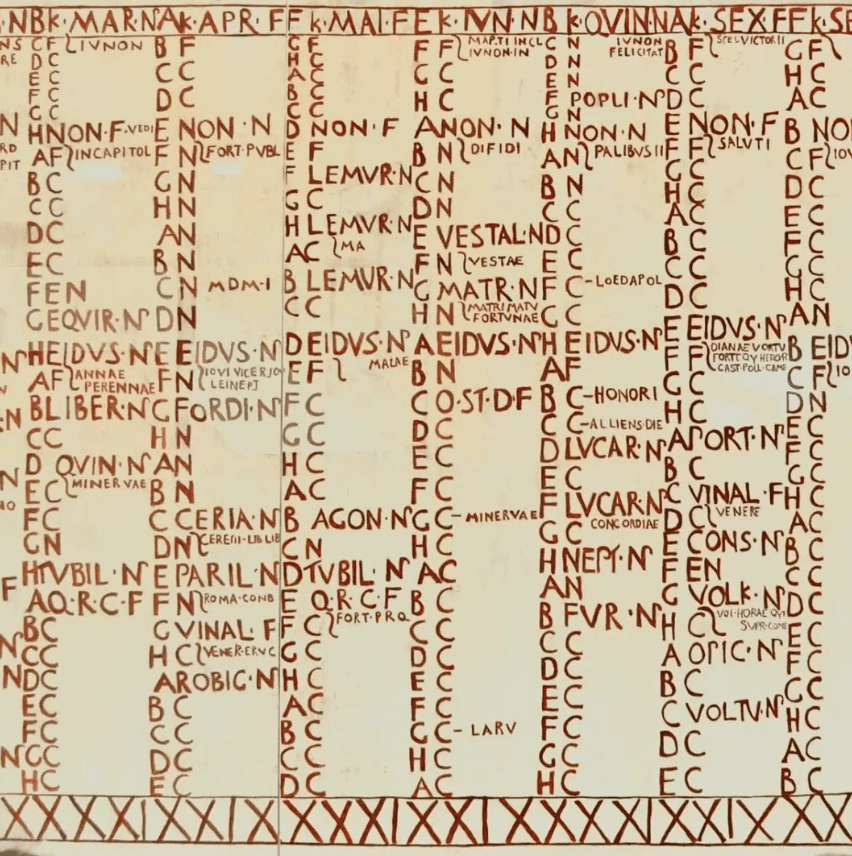
除此之外,Numa还创立了罗马历法。今天我们用的十二月份就是从这来的。
早期罗马月份的命名,并不是为了精确记录时间,而是为了把时间嵌入一套可被承认的秩序之中。传统上,这一套调整被归于 Numa Pompilius。在他的体系里,月份名称并不构成一个统一而优雅的神话系统,而是由军事现实、农业节奏、宗教象征与行政需要拼接而成。
最早的罗马历年并非从一月开始,而是从三月开始,这一事实直接反映了罗马社会的军事/农业属性。三月(Martius)以战神玛尔斯命名,标志着战争与公共行动的开启;四月(Aprilis)通常被理解为“开启、生长”,对应春季的自然复苏;五月(Maius)来自女神玛伊亚,与生长与繁盛相关;六月(Junius)来自女神朱诺,象征婚姻、家庭与社会秩序。这一阶段的月份命名,仍然紧密连接自然循环与神祇象征。
然而,从第五个月开始,罗马月份的命名方式突然发生转变。Quintilis、Sextilis、September、October、November、December,这些名称直接来自数字,分别表示第五到第十个月。这种命名的“去神话化”并非偶然,而是说明在这一段时间中,罗马人已经不再追求象征表达,而更关心计数的便利性与行政操作的清晰性。月份在这里成为一种可管理的时间单元,而非神话叙事的延伸。后来 Quintilis 与 Sextilis 被改名为 July 与 August,是帝制时期的政治行为,与早期结构无关。
传统认为,正是努马在原有十个月的基础上,引入了一月与二月,使一年扩展为十二个月。一月(Ianuarius)来自双面神雅努斯,象征门槛、过渡与开始与结束的并存。这一命名并不指向农业或战争,而是首次明确指向“时间结构本身”,意味着罗马开始将时间视为一种需要被制度性处理的对象。二月(Februarius)则来自净化仪式 februa,它并不是行动的月份,而是清理、赎罪与修正的时间窗口。因此,二月往往天数最少,闰月被插在二月之后,大量宗教禁忌与制度性清算也集中发生在这一时期。
在总天数上,早期罗马历年约为 355 天,明显偏离太阳年,但这并非无知,而是一种有意为之的选择。罗马历法并不以天文精确为最高目标,而以宗教与制度上的“可接受性”为优先。罗马人普遍认为奇数天是完整、吉利和稳定的,而偶数天则被视为不吉或不稳,因此大多数月份被设置为 29 天或 31 天。当时间与季节的偏差积累到无法忽视时,修正并不通过数学计算完成,而是通过插入闰月来实现,而是否插入、何时插入,则完全由宗教权威裁定。
月份并非等价单位,时间并非中性流逝,历年也不是自然周期的简单反映,而是一种被允许、被管理、被调整的公共结构。罗马历法真正关心的,从来不是“真实世界走到了哪一天”,而是“这个城市此刻被允许进入哪一个阶段”。正是在这一意义上,罗马月份的命名与结构,本质上是一种秩序设计,而非时间记录。
按照罗马传统记载,Numa在位约四十余年,在长期稳定的统治后自然死亡,时间大致在公元前 7 世纪中期。他的去世并未引发剧烈动荡,也没有“殉道”“被推翻”或“神罚”的叙事。对罗马人来说,这本身就是对他统治最强的评价:制度已经站得住脚,不需要靠个人继续维持。
与罗慕路斯不同,努马死后没有被神化、升天或转化为超自然存在。他没有成为战争之神、城市之神或祖先英雄,而是被记忆为一个“完成了任务的人”。他的合法性并不依赖个人魅力或暴力功绩,因此他的死亡不会撕裂秩序。相反,他留下的是一整套已经可以自行运转的宗教—制度结构:祭司体系、历法、禁忌、仪式与解释权中心,都不因他的消失而失效。
从叙事层面看,这种结局是高度一致的。努马的角色不是开疆拓土者,也不是危机中的拯救者,而是“奠基者”。他的成功标准不是个人是否继续存在,而是他离开之后,结构是否还能持续。在这一点上,罗马传统几乎是在用他的死亡方式来反向证明他的成就:没有混乱,说明制度有效。
因此,努马·庞庇利乌斯的结局可以概括为一句话:他作为一个人结束了,但他建立的秩序开始真正独立于人而存在。在罗马历史的价值体系中,这是一种极高、也极冷静的评价。
Preface: This essay was written in collaboration with ChatGPT.
Before Numa Pompilius, religious authority in Rome was highly personalized: who controlled ritual knowledge and who could communicate with the gods depended on individual prestige, military achievement, or mythic narrative. This structure worked during the founding phase, but it was neither replicable nor inheritable, and it could not sustain long-term operation.
Roman religion at that time was not a “system” so much as a collection of parallel traditions. Religious practice was deeply embedded in family and clan structures. Each family maintained its own tutelary gods, sacrificial customs, and orally transmitted taboos. The correctness of a ritual derived from the fact that “the ancestors have always done it this way,” rather than from any publicly verifiable standard. As a result, who was considered to “understand the gods” depended largely on age, lineage, experience, or personal reputation, not on institutional authorization. Interpretations of divine will were dispersed, situational, and unstable: the same event could receive entirely different theological explanations across different families or ritual traditions. In other words, religion at this stage lacked the capacity to coordinate the actions of the city as a whole; it functioned more like multiple parallel paths of belief.
Numa’s decisive move was to depersonalize the capacity to “communicate with the gods” and transform it into a stable division of institutional labor. He established the office of the Pontifex Maximus (Chief Priest). The significance of this act did not lie in religion becoming “stronger,” but in the fact that interpretive authority was, for the first time, institutionally centralized. The chief priest was not a spokesperson for the gods, but an arbiter of religious order. Determinations of which rituals were correct, which practices were invalid, which deviations could be corrected, and which errors nullified an entire rite were no longer made by the performer or the performer’s family, but by a publicly recognized authority. This severed the subjective pathway of “I feel the god has accepted it” and replaced it with an objective criterion: whether an action conformed to a public standard. Religious practice thus, for the first time, became subject to review.
At the same time, the chief priest assumed responsibility for what might be called the “management of memory.” Previously, religion had been sustained largely through oral transmission and habitual practice. Under Numa, it was transformed into a form of institutional memory that could be preserved, accumulated, and consulted. Which days were forbidden, which actions were prohibited in specific contexts, how rituals were to be ordered, worded, and enacted—these were no longer merely things “remembered by elders,” but systematically organized and continuously maintained norms. Through centralized control of religious archives, lists of taboos, and ritual templates, religion ceased to depend on the lifespan of individual memories and acquired transgenerational continuity. In effect, this was the creation of a “supra-personal memory structure” for the city.
More importantly still, the chief priest became the final arbiter of religious disputes. In a city composed of multiple families and traditions, disagreements among priests or clans over the interpretation of the same omen or ritual outcome were inevitable. If such disagreements could not be resolved, they would easily escalate into political or social conflict. By establishing a widely recognized center of adjudication, Numa ensured that “disagreements among the gods” did not automatically become “conflicts among humans.” When interpretations clashed, the issue was no longer who was more pious or more ancient, but who possessed institutional authorization to issue the final interpretation. Religion thus became, for the first time, a mechanism for reducing uncertainty rather than generating it.
In addition, Numa differentiated the roles of the Flamines (priests) and the Augures (diviners).
The defining feature of the Flamen was strict specialization. Each Flamen served only a single deity—such as Jupiter, Mars, or Quirinus. He was not a “more devout believer,” but a dedicated institutional interface for a specific god. This one-god–one-office design eliminated the space for personal interpretation of the divine. The god was no longer a freely interpretable supernatural force, but an object explicitly bound to a fixed set of duties and rituals.
To ensure this stability, the Flamen’s rituals, clothing, and taboos were rigidly prescribed. When sacrifices were to be offered, how one walked, what one wore, which words were spoken, and which actions were to be avoided—none of this was left to personal choice. Even the slightest deviation could render a ritual invalid. This meant that whether a god was “properly honored” did not depend on the intensity of the officiant’s emotion, but on the accurate reproduction of procedure.
The Flamen’s personal life itself was brought under institutional control. His form of marriage, modes of travel, and everyday conduct were all restricted; in some cases he could not ride a horse, travel far, or remove certain garments. These were not moral demands placed on him as an individual, but structural requirements designed to ensure that he remained in a stable state of perpetual readiness to perform his sacred duties. The Flamen was no longer a fully private subject, but a continuously operating component within the god–city relationship.
If the Flamines were responsible for determining how the gods were to be properly treated, the Augures addressed a different question: whether, at this moment, a given action was permitted to occur. By observing the flight of birds, thunder, wind direction, and other natural signs, they judged whether an action had received divine authorization. Crucially, the Augures did not evaluate the content of the action itself, nor were they responsible for its outcome.
They did not answer the question “Should this be done?” but only “Can this be done now?” An action might be politically reasonable or militarily necessary, yet if the auspices were unfavorable, it had to be postponed or canceled. Conversely, if procedural authorization had been obtained, then even if the action failed, it remained legitimate in religious and institutional terms. Rome thus established a stark and disciplined distinction: legitimacy and success were not the same thing.
This structural distinction fundamentally altered the role of the gods in political life. The gods no longer expressed their will by making one win or lose, but by determining whether an action could be initiated in the first place. Divine will was moved to the front of action, rather than being inferred retrospectively from results. Responsibility could therefore be clearly allocated: if procedure was correct and authorization granted, failure was neither an affront to the gods nor a negation of legitimacy.
When Flamines and Augures are considered together, the core logic of Numa’s system becomes clear. The divine was decomposed into distinct institutional functions: some gods were “continuously maintained” through fixed rituals, while others were “consulted periodically” through omens. The relationship between humans and gods ceased to be a holistic, emotional dependence and was instead divided into discrete, well-defined operational steps.
Within Numa’s religious system, the significance of ritual (ritus) lay not in the expression of emotion or piety, but in the replication of actions already recognized as correct. Every element of ritual—sequence, wording, movement, object, and timing—was precisely specified, and any deviation could invalidate the entire rite. The decisive factor was not whether the god was “moved,” but whether the procedure was executed fully and accurately. Religious practice was thus thoroughly de-subjectivized: even a person who felt nothing could perform a valid ritual by following the prescribed process, while genuine emotion could not compensate for procedural error. Whether a god “accepted” an action was no longer judged by personal experience, but confirmed by the institution. Ritual ceased to be a psychological interaction and became an operation that could be checked, rejected, and repeated. This shift detached “correctness” from personal character and anchored it in reproducible form, laying the groundwork for the Roman legal principle that procedure takes precedence over motive.
Complementing ritual was a comprehensive system of taboos (tabu). In Roman religion, taboos were not moral judgments but tools of risk management. Their purpose was not to distinguish good from evil, but to mark in advance which actions, times, and domains were untouchable, so as to prevent human activity from encroaching on the divine sphere and disrupting the order between city and gods. Certain days could not host court proceedings, certain moments forbade assemblies, and certain actions had to be suspended in specific contexts. These prohibitions did not require moral explanation; they required only confirmation of permission. By establishing clear red lines in advance, taboos spared society from repeatedly testing divine boundaries under conditions of uncertainty. More importantly, taboos removed responsibility from individual judgment. If action was blocked, the reason lay not in insufficient piety, but in procedural prohibition. Religion thus absorbed risk and buffered conflict instead of generating new uncertainty.
Beyond this, Numa is also credited with creating the Roman calendar—the source of the twelve months still in use today.
Early Roman month names were not designed to record time with precision, but to embed time within a recognized order. Tradition attributes this restructuring to Numa Pompilius. In his system, the names of the months did not form a unified or elegant mythological sequence; rather, they were assembled from military realities, agricultural rhythms, religious symbolism, and administrative needs.
The earliest Roman year did not begin in January, but in March, a fact that directly reflects Rome’s military and agricultural orientation. March (Martius) was named after Mars, the god of war, marking the opening of warfare and public action. April (Aprilis) is commonly understood as signifying “opening” or growth, corresponding to spring renewal. May (Maius) derives from the goddess Maia, associated with growth and fertility, while June (Junius) comes from Juno, symbolizing marriage, family, and social order. In this phase, month names remained closely tied to natural cycles and divine symbolism.
From the fifth month onward, however, the naming system abruptly changed. Quintilis, Sextilis, September, October, November, and December derive directly from numbers, designating the fifth through tenth months. This de-mythologization was not accidental. It indicates that during this stretch, Romans prioritized ease of counting and administrative clarity over symbolic expression. Months became manageable units of time rather than extensions of mythic narrative. The later renaming of Quintilis and Sextilis as July and August was a political act of the imperial period and unrelated to the early structure.
Tradition holds that Numa expanded the original ten-month year by introducing January and February, creating a twelve-month year. January (Ianuarius) takes its name from Janus, the two-faced god of thresholds, transitions, and the coexistence of beginnings and endings. Unlike earlier months, this name does not point to agriculture or war, but explicitly to time as structure. It marks Rome’s first attempt to treat time itself as an object of institutional design. February (Februarius) derives from purification rites (februa). It was not a month of action, but a period for cleansing, atonement, and correction. Accordingly, February was often the shortest month, intercalary months were inserted after it, and many religious prohibitions and institutional reckonings were concentrated in this period.
In total length, the early Roman year comprised approximately 355 days, noticeably divergent from the solar year. This was not ignorance, but a deliberate choice. The Roman calendar did not treat astronomical precision as its highest value; religious and institutional acceptability took precedence. Romans generally regarded odd numbers as complete, auspicious, and stable, while even numbers were seen as unlucky or unstable. Consequently, most months were set at 29 or 31 days. When seasonal drift became impossible to ignore, correction was achieved not through calculation but through the insertion of intercalary months, the timing and necessity of which were determined entirely by religious authority.
Months were not equal units, time did not flow neutrally, and the year was not a simple reflection of natural cycles. Instead, time was a public structure that could be permitted, managed, and adjusted. What the Roman calendar truly concerned itself with was never “what day it is in the real world,” but “which phase the city is currently authorized to enter.” In this sense, the structure and naming of Roman months were fundamentally acts of order-design, not timekeeping.
According to Roman tradition, Numa ruled for more than forty years and died a natural death in the mid–seventh century BCE after a long period of stable governance. His death did not trigger upheaval, nor was it framed as martyrdom, overthrow, or divine punishment. For the Romans, this was itself the strongest evaluation of his reign: the institutions stood on their own and no longer depended on the individual.
Unlike Romulus, Numa was not deified, taken up to the heavens, or transformed into a supernatural being after death. He did not become a god of war, a city deity, or a heroic ancestor, but was remembered as someone who had “completed his task.” His legitimacy did not rest on personal charisma or violent achievement, and therefore his death did not fracture order. What he left behind was a self-sustaining religious–institutional structure—priesthoods, calendar, taboos, rituals, and a center of interpretive authority—that remained effective after his disappearance.
At the narrative level, this ending is perfectly consistent. Numa’s role was neither that of a conqueror nor of a crisis savior, but of a founder. His measure of success was not whether he personally endured, but whether the structure he created could persist after he was gone. In this sense, Roman tradition almost uses the manner of his death to retroactively prove his achievement: the absence of chaos is evidence of institutional validity.
Numa Pompilius’s end can therefore be summarized in a single sentence: the man came to an end, but the order he built began to exist independently of any individual. In the Roman value system, this was an exceptionally high—and exceptionally restrained—form of praise.