Created on
1
/
15
/
2026
,
0
:
13
Updated on
1
/
18
/
2026
,
18
:
40
Location
Oakland, CA
The Old World(iii): The Disappearance of Romulus
旧世界(iii): 消失
前言:人类对信仰的需求,自人类存在之初就开始了。作为灵长动物,我们感觉到和周围动物的脱节,我们的思考,我们的独立,我们的意识,给我们带来了孤独和困惑。这种困惑和焦虑造成的不确定性,使我们自然而然想要寻求比我们更大、更权威的力量。我们是谁?我们被允许做什么?未来是什么样的?本文和chatGPT合作完成。
在早期罗马,乃至整个意大利—伊特鲁里亚文化圈中,空间本身并不自带合法性。一块土地,并不会因为被占据就天然具备建城资格;人群的聚集,也不自动意味着神的认可;即便依靠暴力取得控制,也只能形成暂时性的据点,而无法保证其长期存在。换句话说,物理占有、人口规模与军事优势,都不足以让一个地方“成为城”。
城市存在的合法性只能来自一个来源:神意的确认。而神意并不是抽象推理的结果,它在现实中的唯一可见形式,就是占卜(augury)与随之完成的宗教仪式。只有当占卜显示神的允许,仪式才能展开;只有当仪式完成,空间的性质才会发生转变。在这个语境中,占卜并不是用来预测未来的工具,而是一种授权机制。它回答的不是“这里将来会不会成功”,而是一个更根本的问题:“这块空间,神是否允许人类在此建立秩序?”
在 pomerium 之内,空间的性质被彻底改变。神被正式邀请进入城市,通过祭坛、圣火与持续性的仪式驻留其中;人的行为也不再只是个人或家族层面的行动,而是被纳入一种神—人共同构成的秩序之中。在这一框架下,时间的划分、婚姻的成立、死亡的处理以及审判的执行,都获得了宗教意义,不再只是技术性或功利性的安排。
因此,城内并不是一个单纯“更安全的地方”,而是一个被明确纳入宇宙秩序的空间。这里的一切行为,都默认处在神的注视与认可之下。与之相对,城外仍然属于自然与流动的领域,是战争与暴力可以被正当使用的空间。那里不存在稳定而持续的法秩序,军事行动、强力占据与临时支配都是被允许的状态。
正因为这种根本区分,罗马才形成了一系列看似严格却高度一致的制度安排:将军必须在城外卸任,武装军队不得随意进入城内,战争所附带的权力也不能被带入城中。原因并不在于行政技术,而在于——这些力量一旦进入,就会污染那片已被神承认、并被纳入秩序的空间。
传说中 Remus 跳过边界而被杀,关键并不在于他的态度是否轻佻、言辞是否无礼,而在于如果跨越 pomerium 不需要付出任何代价,那么这条边界在现实中就等同于不存在;而一旦边界不存在,城市成立的前提也随之消失。在这种情况下,这座“城”在诞生的瞬间其实已经被取消了。它不再是一个被神许可、被秩序承认的空间,而只是一个暂时聚集的人群所在地,随时可以解散、迁移或被更强的力量取代。
跨越 pomerium 的行为,意义远远超出“越界”本身。它首先意味着否认神对这座城市存在的许可。如果这条线可以被随意踏过、嘲弄或忽略,那么此前通过占卜与仪式所确认的神意就被取消了,城市的存在基础随之被掏空。其次,这种行为也是否认城内与城外之间的根本区分。城内之所以适用稳定的法、仪式与日常秩序,正是因为它被从自然、战争与暴力的状态中切割出来。一旦边界失效,城内便重新滑回与城外同质的状态,法律与宗教不再拥有优先地位。
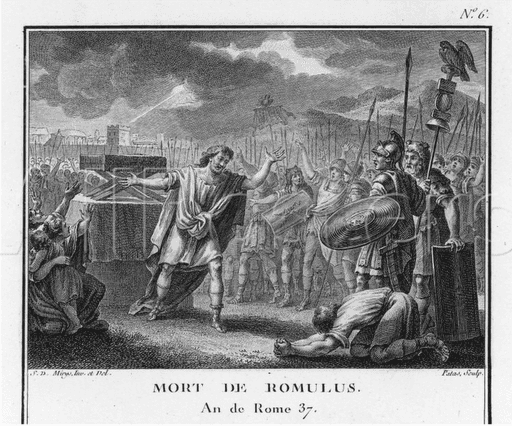
在罗马的传统叙事中,Romulus 的结局被刻意处理为“消失”而非死亡:他在一次公共集会中演说时,风暴骤起、雷云翻滚,人群被迫散开;风暴平息后,Romulus 已不在场。随后,城中宣布他并未死去,而是被接引升天,化为神 Quirinus。这并不是神话化的浪漫修辞,而是一种高度功能性的政治/宗教叙事设计。Romulus 的“退场方式”必须被精确控制,因为它直接关系到罗马这座城市的合法性来源。
如果 Romulus 死于人手,无论是暗杀、内斗还是政变,结果都会指向同一个结论:创城者可以被否定。这会把城市的起点重新解释为一场失败的个人统治,而不是被认可的秩序开端。城不再是“被允许存在”的结果,而只是某次权力斗争的残留物。
如果他被推翻或被罢黜,问题会更严重。那意味着创城权威本身是可被修正、可被撤销的,城市的合法性将随政局起伏而动摇。罗马将失去一个不可争议的起点,城的存在理由会被拖入持续的政治博弈之中。
因此,只剩下一种叙事是安全的:升天。当 Romulus 被宣称为神 Quirinus 时,创城行为被从人间权力体系中抽离出来,交还给神圣领域。他不是被杀、不是被废,而是被神“回收”。创城因此被封存为一个完成态:不可更改、不可追责、不可重演。
古代史家在保留官方神话的同时,也刻意留下了另一层解释的缝隙:Romulus 在统治后期,可能因权力过度集中而遭到元老或贵族的杀害。这个说法并非后世阴谋论,而是出自古代作者本人的“低声补充”:他们知道神话叙事不等于全部事实。
但需要强调的是,这一版本始终被处理为“传言”。它从未被系统展开,没有明确的执行者、没有公开的审判、也没有可被追责的政治过程。它的功能不是取代官方叙事,而是为解释权力紧张提供一个现实层面的注脚:Romulus 的个人权威,确实可能已经触碰到了贵族共同体的容忍边界。
Romulus消失后,罗马并没有立刻选下一任,而是进入了无王期。
Interregnum(无王期)并不是一次被动的权力空窗,而是罗马在创始者退场后,有意识插入的一段“去神化缓冲带”。在 Romulus 消失之后,罗马并未立即推出继任者,而是把权力暂时交还给元老院,以一种高度程序化、刻意降温的方式来处理继承问题。在无王期内,元老院轮流执政。并非集体长期掌权,而是由单个元老短期临时行使最高权力,任期只有数日。这样的设计刻意避免了任何人形成持续权威:时间太短,无法积累个人威望;权力过渡频繁,也防止某一派系借机坐大。
这段安排的目标从一开始就不是“治理城市”,而是管理风险。首先,它防止了创始者消失后可能出现的权力真空:城不能再次滑回部落或暴力竞争状态。其次,通过轮流执政,平衡各家族与派系,让所有关键力量都被纳入过渡结构中,而不是被排除在外。更重要的是,这一阶段为第三个目标服务:寻找一个不会复制 Romulus 的人。罗马需要的不是第二个创始者,而是一个能够把城市带入常态的统治者。
Romulus 之后的罗马并不是“一个整体”,而是由不同家族、战功集团与新旧移民拼合而成。若第二任国王出自罗马内部,任何人选都会被解读为某一派的胜出,直接重燃竞争。而如果继承者是外来者则不同,他不嵌在任何罗马派系的血缘与功勋网络中,因此无法被自然归类为“谁的人”。王权由此被去派系化。
正因为如此,Numa Pompilius 作为萨宾人,既足够“外来”以避免卷入罗马内部派系,又足够“相关”以被接受为共同体的一员。这种地理与文化上的“近而不内”,正是他能够被选为第二任国王的现实基础。
萨宾人(Sabines)是古代意大利中部的山地民族,活动核心在罗马东北方向的亚平宁山区,大致对应今天拉齐奥东北部与翁布里亚南部一带。从地理上看,萨宾人的居住区是内陆、高地、交通相对封闭的山区,与台伯河下游、靠近海岸的罗马形成鲜明对比。这种地理条件塑造了他们的社会特征:人口分散、农业为主、生活节奏保守,政治与宗教结构都更偏向稳定与延续,而非对外扩张。
从文化关系上看,萨宾人与早期罗马既对立又融合。罗马建城传说中的“抢萨宾妇女”,本身就反映了双方的紧张与人口整合过程;而随后萨宾人与罗马的合并,则成为罗马最早的一次“跨族群整合”。因此,萨宾人并非外在的陌生他者,而是罗马共同体早期组成的一部分,只是位置在城外、体系在城内之外。
Preface:
Human beings’ need for belief has existed since the very beginning of human existence. As primates, we sense a rupture between ourselves and the other animals around us. Our capacity for thought, our individuality, and our consciousness bring with them loneliness and confusion. The uncertainty produced by this confusion and anxiety naturally drives us to seek forces greater than ourselves, forces invested with authority. Who are we? What are we permitted to do? What does the future look like?
This essay was written in collaboration with ChatGPT.
In early Rome—and more broadly across the Italian–Etruscan cultural world—space did not possess inherent legitimacy. A piece of land did not automatically qualify as a city simply because it was occupied; the gathering of people did not in itself imply divine approval; even control achieved through violence could only produce a temporary stronghold, not guarantee long-term existence. In other words, physical possession, population size, and military strength were insufficient to make a place truly “a city.”
The legitimacy of a city’s existence could come from only one source: confirmation of divine will. That divine will was not the product of abstract reasoning; its only visible manifestation in reality was augury and the religious rituals that followed from it. Only when augury indicated divine permission could ritual proceed, and only when ritual was completed did the nature of the space itself change. In this context, augury was not a tool for predicting the future but a mechanism of authorization. It answered not the question “Will this place succeed in the future?” but a more fundamental one: “Does the divine allow human beings to establish order here?”
Within the pomerium, the nature of space was fundamentally transformed. The gods were formally invited into the city, residing there through altars, sacred fire, and continuous ritual practice. Human actions were no longer merely individual or familial acts but were incorporated into an order jointly constituted by gods and humans. Within this framework, the division of time, the formation of marriage, the handling of death, and the execution of judgment all acquired religious meaning, no longer serving merely technical or utilitarian purposes.
Accordingly, the city was not simply “a safer place,” but a space explicitly incorporated into the cosmic order. Every action within it was implicitly carried out under divine observation and approval. By contrast, outside the city remained the realm of nature and mobility, where war and violence could be legitimately exercised. There, no stable or enduring legal order existed; military action, forcible occupation, and temporary domination were all permissible states.
It was precisely because of this fundamental distinction that Rome developed a series of arrangements that may appear strict but were in fact highly coherent: generals were required to relinquish command outside the city; armed troops were forbidden to enter the city freely; and the powers associated with war could not be brought within its boundaries. The reason lay not in administrative technique, but in the fact that such forces, once inside, would contaminate a space already acknowledged by the gods and incorporated into order.
In legend, the killing of Remus for leaping over the boundary is not fundamentally about disrespectful attitude or insolent speech. The crucial point is that if crossing the pomerium incurred no cost, the boundary would effectively cease to exist. Once the boundary vanished, the very conditions for the city’s founding would collapse. In such a case, the “city” would have been annulled at the very moment of its birth, reduced to nothing more than a temporary gathering of people, liable at any time to disperse, migrate, or be replaced by a stronger force.
The act of crossing the pomerium therefore carried a meaning far beyond mere trespass. It first signified a denial of the gods’ permission for the city’s existence. If the boundary could be casually stepped over, mocked, or ignored, then the divine will previously confirmed through augury and ritual would be nullified, hollowing out the foundation of the city’s existence. Second, it denied the fundamental distinction between inside and outside. The city was governed by stable law, ritual, and daily order precisely because it had been cut off from the conditions of nature, war, and violence. Once the boundary failed, the city would slide back into a state indistinguishable from the outside, where law and religion no longer held priority.
In Roman tradition, the end of Romulus was deliberately framed not as death but as disappearance. While addressing a public assembly, a sudden storm arose, clouds and thunder obscured the scene, and the crowd scattered. When the storm cleared, Romulus was gone. The city then proclaimed that he had not died but had been taken up to the heavens and transformed into the god Quirinus. This was not a romantic mythologization, but a highly functional political–religious narrative design. The manner of Romulus’s exit had to be carefully controlled, because it bore directly on the source of Rome’s legitimacy.
If Romulus had died at human hands—whether by assassination, internal conflict, or coup—the conclusion would have been the same: the founder of the city could be negated. The city’s origin would then be reinterpreted as the failure of a personal rule, rather than the beginning of a recognized order. Rome would no longer appear as something “permitted to exist,” but merely as the residue of a power struggle.
If he had been overthrown or deposed, the problem would have been even more severe. That would imply that the authority of the founding itself was subject to revision or revocation, leaving the city’s legitimacy vulnerable to political fluctuation. Rome would lose an indisputable point of origin, and the justification for its existence would be drawn into perpetual political contestation.
Thus, only one narrative was safe: ascension. When Romulus was proclaimed the god Quirinus, the act of founding the city was removed from the sphere of human power and returned to the sacred realm. He was not killed, nor deposed, but “reclaimed” by the gods. The founding was thereby sealed as a completed act—unchangeable, unaccountable, and unrepeatable.
Ancient historians, while preserving the official myth, also deliberately left open a narrow gap for another explanation: that Romulus, in the later phase of his rule, may have been killed by senators or nobles because his power had become overly concentrated. This suggestion is not a later conspiracy theory, but a muted aside from ancient authors themselves, who understood that mythological narrative did not exhaust historical reality.
It must be emphasized, however, that this version was always treated as rumor. It was never systematically developed: no clear perpetrators, no public trial, no accountable political process. Its function was not to replace the official narrative, but to provide a realistic footnote explaining political tension—that Romulus’s personal authority may indeed have pressed against the limits of aristocratic tolerance.
After Romulus’s disappearance, Rome did not immediately select a successor, but entered a period without a king.
The Interregnum was not a passive power vacuum, but a deliberately inserted “de-mythologizing buffer” following the founder’s exit. After Romulus disappeared, Rome did not rush to install a new ruler. Instead, power was temporarily returned to the Senate, and succession was handled through a highly procedural, deliberately cooling process. During this period, senators ruled in rotation—not as a collective holding long-term authority, but as individuals exercising supreme power for only a few days at a time. This design intentionally prevented anyone from accumulating lasting authority: the terms were too short to build personal prestige, and the frequent transitions blocked any single faction from consolidating dominance.
From the outset, the purpose of this arrangement was not “to govern the city,” but to manage risk. First, it prevented the power vacuum that might have followed the founder’s disappearance; the city could not be allowed to slide back into tribal conditions or violent competition. Second, rotation balanced families and factions, ensuring that all key forces were included in the transitional structure rather than excluded from it. Most importantly, this stage served a third goal: finding someone who would not replicate Romulus. Rome needed not a second founder, but a ruler capable of bringing the city into a normal, stable condition.
Post-Romulus Rome was not “a unified whole,” but a composite of different families, war-based groups, and both old and new migrants. If the second king had come from within Rome, any candidate would have been interpreted as a victory for one faction, immediately reigniting competition. An outsider, by contrast, was not embedded in Rome’s networks of bloodline and merit, and therefore could not be naturally categorized as “belonging” to anyone. Kingship was thus de-factionalized.
For this reason, Numa Pompilius, as a Sabine, was sufficiently “external” to avoid entanglement in Roman internal factions, yet sufficiently “related” to be accepted as a member of the community. This geographical and cultural position—close but not internal—formed the practical basis for his selection as the second king.
The Sabines were a mountain people of central Italy, whose core territory lay in the Apennine highlands northeast of Rome, roughly corresponding to today’s northeastern Lazio and southern Umbria. Geographically, their homeland was inland, elevated, and relatively isolated, in sharp contrast to Rome’s location along the lower Tiber near the coast. These conditions shaped Sabine society: dispersed populations, an agrarian economy, a conservative pace of life, and political and religious structures oriented toward stability and continuity rather than outward expansion.
Culturally, the Sabines stood in a relationship of both conflict and integration with early Rome. The legendary “abduction of the Sabine women” already reflects tension and demographic incorporation, while the subsequent union of Sabines and Romans constituted one of Rome’s earliest instances of cross-ethnic integration. The Sabines were therefore not an entirely foreign other, but an early component of the Roman community—positioned outside the city spatially, and outside its internal system institutionally.