Created on
Updated on
用传播学的视角解析“绯闻”
Deconstructing Gossip: From Relational Reshuffling to Positional Defense
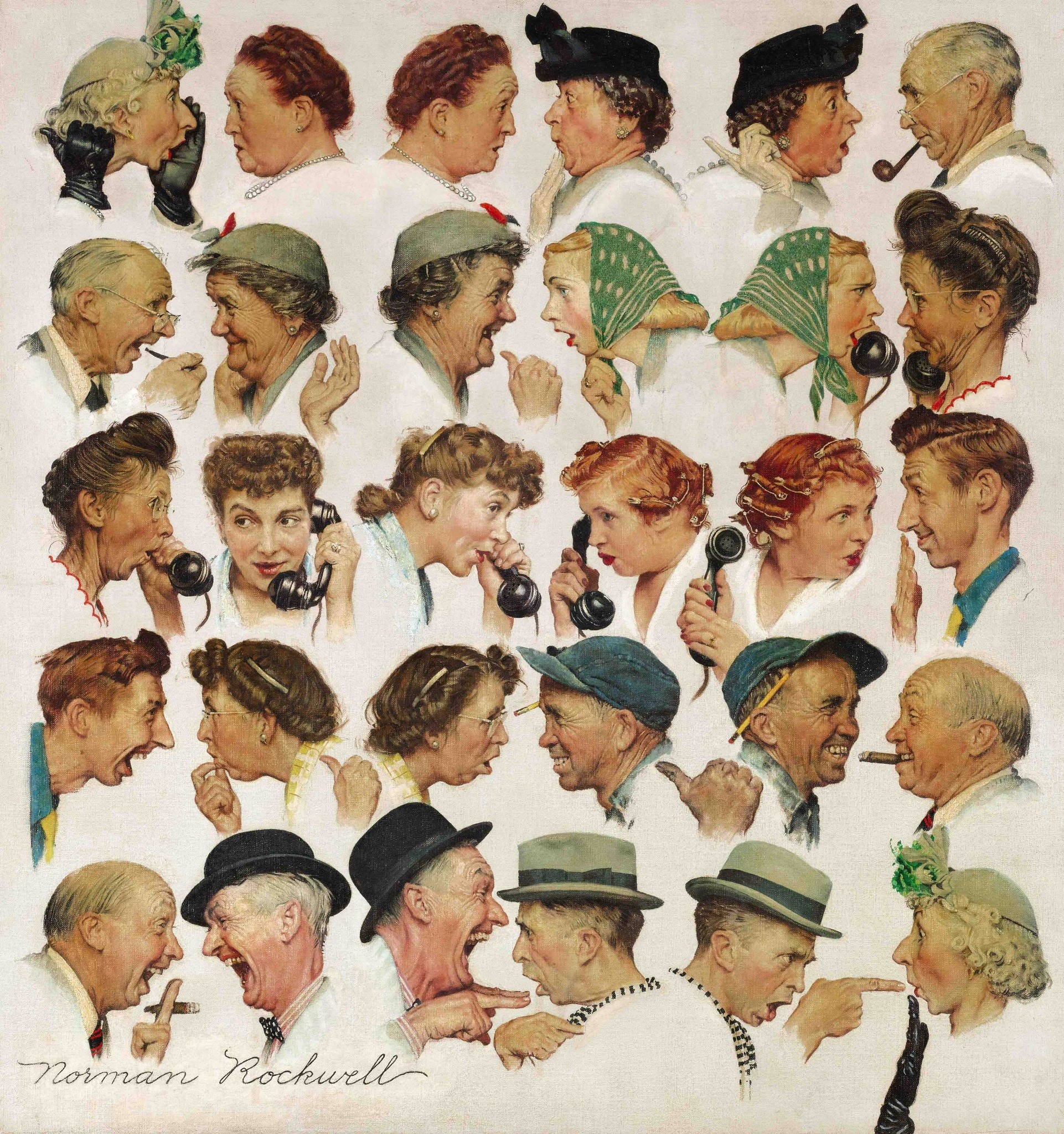
Preface: communicate studies, part 2. Gossip.
1) Gossip
“非正式舆论系统”并不是一个标准化的制度术语,而是一种在现实社会中反复出现的传播结构:一种不经过媒体、制度或公开话语场的意见生成与分配机制。它不依赖权威来源,不以事实一致性为目标,也不承担明确的纠错责任,却能够在相当长的时间内,持续、稳定地影响个体判断与群体走向。这一系统的运作基础,并非信息的真实性,而是人际信任与社会位置。意见沿着熟人关系、情绪共鸣和身份认同流动;谁被相信,更多取决于“你是谁”“你和我处在什么关系中”,而不是“你说得对不对”。因此,它在结构上高度去中心化,却在效果上往往呈现出集中趋势:少数被视为“更接近真相”“更靠近核心”“更值得信任”的节点,会对整体叙事产生不成比例的放大作用。在这一系统中,信息的价值不主要来自内容本身,而来自它在关系网络中的位置。一次转述,往往意味着立场的隐性声明;一次附和,是阵营的确认;而一次刻意的沉默,也可能构成结构性的表态。Gossip 之所以成为这一系统中最常见、也最有效的载体,正是因为它模糊、私密、可变形,既容易被不断转述,又几乎不留下可追责的痕迹。
从传播与社会心理的角度看,非正式舆论系统通常在几类情境中显著活跃:当既有权威失效、当社会秩序发生松动,或当个体位置已经发生上移,却尚未被正式结构承认。它并非异常状态,而更像权力与判断真空期的一种常态反应。正式舆论往往试图回答“我们应该如何理解这件事”,而非正式舆论更常被用来解决另一个问题:在不确定的局势中,“我应该站在哪一边”。这几种情境,本质上指向同一件事:原有的判断坐标已经失灵,而新的坐标尚未建立。非正式舆论系统,正是在这一空档期被激活的。
当权威失效时,人们并不会停止判断,只是失去了统一的参照物。判断权会被迅速下放到最容易获取的层级——身边的人。谁“看起来更懂”、谁“好像知道点内幕”、谁“和关键人物有联系”,就会暂时替代原有权威的位置。在这种情况下,信息是否准确并非首要问题,它是否能填补不确定性才是。Gossip 往往在此时作为一种临时解释系统出现,为个体提供一种“至少我知道发生了什么”的心理稳定感。当秩序动摇时,焦虑的来源并非规则是否存在,而是位置是否还稳定。当资源、机会、话语权或关系结构开始流动,原本清晰的上下游、内外圈变得模糊,人最恐惧的并不是失败,而是不知道自己此刻算什么。非正式舆论系统在这里发挥的作用,是快速为人重新贴标:谁在上升,谁在下沉,谁“出了问题”,谁“已经不行了”。这些判断不需要证据,只需要被反复讲述,就足以在群体中生效。而张力最大、也最容易被忽视的情境,是个体位置已经发生上移,却尚未被结构承认。当一个人的能力、独立性或影响力出现跃迁,但仍被困在旧标签中时,他本身就构成了对既有排序的威胁。此时,非正式舆论系统往往会以 gossip 的形式启动“修正”:不是正面否定其能力,而是侧面污染其动机、人格、情绪稳定性或关系边界,把“位置上移”重新叙述为“问题个体”。这并非偶发的恶意,而是一种典型的结构性反弹。综合来看,一个冷酷但清晰的规律逐渐显现:非正式舆论系统并不以传播事实为目的,而是在修补结构。当权威失效,它提供替代解释;当秩序动摇,它提供临时排序;当个体上移,它提供阻尼机制。它关心的不是“真相是什么”,而是“结构还能不能继续运转”。
这一逻辑,与 Edward Bernays 关于公众判断可被社会线索、情绪叙事与组织化传播持续塑形的观点高度一致。区别只在于,Bernays 讨论的是宏观层面的政治与公共关系操作,而这里描述的,是这一机制在人际尺度上的自发运行形态。从这个角度看,非正式舆论系统并非失控的副产物,而更像系统在彻底失控前的一种自救机制。它之所以显得丑陋、扭曲、甚至伤人,是因为它承担了本应由正式结构承担、却无人再能承担的功能。Gossip 也因此不只是“八卦”,而是一种低成本、高穿透率、去中心化的非正式权力技术。Gossip 的首要目的,并非传递信息,而是重组关系结构。通过谈论第三方,传播者往往在无形中完成三件事:测试立场、制造共同秘密、以及将一个复杂的人压缩为可流通的标签。许多 gossip 并不在乎真假,它们在乎的是,是否成功把某个人推出“我们”的边界,或固定在一个可控的位置上。
在传播方式上,gossip 几乎总以“私人”“关心”“不得不说”为掩护,沿着信任链条跳跃式扩散。每一次转述,都会根据接收者的心理预期被微调。正因为缺乏明确源头,责任被不断稀释,最终形成一种“大家都这么说”的假性共识。其长期后果,远不止名誉受损。现实判断会被持续污染,个体被拖入难以脱身的自证陷阱,群体信任被慢性侵蚀,而权力结构反而在这种看似反权威的机制中被畸形固化。最擅长操纵 gossip 的人获得话语优势,而真正不参与这一系统的人,反而更容易被边缘化。因此,gossip 并不是一个道德问题,而是一种治理失败的症状。它出现的地方,往往意味着正式判断、正式权责和正式沟通机制,已经无法跟上现实变化。它无法被彻底消灭,但可以被削弱。真正有效的路径,并不在于劝人“别说”,而在于重建判断权的来源:让事实、流程、边界重新变得清晰、稳定、可预期;让争议回到可验证、可追责的正式场域;让结构对变化给出明确回应,而不是长期悬置。当判断重新有了着陆点,非正式舆论自然会退化为噪音。不是因为人突然变得理性,而是因为继续传播,已经不再产生结构收益。
2) My Case
在我的具体情境中,我逐渐意识到,关键并不完全在于谣言本身的内容,而在于它出现的时间顺序。从我的观察来看,这些讨论并不是紧跟某个明确的错误或事件而出现的,而是在我开始发生变化之后才逐步启动。在那之前,我是相对“可被识别的”:我被放在一个旧有的位置里,有清晰的标签,也不构成明显的不确定性。当我的输出方式、被认真对待的程度,或他人看待我的框架开始发生变化时,这套旧的定位不再适用。与此同时,一个新的、被广泛承认的位置尚未形成。正是在这种旧标签失效、而新定位尚未稳定的阶段,不确定性开始扩散。从结果上看,gossip 更像是在这个空档期被激活的一种解释工具。它未必源自明确的恶意,也未必是对某个具体事实的回应,而更像是一种尝试:在新的结构尚未固化之前,先行给出一个可供流通的解释版本。
在这一过程中,我注意到,讨论往往并不是围绕我实际做了什么展开,而是逐渐转向对我动机、状态或人格的揣测。这种转移本身具有功能性意义。与行为相比,动机和状态更难被核实,也更容易被不同的人各自补全。一旦讨论的焦点从可验证的行动,转移到不可验证的“我是谁”,解释权就不再掌握在我或事实本身手中,而重新回到讨论者之间。从形式上看,这类 gossip 往往并不以明确的指控出现,而更常以“关心”“困惑”或模糊的不安感受开场,例如“我最近有点看不懂她”“我有点说不上来的感觉”“我只是有点担心”。这种表述并不是在提出可反驳的判断,而是在邀请参与。它让“讨论我”本身变得合理,却不需要对任何具体结论负责。我也注意到,这类信息并非随机扩散。它更倾向于先在那些与我没有直接接触、但与传播者存在关系或情感信任的人之间流动。对这些人来说,验证成本较高,而接受一个现成的解释反而更省力。一旦转述发生,最初的来源就会迅速模糊,讨论逐渐变成“大家都这么说”,个人责任也随之被稀释。
从心理层面理解,这样的过程也可能同时发挥着防御功能。面对他人的变化,人们未必总是准备好更新自己对关系或结构的理解。相比之下,把由变化带来的张力转移到某一个具体的人身上,往往更容易处理。通过将不确定性投射为“这个人是不是有问题”,原本需要被重新理解的结构变化,被简化为一个个体解释。这个情境对我来说之所以清晰,很大程度上是因为顺序本身相对明确:变化先出现,而相关讨论随后才逐步展开。如果这些讨论主要是对某个具体行为的回应,它们通常会紧随事件发生;而在我的经验中,它们更像是紧随变化本身。这使我更倾向于将其理解为一种减速或牵制机制,而不是纠错机制。这也引出一个并不令人愉快、但对我来说逐渐变得清楚的事实:在非正式舆论网络中,解释、澄清或自证,往往并不能从根本上终止这一过程。因为驱动它的并不是信息不足,而是不确定性本身。只有当一个新的角色、位置或外部承认逐渐固定下来,这种解释空间才会自然收缩。在此之前,任何试图直接“纠正”的行为,反而可能被重新吸纳进讨论之中。
从主观体感上说,这种经历并不像单纯的“被说坏话”。更接近的感受是,周围的气压发生了变化。不是某一句具体的话击中了我,而是我察觉到互动方式在整体上发生了偏移。回应变得迟疑、含糊,眼神和语气中多了一层评估意味,好像关于“我是谁”的解释,已经在我不在场的地方被提前生成。最明显的体感是失真。我在做的事情并没有发生实质改变,但反馈却开始围绕一个预设的形象展开。我不再被直接回应,而是被当作某种需要被观察、被判断的对象。这种状态并不喧闹,却持续存在,会让人不自觉地收紧动作、增加自我监控。与此同时,我也清楚地意识到,这种变化并不完全源于我做错了什么。它出现得过于同步、过于结构化,几乎不依赖单一事件。这让我更倾向于把它理解为一种系统层面的反应,而不是针对我个人行为的即时判断。
如果把情绪层面暂时放下,仅从操作层面观察,这个过程呈现出一种相当常见的路径:先是通过模糊表达为讨论铺垫合法性;接着在验证成本较低的关系网络中扩散;随后将焦点从事实转移到状态与人格;并在转述过程中自然变形、去责任化。这些步骤未必是有意识策划的,更像是熟练的人际操作在不确定情境下自动浮现。从结果来看,目标似乎并不是彻底否定我,而是在我被清晰、稳定地理解之前,先行占据解释空间。只要一个模糊而偏负的标签被提前放置,即便后来事实更清楚,这个早期印象也可能长期残留。整体而言,我更愿意把这理解为一套低冲突、低风险、但在结构转换期非常高效的应对方式。它并不依赖证据,也不需要正面交锋,只依赖一个条件:位置正在变化,而新的结构尚未完全成形。正是在这个窗口期,这类操作最容易奏效。
3) How does it start?
最先开始传播 gossip 的人,通常并不是“最坏的人”,而是最依赖非正式结构生存的人。这是理解 gossip 机制的关键判断点。这类人的共同特征在于:他们的位置并非由清晰的角色、可验证的能力或制度性授权支撑,而是高度依赖关系网络、情绪连接与信息优势。在结构稳定时,这种位置是安全的;但一旦结构开始松动,出现上升者或重排信号,他们往往最先感到威胁。对他们而言,gossip 不是道德选择,而是一种位置防御工具。从心理层面看,这类人对“比较”极其敏感。他们关注的并不是事实本身,而是持续扫描相对位置的变化:谁被更多人注意,谁开始被更认真地对待,谁绕过了自己建立直接连接。当他们意识到自己正在失去解释权或中介地位时,会迅速产生强烈的不安。更新自我叙事的成本太高,于是他们选择成本最低的方式——提前污染对方的解释空间。
从能力结构上看,最先传播 gossip 的人,通常并不具备在公开场域竞争的优势。他们不擅长用作品、成果或逻辑说话,却非常擅长读取情绪、判断风向、操作关系。这使他们对非正式传播格外熟练。他们知道哪些话不能说,哪些话只说一半最有效;知道对谁说、什么时候说、说到什么程度就该停。这不是一时冲动,而是长期练习形成的直觉。还有一个关键条件:他们往往处在“边缘但自认为接近核心”的位置。完全边缘的人没有传播能力,真正的核心人物也不需要 gossip。最容易率先行动的,是那些靠近核心、却缺乏正式授权的人。一旦他们感觉自己可能被替代、被绕过或被重新排序,gossip 就会被激活,用来证明“问题在别人身上,而不是结构正在变化”。在动机层面,最先传播 gossip 的人,几乎一定会用“关心”“提醒”“我只是觉得有点不对劲”来包装自己的行为。这并非单纯的伪善,而是一种必要条件。因为 gossip 的第一步不是传播内容,而是合法化讨论对象本身。只有当“谈论某个人”被塑造成合理行为,后续的传播才有空间展开。因此,真正的起点往往不是指控,而是一句模糊的不安。
同样重要但常被忽视的一点是:这类人通常非常害怕被直接对质。他们选择 gossip,正是因为它去中心化、无源头、不可追责。一旦被点名,他们会迅速退回“我也是听说”“我也是担心”的位置。这种结构性的退路,是他们敢于率先行动的前提。因此,最先传播 gossip 的人,并不是因为掌握了真相,而是因为他们最早意识到旧秩序正在失效,而新秩序尚未到来。他们对变化的嗅觉极其灵敏,但处理变化的方式是保守而防御性的。他们并不推动结构更新,而是试图拖慢变化、拉回既有秩序、污染上升者的路径。值得注意的是,这类人并不迟钝,恰恰相反,他们对环境变化异常敏感。他们很早就能察觉到一些细微信号:注意力开始重新分配,话语权出现漂移,连接路径发生绕行,原本默认的中介角色不再被需要。这些变化在正式层面尚未成形,但在关系层面已经开始发酵。许多人要等到结果出现才意识到结构变了,而他们在“趋势阶段”就已经感到不对劲。
问题不在于他们看不见变化,而在于他们无法承受变化带来的身份不确定性。当旧秩序仍然有效时,他们的位置哪怕不强大,至少是清晰而稳定的。但一旦旧秩序松动,新秩序尚未确立,他们会短暂地坠入一个真空区:过去的标签开始失效,未来的位置却无法预测。对这类人来说,这种真空本身就是威胁,甚至比明确的失败更难忍受。在这种状态下,通常只剩下两条路径。一条是推动结构更新,接受新的排序逻辑,用新的标准重新证明自己;另一条是阻止变化完成,让旧秩序“多活一会儿”。前者需要能力、资源和心理承受力,后者只需要关系网络和一点语言技巧。于是他们几乎必然选择后者,而 gossip 正是这种选择的自然结果。需要强调的是,这种行为并不总是经过清晰的理性计算。很多时候,它更像一种本能反应——先把不确定的东西按回原位。通过制造关于上升者的模糊负面叙事,他们试图让环境重新变得“可解释”。一旦上升者被标记为“有问题”“不稳定”“需要观察”,结构就获得了一个临时借口,可以推迟对变化的正式承认。这并非为了彻底否定对方,而是为了延缓由变化引发的重排。
这也是为什么 gossip 的目标往往不是能力最强的人,而是那些正在改变、但尚未被正式确认的人。已经稳固的人不需要被污染,真正弱势的人也不值得花力气。只有处在跃迁阶段、身份尚未被锁定的人,才是最有效的干预对象。对传播者而言,这是风险最低、潜在收益却最大的时点。从这个角度看,gossip 本质上是一种时间策略。它的目的并不是取胜,而是拖延。拖到什么程度并不重要,只要拖到不确定性重新被封装起来,哪怕是以错误的方式。对他们来说,错误的确定性,也比真实的不确定性更容易承受。因此,说他们“不推动结构更新”,并不是指他们缺乏感知变化的能力,而是指他们没有能力或意愿承担变化的代价。他们的防御性并非源自对真相的关心,而是源自对失去位置的恐惧。污染上升者的路径,并不是因为对方真的有问题,而是因为对方的存在本身,已经暴露了旧秩序不再可靠这一事实。他们不是在判断对错,而是在试图让世界重新变得熟悉。
至于参与传播 gossip 的人,大多数并非主动的操纵者,而是在结构不确定中寻找安全感的人。他们的参与更多是顺应,而非发起。在结构动荡、评价标准模糊的阶段,gossip 为许多人提供了一种快速、低风险的“站位方式”。他们往往并不认为自己在作恶,而是把转述理解为分享、提醒或关系维护。正因为如此,gossip 的扩散并不是靠少数坏人完成的,而是靠一群在不确定中选择安全选项的人共同完成的。它之所以顽固,并不是因为它有多强的说服力,而是因为它精准满足了许多人对位置、安全感与归属感的需求。
1) Gossip: The Informal Public Opinion System (非正式舆论系统)
The Structure of Informal Opinion
An "Informal Public Opinion System" is not a standardized institutional term, but a recurring communication structure in actual society: a mechanism for opinion generation and distribution that bypasses media, institutions, and the public sphere of discourse. It does not rely on authoritative sources, aim for factual consistency, or shoulder explicit responsibility for error correction; yet, it exerts a sustained and stable influence on individual judgment and group direction over long periods. The operational foundation of this system is not the truth of information, but interpersonal trust and social positioning. Opinions flow along the lines of acquaintance, emotional resonance, and identity. Who is believed depends more on "who you are" and "what your relationship is to me" than on "whether what you say is correct." Consequently, while it is structurally decentralized, it often exhibits a centralized effect: a few nodes perceived as being "closer to the truth," "nearer the core," or "more trustworthy" exert a disproportionate amplification on the overall narrative. In this system, the value of information is derived not primarily from the content itself, but from its location within the relational network. To retell a story is an implicit declaration of stance; to echo it is a confirmation of allegiance; and a deliberate silence can constitute a structural statement. Gossip becomes the most common and effective vehicle for this system precisely because it is vague, private, and malleable—easy to pass on, yet leaving almost no traceable trail for accountability.
Contexts of Activation
From the perspective of communication and social psychology, informal opinion systems become significantly active in several scenarios: when established authority fails, when social order loosens, or when an individual’s position has shifted upward but has yet to be recognized by the formal structure. This is not an abnormal state, but a normative reaction to a vacuum of power and judgment. Formal public opinion often seeks to answer "how we should understand this," while informal opinion is more often used to solve a different problem: "whose side should I be on" in an uncertain situation. These scenarios essentially point to the same thing: the original coordinates of judgment have malfunctioned, and new ones have not yet been established. The informal opinion system is activated during this gap.
When authority fails, people do not stop judging; they simply lose a unified reference point. The power of judgment is rapidly devolved to the most accessible level—those around them. Whoever "seems to know more," "appears to have inside information," or "has connections to key figures" temporarily replaces the original authority. In this case, whether the information is accurate is not the primary issue; whether it can fill the void of uncertainty is. Gossip often appears here as a makeshift explanatory system, providing individuals with a sense of psychological stability: "at least I know what happened." When order shakes, the source of anxiety is not whether rules exist, but whether one's position is still stable. When resources, opportunities, discourse power, or relationship structures begin to flow—blurring the once-clear lines of upstream and downstream, inner and outer circles—man's greatest fear is not failure, but not knowing what he counts as at this moment. The informal opinion system functions here to rapidly re-label people: who is rising, who is sinking, who is "having problems," and who is "finished." These judgments require no evidence; they only need to be told repeatedly to take effect within the group.
The Structural Dampening Mechanism
The most tense and easily overlooked scenario is when an individual’s position has shifted upward but has not yet been recognized by the structure. When a person’s ability, independence, or influence leaps forward but remains trapped in old labels, they constitute a threat to the existing hierarchy. At this point, the informal opinion system often triggers a "correction" in the form of gossip: not by directly denying their ability, but by obliquely polluting their motives, character, emotional stability, or relational boundaries—re-narrating the "upward shift" as a "problematic individual." This is not an accidental act of malice, but a typical structural backlash. A cold but clear pattern emerges: the informal opinion system does not aim to disseminate facts, but to mend the structure. When authority fails, it provides alternative explanations; when order shakes, it provides temporary ranking; when an individual moves up, it provides a dampening mechanism. Its concern is not "what is the truth," but "can the structure continue to function?"
This logic aligns closely with Edward Bernays’ view that public judgment can be continuously shaped by social cues, emotional narratives, and organized communication. The only difference is that Bernays discussed macro-level political and PR operations, while what is described here is the spontaneous operation of this mechanism on an interpersonal scale. From this perspective, the informal opinion system is not a byproduct of lost control, but a self-rescue mechanism for the system before total collapse. It appears ugly, distorted, or even hurtful because it assumes functions that should be borne by the formal structure but can no longer be. Gossip, therefore, is not just "small talk," but a low-cost, high-penetration, decentralized technology of informal power. Its primary purpose is not to transmit information, but to reorganize relational structures. By talking about a third party, the communicator invisibly accomplishes three things: testing stances, creating shared secrets, and compressing a complex person into a shippable label. Much of gossip does not care for truth; it cares whether it successfully pushes someone outside the boundary of "us" or fixes them in a controllable position.
The Fake Consensus and its Cure
In terms of delivery, gossip almost always hides behind the guises of being "private," "caring," or "something that had to be said," spreading in leaps along chains of trust. Each retelling is fine-tuned to the psychological expectations of the recipient. Because it lacks a clear source, responsibility is continuously diluted, eventually forming a "pseudo-consensus" where "everyone says so." The long-term consequences far exceed reputational damage. Practical judgment is chronically polluted, individuals are dragged into traps of self-justification from which they cannot escape, and group trust is slowly eroded. Paradoxically, the power structure is malformed and solidified through this seemingly anti-authority mechanism. Those most skilled at manipulating gossip gain a discursive advantage, while those who truly abstain are more easily marginalized. Therefore, gossip is not a moral issue, but a symptom of governance failure. Where it appears, it means that formal judgment, formal rights/responsibilities, and formal communication mechanisms can no longer keep up with reality. It cannot be entirely eliminated, but it can be weakened. The only effective path is not to advise people "not to talk," but to rebuild the source of the power of judgment: making facts, processes, and boundaries clear, stable, and predictable again; returning disputes to formal venues where they are verifiable and accountable; and ensuring the structure gives a clear response to changes rather than leaving them in long-term suspension. When judgment finds a place to land, informal opinion naturally regresses into noise. Not because people suddenly become rational, but because continuing to spread it no longer yields structural profit.
2) My Case (我的具体情境)
Gossip as a Tool of Explanation
In my specific situation, I have come to realize that the key lies not entirely in the content of the rumors, but in their chronological order. From my observation, these discussions did not follow a clear error or event; they were initiated gradually after I began to change. Before that, I was relatively "identifiable": I was placed in an old position with clear labels and posed no significant uncertainty. When my way of outputting, the degree to which I was taken seriously, or the framework through which others viewed me began to shift, the old positioning no longer applied. Simultaneously, a new, widely recognized position had not yet formed. It is during this gap—when old labels fail and new ones are not yet stable—that uncertainty spreads. In hindsight, gossip feels more like an explanatory tool activated during this void. It may not stem from explicit malice or respond to a specific fact; rather, it is an attempt to provide a "circulatable version" of an explanation before the new structure solidifies.
Functional Displacement
During this process, I noticed that discussions often did not center on what I actually did, but gradually shifted toward speculating on my motives, state of mind, or personality. This shift has functional significance. Compared to behavior, motives and states are harder to verify and easier for different people to fill in with their own interpretations. Once the focus shifts from verifiable actions to the unverifiable question of "who I am," the power of explanation no longer rests with me or the facts, but returns to the discussants. In form, this type of gossip rarely appears as an explicit accusation; it more often begins with "concern," "confusion," or a vague sense of unease: "I can't quite read her lately," "I have a feeling I can't put into words," or "I'm just a bit worried." Such phrasing does not offer a refutable judgment; it invites participation. It makes "discussing me" appear reasonable without requiring responsibility for any specific conclusion. I also noticed that this information does not spread randomly. It tends to flow first among those who have no direct contact with me but share a relationship or emotional trust with the communicator. For these people, the cost of verification is high, while accepting a ready-made explanation is low-effort. Once the retelling occurs, the original source blurs rapidly, the discussion becomes "everyone says so," and individual responsibility is diluted.
A Systemic Response to Change
Psychologically, this process may also serve a defensive function. Faced with change in others, people are not always ready to update their understanding of relationships or structures. In comparison, it is often easier to transfer the tension brought by change onto a specific individual. By projecting uncertainty as "is there something wrong with this person," a structural change that needs re-understanding is simplified into an individual explanation. This situation is clear to me largely because the sequence was explicit: the change appeared first, and the related discussions followed. If these discussions were primarily reactions to a specific behavior, they would typically follow closely on the heels of the event; in my experience, they closely followed the change itself. This leads me to understand it as a mechanism for deceleration or containment rather than error correction. This brings me to an unpleasant but increasingly clear fact: in informal opinion networks, explaining, clarifying, or self-justifying often cannot fundamentally end the process. This is because what drives it is not a lack of information, but uncertainty itself. Only when a new role, position, or external recognition gradually becomes fixed will this space for explanation naturally contract. Until then, any attempt to directly "correct" it might instead be re-absorbed into the discussion.
The Subjective Experience of "Distortion"
Subjectively, this experience does not feel like merely being "bad-mouthed." It feels more as though the surrounding atmospheric pressure has changed. It is not that a specific sentence hit me, but that I perceived an overall shift in the mode of interaction. Responses become hesitant and vague; eyes and tones acquire a layer of evaluation, as if the explanation of "who I am" has been pre-generated in a place where I was not present. The most obvious sensation is distortion. What I am doing has not substantially changed, yet the feedback begins to revolve around a preset image. I am no longer responded to directly but treated as an object to be observed and judged. This state is not loud, yet its persistence causes one to unconsciously tighten their movements and increase self-monitoring. At the same time, I am clearly aware that this change does not stem entirely from something I did wrong. It appeared too synchronously, too structurally, and relies almost not at all on any single event. This leads me to view it as a system-level reaction rather than an immediate judgment of my personal behavior.
If one sets aside the emotional layer and observes solely from an operational level, the process presents a fairly common path: first, establishing the legitimacy of the discussion through vague expressions; then, spreading through relationship networks where verification costs are low; subsequently, shifting the focus from facts to state and personality; and naturally deforming and de-responsibilizing during the retelling. These steps are not necessarily consciously planned; they are more like a seasoned interpersonal operation that automatically emerges in uncertain situations. The goal seems not to be to completely negate me, but to occupy the explanatory space before I am clearly and stably understood. As long as a vague and biased label is placed in advance, that early impression may persist long after the facts become clearer. Overall, I prefer to understand this as a low-conflict, low-risk, but highly efficient way of coping during a period of structural transition. It does not rely on evidence or direct confrontation; it relies on only one condition: that a position is changing and a new structure has not yet fully formed. It is in this window that such operations are most effective.
3) How Does It Start? (谁在传播?)
The Chieftains of Informal Structures
The first people to spread gossip are usually not the "worst" people, but the people most dependent on informal structures for survival. This is the key insight for understanding the gossip mechanism. The common trait among such people is that their position is not supported by a clear role, verifiable ability, or institutional authorization; instead, it is highly dependent on relationship networks, emotional connections, and information advantages. When the structure is stable, this position is secure; but once the structure begins to loosen—signaling a riser or a reshuffling—they are often the first to feel threatened. For them, gossip is not a moral choice, but a tool for positional defense. Psychologically, these individuals are hypersensitive to "comparison." They do not focus on the facts themselves, but continuously scan for changes in relative position: who is being noticed by more people, who is starting to be taken more seriously, and who is bypassing them to establish direct connections. When they realize they are losing their explanatory power or intermediary status, they quickly develop intense unease. The cost of updating their self-narrative is too high, so they choose the lowest-cost method: polluting the other's explanatory space in advance.
The Logic of Defensive Sabotage
In terms of ability, those who initiate gossip often do not possess an advantage in competing in the public sphere. They are not skilled at speaking through work, results, or logic, but they are very adept at reading emotions, judging the "wind," and manipulating relationships. This makes them exceptionally proficient in informal communication. They know which words not to say and which half-said truths are most effective; they know to whom to speak, when to speak, and exactly when to stop. This is not an impulse, but an intuition formed by long-term practice. Another key condition: they often occupy a position that is "marginal but perceives itself as close to the core." Completely marginal people lack the capacity to spread information, and true core figures do not need gossip. Those most likely to act first are people near the core who lack formal authorization. Once they feel they might be replaced, bypassed, or re-ranked, gossip is activated to prove that "the problem is with the other person, not that the structure is changing." At the motivational level, the initiator will almost certainly wrap their behavior in "concern," "warning," or "I just feel something isn't quite right." This is not simple hypocrisy; it is a necessary condition. The first step of gossip is not to spread content, but to legitimize the discussion of the subject. Only when "talking about someone" is framed as reasonable behavior can subsequent dissemination find room. Thus, the true starting point is rarely an accusation, but a vague unease.
The Fear of Confrontation
An equally important but often overlooked point is that such people are usually terrified of direct confrontation. They choose gossip precisely because it is decentralized, sourceless, and unaccountable. If called out, they quickly retreat to the position of "I also heard..." or "I was also just worried." This structural retreat is the prerequisite for their daring to act first. Therefore, the first people to spread gossip act not because they have mastered the truth, but because they are the first to realize the old order is failing and the new order has not yet arrived. Their scent for change is incredibly keen, but their way of handling it is conservative and defensive. They do not push for structural updates; they try to slow down the change, pull back the old order, and pollute the path of the riser. It is worth noting that these people are not dull; on the other hand, they are exceptionally sensitive to environmental changes. They can detect subtle signals early: attention is being redistributed, discourse power is drifting, connection paths are being bypassed, and the default intermediary role is no longer needed. These changes have not yet formed at the formal level, but they have begun to ferment at the relational level. Many people realize the structure has changed only when the result appears; these people feel it "at the trend stage."
Certainty vs. Truth
The problem is not that they cannot see the change, but that they cannot bear the identity uncertainty it brings. When the old order was effective, their position—even if not powerful—was at least clear and stable. But once the old order loosens and the new order is not yet established, they fall briefly into a vacuum: old labels fail, yet future positions cannot be predicted. For such people, this vacuum itself is the threat, even harder to endure than explicit failure. In this state, only two paths usually remain. One is to push for structural renewal, accepting the new ranking logic and re-proving oneself by new standards; the other is to prevent the change from completing, letting the old order "live a little longer." The former requires ability, resources, and psychological endurance; the latter requires only a relationship network and a bit of linguistic skill. Thus, they almost inevitably choose the latter, and gossip is the natural result of this choice. It must be emphasized that this behavior is not always a clear rational calculation. Often, it is more like an instinctual reaction—to press the uncertain thing back into its original place. By creating a vague negative narrative about the riser, they attempt to make the environment "explainable" again. Once the riser is labeled as "problematic," "unstable," or "needing observation," the structure gains a temporary excuse to delay formal recognition of the change. This is not to completely negate the other person, but to slow down the re-ranking triggered by the change.
This is also why the target of gossip is often not the most powerful person, but those who are changing yet have not been formally confirmed. People who are already established do not need to be polluted, and truly weak people are not worth the effort. Only those in the transition stage, whose identity has not been locked down, are the most effective targets for intervention. For the communicator, this is the moment of lowest risk but highest potential gain. From this perspective, gossip is essentially a temporal strategy. Its goal is not to win, but to delay. How long it delays does not matter, as long as it delays until uncertainty is encapsulated again, even if in the wrong way. For them, a wrong certainty is easier to bear than a true uncertainty. Therefore, saying they "do not push for structural renewal" does not mean they lack the ability to perceive change, but that they lack the ability or will to bear the cost of change. Their defensiveness stems not from a concern for the truth, but from a fear of losing their position. Polluting the path of the riser is not because the other person truly has a problem, but because their existence itself exposes the fact that the old order is no longer reliable. They are not judging right from wrong; they are trying to make the world familiar again.
The Role of the Enablers
As for those who participate in spreading gossip, most are not active manipulators but people seeking security amidst structural uncertainty. Their participation is more an act of conformity than initiation. In a phase of structural upheaval and blurred evaluation standards, gossip provides many with a quick, low-risk way to "take a stand." They often do not believe they are doing something wrong; they understand retelling as sharing, warning, or relationship maintenance. Because of this, the spread of gossip is not accomplished by a few "bad actors," but by a group of people who choose the safe option in the face of uncertainty. Its stubbornness is not due to its persuasive power, but to the precision with which it satisfies the human need for position, security, and belonging.