Created on
Updated on
Filmmaking in the Age of AI(14): The Anatomy of Story by John Truby (2007)
Sense the Difference Between a Story that Was Assembled and One that Was Grown
Preface: Re-teaching myself the new filmmaking pipeline, now with AI (netflix please notice me). co-written with Claude. NOW WITH AUDIO.
There is a sentence near the beginning of The Anatomy of Story that tells you everything you need to know about John Truby's relationship to the rest of this bookshelf. He's describing what he calls "mechanical" stories — stories built by slotting ideas into pre-existing structures, following the beats, hitting the page numbers, ticking the genre boxes. And he writes, with barely contained contempt: "Instead of coming up with a unique designing principle, they pick a genre and impose it on the premise and then force the story to hit the beats typical of that genre. The result is mechanical, generic, unoriginal fiction."
He published this in 2007, two years after Save the Cat! Truby is the contrarian's screenwriting guru. Where Snyder gives you a timetable, Truby gives you a philosophy. Where McKee builds from Aristotle outward, Truby builds from the writer's own moral worldview inward. Where the beat sheet tells you what needs to happen on page twenty-five, Truby tells you to figure out what your story is about — what it's actually arguing — before you think about structure at all. Whether that makes him right depends entirely on the kind of writer you are. But there's no question that the book he wrote is doing something fundamentally different from everything else in this canon. Truby has been Hollywood's best-kept secret for thirty years. Where McKee built a public persona — the firebrand in the auditorium — and Snyder had a commercially successful career, Truby has operated largely in the background. He's a story consultant: the person studios call when a script is almost there but not quite, when a production is twelve weeks from shooting and the third act still doesn't work, when a franchise is losing its way and they need someone to tell them why.
By his own count, he's been a script doctor on over 1,800 films, sitcoms, and television dramas for Disney, Universal, Sony, Fox, HBO, the BBC, Paramount, and more. His students have worked on Ratatouille, Pirates of the Caribbean, Shrek, the X-Men trilogy, Breaking Bad, Lost, House, Scream, Sleepless in Seattle. His own writing credits are modest — a few episodes of 21 Jump Street, a co-writer credit on the Disneynature documentary African Cats — but the list of writers whose work he's shaped is as impressive as anyone in the field. The American Film Institute has declared that his course "allows a writer to succeed in the fiercely competitive climate of Hollywood." PC Magazine called him "the best script doctor in the movie industry." These are not small endorsements.The Anatomy of Story is the book he'd been incubating for decades. His Great Screenwriting course — the one he'd been teaching to sold-out rooms in Los Angeles, New York, London, Paris, Sydney, and Rome — was the live version. The book came out in 2007 and distilled thirty years of consulting and teaching into a single, very long, very demanding volume. Truby's core claim is this: structure does not generate story. Story generates structure.
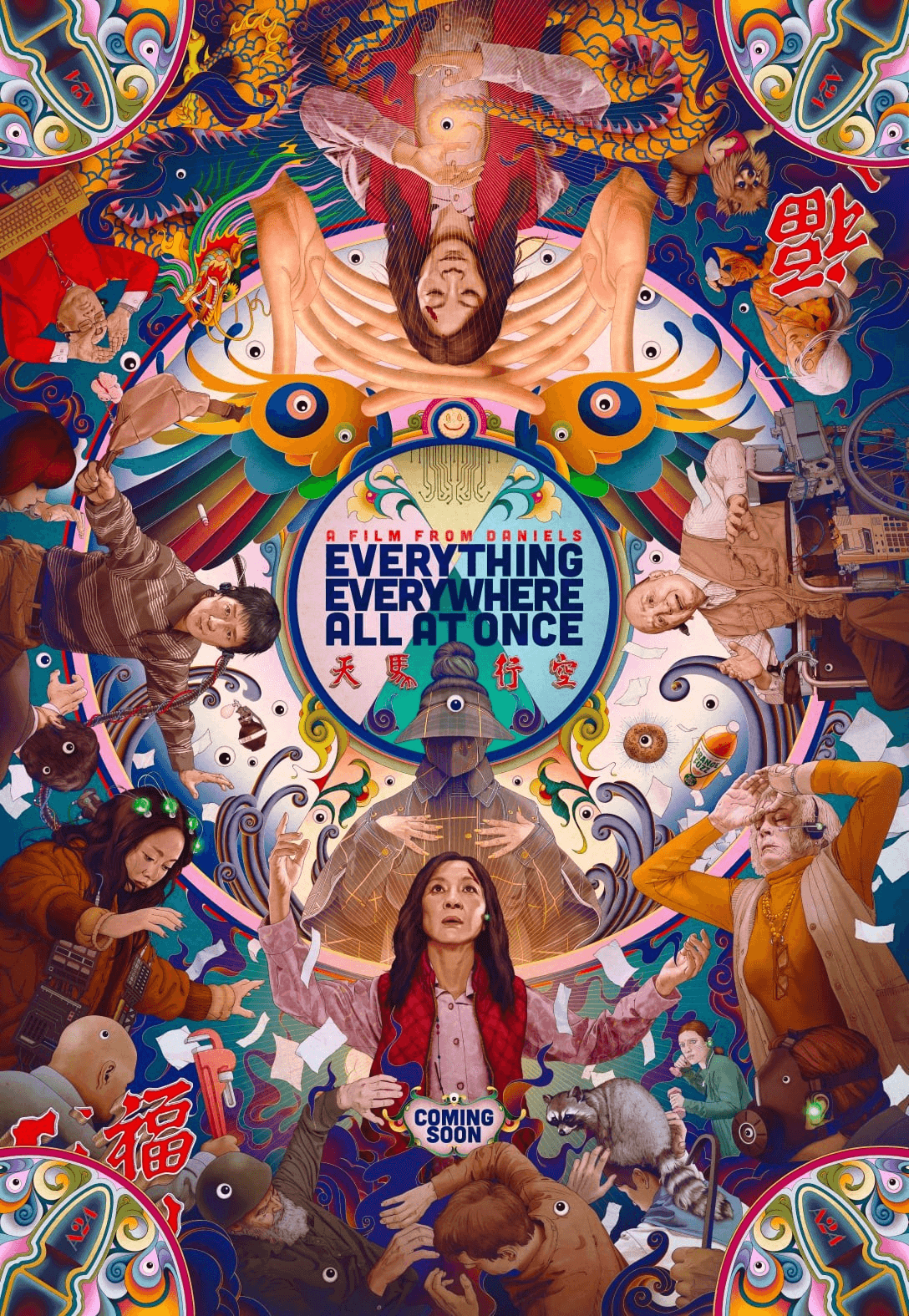
This is Truby's most original and most demanding concept, and it's where the book earns its reputation for being difficult. Every story has a premise — a one-line summary of what happens. Everything Everywhere All at Once (2022): a Chinese-American laundromat owner, drowning in tax audits and a failing marriage, discovers she can access parallel universes and must use that power to stop a nihilistic entity from destroying the multiverse. That's the premise. It tells you the genre, the spectacle, the basic shape of the conflict. It's enough to buy a ticket. But Truby argues that only good stories have a designing principle — an abstract organizing logic that gives the story its internal coherence, that makes all the parts belong together rather than merely follow each other. The designing principle of Everything Everywhere All at Once: force a woman who can only see what her life isn't to save herself by choosing what it is. Read that, then sit with the film for a moment.
The multiverse isn't a science fiction device. It's the designing principle made literal. It is the physical, visual manifestation of what Evelyn Wang has been doing to herself her entire adult life — living in her head in every version of her existence that isn't this one. The movie she glimpses on the laundromat TV. The singing career. The other Waymond. The life she didn't choose when she got on that plane. The multiverse is just Evelyn's regret given a body and a budget. Jobu Tupaki — her daughter Joy, fractured by being forced to experience everything everywhere all at once — is not a villain in the Snyder sense. She's the logical endpoint of the designing principle. She has seen every possibility, every alternate life, every version of every choice, and arrived at the only conclusion that total awareness makes possible: nothing matters. The everything bagel — that black void she constructs by putting everything onto a single point until it collapses into nothing — is the designing principle reduced to an object. Put everything on a bagel, and you get nothing. Try to live in every life simultaneously, and you lose the only one you actually have.
Now go back to the opening. Evelyn can't finish a thought. Can't finish a sentence. She's simultaneously trying to do the taxes, fix the decorations, manage her father, navigate her crumbling marriage, and avoid acknowledging that her daughter is in pain. The chaos of the multiverse isn't something the film imposes on her life — it's something it extracts from it. And Waymond. What does Waymond do? He slows down. He puts googly eyes on things. He dances with customers. He bakes cookies for the IRS auditor who's making their lives miserable. He is ridiculous, and dismissed, and the only character in the film who has already solved the problem the designing principle poses — not by finding the perfect life, but by fully inhabiting the one in front of him.
That is what the designing principle does. It doesn't just describe what the film is about. It governs every scene, every symbol, every character function. The IRS audit isn't a random mundane backdrop — it's the perfect pressure cooker for the designing principle because the IRS demands you account for everything, justify every decision, prove your life adds up to something. Deirdre the auditor, in her other-universe life, is desperately lonely and just wants to be seen — because she, too, is lost in an unlived life. Even Gong Gong, whose rigid traditionalism severed Evelyn from a version of her past that might have held her steady, is a face of the same pressure: the life you didn't get to have.
The premise is what happens. The designing principle is why it could only happen this way.Without the designing principle, you could imagine a different multiverse story — a thriller, a heist, a save-the-world action film. The Wachowskis could have made this. Marvel nearly did. But those films would have had the same premise and a completely different designing principle, and they would have been completely different stories. The multiverse would have been backdrop. Here, it's diagnosis. With the designing principle of Everything Everywhere All at Once, you cannot swap out the laundromat for a mansion. You cannot make Evelyn competent and satisfied. You cannot make Waymond a strong, driven, conventionally successful man. Every detail is load-bearing because every detail is an expression of the same underlying pressure: a woman who has spent her whole life looking elsewhere, learning to look here.
Truby's claim is that the difference between a good film and a great one is often not the premise — it's whether the filmmakers found the designing principle and built the whole story from it. The Daniels (Daniel Kwan and Daniel Scheinert) have said they worked on this film for over a decade. What they were finding, across all those years of drafts, was probably this: not the multiverse plot, which came relatively early, but the precise principle that would make the multiverse mean something specific rather than everything in general. When you find it — when the abstract logic and the concrete story lock into each other — the whole thing clicks. Every scene earns its place. Nothing is decoration. And the audience, even if they couldn't name what they're feeling, senses the difference between a story that was assembled and one that was grown.
In Snyder's model and to a significant degree in McKee's, structure is where you start. Truby thinks this is exactly backwards. And it produces, in his view, exactly the results you'd expect — stories that are structurally correct and emotionally hollow, stories where you can feel the scaffolding through the walls, stories that hit every beat on schedule and still don't make you feel anything. His alternative: begin with premise, find what he calls the designing principle, build characters whose contradictions and conflicts naturally generate the plot, and only then construct the structure — which should emerge from the material rather than be imposed upon it. The phrase he uses for this approach is "organic storytelling." His word for the alternative is "mechanical." He doesn't use these as neutral descriptors. Truby identifies seven elements that he argues are present in every great story. Not in every story. In every great story. He calls these the spine, the DNA, the foundation from which everything else must grow.
Weakness and Need — The hero has one or more profound flaws at the start of the story. Something is genuinely missing, and it is ruining their life even if they don't know it yet. Truby makes a crucial distinction here: the need has two dimensions. The psychological need is what the hero needs to do to heal themselves. The moral need is what they need to do to become better toward others. Great stories, in Truby's framework, require both — and the moral need is the more important one. A hero who grows personally but remains selfish hasn't completed the story's arc.
Desire — The hero has a specific goal that organises the entire narrative. This is the "spine of the story," and it must be singular and sustained. Truby is emphatic: one desire line, steadily building in importance and intensity, never bifurcating or drifting. The desire provides the story's forward momentum and determines what the opponent is.
Opponent — Not villain. Opponent. Truby's distinction is surgical and important. A villain is defined by being evil. An opponent is defined by competing for the same goal as the hero, from a different set of values. The opponent is not there to be defeated — the opponent is there to force the hero to become better or be destroyed. And here is the key: "A purely evil opponent is someone who is inherently bad and therefore mechanical and uninteresting. In most real conflict, there is no clear good and evil, right and wrong. In a good story, both hero and opponent believe that they are right, and both have reasons for believing so."
Plan — The hero develops a strategy to overcome the opponent and achieve the desire.
Battle — The final conflict, where hero and opponent meet at maximum pressure.
Self-Revelation — The hero undergoes a genuine recognition of who they've been and who they need to become. Not a decision. Not a speech. A realisation — and it must be moral as well as psychological. They see not just that they've been failing themselves, but that they've been failing others.
New Equilibrium — The world of the story reaches a new state, better or worse than the opening, reflecting what the hero has done and who they've become.
Every story has a premise — a one-line summary of what happens. Truby argues that only good stories have a designing principle — an abstract organising logic that gives the story its internal coherence, that makes the parts belong together rather than merely following each other.
Parasite (2019) — Premise: a poor family infiltrates a wealthy household by posing as unrelated professionals. Designing principle: force people with nothing to compete against each other for the scraps of people who have everything. The designing principle explains why the basement reveal is the pivot — it's not a plot twist, it's the story revealing that the Kims were never really competing against the Parks. They were always competing against someone exactly like themselves.
Get Out (2017) — Premise: a Black man visits his white girlfriend's family estate and discovers something sinister. Designing principle: expose the violence hidden inside liberal white admiration of Blackness. Every scene — the parents, the guests, the hypnosis, the auction — is an expression of that single pressure.
Everything Everywhere All at Once (2022) — Premise: a Chinese-American laundromat owner discovers she can access parallel universes and must save existence. Designing principle: force someone who sees only what her life isn't to find meaning in exactly what it is. The multiverse isn't a sci-fi gimmick — it's the designing principle made literal.
Barbie (2023) — Premise: a perfect Barbie ventures into the real world after existential doubts. Designing principle: force an ideal to confront its own emptiness by making it human. Works well because the film itself is almost self-consciously structured around this.
The premise is concrete — it's what actually happens. The designing principle is abstract — it's the deeper process the story is enacting. And the difference matters enormously: without the designing principle, you have a series of plot events. With it, you have a story that is unified by a single underlying movement, where every scene is an expression of the same fundamental pressure.
Here is where Truby departs most radically from every other book on this shelf, and where serious writers tend to either fully convert or fully bounce off. Truby's claim: every story is a moral argument. Not every story has a moral lesson. Not every story is didactic or preachy. But every story, at the level of its structure and character arc, is making an argument about how people should act in the world. The hero starts with a moral weakness — not evil, but a flaw that causes harm to others, often without awareness. Over the course of the story, the hero is put under maximum pressure. The opponent argues, by their very existence and opposition, for a different set of values. The battle is not just physical or external — it's a collision of worldviews. And the self-revelation at the end is the moment when the hero either recognises what they've been getting wrong about how to live, or fails to do so and is destroyed. This is a more ambitious claim than McKee's controlling idea. McKee says: every story has a thematic meaning, expressible in a sentence. Truby says: every story is an argument — a dialectical engagement between competing values, enacted through the clash of hero and opponent, resolved (or not) through the hero's transformation.
Think about Breaking Bad. Walter White and Hank Schrader are not opposites in the obvious way — good cop versus bad drug lord. They are opposites in a much more interesting way: both men believe they are right. Both have compelling justifications. Both are, in Truby's framing, wrong in different ways. Walter's argument: a man of genuine brilliance has been humiliated by circumstance, passed over, diminished, forced to watch lesser men succeed. He deserves more. His intelligence is a form of value the world has failed to recognize, and what he does with chemistry — even if it's meth — is an assertion of that value. He is, in his own mind, the one who knocks. His moral flaw is that his wounded pride has curdled into contempt for everyone around him. He is not cooking meth for his family. He is cooking meth because it makes him feel like himself for the first time in decades.
Hank's argument: the law exists for a reason. Order is a genuine good. The people who break it cause real harm to real people. The institutions that enforce it, however imperfect, are worth defending. His moral flaw is different: he is incurious about the humanity of the people he pursues, comfortable in his certainty, unable to see that the system he serves is not as just as he assumes. Both wrong in different ways. Neither a hero, neither a villain. And the clash between them — which the show spends five seasons building toward — is not just a conflict between two men. It is a conflict between two sets of beliefs about what a life is for, what a man is owed, what the law means, whether intelligence confers a right to act outside ordinary moral constraints. That is a moral argument. And the show makes it not through speeches — though there are speeches — but through action. Every choice Walter makes, every lie, every murder, every manipulation, is not just a plot event. It is evidence in the argument. Every consequence that follows is the argument's next move. By the time the show ends, the audience has been walked through a case so carefully constructed that the conclusion — I did it for me. I liked it. I was good at it. I was really alive — lands not as a twist but as an inevitability.
This is why Truby insists that a purely evil opponent is a failure of craft. An opponent who is simply evil doesn't challenge the hero's values — they just threaten the hero's survival. The hero defeats the threat and goes home largely unchanged. Whereas an opponent who is wrong in a different way than the hero — who believes something genuinely defensible, who has good reasons for their position — forces the hero into genuine moral reckoning. The practical consequence of this is that Truby asks writers to do something unusual before they build their story: to know what they believe. What is your moral vision? What do you think is the right way to act toward other people? What kind of mistake do people most often make?
He is the only writer in the canon who insists that the opponent must be as morally complex as the hero — and who explains in practical, specific terms how to build that complexity. The insight that "both hero and opponent believe they are right, and both are wrong in different ways" is one of the most productive ideas in any craft book. Stories built on this principle don't just have interesting villains — they have genuine arguments at their centre. He is the only writer who builds from meaning outward. McKee says: find your controlling idea. Snyder says: find your logline. Truby says: find your moral vision, and let the story grow from it. The designing principle — elusive as it is — describes something real. When you watch a film and feel that every element belongs, that the story seems inevitable, that the ending was always going to be this ending — that's the designing principle working. When you watch a film and feel that it's competently constructed but somehow arbitrary, that any number of different endings might have served equally well — that's the absence of a designing principle. Truby is the only writer who names this quality and tries to teach you how to find it.
The Anatomy of Story is the right book at the wrong time for most writers who encounter it. If you're early in your development — if you're still trying to understand what a scene does, how an act works, why some scripts are boring and some aren't — this book will frustrate you. Come back to it in a few years. If you're more experienced, if you've internalized the basics, if you can identify what's broken in a draft but not why, if you feel like your work is competent but not alive — this is the book that will change how you think. The moral argument framework alone will make you a better writer. If you read Save the Cat and felt, somewhere in the back of your mind, that there must be more to it than this — Truby is the answer to that feeling. He's the book that starts where the others leave off. The LA Weekly put it well: "If you're ready to graduate from the boy-meets-girl league of screenwriting, meet John Truby." More on screenwriting in the next post. ☀️