Created on
Updated on
Filmmaking in the Age of AI(15): The Hero with a Thousand Faces by Joseph Campbell (1949)
The Book That Inspired George Lucas to create Star Wars
Preface: Re-teaching myself the new filmmaking pipeline, now with AI (netflix please notice me). co-written with Claude. NOW WITH AUDIO.
Joseph Campbell was born in 1904 in White Plains, New York, into an upper-middle-class Irish Catholic family. His father took him to the American Museum of Natural History as a boy, and Campbell saw the Native American collection — the totem poles, the ceremonial objects, the mythology made physical — and was struck by something he couldn't yet name. He started reading everything he could find about Native American culture. He was maybe seven or eight years old. He was a natural athlete — a runner, fast enough to be ranked in the top ten in the country during his college years at Columbia. He studied medieval literature, earned his bachelor's degree in 1925, his master's in 1927 with a thesis on the Fisher King legend in Arthurian romance. Then Columbia gave him a fellowship to study in Europe, and he spent two years at the University of Paris and the University of Munich, learning Old French, Provençal, Sanskrit. He became fluent in French and German in a matter of months. He was one of those people to whom languages simply opened.
Europe changed him in ways that had nothing to do with the curriculum. In Paris he encountered Joyce and Picasso and Thomas Mann. He discovered Freud and Jung. He saw a version of the world where the distinction between mythology and psychology was not yet fixed — where the stories people told about gods and heroes and the underworld were understood as the same material the therapist dealt with, just expressed in a different register. He came back from Europe a different kind of thinker than the one who had left. Campbell returned to Columbia in 1929 wanting to expand his doctoral scope — medieval literature, yes, but also Sanskrit, modern art, Jungian psychology. The breadth of what he was trying to think was already apparent. His advisors said no. He left the PhD program rather than narrow himself to fit it, a decision he never reversed and never regretted. He would later joke that a PhD in the liberal arts was a sign of incompetence.
Two weeks after he walked away, the Depression began. There were no jobs. Campbell had no money, no institutional support, no title, no plan. What he had was books and time and the discipline to use both. He rented a shack in Woodstock, New York, for twenty dollars a year. He divided each day into four four-hour blocks — three of reading, one free. Nine hours of reading a day. He kept this schedule for five years. "I went up to Woodstock and just read, and read, and read, and read, for five years," he said later. "No job, no money." He read everything. Joyce. Mann. Spengler. Frobenius. The Sanskrit he'd started in Munich. Jung — all of Jung, working through it slowly, underlining everything. He would later say that his meditation practice was underlining sentences. He was building something in those five years, laying down a foundation so wide and deep that it would take the rest of his life to build on top of it. This is the period Campbell would later describe as the most important of his scholarly life. Not the fellowships, not the publications, not the teaching. Five years of self-directed reading in a shack in the woods, followed by a year of drifting with Steinbeck and Ricketts along the California coast and up into Alaska. This was when the ideas came together. This was when he understood what he was trying to think. In 1934, a professor at Sarah Lawrence College in New York offered him a teaching position. He took it and stayed for thirty-eight years.
Sarah Lawrence in 1934 was a college for women — gifted, intellectually serious women whose questions, Campbell quickly discovered, were different from the medieval scholars he'd trained among. They weren't asking what the Fisher King legend meant in twelfth-century France. They were asking what it meant now, here, in their lives. What did the myths have to say about who you were, who you were becoming, what the trials ahead of you meant? This was the question that shaped the rest of his career. He started calling the material "the myths we live by." He began teaching comparative mythology not as historical artefact but as psychological map — these are not stories about ancient people in foreign places, they are stories about the interior of the human mind, and the interior of the human mind hasn't changed.
By every account, he was electrifying in the classroom. One former student described him as "a beaming flashlight into the darkness." A colleague called him the animateur — the charismatic teacher who doesn't just transmit information but evokes the frisson, the shiver of recognition that arrives when a complex idea suddenly becomes personally true. He was the teacher who made you feel that what you were studying was your own life. He had, by all accounts, the rare quality of genuine enthusiasm — not performed enthusiasm, not the studied excitement of a man who has learned that enthusiasm helps his delivery, but the real thing: a man who had been finding the same pattern everywhere he looked for thirty years and still couldn't quite believe how profound it was. His own fascination with "the great stuff of myth," as he called it, never cooled. He taught it for nearly four decades and was still talking about it as though he'd just figured it out.
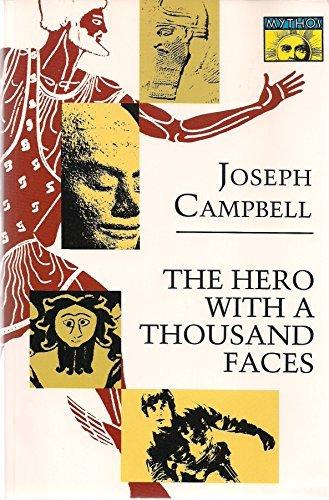
The Hero with a Thousand Faces, published in 1949, grew out of the introductory mythology course he had been teaching at Sarah Lawrence for over a decade. It was originally titled How to Read a Myth. The final book is the course material given its full intellectual architecture. The argument: underneath the infinite variety of the world's myths — Greek, Hindu, Egyptian, Norse, Native American, African, Celtic, Buddhist, Christian — there is one recurring pattern. Campbell called it the monomyth, borrowing the word directly from James Joyce's Finnegans Wake. A hero leaves the ordinary world, ventures into a realm of supernatural trial, undergoes a form of death and transformation, and returns with something that can renew their community. He called it departure, initiation, return.
Why do these stories, despite coming from completely separate cultures with no contact with each other, keep telling the same story? What he found, repeated everywhere, was a single underlying pattern. A hero leaves the ordinary world, ventures into an unknown realm, faces a series of tests and ordeals, is transformed by what they encounter, and returns with something — a treasure, a revelation, a power — that renews their community. He saw this pattern in the Epic of Gilgamesh, in the story of Buddha, in the labours of Hercules, in the life of Moses, in the Norse god Odin, in fairy tales told to children. The call to adventure is the summons toward change. The ordeal in the inmost cave is the confrontation with the Shadow — the part of ourselves we've denied or suppressed. The return with the elixir is the reintegration of what was won in that confrontation. Myths aren't entertainment. They're instruction manuals for how to become.
Campbell connected this pattern to psychology — specifically to the work of Carl Jung. He wasn't just saying these stories share a plot. He was saying that the hero's journey describes something that happens inside the human psyche in every genuine process of transformation and growth. The ordinary world is the psyche's existing state — comfortable, known, limited. The call to adventure is the summons toward change that most people refuse. The ordeal in the innermost cave is the confrontation with the Shadow — Jung's term for the parts of ourselves we've repressed and denied, the things we fear most about who we might be. The return with the elixir is the integration of what was won in that confrontation, brought back to serve not just the self but the community. The myths aren't just stories about ancient heroes. They are, in Campbell's view, instructions for how to become. Every culture that has ever existed has told its children these stories because these stories encode the psychological map for how to move from childhood to adulthood, from ignorance to wisdom, from fear to courage. The hero has a thousand faces because every human being who has ever undergone genuine transformation is that hero.
The book was, by academic standards, a success. Princeton University Press published it. Scholars of mythology and literature read it. It became a respected text in comparative mythology courses. But outside those circles, it was largely unknown — a specialist work written in dense, rich prose saturated with Sanskrit, Greek, Jungian theory, and references to myths most readers had never encountered.
George Lucas had read Campbell before even finishing film school at USC, where he encountered The Hero with a Thousand Faces at exactly the same time that he was watching Star Wars begin to take shape in his imagination. The connection was immediate. After struggling through early drafts of the story — at one point he had hundreds of pages and couldn't find the structure — he read Campbell and found the shape he'd been looking for. In his own words: "It was The Hero with a Thousand Faces that just took what was about 500 pages and said, here is the story. Here's the end; here's the focus; here's the way it's all laid out." The fit is almost too perfect to be accidental — because it wasn't. Look at A New Hope beat by beat.
Luke on Tatooine — the ordinary world. A farm boy dreaming of something more, staring at the binary sunset. Campbell says the hero at first refuses the call to adventure — and Luke refuses Obi-Wan's invitation to join the quest, choosing to go back to his uncle's farm. He only commits after finding his aunt and uncle killed.
Obi-Wan — the mentor, the wise elder who initiates the hero but cannot complete the journey for him. Campbell's myths are full of this figure: Merlin, Gandalf, the sensei, the wizard. He equips Luke, guides him to the threshold, and then must be sacrificed so the hero can proceed alone.
Mos Eisley — crossing the threshold into the special world. Campbell sees the cantina scene as the traditional seaport scene where the hero crosses into a new world — the bar patrons are threshold guardians who threaten the young hero with their strange customs and sudden violence, while Han Solo and Chewbacca are the allies waiting on the other side.
The Death Star — the belly of the whale, the inmost cave, the ordeal. Campbell himself pointed to the trash compactor scene as the belly of the whale — especially when Luke is pulled underwater by the creature and appears dead before resurfacing.
Darth Vader — the Shadow. Not just a villain but a mirror — what Luke could become. And then Lucas added the dimension that made the trilogy mythically complete: Vader is Luke's father. The atonement with the father is one of Campbell's central monomyth elements — the hero must ultimately confront and reconcile with the father figure who represents both their origin and their deepest fear about themselves. The entire arc of the original trilogy is that reconciliation.
The ceremony at the end — the return with the elixir. Luke comes back from the special world transformed, bearing the victory that renews the community.
Lucas and Campbell didn't meet until after Lucas had finished the original trilogy. They finally met in the early 1980s, and Campbell came to Skywalker Ranch to watch all three films in a single day. He was, by all accounts, moved. They became friends in the last years of Campbell's life, and Lucas called him "my Yoda." The broader cultural impact is hard to overstate. After Star Wars, Campbell's ideas moved from academic obscurity to become the operating language of Hollywood storytelling — his concept of the Hero's Journey went from Lucas's secret weapon to an industry standard visible in the majority of studios and franchises. After Campbell's death in 1987, PBS broadcast a six-episode series of conversations between Campbell and journalist Bill Moyers, filmed at Skywalker Ranch, called The Power of Myth. It made Campbell a household name. The reprints of The Hero with a Thousand Faces after 1977 used an image of Mark Hamill as Luke Skywalker on the cover. The irony — and it's a rich one given everything we've been discussing in this series — is that The Hero with a Thousand Faces was never meant to be a screenwriting manual. Campbell was a scholar writing about mythology and psychology. He was not trying to give Hollywood a template. But Vogler's memo, and then The Writer's Journey, translated Campbell's descriptive observation into a prescriptive framework — and in doing so, turned something meant to illuminate the depth of human storytelling into, for many writers, just another set of beats to hit. More on this in the next post. ☀️