Created on
Updated on
Filmmaking in the Age of AI(3): The Paradox of French Neoclassicism
One Time, One Space, and One Plot
Preface: teaching myself the new filmmaking pipeline, now with AI. Co-written with Claude.
The sharpest way to understand the difference between Plautus and Terence is this: Plautus wrote for the audience in the theater, Terence wrote for the reader at home. Plautus's plays work best performed — the music, the physical comedy, the energy of a crowd responding together. Terence's plays reward close reading — the careful construction of character, the nuanced dialogue, the structural elegance. This is why Terence became the Latin author most studied in medieval monasteries and Renaissance schools. His Latin was considered pure and elegant. Generations of European schoolchildren learned Latin by reading Terence. And when those schoolchildren grew up to write plays of their own — Molière in France, Shakespeare in England — the DNA of both Plautus and Terence was running through everything they created. After Rome fell, theater didn't disappear — it transformed. The Church, which had initially suppressed theatrical performance, eventually embraced it as a teaching tool. Mystery plays, morality plays, and miracle plays were performed in town squares and on wagons, often by guilds. The "playwright" was usually anonymous, the work communal. This is the era most people think of when they imagine playwriting at its peak. Shakespeare, Marlowe, Jonson — working in a commercial theater culture that was genuinely popular, not elite. The Globe held around 3,000 people from all classes. To be a working playwright was precarious but possible: you were essentially a contractor for a theater company, writing fast, writing prolifically, often collaborating. Shakespeare likely co-wrote several plays. The work was not considered high literature — plays weren't even reliably published. It's somewhat accidental that we have Shakespeare's texts at all.
French neoclassicism imposed rigid rules on drama — the three unities of time, place, and action. Molière and Racine thrived within these constraints. To understand French neoclassicism you have to go back to Aristotle — specifically his Poetics, written around 335 BCE, which was the first serious attempt to analyze what makes drama work. Aristotle observed, descriptively, that Greek tragedies tended to focus on a single unified action, that they generally took place within a single day, and that they maintained a consistent dramatic focus. He was making observations about what he saw, not laying down commandments. But here is where history plays one of its great tricks. Aristotle's Poetics was lost to Western Europe for centuries. When it was rediscovered and translated in the Renaissance — first in Italy in the 15th and 16th centuries — scholars read his descriptive observations as prescriptive rules. What Aristotle had noticed became what Aristotle had commanded. Italian Renaissance critics, particularly Julius Caesar Scaliger and Lodovico Castelvetro, formalized these observations into a rigid doctrine. The three unities — time, place, and action — became law. And when this doctrine crossed the Alps into France in the 17th century, it found a culture uniquely receptive to it.
17th century France under Louis XIV was a society in love with order, hierarchy, and the idea that civilization meant the triumph of reason over chaos. The Sun King's court at Versailles was itself a kind of living artwork — every gesture, every ceremony, every seating arrangement precisely calibrated to express and reinforce the social order. In this context, the idea that drama should follow rational, orderly rules felt not like a constraint but like a natural expression of what art should be. The French Academy — founded in 1635 by Cardinal Richelieu — became the institutional enforcer of correct taste and correct rules. Literature, language, and theater were all brought under the civilizing influence of reason and decorum. The result was French neoclassicism — a theatrical culture of extraordinary sophistication and, at times, almost suffocating rigidity.
A play must take place within a single revolution of the sun — meaning the events depicted on stage could span no more than 24 hours, and ideally much less. The reasoning was that an audience watching a two-hour play could not credibly be expected to believe that years or months were passing. The closer the fictional time to the real time of the performance, the more believable and emotionally concentrated the drama would be. In practice this created extraordinary pressure on playwrights. Shakespeare could begin The Winter's Tale with a jealous king, jump sixteen years forward, and continue the story with the king's grown daughter. A French neoclassical playwright could not do this. Everything had to happen today. The action must occur in a single location — or at least a single general locale, like a city. The set could not change between acts. The reasoning was similar to unity of time — the audience is sitting in one place watching one stage, and the illusion is broken if the story suddenly leaps to a different country or a different room. Again, the contrast with Shakespeare is stark. Antony and Cleopatra ranges across the entire Mediterranean world — Rome, Egypt, Athens, the plains of battle. A French neoclassical play happened in a single room, a palace anteroom, a public square — and stayed there.
The play must follow a single main plot without significant subplots that distract from the central dramatic question. There should be no comic scenes inserted into tragedies, no mixing of tones, no parallel stories that dilute the primary action. This was actually the unity Aristotle cared about most — and it is arguably the most aesthetically defensible of the three. A drama that knows what it is about and pursues that single thing with total commitment can achieve an intensity that sprawling multi-plot works cannot. The three unities were the most famous constraints but not the only ones. French neoclassical doctrine added several more requirements that shaped the drama profoundly. Tragedy and comedy must not be mixed. A tragedy must be entirely tragic in tone, a comedy entirely comic. No gravediggers in Hamlet, no fools commenting on the action, no moments of levity to release tension. Pure genres only. Violence, death, and anything physically shocking must not be shown on stage. They could be reported by a messenger, described in verse, but never enacted in front of the audience. A character could die — but they had to die offstage and have their death narrated. This rule came partly from Aristotle's observation that the best tragedies achieved their emotional effect through language and situation rather than spectacle, and partly from a French aristocratic sense that certain things were simply not done in polite company.Everything in the play had to be credible according to the standards of rational probability. No supernatural interventions, no miraculous coincidences, nothing that strained the audience's rational acceptance.
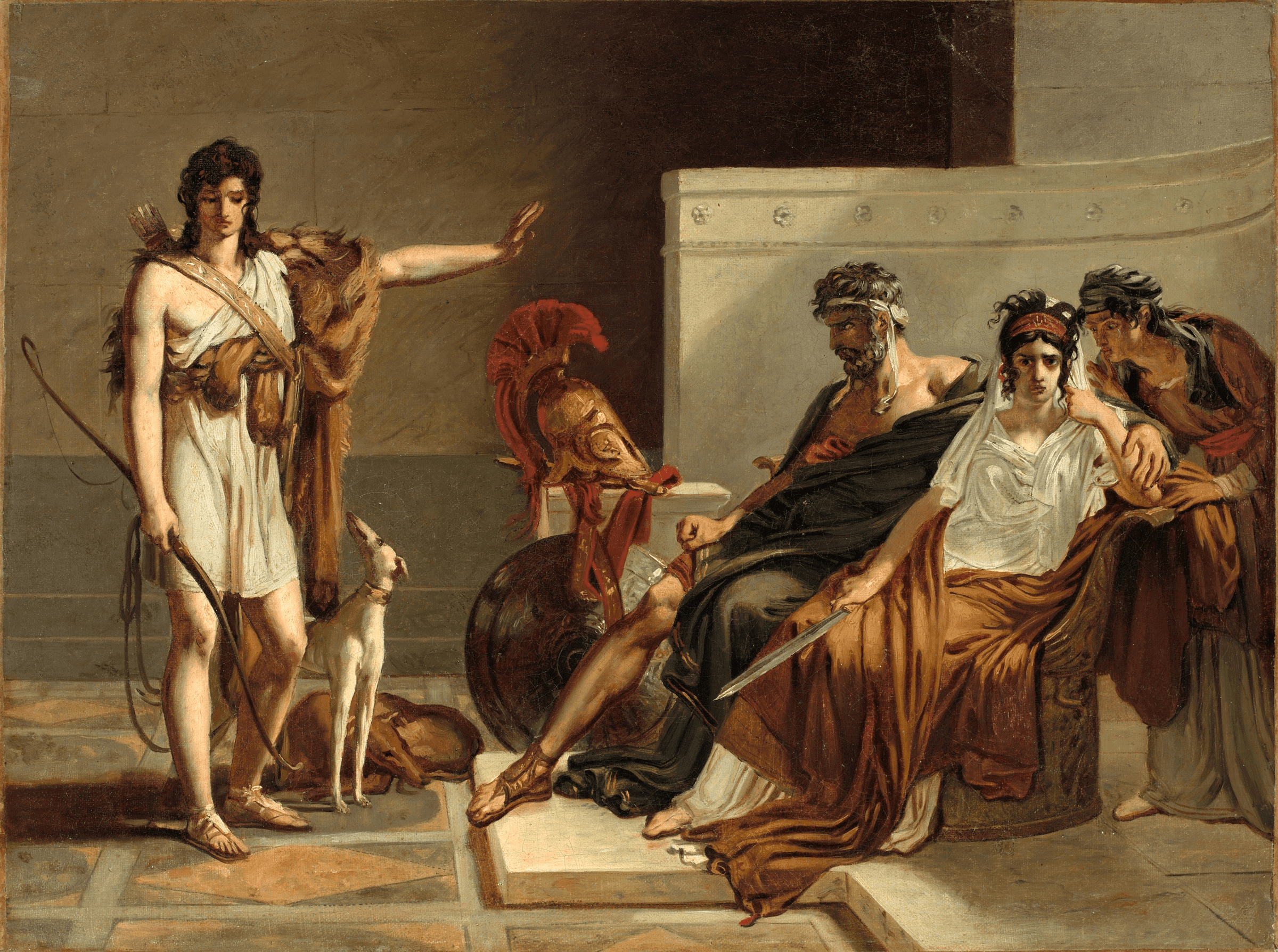
Jean Racine is the supreme master of French neoclassical tragedy — and possibly the greatest tragic playwright in any language after the ancient Greeks. What makes Racine extraordinary is that he did not merely work within the constraints of neoclassicism — he understood that those constraints, properly used, were not limitations at all. They were the source of an almost unbearable dramatic intensity. Think about what the unities actually do to a tragedy. Unity of time means everything must come to a head today — there is no possibility of delay, escape, or gradual change. Unity of place means the characters cannot run away — they are trapped together in the same room, circling each other, unable to escape the confrontation the drama demands. Unity of action means there is nowhere to hide — no subplot to retreat into, no comic relief to release the pressure. Just these people, in this room, today. Racine used this compression to create tragedies of almost claustrophobic psychological intensity. His characters are trapped not just by the dramatic rules but by their own passions — desires they cannot control, obsessions they cannot reason their way out of, loves that destroy everything they touch. His masterpiece is generally considered to be Phèdre — written in 1677, based on Euripides' Hippolytus.
The story goes like this, yes, story time again. Phèdre is the wife of Theseus, the king of Athens. She has developed an overwhelming, consuming passion for her stepson(!!!) Hippolytus — a love she knows is monstrous, forbidden, a violation of every moral and social law. She has been fighting it for years. The play begins on the day her resistance collapses. She believes Theseus is dead. In her grief and the loosening of that restraint, she confesses her love to Hippolytus through her nurse Oenone. Hippolytus is horrified and rejects her.Then Theseus returns — alive. Oenone, trying to protect Phèdre, accuses Hippolytus of having made advances to his stepmother. Theseus believes it. He calls on his divine father Poseidon to destroy Hippolytus. Poseidon obliges — a sea monster drives Hippolytus's horses mad, and he is killed. Phèdre, who could have spoken and saved him, arrives too late. She confesses everything to Theseus, drinks poison, and dies.
Racine took Euripides' play, studied it deeply, and rebuilt it from the inside out. But the differences between the two versions are where things get really interesting — because they reveal everything about what separates ancient Greek tragedy from 17th century French neoclassicism. In Euripides' Hippolytus, the title character is Hippolytus himself. He is the protagonist. The play is fundamentally about him — his extreme, almost pathological devotion to the goddess Artemis and his contemptuous rejection of Aphrodite and everything she represents. Phaedra is important but secondary. She dies halfway through the play and the second half belongs entirely to Hippolytus and his father Theseus. Racine moved Phèdre to the absolute center of the drama. She is on stage more than anyone else. The play lives inside her consciousness. Everything is filtered through her experience of her own passion, her own guilt, her own destruction. This shift changes the entire moral and psychological weight of the play. Euripides was interested in the collision between two divine forces — Aphrodite's revenge on a young man who rejected love, and Artemis's helpless grief at her devotee's destruction. The humans are almost caught in the crossfire of a divine quarrel. Racine removed the gods entirely as active agents. There is no Aphrodite appearing at the beginning to announce her revenge. There is no Artemis at the end to explain the truth to Theseus. The divine machinery is gone. What remains is purely human — a woman's uncontrollable passion, her moral awareness of it, and her inability to master it. This is a profoundly modern shift. Racine's Phèdre is not a victim of divine persecution. She is a victim of herself.She is not simply a villain or a victim. She is fully aware of the horror of her own passion — she despises herself for it, understands perfectly that it is wrong, and cannot stop it anyway. She watches herself destroy everything around her with a kind of lucid, agonized helplessness. The monster is inside her, and she can see it, and she cannot kill it. Racine's verse is something that is almost impossible to fully convey in translation — twelve-syllable lines of perfect Alexandrine verse, the rhythm itself creating a sense of inevitability, of fate moving forward one measured step at a time. French schoolchildren still memorize passages from Phèdre the way English students memorize Shakespeare.
Jean-Baptiste Poquelin — known by his stage name Molière — is the other giant of this era, and he represents something almost opposite to Racine in temperament and method, despite working within the same neoclassical framework. Where Racine worked in tragedy and refined everything toward psychological purity and emotional devastation, Molière worked in comedy and used it as a scalpel — cutting into the hypocrisy, pretension, and folly of French society with a precision that was sometimes genuinely dangerous. Molière was not just a playwright. He was an actor, a director, and the manager of his own theatrical company. He understood performance from the inside in a way that purely literary playwrights did not. His plays are built to be acted — the comedy lives in the timing, the physical business, the relationship between performer and audience. His great subject was human self-deception — the way people construct elaborate fictions about themselves and then defend those fictions against all evidence. His comic villains are not evil exactly; they are people who have mistaken their own obsessions for virtues.
His most celebrated and most controversial play is Tartuffe — first performed in 1664 and immediately banned by the King, not fully performed in its final form until 1669. Tartuffe is a religious hypocrite — a man who has attached himself to a wealthy bourgeois family by performing an elaborate show of piety and devotion. The father of the family, Orgon, is completely taken in, to the point of madness. He wants to marry his daughter to Tartuffe, disinherit his son in Tartuffe's favor, and has signed over the deeds to his house. Everyone around Orgon can see that Tartuffe is a fraud. His wife, his children, his brother-in-law, his maid — all of them try to make him see it. He refuses. His investment in his own judgment is total. To admit Tartuffe is a fraud would be to admit that he himself has been a fool, and that is the one thing Orgon cannot do. The play was banned because the Catholic Church found it a dangerous attack on religious devotion. Molière argued — probably sincerely — that he was attacking hypocrisy, not religion. The distinction was too fine for the Church's comfort. What makes Tartuffe more than a period piece is that Orgon is not stupid. He is a man who has found in religious devotion an escape from the complexity and uncertainty of ordinary life — and Tartuffe, who is genuinely brilliant in his manipulation, has given him exactly what he needed. The dynamic between them is psychologically precise. It could be restaged today with any number of contemporary substitutions — a cult leader, a self-help guru, a political demagogue — and nothing essential would change. More on this in the next post. ☀️