Created on
Updated on
Filmmaking In the Age of AI(2): Being a Playwright in Rome
What Rome added that Greece hadn't
Preface: teaching myself the new filmmaking pipeline, now with AI. Co-written with Gemini, Claude.
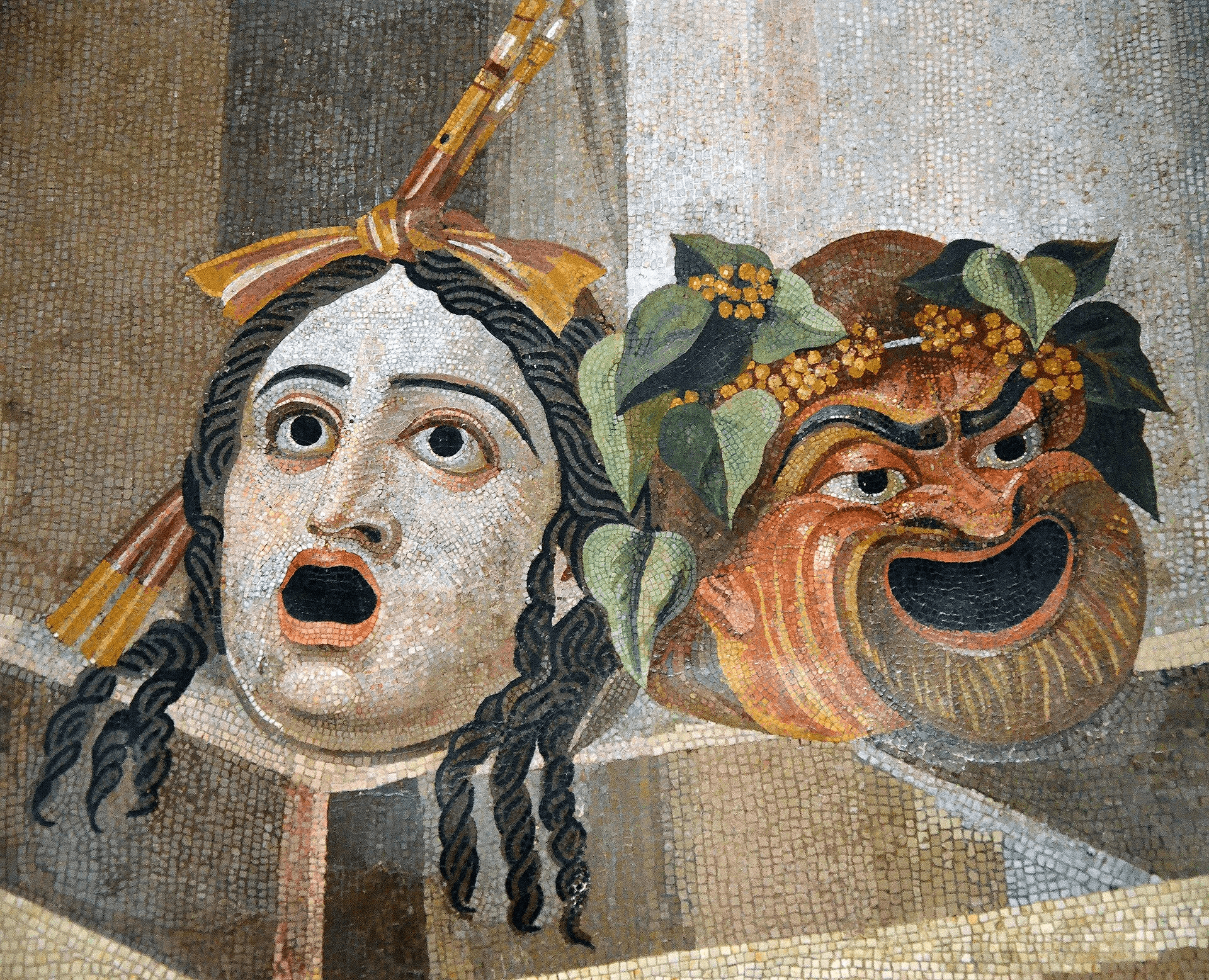
To be a playwright in Athens was a position of genuine civic prestige. Plays were entered into competitions, judged publicly, and winning was a mark of cultural honor. Yet in Athens, being a good playwright was never the highest thing a man could be. Aeschylus as previously mentioned, the author of The Oresteia Trilogy, reportedly fought at Marathon and considered his military service more important than his plays. Roman playwrights like Plautus and Terence largely borrowed from Greek models, but pushed toward comedy, farce, and crowd-pleasing entertainment. When Rome began its rise as a Mediterranean power in the 3rd century BCE, it encountered Greek culture and was, frankly, dazzled by it. Greek philosophy, Greek architecture, Greek art — all of it flooded into Rome. Theater was no different. The Romans didn't invent dramatic writing so much as they transplanted it, adapted it, and reshaped it for a very different audience and culture. The key Latin word here is fabula palliata — plays written in Latin but set in Greece, with Greek characters wearing Greek clothes. It was an open, accepted convention. Nobody pretended these weren't adaptations. The Romans took Greek comedies — particularly the genre called New Comedy, pioneered by the Greek playwright Menander — and rewrote them for Roman stages.
Titus Maccius Plautus is the great entertainer of Roman theater. He wrote somewhere between 21 and 130 plays(!!!) depending on which ancient sources you trust — 20 survive with reasonable confidence. He was wildly popular in his own lifetime and remained so for centuries. What Plautus did was take the relatively refined, psychologically subtle comedies of Menander and Greek New Comedy and crank everything up. Louder. Faster. Funnier. More outrageous. His stock characters, or i guess you could call these Roman character archetypes, became the template for comedy for the next two thousand years. The senex — the foolish old man, usually a father trying to control his son or a husband being cuckolded, always ending up humiliated. The adulescens — the young man desperately in love, usually with someone completely unsuitable, willing to do anything reckless for her. The meretrix — the courtesan, clever and pragmatic, often more intelligent than the men pursuing her. And most importantly — the servus callidus, the clever slave. The clever slave is Plautus's great invention and gift to comedy. This character — a slave who is smarter than everyone around him, who schemes and manipulates and lies with breathtaking audacity to help his young master get the girl — is the engine of most Plautine plots. The humor comes from watching someone with no social power whatsoever run rings around people who have all of it. Roman audiences were, by all accounts, demanding and easily distracted. They came to festivals where theater competed with gladiatorial displays, boxing matches, acrobats, and tightrope walkers. A playwright had to fight for attention. Plautus understood this viscerally. His plays are fast, loud, full of physical comedy, wordplay, and a kind of anarchic energy. There is no subtlety, no psychological depth in the Greek sense — but there is an almost perfect understanding of how to make a large crowd laugh and keep laughing.
Publius Terentius Afer — Terence — is in almost every way Plautus's opposite, which makes it fascinating that they are always discussed together. Terence was born in Carthage, came to Rome as a slave(!!!), was educated by his master and eventually freed. He wrote only six plays — all six survive, which is remarkable — and died young, probably in his mid-thirties, on a voyage to Greece. He was never as popular as Plautus in his own lifetime. And yet he was arguably more influential in the long run. Where Plautus was broad and boisterous, Terence was refined and psychologically careful. He stayed much closer to his Greek sources — particularly Menander — and was genuinely interested in character, motivation, and the complexity of human relationships. His plots involve less frantic scheming and more genuine emotional difficulty. His plays include Andria — "The Girl from Andros" — about a young man in love with a woman his father has forbidden him to marry, handled with real delicacy and emotional intelligence.
Terence based Andria on two plays by the Greek master Menander — Andria and Perinthia — blending them together, which as I mentioned previously was exactly the kind of contaminatio his rivals attacked him for. It was his first play, performed in 166 BCE, and it announced immediately that this young writer was doing something different from Plautus. The young man at the center is Pamphilus. He is in love with Glycerium, a young woman who came to Rome from the island of Andros — hence the title. She is the companion of a courtesan, which in Roman social terms makes her essentially untouchable for a respectable young man of good family. She is also pregnant with Pamphilus's child.
Rome was not a society that believed all people were equal, even in theory. It was organized into sharply defined legal and social categories, and which category you belonged to determined almost every aspect of your life — who you could marry, what jobs you could hold, what rights you had in court, even where you sat in the theater. At the top were the patricians — the old aristocratic families. Below them the plebeians — free Roman citizens of common birth. Below them freedmen — former slaves who had been emancipated. And at the bottom, with essentially no legal rights at all, slaves. But within and alongside these categories was another entire system of social classification based on moral reputation — and this is where it gets particularly relevant to Glycerium's situation. Roman law and Roman morality had a concept called stuprum — which roughly translates as sexual disgrace or illicit sexual relations. Stuprum was not just a moral judgment; it had actual legal consequences. Respectable Roman women — citizen women of good family — were protected from stuprum by law and by the entire apparatus of Roman social life. They were expected to be chaste before marriage and faithful within it. Their sexual honor was considered inseparable from their family's honor and their husband's honor.
The Latin word for this protected status was pudicitia — roughly, chastity or sexual virtue. But this protection only applied to women of respectable status. Certain categories of women were legally and socially defined as outside this protection entirely. They were considered, in the eyes of Roman law, to have forfeited pudicitia. And crucially — a man could not commit stuprum with such a woman, because the concept simply didn't apply to her. She had no sexual honor to violate. Several groups fell under this category. Courtesans and prostitutes — meretrices — were the most obvious. They were registered with the authorities, required to wear a distinctive toga rather than the respectable woman's stola, and were legally defined as sexually available. A man sleeping with a courtesan committed no offense in Roman law. She had no honor to protect. Companions of courtesans — like Glycerium — occupied a deeply ambiguous position. Even if they were not themselves prostitutes, their association with a courtesan's household put them under the same social shadow. Roman society worked largely on the assumption that women in such households were sexually available and morally compromised, regardless of their individual behavior.
Roman marriage among respectable families was not primarily a romantic institution. It was a legal, social, and economic arrangement between families. Its purposes were the production of legitimate heirs, the consolidation of property, and the forging of social alliances. For a man of good family — like Pamphilus — marriage required a woman of equivalent status. She needed to be a Roman citizen of respectable birth. She needed pudicitia — provable, unquestioned sexual virtue. Her children needed to be unambiguously legitimate, with clear citizen status and inheritance rights. A woman from a courtesan's household had none of these qualifications. Marrying her would be, in Roman eyes, not merely a romantic mismatch but a legal and social catastrophe. Any children of such a marriage would have compromised status. The family's reputation — which in Rome was a practical asset, not just a matter of pride — would be damaged. Business relationships, political alliances, future marriage prospects for other family members — all of it affected. This is why his father, Simo, horror at the relationship is not simply snobbery or cruelty. From within the Roman value system he inhabits, he is watching his son prepare to destroy the family's future. Simo has arranged for Pamphilus to marry Philumena, the daughter of a respectable neighbor named Chremes. Simo doesn't yet know about Glycerium, or the pregnancy. He is a man who believes he knows exactly what his son needs and what the future should look like.
Here is where Terence does something immediately interesting. Simo is not a villain. He is not cruel or stupid. He genuinely loves his son and wants good things for him. He has simply decided — as parents do — that he knows better, that the appropriate path is clear, and that his son's feelings are an obstacle to be managed rather than a reality to be reckoned with. Pamphilus is equally well drawn. He is not a rebel or a schemer. He is a genuinely decent young man caught between real love and real duty — between his heart and his father, between Glycerium and the respectable life he was raised to inhabit. There is a clever slave in Andria — Davus — because there is always a clever slave in Roman comedy. But Terence does something quietly subversive with the character. Davus schemes and manipulates in the Plautine tradition, but his schemes keep going wrong. He is not the all-conquering puppet master of Plautus's Pseudolus. He is a clever man operating in a situation more complicated than his cleverness can fully handle, improvising desperately, sometimes making things worse. The play turns on a revelation that was a standard device of Greek and Roman New Comedy — the recognition scene, or anagnorisis, borrowed directly from the Greeks. It emerges that Glycerium is not actually from Andros at all. She was separated from her family as a child — lost, displaced, her identity unknown even to herself. As the plot unravels, it becomes clear that she is the long-lost daughter of Chremes — the very man whose daughter Pamphilus was supposed to marry. Which means Glycerium is Athenian, from a respectable family, and entirely eligible to marry Pamphilus after all. The arranged marriage to Philumena dissolves — it turns out Chremes had already had second thoughts about it anyway, having heard rumors about Pamphilus and Glycerium. Pamphilus and Glycerium are free to marry. Their child will be legitimate. The world reorganizes itself into happiness.
In Plautus, that resolution would be the whole point. The plot machinery delivers the happy ending, everyone laughs, curtain. The emotions along the way are just fuel for the comic engine. Terence is interested in something else entirely. He is interested in what it costs people emotionally to live through the uncertainty before the resolution arrives. The heart of Andria is not the plot. It is the relationship between Pamphilus and his father Simo — and what happens to that relationship under pressure. Simo, we gradually learn, has actually suspected something about Pamphilus and Glycerium all along. Rather than confronting his son directly, he decides to test him — to go ahead with the wedding arrangements and see whether Pamphilus will do his duty or defy him. It is a deeply human and deeply flawed parenting decision. Simo loves his son but doesn't trust him enough to simply talk to him honestly. He maneuvers instead of communicating. Pamphilus, for his part, cannot bring himself to tell his father the truth directly. He loves and respects Simo too much to openly defy him, but he cannot abandon Glycerium either. He is paralyzed between two loyalties, genuinely unable to choose. Both of them are circling each other, unable to say the thing that needs to be said, each one hoping the situation will somehow resolve itself without the confrontation they both dread. Terence renders this with extraordinary precision. It feels less like ancient Roman comedy and more like a scene from a modern family drama.
Andria contains one of the most quoted lines from all of ancient literature. The character Chremes, defending his decision to involve himself in his neighbor's family problems, says: Homo sum, humani nihil a me alienum puto."I am a human being. I consider nothing human to be alien to me." It is a declaration of empathy as a philosophical position — the idea that because we share a common humanity, the suffering and joy of any person is our concern. The philosopher and statesman Cicero loved this line. The playwright Terence, a freed slave from Africa, put it in the mouth of a comfortable Roman citizen — and the irony of that, given his own biography, is probably not accidental. Karl Marx, centuries later, named it his favorite quotation. Andria established a template that echoed through all of Western romantic comedy for the next two millennia. The basic architecture — young lovers separated by social circumstance and parental opposition, identity confusion resolved by a recognition scene, the happy ending secured not by force but by revelation — became the grammar of comedy itself. Shakespeare used it in play after play. The Comedy of Errors, Twelfth Night, The Winter's Tale — all of them turn on recognition scenes, hidden identities, and the reorganization of the social world around revealed truth. Molière used it. The 18th century drawing room comedy used it. The Hollywood romantic comedy uses it still, in its own secularized, modernized form. But what Terence added — the psychological texture, the fathers and sons who love each other but cannot talk to each other, the lovers who are decent people rather than mere comic puppets — that was genuinely new. And it pointed toward something that drama would spend the next two thousand years pursuing: the truth of how people actually feel inside the situations that life puts them in. More on this in the next post. ☀️