Created on
Updated on
Filmmaking in the Age of AI(4): A Doll's House
The touchstone for the emerging women's rights movement
Preface: teaching myself the new filmmaking pipeline, now with AI. Co-written with Claude.
Before screenwriting there was playwriting, and apparently in Athens, there were play festivals much like today's film festivals, where people gather and watch plays together. Some crazy playwright could write 120 plays in their life time, while only 20 of them survived history, and the Greek mythology influenced Roman theater which found its way to France during Renaissance and formed Neoclassical theater, which limited each play to one plot, one location and one day. In England, the Restoration brought theater back after Puritan suppression, with witty, cynical comedies of manners. The playwright's social status began to rise — by the 18th century, figures like Sheridan were celebrated public intellectuals. Henrik Ibsen changed everything. With plays like A Doll's House and Hedda Gabler written by Henrik Ibsen, he insisted that theater should hold a mirror to real life — real speech, real social problems, real moral ambiguity.
Henrik Ibsen was born in 1828 in Skien, Norway — a small provincial town, deeply conservative, deeply religious, deeply concerned with reputation and respectability. His family was prosperous until he was eight years old, when his father's business collapsed and they fell into poverty and social disgrace. That experience — of watching a family's standing in the community crumble, of the gap between respectable appearances and shameful realities, of the crushing weight of what other people think — never left him. It became the engine of almost everything he wrote. He spent years working in provincial Norwegian theaters, directing and writing plays that were largely conventional and largely unsuccessful. He left Norway in 1864, bitter and frustrated, and lived in self-imposed exile in Italy and Germany for nearly thirty years. Distance gave him perspective. Looking back at Norwegian society from abroad, he could see it with a clarity that proximity had denied him. What he saw — the suffocating respectability, the silence around uncomfortable truths, the lives people performed for their neighbors while their inner lives were entirely different — became the subject matter of the plays that changed the world.
To understand what Ibsen did you have to understand what he was reacting against. 19th century theater before Ibsen was dominated by two forms. The first was the well-made play — a French invention, perfected by playwrights like Eugène Scribe and Victorien Sardou, which was essentially a machine for generating suspense and surprise. The well-made play was brilliantly constructed, full of secrets revealed and letters intercepted and misunderstandings resolved, and almost completely hollow at its center. It was plot without meaning — dramatic technique divorced from any serious engagement with human truth. The second dominant form was melodrama — stories of pure virtue threatened by pure villainy, where the good were rewarded and the wicked punished, where moral categories were always clear and the universe always just. Melodrama was enormously popular and genuinely exciting, but it had no relationship to how life actually worked. Real people are not purely virtuous or purely villainous. Real problems do not resolve neatly. Real marriages do not end with the villain unmasked and the hero vindicated. They pretended that life had the shape of a plot — a beginning, a complication, a resolution — and that the resolution would make moral sense. Ibsen looked at this and said: that is not what life is like. And theater that lies about life is not doing its job.
The language of pre-Ibsen drama was theatrical language — elevated, rhetorical, consciously literary. Characters spoke in ways that announced their feelings and explained their situations with a clarity no real person ever achieves. Ibsen's characters speak the way people actually speak — obliquely, incompletely, talking around the things they cannot say directly. His dialogue is full of what is not said — the pause, the changed subject, the remark that seems casual but carries enormous weight. Characters lie to each other, and to themselves, in language that sounds perfectly ordinary.This was shocking to audiences accustomed to theatrical speech. It was also, once experienced, unmistakably true. People recognized in Ibsen's dialogue the actual texture of the conversations they had — or avoided having — in their own lives(🔥). His plays do not have villains. They do not have simple moral lessons. They do not tell you what to think. In an Ibsen play, every character has comprehensible, even sympathetic reasons for what they do. The conflicts are genuine — not between good and evil but between competing legitimate claims, between individual freedom and social responsibility, between personal truth and the needs of the people around you. And the plays do not resolve these conflicts. They present them with unflinching honesty and then leave the audience to sit with the discomfort. This was genuinely new. Audiences were accustomed to leaving the theater knowing what they were supposed to feel. Ibsen sent them home arguing.
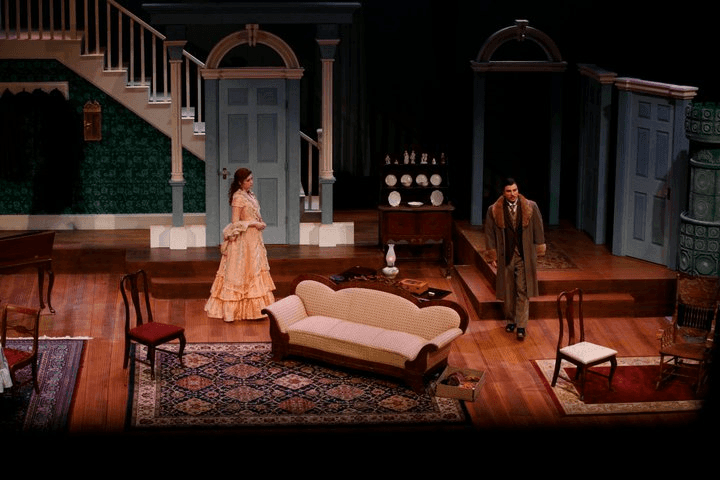
A Doll's House, written in 1879, is probably the most consequential play of the 19th century — not just artistically but socially and politically. Nora Helmer appears, at the play's opening, to be the perfect bourgeois wife — cheerful, childlike, adored by her husband Torvald, the living embodiment of respectable domestic happiness. She is his "little lark," his "little squirrel," his doll. She performs this role with apparent delight. But we quickly learn that Nora has a secret. Years ago, when Torvald was seriously ill and the doctor said he needed to travel south to recover, the family had no money. Torvald would never have accepted charity or a loan — his pride wouldn't allow it. So Nora secretly borrowed the money, forging her dying father's signature on the loan document because she couldn't get credit as a woman in her own right. She has been secretly repaying the debt ever since, skimming from the household money Torvald gives her, doing copying work in secret. She committed a crime — forgery — out of love. And she has been living with the secret for years, proud of it in a private way, feeling that she did something real while playing her doll's role.
The man she borrowed from, Krogstad, is a clerk at the bank Torvald now manages. Torvald plans to fire him. Krogstad threatens to expose Nora's forgery unless she persuades her husband to keep him on. Nora tries, fails, and waits for catastrophe — but she waits in a particular way. She has constructed a fantasy in which Torvald, when the truth comes out, will prove his love by taking the blame upon himself, shielding her, proving that the marriage she has believed in is real. Krogstad exposes her. Torvald reads the letter and is furious — not protective, not self-sacrificing, but panicked and cruel. He tells her she is a criminal, that she is unfit to raise their children, that their marriage will be maintained as an empty facade for the sake of appearances. Then Krogstad sends another letter withdrawing his threat, and Torvald immediately forgives her — as if nothing happened, as if the first reaction revealed nothing important. And in that moment something breaks in Nora. She sees her marriage clearly for the first time. She has never been a person to Torvald — she has been a decoration, a doll in a doll's house. Her father treated her the same way before him. She has gone from one man's doll to another's without ever becoming herself. She sits down with Torvald for the most important conversation of their marriage — perhaps the only real conversation they have ever had. She tells him what she has seen. She tells him she has to leave — not because she doesn't love him or their children, but because she cannot continue to live as something less than a full human being. She needs to discover who she actually is. She puts on her coat, picks up her bag, and walks out the front door. The play ends with the sound of that door closing(👏🏼).
The sound of that door was heard around the world. The play caused an immediate international scandal. Productions were staged across Europe almost instantly. Audiences were divided — some electrified, some outraged. The idea that a wife and mother could walk out on her family for the sake of her own self-realization was, to many people, not dramatic but monstrous. Ibsen was forced, against his will, to write an alternative ending for a German production in which Nora, unable to leave her children, sinks to the floor in despair rather than walking out. He called it a barbaric act of violence against the play and refused to consider it legitimate. The original ending stood. The play became a touchstone for the emerging women's rights movement. Nora's walk out the door was read as a manifesto. Ibsen himself was ambivalent about this — he said he wrote about human beings, not women's rights — but the play's impact on how people thought about marriage, about women's inner lives, about the difference between social performance and genuine selfhood was profound and permanent.
The reason A Doll's House endures is not its politics but its psychology. Ibsen makes Torvald comprehensible — not a monster but a man entirely formed by his society's expectations, genuinely incapable of seeing Nora as a full person because his entire world has told him that wives are not full people. His cruelty in the crisis moment is the cruelty of a man whose comfortable self-image is threatened — ugly, but recognizable. And Nora herself is not simply a victim. She has participated in her own diminishment — has performed the doll role with skill and even pleasure, has used her apparent helplessness as a kind of power, has been complicit in the fiction of her marriage. Her awakening is not the discovery that Torvald is bad but the discovery that she herself has not yet existed.That is a much more uncomfortable and much more true observation than any simple story of oppression would be. More on this in the next post. ☀️