Created on
Updated on
Filmmaking in the Age of AI(7): How Screenwriters Were, and Still Are, Largely Uncredited
House Un-American Activities Committee's Investigation on Communism Influence in Hollywood
Preface: Re-teaching myself the new filmmaking pipeline, now with AI (netflix please notice me). co-written with Claude. NOW WITH AUDIO.
When sound arrived and screenwriting became more prestigious and better paid, men moved in and women were gradually pushed out. By the 1930s the gender balance had completely reversed. The Jazz Singer in October 1927 was not the first sound film — various synchronized sound systems had been demonstrated going back years. And it was not entirely a talking picture — most of it was silent with title cards, with only a few scenes of synchronized dialogue and Al Jolson's musical numbers. But it was a massive commercial sensation that proved audiences would pay to hear actors speak, and within two years the silent film was essentially dead. For screenwriters, sound meant one thing above all: dialogue mattered now. The continuity script, which had been primarily a visual document — describing what the camera would see — suddenly needed to include spoken words. And spoken words required a different kind of writing skill, a different kind of dramatic thinking.
Hollywood panicked. The studio heads looked around for people who could write dialogue and their eyes went immediately to Broadway. A talent raid on the New York theater world began almost immediately — playwrights, novelists, journalists, anyone who could write spoken language was recruited with generous contracts and sent to California.Many of them failed — discovering that the skills of theatrical dialogue writing did not automatically transfer to film. But the influx of literary talent also raised the ambition and sophistication of Hollywood writing considerably. The screenplay format began to standardize in this period. Dialogue scenes required a clear visual distinction between action description and spoken words. The basic architecture of the modern screenplay — scene headings, action lines written in present tense, character names centered above dialogue — began to emerge through practical necessity rather than deliberate design.
The 1930s and 1940s — the classical Hollywood studio era — established the conditions under which most American screenwriting would happen for the next several decades. The major studios — MGM, Paramount, Warner Brothers, RKO, Columbia, Universal — functioned as vertically integrated dream factories, employing hundreds of writers on long-term contracts, assigning them to projects, and exercising enormous control over the final product. Writers did not own their work. They did not control what happened to it. They were employees, and the studio was the author of record. This system produced some of the greatest films ever made — the screwball comedies, the noir thrillers, the musical spectacles of Hollywood's golden age — but it also ground up writers with ruthless efficiency. Assignments were handed out and taken away. Multiple writers worked on the same script simultaneously without knowing about each other. Credit was disputed, denied, and politicized. The writer who originated a story might receive no credit for the final film. The screenwriters of this era organized collectively — the Screen Writers Guild, founded in 1933 and winning its first contract in 1941, established the system of screen credit arbitration and basic working conditions that still governs Hollywood writing today.
In the 1950s French film critics — writing in the influential journal Cahiers du Cinéma — developed what became known as the auteur theory: the idea that the director, not the writer, was the true author of a film. The director's personal vision, expressed through visual style and thematic obsessions consistent across many films, was what gave cinema its artistic identity. This theory — championed by critics like François Truffaut and Jean-Luc Godard, who then went on to become directors themselves in the French New Wave — had enormous influence on how cinema was understood and discussed. It also had the practical effect of further diminishing the perceived importance of the screenwriter, who was already subordinate in the studio system. The auteur theory was not entirely wrong — there are directors whose visual sensibility and thematic consistency genuinely constitute an artistic identity as recognizable as any writer's. But it systematically undervalued writing, and it created a critical framework in which the screenplay was seen as raw material that the director transformed into art, rather than as art in itself. The system was brutal but also extraordinarily productive. Writers like Billy Wilder, Preston Sturges, Nunnally Johnson, Dudley Nichols, and Herman Mankiewicz produced work of genuine literary quality within industrial conditions of almost comic harshness. Wilder famously said the only way to protect your script in Hollywood was to direct it yourself — which he eventually did, becoming one of the great writer-directors in cinema history.
The blacklist era of the late 1940s and 1950s — when the House Un-American Activities Committee investigated alleged Communist influence in Hollywood — devastated the writing community particularly severely. Writers were among the most politically engaged people in the industry and therefore among the most vulnerable. HUAC was a committee of the United States House of Representatives — meaning it was an official arm of the federal government, not a private organization or fringe movement. It was established in 1938 originally to investigate both fascist and communist influence in American society and institutions. The committee had the power to subpoena witnesses — meaning it could legally compel people to appear before it and testify under oath. Refusing to appear, or lying to the committee, carried genuine legal consequences including imprisonment for contempt of Congress. In its early years it investigated a range of targets, including Nazi organizations operating in America. But by the late 1940s — as the Cold War between the United States and the Soviet Union intensified — it had become focused almost exclusively on investigating alleged Communist influence in American life.
HUAC's focus on Hollywood was not arbitrary. Several factors made the film industry a particularly attractive target. The Hollywood community of the 1930s and 1940s was genuinely politically engaged in a way that the entertainment industry today is not. The Depression had radicalized many writers, directors, and actors. The rise of fascism in Europe — and the Spanish Civil War, which many Hollywood figures supported on the anti-fascist side — had pushed significant numbers toward leftist politics, including Communist Party membership. The Communist Party of the United States in the 1930s was not the sinister underground conspiracy it was later portrayed as. It was a legal political party with tens of thousands of members, many of whom joined out of genuine idealism — opposition to fascism, support for labor rights, belief in racial equality at a time when the American mainstream was deeply segregated. Many people who joined the party in the 1930s had left by the late 1940s, disillusioned by the Hitler-Stalin pact of 1939 or by increasing knowledge of Stalin's atrocities. Hollywood films reached enormous audiences. The idea that Communist writers and directors might be inserting subversive propaganda into popular entertainment — subtly shaping the values and beliefs of millions of Americans — was a powerful anxiety, regardless of whether it reflected reality. Celebrities made better headlines than anonymous government workers. Investigating Hollywood guaranteed press coverage and public attention in a way that investigating, say, the Agriculture Department did not.The film industry's dependence on public goodwill made it susceptible to political pressure. Studios feared boycotts. Stars feared public association with controversy. The industry could be pressured to cooperate with the committee in ways that more purely governmental institutions could not.
HUAC conducted several rounds of Hollywood investigations, the most significant in 1947 and 1951-52.The committee's method was essentially simple and extraordinarily effective. Witnesses were called before the committee and asked two questions: Are you now or have you ever been a member of the Communist Party? Can you give us the names of others who were members?The second question was the crucial one — and the most morally devastating. The committee was less interested in punishing past Communist Party membership than in compelling witnesses to inform on their colleagues, friends, and acquaintances. The act of naming names — of providing the committee with a list of people to investigate next — was the price of cooperation. This put every witness in an impossible position. They faced three options, each with serious consequences. Answer the committee's questions fully, including identifying colleagues who had been Communist Party members or sympathizers. This protected the witness from legal consequences but required betraying people who had trusted them, destroying the careers and lives of friends and colleagues, and participating in a process many considered fundamentally unjust. Refuse to answer on grounds of freedom of speech and association, arguing that the committee had no right to ask about political beliefs and associations. This was legally risky — the courts ultimately did not uphold First Amendment defenses before HUAC — and almost certainly meant blacklisting. Refuse to answer on grounds of self-incrimination, using the constitutional protection against being compelled to testify against oneself. This was legally safer than the First Amendment approach but carried an enormous social stigma — the phrase "taking the Fifth" became popularly associated with guilt, and witnesses who invoked it were almost as thoroughly blacklisted as those who refused outright. There was no good option. Every choice involved either betrayal of others or destruction of oneself.
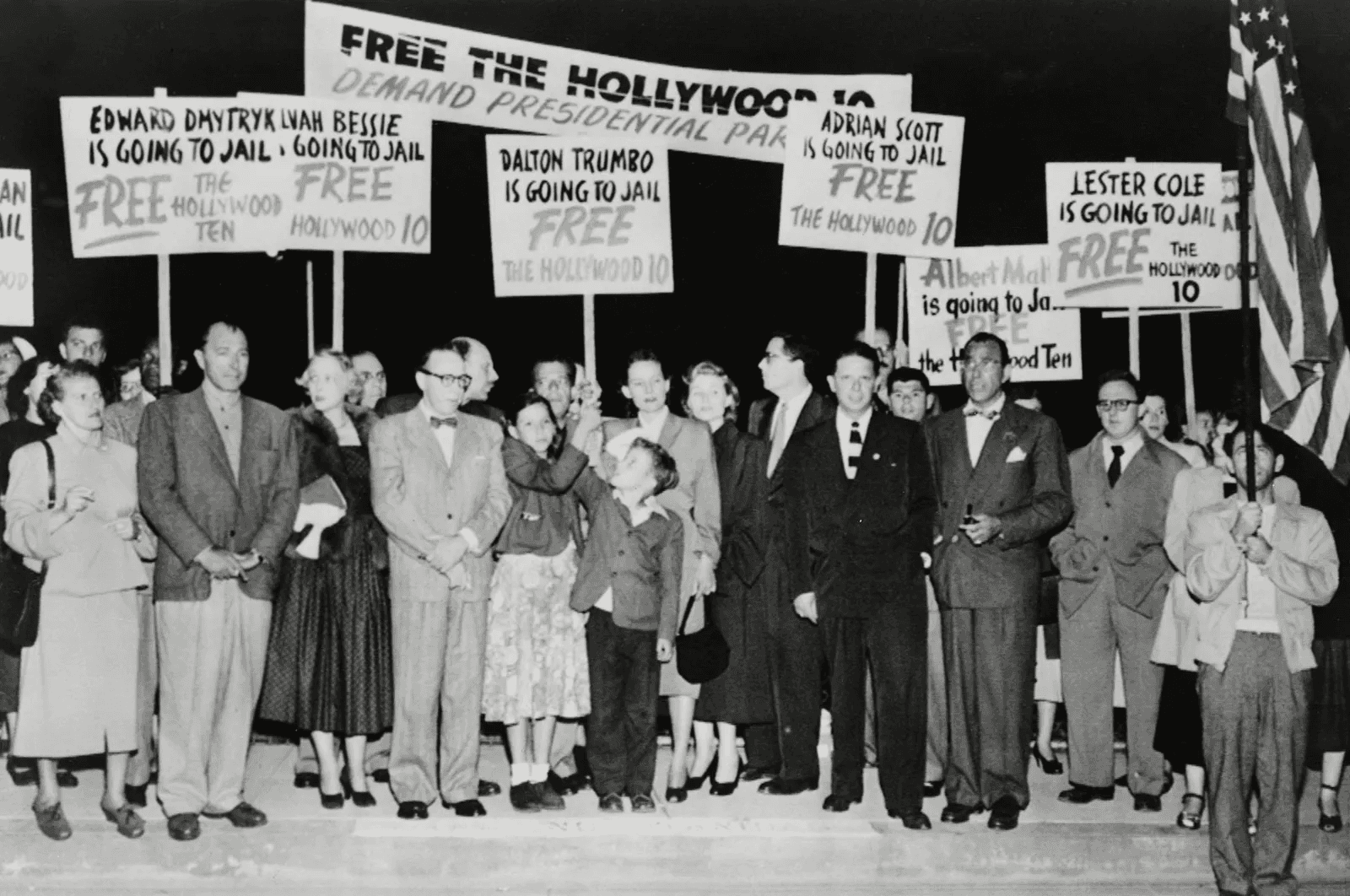
The most celebrated act of resistance to HUAC in Hollywood was that of the Hollywood Ten — a group of ten writers and directors who refused to cooperate with the committee in 1947, invoking First Amendment protections.They were:
Dalton Trumbo — one of the most successful screenwriters in Hollywood, who had written Kitty Foyle and Thirty Seconds Over Tokyo. He became the most famous of the Ten and the most prominent symbol of the blacklist era.
John Howard Lawson — one of the founders of the Screen Writers Guild and its first president, a committed Communist who was the most explicitly political of the Ten.
Albert Maltz — a playwright and screenwriter who had written This Gun for Hire.
Alvah Bessie — a novelist and screenwriter who had fought in the Spanish Civil War.
Herbert Biberman — a director who later made Salt of the Earth while blacklisted, a film about a Mexican-American mining strike that is one of the great works of American political cinema.
Lester Cole — a screenwriter and co-founder of the Screen Writers Guild.
Edward Dmytryk — the only director among the Ten, who later broke with the group and cooperated with the committee — an act of collaboration that damaged his reputation permanently.
Ring Lardner Jr. — the son of the celebrated humorist Ring Lardner, a screenwriter who had won an Academy Award for Woman of the Year.
Samuel Ornitz — a novelist and screenwriter.
Adrian Scott — a producer.
The Hollywood Ten were cited for contempt of Congress, convicted, and sentenced to prison terms of six months to a year(!!!). The studios, under pressure from the committee and fearful of public backlash, immediately fired them all.
In November 1947, in the immediate aftermath of the Hollywood Ten's contempt citations, the major studio heads met at the Waldorf-Astoria Hotel in New York and issued what became known as the Waldorf Statement — a declaration that the studios would not employ Communists or members of subversive organizations and would fire the Hollywood Ten. This was the effective beginning of the Hollywood Blacklist — a systematic practice of denying employment to anyone identified as a Communist or Communist sympathizer, without due process, without evidence, without any formal procedure. The blacklist was not a formal legal institution. There was no official list maintained by a government agency. It operated through informal networks of information sharing, through the industry's own fear of political controversy, and through the activities of private organizations like the American Legion and publications like Red Channels — a pamphlet published in 1950 that listed 151 people in the entertainment industry with alleged Communist associations. Being named in Red Channels or identified before HUAC was sufficient to end a career. Studios and networks would not hire people on the list. Agents dropped their clients. Friends stopped returning calls. People who had been making comfortable livings in the industry found themselves completely unable to work. The blacklist affected approximately 300 to 500 people in the entertainment industry — actors, directors, writers, composers, and others. For writers specifically the impact was particularly severe, because writers could more easily work under assumed names — pseudonyms and fronts — while actors could not disguise their faces. More on this in the next post. ☀️