Created on
12
/
9
/
2025
,
1
:
28
Updated on
1
/
29
/
2026
,
1
:
1
Location
Oakland, CA
Taiwan’s Path to Democracy(v): Before and After the Lifting of Martial Law
台湾民主历程(v):取消戒严的前后
Preface:和ChatGPT合作完成。
1971 年 10 月 25 日,联合国大会通过第 2758 号决议,承认中华人民共和国政府是“中国在联合国的唯一合法代表”,并决定将“蒋介石的代表”逐出联合国体系。该决议的文本本身并未讨论台湾的国际法地位,也未裁定台湾“属于谁”,它解决的是代表权问题,而不是主权归属问题。但在制度结果上,中华民国自此失去了在联合国的一切席位,并被排除在联合国体系之外。
这一结果并非孤立事件,而是多重结构变化叠加的产物。1950 至 1960 年代,随着去殖民化浪潮推进,大量亚非新独立国家加入联合国。联合国的成员结构从最初以战后同盟国为核心,逐渐转变为以第三世界国家为多数。这些新成员国中,相当一部分选择承认北京政府,而不接受台湾“代表全中国”的主张。在这一投票结构下,中华民国逐渐处于少数派位置。
冷战格局的变化同样加速了这一转向。1960 年代末,美国深陷越战泥潭,中苏关系恶化,美国开始重新评估其亚洲战略。在这种背景下,美国试图通过接触北京来牵制苏联。1971 年 7 月,基辛格以访问巴基斯坦为掩护,经伊斯兰堡秘密前往北京,与周恩来会谈。这一行动在当时对美国国务院体系、台湾当局及多数盟国都严格保密,标志着中美关系的实质性破冰。
1972 年 2 月,尼克松正式访华,会见毛泽东,并发表《上海公报》。公报中,美国“acknowledge(认识到)”中方关于“只有一个中国、台湾是中国一部分”的立场,但刻意避免使用“recognize(承认)”,从而保留外交上的战略模糊性。美方表述为“不挑战这一立场”,而北京方面则接受了美方在短期内维持与台湾非官方关系的安排。
与此同时,中华民国政府拒绝“双重代表权”或“只代表台湾”的折衷方案,坚持“代表全中国”的立场。在蒋介石的政治逻辑中,一旦放弃“中国代表权”,就等同于否定政权的根本合法性。因此,与其接受身份降级,不如整体退出。这一选择在制度上切断了台湾继续留在联合国体系内的可能性。
到 1970 年代末,这一叙事体系遭遇了真正的结构性崩解。1971 年失去联合国席位,1979 年美国与中华人民共和国建交、与中华民国断交,原先支撑台湾官方叙事的三根支柱——“代表中国”“反攻大陆的历史使命”“国际社会最终会支持我们”——相继瓦解。国家仍然存在,但“我们代表谁、凭什么代表”的问题,第一次以不可回避的形式出现在社会内部。
这一变化削弱了外省统治集团的国际合法性基础。本省社会开始提出新的问题:如果你已经不再代表中国,那你凭什么代表台湾社会本身?统治正当性的来源,开始从“中国合法政府”转向“是否回应本地社会”。
与此同时,美国的对台政策环境也发生转变。1950—1960 年代,美国对盟友的主要判断标准是是否反共,只要立场一致,对军事独裁、长期戒严、系统性镇压往往选择性忽视。台湾、南韩、菲律宾、南越都处在这一逻辑之下。但 1970 年代,美国经历了越战失败、水门事件与民权运动的冲击,国内政治文化发生变化,对权力滥用的警惕上升,人权逐渐成为可被制度化运用的外交语言。
卡特政府时期,人权被明确纳入美国外交政策的制度框架。国务院开始定期发布各国人权状况报告,国会要求行政部门就盟友的人权实践接受监督。这一变化并非道德觉醒,而是政治文化与治理逻辑的转型结果。对台湾而言,这意味着美国的支持不再是无条件的:镇压行为会产生外交成本,政治犯问题会进入双边议程。
1979 年的美丽岛事件引起美国媒体、国会议员及人权组织的关注,这在 1950 年代几乎不可想象。蒋经国政府逐渐意识到:美国不会再为高压统治提供全面背书,持续镇压只会进一步压缩国际空间。人权议题不会自行消失,而是成为长期约束。
在此之前,台湾的社会结构已经发生深刻变化。1960 年代起,台湾转向出口导向型工业化,引进外资、发展加工制造业,高雄加工出口区成为代表。国家主导土地、金融与劳动力配置,压低劳动成本、严格管控工会,以政治稳定换取经济成长。这一模式短期内高效,但长期上改变了社会结构。
农业社会向工业社会转型,年轻人口大量进入城市,宗族与地方士绅的影响力下降。工厂、科技园区与都市办公体系,将人际关系从血缘、地缘,转向职业与社交网络。人们开始主要依靠工资与技能生活,而不是政治忠诚或国家配给。
中产阶级随之扩大,包括工程师、公务员、教师、技术人员与白领群体。他们不依赖黑箱政治生存,不需要革命,但也难以接受全面控制。他们要求的是规则的可预期性、专业尊严与言论空间。
教育扩张进一步强化了这一趋势。大学数量增加,大量学生赴美、赴欧,接触选举、公民社会与言论自由。即便不直接反对政权,他们也清楚:世界并非只能如此运作。
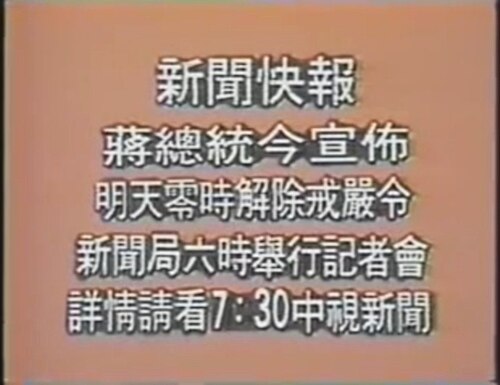
1980 至 1987 年间,政治松动已在事实上展开。政治犯减刑、释放,情治系统不再全面抓捕,反对杂志不再全部查禁。1986 年民进党成立而未被取缔,标志着制度边界的实质性松动。1987 年 7 月 15 日,中华民国政府正式宣布废止自 1949 年实施、持续 38 年的戒严令——这是当时亚洲持续时间最长的戒严之一。
戒严解除后,新报纸合法出现,不同政治立场得以公开表达,政府不再垄断现实解释权。至此,威权统治失去了对社会叙事的最终控制。
Preface: completed in collaboration with ChatGPT.
On October 25, 1971, the United Nations General Assembly adopted Resolution 2758, recognizing the government of the People’s Republic of China as “the only legitimate representative of China to the United Nations” and deciding to expel “the representatives of Chiang Kai-shek” from the UN system. The text of the resolution itself did not address the international legal status of Taiwan, nor did it determine sovereignty over Taiwan. It resolved the issue of representation, not territorial ownership. Nevertheless, in institutional terms, the Republic of China was thereafter entirely excluded from the United Nations system.
This outcome was not an isolated event, but the result of multiple structural shifts converging. From the 1950s through the 1960s, the wave of decolonization brought a large number of newly independent Asian and African states into the United Nations. The organization’s membership gradually transformed from a postwar alliance-centered body into one dominated numerically by what was then called the Third World. Many of these new member states chose to recognize the government in Beijing and rejected the claim that Taiwan could represent all of China. Within this altered voting structure, the Republic of China increasingly found itself in a minority position.
Changes in the Cold War strategic environment further accelerated this shift. By the late 1960s, the United States was deeply entangled in the Vietnam War, while relations between the Soviet Union and China had deteriorated sharply. Under these conditions, Washington began reassessing its Asia strategy and sought rapprochement with Beijing as a means of counterbalancing Moscow. In July 1971, Henry Kissinger secretly traveled to Beijing via Islamabad, under the pretext of visiting Pakistan, and held talks with Zhou Enlai. At the time, this initiative was kept secret from most of the U.S. State Department, the Taiwanese government, and even many American allies, marking the substantive breakthrough in Sino–American relations.
In February 1972, President Richard Nixon formally visited China, meeting Mao Zedong and issuing the Shanghai Communiqué. In that document, the United States stated that it “acknowledges” the Chinese position that there is only one China and that Taiwan is part of China, while deliberately avoiding the word “recognize,” thereby preserving strategic ambiguity. The U.S. position was that it would not challenge this claim, while Beijing accepted that Washington would maintain non-official relations with Taiwan in the short term.
At the same time, the Republic of China government rejected compromise proposals such as “dual representation” or participation in the UN as a Taiwan-only entity. For Chiang Kai-shek, relinquishing the claim to represent China would have amounted to negating the regime’s foundational legitimacy. From this perspective, accepting a downgraded status was worse than complete withdrawal. This choice effectively foreclosed Taiwan’s continued presence within the UN system.
By the late 1970s, this narrative framework had undergone a fundamental collapse. The loss of the UN seat in 1971 and the establishment of diplomatic relations between the United States and the People’s Republic of China in 1979—accompanied by Washington’s severance of official ties with the Republic of China—brought down the three pillars that had long sustained Taiwan’s official self-narrative: that it represented China, that retaking the mainland remained a historical mission, and that the international community would ultimately stand behind it. The state still existed, but questions of “who we represent” and “on what basis we rule” became unavoidable within society for the first time.
This shift undermined the international legitimacy of the mainland-origin ruling elite. Within Taiwanese society, a new question began to surface: if you no longer represent China, on what grounds do you represent Taiwan itself? The source of political legitimacy began to shift from the claim of being the “legitimate Chinese government” toward responsiveness to local society.
At the same time, the external policy environment in the United States was changing. During the 1950s and 1960s, Washington’s primary criterion for evaluating allies was whether they were anti-communist. As long as that condition was met, military dictatorships, prolonged martial law, and systematic repression were largely tolerated or ignored. Taiwan, South Korea, the Philippines, and South Vietnam all fit this pattern. In the 1970s, however, the United States experienced the trauma of defeat in Vietnam, the Watergate scandal, and the aftershocks of the civil rights movement. American political culture shifted toward greater suspicion of unchecked power, and human rights gradually became a language that could be institutionalized in foreign policy.
Under the Carter administration, human rights were explicitly incorporated into the formal framework of U.S. diplomacy. The State Department began issuing regular human rights reports, and Congress required the executive branch to submit assessments of allied governments as well. This was not a sudden moral awakening, but the result of a transformation in political culture and governance logic. For Taiwan, it meant that U.S. support was no longer unconditional: repression now carried diplomatic costs, and political prisoners became points of bilateral friction.
The 1979 Kaohsiung (Formosa) Incident drew the attention of American media, members of Congress, and human rights organizations—an outcome unimaginable in the 1950s. The Chiang Ching-kuo government gradually recognized that the United States would no longer provide blanket cover for repression. The harsher the crackdown, the narrower Taiwan’s international space would become. Human rights scrutiny was not a passing wave, but a long-term constraint.
Meanwhile, Taiwan’s internal social structure had already undergone profound transformation. Beginning in the 1960s, Taiwan shifted toward export-oriented industrialization, attracting foreign investment and developing processing and manufacturing industries. Textiles, electronics, and components manufacturing expanded rapidly, with the Kaohsiung Export Processing Zone as a flagship example. The state dominated land, finance, and labor allocation, tightly controlled unions, and suppressed labor costs in exchange for political stability and investor confidence. This model was highly efficient in the short term but carried long-term structural consequences.
As Taiwan moved from an agrarian to an industrial society, agricultural incomes declined relative to wages, and large numbers of young people migrated to cities. The influence of clans and local gentry weakened. Factories, science parks, and urban office systems reoriented social relationships away from kinship and locality toward occupational, collegial, and social networks. People increasingly lived on wages and skills rather than political loyalty or state distribution.
The middle class expanded accordingly, encompassing engineers, civil servants, teachers, technicians, and white-collar professionals. They were neither capitalists nor peasants, and their defining features were stable income, transferable skills, and relative independence from opaque political patronage. They did not seek revolution, but they could not accept total control. What they demanded were predictable rules, professional dignity, and space for expression. They were not violent or insurrectionary, but they persistently resisted ideological domination.
Educational expansion reinforced these changes. Universities multiplied, enrollment surged, and large numbers of students studied in the United States and Europe, encountering electoral politics, civil society, and freedom of expression. Even if they did not actively oppose the regime, they understood that the world could operate differently. Livelihoods increasingly depended on markets and enterprises rather than the state, and income flowed from wages and expertise rather than political loyalty.
Between 1980 and 1987, significant political change had already taken place in practice. Political prisoners were granted sentence reductions or released, and the security apparatus ceased its indiscriminate arrests. Opposition magazines were no longer uniformly banned. Most notably, the Democratic Progressive Party was founded in 1986 and not suppressed, marking a substantive loosening of institutional boundaries. On July 15, 1987, the Republic of China government formally lifted martial law, which had been in effect since 1949 for 38 years—one of the longest continuous periods of martial law in Asia at the time.
With the end of martial law, new newspapers were legally established, divergent political positions entered the public sphere, and the government lost its monopoly over defining reality. At this point, authoritarian rule also lost its exclusive control over social narrative.