Created on
Updated on
Triple Alpha Process: We are from the Stars
Elon Musk is Lying, there will never be life on Mars
Preface: Co-written with Gemini, but mostly by me.
Ok, if this is what it takes to create consciousness out of molecules, I highly doubt humanity can do it with AI, it sounds way more intricate than some diodes lol. Even if we are standing on the shoulders of some physics/chemist/cosmologist/the knowledge of the entire universe discovered by humanity, we aren’t that smart. Not smart enough to do this level of manipulation, to create something so beautiful, so precise, so gentle, with so much love and care, to create us to be so imperfect, so stupid, so lazy, yet so cute, so much creativity and with so much love. If this doesn’t make your life worth-living, I don’t know what will. But anyways, back to the physics bit of it. I know I have probably convinced you at this point, but I wanna dig a little deeper.
According to the Triple Alpha Process, Helium, which is a common gas in your balloons, and this other particle I have no idea about, called Beryllium-8, according to Wikipedia, is “Beryllium-8 (8Be, Be-8) is a radionuclide with 4 neutrons and 4 protons. It is an unbound resonance of two alpha particles and nominally an isotope of beryllium”. So basically, it is not a molecule that exists in the "natural" world, whatever the word “natural” means these days after I discovered the universe could be a computer, nothing seems all that natural to me now. This Beryllium-8 is just some transitional state radionuclide isotope, that literally only exist in this resonance, as mentioned before, called The Hoyle Resonance, that precisely only can happen at this precise alpha constant, that’s called the The Fine-Structure Constant, I will not paste the equation here anymore at this point, as I already posted it twice, look it up if you’d like, just know it’s associated with speed of light, the Planck’s constant, and charge of a single electron. Precise. This Beryllium-8 was discovered shortly after the construction of the first particle accelerator in 1932 by the way. We can see how important it was to build the first practical accelerator. It opened the door to many possibilities and new discoveries.
Beryllium-8 forms when two Helium-4 nuclei (also known as alpha particles, as we all see why now) collide with enough energy to overcome their mutual electrical repulsion. In the core of a star, the temperature must be at least 100 million degrees Celsius for this to happen. Mathematically, the "Write Command" looks like this:
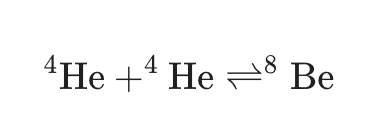
According to Gemini, Beryllium-8 is a "bottleneck" in the laws of physics. Unlike most elements, which become more stable as they get larger (up to a point), Beryllium-8 is energetically "unfavorable." Its internal energy is slightly higher than the combined energy of the two Helium nuclei that created it, which is pretty weird. I wonder how this happens, but I’ll leave it for another section. Because nature always seeks the lowest energy state, Beryllium-8 wants to "crash" back into its original parts immediately. The result is a half-life of only 8 x 10^{-17} seconds, very fast, as mentioned in the previous post. As not mentioned in the previous post, I didn’t put this in perspective. Like ok, that’s a really small number, but what does that mean? It means that light—the fastest thing in the universe—can only travel about the width of a few atoms in the time it takes for a Beryllium-8 nucleus to fall apart. It is so much faster than the speed of light.
Because the center of a Red Giant star is so incredibly crowded and hot, Beryllium-8 is being created and destroyed trillions of times per second. Even though each individual Beryllium atom is a "temporary file" that gets deleted almost instantly, there is always a small, steady population of them present in the core. This is known as a Dynamic Equilibrium. It’s like a fountain where the individual drops of water are always moving and falling, but the "shape" of the fountain stays the same. If Beryllium-8 were stable, the universe would be a very different place. All the Helium in stars would have turned into Beryllium long ago, and the "Carbon Factory" would never have needed a "Resonance" to work. But because it is so unstable, it forces the universe to use the Triple Alpha Process. The only way to move past Beryllium is for a third Helium nucleus to strike the Beryllium-8 "buffer" before it clears. This is why the Hoyle Resonance is so critical—it turns a near-impossible collision into a guaranteed "Save" command, creating the Carbon that eventually becomes the basis of your DNA. I know we are all from Africa, but it seems before that, we were from the Stars.
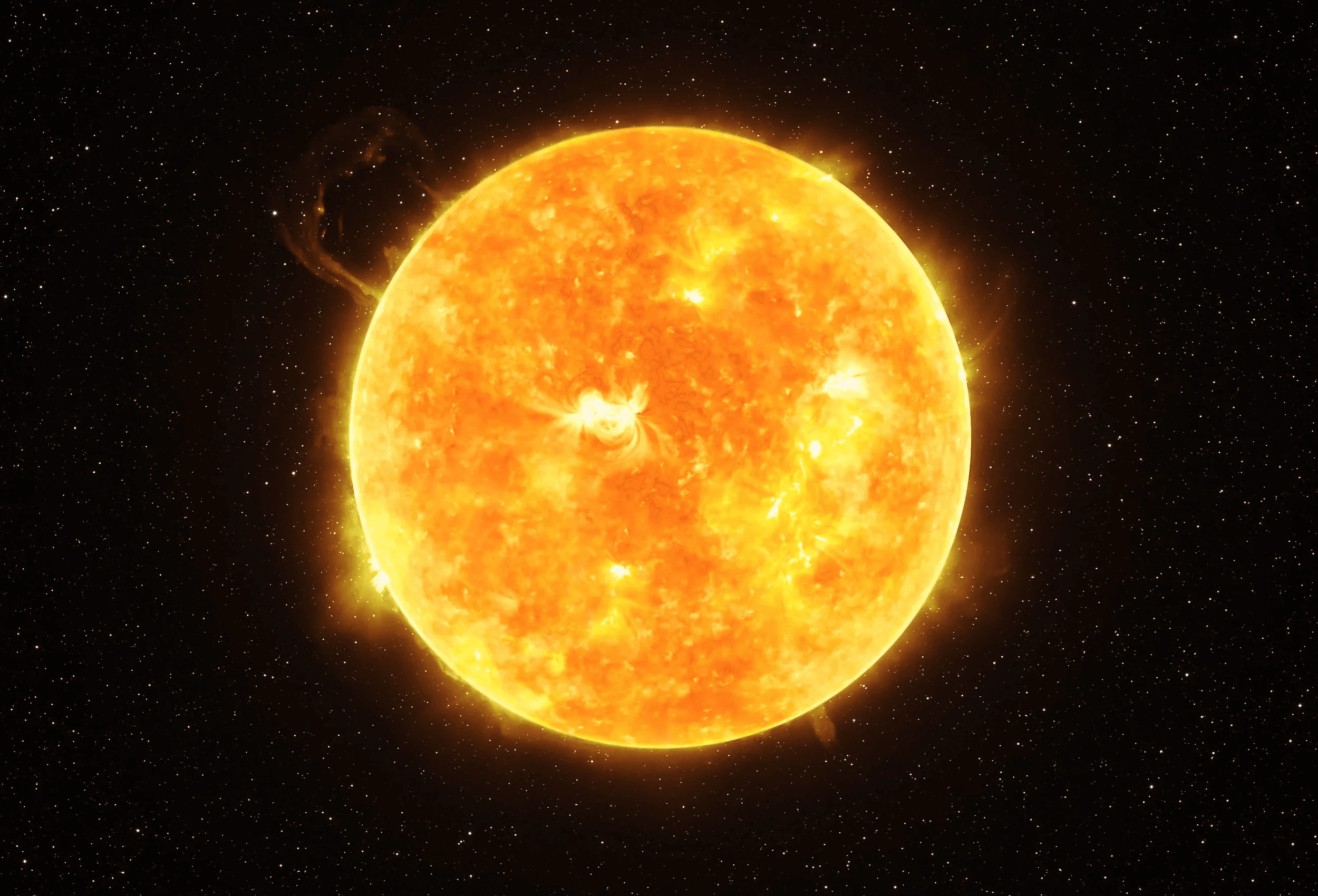
The only Star in our planetary system is the Sun ☀️. That’s why it’s called the Solar System. Not lunar. The moon creates tides, but not life. We don’t need to send a spaceship there to discover life, it’s 100% not there. Come on, where’s my tax money? Also, Elon Musk is lying, there will never be life on Mars. It’s just too hard. So the Sun created Carbon-12, which formed planets, which had these planets rotating around her, because of her gravity, which became earth, which became the building block of all organic life, from which our consciousness arose, ok got it. We are from the Sun. Got it. Why do I want to cry?
The Sun is a massive nuclear reactor. In its core, it performs Nuclear Fusion, crushing 600 million tons of hydrogen into helium every second. This process follows the "source code" of E=mc^2. Because the speed of light (c) is so large, the tiny bit of mass lost during this conversion is "rendered" as a staggering amount of energy. This energy (photons) takes about 100,000 years to "buffer" its way out of the Sun's dense interior, but once it hits the surface, it streams across the vacuum to provide the "input" for photosynthesis and heat on Earth. The Sun’s gravity acts as the universal "connection cable" for the planets. The Sun contains 99.8% of the total mass of our system. This massive concentration of data creates a deep "warp" in spacetime, forcing the planets into stable, predictable orbits. Without the Sun’s gravitational "anchor," the planets would be "disconnected" and fly off into the dark void of interstellar space.
The Sun doesn't just sit there; it constantly "broadcasts" a stream of charged particles known as the Solar Wind. This creates a massive magnetic bubble around us called the Heliosphere. This bubble acts like a Hardware Firewall. It deflects high-energy cosmic rays coming from the rest of the galaxy that would otherwise "corrupt" the delicate biological code of life on Earth. By providing a consistent "Light/Dark" cycle through Earth's rotation, the Sun dictates the Clock Speed of almost all life. Most organisms have "circadian rhythms"—internal subroutines that sync up with the Sun's output. Whether it's a plant's growth cycle or your own sleep patterns, our biological "software" is hard-coded to follow the Sun’s rhythm. However, the Sun is just one of hundreds of billions of stars in our galaxy, the Milky Way.
To use our computer analogy: if the Milky Way is a massive supercomputer, the Sun is just a single node or a single pixel in a gargantuan display. Our galaxy is a spiral disk containing between 100 billion and 400 billion stars. The Sun is located in one of the spiral arms (the Orion Arm), about 26,000 light-years away from the galactic center. Not all stars are like the Sun. In the "Hardware" of the galaxy, there are many different models. The Red Dwarfs are the "low-power" models. They are smaller and cooler than the Sun but make up about 75% of the stars in the galaxy. The Blue Giants are "high-performance" stars. They burn through their fuel incredibly fast and explode as supernovae. Geez, gotta love these naming conventions. Lastly but not least, the Sun (Yellow Dwarf) is actually a relatively stable, middle-of-the-pack "G-type" star. I see, a stable, middle-of-the-pack situation is better than “low-power” one, and is better than “high-performance” one, since it’s the only condition that created us.
What is a “G-type” star? You might ask. In the astronomical "catalog" of the universe, a G-type star (formally a G-type main-sequence star) is often called a Yellow Dwarf. Our Sun is the most famous example of this "hardware model." If stars were computers, G-type stars would be the reliable, high-quality "mid-range" workstations. They aren't the massive, power-hungry supercomputers (O-type Blue Giants) that crash and explode after a few million years, nor are they the tiny, low-power "micro-controllers" (M-type Red Dwarfs) that struggle to provide enough heat for life. They have a surface temperature between 5,200 K and 6,000 K. This specific heat range determines the "color" of the light they output. Although we call them "Yellow Dwarfs," G-type stars are actually white. They only appear yellow to us because Earth’s atmosphere (our "system filter") scatters blue light away, leaving the warmer tones to reach our eyes.
In the "Universal OS," every star has a unique "barcode" called a Spectrum. G-type stars are identified by the presence of strong lines of ionized calcium and both neutral and ionized metals. When astronomers look at a G-type star through a spectroscope, they are essentially reading its "System Info" file. This file tells them exactly what elements are being "processed" in the star’s atmosphere. For a G-type star, this usually includes a rich mix of heavier elements (metals), which suggests the star was formed from the "recycled data" of older, exploded stars. One of the most important features of a G-type star is its stability. A G-type star has a "battery life" of about 10 billion years, yes, even the Sun dies. Unlike smaller stars that often have "glitchy" solar flares that could strip a planet's atmosphere, G-type stars provide a very steady stream of energy.
This high "uptime" is critical for the "Software of Life." It took nearly 4 billion years for complex life to evolve on Earth; if our Sun had been a more massive star, it would have run out of fuel and "shut down" long before we ever reached the "Sentience" update. A G-type star is currently in its Main Sequence phase. This means it is in a state of "Hydrostatic Equilibrium"—a perfect balance between the inward pull of gravity and the outward "processing power" of hydrogen fusion. Eventually, all G-type stars will run out of hydrogen in their cores. When that happens, the "OS" will trigger a major update: the star will expand into a Red Giant and begin the Triple Alpha Process we discussed earlier, fusing helium into carbon. Life restarts again. ☀️