Created on
Updated on
旧金山以前叫芳草
A Century of Conquest, Rebellion, and the Making of Modern California
Preface: Trying to learn more about the land I live on, currently.
1) 芳草
在西班牙人到来之前,旧金山半岛一带居住着 Ohlone 人,有时称 Costanoan。“Ohlone” 是今天学术上使用的统称,指的是生活在 旧金山湾区到蒙特雷湾之间 的一系列原住民部族。“Ohlone” 这个词其实源自其中一个部族的名字 Oljon 或 Olhone。西班牙人早期称他们为 Costanoan,意思是“海岸居民”,源自西语 los costanos。后来出于文化自决与身份恢复,学者与原住民社区更愿意使用 “Ohlone” 一词。Ohlone 人并不是一个单一部落,而是由 约50–60个小型部落或村落组成的网络,每个部落有自己的语言、酋长与领地。Ohlone 的社会基本单位是 村落(village)或部落群(tribelet),每个部落往往控制一块特定的领地。小的部落只有几十人,大的可能上百人,平均每个部落辖有数个永久村与若干季节性营地。每个部落由一个男性或女性酋长(有时称 ruk 或 kaknan)领导。酋长不是君主,而更像是协调者与资源分配者。酋长的权力建立在家族血缘、财富、社会声望之上。chief 家族可以世袭,因此家族血缘很重要。而财富,在当时一般是指贝壳珠饰、狩猎资源。社会声望则是此人调解纠纷、主持仪式的能力。这些准则放在今天也差不多:政、钱、人。在这样的背景下,男或女酋长拥有仓储与再分配权,控制橡实、鱼干等公共储备,还可以主持婚礼、葬礼与节庆仪式,且代表本部落与邻部落进行贸易、结盟或通婚。这种领导结构让他们在没有中央政府的情况下,仍能维持区域和平与生态平衡。
Ohlone 并非单一语言族,而是一个语言联盟(linguistic complex)。学者 Catherine Callaghan 和 Milliken 的研究把 Ohlone 语分为 八种主要方言区,这里稍微简单介绍一下。东湾,今Oakland、Berkeley、Fremont一带,语言最接近北部 Miwok,Muwekma Ohlone 后裔今日多讲此语。旧金山半岛,即San Francisco 至 Daly City,在西班牙传教后最早被同化,现为 Mission Dolores 旧址族群。圣克拉拉谷,即San Jose 一带,与 Santa Clara Mission 密切相关。Santa Cruz 山区与沿海,与南部 Mutsun 有语言交叠。蒙特雷与卡梅尔地区,第一批与西班牙人接触(1770年Mission Carmel)。Gilroy、Hollister 一带,语言保存最久,且现有 Amah Mutsun Tribal Band 复兴项目。Salinas 山谷中部,是文化特征混合北南语支。 最后还有Carquinez 海峡周围,即Martinez、Benicia,说karkin。这正是加州原住民社会的典型特征:多语言、地方性强、靠生态边界划分。每个部落的领地大约覆盖几平方英里至数十平方英里,通常沿着河流、山脊、或海岸线划分。这种划分高度生态化,一块领地通常包含橡树林、湿地、草原、溪流,确保四季都有食物来源,例如橡实、鱼类、浆果、鹿群迁徙路径。领地边界由地貌自然形成,部落间会互访但须遵守仪式或贡品礼节。例如,旧金山北部的Yelamu 部落靠海与湾捕鱼。Fremont一带的Tuibun 部落在内陆采橡实。两者间有贸易与婚姻关系,但不能随意越界。
Ohlone 各部落通过 贸易与婚姻网络 相互连结,例如进行物品交换,交换贝壳珠、羽饰、食盐、火石、石臼,甚至远至 Sierran 内陆的黑曜石也可流入湾区。婚姻方面,他们禁止同部落通婚。你不能和同部落的人结婚(两小无猜的、RIP),只能和外部部落结婚,通过这种外婚制度,维持语言与文化的交流。婚姻也常带有经济互惠意义,例如交换食物、工艺、节庆互访。宗教仪式方面,相邻部落会共同举行季节性仪式,例如橡实节、治病仪式、舞蹈会。这套制度让他们形成一种“去中心化的联邦社会”,没有帝国,没有统一语言,却在生态与精神层面高度协同。今天湾区的许多 Ohlone 后裔仍认同自己来自具体部落:Muwekma,即Chochenyo-speaking Ohlone、Amah Mutsun,即Mutsun-speaking Ohlone、Rumsen OhloneEsselen,虽不完全属 Ohlone,但地缘相关。他们在积极恢复和保存ohlone的文化,包括通过旧传教院手稿与语言学重建来恢复方言,建立部落委员会与教育项目,举办“First Dance”仪式,在城市规划中推动 “land back” 与“shellmound 保护”。1500s,伊比利亚半岛的两个海上强国西班牙与葡萄牙瓜分“新世界”。1494年的 《托尔德西里亚斯条约》(Treaty of Tordesillas) 将全球分为两半,西班牙获得了美洲的大部分殖民权。西班牙最早的目标是夺取墨西哥、秘鲁等地的金银资源,建立太平洋贸易通道,与菲律宾的殖民地形成环线。“加州”一开始并不是他们的终点,而是一个未知的北方边疆。“California” 最早出现在 1510 年的一本西班牙浪漫小说 Las sergas de Esplandián(《埃斯普兰迪安的冒险》),描写一个充满黄金与亚马逊女王的神秘岛屿,名叫 California。当 1530s 年代的西班牙探险者在下加利福尼亚(Baja California)看到那片半岛时,误以为真的发现了“黄金岛”,于是沿用这个名字。直到一个多世纪后人们才意识到它并不是岛屿,而是大陆的一部分。
1530年代,征服墨西哥的Hernán Cortés 派出舰队探索西北方向。他们到达了 Baja California 半岛,但因为干旱缺水、环境恶劣,殖民失败。1602年,Sebastian Vizcaíno 从墨西哥 Acapulco出发,航行沿着太平洋北上,首次绘制了加州海岸线地图,并命名了多个地名:Monterey(纪念墨西哥总督),Carmel Bay,San Diego,Santa Barbara,命名了旧金山远处的海角“Punta de San Francisco”。Vizcaíno 赞美 Monterey 湾“安全可泊船”,建议未来建立殖民点。可结果是,接下来 160年间无人再来,直到 1760年代。到了18世纪中期,西班牙发现自己的殖民帝国在北美面临威胁。西班牙的北方,俄罗斯从阿拉斯加向南扩张,建立毛皮贸易据点。东方,英国与法国也在推进北美殖民。西班牙担心如果不赶紧占领“上加州”(Alta California),太平洋沿岸会被他国夺走。于是西班牙决定,“用信仰而非枪炮占领土地。”这就是加州传教体系(Mission System)的起源。
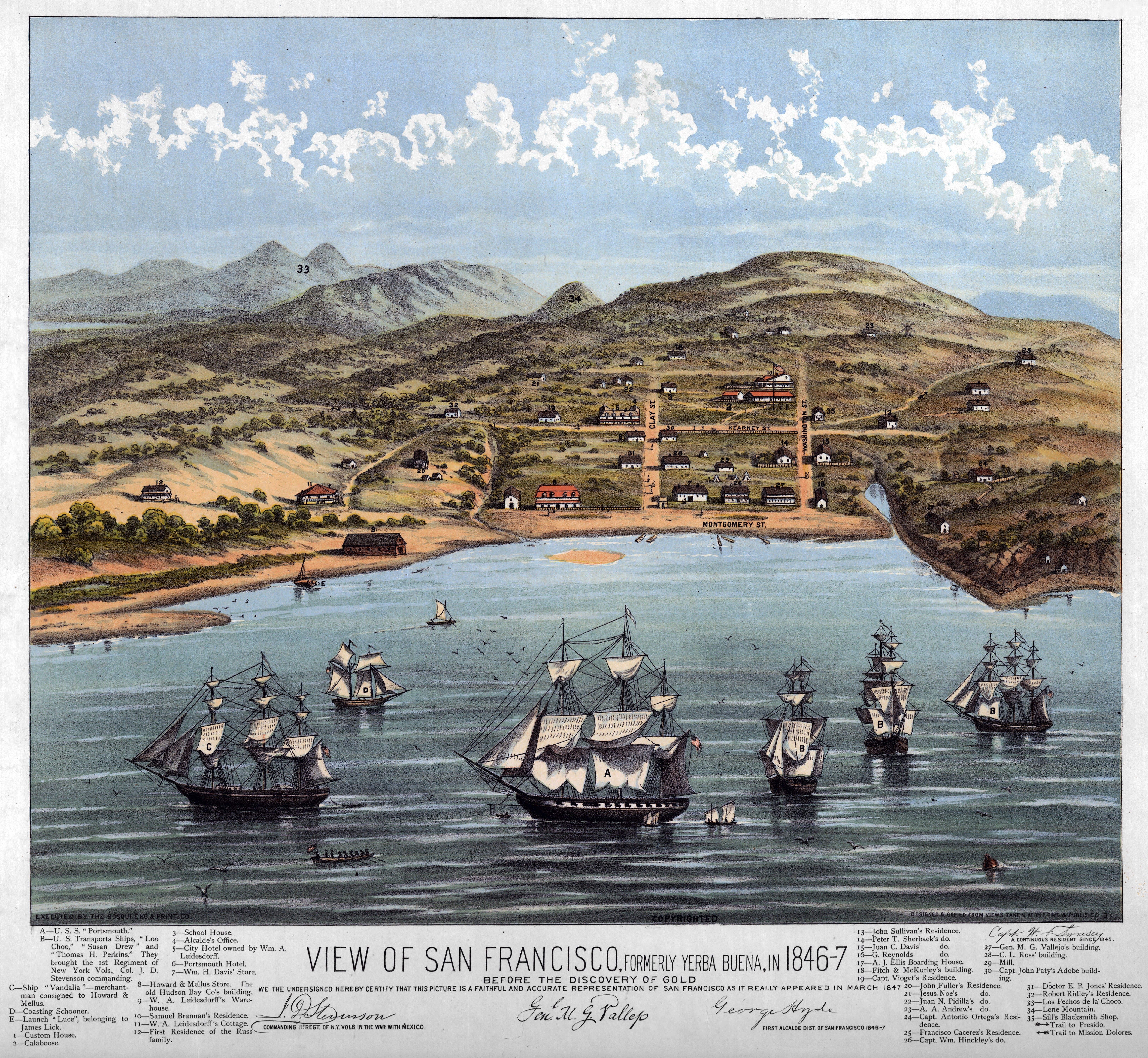
西班牙正式“到达加州”的时间点是 1769年。军事总督 Gaspar de Portolá,方济各会传教士 Father Junípero Serra,还有士兵、印第安辅助兵、牧牛人、妇女共200余人。从下加州(Baja California) 的 Loreto 出发,一路北上陆地行军,沿途建立据点与教堂。当西班牙人建立 Mission 时,他们常试图通过“收编”部落酋长来控制村落。传教士会邀请酋长受洗、赐基督教名。许多酋长在压力下签字,把领地“献给上帝”,直接导致传统领导体系崩溃,原有的地缘社会变成传教院式的等级制度。Yelamu 酋长 Hilisime 是 Mission Dolores 首批受洗者之一,但几年后,他的村落人口几乎全死于传染病。他本人被记录为“忠诚的印第安信徒”,但实际上失去了所有政治权力。传教体系的核心目标是“将原住民转化为天主教徒与劳动力。” 于是数以万计的 Ohlone、Tongva、Chumash 等部族被迫进入 Mission,受洗、更名、被禁止讲母语。他们白天从事农业、畜牧、建筑,夜晚被迫居住在传教院围墙内。由于疾病、营养不良、惩罚,死亡率极高。对原住民来说,这意味着文化与人口的毁灭,但对西班牙来说,这是一种“文明与秩序”的象征。1776年,同年美国独立,西班牙人在旧金山半岛上建起第六座传教站,Mission San Francisco de Asís,俗称 Mission Dolores。这一年,也是在半岛北端建立了军事堡垒 Presidio of San Francisco,以防英国或俄罗斯入侵。在西班牙时期,这片土地被称为 Yerba Buena,意为“芳草”。1846年美国人占领此地后,将其改名为 San Francisco。而淘金热让它在短短两年内从一个800人的小镇,变成超过3万人的国际港口。港口边的帆船、商人、妓院、赌馆、剧院并存——这座城市从一开始就带着冒险、混乱、野性和包容的气质。
2) 淘金热
故事的开端其实非常简单。1848年1月24日,加州北部萨特磨坊(Sutter’s Mill),位于科洛马(Coloma),靠近萨克拉门托河。詹姆斯·马歇尔(James W. Marshall),一名木匠,他在替地主约翰·萨特(John Sutter)修建锯木厂时,在水道里发现了闪亮的金粒。萨特原本想保密,因为他希望发展农业和木材业,不想被淘金者破坏。但消息很快走漏,口耳相传。当时加州还是墨西哥割让给美国不久的地区,1848年的《瓜达卢佩-伊达尔戈条约》才让加州归属美国。初期是当地工人、墨西哥人和夏威夷人参与采金。随着报纸报道和商船消息扩散,旧金山的港口迅速沸腾,大量商人、船员、冒险者都放下原有工作,奔赴内陆淘金。在1848年《瓜达卢佩-伊达尔戈条约》之前,加州是墨西哥领土。墨西哥独立1821年从西班牙独立,获得大片领土,包括今天的德克萨斯。当时德州人口稀少,主要是印第安人、少量西班牙裔牧场主。墨西哥政府为了开发边疆,1820年代允许美国移民进入德州,条件是皈依天主教、遵守墨西哥法律。很快有成千上万美国移民(Anglo settlers)进入德州,他们带来了英语、奴隶制和新教信仰。到1830年,德州的“美国人”移民数量已经超过墨西哥裔居民。1829年,墨西哥废除奴隶制,引起德州移民强烈不满,因为他们依赖奴隶种棉花。隔年,墨西哥又出台法令禁止更多美国人移民德州,矛盾激化。1835年秋,德州移民开始武装反抗墨西哥政府,打响独立战争。主要领导人是Sam Houston、Stephen F. Austin等美国移民首领。墨西哥总统兼独裁者Antonio López de Santa Anna亲自率军进入德州镇压。
Sam Houston出生于弗吉尼亚,美国政治和军事人物,早年参加过1812年美英战争。他1832年迁居德克萨斯,很快成为移民领袖,后被推选为德克萨斯军队总司令。他1836年4月在圣哈辛托战役中率军奇袭圣安纳大军,以18分钟的战斗赢得独立,后来在1836年到1838之间成为德克萨斯共和国的总统。德州并入美国后,当上了德克萨斯州州长、美国参议员,因为在内战前夕反对南方脱离联邦,在1861年被迫辞去州长职务。这位就是“德克萨斯之父”,德州最大城市Houston是以他命名。
Stephen F. Austin, 1793–1836,出生于弗吉尼亚,被称为“德克萨斯的殖民之父”。1821年,他获得墨西哥政府许可,带领美国移民进入德州定居,他组织了“老三百户”(Old Three Hundred,chatgpt说这叫老三百户,我听着非常奇怪,但先这样翻译)是德州最早、最有影响力的美国移民群体。Austin一开始主张在墨西哥体制下争取德州自治,而不是立刻独立。他1833年赴墨西哥城请愿,结果被圣安纳政府监禁一年多,出狱后,他的态度转为支持德克萨斯独立。Austin是另一位被称为德克萨斯之父的人,德州apprently有两个爸爸,没有妈妈。而德州首府奥斯汀市也是以他命名。
Antonio López de Santa Anna, 1794–1876,墨西哥军人、政治家,极富争议的人物。他多次担任墨西哥总统:11次上台下台,既因早年抗击西班牙殖民为看做民族英雄,又因独裁和屡次失败饱受批评。这种先民族英雄、后独裁者的套路也不是什么新鲜事了。他1835年宣布集权统治,取消地方自治,引发德州移民和墨裔居民反抗。1836年亲自率军北上镇压,在Alamo之战和戈利亚德大屠杀中展现强硬。但在圣哈辛托战役中被休斯顿击败并俘虏,被迫签署停战协议,丢掉德克萨斯。他1840s再度执政,在美墨战争中领导墨军,但再次失败。晚年流亡古巴、牙买加,最后在墨西哥去世。
总之,Houston、Austin和Antonio López de Santa Anna大战几回合,墨军围攻圣安东尼奥的“阿拉莫碉堡(The Alamo)”,击败约200名德州守军,所有人几乎被屠杀,which 成为德州人后来的复仇口号,“Remember the Alamo!”。后来又有戈利亚德大屠杀(1836年3月),约400名投降的德州士兵被圣安纳下令处决,进一步激化矛盾。再后来,1836年4月21日圣哈辛托战役,Houston率领的德州军在休斯顿附近袭击圣安纳的大军,仅18分钟就击溃墨军。Santa Anna本人被俘,被迫签署停战协议。结果就是1836年3月2日,Texas正式宣布脱离墨西哥,成立 Republic of Texas。宪法模式几乎照搬美国,允许奴隶制。美国内部因为“奴隶州/自由州平衡”的争议,没有立即并入德州,只是承认其独立。墨西哥拒绝承认德州独立,持续到1845年德州正式加入美国,才真正激化冲突。美国主张边界是里奥格兰德河(Rio Grande),墨西哥主张是更北的努埃塞斯河(Nueces River)。在美国,Manifest Destiny盛行,美国舆论和政府认为国家命运就是要向西扩张至太平洋。美国觊觎的不只是德克萨斯,还包括加利福尼亚和新墨西哥。
1846年,美国总统James K. Polk派兵到里奥格兰德河一带,和墨西哥军队爆发冲突。美国国会迅速向墨西哥宣战,在加利福尼亚和新墨西哥很快占领主要据点。1847年,美军登陆Veracruz,直取墨西哥城。1847年9月,美军攻下墨西哥城,墨西哥中央政府几乎崩溃。美国总统波尔克派出特使Nicholas Trist,在墨西哥与临时政府谈判。Trist原本在战争中被召回,但他拒绝离开,继续推动谈判,最终促成条约。1848年2月2日,条约在墨西哥城附近的 瓜达卢佩-伊达尔戈镇 签署。墨西哥承认德克萨斯并入美国,边界定在里奥格兰德河。墨西哥割让 一半国土,包括加利福尼亚、内华达、犹他、亚利桑那、新墨西哥,以及科罗拉多、怀俄明的一部分。国支付墨西哥 1500万美元,并承担墨西哥对美国公民的债务,约325万美元。至此,美国的版图扩大三分之一,获得太平洋出海口。墨西哥失去一半国土,创伤极大,奠定了长期的国家弱势。在1848年《瓜达卢佩-伊达尔戈条约》之前,加州是墨西哥领土。所以在淘金热“爆发”前,加州已经有一些墨西哥牧场主(Rancheros)、矿工和劳工生活在当地。当黄金消息传开时,他们是最早一批知道和参与的人。
墨西哥有悠久的银矿、金矿开采传统(比如萨卡特卡斯、瓜纳华托)。很多墨西哥矿工有专业技术,他们在加州矿区反而是“老手”,比美国东部来的农夫/木匠更有经验。消息传到墨西哥后,也有大批矿工和商人从墨西哥北部、尤其是Sonora 沙漠的,涌到加州。在1850年代初,旧金山甚至有“索诺拉镇(Sonora Town)”,就是墨西哥移民聚居的社区。除开墨西哥人,最早发现黄金的,还有当地的夏威夷人Kanakas。当时太平洋航线很活跃,夏威夷当时是独立的夏威夷王国,是北美和亚洲航运的中途站。很多夏威夷人长期在捕鲸船、商船、毛皮贸易船上做水手、工人,所以他们自然随船到加州港口。当金矿消息传到Honolulu,一些水手直接“弃船”,或者随着商船到旧金山后就留下来去矿区。在早期矿区记录里,“Kanaka”常常被列为一个单独的族群。1849年春,消息传到美国东部和海外,人们大规模迁往加州,被称为“49ers”。他们的迁入方式各种各样,走陆路穿越北美大陆,从密苏里州出发,走俄勒冈小道(Oregon Trail)、加州小道(California Trail)。走海路,绕过南美洲合恩角,或途经巴拿马穿越地峡再转船北上。除了美国人,还包括中国人、智利人、秘鲁人、墨西哥人、澳大利亚人等。到1852年,中国移民人数激增到2万人,占加州人口的10%左右。
旧金山的崛起原本是只有几百居民的港口小镇,在短短几年间暴涨到三万多人,成为“淘金热首都”。加州一度成为全球人口流动最密集的地区之一。However,矿区缺乏法律,出现大规模冲突、抢劫、种族歧视。华人、拉美裔、印第安人常被排斥。由于人口激增,加州在1850年迅速成为美国第31个州。最初容易获取的砂金很快被开采殆尽,矿业转向需要技术和资本的深井矿、机械化采矿。普通淘金者难以为继,很多人转向农业、商业和铁路建设。华人不少人因无法获得矿权,转而开洗衣店、餐馆、杂货铺,为社区奠定了经济基础。
3)华人
1848年1月24日,詹姆斯·马歇尔在萨特磨坊发现黄金。1848年夏天:美国总统波尔克在国会确认加州“确有黄金”,消息彻底引爆全球。消息一开始在加州本地传播,旧金山港口的船员、水手、商人最先涌入矿区。当时加州人口少、交通慢,东海岸的华盛顿、纽约很久都没有得到确切消息。很多人怀疑这是谣言。到了1848年夏天,黄金的消息陆续传到华盛顿,但缺乏权威证实。美国总统 James K. Polk收到了加州军政官员、商人带回的金块样品。Richard Mason时任加州军事总督,他写了一份详细的报告,确认在加州各地确实发现大量黄金。1848年 12月5日,波尔克在国会发表《总统年度咨文》(State of the Union Address),其中专门提到:“黄金在加利福尼亚被发现,数量极其丰富,几乎无处不在。”(Gold has been found in California in such abundance that it seems almost inexhaustible.)1849年春天,第一批大规模“49ers”潮水般从美国东部和世界各地赶往加州。1848年时,加州人口不到2万人,而到了1849年超过10万人涌入,人口突破25万,其中中国人就有2万人。旧金山从小渔港在几年内膨胀成世界级港口城市。
淘金的早期,也就是1848到1850之间,最简单的淘金盘(Gold Pan)、淘金槽,几乎人人可以试。一个铁盘或木盘,在溪流中不断摇晃,把泥沙和水冲掉,留下沉重的金粒。成本极低,几乎任何人都能上手。还有淘金槽(Long Tom / Sluice Box),是用木板做成长槽,引入溪流,把含金砂石倒入,让水流冲走轻的部分,在槽底放“横木”或“草垫”,用来截留金子。这样做,比单纯的淘金盘效率高,但还是个人或小团队操作。当时的金子往往是砂金(Placer Gold),就在河边浅层,非常容易被发现。一夜之间,人人都怀着“一夜暴富”的幻想,哪怕是农夫、厨子、裁缝,都能立刻丢下工作跑去挖金。这是淘金热最浪漫、最自由的时期,人人有机会。
但这样的浪漫,很快就被开采过度带来的资源枯竭打破。到了中期,也就是1850到1853之间,淘金工具开始升级,需要更多协作和资金。人们开始使用摇床(Cradle / Rocker),因为外形像个摇篮而得名。工人把砂石倒进摇床,用水冲洗,同时摇动装置。摇床的底部有金属网和毛毯状过滤层,可以把金子留下。这样做的效率比淘金盘高很多,可以处理更大量的砂石。大规模团队开始修建木制水渠,把高处的溪水引下来冲刷矿土。这样的操作需要合作和投入,往往是几十人一起组成矿队,用手推车运送砂石,逐渐向工业化过渡。这个时期开始出现“矿权”概念,谁先到达某一地并开采,就拥有该地的使用权。这导致竞争加剧,冲突频发,许多外国矿工(尤其是华人、墨西哥人)被排斥、赶走。1850年《外国矿工税》颁布,每人每月20美元,主要针对华人和拉美裔。到了1850年代初,“散兵游勇”式的个人淘金越来越难,只有组团、用更复杂设备,才能继续生存。
到了后期,1853到1855之间,出现了水力采矿(Hydraulic Mining)。这个技术使用巨大的水炮(水力枪)把高山坡面的砂石冲塌,再冲入长槽分离黄金。效率极高,但需要巨额投资,修水渠、水坝、水管。还有深井开采(Hard-Rock Mining),开凿矿井,进入地下岩层,寻找石英脉中的金矿,并且需要炸药、木支撑、提升设备,投入成本更大。资本集团开始进入,大公司、财团出现,买断大片矿区。个人矿工逐渐失去立足之地,只能转为雇佣工人。大量“49ers”失败而归,许多人破产。外国矿工,尤其华人更难与资本竞争,只能转入服务业,做餐饮、洗衣、裁缝等。矿区环境遭受严重破坏,河流被泥沙淤塞,农田被毁。到1855年左右,淘金热的“狂热期”基本结束,从全民梦想走向工业垄断,社会开始冷却。当时矿区缺乏法律,暴力和抢劫频繁。淘金者带着金粉回城,半路被袭击常见。私刑泛滥,偷盗、债务纠纷,等都用私刑(lynching)解决。各族群矛盾也很尖锐,美国本地白人常通过“矿区法庭”(Mining Camp Courts)驱逐华人、墨西哥人。前面提到的,1850年加州通过 《外国矿工税》(Foreign Miners’ Tax),也是专门针对华人和拉美矿工,每人每月需交20美元,这在当时是巨额的负担。
淘金热狂潮一年之间迁徙而来的华人,大多来自广东珠三角,主要来自 台山、开平、中山、新会、恩平等地。鸦片战争后中国南方经济困顿、土地贫瘠,农民受饥荒和战乱困扰。因此,传说中的“金山梦”吸引了大量农民,旧金山在华人中当时被称为“金山”。直到大约在 1850年代末到1860年代,金山才变成旧金山,而新金山New Gold Mountain 是指澳大利亚墨尔本,来自于1851年维多利亚淘金热。因为澳大利亚淘金热也吸引了大批广东移民,需要区分两个“金山”,所以后来大家才说 “旧金山” 来专指美国的 San Francisco。台山、开平、新会、恩平这几个地方在清代人口稠密、土地贫瘠,农民普遍贫苦。中山、东莞、顺德、番禺 等地也有大量劳工出海,后来在美国形成“台山帮”、“四邑人”社区。前面也提到,鸦片战争后(1840–1842),中国南方经济被打击,鸦片泛滥、赋税沉重。珠江三角洲土地资源有限,人口过剩,农民生活艰难。同时,太平天国运动(1851–1864)造成动荡,大量百姓被迫流亡。而“旧金山”在广东人口中被称为 “金山”(San Francisco = “Gam Saan”),民间传说“一到金山就能发财”,很多人倾尽家财买船票。当时的主要航线,是从广州十三行,到香港,再到旧金山。航程需2–3个月,途中疾病、风暴、饥饿常见,死亡率不低。运输商多由美国、英国商船公司承运。船票费用昂贵,相当于农民数年积蓄。很多人以 “赊账” 形式购票,即成为“契约劳工”(coolies),抵达后要靠打工偿还债务。社会结构也因此很多移民是“男工社会”,因为清政府严格限制妇女外出,导致华人社区长期性别失衡。听上去是非常疯狂的一段历史,但在我眼里怎么这么浪漫呢。一定是我脑补了很多。一定是这样。
旧金山是华人最早、最主要的落脚地。初到者往往先落脚在 唐人街(Chinatown),再通过 “会馆”(clan associations)或“合股制”组织进入矿区。“会馆”按照籍贯划分,如“宁阳会馆”、“冈州会馆”,互助性强。矿区分布上,多数华人进入 内华达山脉金矿带(Sierra Nevada foothills),尤其是萨克拉门托河流域。华人多避开白人争夺的“富矿”,转向白人弃置的小溪流、尾矿。他们依靠耐心和集体合作,从别人放弃的地方挖出黄金。同时,他们降低生存成本,生活节俭,忍受恶劣环境。但后因排斥与暴力,许多华人退出矿区,转入城市和小镇经营。例如在洗衣店提供廉价劳力,几乎垄断行业。开餐馆,炒菜、面点,既服务华人,也逐渐吸引白人。开裁缝、杂货店,以满足矿区和城市生活需求。许多华人退出矿区,转向城镇经济,奠定了唐人街的经济基础。
1) Yerba Buena (芳草)
Before the arrival of the Spaniards, the San Francisco Peninsula was inhabited by the Ohlone people, sometimes referred to as Costanoan. "Ohlone" is the collective academic term used today to describe a series of indigenous tribal groups living between the San Francisco Bay and Monterey Bay. The word "Ohlone" actually originates from the name of one of the tribes, the Oljon or Olhone. Early Spaniards called them Costanoan, meaning "coastal dwellers," derived from the Spanish los costeños. Later, out of a desire for cultural self-determination and identity reclamation, scholars and indigenous communities came to prefer the term "Ohlone."
The Ohlone were not a single unified tribe, but rather a network of approximately 50–60 small tribes or villages, each with its own language, chief, and territory. The basic unit of Ohlone society was the village or tribelet, with each tribe typically controlling a specific piece of land. Small tribes consisted of only a few dozen people, while larger ones could reach the hundreds; on average, each tribe governed several permanent villages and a number of seasonal camps.
Each tribe was led by a male or female chief (sometimes called a ruk or kaknan). The chief was not a monarch, but more of a coordinator and resource distributor. A chief’s power was built upon family lineage, wealth, and social prestige. The office of the chief could be hereditary, making family lineage very important. Wealth, in those days, generally referred to shell beads and hunting resources. Social prestige was the individual’s ability to mediate disputes and preside over ceremonies. These criteria are much the same today: politics, money, and connections. In this context, the male or female chief held the rights to storage and redistribution, controlling communal reserves like acorns and dried fish. They also presided over weddings, funerals, and festival rituals, and represented the tribe in trade, alliances, or intermarriage with neighboring tribes. This leadership structure allowed them to maintain regional peace and ecological balance without a central government.
The Ohlone were not a single linguistic group but a linguistic complex. Research by scholars Catherine Callaghan and Milliken divides the Ohlone languages into eight major dialect regions. Here is a brief introduction:
East Bay: Today’s Oakland, Berkeley, and Fremont areas. The language is closest to Northern Miwok; many descendants of the Muwekma Ohlone speak this today.
San Francisco Peninsula: From San Francisco to Daly City. This group was the first to be assimilated after Spanish missions began; it is now the site of the ancestral Mission Dolores group.
Santa Clara Valley: The San Jose area, closely associated with Mission Santa Clara.
Santa Cruz Mountains and Coast: Overlaps linguistically with the southern Mutsun.
Monterey and Carmel Region: The first to have contact with Spaniards (1770 at Mission Carmel).
Gilroy and Hollister Area: Where the language was preserved the longest; currently home to the Amah Mutsun Tribal Band revival project.
Central Salinas Valley: A mix of northern and southern linguistic traits.
Carquinez Strait: Around Martinez and Benicia, where they spoke Karkin.
This is exactly the typical characteristic of indigenous California society: multilingual, highly localized, and divided by ecological boundaries. Each tribe’s territory covered anywhere from a few square miles to dozens of square miles, usually demarcated by rivers, ridges, or coastlines. This division was highly ecological; a territory usually included oak woodlands, wetlands, grasslands, and streams to ensure a year-round food supply—such as acorns, fish, berries, and deer migration paths.
Territory boundaries were naturally formed by the landscape; tribes would visit each other but had to observe rituals or tribute etiquette. For example, the Yelamu tribe in northern San Francisco relied on the sea and the bay for fishing. The Tuibun tribe in the Fremont area gathered acorns inland. The two had trade and marriage relations but could not cross boundaries at will.
The various Ohlone tribes were linked through trade and marriage networks. They exchanged goods such as shell beads, feather ornaments, salt, flint, and stone mortars; even obsidian from as far as the Sierran interior flowed into the Bay Area. Regarding marriage, they prohibited marrying within the same tribe. You couldn't marry someone from your own tribe (the "childhood sweetheart" dream—RIP); you had to marry into an outside tribe. Through this system of exogamy, they maintained linguistic and cultural exchange. Marriages also carried economic reciprocity, such as exchanging food, crafts, and reciprocal visits during festivals. In terms of religious ceremonies, neighboring tribes would jointly hold seasonal rituals, such as acorn festivals, healing ceremonies, and dance gatherings.
This system allowed them to form a "decentralized federal society"—no empire, no unified language, yet highly synchronized on ecological and spiritual levels. Today, many Ohlone descendants in the Bay Area still identify with specific tribes: Muwekma (Chochenyo-speaking Ohlone), Amah Mutsun (Mutsun-speaking Ohlone), and Rumsen Ohlone/Esselen (geographically related, though not strictly Ohlone). They are actively restoring and preserving Ohlone culture, including reconstructing dialects through old mission manuscripts and linguistics, establishing tribal councils and educational programs, holding "First Dance" ceremonies, and pushing for "land back" and "shellmound protection" in urban planning.
The Spanish "Discovery"
In the 1500s, the two maritime powers of the Iberian Peninsula, Spain and Portugal, divided the "New World." The Treaty of Tordesillas (1494) split the globe in half, with Spain gaining most of the colonial rights in the Americas. Spain’s earliest goal was to seize gold and silver resources in places like Mexico and Peru and establish a Pacific trade route to form a loop with their colonies in the Philippines. "California" was not their original destination, but rather an unknown northern frontier.
The name "California" first appeared in a 1510 Spanish romance novel, Las sergas de Esplandián (The Adventures of Esplandián), which described a mysterious island full of gold and Amazon queens named California. When Spanish explorers in the 1530s saw the peninsula of Baja California, they mistakenly thought they had discovered the "Island of Gold" and adopted the name. It wasn't until over a century later that people realized it wasn't an island, but part of the continent.
In the 1530s, Hernán Cortés, the conqueror of Mexico, sent a fleet to explore the northwest. They reached the Baja California peninsula, but the colonization failed due to drought, lack of water, and harsh environments. In 1602, Sebastian Vizcaíno set out from Acapulco, Mexico, sailing north along the Pacific coast. He was the first to map the California coastline and named several places: Monterey (honoring the Viceroy of Mexico), Carmel Bay, San Diego, Santa Barbara, and he named the distant headland of San Francisco "Punta de San Francisco." Vizcaíno praised Monterey Bay as "safe for anchoring" and suggested establishing a colony there in the future. However, the result was that no one returned for the next 160 years, until the 1760s.
By the mid-18th century, Spain realized its colonial empire was under threat in North America. To the north, Russia was expanding south from Alaska, establishing fur-trading posts. To the east, Britain and France were also pushing North American colonization. Spain feared that if they didn't quickly occupy "Alta California" (Upper California), the Pacific coast would be snatched away by other nations. So, Spain decided to "occupy the land with faith rather than guns." This was the origin of the California Mission System.
The official point of Spain’s "arrival in California" was 1769. Military Governor Gaspar de Portolá, Franciscan missionary Father Junípero Serra, along with soldiers, Indian auxiliaries, vaqueros, and women—totaling over 200 people—departed from Loreto in Baja California. They marched north by land, establishing outposts and churches along the way.
When the Spaniards established Missions, they often tried to control villages by "incorporating" the tribal chiefs. Missionaries would invite chiefs to be baptized and given Christian names. Many chiefs signed under pressure, "offering" their land to God, which directly led to the collapse of the traditional leadership system. The original geographic society transformed into a Mission-style hierarchy. Hilisime, a Yelamu chief, was among the first to be baptized at Mission Dolores, but a few years later, almost the entire population of his village had died from infectious diseases. He was recorded as a "loyal Indian believer," but in reality, he had lost all political power.
The core goal of the Mission system was to "convert the indigenous people into Catholics and a labor force." Thus, tens of thousands of Ohlone, Tongva, Chumash, and other tribes were forced into the Missions, baptized, renamed, and forbidden from speaking their mother tongues. They engaged in agriculture, ranching, and construction by day and were forced to live within the Mission walls by night. Due to disease, malnutrition, and punishment, the mortality rate was extremely high. For the indigenous people, this meant cultural and demographic destruction, but for Spain, it was a symbol of "civilization and order."
In 1776, the same year as American Independence, the Spaniards built their sixth mission on the San Francisco Peninsula: Mission San Francisco de Asís, commonly known as Mission Dolores. That same year, the Presidio of San Francisco, a military fort, was established at the northern tip of the peninsula to guard against British or Russian invasion. During the Spanish period, this land was called Yerba Buena, meaning "Good Herb." After the Americans occupied it in 1846, they renamed it San Francisco. The Gold Rush then transformed it from a small town of 800 people into an international port of over 30,000 in just two years. Sailing ships, merchants, brothels, gambling halls, and theaters coexisted by the harbor—from the very beginning, this city carried an aura of adventure, chaos, wildness, and inclusivity.
2) The Gold Rush
The beginning of the story was actually very simple. On January 24, 1848, at Sutter’s Mill in northern California—located in Coloma, near the Sacramento River—James W. Marshall, a carpenter, discovered shiny gold flakes in the water channel while building a sawmill for landowner John Sutter. Sutter originally wanted to keep it a secret because he wanted to develop agriculture and lumber and didn't want to be disrupted by gold seekers. But the news soon leaked and spread by word of mouth. At that time, California was an area Mexico had only recently ceded to the United States; the Treaty of Guadalupe Hidalgo in 1848 was what made California part of the U.S. Initially, it was local workers, Mexicans, and Hawaiians who participated in mining. As newspaper reports and news from merchant ships spread, San Francisco's port quickly reached a boiling point, and a large number of merchants, sailors, and adventurers dropped their original jobs to rush to the interior to mine gold.
The Backdrop: War and the Republic of Texas
Before the 1848 Treaty of Guadalupe Hidalgo, California was Mexican territory. Mexico gained independence from Spain in 1821, acquiring a vast territory, including today’s Texas. At the time, Texas was sparsely populated, mainly by Indians and a few Hispanic ranchers. To develop the frontier, the Mexican government in the 1820s allowed American immigrants to enter Texas on the condition that they convert to Catholicism and obey Mexican laws. Soon, thousands of American immigrants (Anglo settlers) entered Texas, bringing with them the English language, slavery, and Protestant beliefs. By 1830, the number of "American" immigrants in Texas had already surpassed the Mexican residents.
In 1829, Mexico abolished slavery, causing strong dissatisfaction among Texas immigrants who relied on slaves to grow cotton. The following year, Mexico issued a decree banning more Americans from immigrating to Texas, intensifying the conflict. In the fall of 1835, Texas immigrants began an armed rebellion against the Mexican government, launching the War of Independence. The main leaders were American immigrant heads like Sam Houston and Stephen F. Austin. Mexican President and dictator Antonio López de Santa Anna personally led the army into Texas to suppress the rebellion.
Sam Houston (1793–1863): Born in Virginia, a U.S. political and military figure who participated in the War of 1812. He moved to Texas in 1832, quickly became an immigrant leader, and was elected commander-in-chief of the Texas army. In April 1836, he led a surprise attack on Santa Anna's army at the Battle of San Jacinto, winning independence in just 18 minutes of fighting. He served as President of the Republic of Texas between 1836 and 1838. After Texas was annexed by the U.S., he became the Governor of Texas and a U.S. Senator. He was forced to resign as governor in 1861 because he opposed the South's secession from the Union on the eve of the Civil War. This is the "Father of Texas," and Houston, the largest city in Texas, is named after him.
Stephen F. Austin (1793–1836): Born in Virginia, known as the "Father of Texas Colonization." In 1821, he obtained permission from the Mexican government to lead American immigrants to settle in Texas. He organized the "Old Three Hundred" (ChatGPT calls them the "Old Three Hundred"—it sounds very strange to me, but I'll translate it that way for now), the earliest and most influential American immigrant group in Texas. Austin initially advocated for Texas autonomy under the Mexican system rather than immediate independence. He went to Mexico City to petition in 1833 but was imprisoned by the Santa Anna government for over a year. After his release, his stance shifted to supporting Texas independence. Austin is another man called the "Father of Texas"—Texas apparently has two fathers and no mother. The state capital, Austin, is also named after him.
Antonio López de Santa Anna (1794–1876): A Mexican soldier and politician, a highly controversial figure. He served as President of Mexico multiple times—taking and leaving office 11 times. He was seen as a national hero for fighting Spanish colonialism early on, but was heavily criticized for his dictatorship and repeated failures. This pattern of being a national hero first and a dictator later is nothing new. In 1835, he announced a centralized rule and abolished local autonomy, triggering resistance from Texas immigrants and Mexican residents. In 1836, he personally led the army north to suppress them, showing toughness at the Battle of the Alamo and the Goliad Massacre. However, he was defeated and captured by Houston at the Battle of San Jacinto and forced to sign a ceasefire agreement, losing Texas. He took power again in the 1840s and led the Mexican army in the Mexican-American War but failed again. In his later years, he lived in exile in Cuba and Jamaica before finally dying in Mexico.
In short, Houston, Austin, and Santa Anna fought several rounds. The Mexican army besieged "The Alamo" in San Antonio, defeating about 200 Texas defenders; almost everyone was slaughtered, which became the later revenge cry for Texans: "Remember the Alamo!" Then came the Goliad Massacre (March 1836), where about 400 surrendered Texas soldiers were executed by Santa Anna's orders, further intensifying the conflict. Later, on April 21, 1836, at the Battle of San Jacinto, the Texas army led by Houston attacked Santa Anna's army near Houston, crushing the Mexican forces in just 18 minutes. Santa Anna himself was captured and forced to sign a ceasefire agreement.
The result was that on March 2, 1836, Texas officially declared its separation from Mexico and established the Republic of Texas. Its constitutional model almost mirrored the U.S., including the allowance of slavery. Due to the controversy over the "slave state/free state balance" within the U.S., it was not immediately annexed, but its independence was recognized. Mexico refused to recognize Texas independence, a standoff that lasted until Texas officially joined the U.S. in 1845, which truly intensified the conflict. The U.S. claimed the border was the Rio Grande, while Mexico claimed it was the Nueces River further north. In the U.S., Manifest Destiny was prevalent; public opinion and the government believed it was the nation's destiny to expand west to the Pacific. The U.S. coveted not just Texas, but also California and New Mexico.
The Mexican-American War
In 1846, U.S. President James K. Polk sent troops to the Rio Grande area, where conflict broke out with the Mexican army. The U.S. Congress quickly declared war on Mexico, soon occupying major strongholds in California and New Mexico. In 1847, U.S. troops landed at Veracruz and headed straight for Mexico City. In September 1847, the U.S. took Mexico City, and the Mexican central government nearly collapsed. President Polk sent envoy Nicholas Trist to negotiate with the provisional government in Mexico. Trist had originally been recalled during the war, but he refused to leave and continued to push the negotiations, eventually facilitating the treaty.
On February 2, 1848, the treaty was signed in the town of Guadalupe Hidalgo near Mexico City. Mexico recognized the annexation of Texas into the U.S., with the border set at the Rio Grande. Mexico ceded half of its territory, including California, Nevada, Utah, Arizona, New Mexico, and parts of Colorado and Wyoming. The U.S. paid Mexico $15 million and assumed Mexico’s debts to U.S. citizens, about $3.25 million. With this, the U.S. map expanded by one-third, gaining a Pacific outlet. Mexico lost half its territory—a massive trauma that laid the foundation for its long-term national weakness.
Before the 1848 Treaty of Guadalupe Hidalgo, California was Mexican territory. So before the Gold Rush "exploded," some Mexican ranchers (Rancheros), miners, and laborers were already living there. When the news of gold spread, they were among the first group to know and participate.
Mexico had a long tradition of silver and gold mining (e.g., Zacatecas, Guanajuato). Many Mexican miners had professional skills; in the California mining areas, they were actually "veterans," more experienced than the farmers/carpenters coming from the Eastern U.S. After the news reached Mexico, a large number of miners and merchants from northern Mexico—especially from the Sonoran Desert—poured into California. In the early 1850s, San Francisco even had a "Sonora Town," a community where Mexican immigrants gathered.
Aside from the Mexicans, the earliest to discover gold included the local Hawaiian Kanakas. At that time, Pacific routes were very active; Hawaii was then the independent Kingdom of Hawaii, a stopover for shipping between North America and Asia. Many Hawaiians had long worked as sailors and laborers on whaling ships, merchant ships, and fur trade ships, so they naturally came to California ports with the vessels. When the news of gold reached Honolulu, some sailors directly "abandoned ship," or stayed behind to go to the mines after arriving in San Francisco on merchant ships. In early mining records, "Kanaka" was often listed as a separate ethnic group.
In the spring of 1849, the news reached the Eastern U.S. and overseas, and people moved to California on a massive scale; they were known as the "49ers." They arrived in various ways: traveling overland across the North American continent from Missouri via the Oregon Trail or California Trail; or traveling by sea, rounding Cape Horn in South America or crossing the Isthmus of Panama and then transferring to a ship heading north. Besides Americans, the influx included Chinese, Chileans, Peruvians, Mexicans, and Australians. By 1852, the number of Chinese immigrants surged to 20,000, accounting for about 10% of the California population.
The rise of San Francisco saw it grow from a port town of just a few hundred residents to over 30,000 in just a few years, becoming the "Capital of the Gold Rush." California briefly became one of the regions with the most intensive population movement in the world. However, the mining areas lacked laws, leading to large-scale conflicts, robberies, and racial discrimination. Chinese, Latinos, and Indians were often excluded. Due to the population surge, California quickly became the 31st state of the U.S. in 1850. The easily accessible placer gold was soon exhausted, and the mining industry shifted to deep-shaft mining and mechanized mining, which required technology and capital. Ordinary gold seekers found it hard to continue; many turned to agriculture, commerce, and railroad construction. Many Chinese people, unable to obtain mining rights, turned to opening laundries, restaurants, and grocery stores, laying the economic foundation for their community.
3) The Chinese
James W. Marshall discovered gold at Sutter’s Mill on January 24, 1848. By the summer of 1848, U.S. President Polk confirmed to Congress that there was indeed gold in California, and the news completely ignited the world. The news initially spread locally in California; sailors, mariners, and merchants at the San Francisco port were the first to pour into the mining areas. At the time, California had a small population and slow transportation; Washington and New York on the East Coast did not get definite news for a long time. Many suspected it was a rumor.
By the summer of 1848, news of the gold gradually reached Washington, but it lacked authoritative confirmation. President James K. Polk received gold nugget samples brought back by California military and civil officials and merchants. Richard Mason, then the military governor of California, wrote a detailed report confirming that a large amount of gold had indeed been discovered throughout California. On December 5, 1848, Polk delivered his State of the Union Address to Congress, in which he specifically mentioned: "Gold has been found in California in such abundance that it seems almost inexhaustible." In the spring of 1849, the first wave of "49ers" arrived from the Eastern U.S. and around the world like a tide. In 1848, the California population was less than 20,000, but by 1849, over 100,000 people poured in, with the population exceeding 250,000—20,000 of whom were Chinese. San Francisco expanded from a small fishing port into a world-class port city within a few years.
The Evolution of Mining Technology
In the early stage of the Gold Rush (1848–1850), the simplest tools like the Gold Pan and gold troughs were used; almost everyone could try. An iron or wooden pan was shaken continuously in a stream to wash away the silt and water, leaving behind the heavy gold flakes. The cost was extremely low, and almost anyone could do it. There were also Long Toms or Sluice Boxes, which were long troughs made of wooden boards where stream water was introduced. Gold-bearing sand and gravel were poured in; the water washed away the light parts, while "riffles" or "mats" were placed at the bottom to catch the gold. This was more efficient than a simple gold pan but still operated by individuals or small teams. The gold at the time was often placer gold, found in shallow layers by the river, making it very easy to discover. Overnight, everyone held fantasies of "striking it rich"—even farmers, cooks, and tailors would immediately drop their work to dig for gold. This was the most romantic and free period of the Gold Rush, where everyone had a chance.
But this romance was soon broken by the resource exhaustion brought by over-mining. By the middle period (1850–1853), mining tools began to upgrade, requiring more cooperation and capital. People began to use the Cradle or Rocker, named for its cradle-like shape. Workers poured sand and gravel into the rocker and washed it with water while rocking the device. The bottom of the rocker had a metal mesh and a blanket-like filter layer to catch the gold. This was much more efficient than a gold pan and could process larger amounts of sand. Large-scale teams began building wooden flumes to bring stream water from higher elevations to wash the mining soil. This operation required cooperation and investment; often, dozens of people would form a mining team, using wheelbarrows to transport sand, gradually transitioning to industrialization. During this period, the concept of "mining rights" began to appear—whoever reached a certain place and mined it first held the right to use it. This led to intensified competition and frequent conflicts; many foreign miners (especially Chinese and Mexicans) were excluded and driven away. The Foreign Miners’ Tax of 1850 was enacted, charging $20 per person per month, mainly targeting Chinese and Latinos. By the early 1850s, individual gold seeking became harder and harder; only by forming groups and using more complex equipment could one survive.
By the late period (1853–1855), Hydraulic Mining appeared. This technology used massive water cannons (monitors) to wash away high mountain slopes, flushing the debris into long sluices to separate the gold. It was extremely efficient but required huge investment to build flumes, dams, and pipes. There was also Hard-Rock Mining, which involved digging shafts into underground rock layers to find gold in quartz veins; this required explosives, wooden supports, and hoisting equipment, with even greater investment costs. Capital groups began to move in, and large companies and syndicates appeared, buying out large swaths of mining areas. Individual miners gradually lost their footing and could only turn into wage laborers. Many "49ers" returned in failure, and many went bankrupt. Foreign miners, especially the Chinese, found it harder to compete with capital and could only move into the service industry, doing catering, laundry, and tailoring. The mining environment suffered severe damage, with rivers choked by silt and farmland destroyed. By around 1855, the "fever period" of the Gold Rush basically ended, moving from a universal dream to industrial monopoly; society began to cool down.
At the time, mining areas lacked laws, and violence and robbery were frequent. Gold seekers carrying gold dust back to town were commonly attacked on the road. Vigilante justice was rampant; theft, debt disputes, and more were settled through lynching. Conflicts between ethnic groups were also sharp; local white Americans often used "Mining Camp Courts" to expel Chinese and Mexicans. As mentioned earlier, the 1850 California Foreign Miners’ Tax specifically targeted Chinese and Latino miners, requiring a payment of $20 per month—a huge burden at the time.
The Chinese Immigrant Experience
The wave of Chinese who migrated within a year of the Gold Rush mostly came from the Pearl River Delta in Guangdong, primarily from Taishan, Kaiping, Zhongshan, Xinhui, and Enping. After the Opium Wars, the economy in southern China was in distress, the land was barren, and peasants were plagued by famine and war. Therefore, the legendary "Gold Mountain Dream" attracted a large number of peasants. San Francisco was known among the Chinese at the time as "Gold Mountain" (Gam Saan). It wasn't until around the late 1850s to 1860s that "Gold Mountain" became "Old Gold Mountain" (Jiu Jin Shan); the "New Gold Mountain" (Xin Jin Shan) referred to Melbourne, Australia, following the Victorian Gold Rush of 1851. Because the Australian Gold Rush also attracted many Guangdong immigrants, it was necessary to distinguish between the two "Gold Mountains," so people later said "Old Gold Mountain" to specifically refer to San Francisco.
Places like Taishan, Kaiping, Xinhui, and Enping were densely populated and had barren land during the Qing Dynasty; the peasants were generally impoverished. Large numbers of laborers also went overseas from Zhongshan, Dongguan, Shunde, and Panyu, later forming the "Taishan Gang" and "Sze Yup" communities in the U.S. As mentioned before, after the Opium Wars (1840–1842), the economy of southern China was struck; opium was rampant and taxes were heavy. Land resources in the Pearl River Delta were limited, the population was surplus, and peasant life was difficult. At the same time, the Taiping Rebellion (1851–1864) caused turmoil, forcing many people into exile. "Gold Mountain" became a legend among the Guangdong people, with folk tales saying "you can get rich as soon as you reach Gold Mountain," so many people exhausted their family fortunes to buy tickets.
The main route at the time was from the Thirteen Factories in Guangzhou to Hong Kong, and then to San Francisco. The voyage took 2–3 months; diseases, storms, and hunger were common, and the mortality rate was not low. Transporters were mostly American or British merchant ship companies. Ticket costs were expensive, equivalent to several years of a peasant's savings. Many people bought tickets on "credit," becoming "indentured laborers" (coolies), who had to work off their debts after arriving. The social structure was thus a "male labor society" because the Qing government strictly restricted women from leaving, leading to a long-term gender imbalance in the Chinese community. It sounds like a very crazy period of history, but in my eyes, why does it seem so romantic? I must have filled in a lot of details with my own imagination. It must be so.
San Francisco was the earliest and primary landing spot for the Chinese. Newcomers usually first settled in Chinatown and then entered the mining areas through "clan associations" (huiguan) or "joint-stock" organizations. These associations were divided by place of origin, such as the "Ning Yang Association" or "Kong Chow Association," and were highly supportive. In terms of mining distribution, most Chinese entered the Sierra Nevada foothills, especially the Sacramento River basin. Many Chinese avoided the "rich mines" contested by whites and turned to the small streams and tailings abandoned by whites. Relying on patience and collective cooperation, they dug gold from places others had given up on. Meanwhile, they lowered their cost of living, lived frugally, and endured harsh environments. However, due to exclusion and violence, many Chinese later withdrew from the mining areas and moved into operating in cities and small towns. For example, they provided cheap labor in laundries, almost monopolizing the industry. They opened restaurants, serving stir-fry and pastries—serving both Chinese people and gradually attracting whites. They opened tailor shops and grocery stores to meet the needs of mining and urban life. Many Chinese withdrew from the mining areas and turned to the urban economy, laying the economic foundation of Chinatown.