Created on
Updated on
1420s–1480s/ Henry The Navigator
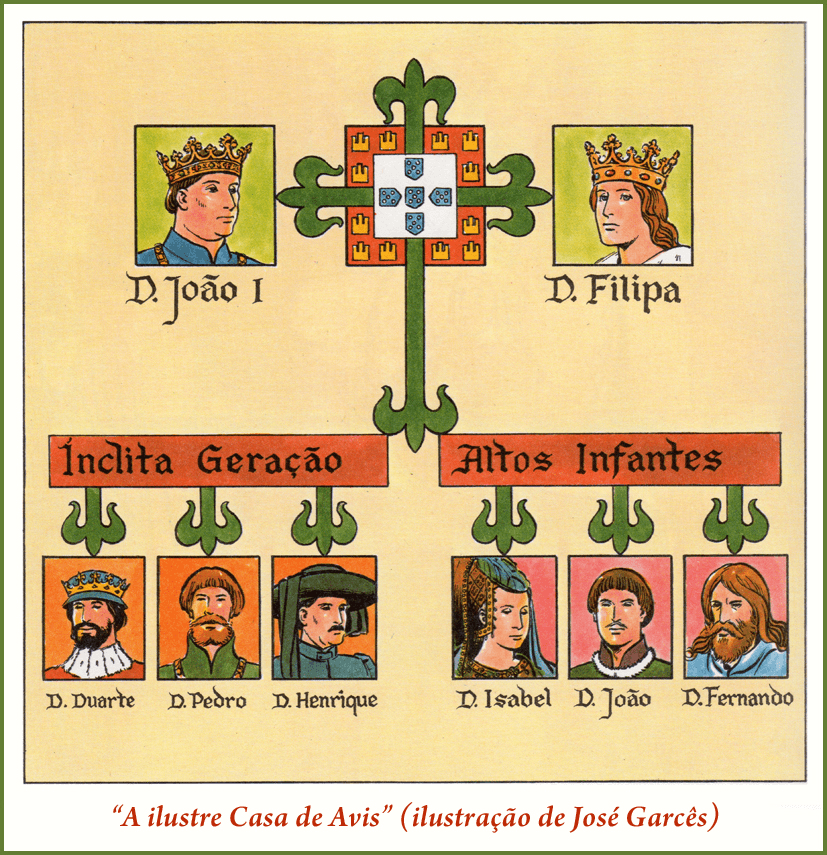
Ínclita Geração, the "Illustrious Generation."
Preface: Welcome to this quick recap of the history of immigration of US. Celebrating 250 years of USA.
Between 1415 and the 1480s, Portugal worked its way down the western coast of Africa, from the Strait of Gibraltar toward the southern tip of the continent, one voyage at a time. The effort is usually called the Age of Discovery. The man who set it going was Prince Henry, born in 1394, the third of King João I's five sons — the generation later Portuguese writers would call the Ínclita Geração, the "Illustrious Generation."
1394/ Prince Henry
Prince Henry was born on 4 March 1394 in Porto, the third of the surviving sons of King João I — founder of the House of Aviz — and Philippa of Lancaster, daughter of John of Gaunt and sister of Henry IV of England. His mother's marriage was a political one, sealing the Anglo-Portuguese alliance against Castile, and it mattered to who Henry became: the English, devout, chivalric strain in his upbringing came largely from her. He and his elder brothers Duarte and Pedro — the trio at the center of what Portuguese writers later called the Ínclita Geração, the "Illustrious Generation" — were educated under their parents in the standard noble curriculum of the age: military arts, administration, and the chivalric codes, steeped in crusading ideals. Philippa bore nine; three died young. The six who survived turned out to be an unusually capable, cultivated cluster of siblings, and their devout, rigorous, English-inflected upbringing under Philippa got much of the credit — she died of plague in July 1415, days before the sons she'd raised sailed for Ceuta. The reputation is real, but so is the darkness underneath it, which the flattering label tends to hide.
The six, in birth order. Duarte (b. 1391), the eldest, became King Duarte I in 1433 — "the Philosopher King," who actually wrote books (a treatise on ethics and counsel, O Leal Conselheiro, and one on horsemanship); his short reign was wrecked by the Tangier disaster and he died of plague in 1438, worn down, some said, by guilt over his captive brother. Pedro (b. 1392), Duke of Coimbra, was the great traveler of the age — nicknamed "das Sete Partidas," of the seven parts of the world, for his journeys across England, Flanders, the Empire, Hungary, Italy, and the Holy Land — and the most learned of them; he served as an able regent for his boy-nephew Afonso V through the 1440s. Henrique (b. 1394) you know, this is the Prince Henry we've been discussing. Isabel (b. 1397), the only surviving daughter, was raised in the same curriculum as her brothers — Latin, languages, science, statecraft — and became Duchess of Burgundy by marrying Philip the Good in 1430; the Order of the Golden Fleece was founded around their wedding, and she grew into a formidable political operator and mother of Charles the Bold. João (b. c. 1398), Constable of Portugal, was the quietest — a man who by one account disliked fighting — but dynastically enormous in hindsight: through his children he became grandfather both of Manuel I of Portugal and of Isabella the Catholic of Castile. Fernando (b. 1402), the youngest, is remembered as the Infante Santo, the Saint Prince. Left behind as a hostage after Henry's botched 1437 assault on Tangier, to be redeemed only if Portugal returned Ceuta, he was abandoned when the crown — Henry among the voices — refused to give the city up, and he died after six years in a Fez prison in 1443. Pedro, the traveled and learned regent, fell out with the nephew he had governed for and was killed in 1449 at the Battle of Alfarrobeira, cut down by a royal army in what was effectively a family civil war. So the glittering set of siblings produced a martyr left to rot and a regent killed by the crown, within a decade of each other.
Camões, who coined the celebratory phrase and wrote the national epic of the discoveries, did not actually make Henry its hero — he praised the generation as a whole and gave the sea-story to others. The centering of Henry as the figure of the discoveries came later, with the nineteenth-century "Navigator" myth and its Salazar-era afterlife. There's even a decent revisionist case that his father João I and his brother Pedro were more genuinely curious about southward exploration than Henry was, whose own energies bent toward North African crusade, the Canaries, and the gold-and-slave profit. Britannica's summary of what he grew into is telling: he emerged with pronounced tastes for chivalric romance and astrological literature, and with ambitions to fight campaigns and, if he could, win a kingdom of his own. His chroniclers made much of a birth horoscope that supposedly foretold he would be a crusader and a discoverer of hidden things. Beyond that the documented childhood is thin; he steps into real history at twenty-one, at Ceuta.
1415/ Ceuta
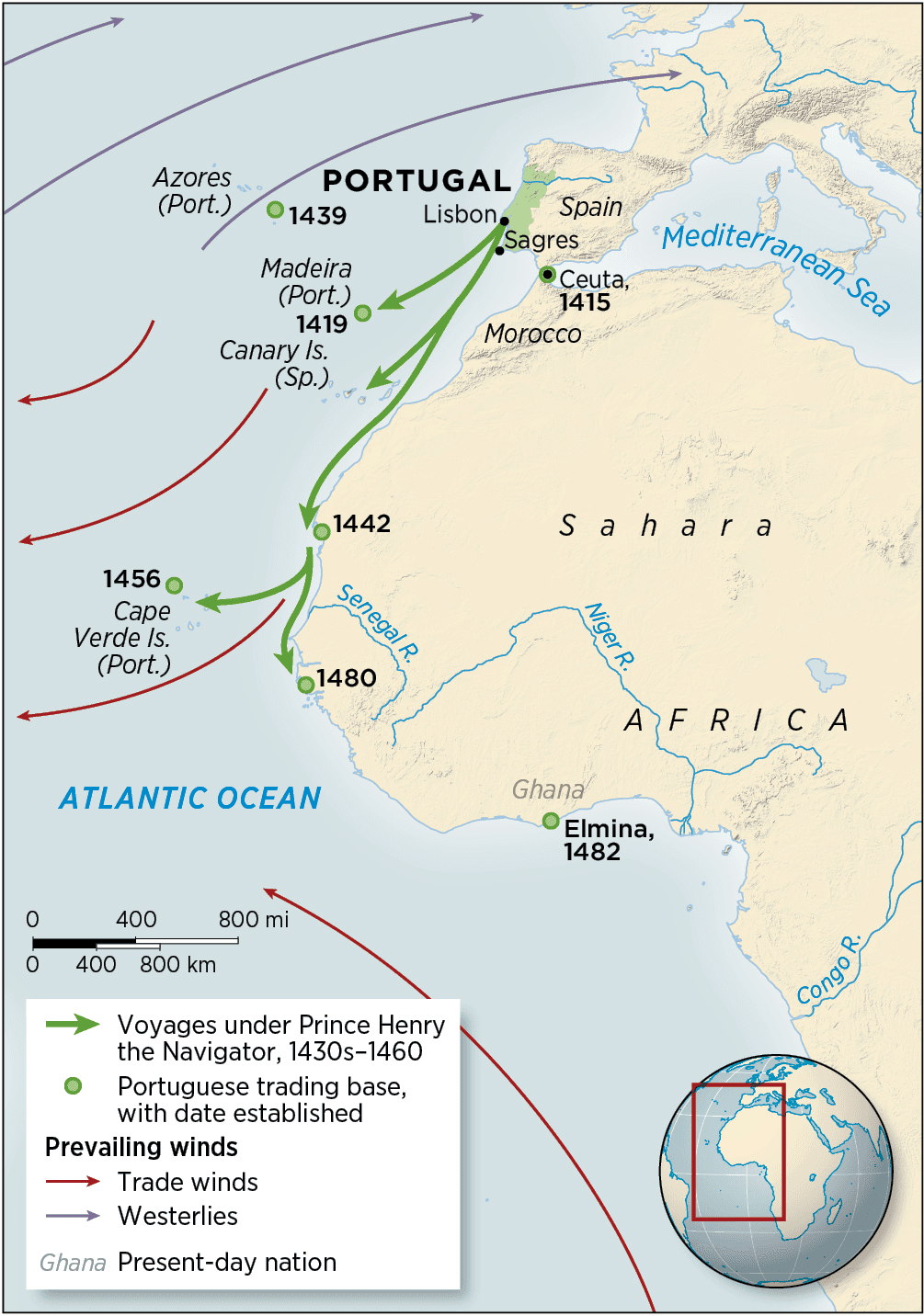
Ceuta was Portugal's first overseas conquest, and for Henry it was the making of him. The campaign fit the young man exactly: a third son with no crown coming to him, a hunger to prove himself in arms, and the crusading cast of mind he'd taken from his English mother. When a recent peace with Castile left the king's grown sons no war in which to earn their knighthoods, the three princes persuaded their still-vigorous father to undertake a campaign that would let them win their spurs in real combat instead of in the mock warfare of a tournament — and the target they chose, a Muslim port on the Moroccan side of the strait, made the venture a crusade as well as a proving ground. An army of some 240 ships and twenty thousand men sailed in the summer of 1415 — days after Henry's mother, Queen Philippa, died of the plague — and took the unprepared city in a single day's fighting.
The target had been hidden behind rumors of other destinations, but weather scattered the fleet off the Moroccan coast and forced it to regroup, and the delay helped Portugal: Ceuta's governor, Salah ben Salah, had gathered tribesmen and volunteers to hold the city — the Portuguese would later boast, absurdly, that a hundred thousand men had reinforced it — but when the ships seemed to falter and drift off, the defenders relaxed. No relief came from the Marinid sultan at Fez, whose dynasty was too tangled in its own quarrels to send any. By the time the Portuguese struck, the city was far less ready than it had been days earlier.
The assault opened on the morning of 21 August 1415. As King João boarded a longboat to go ashore he took a wound in the leg, and the landing fell to his sons, who drove the defenders back through the Almedina gate before it could be barred and carried the fight into the narrow streets — where, in the episode the chroniclers loved, a single giant Nubian fighter held off the attackers with hurled stones until he was cut down and the resistance behind him folded. Salah ben Salah held the citadel until dusk, then slipped out of the city in the dark with his men and their families; by the next morning the Portuguese found the fortress empty and Ceuta wholly in their hands. The chroniclers put their own dead at eight — a number meant to announce a miracle rather than to count the fallen — against thousands of the city's defenders killed or captured. In substance it had been the work of a day.
Ceuta was a rich entrepôt, its warehouses packed with the goods of the Saharan and Mediterranean trades, and the soldiers tore through them with little sense of what they were ruining — slashing open sacks of pepper and cinnamon and grinding a fortune in spice into the street underfoot. The plunder disappointed in the end; there was less ready wealth in it than the crown had hoped. The main mosque was consecrated as a church, a Te Deum sung inside it, and there the three princes were knighted. What Portugal had seized was less a treasure than a position — and, in those ransacked warehouses, a glimpse of how much wealth moved along this coast, and of where it came from.
1419/ Madeira
In 1418, two squires of Henry's household, João Gonçalves Zarco and Tristão Vaz Teixeira, were sailing the Moroccan coast when a storm blew them out into the open Atlantic and onto a small island they named Porto Santo, "holy port," in thanks for the shelter. The larger island beyond it, wrapped in cloud, they reached the following year: Madeira, "the wooded isle," uninhabited and thick with timber. It was the first territorial gain of the whole enterprise, and it set the pattern for how Henry would handle everything he found. He did not govern it himself. As lord of the islands — a lordship he vested in his Order of Christ — he parceled Madeira out to hereditary captains drawn from his own household, Zarco and Vaz Teixeira among them, each granted a stretch of the island, the right to distribute land to settlers who had to clear and plant it, and a share of what it produced, in exchange for populating and defending it at his own cost.
What the settlers produced turned the accident into something consequential. They burned off the forest to open the ground — the fires on Madeira were said to have smouldered for years — and planted first wheat and then the crop that would matter, sugar cane, which took to the volcanic soil so well that within a few decades Madeira was one of Europe's leading producers of what had been a rare luxury.
Sugar at scale needed labor no free workforce would supply, and the island filled it with enslaved people — Guanches seized from the Canaries, Berbers from the Barbary coast, and, before long, Africans bought down the coast the caravels were opening. The whole arrangement — a hereditary captain developing colonial land at his own risk, a cash crop worked by slaves, the profits split with the crown — was worked out here, on a small Atlantic island, a generation before it crossed the ocean. Madeira was the model. Everything Portugal did later in Cape Verde, in São Tomé, and finally in Brazil was a version of it.
Several major traditions locate capitalism's origin right about here. Immanuel Wallerstein's world-systems theory dates the "modern world-system" to the long sixteenth century and puts the Iberian Atlantic — cash-crop islands and colonies producing for a European core — at its founding edge; on that map Madeira is nearly the first pixel. Sidney Mintz, in Sweetness and Power, argued the sugar plantation was essentially proto-industrial: a factory in the field, combining agriculture with the milling process, disciplining labor to something like a clock, producing a single commodity not for use but for sale to a distant mass market. Marx, in the section of Capital on "primitive accumulation," treated colonization, the slave trade, and the plunder of the Atlantic and the Indies as the violent prehistory that made industrial capital possible — the "rosy dawn," in his phrase. And the current New History of Capitalism (Sven Beckert's "war capitalism," building on Eric Williams's older thesis that slave profits financed British industrialization) insists slavery wasn't a pre-capitalist leftover but the engine room of capitalism's first phase. On all of these readings, what they described on Madeira — land and labor reorganized purely to produce a commodity for profit, financed by merchant capital (Genoese money and Genoese sugar expertise flowed into Madeira, carrying the trade straight out of the medieval Mediterranean) — is capitalism being born.
However, for a large body of thought, capitalism means free wage labor — workers who own nothing but sell their labor-power on a market — and a slave plantation is precisely not that. It runs on coercion, not a labor market. The "political Marxists" (Robert Brenner, Ellen Meiksins Wood) go further and argue capitalism proper wasn't born of trade or plantations at all but of specific social-property relations in the English countryside (I disagree), where landholders and tenants became market-dependent and competition compelled improvement; on that account, merchant wealth and slave sugar, however vast and profitable, are a different system — commercial, extractive, but not capitalist. Madeira — and then, at larger scale and with fully African enslaved labor, São Tomé — is where the Atlantic plantation complex was assembled, the direct ancestor of Brazil and the Caribbean, and the hinge between medieval Mediterranean sugar-slavery (Cyprus, Sicily, the Crusader Levant) and the American system. Historians like Charles Verlinden and Philip Curtin built careers on that lineage. Whether you then call that the "beginning of capitalism," or "merchant capitalism," or "primitive accumulation," or just "the plantation complex," tells you which theory of capitalism you hold more than it tells you a new fact about Madeira.
1427/ Azores
The Azores followed the same logic, further out and to a different end. They lie roughly 1,400 kilometers into the open Atlantic — a third of the way to America — and Portuguese ships came upon them in the later 1420s, around 1427, in the person of a pilot named Diogo de Silves, of whom almost nothing is known; his name survives as a note on a chart. He reached them, most likely, not by steering for them but by riding the great westward arc of open ocean that the volta do mar traced — the Azores sit close to the point a homebound ship swings through on its long loop back to Portugal, which is to say they were less discovered than passed through. Like Madeira, they were uninhabited when the Portuguese arrived, and Henry settled them the same way: vested in the Order of Christ, parceled to hereditary captains, the first of them Gonçalo Velho Cabral, and seeded from the mainland with colonists, livestock, wheat, and woad from about 1439.
Sitting in the mid-Atlantic astride the return route, they became the indispensable waystation of the ocean — the place ships stopped to take on water and repairs on the way home, and later the hinge of a much larger traffic than Henry's. Columbus put in there on his way back from the first American voyage; the treasure fleets from the Indies and Brazil would call there for generations. Two small clusters of empty islands, found by accident and settled almost as an afterthought, turned out to be the fixed points that made the whole Atlantic navigable. And the technique that reached them — sailing away from land into open water to come home — was the same one that, in 1434, would finally carry a ship past the barrier to the south.
1434/ Cape Bojador
By the mid-1420s, settled on the Algarve with the Order's money behind him, Henry began sending ships south — and for the better part of a decade they accomplished almost nothing. The obstacle was a low, sandy headland on the Saharan coast, Cape Bojador, about a hundred miles below the Canaries, that fifteenth-century sailors treated as the end of the navigable world — the "Cape of Fear." Arab geographers had warned of it; European crews called the water beyond it the Green Sea of Darkness and told one another that past the cape the sun boiled the sea and scorched men black. The dread was not pure invention. The cape threw up real hazards — shallows that ran a league out from shore, heavy surf and currents along its northern side, frequent fog — and, worse, a genuine trap in the wind: the prevailing northeasterlies and the southward current made it easy to run past the cape and very hard to beat back north again. A ship that rounded Bojador might not get home. So Henry's captains kept reaching it and turning around. By one reckoning, some fifteen voyages failed at the cape across a dozen years.
The man who finally passed it was Gil Eanes, a squire from Lagos in Henry's household — and he failed first. Sent out in 1433, he got no farther than the Canaries and came home with excuses about the dangers, to a cold reception. Henry sent him straight back the next year with orders to ignore the sailors' legends and not to return without rounding the cape, promising him the "honour and profit" that would come of it. This time Eanes did the thing that actually worked, and that would define Portuguese sailing for the rest of the century: rather than hugging the dreaded shore, he stood well out into the open Atlantic, swung south, and came back to land below the cape. Beyond it he found no boiling sea and no monsters — only a calm ocean and an empty desert coast. There were no people to be seen, so for proof that he had been there he gathered a few hardy wildflowers the Portuguese came to call St. Mary's roses, and carried them home.
Measured as geography, it was almost nothing — a competent piece of seamanship that added a short stretch of barren coastline to the map. Measured as a barrier broken in the mind, it was the whole beginning. Once a single ship had gone past Bojador and come back, the terror drained out of the place and the turning-back stopped.
1435–36/ beyond Bojador to the Rio de Ouro
Passing Bojador only opened the next stretch of nothing. The coast below Bojador was barren in a way that unsettled sailors on its own. The Sahara simply runs into the Atlantic there — a low, flat, dun-colored shore with no hills to steer by, no trees, no green, the same bare line of sand and rock unspooling mile after mile under a hazed sky, the sea shallow and breaking white a long way out. Two small ships worked south along it, Eanes's and Baldaia's, days of that sameness sliding past the rail. When they put in at a bay and waded ashore, what they found in the sand were footprints — men's, and the splayed pads of camels — fresh enough to say that people were near, though the people themselves had gone into the desert and were nowhere in sight. They stood on a shore that was inhabited and blank at once, named the inlet, and sailed on.
In 1435 Henry sent Eanes out again, now with a second ship — a barinel under Afonso Gonçalves Baldaia, the prince's own cupbearer — and orders to see what lay beyond. They pushed about 150 miles past the cape down a coast as barren as the one above it and anchored at a bay where they found the first sign that anyone lived on this shore at all: the footprints of men and camels in the sand. They named the inlet Angra dos Ruivos. But the people themselves kept out of sight, and there was nothing to trade for and no one to trade with.
The next year Baldaia came back carrying two horses in the hold for the single purpose of running a man down, and put them ashore on that sand; his people sighted figures in the distance, gave chase, closed to a brief clumsy scuffle, and caught no one. Farther south the coast opened into a long tongue of seawater reaching back among the dunes, and because Saharan traders had spoken of a great river of gold somewhere below the desert, they decided this must be it and wrote Rio do Ouro onto the chart — the River of Gold — over what was in fact a dead-end arm of the sea, no river running into it and no gold within reach of it. What the shore did hold was seals: monk seals hauled out to bask on the rocks, slow and unafraid, and the men clubbed and skinned them until the hold was full. That was what the first opened stretch of Africa gave up — not gold, not spices, a stack of oily hides — and the ships turned and rode the long ocean loop home with it. The map now reached south into a blank they had barely entered. What waited down there, when they came back for it, was not gold and not empty sand. It was people.
1441 / Cape Blanc, and the first captives.
(writing)