Created on
Updated on
1564/ Fort Caroline, Huguenots
From French Wars of Religion to Fort Caroline

Preface: Welcome to this quick recap of the history of immigration of US. Celebrating 250 years of USA.
Pedro Menéndez de Avilés stood on a stretch of Florida sand the Spanish would name Matanzas — slaughters — and asked the men in front of him a single question: were they Catholic. Most said no. They were shipwrecked, starving, and under the impression that surrender meant mercy. Menéndez had them bound and walked, in small groups, past a line drawn in the sand, and killed. His chaplain recorded the date as September 29, 1565, St. Michael’s Day, and described the dead simply as “all Lutherans.” Several hundred Frenchmen died there in two separate massacres within days of each other. The river still carries the name five centuries later. Most people who know St. Augustine know it as the oldest continuously occupied European settlement in what is now the United States. Few know that its founding act, weeks after its founding, was a massacre — or that the massacre was the final battle of a war that had started in France three years earlier, over a religious argument that had nothing to do with Florida at all.
1560: Amboise Conspiracy
By the early sixteenth century France had a Protestant problem the way it had a plague problem: not a fringe infection but a current running through the educated and propertied classes. Calvinism reached France early and spread fastest among nobility, intellectuals, and professionals — physicians, judges, merchants, military officers. These were not peasants chasing a heretical preacher through the woods. The Huguenots, as French Calvinists came to be called, included royal houses — Navarre, Condé — and the country’s most capable military commander, Admiral Gaspard de Coligny. They were a rival faction inside the ruling class. The break came into the open in 1534, when French Calvinists distributed anti-Catholic pamphlets in what became known as the Affair of the Placards, prompting King Francis I to formally condemn Calvinism as heresy. For the next quarter-century the crown alternated between persecution and uneasy tolerance, while underneath the theological argument sat a much older and more familiar fight: the Catholic House of Guise against the Bourbon-aligned Protestant nobility, each maneuvering for control of a monarchy currently held by children.
Henry II died on July 10, 1559, from wounds suffered in a jousting tournament ten days earlier, and was succeeded by his young son Francis II. Power was almost immediately seized by Francis, Duke of Guise, and his brother Charles, Cardinal of Lorraine, who pushed the princes of the blood and other senior aristocrats out of any position of authority. The Guises kept up Henry’s persecution of Protestants, and resentment built from there.
The execution of a Parlement counsellor named Anne de Bourg for heresy convinced a circle of Huguenot nobles that the king himself needed to be physically separated from Guise influence. Anne du Bourg was a French magistrate born in 1521 in the Auvergne region, who studied law, became a professor of civil law at the University of Orléans and was appointed a counselor in the Parlement of Paris in 1557, despite having already privately aligned himself with Calvinist doctrine. He was a sitting judge in the kingdom’s highest court, part of a body that had condemned dozens of suspected heretics to execution or the galleys in the 1550s, with over 200 burnings recorded in Paris alone between 1547 and 1559.
By 1559, the Paris judiciary itself was split between a moderate Erasmian Catholic wing — uncomfortable with executing people purely for privately held religious views — and an ultra-Catholic wing, and the more liberal-minded judges, reluctant to impose death, offered them amnesty in exchange for recanting instead. Henry II found this leniency intolerable. On June 10, 1559, during a plenary session of Parlement that the king himself attended, du Bourg rose to object — criticizing Henry’s policy of leniency toward serious criminals alongside harsh persecution of people du Bourg considered innocent Protestants.
Henry II took this as a direct, personal attack and treated it as lèse-majesté, the crime of insulting the crown’s dignity. Henry had him arrested and imprisoned in the Bastille immediately, despite du Bourg’s parliamentary privileges that should have shielded him from summary arrest. A contemporary account preserves something closer to what he actually said in the room: “We see crimes committed every day that go unpunished, while we invent new punishments against men who have committed no crime,” and, on the gravity of burning people alive for their faith: “Condemning individuals who, while engulfed in flames, invoke the name of Jesus Christ is not a trifling matter.”
Before persecution went further, and a Périgord lord named La Renaudie — whose own brother-in-law the Guises had already executed — took on the job of organizing what became known as the Amboise conspiracy. The goal was to seize the young King Francis II — physically, by force — and pull him out from under the control of the Guise family, who were running the government in his name. The coup initially aimed to assert Antoine de Navarre’s right to a regency, and when he wasn’t interested, fell back on Condé’s more dubious claim as a minor prince of the blood instead. The deeper objective was to arrest, and likely execute, the Guise brothers themselves — Francis, Duke of Guise, and his brother the Cardinal of Lorraine. All of of these was with quiet money from Elizabeth I and a recruitment network that reached as far as Provence.
The plan leaked almost immediately, betrayed by a Paris lawyer whose own home the conspirators had been using as a safehouse; the Guises moved the king to the more defensible château of Amboise and waited. When the conspirators finally rode on the castle in mid-March 1560, they were routed within hours. What followed was less a suppression than a public spectacle: La Renaudie was hunted down, killed, drawn and quartered, and hung from the town gates with a placard naming him as the conspiracy’s leader; as many as 1,200 to 1,500 of his followers were killed in the days afterward by rope, sword, or drowning, and their bodies were hung on hooks along the château’s own façade, in front of the King and Queen, for the court to see. The message was not subtle, and it worked exactly backward from its intent — rather than ending Huguenot resistance, Amboise convinced them that the crown answered every grievance with a massacre, and pushed them from petitioning toward arming themselves.
1562, The Massacre of Vassy
The town of Vassy itself had been a Huguenot stronghold in the making for years before anyone there had heard of Condé or the Bourbons. The Guise family held feudal rights over part of the town, including the castle district, but Calvinist preaching had taken root anyway: a first officiated service in 1561 drew about 120 people to a draper’s house, and by that December a baptism performed by a pastor sent from Troyes pulled a Christmas congregation of roughly 900 — making Vassy more thoroughly Huguenot, proportionally, than any other town in the region, sitting inside territory the Guise family considered their own power base.
The Duke’s own mother had overseen the burning of a Protestant preacher in the town three decades earlier; the family had been trying and failing to put this fire out for a generation. In late 1561 the Cardinal of Lorraine, the Duke of Guise’s brother, sent a bishop to break up the services and bring the town back to Rome. The bishop was chased out of the meeting house in humiliation, and the congregation only grew larger afterward. The crown, meanwhile, was trying to buy time. On January 17, 1562, Catherine de Medici’s regency government issued the Edict of January, a limited toleration that let Protestants worship outside town walls while the king waited on word from the Council of Trent. The Guise faction never accepted it.
On March 1, 1562, the Duke of Guise, traveling through territory he considered his own, came upon a congregation of Huguenots worshipping inside the town walls — illegal, by the letter of an edict the Parlement of Paris hadn’t even finished registering yet. Accounts differ on what happened next: in the Protestant version, Guise’s men forced their way toward the building unprovoked; in the version Guise himself gave a Lutheran duke he was courting as an ally, his men were attacked first and he was struck by a thrown stone before he ordered the building stormed. What isn’t disputed is the outcome. Guise’s soldiers broke into the barn serving as the town’s Protestant meeting house and killed the congregation inside — estimates range from roughly fifty to as many as eighty unarmed worshippers dead, with well over a hundred wounded, women and children among them.
The Massacre of Vassy is conventionally treated as the spark that lit the French Wars of Religion — eight wars, fought intermittently, over the next thirty-six years, that would kill between two and four million people from violence, famine, and disease and permanently weaken the French crown that started them to protect.
1564: Fort Caroline
Gaspard de Coligny was a French nobleman and one of the kingdom’s most capable military commanders — he held the title of Admiral of France. He converted to Calvinism in the early 1560s and became the foremost military and political leader of the Huguenots, effectively their general in the French Wars of Religion. He came from a powerful family connected by marriage to the Montmorency, one of the great noble houses of France. As the Huguenots’ military leader, Coligny got a royal commission to plant a French Protestant colony in Florida — both to relieve pressure on persecuted Huguenots at home and to extend French claims against Spain. He sent Jean Ribault to lead the expedition. Ribault reached the Florida coast, sailed north, and landed at the mouth of a river he named the Rivière de Mai — what’s now the St. Johns — before continuing on to found a small outpost called Charlesfort on present-day Parris Island, South Carolina. He left twenty-eight men to hold it and sailed home for supplies. He arrived back in France to find the war he’d left had only gotten worse, was suspected of treason, and fled to England, where Elizabeth I had him thrown in the Tower of London on suspicion of espionage. Charlesfort, unsupplied and unled, collapsed within the year.
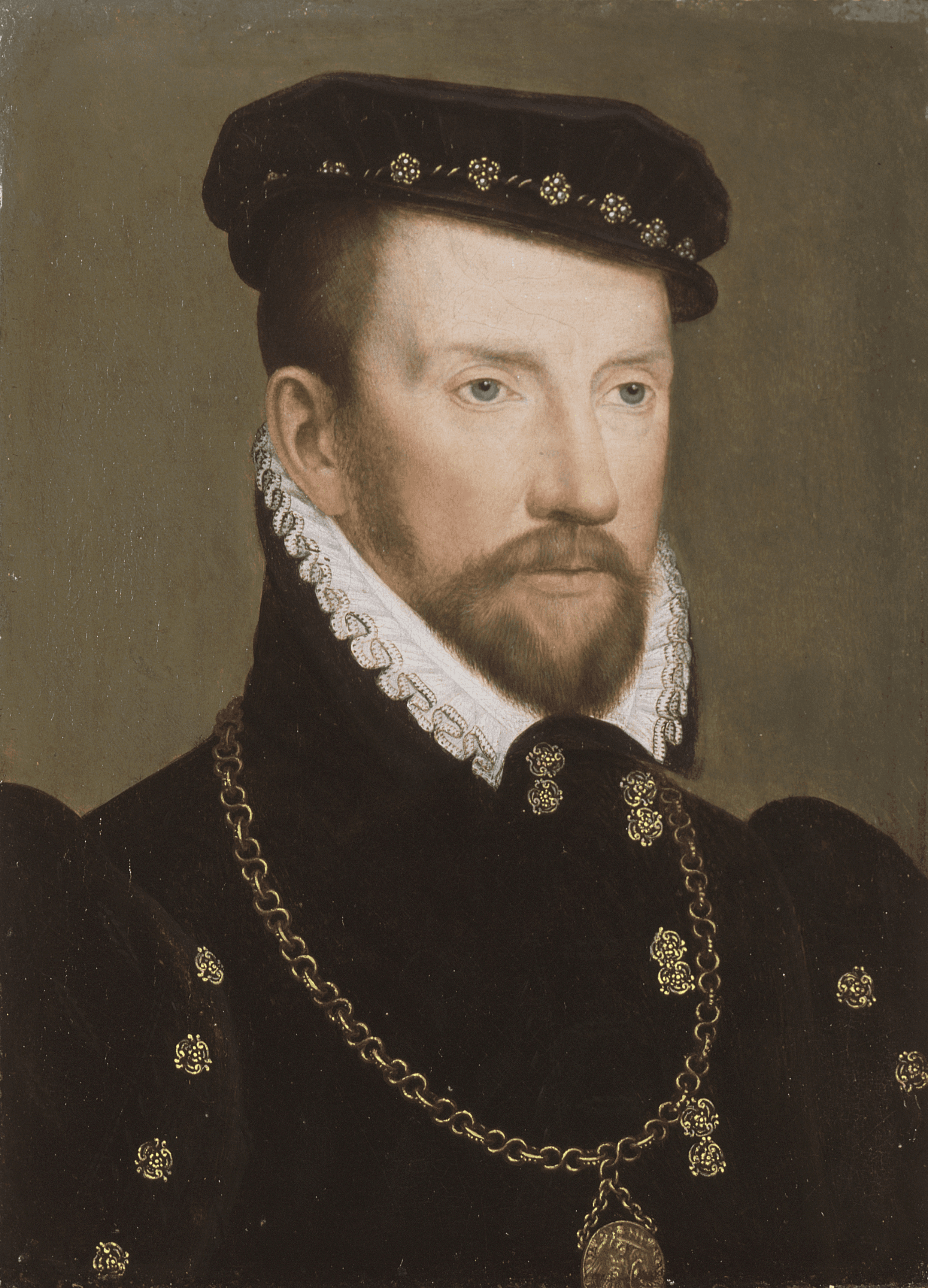
With Ribault locked up in London, Coligny sent his second-in-command, René Goulaine de Laudonnière, to try again. Laudonnière left France in April 1564 with roughly three hundred colonists — soldiers, artisans, women, children, and at least one working artist, Jacques Le Moyne, brought along specifically to document the new land. They landed at the same river Ribault had named two years earlier and built a triangular fort on a bluff, calling it Fort Caroline after King Charles IX. The colonists were mostly Huguenot, with some Catholics and agnostics mixed in — practical proof, if anyone needed it, that this was a colonial venture wearing a religious banner more than a religious community in exile.
The fort’s survival depended almost entirely on the Timucua, led by a chief named Saturiwa, who supplied the French with food and alliance against rival tribes in exchange for support against the Spanish. The arrangement worked for a while. It did not solve the colony’s actual problem, which was that France kept forgetting to resupply it. By 1565 the garrison was starving, some of the soldiers had mutinied and turned pirate, and the rest were simply waiting to go home. When Menéndez later wrote home about the colony he was about to destroy, he noted that free Africans had already been living and working at Fort Caroline before his own settlers arrived at St. Augustine, and that the fort had also used enslaved Black labor. Fort Caroline and St. Augustine, together, mark some of the earliest documented points in Black American history.🇺🇸
Timeline for “Fort Caroline, Huguenots”
1513 — Juan Ponce de León lands in Florida, first European contact with the peninsula. Spain claims it but does nothing with the claim for decades.
1521–1561 — A 48-year sequence of failed Spanish attempts to establish anything permanent: Ponce de León’s own follow-up expedition (he’s killed), Pánfilo de Narváez (disaster, survivors wash up as far as Texas/Mexico), Hernando de Soto (a four-year armed wandering through the Southeast, no settlement, de Soto dies), Tristán de Luna (founds and abandons a settlement near Pensacola). Philip II issues an abandonment decree around 1561, effectively giving up on Florida.
February 1562 — Jean Ribault leads the first French Huguenot expedition to Florida, founds the short-lived Charlesfort in present-day South Carolina.
22 June 1564 — René Goulaine de Laudonnière founds Fort Caroline on the St. Johns River — the actual first European settlement (not just contact) in what becomes the continental U.S. French, Protestant, intended as a Huguenot refuge.
August 1565 — Jean Ribault returns to Fort Caroline with reinforcements, just as Spain — alarmed by the French claim — dispatches Pedro Menéndez de Avilés with orders to destroy the colony.
8 September 1565 — Menéndez founds St. Augustine, 30-some miles south, explicitly as a base from which to attack Fort Caroline.
20 September 1565 — Menéndez marches north and destroys Fort Caroline in a surprise dawn raid.
29 September 1565 — Menéndez executes Ribault and several hundred surviving Huguenots at Matanzas Inlet as heretics.
1568 — French revenge raid under Dominique de Gourgues destroys the Spanish fort built on Fort Caroline’s ruins, then abandons the site for good.
1607 — Jamestown, English, the one popular memory credits as “first” — 43 years after Fort Caroline, 42 after St. Augustine.