Created on
Updated on
1500s/ Indian Ocean Trade
古印度洋贸易系统

Preface: The ancient Indian Ocean Trading System, until the Portuguese discovered it.
It's tempting to read Zheng He's voyages as the story of China "discovering" the Indian Ocean. But actually, trade across this ocean is ancient, with archaeological and textual evidence reaching back over two thousand years, to Bronze Age exchange between the Indus Valley and Mesopotamia and, later, the well-documented Roman-Indian spice trade of antiquity. But the specific system Zheng He's fleet sailed into — a monsoon-driven relay of ports run by nobody in particular, held together by Islamic commercial law rather than any single empire's navy — is younger than that: it took shape after the rise of Islam in the 7th and 8th centuries, as Arab and Persian merchants came to dominate the ocean's key nodes, and it reached its full maturity between roughly the 13th and 15th centuries. Zheng He's first voyage in 1405 landed almost exactly at the tail end of that golden age. He wasn't arriving early, and he wasn't arriving to open something new. Within a century of his death, Portuguese ships would round the Cape and, by 1511, seize Malacca by force — the first serious crack in eight hundred years of a trading world that had never needed an empire to run it. Zheng He caught the very last stretch of that world at its peak, just before the ground under it started to shift.
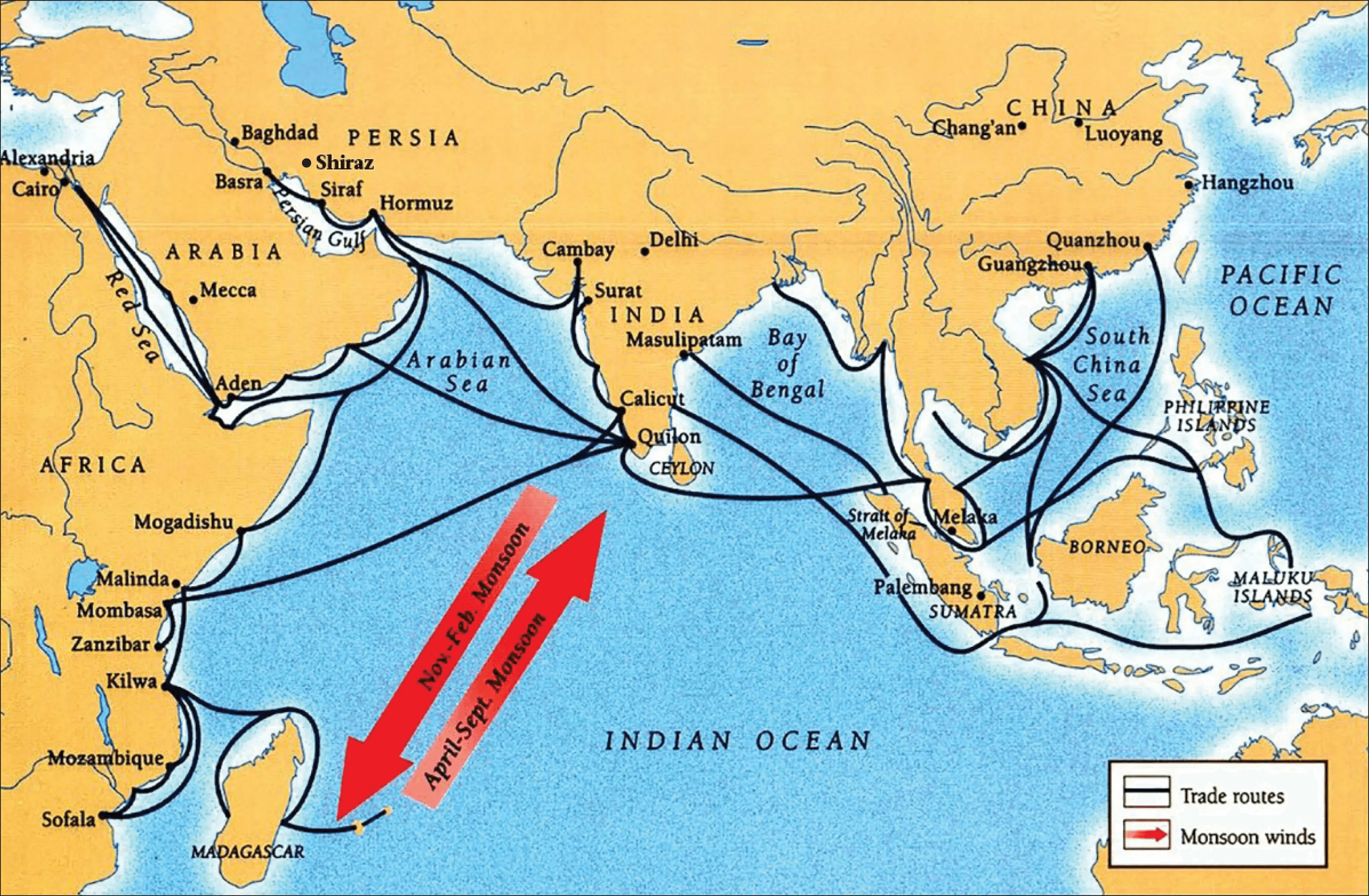
季风决定的商业节奏 / Monsoon Calendar
The underlying logic of the entire Indian Ocean trading system wasn't political and it wasn't military — it was wind. Roughly every year from November through February, the northeast monsoon blows from the direction of mainland China and Southeast Asia toward India, and on toward the Arabian Peninsula and East Africa. Then, from April through August, the pattern reverses entirely: the southwest monsoon pushes ships back from the Arabian Sea toward India, Southeast Asia, and China. This wind schedule wasn't a rough tendency or a helpful guideline — it was close to an iron law, the kind of natural condition that, in the age of sail, was a genuine matter of life and death. Sailing against the prevailing monsoon was, for all practical purposes, not something a wooden sailing ship could do.
What did that mean in practice? If a merchant reached a foreign port and missed the seasonal window for the return voyage, he could be stuck there for months — sometimes the better part of a year — waiting for the next monsoon to open up. So from the very beginning, port cities weren't simply places where deals got made; they were, just as much, waystations for waiting out the wind. Places like Malacca and Calicut carried a permanent population of foreign merchants stranded there season after season, their entire rhythm of life dictated by that wind calendar rather than by anything they chose. Zheng He's own fleet was no exception to this rule. On the seventh voyage, after departing Nanjing in early 1431, the fleet put in at Changle in Fujian and sat there through an entire winter — not out of hesitation or delay, but because there was no other option. They were simply waiting for the wind that would let them sail at all.
港口接力网络 / A Relay of Ports
Many people picture Zheng He's voyages as one continuous line — a fleet setting out from Nanjing and sailing, more or less directly, all the way to East Africa. That picture is wrong. There was never a "straight shot" mode of travel across this ocean. The entire Indian Ocean trading system ran instead as a relay of ports, a chain along which goods — and sometimes the ships and crews carrying them — changed hands and got handed off again at every link.
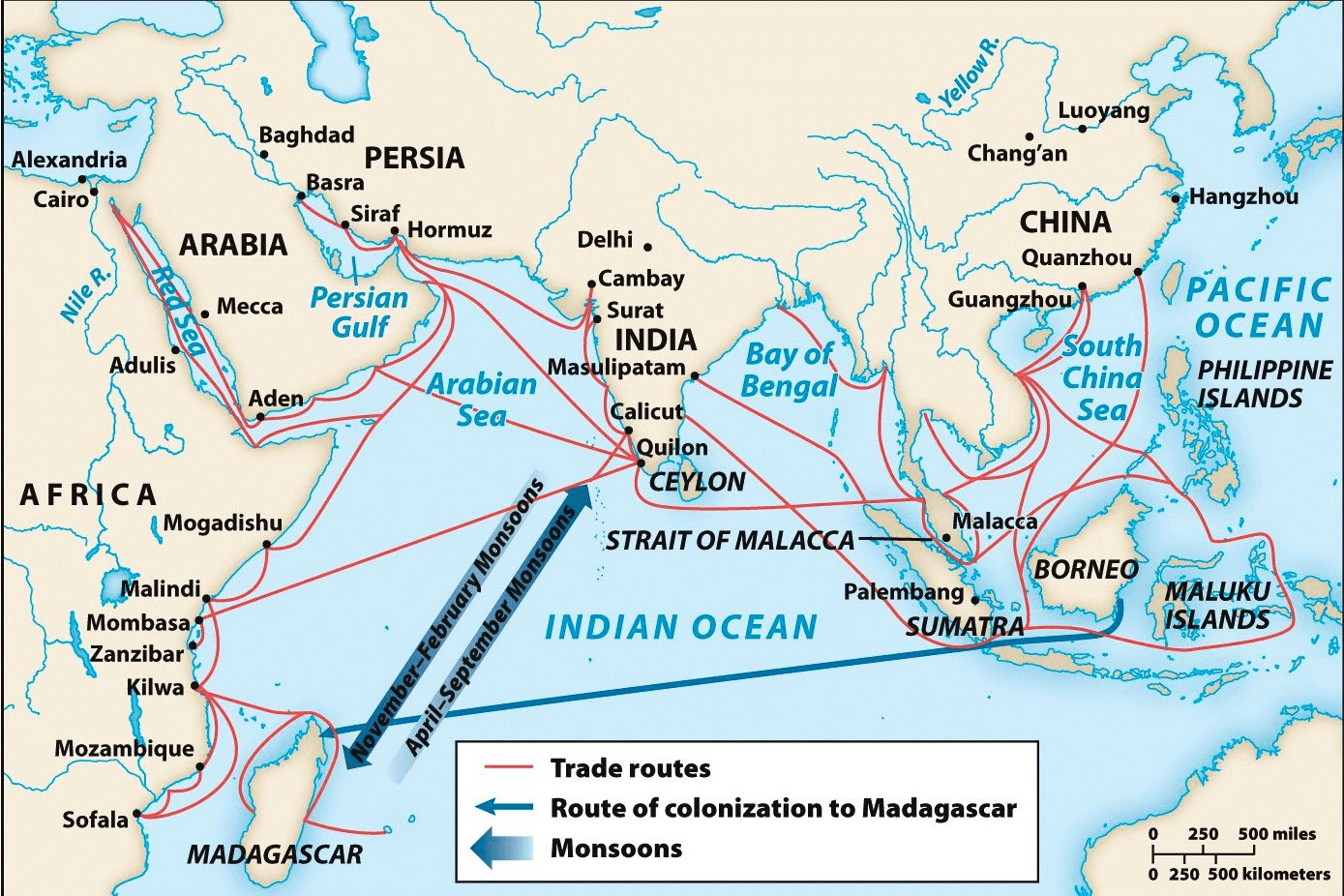
The chain ran roughly like this: ports along the South China coast, Guangzhou among them, fed goods into Malacca — the great funnel point at the tip of the Malay Peninsula. Malacca in turn fed them onward to Calicut on India's southwestern coast. From Calicut, the chain split westward: one branch ran to Hormuz at the mouth of the Persian Gulf, another to Aden at the mouth of the Red Sea. And from the Arabian side, a separate southward branch ran down the coast, connecting Kilwa, Mogadishu, and Malindi and the rest of East Africa's port cities. No single merchant ever really walked this entire chain start to finish. A length of Chinese silk might pass through five or six different ports, changing hands among five or six entirely different merchant communities, before it ever finally reached a buyer in Cairo or Zanzibar. His fleet didn't "discover" Hormuz, or Malacca, or Malindi — these were already international trading cities that had been running for centuries before he ever arrived. What the fleet actually did was sail into an existing relay system already in motion, and follow its established rhythm, rather than carve out any genuinely new route of its own.
无帝国主导的多元商人社区 / A Cosmopolitan System With No Empire at the Center
The most counterintuitive thing about this trading system is that it had no center at all. No navy patrolled the whole of the Indian Ocean. No single empire skimmed a cut off the entire length of the trade chain. This is a fundamentally different arrangement from the one the Portuguese would impose a century later, when they arrived with gunships, forced merchant vessels to pay for a cartaz — a passage permit — and moved to monopolize the export rights on specific commodities. In Zheng He's era, this ocean ran on mutual accommodation, not domination. Nobody needed to be subdued for anyone else to trade.
Malacca is the clearest example of how this worked in practice. The historical record describes the port city maintaining separate quarters for merchant communities from Gujarat, Bengal, Pegu, and Java, and China, each with its own resident population and its own appointed headman who handled disputes and everyday affairs within that community. Arab, Persian, Indian, Malay, Chinese, and Jewish merchants all conducted business side by side in the same port, operating under a broadly shared set of hospitality and taxation norms, with no group needing to conquer another before doing business with them. What this amounted to was a genuinely collaborative commercial order, built up over generations of practical adjustment between communities — not a system handed down from above by any single ruling power.
A day in Malacca around the 1420s–1430s — right in Zheng He's era — would have felt less like a single city and more like a dozen overlapping ones stacked on top of each other, all keeping different rhythms.
You'd wake to the harbor already busy. Ships anchored in the roadstead outside the river mouth — some had been sitting there for weeks or months, waiting out the monsoon before they could sail home — and smaller boats ferried goods and people between the ships and the shore all day. The port ran on a system of four syahbandars, harbourmasters each drawn from a different bloc of resident merchant communities: one for Gujaratis, one for merchants from South India, Bengal, and Pegu, one for Javanese and other archipelago traders, one for the Chinese. Each syahbandar managed his own community's disputes, taxes, and dealings with the palace, which meant the city functioned less like one administration and more like several parallel ones operating side by side under a single sultan.
Walking through it, you'd hear an almost absurd range of languages — contemporary accounts put the number spoken in the markets at somewhere around eighty. Classical Malay had become the practical common tongue for actually getting business done, the way a trade pidgin does in any port that diverse, but the residential pattern underneath it was intensely segmented: separate quarters for Gujaratis, Tamils, Javanese, Chinese, and, per some accounts, even Thai, Persian, and Armenian merchants, each with their own headman, their own customs, sometimes their own laws for internal matters. You lived among your own community and did business across all of them.
The bazaar itself would have been the real spectacle — one contemporary observer claimed more ships arrived at Malacca than anywhere else on earth, and the market reflected that: Chinese porcelain and silk stacked next to Gujarati cotton cloth, Moluccan cloves and nutmeg fresh off boats from the eastern islands, Persian rosewater, Venetian glass beads that had traveled the entire length of the known trading world to get there, horses brought in from further west because Southeast Asia couldn't breed enough of its own. Goods got weighed and measured under official supervision before changing hands, taxes assessed on the spot, and moneychangers worked the edges of the market converting between the various currencies different merchant communities carried.
Housing along the riverbanks was mostly built on stilts, timber and thatch rather than stone, practical for a tropical port that flooded and needed airflow more than permanence — a sharp physical contrast to the wealth passing through the market each day. Wealthier resident merchants kept orchards and estates on the city's outskirts, so the settlement thinned out from a dense commercial core down to something more like scattered private gardens the further you got from the harbor. Religious life was similarly layered: Malacca's ruling house had converted to Islam only a couple of decades before Zheng He's fleet started calling there, and the city became a genuine hub for Sufi teachers and Islamic scholars from Arabia, Persia, and India — even as, by some foreign travelers' accounts, everyday religious practice among the wider population stayed fairly relaxed, with wine sold openly and not everyone strict about halal food. It wasn't a puritanical place; it was a working port, and the loudest common values were commercial ones — reliable weights, honored contracts, safe passage — more than religious ones.
The whole city breathed in and out with the monsoon. During the trading season, the population swelled with visiting merchants stuck waiting for their return wind, warehouses filled, the market ran loud and constant. Once the season turned and the fleets sailed off in whichever direction the wind now allowed, a lot of that transient population left with them, and the city would have felt noticeably quieter until the cycle brought the next wave back in. This also helps explain why Zheng He, a Muslim commanding a fleet that represented a Confucian empire, could move through this ocean with such apparent ease. It wasn't simply that he was diplomatically well received. It was that he could genuinely plug into the actual rules and networks that made this maritime commerce function in the first place.
伊斯兰商法:跨政权的通用信用体系 / Islamic Commercial Law: A Shared Credit System Across Rival Powers
The real connective tissue holding this trading network together was, to a significant degree, Islamic commercial law. By the 15th century, it had become something close to a common operating system for every port along the Indian Ocean's rim — regardless of which god the merchant standing at any given dock happened to pray to, everyone was doing business under broadly the same set of rules.
Two instruments stand out as the clearest examples. The first is the qirad, a partnership contract in which an investor supplies the capital and a traveling merchant supplies the labor and risk of the voyage itself, with profit split between them by prior agreement. Neither party needed personal ties or family connections to guarantee the arrangement — the contract itself was sufficient.
Say a merchant in Calicut has capital but doesn't want to sail — he's the investor, called the rab al-mal ("owner of the capital"). Another merchant is willing to make the voyage — to Malacca, say, or up to Hormuz — but doesn't have enough money of his own to buy a full cargo. He's the mudarib, the working partner. The investor hands over a sum of coined money — and it had to be coin specifically, dinars or dirhams, not goods like grain, because goods fluctuate in value and that would make the initial "capital" ambiguous. The mudarib takes that money, buys a cargo, sails it to Malacca, sells it there, buys something else with the proceeds if he chooses, and eventually brings the whole venture back to cash.
Before any of this happens, the two of them agree on a split — say 50/50, or whatever ratio they negotiate — of whatever profit comes out at the end. Here's the part that makes it distinctly Islamic rather than just a loan with extra steps: the investor is not allowed to specify a fixed return, like "you owe me 20 dinars back no matter what." That's precisely the structure a loan-with-interest would have, and interest (riba) is prohibited. Instead the return has to be a genuine share of whatever profit actually materializes — which could be a lot, a little, or nothing.
And that asymmetry runs all the way through to how losses get handled, which is really the clever part. If the voyage loses money — pirates, a storm, a market that collapsed by the time the ship arrived — the investor absorbs the entire financial loss. The mudarib doesn't have to reach into his own pocket to make the investor whole; what he loses is his own time and labor, which was never guaranteed a return in the first place. The only exception was if the mudarib had been negligent or dishonest — exceeded the scope of what he was authorized to do, or mismanaged the capital recklessly — in which case he could be held personally liable. So the risk allocation is deliberate: the person supplying money bears the money risk, the person supplying labor bears the labor risk, and neither one owes the other anything if the venture legitimately fails.
The contract wasn't considered closed, and the investor couldn't demand his principal back, while the capital was still tied up in goods at sea or in a foreign market. Everything had to be converted back into cash before the partnership could be settled and the profit split. Which is exactly why these voyages functioned as discrete, bounded ventures — the wind calendar we talked about earlier and the qirad's settlement structure fit together almost perfectly: a merchant sails out on one monsoon, converts everything back to coin once the goods are sold, and the partnership closes out before or around the time he sails home on the next one. Historians generally think this is where the medieval Italian commenda contract — the one Genoese and Venetian merchants used for exactly the same kind of risk-sharing sea venture — came from, or at minimum evolved in close parallel with it, since Italian merchants were doing business directly with Islamic trading partners around the Mediterranean for centuries before the commenda shows up in European records.
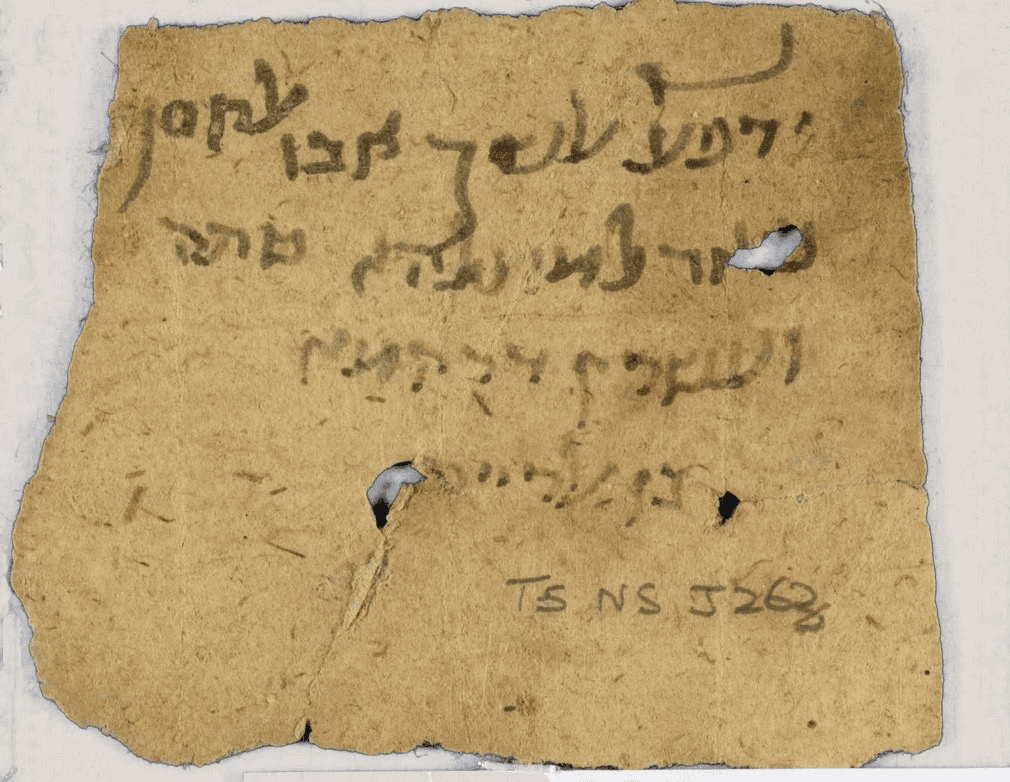
The second is the suftaja, a kind of bill of exchange: a merchant could issue one in Cairo and have it honored in Calicut, without ever having to physically haul a shipload of gold across the length of the Indian Ocean.
Say a merchant in Cairo wants to send money to be picked up in Calicut. He doesn't hand cash to a courier. Instead, he deposits the sum with a banker or merchant house in Cairo — someone he already has a relationship with. That Cairo banker then writes the suftaja: a document instructing his own correspondent in Calicut — a business partner, a relative, or a fellow member of the same trading network — to pay out that sum to whoever shows up holding the note. One surviving example from the Cairo Geniza archive, from around the 12th century, reads almost exactly like this: "The Elder, Abū al-Ḥasan Khiyār, shall pay its bearer six and twenty dirhams." Three parties, every time: the person depositing the money, the local banker who takes it and writes the instruction, and the distant correspondent who's on the hook to pay it out.
The reason it wasn't just an elaborate way to get robbed is that the Cairo banker and the Calicut correspondent already knew and trusted each other — often through kinship, or because they belonged to the same long-running merchant network that did repeat business together over years or generations. A lot of the best-documented examples come from Jewish merchant communities operating across the Islamic Mediterranean and beyond, precisely because these were exactly that kind of tight, multi-generational trading network with agents planted in multiple ports. The note wasn't valuable because a stranger in Calicut trusted a stranger in Cairo. It was valuable because both bankers trusted each other, and the bearer just needed to physically carry the paper between two people who already had an account to settle.
And that's the other half of it — the "settling." The Calicut correspondent doesn't need to have Cairo's exact deposit sitting in a vault waiting. He pays out from his own funds, and then, separately, on his own schedule, nets that out against everything else he and the Cairo banker owe each other from all the other suftajas moving in both directions that month or that year. This is basically the same principle modern correspondent banks use — Bank A doesn't wire physical currency for every transaction, it just adjusts a running ledger with Bank B and settles the net difference periodically. Medieval merchant houses were doing a version of that same trick eight hundred years before wire transfers existed, just with paper, trust, and family or communal ties standing in for a central clearing system. This dramatically reduced the risk that a long-distance trader's entire capital would be wiped out by piracy or a storm along the way. Neither instrument required its user to be a believer — only to trust that the system as a whole would honor its obligations, and by and large, it did.
实际流通的货物 / what's being traded?
The real hard currency of this trading network was spice. Pepper was the bulk commodity, with cloves, nutmeg, and cinnamon close behind, and what made all of them so valuable was how narrowly concentrated their origins were — almost none of them grew anywhere near where they were eventually eaten. Cloves and nutmeg came from a handful of small islands in the Maluku archipelago in eastern Indonesia and almost nowhere else on earth. By the time a single clove reached a dinner table in Venice or Cairo, it might have changed hands more than twenty times and passed through a dozen different ports along the way. Alongside the spices, Indian cotton textiles moved in enormous volume in both directions, Persian and Arabian horses were shipped into India in large numbers because the subcontinent couldn't breed enough good ones domestically, East African gold and ivory flowed north, and Chinese silk — and above all, porcelain — flowed to essentially every corner of the network.
Porcelain is the piece of this that leaves the clearest physical evidence behind. Along Kenya's Swahili coast — at sites like Shanga on Pate Island, and at Malindi — archaeologists have pulled hundreds upon hundreds of Chinese ceramic shards out of the ground, a substantial share of them Longquan celadon. The volume of these finds peaks precisely in the late Yuan to early Ming period, the 13th through 15th centuries, which tells you this trade route had already been running for at least two hundred years before Zheng He's fleet ever left Nanjing.
What makes it more interesting still is that a portion of the recovered Longquan pieces are of a grade identified as imperial kiln production — the kind of ware made specifically for the court or for official diplomatic use, not the ordinary export-grade porcelain an independent merchant would have been carrying in his cargo hold. Finding that specific category of object on the East African coast is about as close as archaeology gets to physical confirmation of the written record: it corroborates that Zheng He's fleet really did leave material traces of official Ming diplomacy at the far southwestern edge of a commercial network that had already been carrying Chinese goods to that same stretch of coastline for two centuries, thousands of miles from Nanjing.
Connecting to Zheng He
None of this is to say the voyages didn't matter — for the roughly thirty years they lasted, they layered a degree of state power onto this ocean that it had genuinely never seen before: hundreds of ships and tens of thousands of men, backed directly by an emperor, moving through ports that were used to dealing with individual merchant families, harbourmasters, and city-states, not with a single foreign government's navy. That's a real disruption, at least for as long as it ran.
But set against the system itself, the voyages look more like a visitor than a builder. The monsoon calendar that dictated when anyone could sail at all, the relay of ports handing goods from Guangzhou to Malacca to Calicut to Hormuz and Aden and on to the Swahili coast, the cosmopolitan merchant quarters that let Gujaratis, Persians, Arabs, Chinese, and a dozen other communities trade side by side without conquering each other first, the shared Islamic legal and financial infrastructure — the qirad, the suftaja — that let a contract signed in Cairo mean something in Calicut: none of that was Ming China's creation, and none of it needed Ming China to keep functioning. It had taken shape over the seven or eight centuries since the rise of Islam, reached its full maturity well before Zheng He was born, and Zheng He's fleet arrived right at the tail end of that maturity, not at its beginning.
That timing is what gives the story its real shape. Zheng He wasn't opening a new world; he was catching the last clear stretch of an eight-hundred-year-old one, just before the ground under it started to shift. Within a century of his death, Portuguese ships would round the Cape of Good Hope, and by 1511 they'd take Malacca by force — the first serious crack in a trading order that had never needed an empire to run it in the first place. When the Ming court pulled its own fleet out after the seventh voyage, the dhows and junks kept moving on the same winds, through the same ports, carrying the same pepper and porcelain and cloves, largely as if the largest navy the pre-modern world had ever built had never shown up there at all. It's the Portuguese arrival, not the Ming withdrawal, that actually marks the beginning of the end. 🌏