Created on
Updated on
1368–1644/ Ming Dynasty

Preface: China during dynasties.
The Ming Dynasty (1368–1644) was the last unified dynasty in Chinese history founded by the Han ethnic majority. Zhu Yuanzhang established it after overthrowing Mongol rule under the Yuan Dynasty, and it lasted 276 years through 16 emperors, until it was overthrown by Li Zicheng's rebellion and subsequently replaced by the Qing Dynasty after the Manchu conquest. To really understand this dynasty, you have to look at it from several angles, because it was inherently full of contradictions — highly authoritarian and conservative on one hand, yet extraordinarily prosperous in commerce and urban culture on the other.
Political System
The single most consequential political act of the Ming was Hongwu's abolition of the chancellorship in 1380 — and the way he did it tells you almost everything about how this dynasty would come to govern itself. The pretext was the Hu Weiyong case: Hu, the sitting chancellor, was accused of plotting treason with Mongol remnants and Japanese pirates after he failed to properly report the arrival of a foreign delegation. Hu was executed on February 12, 1380, and what followed was not a contained purge but a decade-long unraveling. Hongwu kept "discovering" new co-conspirators — distant relatives, protégés, the protégés' relatives — for years afterward, and by the time the bloodletting stopped, somewhere between 30,000 and 40,000 people connected to the case, however tenuously, had been executed. It was not the last time Hongwu would do this: a second great purge in 1393, the Lan Yu case, claimed roughly another 15,000 lives, this time gutting the senior officer corps of the very army that had won him the throne.
For over a millennium before this, Chinese emperors had ruled through a chancellor who absorbed the daily grind of administration. Hongwu used Hu's execution to abolish the position outright, folding the Central Secretariat into the throne and placing the Six Ministries under his own direct personal command. He then decreed, in writing, that the office should never be revived by any future emperor — and largely, his successors obeyed him, at the cost of turning the emperor into the empire's single administrative bottleneck. Hongwu himself was reportedly processing over a thousand documents a day by the end of his reign, a workload no single human being could indefinitely sustain, let alone an emperor several generations removed from a founder's appetite for control.
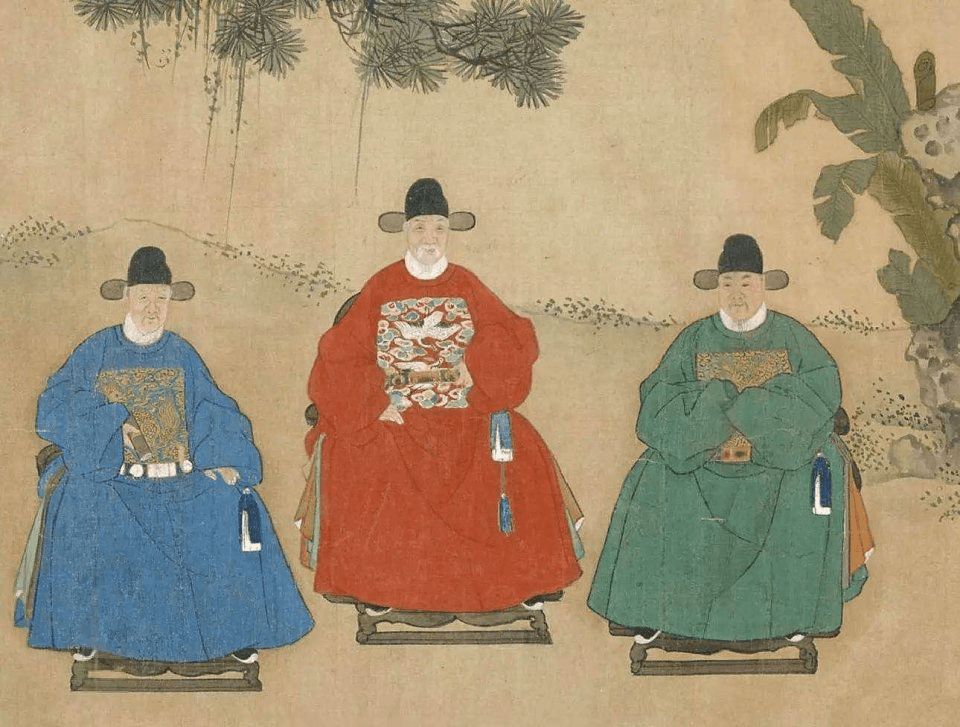
What filled the vacuum was the Grand Secretariat (内阁), which took shape under the Yongle Emperor as a small body of scholar-officials pulled in to help draft responses to memorials. Critically, it was designed as a workaround rather than a restoration: Grand Secretaries held no formal ministerial rank, commanded no ministry directly, and existed purely at the emperor's pleasure. Because no single emperor — especially the less diligent ones further down the dynastic line — could realistically run an empire alone from that position, real influence drifted instead to whoever controlled physical access to the throne: the palace eunuchs. Ming eunuchs staffed the Directorate of Ceremonial, which had the power to countersign and even draft imperial rescripts on the emperor's behalf, effectively giving them a hand on the paperwork that decided who got promoted, punished, or ignored. At their worst, this tipped into outright capture of the state: Liu Jin, in the early 1500s, ran the government for roughly five years while the Zhengde Emperor indulged his own pleasures, until he was finally arrested and executed by slow slicing after 3,000 taels of gold and 500,000 taels of silver were found hidden in his residence. A century later, Wei Zhongxian built an even more extensive personal cult under the Tianqi Emperor, having temples erected in his own honor across the empire and purging the reformist Donglin faction of officials who opposed him, before being forced to suicide when the next emperor turned on him in 1627.
The Ming also institutionalized secret police in a way no earlier dynasty had attempted at this scale. The Jinyiwei ("Embroidered Uniform Guard") began in 1368 as Hongwu's personal bodyguard and was formally reorganized in 1382 into an imperial security service with the authority to investigate, arrest, interrogate, and execute — bypassing the regular judiciary entirely. Later emperors layered eunuch-controlled rivals on top of it: the Eastern Depot, founded under the Yongle Emperor specifically to watch the Jinyiwei itself, and later the short-lived, even more feared Western Depot. By the dynasty's final years the Jinyiwei had effectively been subordinated to the Eastern Depot's eunuch leadership — the watchers, watched by the watchers' watchers. Add to this an examination system that had calcified around the rigid, formulaic eight-legged essay (八股文) — a structure of eight fixed rhetorical sections built almost entirely around orthodox interpretation of the Confucian classics, leaving little room for original argument — and you get a state that was, on paper, more centralized and more surveilled than any before it, while in practice frequently paralyzed by the very structures it had built to concentrate power in the first place.
Commerce and Economy
Hongwu's instincts here were as controlling as his politics. He ranked merchants at the bottom of the Confucian social order — beneath scholars, farmers, and even artisans — taxed them heavily, restricted the fabrics and colors they were legally permitted to wear regardless of their actual wealth, and treated commerce as morally suspect, a distraction from the agrarian order he believed sustained the state. And yet the Ming presided over one of the most commercially dynamic periods in premodern Chinese history, almost in spite of itself — the gap between what the founder wanted and what the economy actually did is, in many ways, the whole story.
In the mid-to-late dynasty, the textile industries of the Jiangnan region became the clearest evidence of that gap. Suzhou's silk workshops and Songjiang's cotton mills grew large and specialized enough that some historians describe genuine wage-labor relationships forming inside them — workers who owned no looms of their own, hired by the day or the piece by workshop owners who did — the so-called "sprouts of capitalism" (资本主义萌芽), a term that Chinese historiography has debated for decades over how far to push the comparison to European proto-industrialization. Whatever the right theoretical label, the scale was real: Songjiang, in particular, became so associated with cotton cloth production that the saying "cloth is to Songjiang as grain is to Suzhou" reportedly circulated to describe how thoroughly the local economy had specialized around it. Jingdezhen's kilns, meanwhile, were turning out tens of millions of porcelain pieces a year by 1600, produced across a division of labor so fine that a single piece might pass through dozens of specialized hands before it was finished — output valued in the millions of taels of silver and shipped as far as European and Southeast Asian markets.
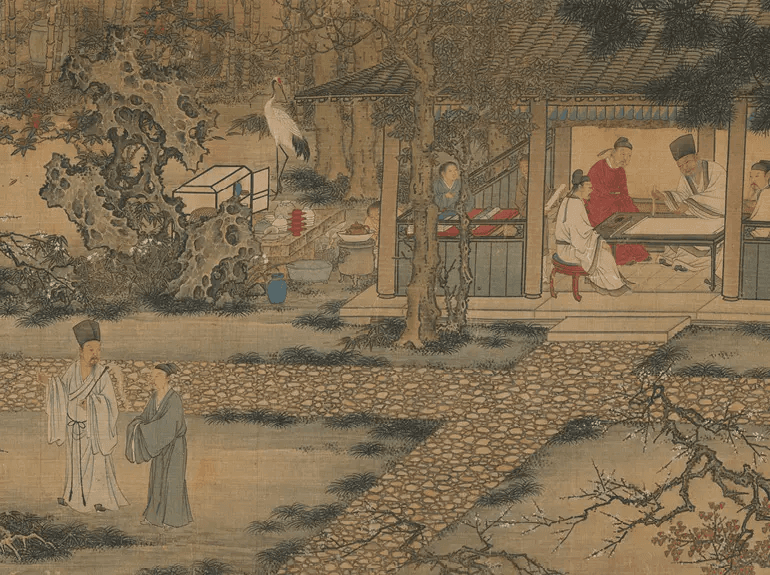
That silver is its own story. By the 16th century it had become the empire's effective national currency, a shift formalized under Grand Secretary Zhang Juzheng's 1581 "Single Whip" (一条鞭法) tax reform, which collapsed the old tangle of labor-service obligations and in-kind grain taxes into a single, unified payment rendered in silver. The silver itself arrived from two directions simultaneously: Japanese mines like Iwami Ginzan, and — after the Spanish founded Manila in 1571 and began running galleons across the Pacific — vast quantities of silver mined by forced indigenous and enslaved labor at Potosí and Zacatecas in the Americas, shipped to Manila, and exchanged there for Chinese silk and porcelain before continuing on to Spain. By some estimates, China absorbed something on the order of a third of all the silver mined in the world during this period, effectively making Ming tax policy in Beijing and colonial mining output in the Andes two ends of the same economic chain.
Around this bloodstream of silver grew regional merchant networks that operated more like early trading empires than local guilds. The Huizhou merchants of southern Anhui became so dominant that by the end of the Ming, contemporaries claimed more than seventy percent of Huizhou's population was engaged in trade in one form or another — boys were apprenticed into the family business around age thirteen and doing business independently across the empire by seventeen. They built their wealth on salt monopolies, tea, timber, and the production of scholarly luxury goods like the "Four Treasures of the Study" (writing brushes, ink sticks, ink slabs, and paper), and cultivated a reputation for strict commercial honesty precisely because reputation was their main form of collateral across long trade routes. The Shanxi merchants built their own fortune through a different mechanism entirely: the Ming government's kaizhongfa system, which granted lucrative salt-trading licenses to merchants willing to transport grain and supplies to frontier garrisons along the northern border — turning military logistics into a multigenerational monopoly, and eventually seeding the private banking networks (piaohao) that would make Shanxi merchants central to Chinese finance well into the Qing.
None of this erased merchants' formally low legal status, and the Ming state never stopped treating maritime private trade as something to be banned outright for most of the dynasty's history. That contradiction — official doctrine holding commerce in contempt while the empire's most dynamic growth, and a meaningful share of the world's silver supply, ran directly through merchant hands — is arguably the single most useful thread for understanding how the Ming economy actually worked.
Foreign Relations: Between Openness and Closure
Zheng He's seven voyages to the Western Ocean in the early Ming (1405–1433) were the most spectacular external events of the period — his fleets reached as far as East Africa and the Arabian Peninsula, demonstrating the Ming's naval and diplomatic power at the time, while also sustaining a China-centered tribute system in which states like Korea, Ryukyu, Vietnam, and Siam paid regular tribute. But after Zheng He, the Ming turned conservative, implementing maritime bans that prohibited private citizens from going to sea to trade (which gave rise to smuggling and the wokou pirate problem). By the mid-to-late 16th century, things shifted again: the Portuguese established a trading post in Macau, the Spanish brought American silver via Manila in the Philippines, and Jesuit missionaries like Matteo Ricci entered China to spread Western science (calendrical systems, geometry), even serving in the imperial court for a time. So Ming foreign relations followed a fluctuating trajectory of "openness — contraction — limited reopening," rather than being a static, closed-off isolationism.
Folk Customs and Urban Culture
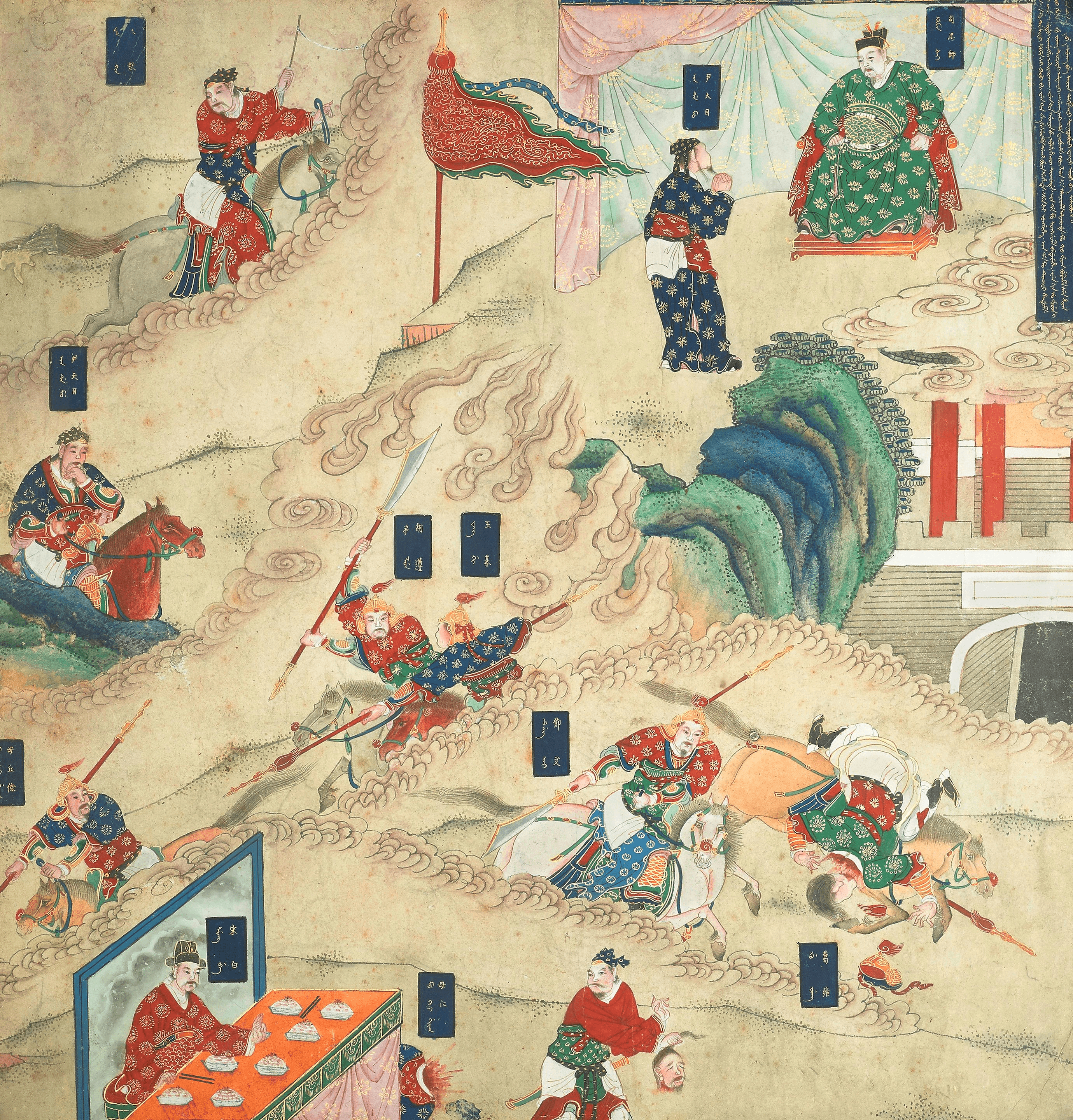
If you want to feel the texture of everyday Ming life, don't look at the court — look at the bookshops. This was the golden age of the Chinese vernacular novel: Romance of the Three Kingdoms, attributed to Luo Guanzhong, Water Margin, attributed to Shi Nai'an, and Wu Cheng'en's Journey to the West — three of what would later be canonized as the Four Great Classical Novels — were all composed or reached their standard printed form during the Ming, drawing on centuries of oral storytelling and earlier fragmentary texts and welding them into the versions still read today.
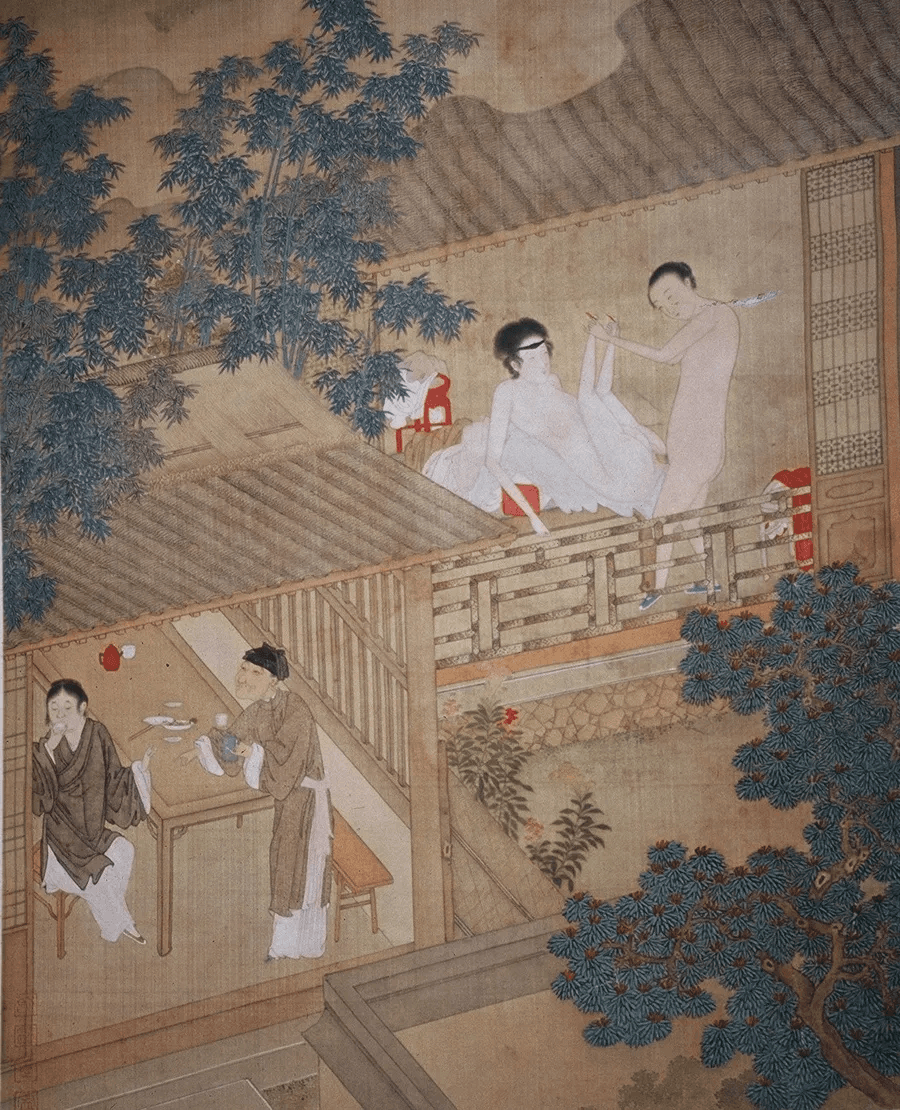
Then there's Jin Ping Mei, which is really its own case study in what the Ming reading public wanted. It began circulating in manuscript around 1596 and reached print in 1610, published under the transparent pseudonym "Lanling Xiaoxiao Sheng" — "The Scoffing Scholar of Lanling" — an identity nobody has ever definitively unmasked, with candidates ranging from the playwright Tang Xianzu to the official Wang Shizhen still debated by scholars today. Over a hundred chapters and a million words, it follows Ximen Qing, a corrupt, socially climbing merchant, and the wives and concubines competing for status inside his household — sexually explicit passages make up a small fraction of the actual text, but they were enough to get the book banned repeatedly for centuries, even as literary scholars increasingly rank it as one of the most technically sophisticated novels of character in premodern world literature. What makes it useful as a historical document is precisely what got it banned: it's less interested in emperors and battles than in household budgets, gift economies, sexual jealousy, and the anxious status games of a newly wealthy merchant class — fiction functioning as social record.
None of this would have reached the audience it did without the printing boom underneath it. Cheap woodblock printing turned books from elite luxury objects into mass commercial products, and a genuinely urban reading public — literate beyond the narrow examination-bound gentry — created real commercial demand for fiction, drama scripts, and even how-to guides. The same commercial prosperity the state officially disdained was quietly bankrolling a golden age of popular publishing.
Opera followed a similar arc. Kunqu emerged in the 16th century out of reforms to older regional melodies traditionally credited to the musician Wei Liangfu, who slowed and refined the vocal style into something more lyrical and technically demanding — and it found its defining masterpiece in Tang Xianzu's 1598 The Peony Pavilion, a supernatural love story in which a young woman dies of longing, is resurrected by the force of her own desire, and marries the scholar she'd only ever seen in a dream. It's a plot that reads, not coincidentally, like an argument for the legitimacy of romantic feeling in an era whose official ideology had very little patience for exactly that.
Beyond the page and the stage, urban life had its own rhythm: teahouses that functioned as informal news exchanges and business venues, temple fairs that mixed religious observance with markets, acrobatics, and street food, and native-place and trade guild associations (huiguan) that gave merchants and migrants from the same region a social anchor in unfamiliar cities. Food was quietly changing too — the earliest known written Chinese reference to the chili pepper appears in a 1591 gardening manual by Gao Lian, who described it purely as an ornamental plant, "fanjiao" or "foreign pepper," grown for its flowers rather than eaten. It would take until well into the following Qing dynasty for chilies to work their way into the cooking of Sichuan and Hunan and reshape those cuisines as we know them now — a reminder that even something as basic-feeling as "traditional" Chinese food has its own, sometimes surprisingly late, historical arrival date.

Clothing, meanwhile, was one of the most tightly legislated aspects of daily life, and one of the most openly defied. Imperial yellow and the five-clawed dragon motif were reserved exclusively for the emperor and his heirs, on pain of treason charges. Nobility were assigned specific reds, golds, and purples by exact rank — two women of different noble ranks might both technically wear "red," but not the same shade, the same sleeve width, or the same embroidery pattern, with the distinctions spelled out in law. Commoners were restricted to humbler tones like peach-red and muted purple-green, and by statute, silk was reserved for the highborn while commoners were required to wear cotton or linen, with tailors who cut a forbidden color facing formal punishment. The problem, from the state's perspective, was that by the 1500s a great many merchants could easily afford silk and forbidden colors — the law increasingly criminalized what wealth alone should have made possible, and magistrates ran periodic crackdowns confiscating illegal garments and fining tailors, an enforcement effort that never fully caught up with what people could actually buy. It's worth remembering, too, that the era's most enduring domestic architecture and garden design — the scholar's gardens of Suzhou, for instance — were built by exactly the merchant and gentry class the state kept trying, and largely failing, to keep in its assigned place.
Gender Equality
Overall, the Ming was conservative — even regressive — when it came to gender attitudes, and it built an entire administrative apparatus to enforce that conservatism rather than just preach it. Cheng-Zhu Neo-Confucianism, developed centuries earlier in the Song, was elevated to unquestioned state orthodoxy, and with it came the codification of ideas that earlier dynasties had held more as cultural preference than hard law. The "three obediences and four virtues" (三从四德) prescribed that a woman obey her father before marriage, her husband during marriage, and her son after her husband's death — a lifelong subordination with no stage at which a woman was simply her own agent. The line "starving to death is a small matter, but losing one's chastity is a serious one," originally a throwaway remark by the Song philosopher Cheng Yi, was resurrected and treated by Ming moralists as settled doctrine.
The state didn't just endorse this ideology, it administered it. Widows who refused to remarry after their husbands' deaths could receive a "testimonial of merit" (旌表, jingbiao) from the imperial government itself, and families or communities were permitted to build commemorative memorial arches — chastity paifang — in their honor, physical monuments still scattered across parts of China today. In the late 16th century, the honor system was extended further to cover women who died resisting rape. The dark underside of this incentive structure is well documented: suicide among widows rose sharply during the Ming, as chastity became entangled with self-destruction as its most unambiguous, most honorable proof.
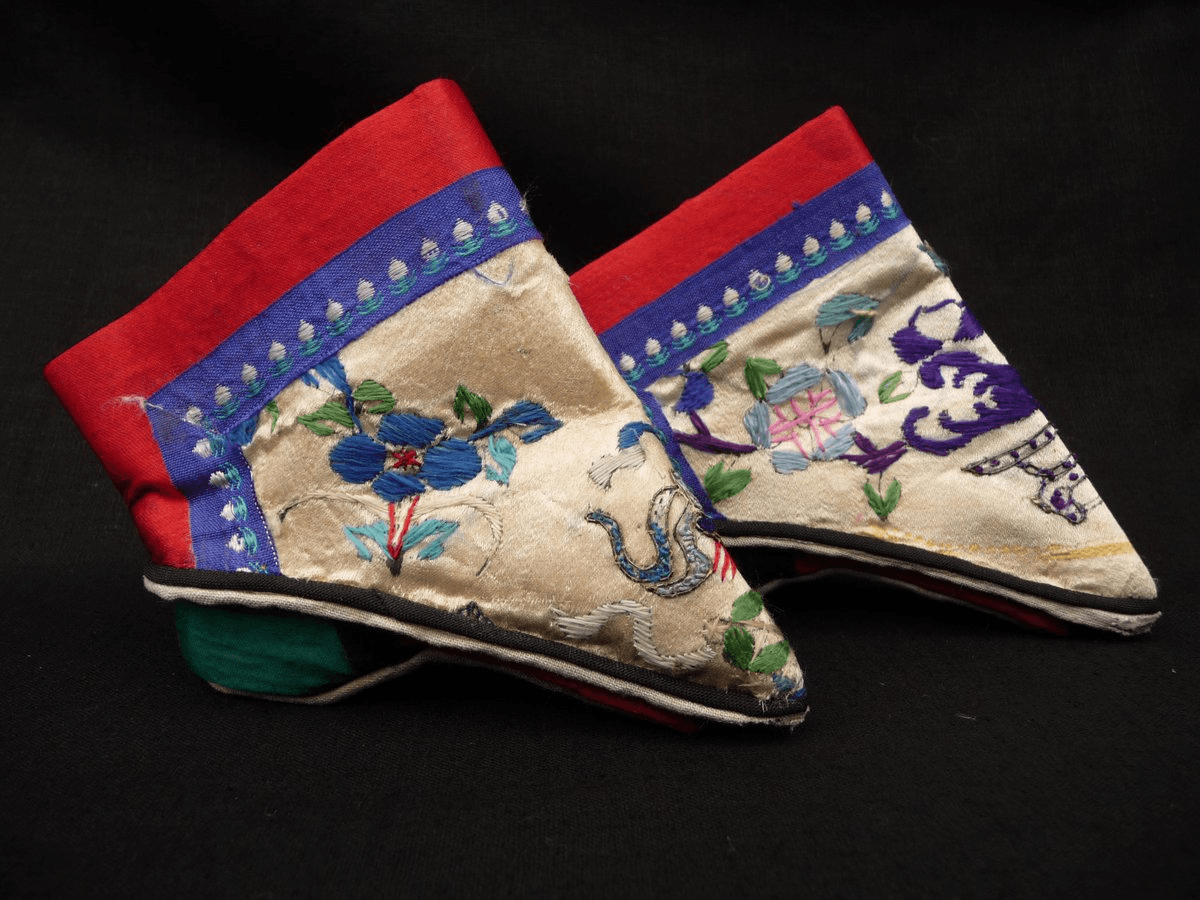
Foot-binding intensified alongside this ideology. It wasn't a Ming invention — it had emerged as an elite fashion in the Five Dynasties and Song periods — but during the Ming it spread substantially further down the social ladder, becoming something closer to a normalized expectation for Han Chinese women broadly rather than a marker of aristocratic status alone.
And yet the same period, especially in the wealthy Jiangnan region, produced a real flourishing of elite women's literary culture that sat awkwardly alongside all of this. Women's poetry societies met in domestic inner chambers, women's own writing circulated in print and in manuscript, and courtesan culture produced genuinely formidable public intellectuals rather than merely decorative companions. Liu Rushi is the standout case: sold into a courtesan's training academy as a child, she had published four collections of poetry by the time she was twenty-two, was recognized for a bold, "wild-grass" calligraphic style unusual for a woman of her era, and painted landscapes now held in the Palace Museum's collection. In 1640 she famously approached the scholar-official Qian Qianyi dressed in men's clothing to request his critique of her poetry; they married the following year, and although technically only a concubine, he treated her with the ceremony due a principal wife. When the Ming collapsed in 1644, it was Liu — not her husband — who urged suicide as an act of political martyrdom, and when he chose not to, she stayed and supported his underground resistance to the Qing instead. The historian Chen Yinke later called her "a heroine, a belle, a wordsmith, and a patriot," a description that would have been almost unthinkable applied to a woman just a generation or two earlier.
So it isn't accurate to simply call the Ming "unequal" and leave it there. What you actually see is two systems running in parallel: an official ritual order clamping down harder than ever on women's bodies and choices, and a real, growing space — concentrated among the literate elite — where women's intellectual and even political lives were expanding. Neither cancels the other out; they're both simply true of the same decades, often of the same households.
Ethnic and Racial Composition
The Ming's founding ideology was explicit and unambiguous: Zhu Yuanzhang's rebellion was framed from the start as a project to "expel the barbarians and restore China" (驱除胡虏,恢复中华), positioning the new dynasty as a Han Chinese restoration after nearly a century of Mongol Yuan rule. But the lived reality of how the Ming actually governed its population was considerably messier than that founding slogan suggests.
Take the conquest of Yunnan in 1381–82, one of the last major campaigns needed to fully secure Ming territory from Yuan loyalist holdouts. The Ming mobilized somewhere between 250,000 and 300,000 troops — notably including Hui Muslim soldiers fighting on the Ming side against Yuan loyalist Muslim forces, a detail that alone complicates any simple ethnic reading of the conflict. Among the captives taken was a boy of about ten, from a Hui Muslim family with Central Asian ancestry, who was one of roughly 380 captured Mongol and Muslim boys and men castrated by the Ming generals Lan Yu and Fu Youde and funneled into palace eunuch service. That boy would eventually be given the name Zheng He, and would go on to command the largest fleets the world had yet seen on behalf of the same dynasty that had mutilated him as a war captive — a biography that sits very uneasily next to any tidy "Han restoration" narrative, and arguably says more about the Ming's actual relationship to ethnicity than the founding rhetoric does. In the campaign's aftermath, Ming soldiers who settled permanently in Yunnan intermarried with local Han, Miao, and Yao women; their descendants, known as Tunbao, still live in the region and maintain a distinct identity today.
Elsewhere, the Ming's approach to non-Han populations was less about assimilation than about low-cost indirect control. Mongol and Semu (Central and West Asian) elites who had settled in China under Yuan rule were largely permitted to remain and gradually assimilate into Han society rather than being expelled or purged, a pragmatic choice given how deeply embedded some of these families had become in local administration and commerce. In the southwest and parts of the northwest — regions home to Miao, Yao, Zhuang, Tibetan, and other populations — the Ming relied heavily on the tusi system: hereditary local chieftains, drawn from the existing indigenous elite, who governed their own territories by their own customary law while formally answering to the Ming state and supplying tribute, labor, or troops when called on. It was a system built entirely around practicality rather than principle — Beijing had neither the administrative capacity nor, frankly, much interest in directly ruling these regions, so long as they stayed quiet and paid their dues. (It would eventually be dismantled under the Qing's more aggressive "gaitu guiliu" reforms, which replaced native chieftains with directly appointed imperial officials.)
Put together, the picture is of a state whose founding myth was ethnically exclusive but whose actual governing style was opportunistic and locally negotiated — willing to absorb Mongol descendants, arm and rely on Muslim soldiers, elevate a castrated Hui admiral to command its most prestigious military project, and govern its most ethnically diverse frontiers through local proxies rather than direct Han administration. None of this reflected anything like a modern ideal of pluralism; it was centralized power and frontier stability, achieved by whatever mixture of assimilation, tolerance, and indirect rule got the job done. 🇨🇳