Created on
Updated on
How to Solve Virtual Lighting
everything that makes anything look real
Preface: Welcome to this very long series of filmmaking in the age of AI(2026).
Geometry without illumination is invisible. A perfectly textured character in a dark scene is a dark scene. Lighting is the stage at which the virtual world becomes a photographed image, and it is the stage at which CG either integrates into the live plate or fails to. It is the most cinematographically demanding discipline in the pipeline. The lighting artist is the DP's counterpart in the virtual world. They work from the same principles that govern physical cinematography: how light defines form, how it establishes time of day and weather and psychological state, how it creates the separation between subject and background that the eye reads as three-dimensional space and they apply those principles to a scene that exists only as mathematics. Their job is not just to make the CG look good. It is to make the CG look like it belongs to the same frame as the plate.
How it began
The first CG lighting systems were manual and arbitrary. An artist placed point lights — infinitely small sources that emit light equally in all directions — at positions in 3D space and adjusted their intensity and color until the result looked acceptable. There was no physical basis for any of it. The light did not bounce. It did not scatter. Surfaces that were not directly in the path of a light ray were simply dark, or had a manually set "ambient" value — a flat additive constant applied to every surface in the scene to simulate the general brightness of an environment. This ambient term was not light. It was a fudge — a way of preventing surfaces from going completely black in a system that could not compute indirect illumination. The result was recognizably CG. Shadows were hard-edged and precisely geometric. Surfaces facing away from lights were flat and featureless. There was no color bleeding — the red of a wall does not bounce onto a white floor in the real world's way — because the renderer had no mechanism to calculate it. The images looked like the inside of a computer, because they were.
Cornell University's Program of Computer Graphics began working on this problem in the early 1980s. The research group, led by Donald Greenberg, developed radiosity — a global illumination algorithm based on the principles of radiative heat transfer, adapted for the problem of rendering computer graphics. Radiosity modeled the way diffuse light energy distributes itself across a closed environment: the way light bounces from a colored wall onto the floor and ceiling, changing everything it touches. The first fully radiosity-rendered images, produced at Cornell in 1984 by Cindy Goral, Kenneth Torrance, and Donald Greenberg, showed an empty room — what became known as the Cornell Box — with red, blue, and gray walls, demonstrating color bleeding between surfaces with no objects inside. The color bleeding was visible and convincing. It was the first rendered image that looked like a real physical space rather than a lit polygon set.
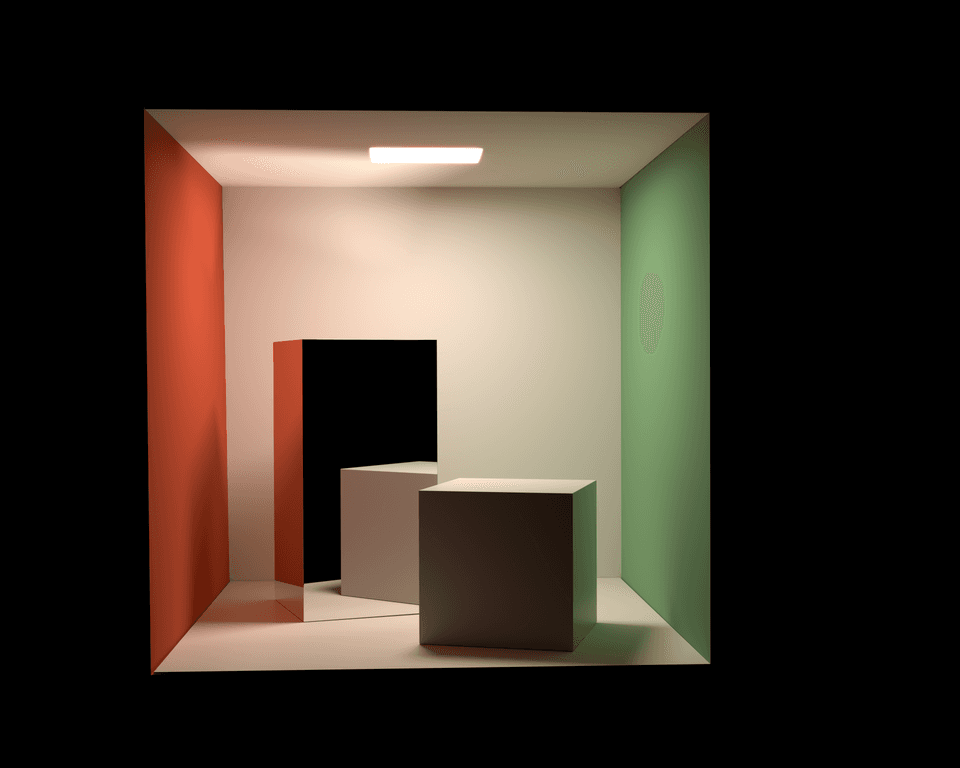
When sunlight comes through a window and hits a red wall, the wall doesn't just absorb that light — it reflects some of it back into the room. That reflected light is red. It lands on the white ceiling, the floor, the objects nearby, tinting them slightly red. Then those surfaces reflect their own light further. Light is constantly bouncing between surfaces, carrying color information with it, until it disperses. This is why a white room lit by a single candle doesn't divide cleanly into lit areas and total blackness — indirect light wraps around and fills in the shadows with subtle, soft illumination. It's also why a red wall makes everything near it look slightly warmer.
Early CG renderers could not calculate any of this. They could only compute direct illumination — light traveling in a straight line from the source to the surface. If a surface was directly facing a light, it received that light. If it wasn't, it received nothing. Shadows were perfectly hard-edged because they were simply the absence of direct light, with no indirect light filling them in. Surfaces in shadow went flat and featureless. There was no color bleeding from wall to floor because the renderer had no way to track where reflected light went after it left the first surface.
The fix was a manual fudge called ambient light: a flat constant brightness applied uniformly to every surface in the scene, regardless of position or geometry. It prevented surfaces from going completely black, but it was not physically real. It had no direction, no color variation, no relationship to where the actual light sources were. It just lifted the floor of the image. The result was images that divided visibly into two zones: directly lit surfaces that looked plausible, and everything else — flat, uniformly dark, obviously artificial. That visual signature is what people mean when they say something looks "early CG."
Cornell's radiosity work in 1984 solved the first part of the problem. Radiosity calculated how diffuse surfaces exchange light energy with each other — not just receiving light from the source, but bouncing it to neighboring surfaces, which bounce it further. A red wall now reflected red light onto the floor. Shadows filled with soft indirect illumination. The Cornell Box image looked like a real room because for the first time, a renderer was accounting for where light actually went after it hit the first surface. But radiosity only handled diffuse surfaces — matte materials that scatter light evenly in all directions. It could not model specular reflection, the sharp mirror-like bounces that appear on glossy surfaces, water, metal, or any material that reflects light directionally. A radiosity renderer could not produce a correct reflection in a window, or show the caustic patterns that form when light bends through glass.
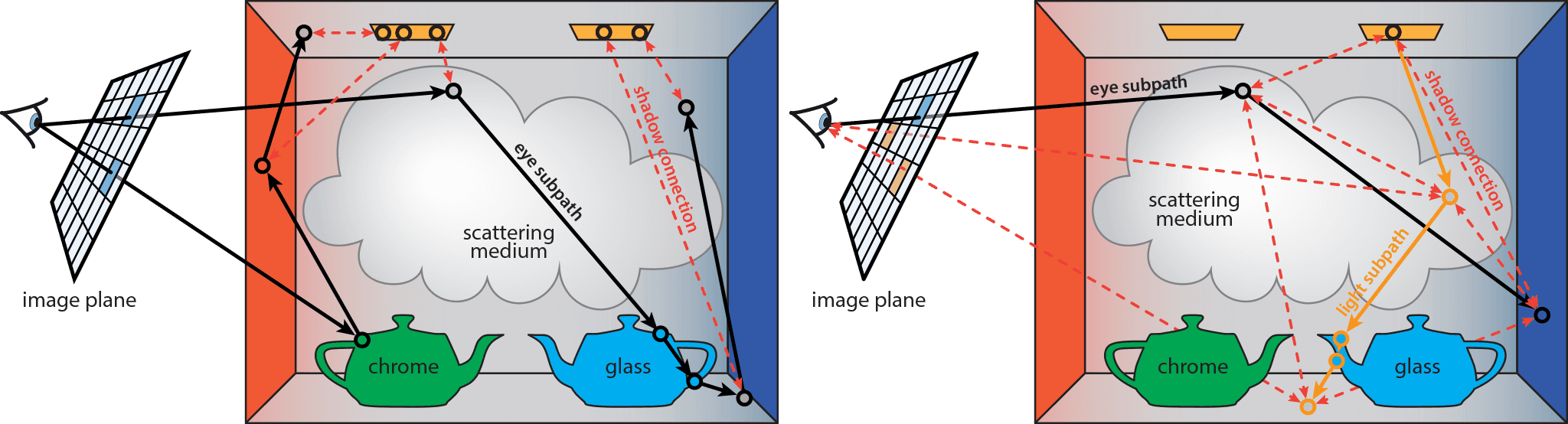
Path tracing solved everything at once. Rather than calculating light transfer between surfaces as a system of equations — which is what radiosity does — a path tracer simply simulates what a photon actually does: fires a ray from the camera, traces where it goes, lets it bounce off whatever it hits, carries the color and light it picks up at each bounce, and eventually reaches a light source or escapes. Diffuse bounce, specular reflection, refraction, shadows — all of it falls out of the same algorithm, because the algorithm is just physics. The problem was that one ray per pixel gives a noisy result. You need thousands of rays per pixel for the statistical averaging to converge to a clean image, which meant hours or days of render time per frame. It stayed a research technique through the 1990s for exactly that reason, while production used faster approximations. By the 2010s, hardware had caught up enough that path tracing became viable in production — and that is the specific moment when CG stopped looking like CG.
Debevec and image-based lighting
The practical breakthrough came from a different direction. Rather than simulating the physics of an imaginary lighting environment, Paul Debevec at UC Berkeley asked a different question: what if you could capture the actual lighting of a real place and use that measurement to illuminate CG objects?
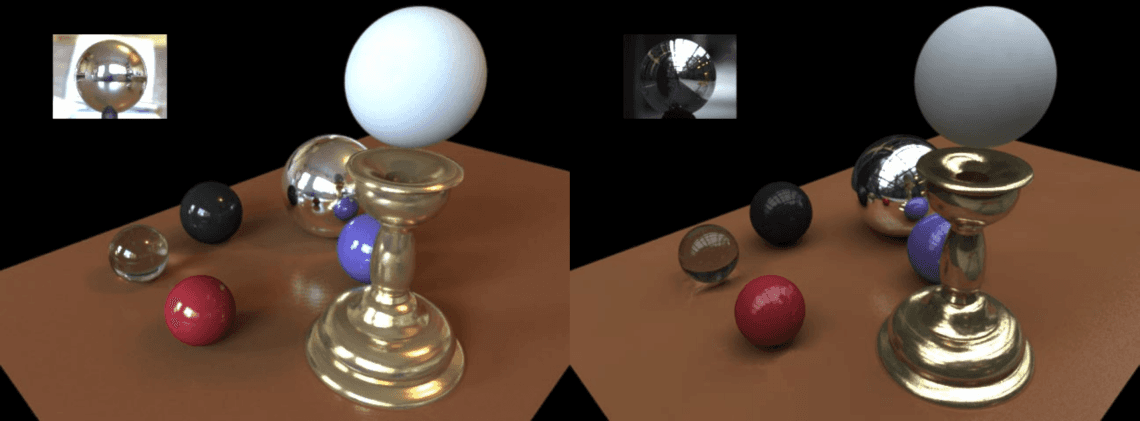
His 1998 SIGGRAPH paper, Rendering Synthetic Objects Into Real Scenes, introduced image-based lighting to production. The technique used a chrome sphere — a mirrored ball — placed on set to capture a panoramic reflection of the entire lighting environment from a single point, as mentioned previously. That reflection, photographed across multiple exposures to capture the full dynamic range from shadow to direct sunlight, was assembled into an HDR image — a High Dynamic Range Image — that encoded the actual intensity and color of every light source in the scene, from every direction. That HDRI could then be used as a lighting environment in the renderer, wrapping around the CG elements and illuminating them with the real-world light that existed on the day of the shoot.
The result was CG that shared the specific color temperature, directionality, and quality of the plate it was being composited into — because it was lit by the same light. Digital Domain used Debevec's techniques on the Senator Kelly transformation sequence in X-Men in 2000, which is considered the first feature film production to directly apply his IBL(image based lighting) work. The Matrix sequels, King Kong, The Curious Case of Benjamin Button, District 9, and Avatar followed. Every major production has used image-based lighting ever since. The chrome ball became standard on-set VFX equipment. It appears in most behind-the-scenes photographs from any major VFX production — a small reflective sphere on a stand, placed near the actors, capturing the light that the CG will need to match.
What a lighting artist does
A shot arrives in lighting with a camera, a live-action plate, a fully animated and look-devved character, and a lighting brief. The lighting artist has to produce a render that, when composited over the plate, reads as if the CG was physically present in the scene when it was photographed.
The first task is building the light rig — the collection of virtual light sources that will illuminate the scene. The HDRI from set provides the base: the ambient sky, the general diffuse environment. On top of that, the lighting artist adds direct light sources that match the specific key lights, fill lights, and practicals visible in the plate and in the on-set lighting documentation. The lighting notes from the shoot specify the type, position, and color temperature of every light used on the day. The lighting artist recreates that setup in the virtual environment.
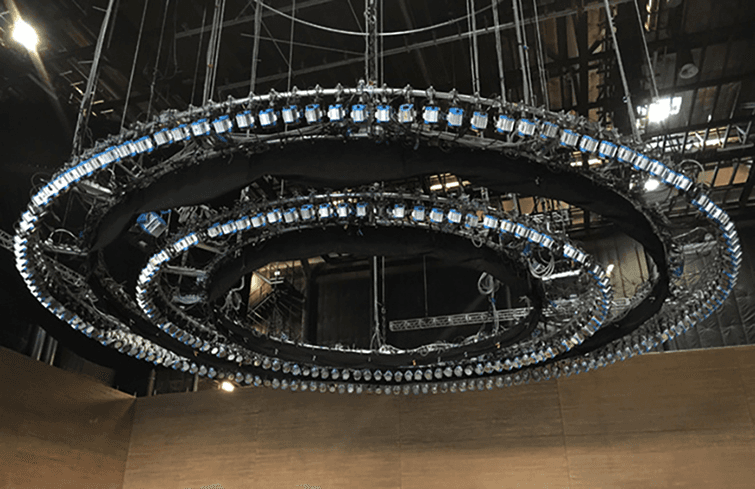
Then comes the process of matching. The lighting artist renders the CG element, takes it into the compositing package, places it over the plate, and examines where it fails to integrate. The color temperature is wrong. The shadow falls in the wrong direction. The rim light is too hard, or too soft, or the wrong intensity. The specular on the skin reads differently than the specular on the plate's practical elements. Each of these failures is evidence of a specific lighting problem in the rig, and the lighting artist works through them systematically until the render sits in the plate without the eye finding an objection.
Render passes are the lighting artist's editorial tool. The rendering produces not just the final beauty but separate passes for each light source — the key light pass, the fill light pass, the rim light pass, the ambient pass, the reflected light pass. In compositing, the lighter can adjust the intensity and color of individual lights after the render is done, without re-rendering the entire shot. The interactive loop between lighting and compositing is where shots get refined. A note that says "the fill is too warm" gets addressed by pulling down the saturation of the fill light pass in Nuke, checking the result, and either accepting it or sending the shot back to lighting for a re-render at the corrected value.
The cinematography problem
The first is physical accuracy: making the CG element respond to light the way the real object would, so that the integration with the plate is convincing. This is primarily a technical problem, and it is what physically based rendering was designed to address. The second is cinematic intent: making the CG element serve the story the same way the DP's lighting serves the story. A DP does not place lights to be physically accurate. They place lights to direct attention, establish mood, separate subjects from backgrounds, reveal or conceal emotion. The lighting in any given scene was chosen because it serves specific narrative purposes. The CG must not only match that lighting; it must carry the same intent.
These two requirements create the specific expertise the job demands. A lighting artist who only understands physics will produce CG that is technically integrated but cinematically inert. One who only understands cinematography will produce beautiful images that don't match the plate. The best ones can diagnose a failed integration in physical terms and make the correction serve the story.
There is a specific quality that well-lit CG has and poorly-lit CG doesn't: it looks like it was shot. The camera that photographed the plate created certain relationships between light, surface, and lens — depth of field, lens flare, chromatic aberration, the specific behavior of light at the edges of a shadow. The lighting artist's job is to produce a render that could have come from that same camera in that same environment. When they get it right, the audience does not think about the visual effects at all. They think about the scene. That is the measure of the work.
🫶🏼