Created on
Updated on
Modern Art(8.1): Surrealism and Mexico City
荒野侦探们寻找的女诗人
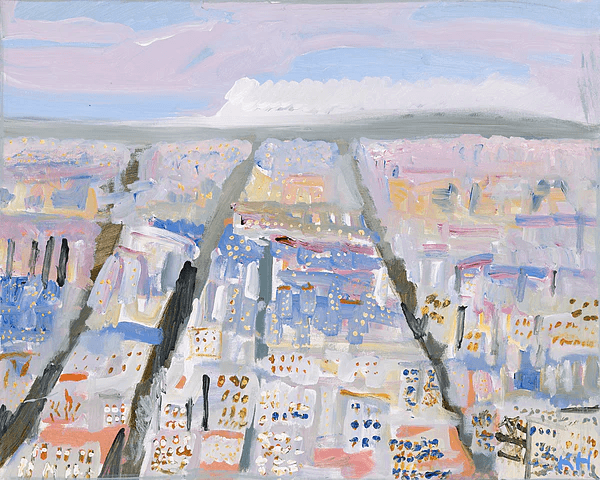
Preface: welcome to this very brief intro to modern art. Please feel free to use this as a guide for museum visits.
Infrarealism
Mexico City, 1975. Two young men, both broke, both unpublished, decided to found a poetry movement. Roberto Bolaño, Chilean, 22, had immigrated to Mexico with his family in 1968. In 1973 he returned to Chile to support the Allende government, witnessed the Pinochet coup firsthand, was detained for several days, and was released only because one of his guards happened to know him. Then he fled back to Mexico. Mario Santiago Papasquiaro (born José Alfredo Zendejas Pineda), Mexican, 22, from a working-class family, grew up on the streets of Mexico City. These two men are the real models for Arturo Belano and Ulises Lima in The Savage Detectives. They called their movement Infrarealism — Infrarrealismo.
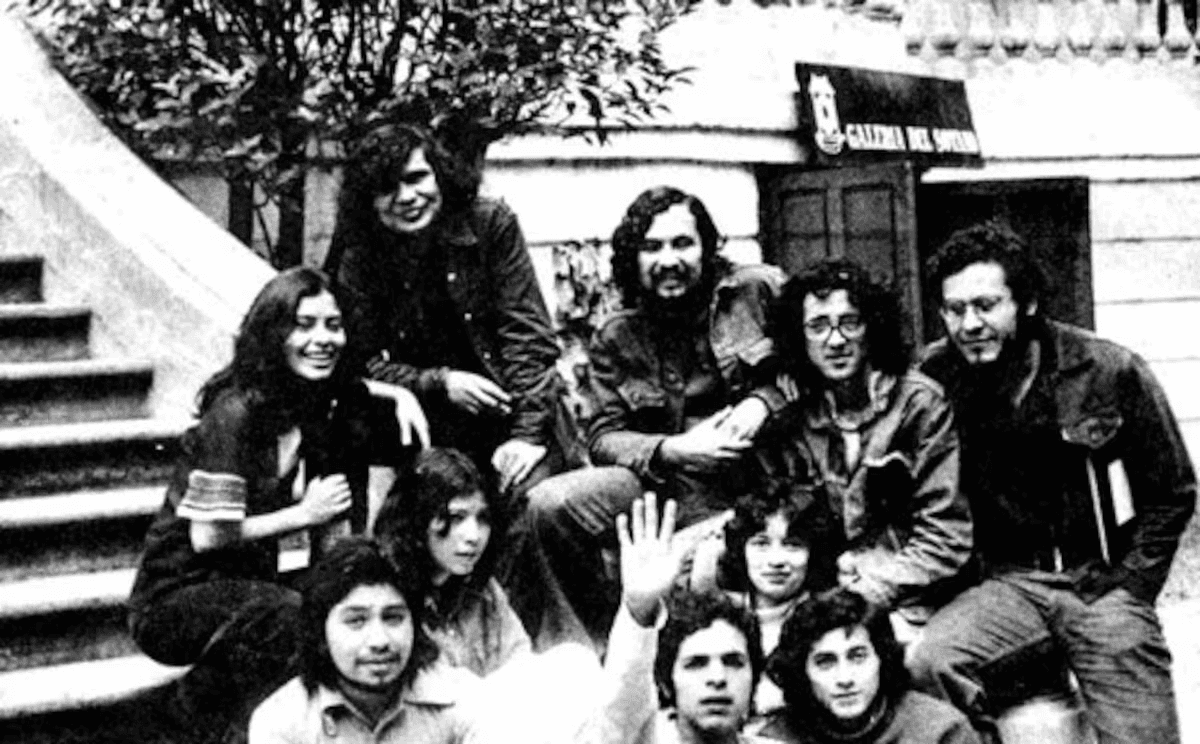
Why infrared?
Infrared is the part of the light spectrum invisible to the naked eye — below visible light, outside the range that official culture is willing to acknowledge. The name was a declaration of position: we are here. You simply choose not to see us. In 1976 they published their manifesto — Déjenlo todo, nuevamente (Leave Everything, Again). Bolaño and Mario Santiago signed it together. The tone is explosive, chaotic, saturated with references — they invoke the Blue Rider, Dada, Vertov, Ginsberg, Breton, Che Guevara, Mayakovsky, the French New Wave. It is not a clear political platform. It is shrapnel, fired simultaneously in every direction.
Several core claims:
Poetry must be lived, not only written. Not a literary practice conducted in a study — a way of life, a choice to invest your body and your time entirely.
Against all institutions. Paz, official literary magazines, universities, prizes, everything that turns poetry into a career ladder.
Lean toward the margins. Workers, the poor, migrants, prostitutes, addicts — their reality is poetry's true material, not the conversational currency of elite cultural salons.
Language itself must be blown open. Not elegant Spanish, not the carefully constructed imagery of Paz — street language, raw, incomplete, full of errors.
Infrarealism didn't emerge from nowhere. Their influences came from several directions.
Estridentismo: The Mexican avant-garde movement of the 1920s — Manuel Maples Arce — a fusion of Mexican Futurism and Dada. Equally anti-establishment, equally enamored of the city and the machine, equally wielding the manifesto as weapon. The infrarealists considered themselves inheritors of this tradition. There is a direct line here: Estridentismo produced those forgotten women poets — Bolaño's construction of Cesárea Tinajero as a character digs from exactly this tradition.
The Beat Generation: Ginsberg, Kerouac, Corso — poetry as a way of life, marginal experience as material, vernacular language breaking the boundaries of elite literature. Bolaño was deeply influenced; he mentions Ginsberg directly in the manifesto.
Russian Futurism: Mayakovsky — poetry as political action, recited on streets, existing in public space.
Dada: The destructive gesture, the interruption, the manufacture of chaos, provocation itself as artistic act.
Buñuel and the New Wave: They were interested in cinema as much as literature. Buñuel's surrealist narrative logic, Godard's editing, Vertov's camera-eye — these influences left traces in the structure of their poetry.
What They Actually Did
Interrupting Paz's readings: Their most famous action. They showed up at Paz's public readings and literary events, asked loud questions, created disruption, distributed flyers, read their own poems aloud. In the Mexico City literary world of that era this was an act of extreme provocation — Paz was a national cultural symbol, and challenging him required a particular kind of recklessness. They were reckless because they had nothing to lose.
Publishing small magazines and flyers: No money, no printing equipment — they used photocopiers and hand-printing to produce pamphlets and distributed them on the street. Print runs were tiny. Most have disappeared.
Living on the street: They moved through Mexico City — cafés, bars, markets, the university campus, poor neighborhoods. They knew prostitutes, addicts, and drifters, and brought those encounters into their poetry. This was not a romanticization of poverty. They were poor themselves.
Writing: They wrote enormous quantities of poetry — on napkins, in notebooks, on whatever surface was available. Most of it was never published.
Mario Santiago: The Real Ulises Lima
This is the most important and most heartbreaking figure in the entire story. Mario Santiago was infrarealism's true soul — more radical than Bolaño, more thorough, more completely impossible for any institution to absorb. Bolaño eventually left Mexico for Europe, gradually began writing novels, and ultimately achieved international recognition. Mario Santiago stayed. He came from a poor working-class family in Mexico City. He read voraciously — he had read nearly everything, possessed a staggering intellectual energy, but that energy never found a stable outlet. He used drugs, moved through a series of chaotic relationships, drifted between friends' apartments, was perpetually broke.
His poetry was genuinely radical — dense, free, refusing any meter or traditional structure, a strange mixture of street language and literary reference. Among those who knew him, he was considered one of the most gifted Mexican poets of his generation. Among those who didn't, he barely existed. In 1998 he was struck by a car on a Mexico City street and died. He was 45. That same year, The Savage Detectives was published. Bolaño had finished writing the novel about the two of them wandering through Mexico City as young men — in Spain, from memory — and then Mario died on a street in Mexico.
The Savage Detectives
At the heart of The Savage Detectives is a poem that nobody can read.It belongs to Cesárea Tinajero — a woman poet who disappeared from Mexico City sometime in the 1920s, leaving behind almost nothing: a few traces in old literary magazines, a name that nobody remembers, and one surviving poem that isn't really a poem at all. It's a drawing. Three small panels. A straight line, a wavy line, a wavy line with a sailboat on it. That's everything. Two young poets spend the entire novel — and several years of their lives — searching for the woman who drew it. Bolaño wrote The Savage Detectives from exile, from memory, from the position of someone who had lived in Mexico City as a young man, left, and never quite left. The city in the novel is mid-1970s Mexico City: cheap cafés, literary magazines nobody read, rooftop parties and street corners, and the UNAM campus where the visceral realists declared war on the Mexican literary establishment. The visceral realists were Bolaño's fictional counterpart to the real infrarealist movement he co-founded. The establishment they were declaring war on had a specific face: Octavio Paz.
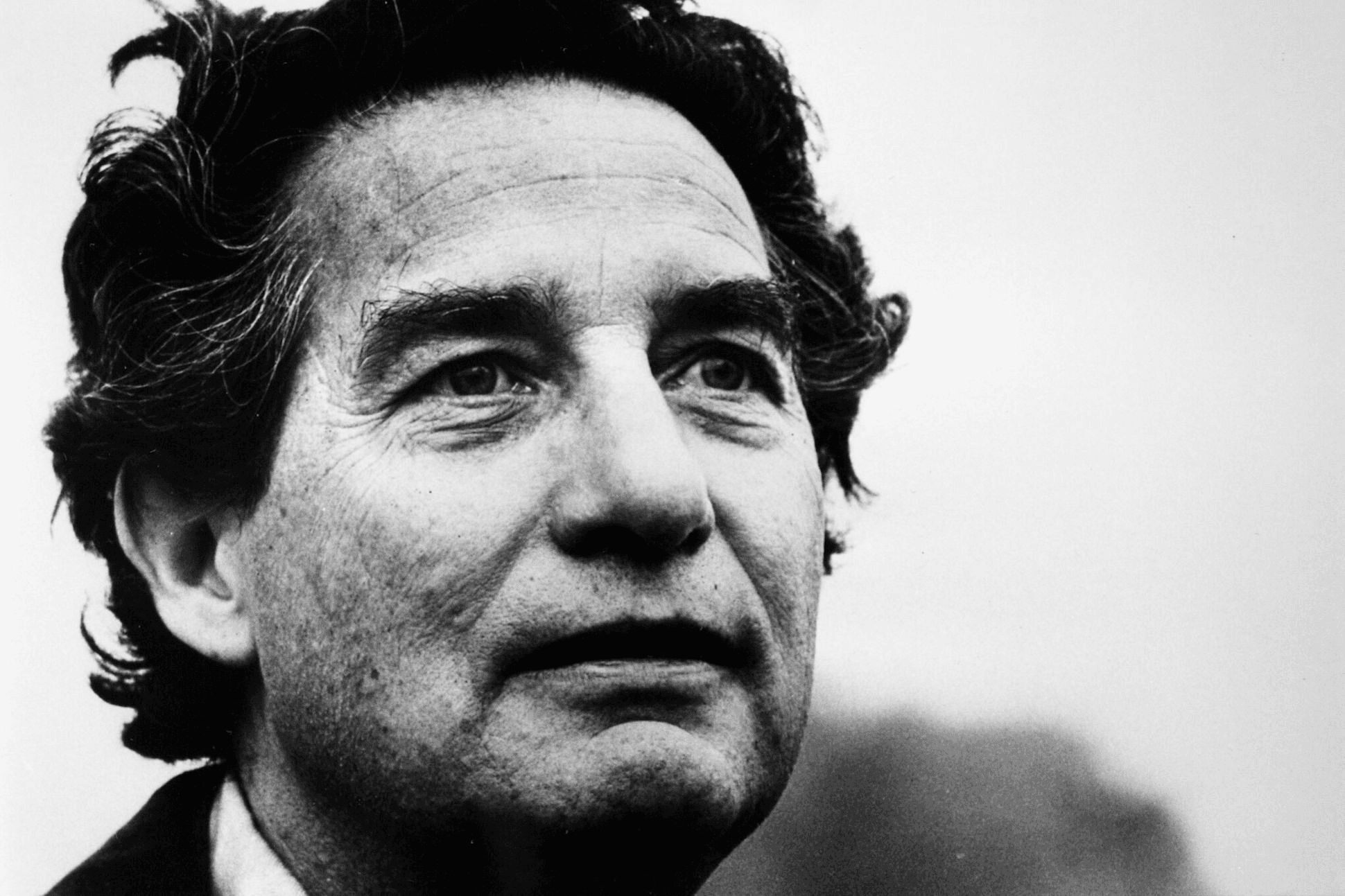
Octavio Paz (1914–1998) was a poet, essayist, diplomat, and cultural theorist. Nobel Prize in Literature, 1990. He is the central figure in twentieth-century Latin American literature — but unlike García Márquez or Borges, he was not a novelist. He was a poet and a thinker. His influence spans three domains.
Poetry: His work fused Surrealism, Eastern philosophy (he served as Mexico's ambassador to India and was deeply shaped by Hinduism and Buddhism), Aztec mythology, and the musicality of the Spanish language. His masterpiece Piedra de Sol (Sunstone, 1957) is a poem of 584 lines whose structure is drawn from the Aztec calendar's Venus cycle — the first and last lines are identical. Time is circular, not linear.
Cultural criticism: His most important prose work is El laberinto de la soledad (The Labyrinth of Solitude, 1950) — an analysis of the Mexican national psyche, exploring conquest, death, the mask, and la chingada (the violated, the conquered) as core concepts of Mexican culture. This book changed how Mexicans understood themselves and remains an inescapable text for anyone trying to understand Mexico.
Cultural politics: He edited literary magazines, discovered and supported young writers, and defined the taste of entire generations of Mexican literature. This kind of power cuts both ways — those he supported were seen; those he ignored were not.
In 1937, during the Spanish Civil War, he traveled to Europe for the first time and encountered the Surrealist circle in Paris. In 1945 he was formally posted to Paris, developed a close relationship with Breton, translated Surrealist poetry, and systematically introduced the movement's theory and practice into Spanish-language literature. But his absorption of Surrealism was selective — what he took was its emphasis on the unconscious and the image, its exploration of language as an instrument of knowing, not Breton's totalitarian management of the movement. He fused Surrealism with Mexico's culture of death, the Aztec conception of time, and Indian philosophical tradition, and made something entirely his own. There is an interesting structure here. As a young man, Paz was a rebel — he supported the Spanish Republicans, and after the Tlatelolco massacre in 1968 he resigned his ambassadorship to India in protest, an act that required real courage at the time. But by the 1970s he had become the establishment itself. The literary magazines he edited, Plural and later Vuelta, were Mexico's most influential cultural platforms, and his taste determined who was seen. Bolaño and the infrarealists opposed Paz not only aesthetically but politically. In his later years Paz moved right — he criticized the Latin American left and supported free markets. Bolaño was a committed leftist who had supported Allende's government in Chile (he was in Chile and witnessed the 1973 coup firsthand). This was not simply a generational quarrel between two cohorts of writers. It was a genuine political disagreement.
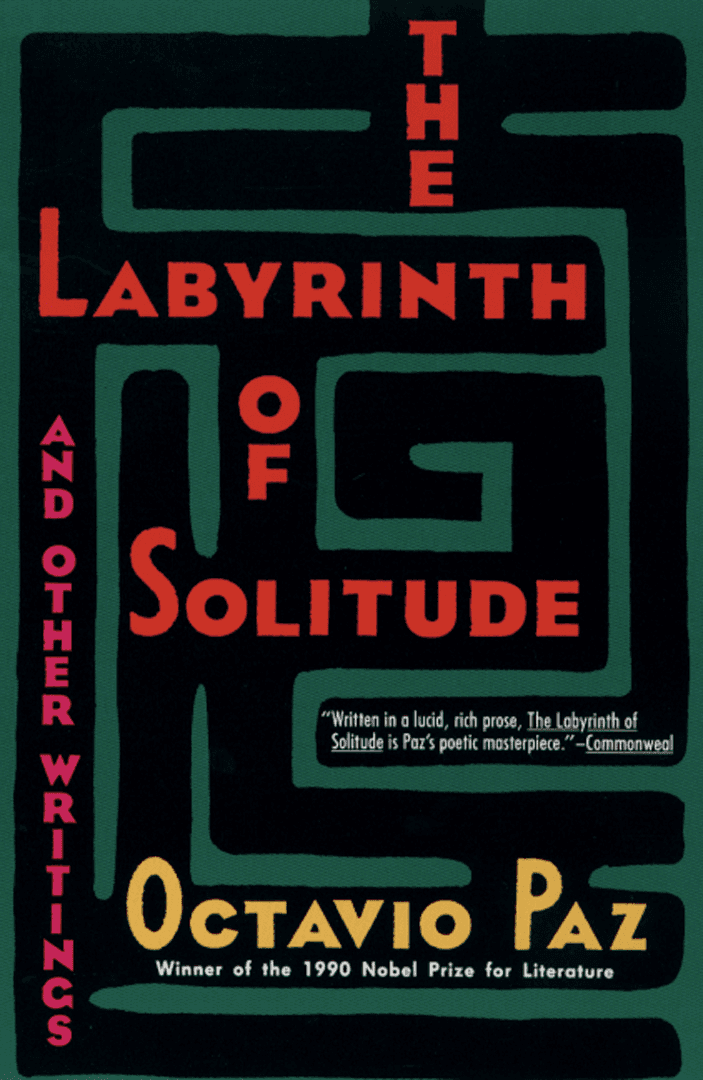
The most important argument in The Labyrinth of Solitude is Paz's analysis of the Mexican "mask." Mexican men use no rajarse — literally "not splitting open" — to protect a vulnerable interior. Death for Mexicans is quotidian, mocked, embraced, because in a history shaped by conquest, colonialism, and revolution, death has never been a stranger. The Day of the Dead is not fear of death. It is familiarity with death. This observation and Pedro Páramo are two faces of the same cultural reality, from the same era — Rulfo with a novel, Paz with an essay, describing the same thing.
The Chain from Paris
Paz met André Breton in Paris in the 1940s. He was already one of Mexico's most important poets; Breton was Surrealism's self-appointed pope, the man who had visited Mexico in 1938 and declared it "a naturally surrealist country." They recognized something in each other — two men who believed that poetry was not decoration but a way of knowing, that the irrational could touch truths reason couldn't reach. Paz brought Surrealism home. He absorbed it, transformed it, wrote about it, edited anthologies of it, made it part of the Mexican literary conversation. Then, over decades, he became what every revolutionary eventually becomes if they live long enough: authority. The Nobel Prize in 1990 was the official seal. By the time Bolaño arrived in Mexico City in 1974, Paz was the establishment itself — the gatekeeper, the measure against which all other Mexican poetry was judged.
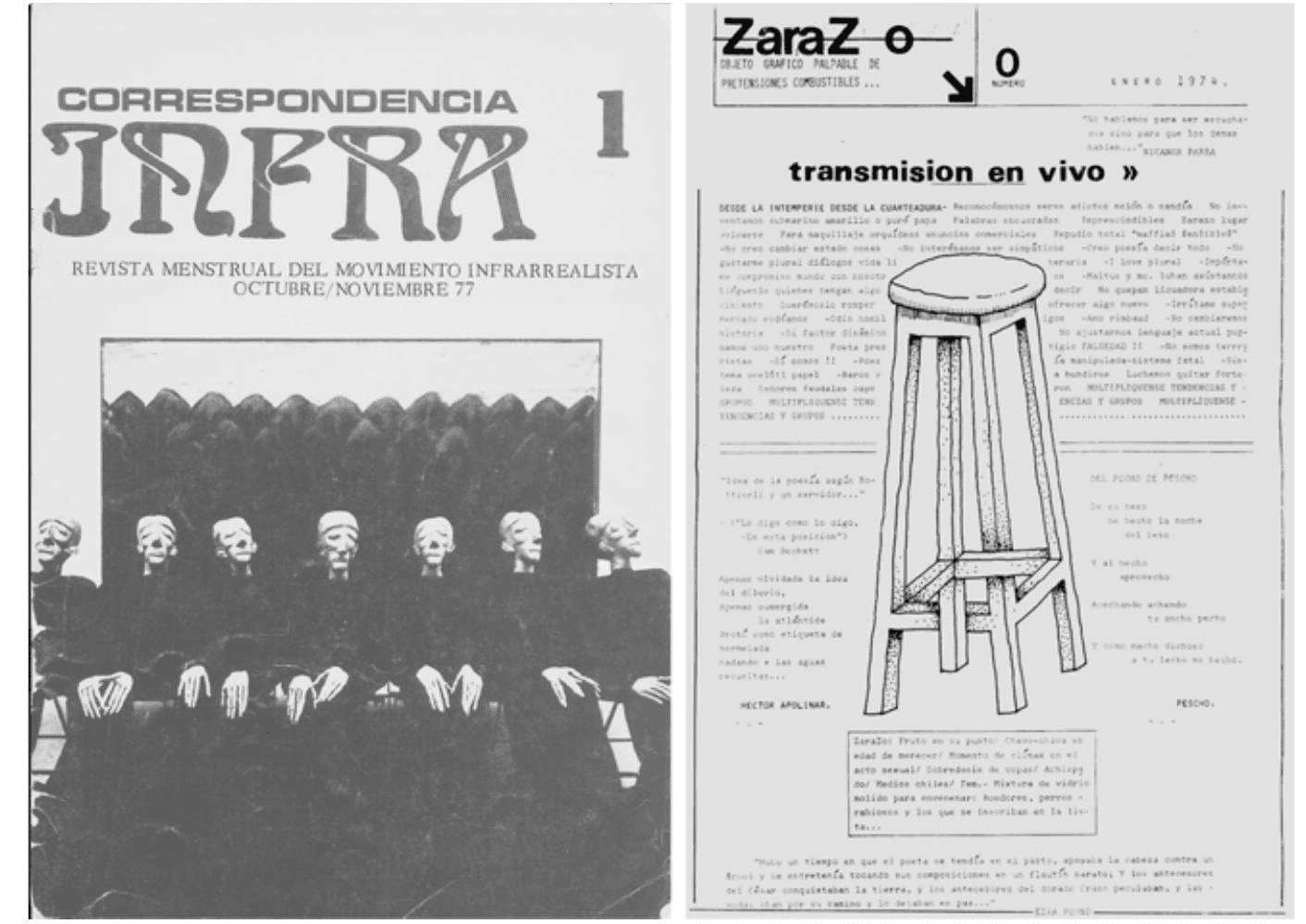
The infrarealists wrote a manifesto. They interrupted Paz's public readings. They made noise. They were broke and young and nobody published them. Arturo Belano and Ulises Lima — Bolaño's fictional versions of himself and his closest friend Mario Santiago Papasquiaro — moved through the city at night like men trying to learn to read a text. What they were rebelling against, in ways they might not have been able to clearly name, was this: Surrealism had arrived in Mexico City as liberation and calcified into institution. The chain ran from Breton's Paris to Paz's Mexico City, to the literary magazines that published certain poets and ignored others, to the power structure that decided whose unreality counted as literature and whose was just noise. But about Breton's declaration that Mexico was naturally surrealist — he was describing something real while understanding it completely wrong. The market altars piled with marigolds and sugar skulls, the Catholic churches built on top of Aztec temples with the old stones still visible in the foundations, the Day of the Dead processions where the boundary between the living and the dead is a social arrangement rather than a metaphysical absolute.
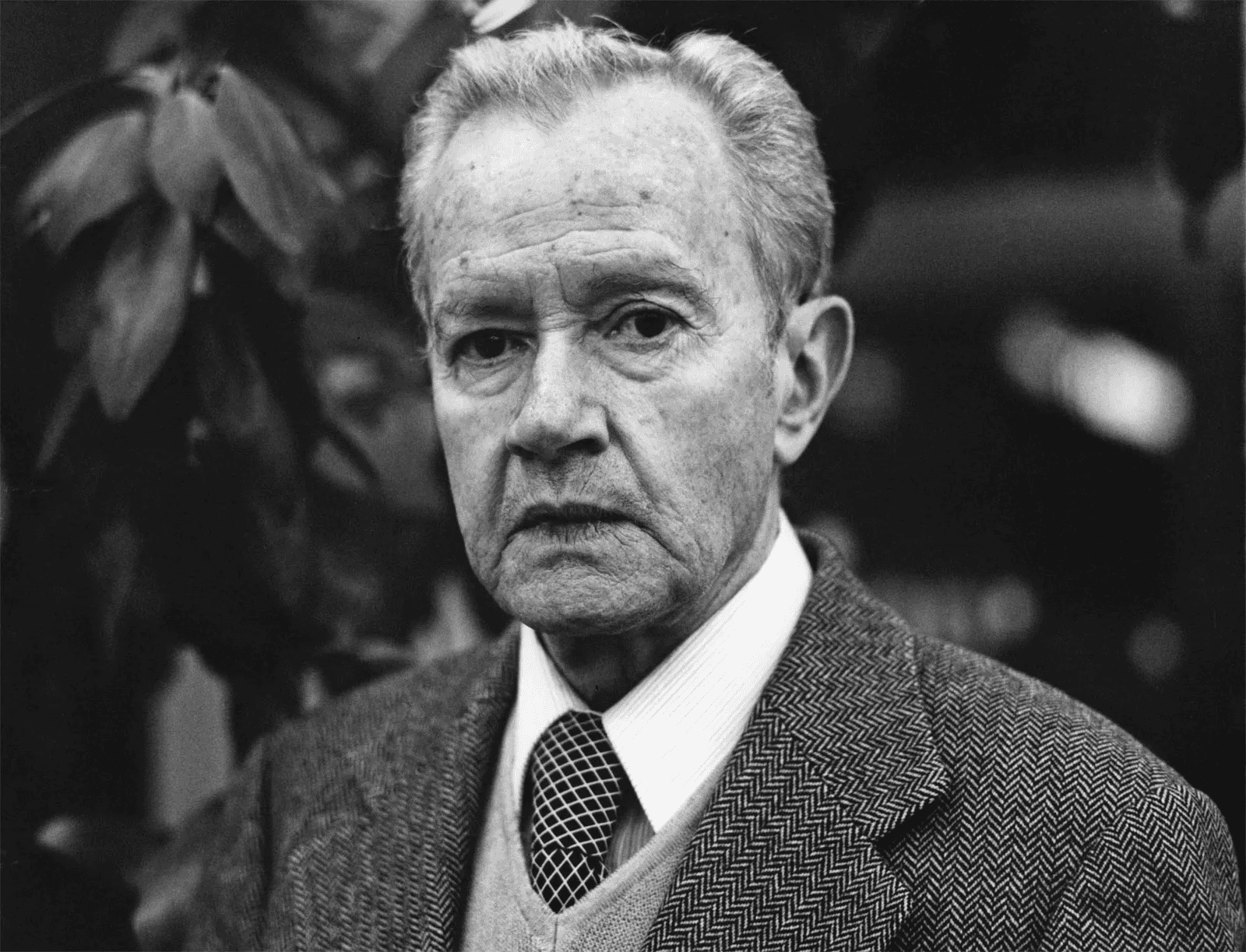
Juan Rulfo understood what it actually was. Pedro Páramo, published in 1955, is one hundred and twenty pages long and contains the entire logic of what Breton was trying to describe and couldn't. A man named Juan Preciado travels to a village called Comala to find his father. When he arrives, the village is empty. Or appears to be. Voices emerge from walls, from the ground, from the air. The dead speak. Time moves in circles. His father, Pedro Páramo, exists simultaneously as a living man, a memory, a ghost, and an absence. The novel has no interest in distinguishing between these states because the culture it comes from has never required that distinction. This is not Surrealism. Surrealism was a movement of European artists who had to work to dismantle the boundary between rational and irrational, who had to use techniques — automatic writing, chance operations, dream recording — to access what their civilization had suppressed. Rulfo didn't need techniques. He was writing from inside a culture where the dead were never far from the living, where colonialism had created a reality layered with so much violence, erasure, and myth that "the surreal" was just another word for Tuesday. Breton saw the surface and claimed it as his own. Rulfo wrote from the interior and changed everything.
Searching for the Lost Woman
Back to Cesárea Tinajero. Bolaño modeled her loosely on real women — real poets who existed on the margins of the 1920s Mexican avant-garde and were largely forgotten. The Estridentismo movement — Mexico's version of Futurism and Dada — produced several such figures: women who wrote, who appeared in literary magazines, and then disappeared from the record. Tinajero is a composite ghost, a placeholder for all the female voices that Mexican literary history decided it didn't need to keep. The visceral realists' search for her is, in many ways, a search for an alternative lineage — a way of connecting to the avant-garde that doesn't run through Paz, that doesn't run through the official story, that finds its origin in someone who was erased rather than celebrated. This is the same search Carrington and Varo were conducting in the 1940s, in the same city, twenty years earlier. They had escaped Europe, escaped the male Surrealist world where women were muses, doorways, objects of the gaze, and arrived in Mexico City where they built something entirely different: a private mythology assembled from alchemy, Kabbalah, Mayan cosmology, Celtic witchcraft, and the particular freedom that comes from being completely outside the institutional art world. Their friendship, their shared dinners, their collaborative imagination, happened in almost complete invisibility. They didn't need an audience. They needed a room, a table, and each other. Two of the most undervalued, most worth rediscovering women artists in the history of Surrealism. They were covered in depth in the Surrealism chapter, but let me put them together here and look at them again on their own terms.
Leonora Carrington (1917–2011)
British, born into a wealthy Catholic family in Lancashire. Her father was a textile magnate; her mother was Irish — Celtic myth and folklore were the air of her childhood. From an early age she was a problem child: expelled from multiple boarding schools because she refused to comply, refused to pretend she was interested in the rules. At 19 she met Max Ernst at a dinner party in London. He was 47, married, a central figure in Surrealism. They fell in love on the spot; she followed him to Paris and entered the Surrealist circle. She was accepted by the circle, but in a specific way — as Ernst's companion, as a beautiful and mysterious young woman, as yet another incarnation of Breton's theoretical "marvellous woman." She was dissatisfied with this position from the beginning. She had her own paintings, her own writing, her own intellectual system, but these were secondary within the circle. In 1940 Germany invaded France. Ernst was interned by the Nazis — he was German, and in France that made him an enemy national. She remained in France alone and suffered a mental breakdown. Her father arranged for her to be sent to a psychiatric institution in Santander, Spain, where she received insulin shock therapy — the standard treatment for "mental illness" at the time, which essentially induced shock and convulsions through drugs.
She later turned this experience into the novel Down Below (1944) — one of the most important female narratives in all of Surrealist literature. It is not the Surrealism of dreams and the unconscious. It is a direct record of a real, concrete, suffocating experience. She describes the process of losing her sense of self, describes the captive body, describes the ordinariness of medical violence. She made her way to Portugal, where she married a Mexican diplomat — the marriage was primarily a means of obtaining documents to leave Europe — and then arrived in Mexico City. In Mexico City she met Remedios Varo. Her visual language is distinctive: alchemical symbols, creatures from Celtic mythology, witches' gatherings, half-human half-animal beings, ancient rituals. Her pictures contain a continuous transformation and transgression of boundaries — humans becoming animals, animals becoming plants, solid becoming liquid. But this transformation is different from that of the male Surrealist artists. Dalí's transformations are about sexual desire and the death drive; Magritte's are about logical error. Carrington's are about the transmission of knowledge. The women in her pictures are practitioners of magic, holders of ancient knowledge — active, not passive.
Key works:
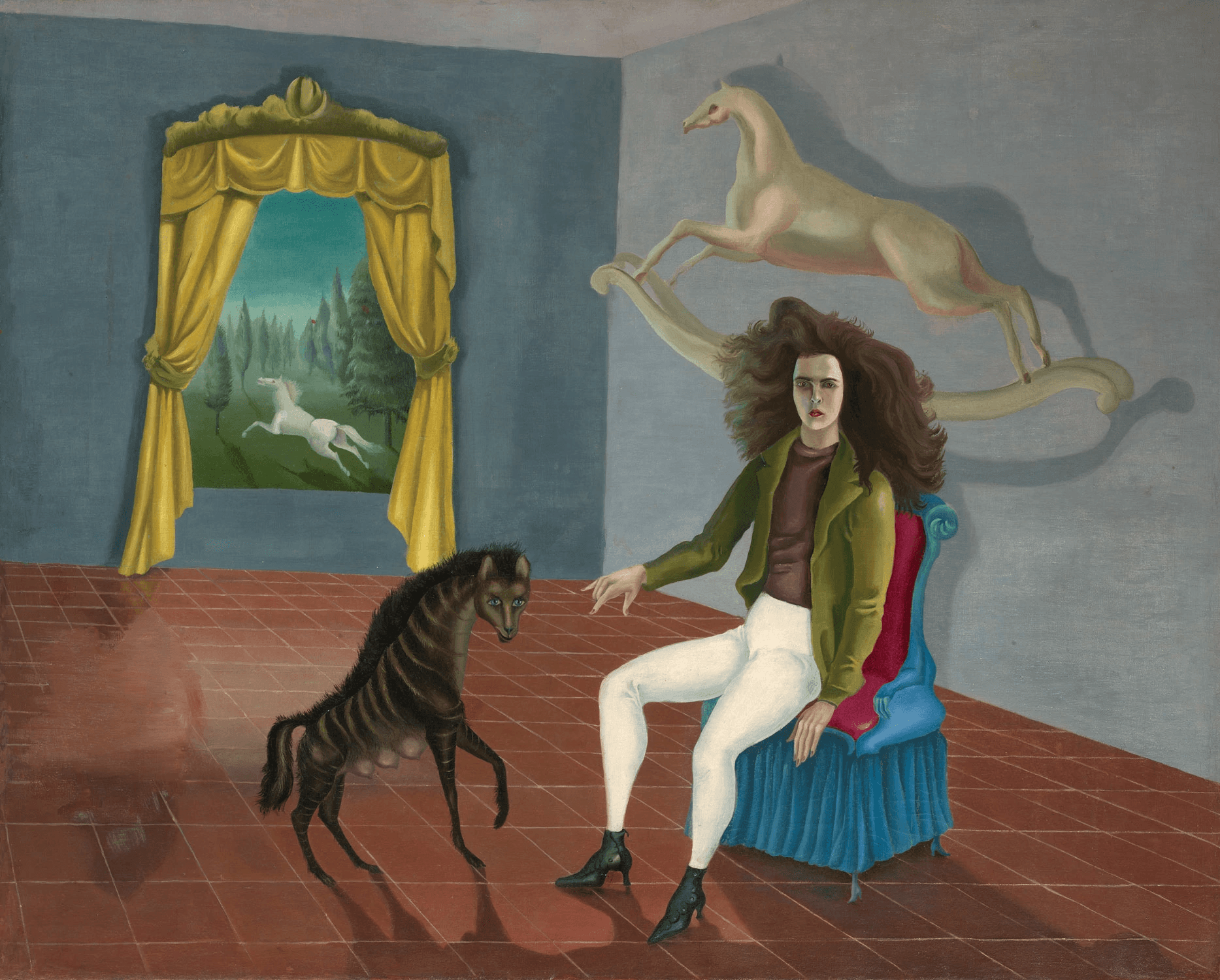
The Inn of the Dawn Horse (1937–38): Her earliest important self-portrait, painted during her time with Ernst. She sits in a chair; behind her through the window a white horse runs (her family's symbol); before her is a hyena. Her gaze is direct and uncontained.
The Temptation of Saint Anthony (1947): Not Dalí's eroticized version of temptation — a parable about knowledge and transformation.
Cooking Eagle series (1957–58): Women are cooking, but what they are cooking is the cosmos — the pots contain planets and constellations. The kitchen as cosmic laboratory; women's domestic labor is given a sacred dimension, while simultaneously mocking that sacralization.
She was also a writer — novels, short stories, plays. Her literary work is harder to find than her paintings but of exceptional quality. Her stories have a strange mixture of dark humor and mythological logic; her female characters always operate within some ancient system of knowledge, resisting patriarchal control in all its forms. She lived the rest of her life in Mexico City, painting until the end. She refused to be defined as a "Surrealist," refused to be defined as a "female artist," refused any label that tried to fix her within a frame. In 2011, at 94, she died in Mexico City. Her work is now in museums around the world, but her recognition in popular culture remains far below what she deserves.
Remedios Varo (1908–1963)
Spanish, born in Anglès, Girona — her father was a hydraulic engineer who frequently moved the whole family around Spain. From childhood she learned engineering draftsmanship alongside her father — precise lines, accurate detail, an understanding of physical structure — a training that entered directly into the visual language of her paintings. She studied at the Madrid School of Fine Arts, one of the very few women in her class. She encountered Surrealism early, fled to Paris when the Spanish Civil War broke out in 1937, entered the Surrealist circle, was with the French Surrealist poet Benjamin Péret, and later fled with him to Mexico. Her friendship with Carrington is one of the most important relationships in the entire story. They lived close to each other in Mexico City, frequently ate meals in each other's homes. Together they studied: alchemical texts, Hermeticism, Kabbalah, Mayan mythology, pre-Columbian cosmology, Jungian psychology, Gurdjieff's mystical teachings. This was not a hobby — it was serious intellectual exploration. They believed there existed a knowledge tradition that mainstream culture, and Western male rationalism in particular, had systematically suppressed: a tradition that was feminine, mystical, and ancient. They were trying to re-enter it. They also played tricks together — they would research strange recipes, and reportedly once gave a man who was bothering them something to drink that made him fall madly in love with a tree. The accuracy of this story is uncertain, but it captures something true about their relationship: a dark humor and a light, easy subversion of power.
Her visual language is the most precise, the most jewel-like in all of Surrealism — lines of extreme fineness, detail accurate enough for engineering drawings, every element in the picture carrying its own internal logic. Her figures typically have elongated, elfin faces, wear medieval-style clothing, travel in strange vessels, or perform some kind of work in mysterious interior spaces. These activities — weaving, cooking, exploring, cartography — are all given cosmic significance. Her figures are mostly women, and they are active women — not being gazed at, not waiting, but doing, traveling, exploring, building. Within the visual tradition of Surrealism, this is a radical difference.
Key works:
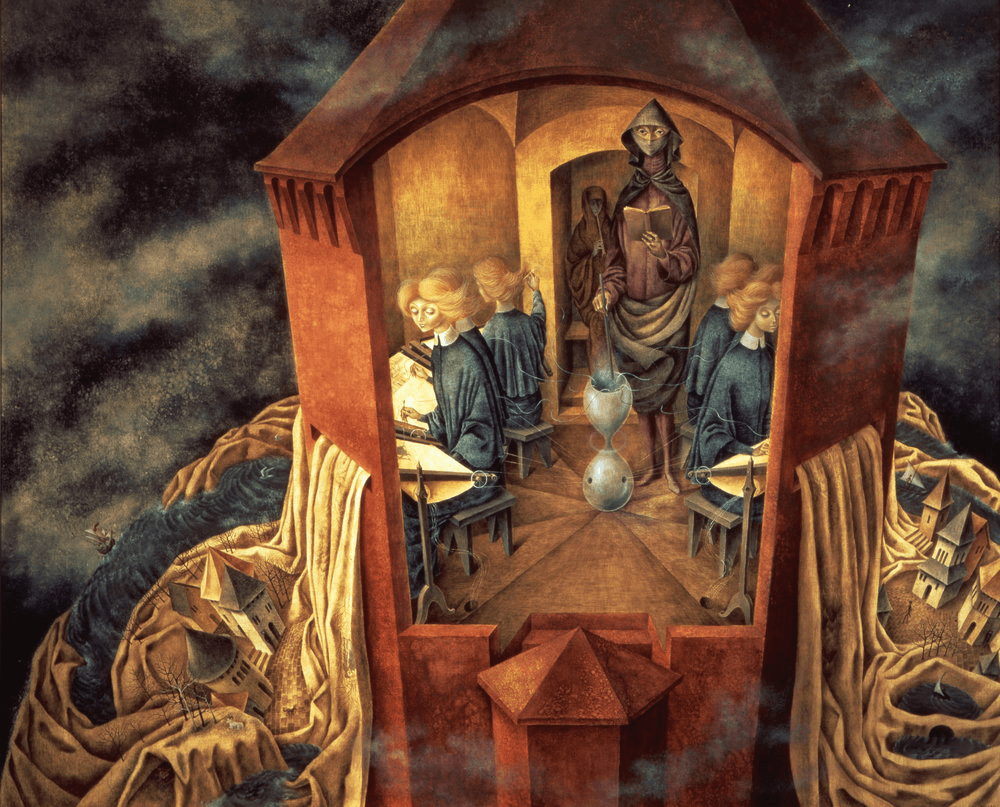
Embroidering the Earth's Mantle (1961): Figures sit at windows in a high tower weaving fabric; the fabric flows down from the windows and becomes the cities, rivers, and trees of the ground below. They are literally weaving the world.
Still Life by Moonlight (1956): A nighttime tabletop, an owl, fruit and objects glowing in moonlight. A still life becomes the scene of a mysterious ritual.
Exploration of the Sources of the Orinoco River (1959): A figure travels alone through a forest, sitting in a small boat made from her own cloak, navigating into dark trees, searching for the source of a river. This is the image that recurs most often in Varo's work — a woman traveling alone, moving toward an unknown depth.
The Weaving of Space (1956): A woman spins thread, but what she spins is not thread — it is space itself, the fabric of the cosmos.
In 1963, at fifty-four, she died suddenly of a heart attack. She was at the peak of her creative powers — her paintings were growing more complex, more deeply embedded in her own mythological system. Her death was a tremendous blow to Carrington. Carrington rarely spoke about Varo in interviews afterward, and that silence says what words didn't. Her paintings are now primarily in the Museo Remedios Varo in Mexico City, one of the most visited art museums in Mexico. People line up to see her work. This was unimaginable during her lifetime — she died almost entirely unknown outside Mexico.
Looked at together, what they were doing was not a female version of Surrealism. They built something entirely different, one that happened to share certain tools with Surrealism — strange imagery, dream logic, a refusal of reason. But the direction was opposite. The male Surrealist artists dug inward — toward the Freudian personal unconscious, toward sexual desire and the death drive, toward repressed trauma. Carrington and Varo moved outward — toward an ancient, collective, cosmic knowledge tradition, toward the logic of alchemy and myth and nature, toward a world where women are subjects, not objects. Their pictures contain no fear, no anxiety, no repressed thing seeking an outlet. What they contain is curiosity, exploration, and a deep, unhurried pleasure. This difference is fundamental. It explains why they could never finally be contained within the Surrealist frame — not because they weren't good enough, but because they were doing something entirely different that simply didn't have a large enough voice to be heard.
The Structure of the Search
The Savage Detectives is in three parts. A young poet's diary. Then hundreds of pages of testimony from dozens of characters, spread across years and continents, describing in fragments what happened to Arturo Belano and Ulises Lima after they left Mexico City. Then the diary again, briefly, in the Sonoran desert, at the end of the search. The novel never tells you what Cesárea Tinajero's poem means. The three panels — straight line, wavy line, wavy line with boat — are reproduced in the text, and various characters attempt interpretations. Calm sea, rough sea, storm with a ship that hasn't sunk yet. Or: youth, maturity, old age. Or: something else entirely. The interpretations multiply and cancel each other out. The poem holds its silence. This, I think, is what Mexico City does to literary movements that arrive with too much certainty about what they mean. It absorbs them. The Surrealists came with their theories of the unconscious, their techniques for bypassing reason, their declarations that this country was naturally theirs, and the city took all of it in and continued being itself. The Aztec foundations under the colonial churches under the sinking streets; Rulfo's dead speaking from the walls; the lost women poets waiting in old magazines for someone to come looking. Bolaño's young poets search for Cesárea Tinajero not because they expect to find a message but because the search itself is the only honest thing they know how to do. They are looking for proof that someone like them existed before, that the margins of literary history contain real people who made real work that mattered even when nobody was watching. They find her, finally, in the desert. What happens there I won't describe. But the poem's meaning stays open.
Breton went back to Paris. Paz won the Nobel. Bolaño left Mexico City and wrote the whole thing down from memory, years later, in Spain. Carrington stayed in Mexico City until 2011. She was ninety-four. She had been painting until near the end — still the alchemy, still the witches, still the ancient women navigating impossible spaces. Varo died in 1963, at fifty-four, of a heart attack. Her paintings are in a museum in Mexico City now. People line up to see them. Rulfo published two books: Pedro Páramo and a short story collection. Then he stopped writing, or said he had stopped, or said the voice he had been listening to had gone quiet. He spent the rest of his life telling people he had nothing more to say. He died in 1986. The foundations of Tenochtitlán are still down there. The city is still sinking. Some searches don't end. Some poems stay unread. Some women stay lost until someone young and broke and furious decides to go looking. This is the surrealism of Mexico City. It was never André Breton's to name.
🖼️
红外线主义
1975年,墨西哥城。两个年轻人,都没有钱,都没有人出版他们,决定创立一个诗歌运动。罗贝托·波拉尼奥,智利人,22岁,1968年随家人移民墨西哥,后来1973年回智利支持阿连德政府,亲历了皮诺切特政变,被关押了几天,靠认识他的狱卒帮忙才得以释放,然后逃回墨西哥。马里奥·圣地亚哥·帕帕斯基亚罗(本名何塞·阿尔弗雷多·曾德哈斯·皮内达),墨西哥人,22岁,来自工人阶级家庭,在墨西哥城街头长大。这两个人是《荒野侦探》里阿图罗·贝拉诺和乌利塞斯·利马的真实原型。他们把运动叫做红外线主义(Infrarrealismo)。为什么是红外线?红外线是光谱里肉眼不可见的部分——在可见光之下,在官方文化承认的范围之外。这个名字是一个位置声明:我们在那里,只是你们选择看不见。
1976年,他们发表了宣言——《再次,放弃一切》(Déjenlo todo, nuevamente)。波拉尼奥和马里奥·圣地亚哥联合署名。宣言的语气是爆炸性的、混乱的、充满引用的,他们提到了蓝骑士、达达、维尔托夫、金斯堡、布勒东、切·格瓦拉、马雅可夫斯基、法国新浪潮电影。它不是一份清晰的政治纲领,是一片弹片,向所有方向同时射出。
几个核心主张:
诗歌必须被活出来,不只是被写出来。 不是在书房里的文学实践,是一种生活方式,是把你的身体和你的时间都投入进去的选择。
反对一切建制。 帕斯、官方文学杂志、大学、奖项、一切把诗歌变成职业阶梯的东西。
向边缘倾斜。 工人、穷人、移民、妓女、瘾君子——他们的现实是诗歌真正的材料,不是精英文化沙龙里的谈资。
语言本身必须被炸开。 不是优雅的西班牙语,不是帕斯那种精心构建的意象——是街头语言,是粗粝的、不完整的、充满错误的语言。
红外线主义不是凭空出现的。他们的影响来自几个方向:
嚣鸣主义(Estridentismo):1920年代墨西哥的先锋派运动——马努埃尔·马普尔斯·阿塞,是墨西哥的未来主义和达达的混合体。同样反对建制,同样崇拜城市和机器,同样用宣言作为武器。红外线主义者认自己是这个传统的继承者。
这里有一个直接的连线:嚣鸣主义产生了那些被遗忘的女诗人——波拉尼奥塑造塞萨雷娅·蒂纳赫罗这个角色,就是从这个传统里挖掘的。
垮掉的一代:金斯堡、凯鲁亚克、科尔索,把诗歌作为生活方式,把边缘经验作为材料,用口语化的语言打破精英文学的边界。波拉尼奥深受影响,他在宣言里直接提到了金斯堡。
俄国未来主义:马雅可夫斯基,诗歌作为政治行动,在街头朗诵,在公共空间存在。
达达:破坏性的姿态,打断,制造混乱,把挑衅本身当作艺术行动。
布努埃尔和新浪潮电影:他们不只对文学感兴趣,对电影也是。布努埃尔的超现实主义叙事逻辑,戈达尔的剪辑方式,维尔托夫的摄影机眼睛——这些影响在他们的诗歌结构里有痕迹。
他们具体做了什么
打断帕斯的朗诵:这是他们最著名的行动。他们出现在帕斯的公开朗诵和文学活动上,大声提问,制造混乱,发传单,宣读自己的诗歌。这在当时的墨西哥文学圈是极度冒犯的行为,帕斯是国家级别的文化象征,挑战他需要某种无所顾忌。他们无所顾忌,因为他们没有任何可以失去的东西。
出版小杂志和传单:没有钱,没有印刷设备,他们用复印机和手工印刷出版小册子,在街头分发。这些出版物的印量很小,大多数已经消失。
在街头生活:他们在墨西哥城游荡,咖啡馆、酒吧、市场、大学校园、贫民区。他们认识妓女、瘾君子、流浪汉,把这些相遇带进诗歌。这不是浪漫化贫困的姿态,他们自己就是穷的。
写作:他们写了大量诗歌,在餐巾纸上,在笔记本里,在任何可以写字的地方。大多数从未出版。
马里奥·圣地亚哥:真正的乌利塞斯·利马
这是整个故事里最重要、最令人心碎的人物。马里奥·圣地亚哥是红外线主义真正的灵魂,比波拉尼奥更激进,更彻底,更无法被体制吸收。波拉尼奥后来离开墨西哥去了欧洲,慢慢开始写小说,最终获得了国际声誉。他来自墨西哥城贫困的工人阶级家庭。他读书广博,他几乎读了所有东西,有一种令人惊异的智识能量,但这种能量从未找到一个稳定的出口。他用毒品,经历了多段混乱的感情关系,住在不同朋友家里辗转,长期身无分文。他的诗歌是真正激进的,密集的、自由的、拒绝任何格律或传统结构的,充满了街头语言和文学引用的奇怪混合。在认识他的人里,他被认为是那一代最有才华的墨西哥诗人之一。在不认识他的人里,他几乎完全不存在。他1998年在墨西哥城被汽车撞倒,死亡。45岁。同一年,《荒野侦探》出版。波拉尼奥在西班牙写完了这本关于他们两个年轻时在墨西哥城游荡的小说,然后马里奥在墨西哥的街上死了。
红外线主义作为一个有组织的运动只持续了几年。1977年波拉尼奥离开墨西哥,运动实际上解散了。它没有改变墨西哥的文学建制,帕斯继续统治,官方文学机构继续运转。它出版的作品大多消失了,它组织的活动没有留下系统性的记录。波拉尼奥花了二十年消化这段经历,然后写了一部关于它的小说,这部小说改变了西班牙语文学的走向,被翻译成数十种语言,让世界各地的读者认识了墨西哥城1970年代的这群年轻诗人。
荒野侦探
《荒野侦探》的核心,有一首没有人能读懂的诗。它属于塞萨雷娅·蒂纳赫罗,,一个在1920年代某个时刻从墨西哥城消失的女诗人,几乎什么都没留下:几处旧文学杂志里的痕迹,一个没有人记得的名字,以及一首幸存下来的诗,但其实根本不是诗,是一幅画。三个小格子。一条直线,一条波浪线,一条波浪线上有一艘帆船。就这些。两个年轻诗人用了整部小说的篇幅,以及他们生命中的几年时光,去寻找画出它的女人。
波拉尼奥从流亡中写下《荒野侦探》,从记忆里,从一个曾经在墨西哥城作为年轻人生活过、后来离开、却从未真正离开的人的位置上写下它。小说里的城市是1970年代中期的墨西哥城:廉价的咖啡馆,没有人读的文学杂志,屋顶派对和街角,以及国立自治大学的校园,内脏现实主义者们在那里向墨西哥文学建制宣战。内脏现实主义是波拉尼奥为他真实参与创立的红外线主义运动所虚构的对应物。他们宣战的建制,有一张具体的脸:奥克塔维奥·帕斯。
奥克塔维奥·帕斯(1914-1998),诗人、散文家、外交官、文化理论家。1990年诺贝尔文学奖。他是20世纪拉丁美洲文学的核心人物,但和马尔克斯、博尔赫斯不同——他不是小说家,他是诗人和思想家。
他的影响横跨三个领域:
诗歌: 他的诗歌融合了超现实主义、东方哲学(他在印度做过大使,深受印度教和佛教影响)、阿兹特克神话、西班牙语的音乐性。他的代表作《太阳石》(Piedra de Sol,1957)是一首584行的诗,结构来自阿兹特克历法的金星周期,首尾两句完全一样——时间是圆的,不是线性的。
文化批评: 他最重要的散文著作是《孤独的迷宫》(El laberinto de la soledad,1950)——分析墨西哥的民族心理,探讨征服、死亡、面具、"chingada"(被征服者)这些墨西哥文化的核心概念。这本书改变了墨西哥人理解自己的方式,至今仍是理解墨西哥不可绕过的文本。
文化政治: 他主编文学杂志,发现和支持年轻作家,定义了整整几代墨西哥文学的品味标准。这种权力是双刃的——他支持的人被支持,他忽视的人被忽视。
1937年西班牙内战期间,他第一次去欧洲,在巴黎接触到超现实主义圈子。1945年他正式被派驻巴黎,和布勒东深入来往,翻译超现实主义诗歌,把运动的理论和实践系统性地引入西班牙语文学。但他对超现实主义的吸收是选择性的,他取的是对潜意识和图像的重视,对语言本身作为认识工具的探索,而不是布勒东那种极权式的运动管理。他把超现实主义和墨西哥的死亡文化、阿兹特克的时间观、印度的哲学传统结合,做出了完全属于他自己的东西。
这里有一个有趣的结构:帕斯年轻时是反叛者,他支持西班牙共和派,1968年特拉特洛尔科广场屠杀发生后,他辞去了驻印度大使职务以示抗议,这在当时需要真正的勇气。但到了1970年代,他已经是建制本身。他主编的杂志《复数》(Plural)和后来的《Vuelta》是墨西哥最有影响力的文学平台,他的品味决定了谁被看见。波拉尼奥和红外线主义者不只是在美学上反对帕斯,他们在政治上也反对他。帕斯晚年思想右转,批评拉丁美洲左翼,支持自由市场。波拉尼奥是坚定的左翼,曾经支持智利的阿连德政府(他1973年的政变亲历者)。这不只是两代文人之间的代际冲突,是真实的政治分歧。
《孤独的迷宫》里最重要的观点, 是他分析墨西哥人的"面具",墨西哥男性用"不动声色"(no rajarse,字面意思是"不裂开")来保护脆弱的内心。死亡对墨西哥人是日常的、被嘲笑的、被拥抱的,因为在一个经历了征服、殖民、革命的历史里,死亡从来不是陌生人。骷髅节不是对死亡的恐惧,是对死亡的熟悉。这个观察和《佩德罗·巴拉莫》是同一个时代、同一个文化现实的两个面,鲁尔福用小说,帕斯用散文,描述的是同一件事。
从巴黎延伸的链条
帕斯在1940年代于巴黎遇见了安德烈·布勒东。他当时已经是墨西哥最重要的诗人之一;布勒东是超现实主义自封的教皇,那个在1938年访问墨西哥后宣称"墨西哥是天然的超现实主义国家"的人。安德烈·布勒东(1896-1966),法国诗人、作家、理论家。他不是超现实主义最好的艺术家,但他是超现实主义的发明者、组织者、和守门人。他年轻时学医,一战期间在精神病院实习,第一次系统性地接触了弗洛伊德的理论。他看到了战争对人类神经系统的摧毁,看到了被压抑的创伤以症状的形式浮现,这个经历直接催生了他后来对潜意识的痴迷。他早期是达达主义者,和查拉在巴黎共事,但很快对达达的纯粹虚无主义感到不满足。达达说:什么都没有意义。布勒东说:不对,有一个更深的意义,只是在别的地方。1924年,他写了《超现实主义宣言》,超现实主义作为正式运动诞生。没有布勒东,超现实主义可能作为一种感受和冲动存在,但不会作为一个有名字、有宣言、有历史的运动存在。
帕斯把超现实主义带回了家。他吸收它,改造它,写作它,编辑它的选集,把它变成墨西哥文学对话的一部分。然后,经过数十年,他变成了每一个活得足够长的革命者最终都会变成的东西:权威。1990年的诺贝尔奖是官方的印章。等到波拉尼奥1974年抵达墨西哥城,帕斯已经是建制本身,守门人,衡量所有其他墨西哥诗歌的标尺。
红外线主义者写了一份宣言。他们打断帕斯的公开朗诵。他们制造噪音。他们身无分文,年轻,没有人出版他们。阿图罗·贝拉诺和乌利塞斯·利马——波拉尼奥对自己和最亲密的朋友马里奥·圣地亚哥·帕帕斯基亚罗的虚构化身——在夜里穿行于这座城市,像在努力学会阅读一段文字。他们在反抗的,用他们自己也未必能清晰命名的方式,是这样一件事:超现实主义作为解放抵达墨西哥城,然后钙化成了制度。这条链条从布勒东的巴黎延伸到帕斯的墨西哥城,延伸到那些发表某些诗人、无视另一些诗人的文学杂志,延伸到那个决定谁的非现实算作文学、谁的只是噪音的权力结构。
但关于布勒东说墨西哥天然是超现实主义的,那些摆满万寿菊和糖骷髅的市场祭坛,那些建在阿兹特克神庙上、地基里仍然可见旧石块的天主教教堂,那些亡灵节游行,在那里,生死之间的边界是一种社会安排而非形而上学的绝对。胡安·鲁尔福理解那实际上是什么。《佩德罗·巴拉莫》,1955年出版,只有一百二十页,却包含了布勒东试图描述却无法描述的全部逻辑。一个叫胡安·普雷西亚多的男人去科马拉村寻找他的父亲。到达时,村子是空的。或者看起来是空的。声音从墙里、从地下、从空气中涌现。死者说话。时间以圆圈运动。他的父亲佩德罗·巴拉莫同时作为活人、记忆、鬼魂和缺席而存在。这部小说对区分这些状态没有任何兴趣,因为它所来自的文化从未要求做出这种区分。
这不是超现实主义。超现实主义是一批欧洲艺术家的运动,他们必须努力拆除理性与非理性之间的边界,必须使用技术,自动书写、偶然操作、梦境记录来触及他们的文明所压抑的东西。鲁尔福不需要技术。他是从一种文化的内部写作,在那种文化里,死者从来都离生者不远,在那里,殖民主义创造的现实层叠着如此之多的暴力、抹除与神话,以至于"超现实"只不过是"星期二"的另一种说法。布勒东看到了表面,宣称那是他的。鲁尔福从内部写作,改变了一切。
寻找失踪的女人
回到塞萨雷娅·蒂纳赫罗。波拉尼奥以真实的女性为原型,松散地塑造了她,真实存在过的诗人,活在1920年代墨西哥先锋派的边缘,大多被遗忘了。墨西哥的嚣鸣主义运动,也就是墨西哥的未来主义与达达版本,产生了几个这样的人物:写作的女性,出现在文学杂志里,然后从记录中消失。蒂纳赫罗是一个复合的幽灵,是墨西哥文学史认为不必保留的所有女性声音的占位符。内脏现实主义者对她的寻找,在诸多意义上,是对另一条谱系的寻找,一种连接先锋派的方式,不经过帕斯,不经过官方叙事,在某个被抹除而非被颂扬的人那里找到源头。这是卡灵顿和瓦罗在1940年代进行的同一种寻找,在同一座城市,早了二十年。她们逃离了欧洲,逃离了超现实主义的男性世界,在那个世界里,女性是缪斯,是入口,是凝视的对象,她们抵达墨西哥城,在那里建立了完全不同的东西:一个从炼金术、卡巴拉、玛雅宇宙观、凯尔特巫术、以及彻底置身于体制艺术世界之外所带来的特殊自由中拼装起来的私人神话。她们的友谊,她们共同的晚餐,她们协作的想象力,在几乎完全的隐形中发生。她们不需要观众。她们需要的是一个房间,一张桌子,以及彼此。两个在超现实主义历史里最被低估、最值得被重新看见的女性艺术家。已经在超现实主义那一章里详细介绍过她们,但让我单独把她们放在一起再看一遍。
里奥诺拉·卡灵顿 Leonora Carrington(1917-2011)
英国人,出生于兰开夏郡的一个富裕天主教家庭。父亲是纺织业大亨,母亲是爱尔兰人,凯尔特神话和民间故事是她童年的空气。她从小就是一个问题儿童:被多所寄宿学校开除,因为她拒绝服从,拒绝假装对那些规则感兴趣。 她19岁在伦敦的一个晚宴上遇见了马克斯·恩斯特,当时47岁,已婚,是超现实主义的核心人物。他们当场相爱,她跟他去了巴黎,进入了超现实主义圈子。她被圈子接受,但以一种特定的方式,作为恩斯特的伴侣,作为一个美丽的、神秘的年轻女性,作为布勒东理论里"神奇女性"的又一个化身。她从一开始就对这个位置感到不满。她有自己的画,自己的写作,自己的思想系统,但这些在圈子里是次要的。
1940年,德国入侵法国。恩斯特被纳粹关押(他是德国人,在法国被视为敌国公民)。她独自留在法国,精神崩溃,被她的父亲安排送进了西班牙桑坦德的一家精神病院,接受胰岛素休克治疗——这是当时对"精神疾病"的标准治疗,本质上是用药物诱发休克和痉挛。她后来把这段经历写成了小说《下面》(Down Below,1944)——是整个超现实主义文学里最重要的女性叙事之一。它不是梦境和潜意识的超现实主义,是真实的、具体的、令人窒息的经历的直接记录。她在里面描述了失去自我感知的过程,描述了被关押的身体,描述了医疗暴力的日常性。她辗转逃到葡萄牙,在那里嫁给了一个墨西哥外交官(这段婚姻主要是为了获得离开欧洲的文件),然后到了墨西哥城。在墨西哥城,她遇见了雷梅迪奥斯·瓦罗。
她的视觉语言是独特的,炼金术的符号、凯尔特神话的生物、女巫的聚会、半人半兽的存在、古老的仪式。她的画面里有一种持续的变形和越界:人变成动物,动物变成植物,固体变成液体。但和超现实主义男性艺术家的变形不同,达利的变形是关于性欲和死亡本能,马格利特的变形是关于逻辑错误,卡灵顿的变形是关于知识的传递。她画面里的女性是魔法的实践者,是古老知识的持有者,是主动的而不是被动的。
代表作:
《宾馆女男爵》(The Inn of the Dawn Horse,1937-38): 她最早的重要自画像,画于和恩斯特在一起的时期。她坐在椅子上,背后是窗外一匹奔跑的白马(她家族的象征),面前是一只鬣狗。她的眼神是直接的、不羁的。
《圣·安东尼的诱惑》(1947): 不是达利版本的性欲化诱惑,是一个关于知识和转化的寓言。
《烹饪雄鹰》系列(1957-58): 女性在烹饪,但烹饪的是宇宙——锅里是行星和星座。厨房作为宇宙实验室,女性的家务劳动被重新赋予了神圣的维度,同时也在嘲笑这种神圣化本身。
她同时是作家,小说、短篇故事、戏剧。她的文学作品比她的画更难找到,但质量极高。她的故事有一种黑色幽默和神话逻辑的奇怪混合,女性角色总是在某种古老的知识系统里运作,对抗各种形式的父权控制。她在墨西哥城住了余生,一直画到最后。她拒绝被定义为"超现实主义者",拒绝被定义为"女性艺术家",拒绝任何试图把她固定在某个框架里的标签。2011年,94岁,在墨西哥城去世。她的作品现在在世界各地的博物馆里,但她在大众文化里的知名度仍然远低于她应得的位置。
雷梅迪奥斯·瓦罗 Remedios Varo(1908-1963)
西班牙人,出生于安达卢西亚的赫雷斯,父亲是水利工程师,经常带着全家在西班牙各地迁移。她从小跟着父亲学习工程制图——精密的线条,准确的细节,对物理结构的理解,这个训练后来直接进入了她画面的视觉语言。她在马德里美术学院学习,是班里极少数女学生之一。她早期接触了超现实主义,1937年西班牙内战爆发,她逃往巴黎,进入了超现实主义圈子,和本亚明·佩雷(法国超现实主义诗人)在一起,后来和他一起逃往墨西哥。
她和卡灵顿的友谊是整个故事里最重要的关系之一。她们在墨西哥城住得很近,经常在彼此家里吃饭。她们一起研究:炼金术文本、赫耳墨斯主义、卡巴拉、玛雅神话、前哥伦布时代的宇宙观、荣格心理学、古吉夫的神秘主义教导。这不是业余爱好,是严肃的智识探索。她们相信存在一种被主流文化,特别是被西方男性理性主义,系统性压制的知识传统,那个传统是女性的、神秘的、古老的。她们试图重新进入那个传统。她们也一起恶作剧,她们会研究各种奇怪的配方,据说曾经给一个让她们烦恼的男人喝了某种东西,让他疯狂地爱上了一棵树。这个故事的真实性存疑,但它描述了她们关系里的那种黑色幽默和对权力的轻盈颠覆。
她的视觉语言是整个超现实主义里最精密、最宝石般的,极细的线条,精确到工程制图的细节,画面里的每一个元素都有其内在的逻辑。她画面里的人物通常有拉长的、精灵般的面孔,穿着中世纪风格的服装,在奇异的载具里旅行,或者在神秘的室内空间里进行某种工作。这些工作,织布、烹饪、探索、制图,都被赋予了宇宙性的意义。她画面里的人物大多是女性,而且是主动的女性——不是被凝视的,不是在等待的,是在做事的,是在旅行的,是在探索的,是在建造的。这在超现实主义的视觉传统里是激进的区别。
代表作:
《刺绣地球》(Embroidering the Earth's Mantle,1961): 一群人物坐在高塔的窗户里织布,她们织出的布料从窗户流下来,变成了地面上的城市、河流、树木。她们在字面意义上编织世界。
《探索的猫头鹰》(Still Life by Moonlight,1956): 夜晚的桌面,一只猫头鹰,水果和器具在月光下发光。静物画变成了一个神秘仪式的场景。
《星光旅行》(Exploration of the Sources of the Orinoco River,1959): 一个人物在森林里独自旅行,坐在一艘用她自己的斗篷做成的小船里,导航进入黑暗的树林,寻找一条河流的源头。这是瓦罗画面里最反复出现的图像——独自旅行的女性,向未知的深处前进。
《宇宙纺织者》(The Weaving of Space,1956): 一个女性在纺纱,纺出来的不是线,是空间本身,是宇宙的织物。
1963年,五十四岁,心脏病发作,突然去世。她死时正处于创作的巅峰期,她的画越来越复杂,越来越深入她自己的神话系统。她的死对卡灵顿是巨大的打击。她的画现在主要在墨西哥城的雷梅迪奥斯·瓦罗博物馆,是墨西哥最受欢迎的艺术博物馆之一。人们排队去看她的画。这在她生前是无法想象的,她死时在国际上几乎完全不为人知。瓦罗的画里,人物通常是独自旅行的女性。在不可能的载具里穿越神秘的空间,导航、探索、建造、创造。不是被看见,是在移动。卡灵顿写的小说和故事里,女性不是缪斯而是魔法师,不是客体而是古老知识的实践者。她的墨西哥城是一座有着真实魔法的城市,不是超现实主义技术所制造的那种舞台魔法。到最后,她们两人都不再自称超现实主义者。这座城市给了她们更好的东西:成为无法被翻译之物的空间。
把她们放在一起看,她们做的不是超现实主义的女性版本。她们建立的是完全不同的东西,只是碰巧使用了和超现实主义重叠的某些工具,奇异的图像、梦境的逻辑、对理性的拒绝。超现实主义的男性艺术家向内挖,向弗洛伊德的个人潜意识,向性欲和死亡本能,向压抑的创伤。卡灵顿和瓦罗向外走,向一个古老的、集体的、宇宙性的知识传统,向炼金术和神话和自然的逻辑,向一个女性不是客体而是主体的世界。她们的画面里没有恐惧,没有焦虑,没有被压抑的东西寻求出口。有的是好奇,是探索,是某种深沉的愉悦。这个区别是根本性的,它解释了为什么她们最终无法被超现实主义的框架装下,不是因为她们不够好,而是因为她们在做完全不同的事情,只是没有足够大的声音让人听见。
搜寻的结构
《荒野侦探》分三部分。一个年轻诗人的日记。然后是数百页来自数十个人物的证词,跨越数年,跨越数大洲,碎片式地描述阿图罗·贝拉诺和乌利塞斯·利马离开墨西哥城之后发生了什么。然后日记再次出现,简短地,在索诺拉沙漠,在搜寻的终点。小说从未告诉你塞萨雷娅·蒂纳赫罗的诗意味着什么。三个格子,直线,波浪线,有船的波浪线,被复现在文本里,各种人物尝试解读。平静的海,波涛汹涌的海,暴风雨中尚未沉没的船。或者:青春,成熟,老年。或者:完全别的什么。解读不断增殖,互相抵消。那首诗保持着它的沉默。
我认为,这就是墨西哥城对那些带着过多确定性抵达的文学运动所做的事。它把它们吸收了超现实主义者带着他们关于潜意识的理论,带着他们绕过理性的技术,带着他们宣告这个国家天然属于他们的宣言来到这里,这座城市把这一切全部纳入,然后继续做它自己。阿兹特克地基在殖民教堂之下,在下沉的街道之下;鲁尔福的死者从墙里开口说话;失踪的女诗人在旧杂志里等待某个人来寻找。波拉尼奥的年轻诗人们寻找塞萨雷娅·蒂纳赫罗,不是因为他们期待找到某个信息,而是因为这种寻找本身是他们所知道的唯一诚实的事。他们在寻找一个证明:在他们之前,曾有和他们相似的人存在过,文学史的边缘包含着真实的人,他们创作了真实的作品,那作品是有意义的,即使没有人在看。他们最终在沙漠里找到了她。那里发生了什么,我不打算描述。但那首诗的意义保持开放。
布勒东回了巴黎。帕斯获得了诺贝尔奖。波拉尼奥离开墨西哥城,多年后在西班牙,从记忆里把这一切写了下来。卡灵顿留在墨西哥城,直到2011年。她九十四岁。她在去世前不久还在作画,仍然是那些炼金术,仍然是那些女巫,仍然是那些在不可能的空间里导航的古老女性。瓦罗死于1963年,五十四岁,心脏病发。她的画现在在墨西哥城的一座博物馆里。人们排队去看它们。鲁尔福出版了两本书:《佩德罗·巴拉莫》和一本短篇小说集。然后他停止了写作,或者说他停止了,或者说他一直在倾听的那个声音沉默了。他此后的余生一直告诉人们他没有更多要说的了。他死于1986年。特诺奇提特兰的地基还在下面。这座城市还在下沉。有些寻找不会结束。有些诗保持未被阅读。有些女性保持失踪,直到某个年轻的、身无分文的、愤怒的人决定去寻找她们。这才是墨西哥城的超现实主义。
🖼️