Created on
Updated on
1870s-1900s | 印象派 Impressionism
神们
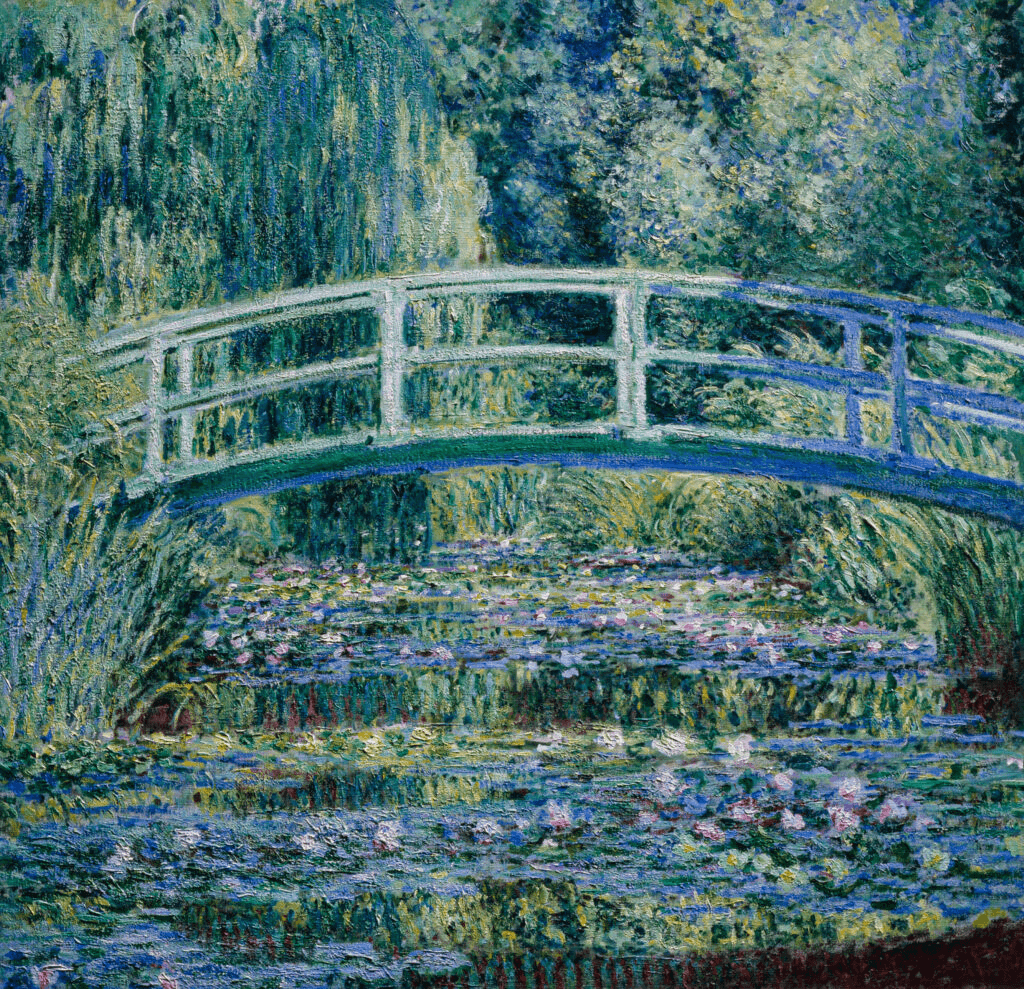
Preface: welcome to this very brief intro to modern art. Please feel free to use this as a guide for museum visits.
TLDR:
France is where it starts — the first time anyone said: rules can be broken. Monet, Renoir, Degas — rejecting the Academy’s precise storytelling, chasing light, instants, perception. Paintings no longer “finished,” brushstrokes visible, edges blurred. Themes: everyday life, nature, urban modernity, the passage of time. Impressionism was a club for white European men. Berthe Morisot (a woman) and Mary Cassatt (an American woman) spent their careers fighting for recognition within it. The movement also survived on private money, not institutional approval — Gustave Caillebotte quietly bankrolled it from inside the group, and the dealer Paul Durand-Ruel nearly went bankrupt twice keeping it alive before American buyers, not French ones, finally made it profitable. Globally at the same time: Japanese ukiyo-e (Hokusai, Hiroshige) was profoundly shaping Impressionism — flat composition, bold color fields, everyday scenes. This is called Japonisme, and it marks the first time non-Western art systematically influenced Western modern art.
Background: What Were They Rebelling Against?
To understand Impressionism, you first have to understand their enemy: the French Royal Academy of Fine Arts and the official Salon it controlled. As the AI filmmaking series put it, this system dominated French art for two hundred years, with clear rules: brushstrokes must be invisible, surfaces perfectly smooth; subjects must be elevated — history, mythology, religion, war; composition must be classical, perspective precise; colors must be mixed on the palette indoors and finished in the studio. The Academy also ran a strict internal ranking of subject matter itself, the so-called hierarchy of genres — history painting at the very top, then portraiture, then genre scenes of everyday life, then landscape, with still life at the bottom, barely worth an ambitious painter’s time. A landscape or a café scene wasn’t just stylistically minor in this system; it was categorically minor, regardless of how well it was painted. The Academy’s most prized credential, the Prix de Rome, was awarded almost exclusively to history painting, which meant the entire pipeline of state-sanctioned artistic success — scholarships, medals, government commissions, a studio in Rome — ran through mythology and battle scenes, not through anything an Impressionist would ever choose to paint. Looking back now, these rules seem almost absurd — just a very specific kind of formulaic creative practice, and artists aren’t something you can regulate like that. But within the Salon system of that era, as a painter, the annual official Salon was your only path forward. If the Salon rejected you, you had no career. The judging committee was composed of Academy members — their standards calcified, their tastes conservative. And the first thing the Impressionists did was not a stylistic revolution but an institutional one. They said: we don’t need your approval.
1863: The Salon des Refusés
That year, the Salon rejected over three thousand works. As mentioned, artists were furious, and Napoleon III — somewhat surprisingly — ordered a “Salon of the Rejected” to be held at the original Légion d’honneur in France (not the knockoff one in San Francisco), letting the public judge for themselves. I’m not sure how such an absurd decision got executed so seriously, but Manet’s Le Déjeuner sur l’herbe was shown there and became the first scandal of modern art. The scene, as described before: two men in contemporary clothing sitting on grass in a forest, beside a completely nude woman looking directly at the viewer. A half-nude woman wades in the background. The audience wasn’t outraged because of nudity — the Salon was full of nude paintings. That same year, the official Salon itself awarded its top honor to Alexandre Cabanel’s The Birth of Venus — a nude goddess reclining on sea foam, eyes half-closed, offering herself to no one in particular. Napoleon III personally bought it. The contrast is the whole argument in miniature: a mythological Venus could be nude because she wasn’t a real woman, and because she wasn’t looking back at you. This was a modern Parisian woman, her clothes sitting right beside her, looking straight at the viewer. She knew you were watching. She didn’t care. It broke the fourth wall between painting and looking. The American-born painter James Whistler was rejected the same year and exhibited alongside Manet at the Salon des Refusés with The White Girl — proof that the scandal wasn’t a solitary French incident but the first crack in a wall that was already under pressure from multiple directions.
1874: The First Impressionist Exhibition
Monet, Renoir, Degas, Pissarro, Sisley, Morisot — thirty artists — held an exhibition in photographer Nadar’s studio, bypassing the Salon system entirely. What made this possible wasn’t just nerve; it was a legal structure. The group had incorporated themselves the previous year as the Société Anonyme Coopérative des Artistes Peintres, Sculpteurs, Graveurs — a cooperative, joint-stock company modeled loosely on a bakers’ union, where each member paid dues, retained ownership of and profit from their own work, and shared costs and any surplus equally. It was a deliberately unglamorous, almost bureaucratic answer to an institution, the Academy, that ran entirely on prestige and permission. Critic Louis Leroy saw Monet’s painting Impression, Sunrise and mocked it: “It’s nothing but an impression.” They said: exactly. That’s how the name was born. The exhibition drew roughly 3,500 visitors over its run — a fraction of Salon traffic — and made almost no money; several of the artists never recouped their share of the costs. Financially, the first Impressionist exhibition was close to a failure. It succeeded only in the sense that it proved the alternative could exist at all.
Financing the Rebellion
The movement’s survival owed less to public taste than to two men who weren’t primarily painters. Gustave Caillebotte (1848–1894), independently wealthy from a family fortune built supplying uniforms and bedding to Napoleon’s army, painted alongside the group — Paris Street; Rainy Day (1877), with its steep, almost photographic perspective on a rain-slicked Haussmann intersection, is now considered one of the era’s masterpieces, though the Salon jury had rejected an earlier submission of his as “vulgar.” But Caillebotte’s more consequential role was as patron: he organized and helped finance several of the group exhibitions, quietly paid Monet’s studio rent during lean years, and bought dozens of paintings from his struggling friends at prices well above what the open market offered — not out of charity exactly, but out of a collector’s genuine conviction that this work mattered. The dealer Paul Durand-Ruel provided the other half of the financial floor: he bought Impressionist paintings in bulk through the 1870s and 1880s, paid several of the artists monthly stipends against future work, and came close to personal bankruptcy at least twice doing it — through the banking crises of 1874 and 1882. Monet later said plainly that without Durand-Ruel, the Impressionists would have starved. The turning point wasn’t French at all: in 1886, the American Art Association invited Durand-Ruel to bring roughly 300 Impressionist works to New York, covering shipping and insurance themselves. The exhibition sold. Durand-Ruel himself put it bluntly afterward: American collectors didn’t criticize — they bought. It took American money, not French institutional acceptance, to make Impressionism commercially survivable, more than a decade after the movement had already produced most of the paintings now considered its masterpieces.
The Caillebotte Bequest
Caillebotte died suddenly of a stroke in his garden in 1894, at forty-five. His will, drafted years earlier, left his collection of some sixty-eight Impressionist paintings — by then including major works by Monet, Renoir, Pissarro, Sisley, Degas, Cézanne, and Manet — to the French state, on the condition that all of them be accepted together and eventually hung in the Louvre. The state’s response is the detail usually left out of the tidy version of this story: it hesitated for two years. Academy painters, led by Jean-Léon Gérôme, publicly lobbied against the donation; Gérôme is reported to have said that accepting such filth into a national collection would require a serious moral collapse. After protracted negotiation between the executor Renoir and Caillebotte’s brother Martial, the state agreed to accept only about forty of the sixty-eight works, still refusing to exhibit works it considered inferior even from artists it was now willing to admit. The accepted paintings opened at the Musée du Luxembourg in 1897 — the first time Impressionist work had ever hung in a French public museum — and now form the backbone of the Impressionist galleries at the Musée d’Orsay. The remaining works, offered to the state twice more in 1904 and 1908, were refused both times and eventually dispersed onto the private market, some ending up in American collections like the Barnes Foundation. The paintings now treated as the canonical center of Impressionism were, in other words, selected as much by a reluctant government’s negotiating limits in the 1890s as by any purely artistic judgment — a fact worth sitting with the next time a museum wall presents “the Impressionists” as a settled, self-evident list.
Technical Innovations: What Exactly Did They Do?
En plein air painting was technically made possible by paint in metal tubes, invented in 1841. Before that, paint was stored in pig bladders and couldn’t be taken outside. With metal tubes, painters could bring their tools outdoors and paint directly in natural light. The same decades also brought a wave of new synthetic pigments — chrome yellow, cobalt blue, synthetic ultramarine, and later cadmium yellow — colors that were simply unavailable, or prohibitively expensive, to earlier generations of painters working from natural mineral and organic sources. The vividness people now associate with Impressionist canvases was in part a straightforward consequence of industrial chemistry catching up with what painters wanted to do. Light is alive — it changes every minute. You have to be fast. You can’t paint outdoor light slowly. The Academy demanded brushstrokes disappear, surfaces mirror-smooth. The Impressionists did the opposite — the brushstroke itself became part of the work, and viewers could see how the painter’s hand moved. For the first time, the act of making became a visible component of the finished piece. The traditional approach was to mix colors on the palette before applying them to canvas. Some Impressionists instead placed small strokes of pure color side by side, letting the viewer’s eye complete the mixture on the retina. This was radical at the time, drawing on the color perception research of Helmholtz and Chevreul. Conventionally, the Academy painted shadows in black and brown. The Impressionists discovered that shadow isn’t the absence of light — it’s a different kind of light. Grass in shade is blue-violet, not dark green. This came from direct observation of real light, not from imitating earlier paintings. Impressionist paintings often look “unfinished” — edges loose, details omitted, subjects dissolving into background. This was intentional. They were capturing a single instant of perception, not a stable reality.
The Core Artists
The purest practitioner of Impressionism. His obsession: the same object under different light is a different object. He painted 28 versions of Rouen Cathedral — dawn, noon, dusk, overcast, clear. Not painting the cathedral. Painting the relationship between time and light. His late Water Lilies series: as his eyesight deteriorated, the paintings grew increasingly abstract, edging toward the Abstract Expressionism of the twentieth century. He didn’t know he was predicting the future.
Strictly speaking, Manet was not an Impressionist — he refused to join their exhibitions and continued submitting to the Salon. But he was their spiritual father. His Olympia (1865): another nude woman looking directly at the viewer, unmistakably a prostitute (black ribbon, slippers, a Black maid holding flowers). Her gaze is cold, autonomous, asking nothing from you. In the Victorian era, this was a profound provocation. Manet’s core subject: the social class structure of modern Paris, and the politics of the gaze.
Ballet dancers, bathers, racehorses — Degas was interested in movement and the instant, but he disliked the outdoors and worked mostly indoors. He drew heavily on Japanese ukiyo-e compositional techniques: asymmetry, figures cut off by the picture’s edge, unusual angles (looking down from above, entering from the side). In the Western compositional tradition, this was unconventional. His ballet series looks elegant on the surface but actually reveals these girls’ laboring bodies, their condition of being watched, their class backgrounds. Not romanticization — observation. Degas was a known antisemite who took an anti-Dreyfus position late in life — one of the moral fault lines within Impressionism.
Pierre-Auguste Renoir (1841–1919)
The most publicly beloved Impressionist — warm colors, joyful figures, the pleasure of living. Moulin de la Galette is the peak of this direction. But he’s also the most problematic figure in the movement: in his later years he said openly that women shouldn’t be artists, and he painted large quantities of female nudes with no interiority or agency. Behind his sense of pleasure was an unconscious patriarchal aesthetic.
The only Impressionist who participated in all eight exhibitions. Born in the West Indies (Saint Thomas island), Jewish, anarchist. He painted peasants, fields, rural labor — not romanticized countryside but real physical work. The most class-conscious painter in the movement. He was Cézanne and Gauguin’s teacher — in a sense, Post-Impressionism grew out of him.
The most consistently Impressionist of the group, in the narrowest technical sense — Sisley never really deviated from landscape or diluted the method with narrative subject matter the way Monet, Degas, and Renoir eventually did. English by descent but French by upbringing, he never took French citizenship, which quietly cut him off from state patronage and juried prizes his entire career. He painted the Seine and its small towns — Marly, Louveciennes, Moret-sur-Loing — over and over, chasing the same kind of temporal variation Monet pursued with cathedrals and haystacks, but with none of Monet’s eventual market success. Sisley died in relative poverty in 1899, a year before the art market finally caught up to what he had been doing for three decades.
Gustave Caillebotte (1848–1894)
Wealthy, self-taught alongside his formal training, and the group’s financial backbone as much as its member — see above. As a painter, Caillebotte occupied an odd position inside Impressionism: his brushwork could be as loose as Monet’s, but his compositions relied on a tight, almost photographic sense of perspective that owed more to the Academy’s discipline than to anything the rest of the group was doing. Paris Street; Rainy Day and The Floor Scrapers (the latter rejected by the 1875 Salon for depicting shirtless laborers, a subject the jury deemed beneath serious painting) both use plunging, engineered sightlines to turn ordinary Parisians into monumental, almost cinematic figures. He was, in short, an Impressionist of subject and company but not entirely of method — which may be part of why it took nearly a century after his death for his own paintings, rather than his patronage, to be taken seriously.
The most important female artist in Impressionism. Manet’s brother married her (she married Manet’s brother), and she and Manet deeply influenced each other. She painted women’s private spaces — bedrooms, gardens, childcare, the mirror. These subjects were considered “feminine,” so her work was long undervalued. But look again: she was documenting the reality of middle-class women in the nineteenth century being confined to the private sphere, while finding the limits of painting within that confined space. She was one of the rare Impressionist women recognized by her peers during her lifetime — but after her death, her name disappeared from the mainstream narrative for a long time.
American — the only American formally accepted into the Impressionist inner circle. Degas invited her to participate in their exhibitions. She painted mothers and children, women’s daily life — subjects equally dismissed as “minor.” But her compositions came from Japanese ukiyo-e (she was one of the earliest Western painters to study it systematically): strong flatness, bold color, intimate viewpoint. As an American woman in Paris, she couldn’t go to cafés alone or enter the male artists’ social world. The women’s spaces she painted were the spaces she herself was confined to. Cassatt’s role wasn’t only artistic — it was also financial in a quieter way than Caillebotte’s: fluent in the tastes of wealthy American collectors, she personally steered friends like the Havemeyer family toward Durand-Ruel’s gallery, helping build the American buying base that eventually rescued the movement’s finances.
The Influence of Japanese Ukiyo-e
In 1856, a collection of Japanese woodblock prints arrived in France wrapped around ceramic goods (Japan was using them as packing material). Parisian artists were stunned:
Flat composition, with none of the depth illusion of Western perspective
Bold outlines
Asymmetry, with negative space used actively
Scenes of everyday life treated as serious subjects
Blocks of color rather than gradated tones
Monet hung over two hundred ukiyo-e prints in his home. Degas’s compositions came directly from Hiroshige. Van Gogh copied prints by Hokusai and Hiroshige. This was the first large-scale instance in modern art history of non-Western visual language influencing the West. But this influence is usually described as Western “absorption” — rarely as a Japanese achievement.
What They Painted: The Revolution in Subject Matter
Modern life replaced mythology and history. Cafés, racetracks, opera houses, boating on the river, train stations, department stores — these were the new spaces of modern life that the Industrial Revolution had created.
Haussmann’s transformation of Paris (1853–1870): Napoleon III ordered Haussmann to demolish the labyrinthine old streets of Paris and build wide boulevards. The city the Impressionists faced was a city being remade by modernity in real time — their paintings are a live record of that process.
Middle-class leisure — the Impressionists depicted neither the aristocracy nor the working class, but the newly emerging middle class and what they did on weekends: picnics in the countryside, boating on the river, dancing at balls. This is itself a class position.
Why It Matters
The significance of Impressionism goes beyond beautiful images. They changed the act of looking itself. Before them, painting told you what the world looked like. After them, painting began to tell you how seeing happens: light enters the eye, the nervous system processes it, the brain constructs an image. The picture is not reality — it is perception. This shift is philosophical. It belongs to the same spirit of the age as the psychology of its moment (William James’s stream of consciousness), the physics of light, and the early stirrings of phenomenology. And they institutionalized the autonomy of the artist — artists no longer needed to wait for institutional permission. That legacy extends to today. The most fundamental discovery of Impressionism: reality is not objective — it is perceptual. The same world, under different light, at a different moment, through different eyes, is a completely different world.
What Came Next
Impressionism didn’t end so much as fragment under its own internal contradiction: a method built for capturing fleeting instants of perception is structurally unsuited to the kind of durable, monumental statement some of its own members eventually wanted to make. Seurat and Signac responded by trying to make the loose Impressionist dab scientific again — Neo-Impressionism, or Divisionism, breaking color into small calculated points of pure pigment governed by optical theory rather than instinct. Cézanne, Van Gogh, and Gauguin — the artists now grouped as Post-Impressionists, several of them formed directly under Pissarro’s early guidance — kept the bright Impressionist palette but reintroduced the structure, symbolism, and emotional intensity Impressionism had deliberately set aside. And that Neo-Impressionist theory would itself become the thing a young Matisse studied under Signac in 1904, one full generation after the first Impressionist exhibition, before breaking from it entirely the following summer in Collioure to help found Fauvism. The rebellion against realism kept rebelling against itself, one generation at a time, for the next forty years.🖼️
TLDR:
法国为核心,从这里开始,因为这是第一次有人说:”规则可以打破。”莫奈、雷诺阿、德加——拒绝学院派的精确叙事,捕捉光线、瞬间、感知。画面不再”完成”,笔触可见,边界模糊。主题:日常生活、自然、城市现代性、时间的流逝。印象派是白人欧洲男性的俱乐部。 贝尔特·莫里索(女性)和玛丽·卡萨特(美国女性)在其中挣扎获得认可。这场运动能活下来靠的也不是体制认可,而是私人的钱:古斯塔夫·卡耶博特从群体内部悄悄为它输血,画商保罗·杜朗-吕埃尔为了维持它两度濒临破产,最终让它在财务上真正立住的,是美国买家,而不是法国机构。同期全球:日本浮世绘(葛饰北斋、歌川广重)正在深刻影响印象派:平面构图、大胆色块、日常场景。这叫日本主义Japonisme,是第一次非西方艺术系统性影响西方现代艺术。
背景:他们在反抗什么?
要理解印象派,先要理解他们的敌人:法国皇家美术学院和它控制的官方沙龙。正如ai filmmaking系列所说,这个体系统治法国艺术两百年,规则清晰:画面必须光滑,笔触不可见;主题必须高尚——历史、神话、宗教、战争;构图必须古典,透视必须精确;颜色必须在画室里混好,在室内完成。学院内部还有一套严格的题材等级制度:历史画高居顶端,其次是肖像画,再往下是日常生活的风俗画,然后是风景画,静物画垫底,几乎不值得一位有抱负的画家花时间。在这套体系里,一幅风景画或一幅咖啡馆场景不只是风格上”次要”,而是从类别上就被判定为次要,无论画得多好。学院最看重的荣誉”罗马大奖”几乎只颁给历史画,也就是说,整条国家认可的艺术成功路径——奖学金、奖章、政府委托、罗马的画室——都要经由神话与战争题材,而不是印象派画家会选择的任何主题。在现在看来,这些规定简直莫名其妙。这只是一种很特定的八股文创作方式,艺术家也不是你能规定的。但在当时的这种沙龙体系里,作为艺术家,或者说是画家,每年一次的官方沙龙是你唯一的出路。沙龙拒绝你,你就没有职业。而评审委员会由学院院士组成,标准固化,口味保守。而印象派做的第一件事,不是风格革命,是机构革命。 他们说:我们不需要你们的认可。
1863年:落选者沙龙
这一年,沙龙拒绝了三千多件作品。正如之前所说,艺术家们很愤怒,拿破仑三世有点出人意料地下令举办”落选者沙龙”,在法国原版的legion of honor举办,不是在旧金山这个盗版的,让公众自己评判。我不知道这么无厘头的决定是怎么被正经执行的,但当时马奈的《草地上的午餐》 在这里展出,成为现代艺术的第一个丑闻。画面正如之前所说,是树林里,两个穿着当代服装的男人坐在草地上,旁边有一个完全裸体的女人,正在看着观众。背景里还有一个半裸女人在水里。观众愤怒不是因为裸体,因为沙龙里有大量裸体画。同一年,官方沙龙把最高荣誉颁给了亚历山大·卡巴内尔的《维纳斯的诞生》——一位半闭双眼、躺在海浪泡沫上的裸体女神,姿态是向不特定的某人献身。拿破仑三世亲自买下了这幅画。这两幅画的对比就是整个争议的缩影:神话里的维纳斯可以裸体,因为她不是真实的女人,也因为她没有回望你。而马奈画的是一个现代巴黎女性,穿着她的衣服就放在旁边,直视你。她知道你在看她,她不在意。这打破了绘画与观看之间的第四堵墙。美国出生的画家惠斯勒同年也被沙龙拒绝,与马奈一同在落选者沙龙展出了《白衣女子》——这说明这场丑闻并非孤立的法国事件,而是一堵早已四面承压的墙上出现的第一道裂缝。
1874年:第一届印象派展览
莫奈、雷诺阿、德加、毕沙罗、西斯莱、莫里索,三十位艺术家,在摄影师纳达尔的工作室举办展览,完全绕开沙龙体制。让这一切成为可能的不只是胆量,还有一套法律结构。这群人前一年正式注册成立了”画家、雕塑家、版画家匿名合作社“(Société Anonyme Coopérative des Artistes Peintres, Sculpteurs, Graveurs)——一种松散仿照面包师工会模式的合作股份制组织:每位成员缴纳会费,保留自己作品的所有权与收益,共同分摊成本,也共同分享盈余。这是一个刻意朴素、近乎官僚化的答案,用来对抗一个完全靠声望和许可运转的机构——学院。批评家路易·勒鲁瓦看到莫奈的画《印象·日出》,嘲讽道:”这不过是个印象。”他们说:对,就是印象。名字就这么来了。整个展期大约吸引了三千五百名观众——只是沙龙客流量的零头——而且几乎没赚到钱;几位艺术家甚至没能收回自己分摊的成本。从财务角度看,第一届印象派展览几乎是一次失败。它唯一的成功之处,是证明了这个替代方案确实能够存在。
资助这场反叛
这场运动能存活下来,靠的与其说是公众品味,不如说是两位主业并非绘画的人。古斯塔夫·卡耶博特(1848–1894)家境优渥,家族财富来自为拿破仑军队供应制服和床品,他与这群人一同作画——《巴黎街道,雨天》(1877)以近乎摄影般陡峭的视角描绘了一处被雨水打湿的奥斯曼式路口,如今被视为那个时代的杰作之一,尽管沙龙评审团曾以”粗俗”为由拒绝过他更早的一幅投稿。但卡耶博特更重要的角色是赞助人:他组织并资助了好几届群展,在艰难岁月里悄悄替莫奈付工作室的租金,还以远高于市场行情的价格从困顿的朋友们手中买下几十幅画——与其说是出于慈善,不如说是出于一位藏家对这些作品确实有价值的真实信念。画商保罗·杜朗-吕埃尔提供了另一半的资金支撑:他在1870到1880年代大量买入印象派作品,向几位画家提供按未来作品预支的月度津贴,并因此至少两次几近破产——分别经历了1874年和1882年的银行业危机。莫奈后来直言,若没有杜朗-吕埃尔,印象派画家们早就饿死了。真正的转折点根本不在法国:1886年,美国艺术协会邀请杜朗-吕埃尔把大约三百件印象派作品带到纽约,运输和保险费用由协会承担。展览卖出去了。杜朗-吕埃尔后来直白地说:美国藏家不挑剔——他们直接买。让印象派在商业上真正得以存续的,是美国的钱,而不是法国机构的认可——而这已经是这场运动大部分如今被视为杰作的作品完成十多年之后的事了。
卡耶博特遗赠
1894年,卡耶博特在自家花园中突发中风去世,年仅45岁。他多年前立下的遗嘱,把自己收藏的约六十八幅印象派画作——其中已包括莫奈、雷诺阿、毕沙罗、西斯莱、德加、塞尚、马奈的重要作品——留给了法国国家,条件是这些作品必须整体接收,并最终悬挂在卢浮宫。国家的反应,正是这个故事的”整洁版本”通常会略去的部分:它犹豫了整整两年。以让-莱昂·热罗姆为首的学院派画家公开游说反对接受这份遗赠;据说热罗姆曾表示,让国家收藏接纳这样的”污秽之物”,需要一次严重的道德滑坡。在遗嘱执行人雷诺阿与卡耶博特的弟弟马夏尔漫长的协商之后,国家最终只同意接收六十八幅中的约四十幅,即便对于它已经愿意承认的这些艺术家,它仍然拒绝展出那些被认为水准较低的作品。被接收的画作于1897年在卢森堡博物馆展出——这是印象派作品第一次悬挂在法国公立博物馆里——如今构成了奥赛博物馆印象派展厅的核心。剩下的作品在1904年和1908年又两次提交给国家,均被拒绝,最终流散进私人市场,其中一些落入了像巴恩斯基金会这样的美国收藏机构手中。换句话说,如今被视为印象派”正典核心”的这批画作,与其说完全出自纯粹的艺术判断,不如说很大程度上是1890年代一个不情愿的政府在谈判中划定的接收上限所决定的——下次博物馆的墙上把”印象派”呈现为一份不言自明、早已定论的名单时,这个事实值得多想一层。
技术革新:他们具体做了什么?
户外写生(en plein air):这在技术上是被铅管装颜料(1841年发明)才真正实现的。之前颜料装在猪膀胱里,不能带出去。有了金属管,画家可以带着工具去户外,在光线下直接画。同一时期还出现了一批新的合成颜料——铬黄、钴蓝、合成群青,后来还有镉黄——这些颜色对于依赖天然矿物与有机原料的前几代画家而言,要么根本无法获得,要么贵得离谱。人们如今联想到印象派画作时那种鲜艳感,某种程度上正是工业化学终于赶上了画家们想要做的事。光线是活的,每分钟都在变。你必须快。慢慢来画不了户外的光。学院派要求笔触消失,画面如镜。印象派反其道而行——笔触本身成为画面的一部分,观众能看到画家的手怎么动。这是第一次把创作过程变成作品的可见组成部分。传统做法是在调色板上混出需要的颜色,而印象派有的做法是把纯色小笔触并排放在画布上,让观看者的眼睛在视网膜上完成混合。这在当时是激进的,利用了亥姆霍兹和谢弗勒尔关于色彩感知的科学研究。**通常来说,**学院派画阴影用黑色和棕色。印象派发现阴影不是”没有光”,是另一种光。树荫下的草地是蓝紫色的,不是深绿色的。这个观察来自对真实光线的直接观察,而不是对前人作品的模仿。印象派的画面经常看起来像”没画完”,边缘松散,细节省略,主体溶入背景。这是故意的。他们捕捉的是一个瞬间的感知,不是一个稳定的现实。
核心艺术家
克劳德·莫奈 Claude Monet(1840-1926)
印象派最纯粹的实践者。他最痴迷的问题:**同一个对象在不同光线下是不同的对象。**他画了28幅鲁昂大教堂——清晨、正午、傍晚、阴天、晴天。不是在画教堂,是在画时间和光的关系。睡莲系列:晚年视力下降,画面越来越抽象,越来越接近二十世纪的抽象表现主义。他不知道自己在预言未来。
爱德华·马奈 Édouard Manet(1832-1883)
严格说,马奈不是印象派——他拒绝参加他们的展览,仍然坚持参加沙龙。但他是精神教父。他的《奥林匹亚》(1865):又一个直视观众的裸体女性,明显是妓女(黑色丝带、拖鞋、黑人女仆拿着花)。她的凝视冷淡、自主、不要求你的怜悯。在维多利亚时代,这是深刻的挑衅。马奈处理的核心主题:现代巴黎的社会阶层,以及凝视的政治。
芭蕾舞女、浴女、赛马——德加感兴趣的是运动和瞬间,但他不喜欢户外,更多在室内。他大量使用日本浮世绘的构图技法:不对称,人物被画面边缘截断,视角奇特(从上方看,从侧面切入)。这在西方构图传统里是非常规的。他的芭蕾系列表面优雅,实际揭示的是这些女孩的劳动身体、被观看的处境、阶级背景。不是浪漫化,是观察。德加是已知的反犹太主义者,晚年支持德雷福斯案中的反犹立场——这是印象派内部的道德裂缝之一。
皮埃尔-奥古斯特·雷诺阿 Pierre-Auguste Renoir(1841-1919)
最受大众喜爱的印象派画家——色彩温暖,人物欢乐,生活享乐。《煎饼磨坊的舞会》是这个方向的顶点。但他也是印象派里最有问题的:晚年公开说女人不应该成为艺术家,画了大量没有主体性的女性裸体。他的愉悦感背后是一种不自觉的父权审美。
卡米耶·毕沙罗 Camille Pissarro(1830-1903)
印象派里唯一参加了全部八届展览的人。西印度群岛出生(圣托马斯岛),犹太人,无政府主义者。他画农民、田野、乡村劳动——不是浪漫化的田园,是真实的体力劳动。阶级意识最强的印象派画家。他是塞尚、高更的老师——某种意义上,后印象派是从他身上生长出来的。
阿尔弗雷德·西斯莱 Alfred Sisley(1839-1899)
从最严格的技术意义上说,他是这群人中最始终如一的”印象派”——西斯莱几乎从未偏离风景画,也没有像莫奈、德加、雷诺阿后来那样,让叙事性题材冲淡这套方法。他血统上是英国人,成长于法国,却终生没有加入法国国籍,这也悄悄让他一辈子与国家资助和评审制奖项无缘。他反复画塞纳河及其沿岸小镇——马利、卢韦谢讷、莫雷河畔——追逐着与莫奈画教堂、画干草垛时同样的时间变奏,却始终没有等到莫奈后来那种市场成功。西斯莱在1899年相对贫困地去世,仅仅一年后,艺术市场才终于追上了他三十年来一直在做的事。
古斯塔夫·卡耶博特 Gustave Caillebotte(1848-1894)
家境富裕,既受过正规训练也部分靠自学,是这群人财务上的支柱,同时也是其中一员——详见上文。作为画家,卡耶博特在印象派内部的位置有些特殊:他的笔触可以像莫奈一样松散,但他的构图依赖一种紧密、近乎摄影式的透视,这更多来自学院训练的纪律,而非群体中其他人的做法。《巴黎街道,雨天》和《刨地板的工人》(后者因描绘赤膊劳工,被评审团认为不配作为严肃绘画的题材,遭1875年沙龙拒绝)都运用陡峭、精心设计的视线,把普通的巴黎人变成了纪念碑般、近乎电影感的形象。简而言之,他在题材与交游上属于印象派,但在方法上并不完全属于——这或许也是为什么在他去世将近一个世纪后,人们才开始认真对待他作为画家、而不只是赞助人的成就。
贝尔特·莫里索 Berthe Morisot(1841-1895)
印象派里最重要的女性艺术家。马奈的妹妹嫁给了她(她嫁给了马奈的弟弟),她和马奈互相影响极深。她画女性的私人空间——卧室、花园、育儿、镜子前。这些主题被认为是”女性的”,所以她的作品长期被低估。但重新看:她在记录19世纪中产阶级女性被限制在私人领域的现实,同时在这个有限的空间里找到绘画的极限。她是少数在世时就被同辈认可的印象派女性——但死后,她的名字在很长时间里从主流叙事里消失了。
玛丽·卡萨特 Mary Cassatt(1844-1926)
美国人,唯一被正式纳入印象派核心圈的美国艺术家。德加邀请她参加展览。她画母亲与孩子、女性的日常生活——同样被认为是”小”的主题。但她的构图来自日本浮世绘(她是早期最系统研究浮世绘的西方画家之一),平面感强,色彩大胆,视角亲密。作为美国女性在巴黎,她无法单独去咖啡馆,无法进入男性艺术家的社交圈。她画的女性空间,是她自己被限制在其中的空间。卡萨特的作用不止于创作——她也以一种比卡耶博特更低调的方式参与了资金层面:她熟悉美国富裕藏家的品味,亲自把哈弗迈耶家族这样的朋友引荐给杜朗-吕埃尔的画廊,帮助建立起最终挽救了这场运动财务状况的美国买家基础。
日本浮世绘的影响
1856年,一批日本版画随着陶瓷包装纸流入法国(日本当时把它们当包装材料)。巴黎艺术家们震惊了:
平面构图,没有西方透视的深度幻觉
大胆的轮廓线
不对称,空白空间被积极使用
日常生活场景被当作严肃主题
色块,不是色调渐变
莫奈的家里挂了两百多张浮世绘。德加的构图直接来自广重。梵高临摹了北斋和广重的版画。这是现代艺术史上第一次大规模的非西方视觉语言影响西方。但这个影响通常被描述为西方的”吸收”,很少被描述为日本艺术的成就。
他们画什么:主题的革命
现代生活取代了神话与历史。咖啡馆、赛马场、歌剧院、河上划船、火车站、百货商店——这些是工业革命之后新兴的现代生活场域。
奥斯曼改造巴黎(1853-1870):拿破仑三世命令奥斯曼把老巴黎的迷宫街道炸掉,建宽阔的林荫大道。印象派画家面对的城市是一个正在被现代性改造的城市——他们的画是这个过程的实时记录。
中产阶级的休闲——印象派描绘的不是贵族,也不是无产阶级,是新兴的中产阶级在周末做什么:去郊外野餐,去河边划船,去舞会跳舞。这本身是一种阶级立场。
为什么重要?
印象派的意义不只是美丽的画面。他们改变了”看”这件事本身。 在他们之前,绘画告诉你世界是什么样的。在他们之后,绘画开始告诉你看是怎么发生的:光进入眼睛,神经系统处理,大脑建构画面。画面不是现实,是感知。这个转变是哲学性的。它和同时代的心理学(威廉·詹姆斯的意识流)、物理学(对光的研究)、哲学(现象学的萌芽)是同一个时代精神的不同表达。而且他们体制化了艺术家的自主权:艺术家不需要等待机构的许可。这个遗产一直延续到今天。印象派最核心的发现是:真实不是客观的,是感知的。同一个世界,在不同的光线下,不同的时刻,不同的眼睛里,是完全不同的世界。
后来发生了什么
印象派与其说是终结,不如说是被自身内部的矛盾拆解了:一套用来捕捉瞬间感知的方法,天生不适合用来做出持久、宏大的陈述——而这恰恰是它自己一些成员后来想要的东西。修拉和西涅克的回应,是想把印象派那种松散的笔触重新变得”科学”——新印象主义,或称分割主义,把色彩拆解成受光学理论而非直觉支配的、经过计算的纯色小点。塞尚、梵高、高更——如今被归为后印象派的这些人,其中几位还是在毕沙罗早年的直接指导下成长起来的——保留了印象派明亮的调色板,却重新引入了印象派曾刻意舍弃的结构、象征与情绪强度。而这套新印象主义理论,后来又成了年轻的马蒂斯在1904年跟随西涅克研习的对象——距离第一届印象派展览整整一代人之后——他第二年夏天就在科利乌尔与之彻底决裂,转而参与了野兽派的创立。这场对写实主义的反叛,此后四十年里一代接一代地,不断反叛着自己。 🖼️