Created on
Updated on
1880s-1910s | 后印象派 Post-Impressionism
被印象派影响的四位
Preface: welcome to this very brief intro to modern art. Please feel free to use this as a guide for museum visits.
TLDR:
“Post-Impressionism” is a term invented in 1910 by art historian Roger Fry to describe four artists who had almost nothing to do with each other — their only common ground being that each started from Impressionism and then moved in a completely different direction. Impressionism answered one question: how do you capture light and the instant? Post-Impressionism asked the next question: then what? Beyond light and the instant, what else can painting do? Cézanne, Van Gogh, Gauguin, Seurat — four people, four completely different answers.
Cézanne: reduced nature to geometric form. The spiritual father of Picasso.
Van Gogh (Dutch): the brushstroke became emotion itself. The starting point of Expressionism.
Gauguin: fled to Tahiti, painted Polynesian women — saturated with colonial gaze, but also the first time non-Western bodies entered Western high art.
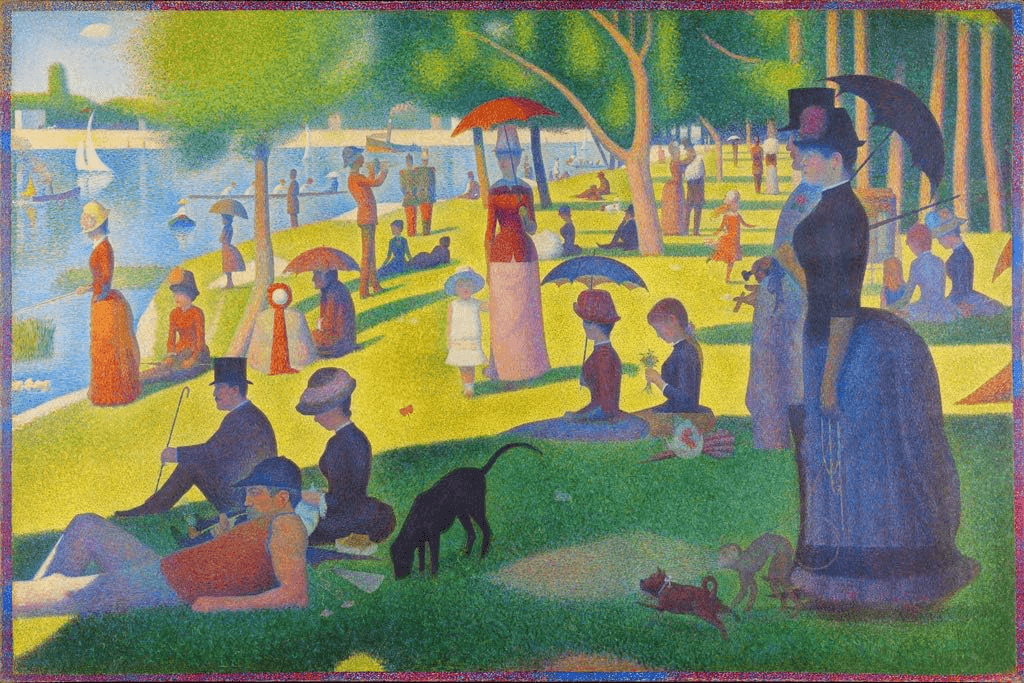
Seurat: Pointillism — making painting into a science.
Themes: subjective feeling, the romanticization of “primitiveness,” escape from modern civilization.
Paul Cézanne (1839–1906)
Keywords: structure, geometry, permanence
Cézanne was a contemporary of the Impressionists, but he had one fundamental complaint against them: Impressionism was too fleeting. Monet captured a moment of light, but that moment vanished and left nothing behind.
What he wanted: the Impressionists’ direct observation of nature combined with the solid permanence of classical art.
His solution: reduce nature to basic geometric forms.
He painted the same mountain in his home province of Provence over and over — Mont Sainte-Victoire — not to paint the mountain, but to investigate a question: how can three-dimensional space be honestly rendered on a two-dimensional surface? The Western answer since the Renaissance was single-point perspective — simulate the human eye, create the illusion of depth. Cézanne thought this was a lie. Your two eyes see slightly different angles, your head moves, your perception is multiple, not a single fixed viewpoint. So he began painting multiple viewpoints simultaneously — a table’s edge rendered from two angles at once, an apple’s outline left deliberately unclosed. The picture begins to loosen, to tremble. Reality begins to come apart.
Mont Sainte-Victoire series: The later versions grow increasingly abstract — the mountain becomes an arrangement of color planes, the boundary between sky and mountain disappears, the entire picture becomes a structural system of color and form.
The Large Bathers (1906): He painted the bather subject for twenty years. In the final version the figures have nearly become geometric shapes, merging with the trees behind them. Form overtakes narrative.
Character and life: Cézanne was a person of extreme anxiety and social difficulty. He was a marginal figure in the Paris art world, unrecognized for years, and in his later life he was almost a recluse in Provence. He and Zola — the celebrated novelist — were childhood friends, but Zola wrote a novel featuring a failed painter, and Cézanne believed it was based on him. They broke off contact and never spoke again. He was deeply uncomfortable with models: he said he couldn’t stand being looked at. His still lifes — apples, tablecloths, bottles — were freer than his figure paintings because apples don’t look back.
The spiritual father of Picasso: Picasso took Cézanne’s multiple viewpoints to their extreme: if two viewpoints can be shown simultaneously, why not five? Why not paint a face’s front and profile at the same time? That is the logical starting point of Cubism. After Cézanne’s death, his 1907 retrospective stunned the entire Paris art world. Picasso and Braque immediately began their Cubist experiments in its wake.
Vincent van Gogh (1853–1890)
Keywords: emotion, brushstroke, between madness and lucidity
Van Gogh was Dutch, didn’t start painting until he was 27, and died at 37. In his ten-year creative life he produced over two thousand works and sold exactly one. He learned color from the Impressionists — before coming to Paris, his paintings were in the dark, heavy Dutch manner (The Potato Eaters, 1885: brown, somber, the roughness of laboring people). After contact with Impressionism, his canvases exploded into light. But his fundamental difference from the Impressionists: their brushstrokes recorded light. Van Gogh’s brushstrokes recorded emotional states. Look at The Starry Night (1889): the sky is not a sky — it is a vortex, a movement, some cosmic force surging. This is not the sky he saw. It is the sky he felt. The brushstroke itself becomes the direct material expression of emotion. This is the starting point of Expressionism.
Key works:
Sunflowers (1888): different depths of yellow, warmth and anxiety coexisting. Painted to welcome Gauguin to Arles, to decorate the room.
The Bedroom (1888): his own room, intense color, perspective deliberately distorted. He said he wanted to express “absolute calm” — but the picture contains a suffocating tension.
Wheatfield with Crows (1890): completed weeks before his death, crows rising from a wheat field, roads leading nowhere in particular. People always read it as a premonition of suicide — but this may be retrospective over-interpretation.
The Arles period and Gauguin: In 1888 Van Gogh persuaded Gauguin to come live with him in Arles in the south of France, to build a “Studio of the South” together. Two months later they had a violent argument (the cause remains unknown), Gauguin left, and that night Van Gogh cut off his own left ear and gave it to a local prostitute. This event has been mythologized endlessly — the madness of genius. But psychiatric research suggests he may have suffered from temporal lobe epilepsy rather than madness in any romantic sense. During his hospitalizations he continued working steadily, his thinking clear, writing his brother Theo letters of remarkable lucidity and perceptiveness. The relationship between his mental state and his art is far more complex than the “mad genius” narrative allows.
His brother Theo: Theo was an art dealer in Paris who spent his entire career supporting Van Gogh with his own salary — buying his paints and canvases, receiving his letters. Six months after Van Gogh died, Theo also died: a mental collapse. They are buried in the same cemetery, in Auvers-sur-Oise.
Paul Gauguin (1848–1903)
Keywords: escape, colonial gaze, primitivism, contradiction
Gauguin is the most controversial figure in Post-Impressionism, and the one who most requires a critical eye.
His narrative: Gauguin had been a stockbroker at the Paris exchange, painting on the side. The financial crisis of 1882 left him unemployed, and he decided to become a full-time artist — abandoning his wife (Danish, with five children) and his middle-class life. He believed European civilization was corrupt and excessively rational; he wanted to find a “primitive,” uncorrupted vitality. He went first to Brittany in rural France — not “primitive” enough. In 1891 he went to Tahiti.
In Tahiti: He painted Polynesian women: earth tones, thick, full of life force. Where Do We Come From? What Are We? Where Are We Going? (1897–98) is his masterwork — enormous, like a mythological narrative, but rendered through Polynesian bodies and landscape.

The problem: Gauguin lived with multiple local women in Tahiti, including underage girls — Teha’amana, who was 13 when he arrived, and later Pau’ura. In his memoirs he romanticized these relationships as “primitive love.” His gaze toward Polynesian culture was colonial: treating local people as “natural beings uncorrupted by civilization” — itself a projection of European centrism. The Tahitian women in his paintings are beautiful, but they are objects of the gaze, not people with subjectivity.
But art history cannot ignore his contribution: He was the first artist to systematically bring non-Western visual language into Western painting — not decoratively “borrowing” it, but fundamentally reconstructing the logic of the picture plane. His color — non-naturalistic, bold, symbolic — directly influenced the Fauves (Matisse) and Expressionism. He opened a question: does the visual language of painting have to come from Europe? The answer is no. But the way he gave that answer was saturated with the power structures of the very civilization he wanted to escape. This contradiction cannot be resolved — only confronted.
Georges Seurat (1859–1891)
Keywords: science, system, dots, distance
Seurat was the most rational figure in Post-Impressionism.
His question: the Impressionists placed colors side by side intuitively and let the eye blend them. Could this process be made scientific? He studied the physicist Helmholtz and color theorist Chevreul, and developed Divisionism — later called Pointillism:
Only pure color dots, never mixed
Color placement calculated precisely according to color theory to produce the strongest optical mixing effect
Complementary colors adjacent (red next to green, blue next to orange) to create maximum contrast and visual vibration
This was technically grueling — his large works took years to complete.
A Sunday on La Grande Jatte (1884–86):His most famous work. Middle-class Parisians at leisure on the banks of the Seine near the island of La Grande Jatte — the same subject matter as Impressionism, but treated in an entirely different way. The figures are like sculptures: still, expressionless, maintaining a strange distance from each other. None of Impressionism’s vitality or warmth. The picture has an uncanny quality of alienation and solemnity. Three million dots. Two years.
The Circus (1891): His last painting, unfinished at his death. Brighter color, more dynamic line. He had been researching the relationship between line and emotion — ascending lines express joy, horizontal lines express calm, descending lines express sadness. A grammar of emotion in paint.
Death: Seurat died at 31 of diphtheria, or possibly meningitis — the diagnosis was unclear. He was at the height of his powers. His infant son died of the same illness three weeks later. He lived only 31 years, but the system he invented profoundly influenced later abstract art: liberating color from the figure, turning it into an independent unit — one of the logical preconditions of abstraction.
The Relationships Between the Four
They knew each other but were not a group. Pissarro (the Impressionist) was the teacher of both Cézanne and Gauguin, and the earliest champion of Seurat — he tried Pointillism for a period and eventually abandoned it. Van Gogh and Gauguin had their famous Arles cohabitation, which ended with the severed ear. Cézanne and Gauguin worked together in Brittany, but Cézanne had reservations about Gauguin — he said: “Gauguin stole my sensation.” Seurat had almost no personal contact with the other three. He was more like a solitary scientist.
The Historical Significance of Post-Impressionism
Together these four pushed open the Pandora’s box that Impressionism had cracked:
Cézanne → Cubism → Abstract Art
Van Gogh → Expressionism → German Expressionism → Abstract Expressionism
Gauguin → Fauvism → Primitivism → the (contested) reappraisal of non-Western art
Seurat → Abstraction → Op Art → color theory in design
Nearly every major art movement of the twentieth century can be traced back to at least one of these four people.🖼️
TLDR:
“后印象派”是艺术史家罗杰·弗莱1910年发明的词,用来描述四个几乎没有关联的艺术家,他们唯一的共同点是:从印象派出发,然后各自走向完全不同的方向。印象派回答了一个问题:如何捕捉光线和瞬间?后印象派问的是下一个问题:然后呢?光线和瞬间之外,绘画还能做什么?塞尚、梵高、高更、修拉:四个人,四种完全不同的答案。
塞尚:把自然还原为几何形体。他是毕加索的精神之父。
梵高(荷兰人):笔触成为情感本身。表现主义的起点。
高更:逃到塔希提,画波利尼西亚女性——充满殖民凝视,但也是第一次将非西方身体带入西方高雅艺术。
修拉:点彩主义,把绘画科学化。
主题:主观感受、原始性的浪漫化、现代文明的逃离。
保罗·塞尚 Paul Cézanne(1839-1906)
关键词:结构、几何、永恒
塞尚是印象派的同代人,但他对印象派有一个根本性的不满:印象派太短暂了。 莫奈捕捉一个瞬间的光线,但那个瞬间消失了,什么也没留下。
他想要的是:既有印象派对自然的直接观察,又有古典艺术的坚固永恒。
他的解决方案:把自然还原为基本几何形体。
他在普罗旺斯的家乡反复画同一座山:圣维克多山,是在研究一个问题:三维空间怎么在二维平面上被诚实地呈现?西方透视法(从文艺复兴开始)的回答是:模拟人眼的单点透视,制造深度幻觉。塞尚认为这是谎言,你的两只眼睛看到的是稍微不同的角度,你的头在动,你的感知是多重的,不是单一视点的。所以他开始同时画多个视点:一张桌子的边缘从两个角度同时呈现,一个苹果的轮廓线不完全闭合。画面开始松动、颤动,现实开始解体。
《圣维克多山》系列: 晚期的版本越来越抽象——山变成色块的组合,天空和山之间的边界消失,整个画面变成一个色彩和形式的结构系统。
《大浴女》(1906): 他画了二十年的浴女题材,最终版本里人物几乎变成几何形,与背景的树木融为一体。形式压倒了叙事。
性格与生活:
塞尚是一个极度焦虑、社交困难的人。他在巴黎艺术圈是边缘人物,长期不被承认,晚年几乎隐居在普罗旺斯。他和左拉(著名作家)是童年好友,但左拉在小说里写了一个失败画家的形象,塞尚认为那是在写他,两人决裂,此后再未联系。他对模特极度不舒适:他说他无法忍受被人看。他的静物画(苹果、桌布、瓶子)比人物画更自由,因为苹果不会”看回来”。
毕加索的精神之父:
毕加索把塞尚的多视点推到极端:如果可以同时呈现两个视点,为什么不是五个?为什么不把一张脸的正面和侧面同时画在一起?这就是立体主义的逻辑起点。塞尚死后,1907年的回顾展震撼了整个巴黎艺术界。毕加索和布拉克在展览之后立刻开始了立体主义实验。
文森特·梵高 Vincent van Gogh(1853-1890)
关键词:情感、笔触、疯狂与清醒之间
梵高是荷兰人,27岁才开始画画,37岁死亡。在他短短十年的创作生涯里,他画了两千多件作品,卖出去的只有一幅。他从印象派学到了颜色:来巴黎之前,他的画是黑暗沉重的荷兰风格(《吃土豆的人》,1885,棕色、阴郁、劳动者的粗糙)。接触印象派之后,画面突然爆炸性地变亮。但他和印象派的根本区别:印象派的笔触在记录光线,梵高的笔触在记录情感状态。看《星夜》(1889):天空不是天空,是旋涡,是运动,是某种宇宙性的力量在涌动。这不是他看到的天空,是他感受到的天空。笔触本身变成了情绪的直接物质表达:这是表现主义的起点。
关键作品:
《向日葵》(1888):黄色的不同深浅,温暖与焦虑并存。他为迎接高更来阿尔勒同住而画,想用它装饰房间。
《卧室》(1888):他自己的房间,色彩强烈,透视故意扭曲。他说他想表达”绝对的安静”——但画面里有一种压迫性的张力。
《麦田与乌鸦》(1890):死前数周完成,乌鸦从麦田飞起,道路不知通向哪里。人们总把它读作自杀前兆,但这可能是后知后觉的过度解读。
阿尔勒时期与高更:
1888年,梵高说服高更来南法阿尔勒与他同住,共同建立”南方画室”。两个月后,两人发生激烈争吵(起因至今不明),高更离开,当晚梵高切下自己的左耳送给了当地一名妓女。这个事件被反复神话化:天才的疯狂。但精神病学研究认为他可能患有颞叶癫痫,而不是浪漫意义上的”疯狂”。他住院期间仍然持续创作,思路清晰,给弟弟提奥写了大量极其理性、敏锐的信件。他的精神状态与他的艺术之间的关系,比”疯子天才”这个叙事复杂得多。
弟弟提奥:
提奥是巴黎的画商,一生用自己的薪水供养梵高,购买他的颜料和画布,收他的信。梵高死后六个月,提奥也死了:精神崩溃。他们葬在同一块墓地,比利时奥弗。
保罗·高更 Paul Gauguin(1848-1903)
关键词:逃离、殖民凝视、原始主义、矛盾
高更是后印象派里最有争议的人物,也是最需要被批判性看待的人物。
他的叙事:
高更曾是巴黎证券交易所的经纪人,业余画画。1882年金融危机让他失业,他决定全职做艺术家,抛弃了妻子(丹麦人,带着五个孩子)和中产阶级生活。他认为欧洲文明是腐败的、过度理性的,他要找到”原始”的、未被污染的生命力。先去布列塔尼(法国农村),觉得不够”原始”。1891年,去了塔希提。
在塔希提:
他画波利尼西亚女性:大地色,厚重,生命力充沛。《我们从哪里来?我们是谁?我们往哪里去?》(1897-98)是他的代表作,巨幅,像一个神话叙事,但用的是波利尼西亚的人体和自然。
问题所在:
高更在塔希提与多名当地女性同居,其中包括未成年女孩——他抵达时13岁的豪拉,后来的玛丽。他在自传里把这些关系浪漫化为”原始爱情”。他对波利尼西亚文化的凝视是殖民性的:把当地人当作”未被文明污染的自然存在”,这本身是一种欧洲中心的投射。他笔下的塔希提女性是美丽的,但是被凝视的客体,不是有主体性的人。
但艺术史无法忽视他的贡献:
他是第一个系统性地把非西方图像语言,不只是装饰性地”借用”,而是从根本上重构画面逻辑,引入西方绘画的艺术家。他的色彩是非自然主义的,大胆的,象征性的——直接影响了野兽派(马蒂斯)和表现主义。他打开了一个问题:绘画的视觉语言是否可以不来自欧洲? 答案是可以。但他给出答案的方式本身充满了他想逃离的那个文明的权力结构。这个矛盾无法被解决,只能被正视。
乔治·修拉 Georges Seurat(1859-1891)
关键词:科学、系统、点、距离
修拉是后印象派里最理性的人,他不相信感觉,他相信系统。
他的问题:印象派凭直觉把颜色并排放,让眼睛混合。这个过程能不能被科学化?他研读了物理学家亥姆霍兹和色彩理论家谢弗勒尔的著作,提出色彩分割法(Divisionism),后来被称为点彩主义(Pointillism):
只用纯色小圆点,不混合
按照色彩理论精确计算哪些颜色并排会产生最强的视觉混合效果
补色相邻(红与绿,蓝与橙)制造最大对比和振动感
这在技术上极度耗时,他的大型作品需要数年完成。
《大碗岛的星期日下午》(1884-86):他最著名的作品。巴黎近郊的大碗岛,中产阶级在河边休闲——和印象派的主题一样,但处理方式截然不同。人物像雕塑,静止,没有表情,相互之间保持奇怪的距离感。没有印象派的生动和温暖。画面有一种奇异的疏离和庄严。这幅画用了三百万个点,花了两年。
《马戏团》(1891):他死前未完成的最后一幅画,色彩更明亮,线条更动感。他研究了线条与情绪的关系——上升的线条表达欢乐,水平的线条表达平静,下降的线条表达悲伤。这是一种绘画的情绪语法。
死亡:
修拉31岁死于白喉,或者说脑膜炎,诊断不清。他死时正值创作巅峰。他的儿子在他死后三周也死于同样疾病。他只活了31年,但他发明的系统深刻影响了后来的抽象艺术:把颜色从形象里解放出来,变成独立的单位,这是抽象的逻辑前提之一。
四个人的关系
他们认识彼此,但不是一个团体。
毕沙罗(印象派)是塞尚和高更的老师,也是最早支持修拉的人——他一度改用点彩主义,后来放弃了。
梵高和高更有那段著名的阿尔勒同住,以切耳朵结束。
塞尚和高更在布列塔尼一起工作过,但塞尚对高更有保留——他说:”高更偷了我的感觉。”
修拉与其他三人几乎没有个人往来,他更像一个孤独的科学家。
后印象派的历史意义
他们四个人加在一起,把印象派开启的潘多拉盒子推得更开:
塞尚→立体主义→抽象艺术
梵高→表现主义→德国表现主义→抽象表现主义
高更→野兽派→原始主义→对非西方艺术的(有争议的)重新评价
修拉→抽象→欧普艺术(Op Art)→色彩理论在设计中的应用
20世纪几乎所有重要的艺术运动都可以追溯到这四个人中的至少一个。
🖼️