Created on
Updated on
1905–1908 | 野兽派 Fauvism
色彩大于写实的野兽们
Preface: welcome to this very brief intro to modern art. Please feel free to use this as a guide for museum visits.
Fauvism|1905–1908
Key figures: Henri Matisse, André Derain, Maurice de Vlaminck — with a wider circle including Albert Marquet, Kees van Dongen, Raoul Dufy, Othon Friesz, Charles Camoin, Henri Manguin, and Jean Puy
The official myth is that Fauvism erupted out of nowhere — a group of young painters throwing raw color at canvas in a fit of collective intuition, no theory, no warning. The mechanics are less romantic and more interesting. Fauvism had a rehearsal.
The rehearsal: Saint-Tropez, summer 1904. A year before the scandal, Matisse spent the summer at Paul Signac’s house in Saint-Tropez, working alongside Signac and Henri-Edmond Cross — the two senior standard-bearers of Neo-Impressionist Divisionism, the scientific, dot-by-dot descendant of Seurat’s Pointillism. Matisse had read Signac’s 1899 treatise D’Eugène Delacroix au Néo-Impressionnisme years earlier and arrived already sympathetic to the theory: that color, broken into small units of pure pigment, could recombine in the viewer’s eye more luminously than any mixed tone on a palette. The result of that summer was Luxe, Calme et Volupté — a beach scene of reclining bathers, its title lifted from Baudelaire, rendered in careful mosaic strokes of divided color. Signac bought it immediately and hung it in his own villa. It is usually filed under proto-Fauvism, and that filing undersells what actually happened: Matisse built the painting inside somebody else’s system, on scientific principles about optical mixing, before he broke with that system. This matters for a reason worth stating plainly: Fauvism is often taught as pure instinct arriving without preamble, but its actual origin story runs through a season of disciplined, theory-first labor that Matisse then discarded. He said as much himself, later, admitting that breaking color apart this rigidly also broke apart form and outline — a problem, not a solution. The theory came first. The rebellion against the theory came second. Practice didn’t precede theory here; it digested theory and then walked away from it.
The actual break: Collioure, summer 1905. The following summer, Matisse invited Derain to the Mediterranean fishing village of Collioure, near the Spanish border. The light there was sharper and less forgiving than anything in Paris or even Saint-Tropez, and it seems to have dissolved whatever remained of Divisionist discipline. The small, calculated dots of 1904 gave way to broad, unmixed slabs of color squeezed straight from the tube — no optical blending required, no scientific justification needed. Color stopped describing light and started performing emotion directly. The two men produced dozens of small oil sketches that summer, trading canvases and pushing each other past what either might have reached alone; several of those Collioure sketches went directly into the paintings that would detonate in Paris three months later.
The detonation: Salon d’Automne, Room VII, October 1905. The Salon d’Automne itself was only two years old, founded in 1903 as a deliberately looser, less academic alternative to the official state Salon. In 1905, its hanging committee — which included Matisse himself, along with fellow former students of the Symbolist painter Gustave Moreau — made a decision that would matter more than anyone anticipated: canvases by Matisse, Derain, Vlaminck, Albert Marquet, Kees van Dongen, Charles Camoin, and Jean Puy were grouped together in a single room, Room VII, rather than scattered through the exhibition. The co-founder Georges Desvallières, a friend of Matisse’s, appears to have championed both the inclusion of the more extreme canvases and their concentration in one space — a curatorial choice that manufactured maximum impact whether or not that was the intent. At the center of the room sat an ordinary, competently sculpted marble bust by a minor sculptor named Albert Marque, done in a restrained Renaissance manner. Surrounded by the blazing canvases, it looked marooned. The critic Louis Vauxcelles, writing in the newspaper Gil Blas on October 17, 1905, described the scene as pure tones in an “orgy,” with the quiet classical bust sitting amid them like “Donatello parmi les fauves” — Donatello among the wild beasts. He had apparently first said the line aloud to Matisse himself, half as a joke, before deciding it was good enough to print. The room was nicknamed la cage aux fauves almost immediately. Not every critic was hostile — the conservative press was harsher than Vauxcelles himself, who had privately encouraged Matisse’s earlier, gentler experiments — but the harshest line came from Camille Mauclair, who compared the effect of the exhibition to paint thrown carelessly at the public. The insult stuck as the name.
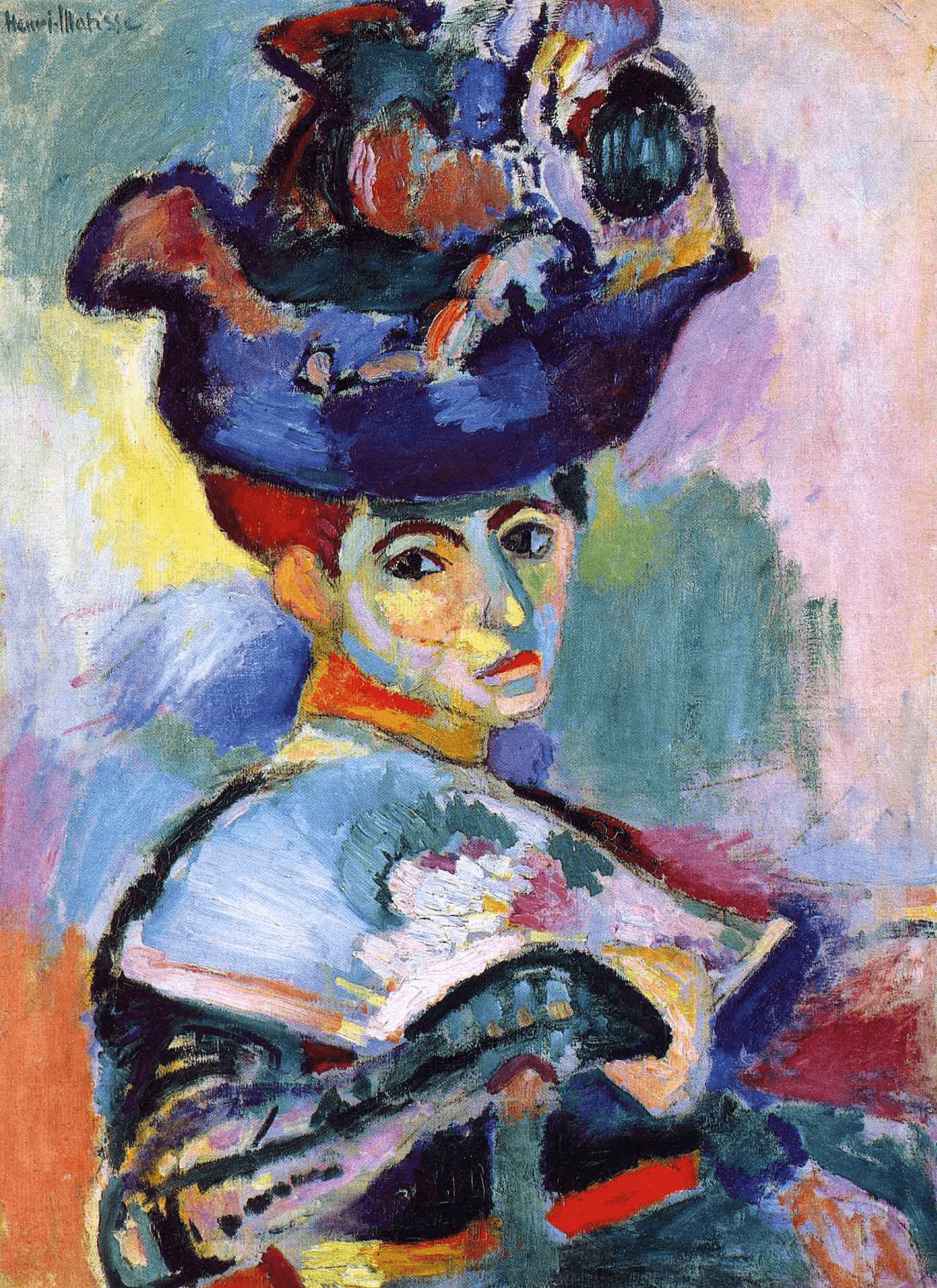
What they were doing: Color was liberated entirely from the task of describing reality. A tree could be red, a face could be green, water could be orange — not because the tree was red, but because red felt right there. This was a declaration of color as emotional carrier, not color as representational tool. Matisse’s Woman with a Hat (1905) is the extreme demonstration of this logic: his wife Amélie’s face painted in a mixture of green, orange, and violet — not to uglify her, but to turn the act of looking itself into an experience.
Key characteristics:
Pure color, squeezed directly from the tube, unmixed
Visible, rough brushwork that makes no attempt to hide the process
Compressed perspective, spatial depth deliberately weakened
Subject matter itself is irrelevant — beaches, figures, landscapes are just pretexts for color relationships
Why it was short-lived: Fauvism as a collective movement lasted only about three years. Because it was fundamentally intuitive, with no theoretical skeleton of its own — its one real theoretical inheritance, Divisionism, had already been abandoned — the members dispersed to develop more complex individual languages. Matisse continued along a decorative path, Derain turned toward classicism, Braque walked into Cubism.
The Wider Cage: The Other Fauves
Fauvism is taught almost exclusively as a story about three men, which flattens a movement that filled an entire room. Albert Marquet, Matisse’s close friend since their student days under Moreau, painted alongside the others in Room VII but never fully surrendered to the movement’s violence — his color stayed slightly more tethered to observed light, and by the 1910s he had settled into a long, quiet career as a painter of ports and rivers, the most understated member of a famously unquiet group. Kees van Dongen, Dutch by birth and the only major foreign presence in the original circle, pushed Fauvist color toward something more theatrical and erotic, applying it to portraits of dancers, courtesans, and Parisian nightlife with a cosmetic, almost lurid glamour that the others avoided; he would go on to become a fashionable society portraitist, a trajectory none of his Fauvist peers shared. Raoul Dufy initially painted in a fairly conventional Impressionist mode before a 1905 encounter with Matisse’s Luxe, Calme et Volupté converted him almost overnight; his mature style — bright, calligraphic, decorative — outlasted Fauvism by decades and became closely associated with images of regattas, racetracks, and French leisure. Othon Friesz worked in a bolder, more structurally weighted version of the style before drifting, like Derain, toward a heavier classicism after 1907. And Georges Braque, often introduced straight into the Cubism story, spent 1906 and 1907 painting in a fully Fauvist idiom — his Estaque landscapes from that period are drenched in the same unmixed color as Derain’s — before he later said, of the Fauvist temperature itself, that no one could sustain a permanent state of crisis. Braque’s route out of Fauvism ran directly into Cubism by way of Cézanne; his 1908 landscapes, rejected by the Salon d’Automne jury and mocked by Vauxcelles as mere “cubes,” gave the next movement its name in almost exactly the way Room VII had given this one its name three years earlier — the same critic, coining the label for the second time.
Henri Matisse|1869–1954
Who he was: The intellectual core of Fauvism, and the only member of the movement who left a truly lasting legacy. But Matisse was not a born revolutionary — he was the son of a fabric merchant in northern France, and before the age of twenty his life was on track to become a lawyer. During the long recovery from an appendectomy in 1889, his mother gave him a box of paints to pass the time. He later said that the moment he discovered painting felt “like entering paradise.” He went to Paris to study, entering the studio of Symbolist painter Gustave Moreau. Moreau was an unusual teacher — he never forced students to imitate him, instead encouraging them to find their own eyes. Matisse met Rouault there and began to understand that color was more than a descriptive tool. His early work was fairly traditional, even conservative, built on copying old masters in the Louvre. The real transformation came in stages: first Impressionism and Cézanne, then a full season of Neo-Impressionist discipline under Signac in 1904, and only then the final break at Collioure in 1905.
Woman with a Hat (1905): His wife Amélie sits wearing an extravagant large hat. The shadows on her face are not grey or brown but green, orange, and violet placed side by side. The hat is an explosion of red, yellow, and blue. The background is smeared color blocks. The critical response was outrage. But Gertrude Stein and her brother Leo bought the painting — marking the beginning of Matisse’s entry into the American collector’s eye, and stabilizing his finances for the years that followed. The painting now hangs in the San Francisco Museum of Modern Art, having crossed an ocean the way so much of the Fauvist movement’s actual survival depended on foreign collectors rather than French institutions: the Stein family in Paris, and later the Moscow textile magnate Sergei Shchukin, who bought Matisse aggressively enough to shape entire rooms of his own mansion around the artist’s work and effectively pre-installed a permanent Matisse collection on Russian soil years before the Bolshevik nationalization that would eventually fold it into the Hermitage and Pushkin museums.
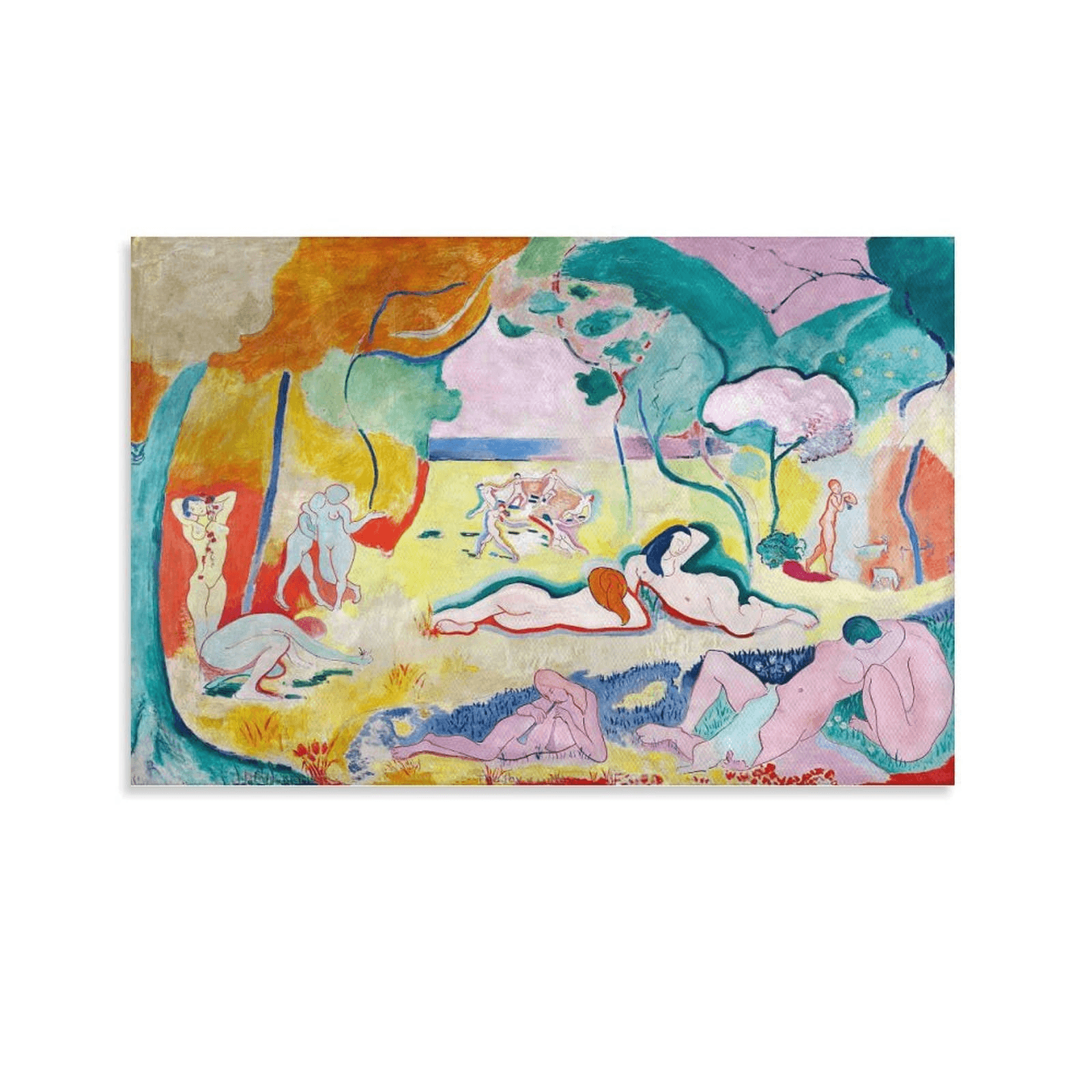
Le bonheur de vivre (The Joy of Life, 1906): This painting is the philosophical manifesto of Fauvism. Nude figures are scattered across an unrealistic landscape, dancing, reclining, embracing. The colors are pink, yellow, green, orange — like a dream of sensory paradise. Perspective is compressed, contours are flowing lines. This is Matisse’s farewell to Impressionism, and his rebellion against Cézanne’s severe geometry. What he wanted was pleasure itself — no anxiety, no critique, no philosophy. Just pure joy existing in color and form.
Matisse after Fauvism: After the movement collapsed, Matisse didn’t stop. He entered a long period of exploration:
1910s: Influenced by Islamic art and his trips to Morocco, his canvases grew increasingly flat and decorative
1920s–30s: The Nice period — light, interiors, women, windows. Very sensual, very French
Late career (1940s onward): After surgery on his legs left him unable to stand at a canvas, he began working with cut paper. Jazz (1947) and his late cut-paper series became his final and purest language — blocks of color that are form itself, needing no line, no brushstroke
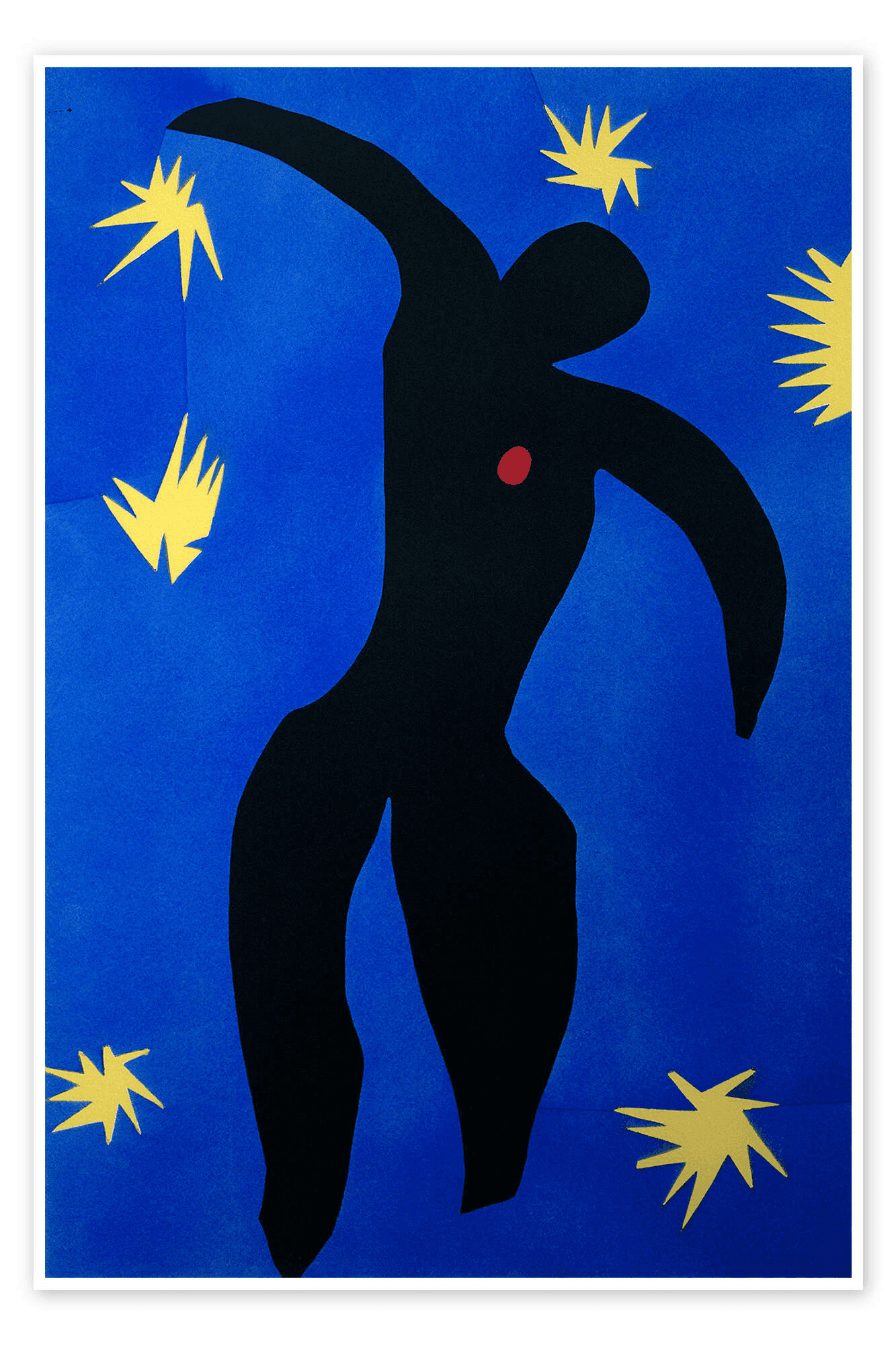
Matisse lived to 85, creating until a few years before his death. He and Picasso were mirrors to each other for a lifetime — completely opposed in style, never willing to concede, yet both acknowledging the other as their only true rival.
André Derain|1880–1954
Who he was: One of Fauvism’s most important co-creators, and the movement’s greatest “defector.” Derain’s story carries a tragic quality — he was most courageous at his youngest, then spent the remaining thirty years slowly retreating toward conservatism. Born in Chatou, a suburb of Paris, his father was a pastry chef and municipal official — a stable household with no enthusiasm for art. Derain started painting at fifteen, entirely self-taught. He met Vlaminck by chance on a train, an encounter that changed both their trajectories. They began painting together in Chatou, forming what would later be called the “School of Chatou.” In 1900, Derain went to study in Paris and met Matisse, who was ten years his senior and became a decisive influence.
Co-inventing the language: In the summer of 1905, Matisse invited Derain to Collioure. Derain was only 24 and at the peak of his energy. They pushed each other there, jointly developing the core language of Fauvism. Derain’s work from Collioure ranks among his finest: Boats in the Harbor at Collioure, The Drying of the Sails — colors blazing, brushwork free, compositions driven by color logic rather than perspective. That autumn he also painted Matisse’s portrait directly, half the face turned turquoise, the beard streaked crimson — the two men were, for that one season, painting each other into existence.
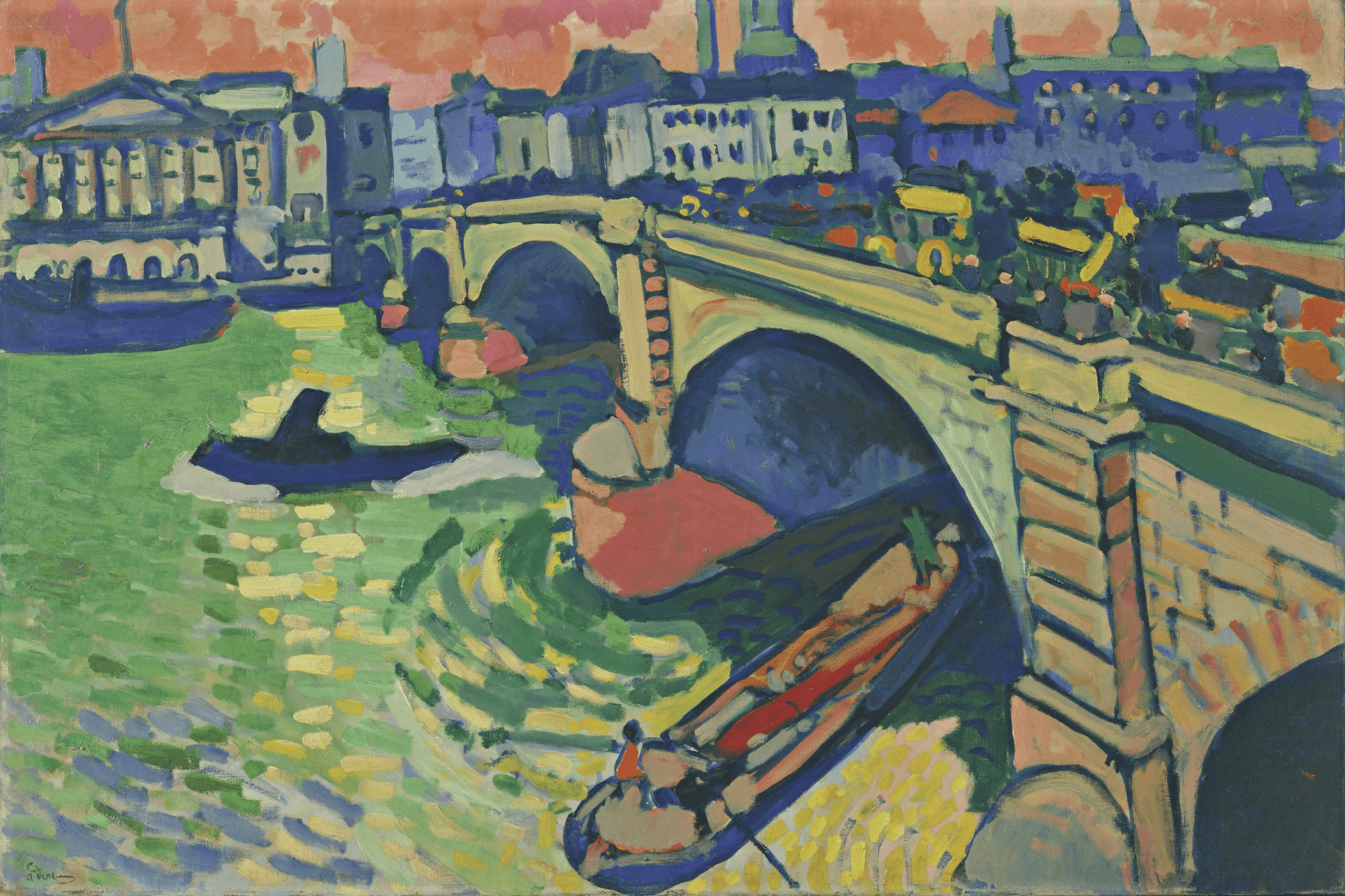
The London Series (1906): At the peak of Fauvism, the art dealer Ambroise Vollard commissioned Derain to paint a series along the Thames — a response to Monet’s earlier London series, but reworked entirely in the Fauvist language. The results were powerful. The Charing Cross Bridge and Thames series — London’s grey skies painted orange and pink, the river layered in blue-green impasto, the buildings reduced to pivot points for color relationships. These paintings are among the most accomplished works Fauvism ever produced, and arguably the movement’s clearest proof that its method could be exported wholesale onto foreign subject matter and still hold together.
Then he retreated: After 1907, Derain grew interested in Primitivism — African sculpture, Cézanne’s structural logic. He slowly abandoned the sensory freedom of Fauvism and moved toward a heavier, more classical style. By the 1910s he was visibly returning to classicism, copying Renaissance paintings, making still lifes and portraits, his style increasingly resembling that of a skilled but conservative academic painter. The most controversial chapter: during the Nazi occupation of France in World War II, Derain visited Germany and participated in cultural exchange events organized by the Nazis. After the war, this left him nearly completely ostracized from French cultural life. He spent his final years in disgrace, dying in a car accident in 1954, a few months before Matisse.
Why his retreat deserves to be taken seriously: Derain didn’t lack talent — he chose to abandon it. He understood clearly what the sensory adventure of Fauvism was, and chose safety instead. What he left in art history is a case study in how talent consumes itself through caution.
Maurice de Vlaminck|1876–1958
Who he was: The most rough-edged, most instinctive, least “intellectual” of the three. Vlaminck was a genuine outsider — no formal art training, making a living playing violin, racing bicycles, and writing erotic novels. Painting for him was a bodily impulse, not a career plan.
Both his parents were musicians. The family was poor and he had to support himself early. His encounter with Derain happened in 1900 during a train collision — two trains crashed, and while waiting they started talking, discovered they both painted, and rented a studio together in Chatou. They called it “La Maison Fournaise,” and it became the base for their early experiments.
Paint squeezed straight from the tube: Vlaminck often boasted that he never mixed colors, squeezing paint directly from the tube onto the canvas. This wasn’t coarseness — it was an aesthetic position: painting should be direct, physiological, an impulse that passes through as little intellectual filtering as possible. He worshipped Van Gogh to a near-religious degree. After seeing a Van Gogh retrospective in Paris in 1901, he later described loving Van Gogh in that moment more than his own father. The influence is directly visible — his brushwork, his use of color, his sensitivity to the emotional charge in landscape all trace straight back to Van Gogh.

Work at his peak: The Seine at Chatou, The Red Trees, The Dance Hall — in these paintings the intensity of color and the violence of the brushwork are the most extreme of any of the three. The reds he used were often pure vermilion, the greens pure emerald — no softening, no transition. The canvases carry something close to violent energy. His landscapes especially. He didn’t paint landscape — he painted the weight of landscape pressing down on a person. The sky hangs low, the colors are threatening, the horizon is taut. This temperament makes his Fauvist work fundamentally different from Matisse’s joy — Matisse was celebrating, Vlaminck was releasing.
His limitations: Vlaminck’s limitation and his strength were the same thing: he was too instinctive, lacking any internal logic of development. After Fauvism, he shifted toward a darker, more traditional Post-Impressionist style. His late work is large quantities of French rural landscape — technically accomplished, but without the savage energy of his early years. He knew this clearly himself, stating in late-life writings that his best work was in the Fauvist period. He lived to 82, writing several memoirs — including a defense of Derain’s wartime conduct. The two remained friends until the end.
What Fauvism Left Behind
Fauvism’s afterlife runs almost entirely through Germany, not France. In 1905 — the same year as the Salon d’Automne scandal — a group of architecture students in Dresden, Ernst Ludwig Kirchner and Erich Heckel among them, formed Die Brücke (The Bridge), independently arriving at a similarly liberated, emotionally loaded use of color before most of them had even seen the French work firsthand; once they did, the affinity was unmistakable, and the German group pushed the coloristic freedom of Fauvism toward something rawer and more psychologically distressed. A few years later, in Munich, Der Blaue Reiter — Wassily Kandinsky and Franz Marc, founded in 1911 — carried the same inheritance further still, toward the edge of full abstraction; Kandinsky had reportedly seen the 1905 Salon d’Automne canvases in person and left impressed. What Fauvism handed to German Expressionism, in other words, was permission — the demonstrated proof that color no longer owed reality anything. In France itself, the movement’s own members mostly walked away from what they’d built: Braque into Cubism, Derain into classicism, Friesz into a heavier structural mode. Only Matisse kept excavating the same vein for another five decades, which is a large part of why Fauvism is remembered today as a Matisse movement with two credited co-founders, rather than as the eight-or-nine-person room it actually was in October 1905.🖼️