Created on
Updated on
1905–1920s | 表现主义 German Expressionism
堕落的艺术家们
Preface: welcome to this very brief intro to modern art. Please feel free to use this as a guide for museum visits.
1905–1920s | German Expressionism
If Fauvism was the liberation of the senses, German Expressionism was the judgment of the senses. Both distort, both reject realism — but the motivations are completely different. Fauvism wanted to celebrate existence. Expressionism wanted to diagnose the sickness within it.
Why Germany, Why This Moment
Germany in the 1900s was a society undergoing rapid industrialization and urbanization while carrying enormous cultural anxiety. Nietzsche had declared God dead. Darwin had reduced humanity from the crown of creation to one animal among many. Freud in Vienna was excavating the unconscious. Three knives, plunged simultaneously into the body of European intellectual life.
Germany had only recently completed national unification (1871), lived under authoritarian political pressure, and harbored a deep collective anxiety in its culture. In France, Impressionism’s light and color represented a comfortable bourgeois pleasure. But Germany’s intellectual class refused that comfort. Their question wasn’t “how beautiful is the light” — it was “what can a person even be in the modern world.”
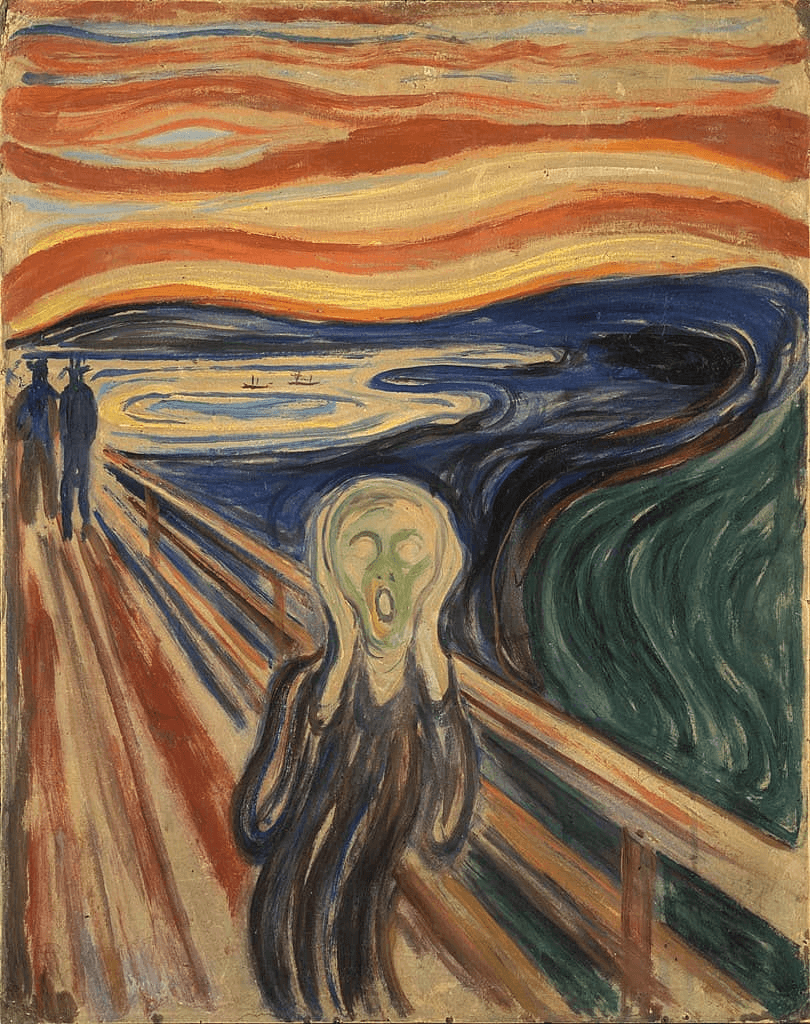
Another key influence: the Northern European art tradition. The Norwegian Edvard Munch (The Scream, 1893) had already arrived at the core logic of Expressionism before the movement had a name — distortion is not a mistake, it is the externalization of inner truth. His influence on the Brücke artists is directly visible.
Die Brücke | 1905–1913, Dresden → Berlin
Founded: In 1905, four architecture students at the Dresden University of Technology — Ernst Ludwig Kirchner, Erich Heckel, Karl Schmidt-Rottluff, Fritz Bleyl — declared themselves an art group in their dormitory. Not one of them had received formal painting training. The name “Bridge” came from a line in Nietzsche’s Thus Spoke Zarathustra: man is a bridge, not a destination. What they wanted to do was connect — connect the present to a more authentic, more instinctual state of being.
What they opposed: Academic realism. The sensory pleasure of Impressionism — they felt Impressionism only skimmed the surface. All decorative, flattering painting.
What they wanted: Directness. Primitiveness. They studied African and Oceanic art. The context was colonial, but these German artists saw in it a resource for rebellion against Western civilization. They painted at nudist camps, trying to recover a bodily perception uncorrupted by civilization.
Ernst Ludwig Kirchner | The Soul of Die Brücke
Kirchner was the most important and most complex figure in the group. In his early Dresden period he painted nude figures and studio scenes — colors primitivist, brushwork rough, but still containing something close to pleasure. The Berlin period (1910–1915) was his true peak. Die Brücke moved to Berlin in 1911 and encountered a real modern metropolis. Berlin was then one of the fastest-growing cities in Europe: loud, overcrowded, sharply divided by class, its sex trade openly visible, its wealth and poverty extreme.
His Berlin Street Scenes series (1913–1915) is the direct product of this encounter:
Figures elongated, sharpened — like blades
Faces are masks, eyes hollow
Colors are sickly — yellow-green, cold pink, a waxy corpse-white
Space is suffocating, streets so narrow they feel like throats
The body language of prostitutes and passersby carries a silent despair
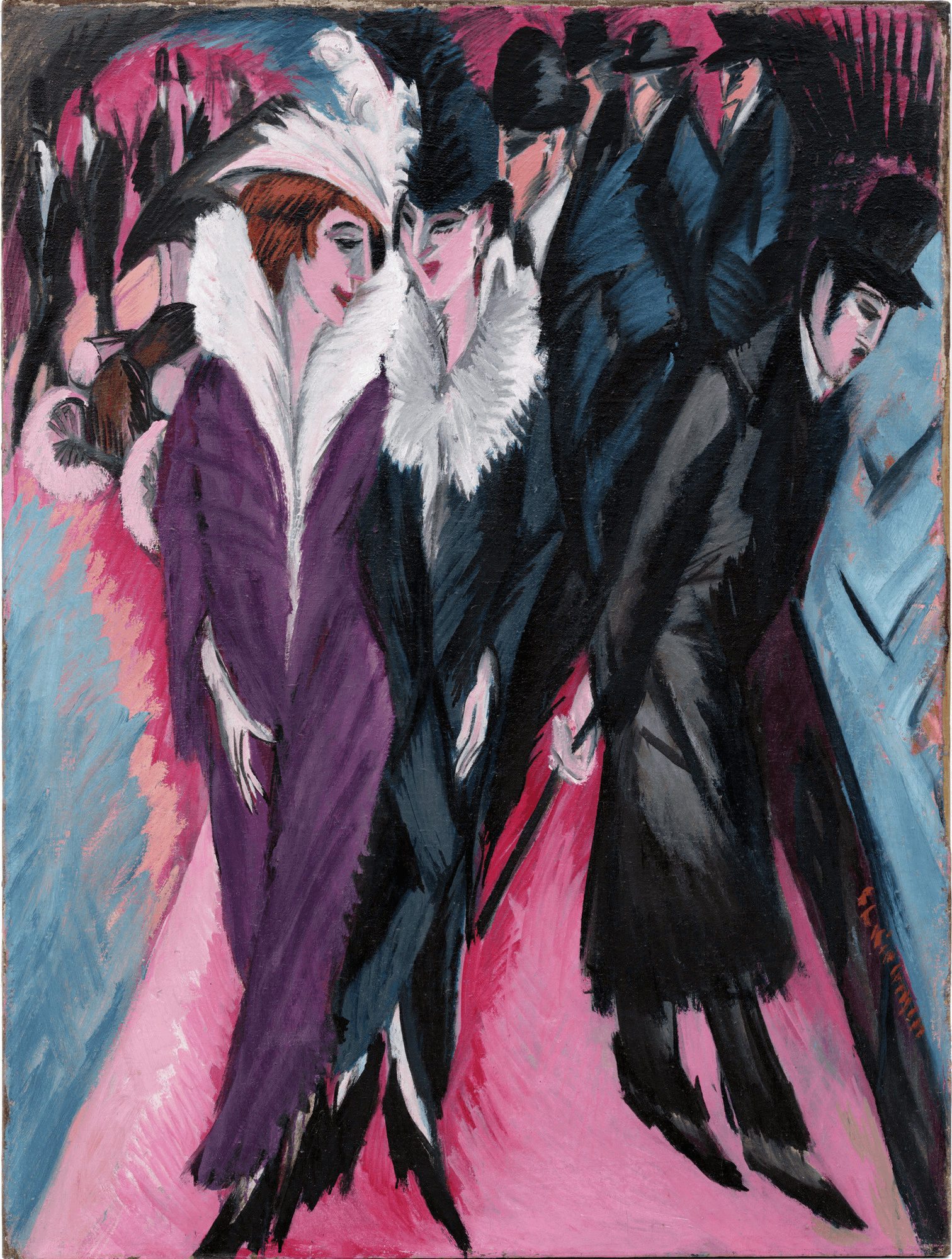
This is not a critique of Berlin. It is Berlin speaking through Kirchner’s body. When the First World War broke out Kirchner was conscripted. He never reached the front, but army life alone was enough to destroy him: he suffered a mental breakdown, was sent to a Swiss sanatorium, and remained dependent on sedatives for the rest of his life. His late work turned toward more abstract mountain landscapes, but the wound-tight energy of the Berlin period never returned. In 1938 the Nazis classified his work as Entartete Kunst — Degenerate Art — and seized and destroyed large numbers of his paintings. That same year he killed himself in Switzerland. He was 58.
Erich Heckel & Karl Schmidt-Rottluff
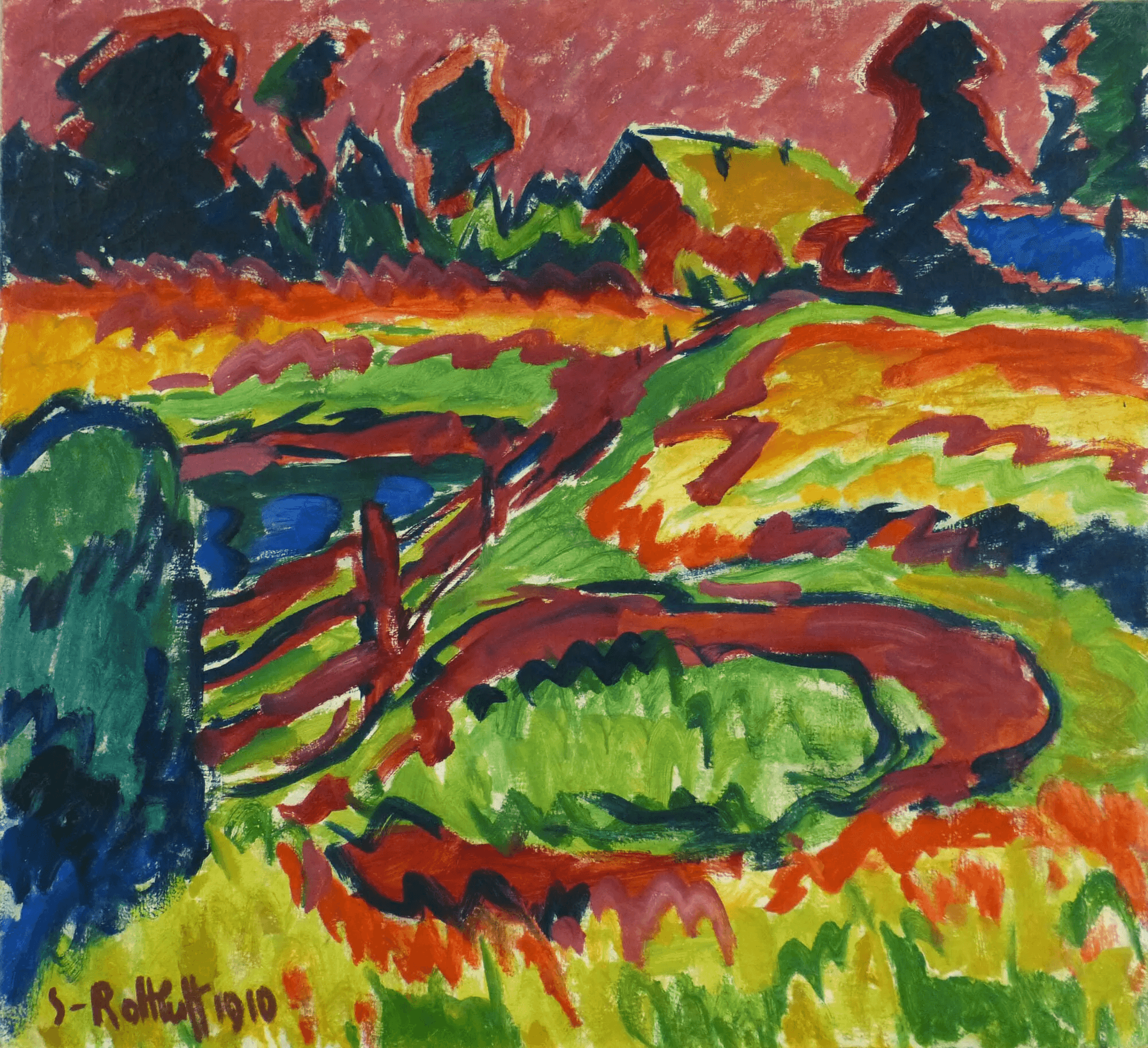
Both important, but temperamentally distinct. Heckel is more introverted — his pictures contain a near-religious quality of solitude. He was drawn to the sick, the isolated, figures of the emaciated — a spiritual suffering more than a social critique. Schmidt-Rottluff was the most violent colorist of the three. His paintings sometimes approach abstraction, forms reduced by the force of color to their most basic geometric planes. He lived the longest (dying in 1976), long enough to watch his work seized by the Nazis and then reappraised by history.
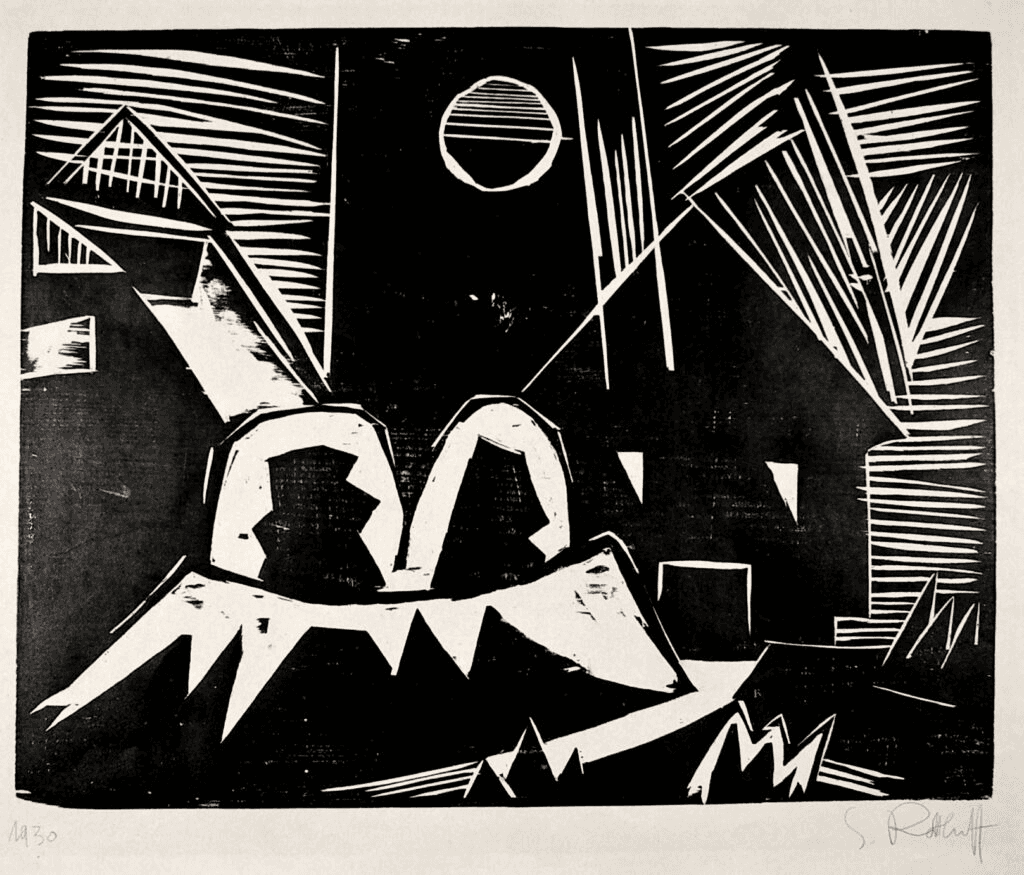
Woodcut Printmaking: Die Brücke’s True Medium
If Fauvism was a revolution in oil painting, Die Brücke’s equally significant revolution happened in the woodcut. They reactivated the German medieval and Renaissance woodcut tradition — Dürer’s tradition — replacing refined line with rough knife cuts. The physical nature of woodcut was a perfect match for their subjects: the act of cutting into wood carries an intrinsic violence, and the printed line has an irreducible rawness that cannot be softened. This is a complete unity of technique and content.
Der Blaue Reiter | 1911–1914, Munich
If Die Brücke dug downward — into urban filth, bodily anxiety — Der Blaue Reiter moved upward: toward spirituality, toward music, toward abstraction.
Core figures: Wassily Kandinsky (Russian, based in Munich), Franz Marc, August Macke, Paul Klee (joining later). The name came from the fact that both Kandinsky and Marc loved the color blue (Kandinsky considered it the most spiritual color), Kandinsky liked riders, and Marc liked horses. That simple.
Wassily Kandinsky | The Inventor of Abstract Painting
Kandinsky represents one of the most important theoretical turning points in all of modern art history. He arrived at a place no contemporary had reached: completely severing painting’s connection to the visible world.
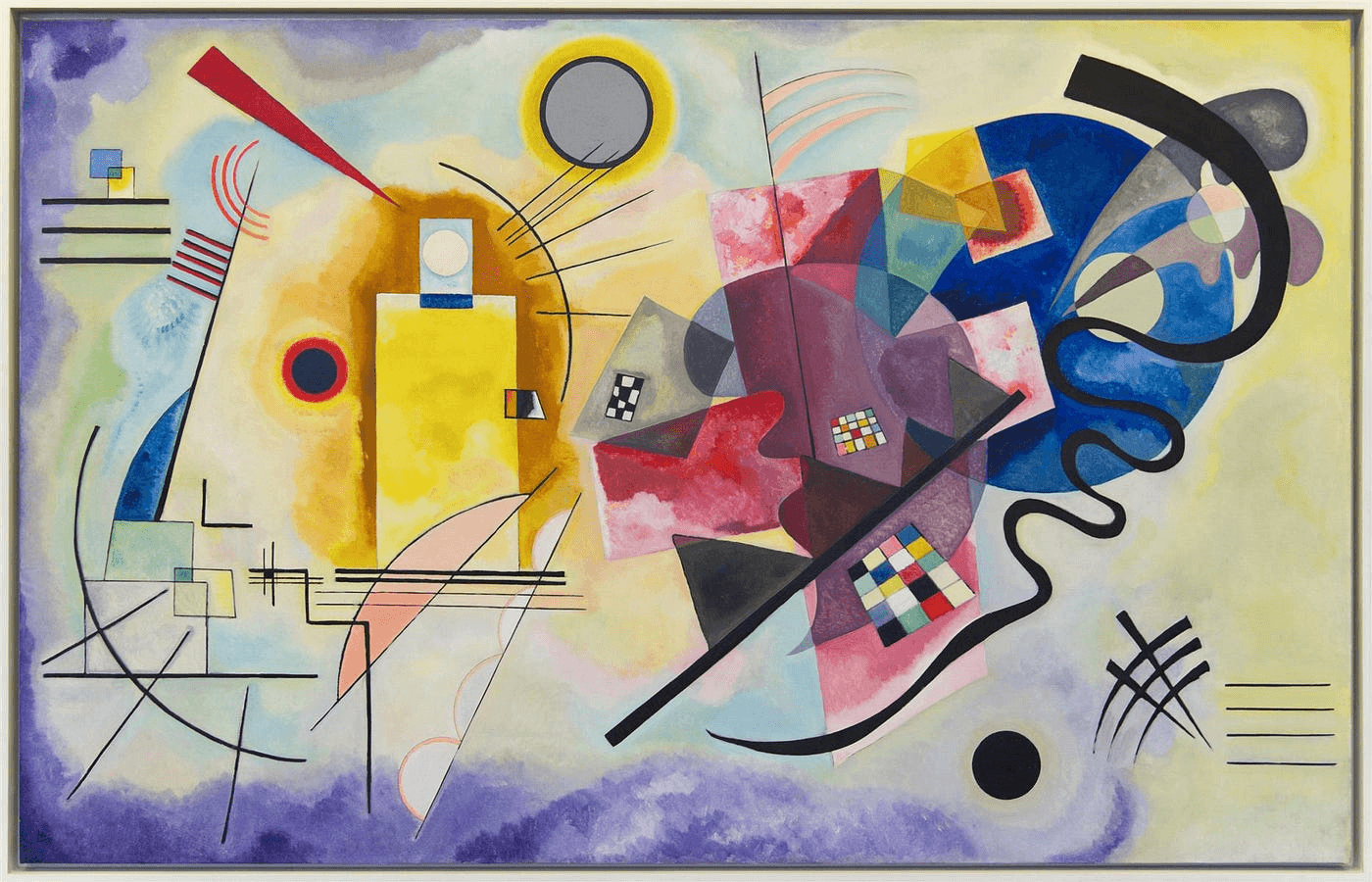
He wrote Concerning the Spiritual in Art (Über das Geistige in der Kunst, 1911). The book’s central argument: color and form, like music, can touch the soul directly — no concrete object required as intermediary. Yellow carries aggressive energy. Blue is introverted and spiritual. Red is the warmth of passion. Green is stable calm. He described a key moment: returning to his studio one evening, in dim light he saw an unfamiliar painting of extraordinary beauty — then walked closer and realized it was one of his own landscape paintings placed sideways. Precisely because he hadn’t recognized the subject, he had for the first time seen the pure force of color and form themselves.
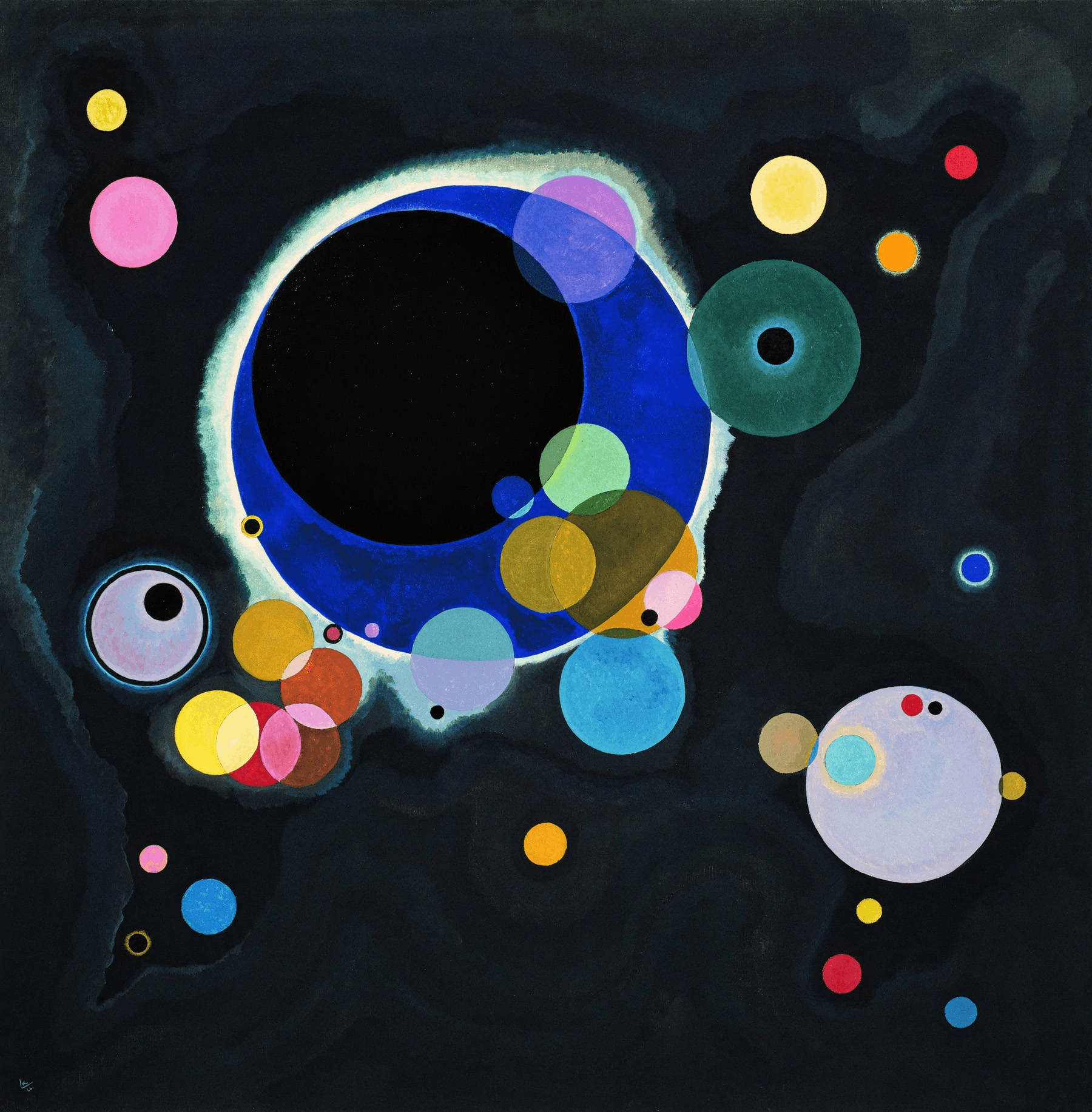
His series of Impressions, Improvisations, and Compositions from 1910–1913 trace his path to complete abstraction: recognizable forms grow increasingly blurred, then disappear entirely, leaving only the relationships between colors and lines.
Franz Marc | Animals as Spiritual Sanctuary
Marc is, personally, the Blaue Reiter painter most worth going deep on. He didn’t paint cities. He didn’t paint people. He painted animals. But his animals are not naturalistic — they are symbolic. He believed animals lived closer to a pure, uncontaminated state of being, uncorrupted by consciousness.

His color system was an explicit symbolic language:
Blue = masculine, spiritual, grave
Yellow = feminine, tender, sensual
Red = material, violent — something to be overcome by blue and yellow
Blue Horses (1911): four horses in an impossible blue, bodies in flowing curves, background in orange and green. This is not a painting of horses. It is a painting of longing for pure existence.
Fate of the Animals (1913): his most important work, and a kind of prophecy. The picture is catastrophe — trees shattering, animals in struggle, the colors deep red and black. On the back of the canvas he wrote: “All being is flaming suffering.”
In 1914 the First World War broke out and Marc volunteered. He believed the war would be a purification. In 1916, at the Battle of Verdun, he was struck in the head by shell fragments and died instantly. He was 36.
The Literary and Theatrical Dimension of Expressionism
Painting was only one part. Simultaneously:
Theater: Georg Kaiser, Ernst Toller — characters are not individuals but types (“The Worker,” “The Mother,” “The Bureaucrat”), dialogue is fragmented and declamatory, stage design is twisted geometric form.
Literature: Georg Trakl’s poetry: color imagery, decay, the premonition of death, language compressed to the point of collapse. Franz Kafka (contested, but many place him within the Expressionist lineage).
Architecture: Erich Mendelsohn’s Einstein Tower (1921) — flowing, organic, concrete that refuses straight lines. The purest specimen of Expressionist architecture.
The Nazis and “Degenerate Art” | 1937
In 1937 the Nazis staged the Entartete Kunst exhibition in Munich: confiscated works of Expressionism, Dada, and Bauhaus put on display, with the explicit aim of public ridicule — come see what these madmen painted. The result was a political disaster for the Nazis: the show drew over two million visitors, several times the attendance of the simultaneously running exhibition of officially approved Germanic art. People came to see the “degenerate” work, and many came with genuine aesthetic curiosity.
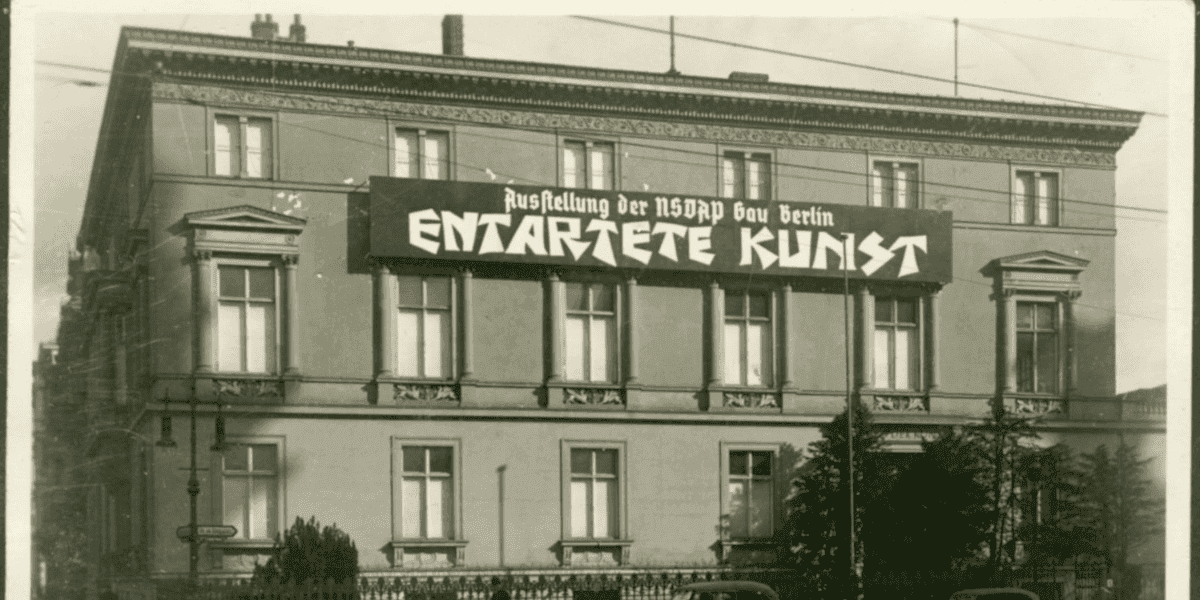
Artists classified as degenerate included Kirchner, Heckel, Schmidt-Rottluff, Kandinsky, Klee, Marc (already dead), and Grosz, Dix, Beckmann, and others. Large numbers of works were destroyed. Some were secretly sold abroad for foreign currency. Some entered American museum collections. The persecution objectively accomplished one thing: it permanently bound the moral legacy of Expressionism to the symbolism of resistance against dictatorship.
The Legacy of Expressionism
The direct line of influence:
German Expressionism → Abstract Expressionism (New York, 1940s–50s) — Pollock, Rothko, de Kooning. Many were directly influenced by Expressionist artists who had fled to America.
German Expressionist cinema → Film Noir → New Hollywood → contemporary thriller and science fiction visual language.
The emotional logic of Expressionism → psychological realism across the entire twentieth century — the principle that external space reflects internal state entered the novel, film, and theater.
Into Film
German Expressionist cinema (1919–1926) is the direct cinematization of visual Expressionism. Brücke painters participated in the art direction of some of these films, and the directors, writers, and cinematographers were largely immersed in the same Berlin cultural world. The key works and techniques can be explored separately, but the core logic is:
Tilted architecture = the suffocating space of Kirchner’s street scenes
Extreme contrast of hard light and deep shadow = the black-and-white logic of woodcut prints transferred to celluloid
Mask-like human faces = the direct extension of the Berlin Street Scenes figures
Distorted interiors = the externalization of psychological state, not a description of reality
The Cabinet of Dr. Caligari (1920), Nosferatu (1922), Metropolis (1927): these three together constitute a complete thesis on how Expressionism became cinematic language.🖼️
1905–1920s |德国表现主义 German Expressionism
如果说野兽派是感官的解放,德国表现主义是感官的审判。同样变形,同样反写实,但动机完全不同:野兽派想庆祝存在,表现主义想诊断存在里的病。
为什么是德国,为什么是这个时间
1900年代的德国是一个高速工业化、高度城市化、同时承载着巨大文化焦虑的社会。尼采宣布上帝死了,达尔文让人类从万物之灵变成了一种动物,弗洛伊德在维也纳挖掘无意识——这三把刀同时插在欧洲知识界的身体里。
德国当时还没有完成真正意义上的民族统一(1871年才统一),政治上有威权压力,文化上有强烈的集体焦虑。印象派的光与色在法国代表了一种从容的布尔乔亚乐趣,但德国的知识分子阶层对这种从容是拒绝的。他们的问题不是”光线怎么漂亮”,而是”人在现代世界里还能是什么”。
另一个关键影响:北欧艺术传统。挪威人Edvard Munch(《呐喊》,1893)早在德国表现主义命名之前就已经画出了表现主义的核心逻辑:扭曲不是失误,是内在真实的外化。他的影响在桥社成员里是直接可见的。
桥社 Die Brücke|1905–1913,德累斯顿→柏林
成立: 1905年,四个德累斯顿工业大学的建筑系学生:Ernst Ludwig Kirchner, Erich Heckel, Karl Schmidt-Rottluff, Fritz Bleyl 在宿舍里宣布成立艺术团体。他们没有一个受过正式绘画训练。名字”桥”来自尼采《查拉图斯特拉如是说》里的一句话:人是一座桥,不是终点。他们想做的是连接,连接现在和一个更真实、更本能的存在状态。
他们反对什么:学院派写实主义。印象派的感官愉悦,他们认为印象派只在表面滑行。一切装饰性的、讨好性的绘画。
他们要什么:直接性。原始性。他们研究非洲和大洋洲的原始艺术。当时的语境是殖民语境,但这批德国艺术家在其中看到的是对西方文明的反叛资源。他们去裸体营写生,想找回一种未被文明污染的身体感知。
Ernst Ludwig Kirchner|桥社的灵魂
Kirchner是桥社里最重要、也最复杂的人物。早期在德累斯顿,他画裸体人物、工作室场景:颜色是原始主义的,笔触是粗糙的,但还有某种接近快乐的东西。柏林时期(1910–1915)才是他真正的高峰。桥社1911年迁到柏林,遭遇了真正的现代大城市。柏林当时是欧洲人口增长最快的城市之一:嘈杂、拥挤、阶级分化剧烈、性产业公开化、贫富极度悬殊。Kirchner的《柏林街景》系列(1913–1915)是这个遭遇的直接产物:
人物被拉长、削尖,像刀片一样
脸是面具,眼神是空的
颜色是病态的——黄绿、冷粉、尸体般的蜡白
空间是压迫性的,街道狭窄到像喉咙
妓女和路人的身体语言透着一种无声的绝望
这不是对柏林的批判,是柏林用Kirchner的身体说话。一战爆发,Kirchner应征入伍。他没有上前线,但军队生活本身就足以摧毁他:他精神崩溃,被送进瑞士疗养院,此后长期依赖镇静剂。晚期画风转向更抽象的山地风景,但那种柏林时期的紧张能量再没回来。1938年,纳粹将他的作品列为”堕落艺术”(Entartete Kunst),大批画作被没收销毁。同年他在瑞士自杀,时年58岁。
Erich Heckel & Karl Schmidt-Rottluff
两人都重要,但气质不同:Heckel 更内省,画面里有一种近乎宗教性的孤独感。他偏爱病人、孤独者、瘦削的人物——一种精神性的痛苦多于社会批判。Schmidt-Rottluff 是三人里颜色最粗暴的。画面有时接近抽象,形式被颜色的暴力削减到最基本的几何块面。他活得最长(1976年去世),也因此亲眼看着自己的作品被纳粹没收,又被战后重新评价。木刻版画:桥社的真正媒介
如果说野兽派是油画的革命,桥社同样重要的革命发生在木刻版画。他们重新激活了德国中世纪和文艺复兴时期的木刻传统(Dürer的传统),用粗糙的刀痕代替精细的线条。木刻的物质性和他们的主题完全匹配:刀切入木头的动作有一种内在的暴力,印出来的线条有一种无法修饰的粗粝。这是表现主义的技术与内容的完美统一。
蓝骑士 Der Blaue Reiter|1911–1914,慕尼黑
如果桥社是向下挖,挖进城市的污泥、身体的焦虑,蓝骑士是向上走——走向精神性、走向音乐、走向抽象。
核心人物: Wassily Kandinsky(俄国人,在慕尼黑),Franz Marc,August Macke,Paul Klee(后期加入)名字来自Kandinsky和Marc都喜欢蓝色(Kandinsky认为蓝色是最精神性的颜色),Kandinsky喜欢骑手,Marc喜欢马。就这么简单。
Wassily Kandinsky|抽象绘画的发明者
Kandinsky是整个现代艺术史里最重要的理论转折点之一。他走到了一个地方,是同时代没有其他人走到的:彻底切断绘画与可见世界的联系。
他写了《论艺术的精神》(Über das Geistige in der Kunst,1911)。这本书的核心论点是:颜色和形式像音乐一样,可以直接触动灵魂,不需要任何具象物体作为媒介。黄色有攻击性的能量,蓝色是内向和精神性的,红色是激情的暖,绿色是平静的稳定。他自己说过一个关键时刻:有一天回到工作室,在昏暗光线中看到一幅陌生的、非常美的画,走近才发现是自己的一幅风景画横放着。正是因为他认不出主题,才第一次看见了纯粹的颜色和形式本身的力量。
1910–1913年的”印象”、”即兴”、”构成”系列是他走向完全抽象的轨迹:物象越来越模糊,最后消失,只剩颜色和线条的关系。
Franz Marc|动物作为精神净土
Marc是我个人认为蓝骑士里最值得深入的画家。他不画城市,不画人。他画动物。但他的动物不是自然主义的,是符号性的。他相信动物比人类更接近一种纯粹的、未被意识污染的存在状态。他的颜色系统是明确的象征体系:
蓝色 = 男性,精神性,严肃
黄色 = 女性,温柔,感性
红色 = 物质,暴力,必须被蓝色和黄色克服
《蓝马》(Blue Horses,1911):四匹马,颜色是不可能的蓝,身体是流动的曲线,背景是橙和绿。这不是在画马,是在画一种关于纯粹存在的向往。
《动物命运》(Fate of the Animals,1913):他最重要的作品,也是某种预言。画面是一场灾难——树在碎裂,动物在挣扎,颜色是深红和黑。他在画布背面写道:”所有存在都是痛苦的燃烧。”
1914年一战爆发,Marc志愿入伍。他认为战争是一种净化。1916年,凡尔登战役,他被炮弹碎片击中头部,当场死亡。36岁。
表现主义的文学和戏剧维度
绘画只是表现主义的一部分。同时期还有:
戏剧: Georg Kaiser, Ernst Toller:人物不是个体而是类型(”工人”、”母亲”、”官僚”),台词是喊叫式的、片段式的,舞台设计是扭曲的几何形状。
文学: Georg Trakl的诗:颜色意象、衰败、死亡预感,语言被压缩到崩溃边缘。Frank Kafka(有争议,但很多人把他纳入表现主义谱系)。
建筑: Erich Mendelsohn的爱因斯坦塔(1921)——流动的、有机的、拒绝直线的混凝土建筑,是表现主义建筑最纯粹的标本。
纳粹与”堕落艺术”|1937
1937年,纳粹在慕尼黑举办了《堕落艺术展》(Entartete Kunst):把没收的表现主义、达达、包豪斯作品展出,目的是公开嘲弄,让观众来”看看这些疯子画的什么垃圾”。结果是纳粹的政治公关灾难:展览吸引了超过两百万参观者,是同期举办的”正统”日耳曼艺术展的数倍。人们来看”堕落艺术”,很多人是带着真正的审美好奇来的。
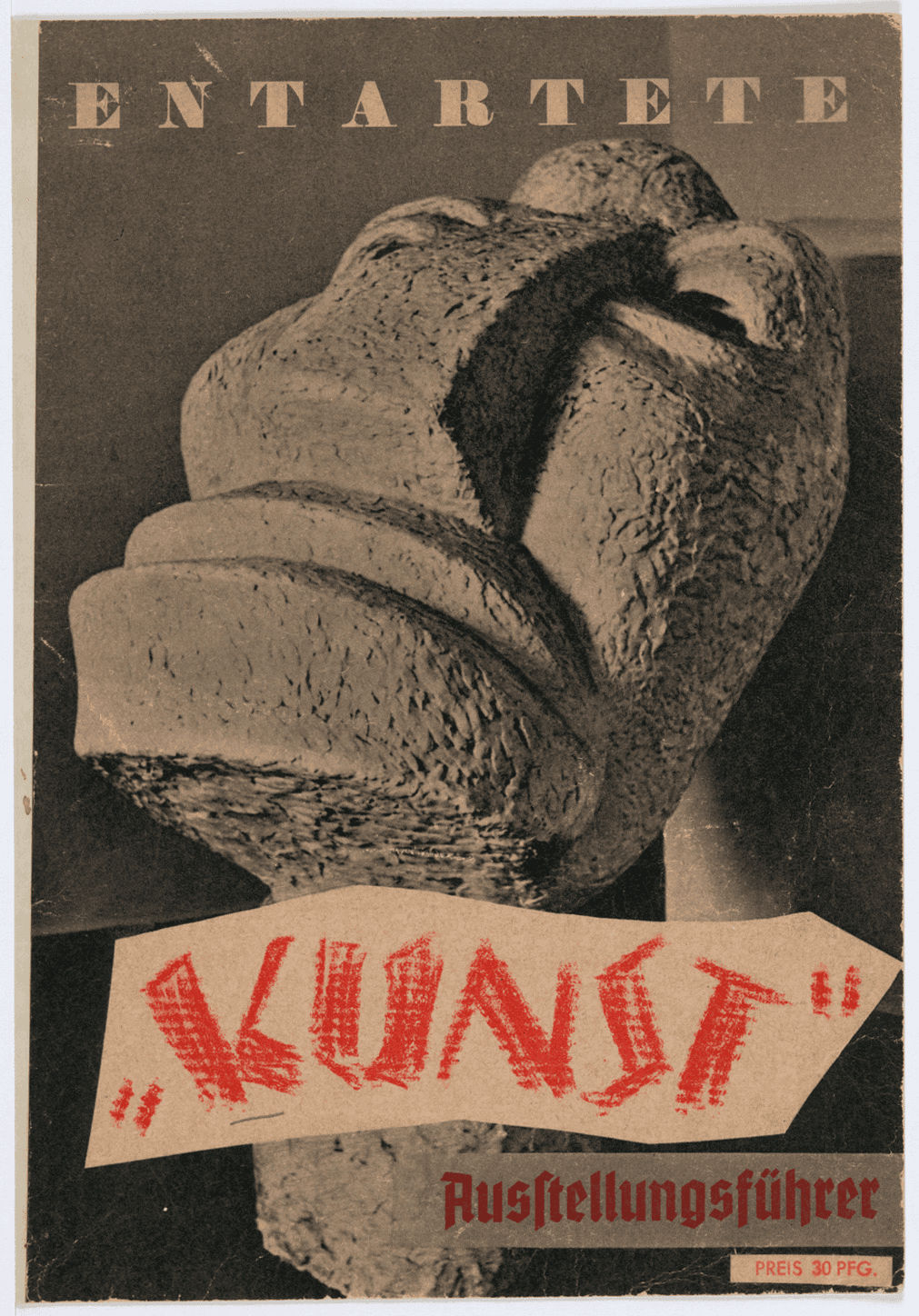
被列为堕落的艺术家包括Kirchner, Heckel, Schmidt-Rottluff, Kandinsky, Klee, Marc(已死),以及Grosz, Dix, Beckmann等。大批作品被销毁,部分被秘密出售换外汇,部分流入美国博物馆收藏。这场迫害在客观上完成了一件事:把表现主义的道德遗产和对抗独裁的象征意义永久绑定在一起。
表现主义的遗产
直接影响链:
德国表现主义→抽象表现主义(纽约,1940s-50s)——波洛克、罗斯科、德·库宁。很多人直接受到流亡美国的表现主义艺术家影响。
德国表现主义电影→黑色电影→新好莱坞→当代惊悚/科幻视觉语言
表现主义的情绪逻辑→整个20世纪的心理现实主义——外部空间反映内心状态这个原则,进入了小说、电影、戏剧。
进入电影
德国表现主义电影(1919–1926)是视觉艺术表现主义的直接电影化。桥社画家就参与了部分电影的美术设计,而这批电影的导演、编剧、摄影师很多都浸泡在同一个柏林文化圈里。关键作品和关键技术后面可以单独展开,但核心逻辑是:
倾斜的建筑 = Kirchner街景里的压迫性空间
强光与硬阴影的极端对比 = 木刻版画的黑白逻辑搬到胶片上
面具般的人脸 = 柏林街景系列人物的直接延伸
扭曲的室内 = 精神状态的外化,不是现实描述
《卡里加里博士的小屋》(1920)、《诺斯费拉图》(1922)、《大都会》(1927):这三部放在一起,就是一部关于”表现主义如何变成电影语言”的完整论文。
🖼️