Created on
Updated on
1907-1920s | 立体主义 Cubism
毕加索有点问题
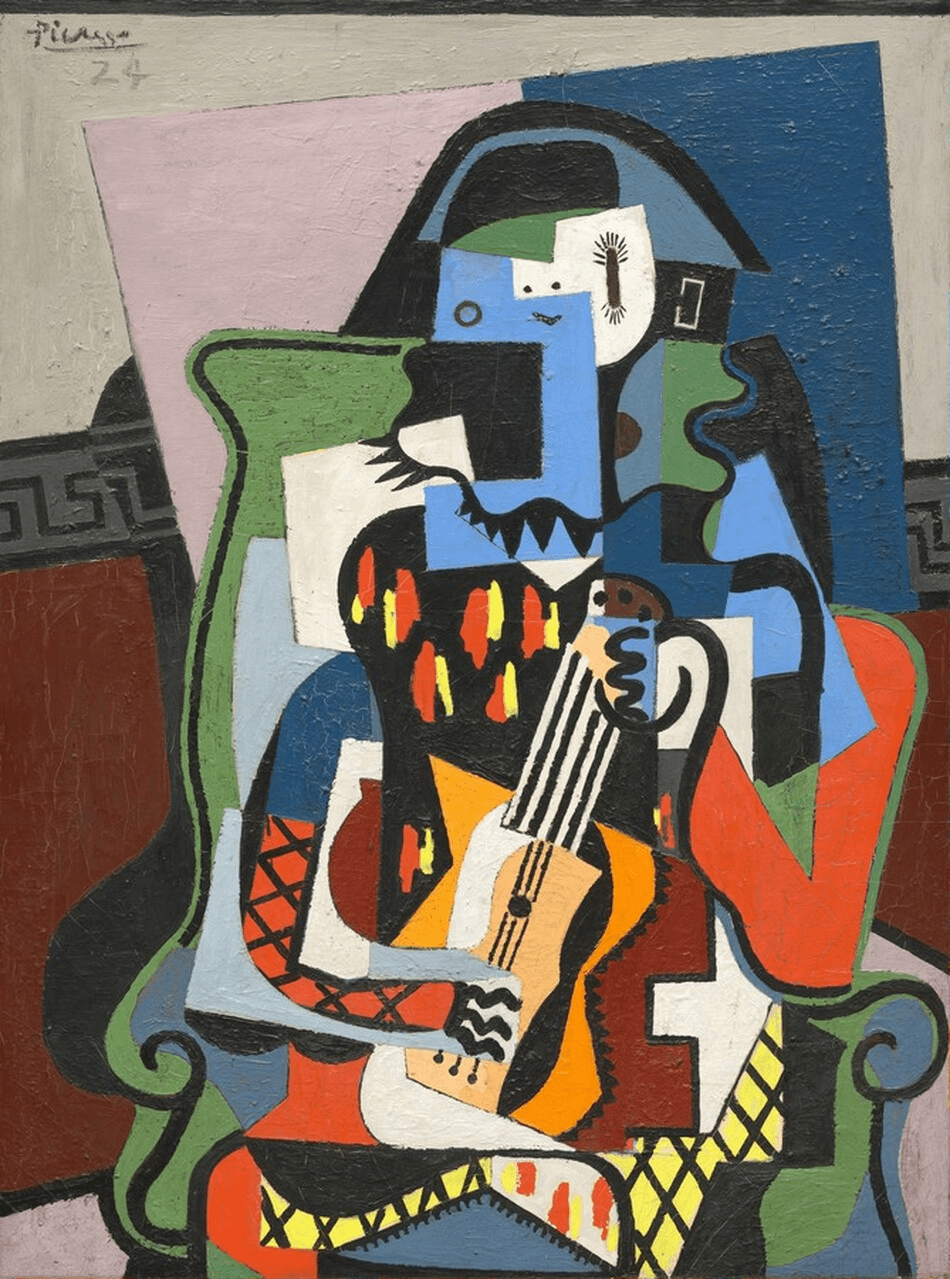
Preface: welcome to this very brief intro to modern art. Please feel free to use this as a guide for museum visits.
What is Cubism?
In one sentence: viewing an object from multiple angles simultaneously, then compressing all those viewpoints into a single plane.
But that definition is too technical. The deeper answer: Cubism was the first time artists said that painting should not simulate what the human eye sees — it should simulate how the human mind knows the world. When you look at a face, your eyes scan across it, your memory layers onto it, your emotions color it. Your “knowledge” of a face is not a snapshot from a single viewpoint at a single instant — it is a composite built up over time. Cubism wanted to paint that composite directly. This is an epistemological revolution, not merely a stylistic one.
Historical Context: Why 1907?
Three things happened simultaneously.
1. Cézanne died in 1906; his retrospective was held in 1907.
Cézanne’s multiple viewpoints, his geometric simplification, his skepticism toward perspective — these seeds exploded into flower in Paris in 1907. Picasso and Braque began experimenting immediately after the retrospective.
2. The impact of African sculpture.
In the spring of 1907, Picasso saw African and Oceanic masks and sculptures at the Trocadéro anthropology museum in Paris. He later described that night as a “revelation” — he stayed a long time, and by the time he left, the conception of Les Demoiselles d’Avignon had formed. The visual logic of African sculpture: presenting front and side simultaneously, making no attempt to create a three-dimensional illusion, treating the human body directly through flat geometric form. This was a different direction arriving at the same answer as Cézanne’s geometry.
3. Einstein published the Special Theory of Relativity in 1905.
Time and space are not absolute — they are relative to the observer. There is no “objective” single viewpoint. This revolution in physics is structurally identical to the epistemology of Cubism. Picasso hadn’t read Einstein’s papers, of course, but both were products of the same spirit of the age.
Les Demoiselles d’Avignon (1907)
This painting is Cubism’s manifesto, but it is not yet Cubism itself — it is the transition, the crack before the explosion.
The image: Five nude women facing the viewer directly. The two figures on the left have Iberian-style faces (the influence of ancient Spanish sculpture). The two on the right have African mask faces — noses skewed, eyes asymmetrical, entirely ignoring the rules of Western portraiture. Picasso spent nearly a year on this painting and left hundreds of preparatory sketches. The original composition included male figures (a sailor and a medical student), later removed entirely — the final version is a direct confrontation between pure female bodies and the viewer.
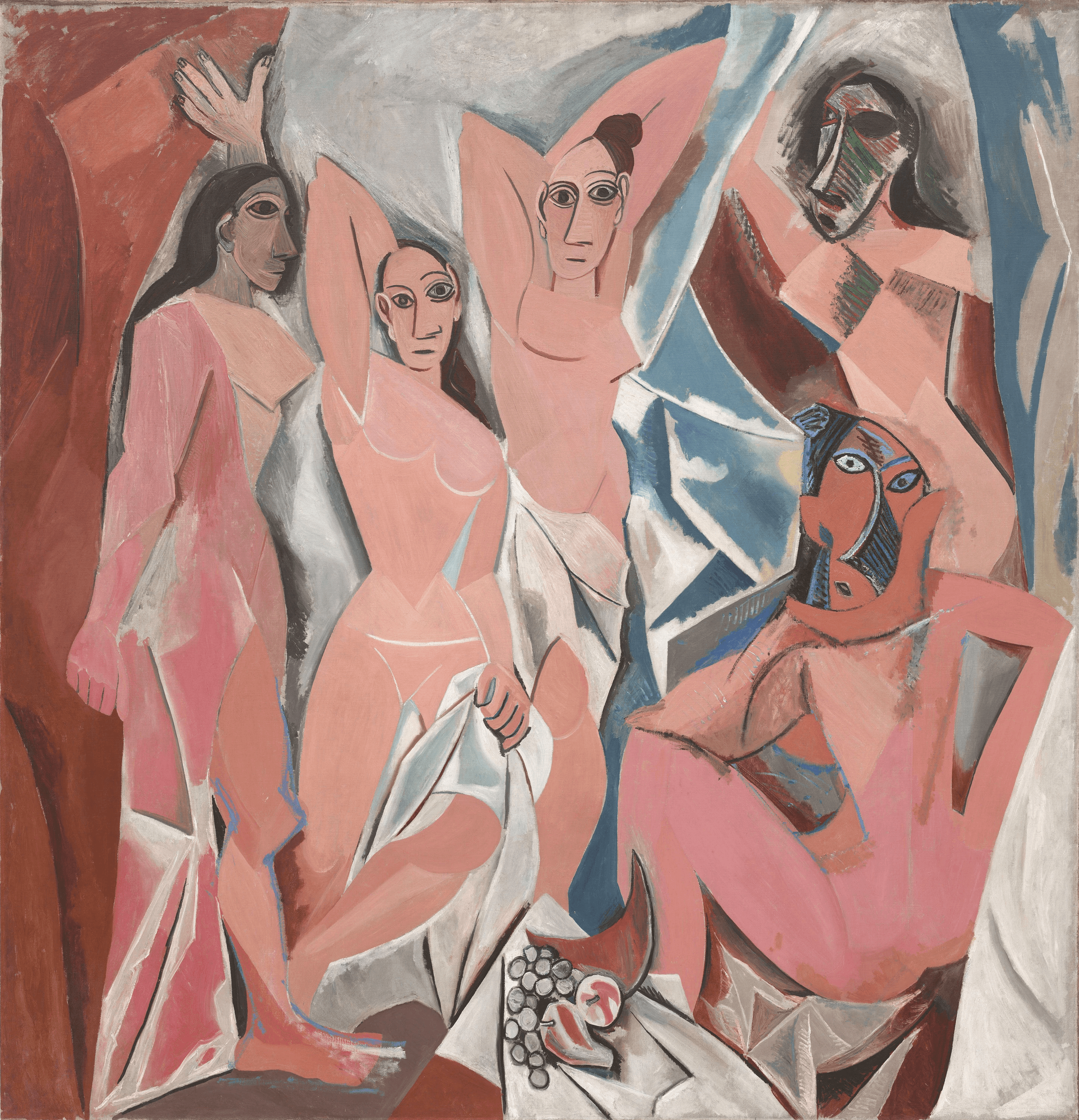
Why the title “Demoiselles d’Avignon”: The title was not Picasso’s — it was given later by his friend André Salmon. Avignon Street was a famous brothel street in Barcelona. Picasso never liked the title.
His friends’ reactions: After completing the painting Picasso hid it in his studio for a long time. He showed it to a few close friends — Matisse thought Picasso was mocking the modern art movement. Braque said on first seeing it that it felt like Picasso was asking them to “drink kerosene.” Yet Braque became Picasso’s most important collaborator. The painting was never publicly exhibited during Picasso’s lifetime until 1916.
Analytic Cubism (1908–1912) — Picasso + Braque
The purest and most radical phase of Cubism.
Method: Decompose an object (a person, a musical instrument, a bottle) into multiple geometric planes, present them simultaneously from multiple angles, then reassemble them on the picture surface. On the surface the result looks like an accumulation of fragments — but if you look long enough, the fragments from different viewpoints begin to activate each other, and you begin to feel space folding multiply across the flat surface.
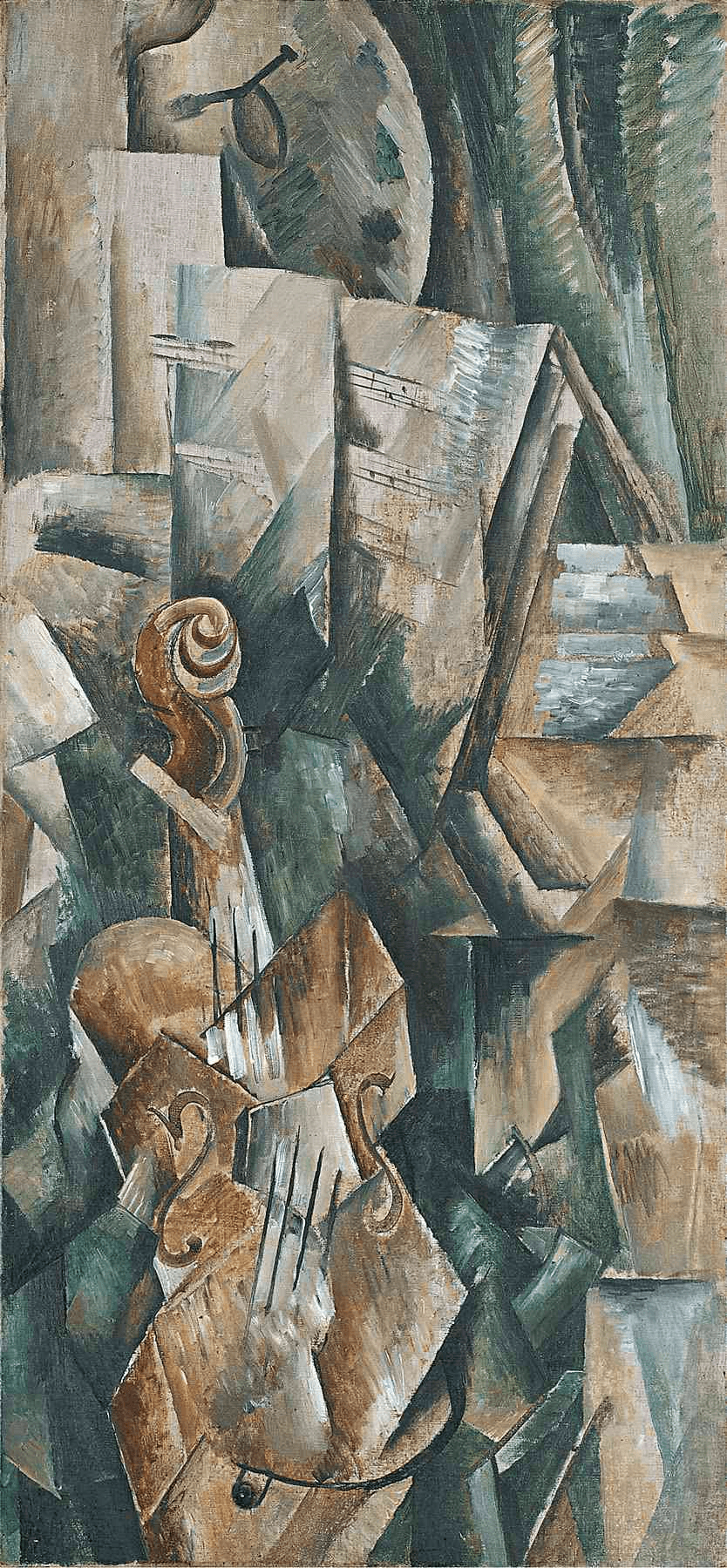
Color: Nearly abandoned entirely. The palette is brown, gray, off-white — approaching monochrome. Why? Because they didn’t want color to distract attention. They wanted to concentrate all their energy on problems of form and space. Color is sensory; the problem they were solving was epistemological.
Repetition of subjects: They painted the same subjects over and over — guitar, violin, wine bottle, newspaper, figure. Because they were not studying the subject — they were studying a method of visual analysis. The subject was the object being analyzed, not the point.
The relationship between Picasso and Braque: This collaboration is one of the strangest creative partnerships in art history. Between 1908 and 1914 their styles grew so close that sometimes neither of them could tell their work apart. They placed each other’s paintings together without signatures and tested whether they could identify who had painted what — sometimes they couldn’t. Picasso later described their relationship as being like “two mountaineers roped together” — you trust this person’s judgment, you go together to places no one has gone before, you are on the same rope. When the First World War broke out Braque was conscripted, suffered a head wound, and nearly lost his sight. Their collaboration ended and never recovered that density.
Synthetic Cubism (1912–1920s)
If Analytic Cubism took objects apart, Synthetic Cubism assembled different materials into a new whole.
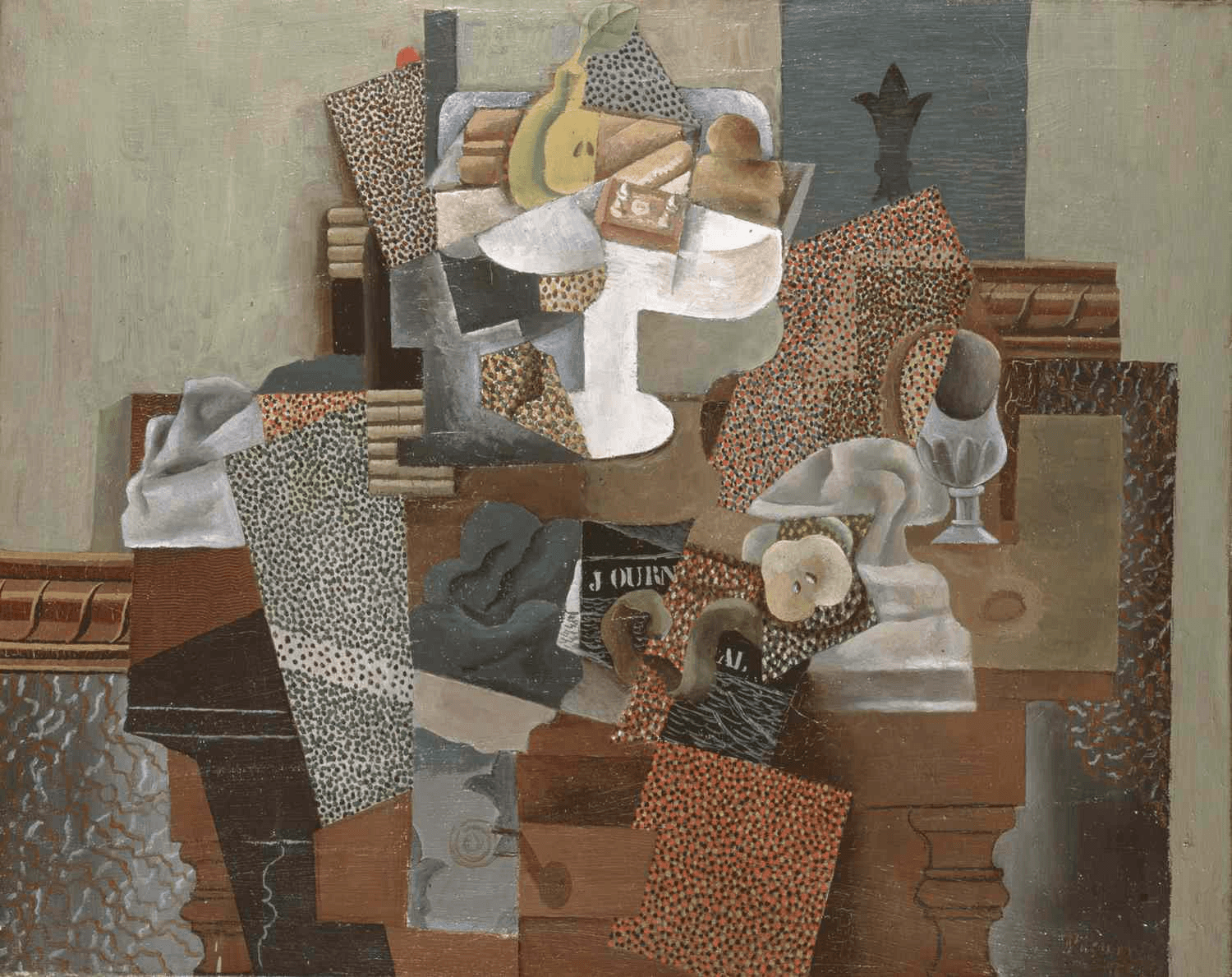
The invention of collage: In 1912 Braque was the first to paste newspaper fragments and wallpaper into a picture. Picasso followed immediately and went further — rope, oilcloth, sand, wood shavings all entered the picture surface.
This is an important moment in art history: painting shifted from representation to construction. The picture was no longer an imitation of reality — it was a new reality assembled from fragments of the real. Pasting newspaper into the picture had another meaning: the text on the paper (news headlines, advertisements) carried a real-world timestamp into the artwork, breaking the boundary between painting and daily life once again.
Color returned: The Synthetic phase is richer in color, more decorative in form — less of the tense intellectual density of the Analytic phase, more visual pleasure.
The Core Figures
Pablo Picasso (1881–1973)
The engine of Cubism. But Picasso is a figure who needs to be understood fully, not only as a genius myth.
The facts of the genius: his technical ability was staggering — his academic drawings at 15 reached the level of a mature master. He abandoned realism not because he couldn’t do it but because he chose not to. The weight of that choice is entirely different. Over his lifetime he produced approximately 20,000 works, spanning Cubism, Surrealism, Neoclassicism, late Expressionism — no other artist has that range of style or that volume.
The facts of the problem: Picasso’s relationships with women are the dark side of his life, and a subject art history long avoided. The pattern across his relationships was consistent: find a young woman, she becomes muse and model, his art explodes during the relationship, then he moves to the next one, and the previous one falls into depression or collapse.
Marie-Thérèse Walter: he began a relationship with her when she was 17 and she didn’t know who he was. She killed herself four years after his death.
Dora Maar: a photographer, his intellectual equal — he painted large numbers of portraits of her weeping; she later suffered a mental breakdown.
Françoise Gilot was the only woman who left him on her own terms. She later wrote a memoir documenting all of it. Picasso was furious and tried to block publication. He failed.
These are not private matters unrelated to his art. His gaze toward women directly constitutes the content of a large portion of his work, and he exploited these women.
Georges Braque (1882–1963)
The co-inventor of Cubism, but long overshadowed in the narrative by Picasso. Braque was a more introverted person. He didn’t pursue Picasso’s constant style changes — after the First World War he developed his own more stable, more quietly contemplative style on the foundation of Cubism: still lifes, interiors, colors rich but restrained, pictures carrying a quality of deliberate calm. One of his lines is worth keeping: “Truth exists for everyone to find. Only lies are invented.”
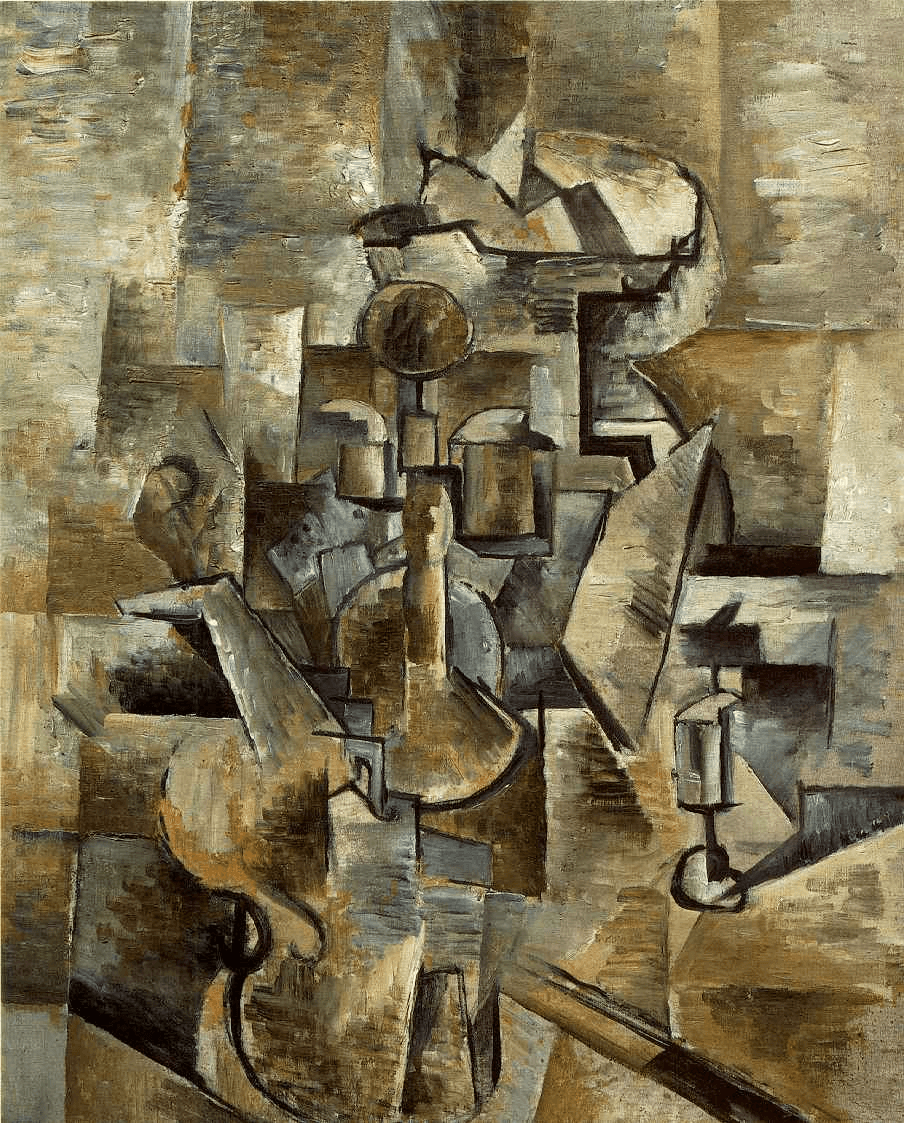
Violin and Candlestick, 1910: The essential specimen of Analytic Cubism. Color has almost entirely disappeared — brown-gray monochrome, because the problem they were solving was spatial, not chromatic. The violin is decomposed from multiple angles simultaneously; you can identify the strings and the body, but they present themselves from three or four directions at once. The boundaries between candlestick and violin interpenetrate. A typical work from the most intense period of the Braque-Picasso collaboration — tense, intellectually dense.
Fruit Dish and Glass, 1912: The period in which Braque invented collage. He pasted wood-grain printed paper into the picture surface — the starting point of Synthetic Cubism. Notice the fragments of text beginning to appear. Real material enters painting; painting begins to construct rather than represent.
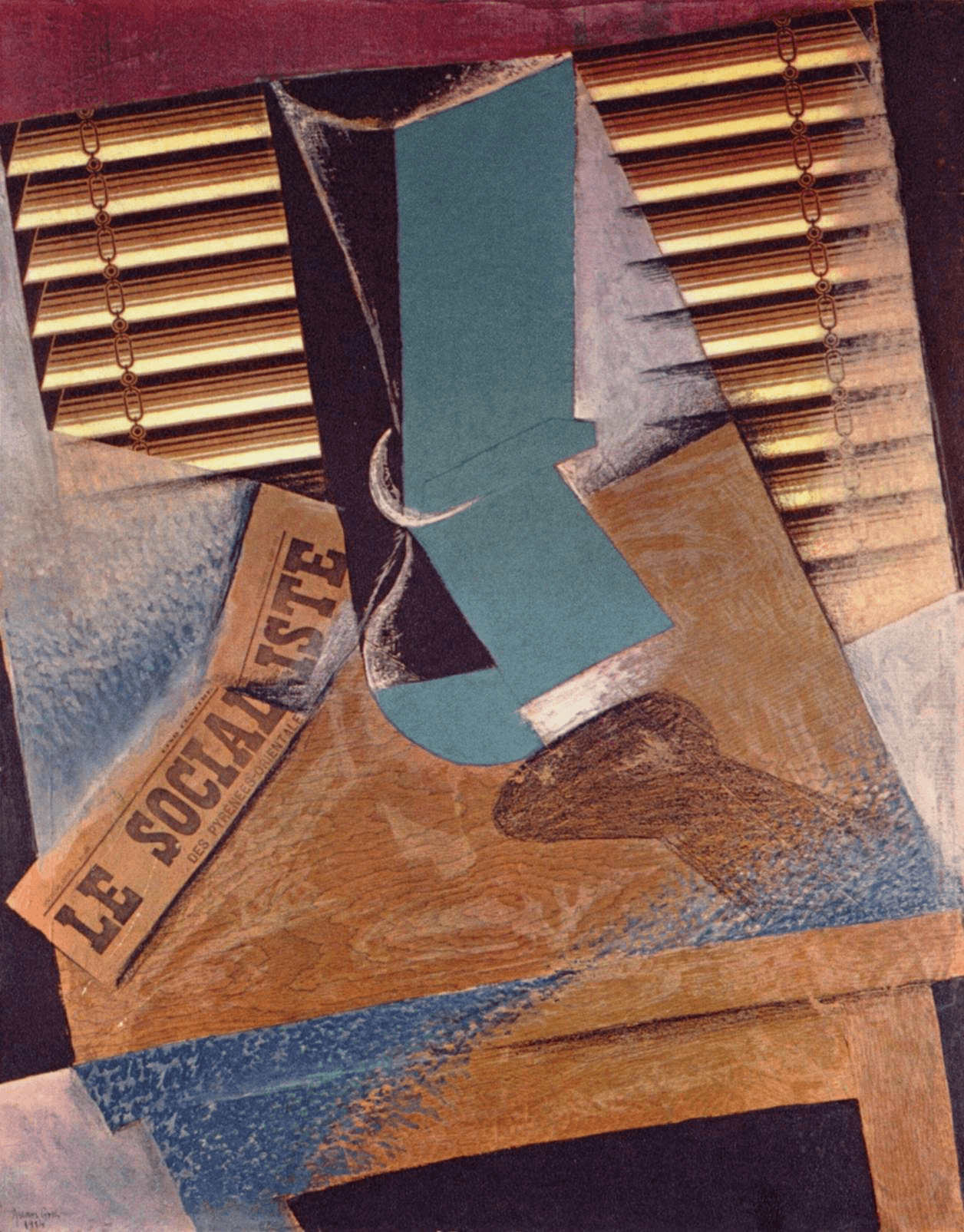
The Sunblind, 1914 / Portrait of Picasso, 1912: The difference from Braque and Picasso is immediately visible — color has returned, and it is calculated color relationships. His pictures have a geometric elegance; every color plane has a clear positional logic, nothing like Picasso’s explosiveness. The Portrait of Picasso is one of his most famous works — you can make out a person’s outline, but the face is systematically decomposed into geometric planes, each with its own independent light source. This is exactly what he meant by “starting from a painting and arriving at an object” — establish the system first, then let the object materialize within it.
Juan Gris (1887–1927)
Spanish, in Paris. The artist who pushed Cubism toward its clearest and most systematic form. If Picasso’s Cubism is an explosion, Gris’s Cubism is a precision instrument. His compositions are rigorously structured, his colors carry an internal mathematical relationship, and the geometric decomposition of objects has an almost architectural stability. He said: “Picasso starts from an object and arrives at a painting. I start from a painting and arrive at an object.” He died of tuberculosis at 40, leaving a small body of work of exceptionally high quality.
Fernand Léger (1881–1955)
He pushed Cubism toward the industrial and the collective. His paintings are full of pipes, gears, mechanical components; the human body is treated as cylindrical mechanical parts. This is not a critique of industry but an embrace of it. He had genuine political sympathy for the working class (he was a Communist Party member) and he wanted to create art that ordinary workers could understand and love. His style is called Tubism — pushing Cubism’s geometry toward a thicker, more industrial direction.
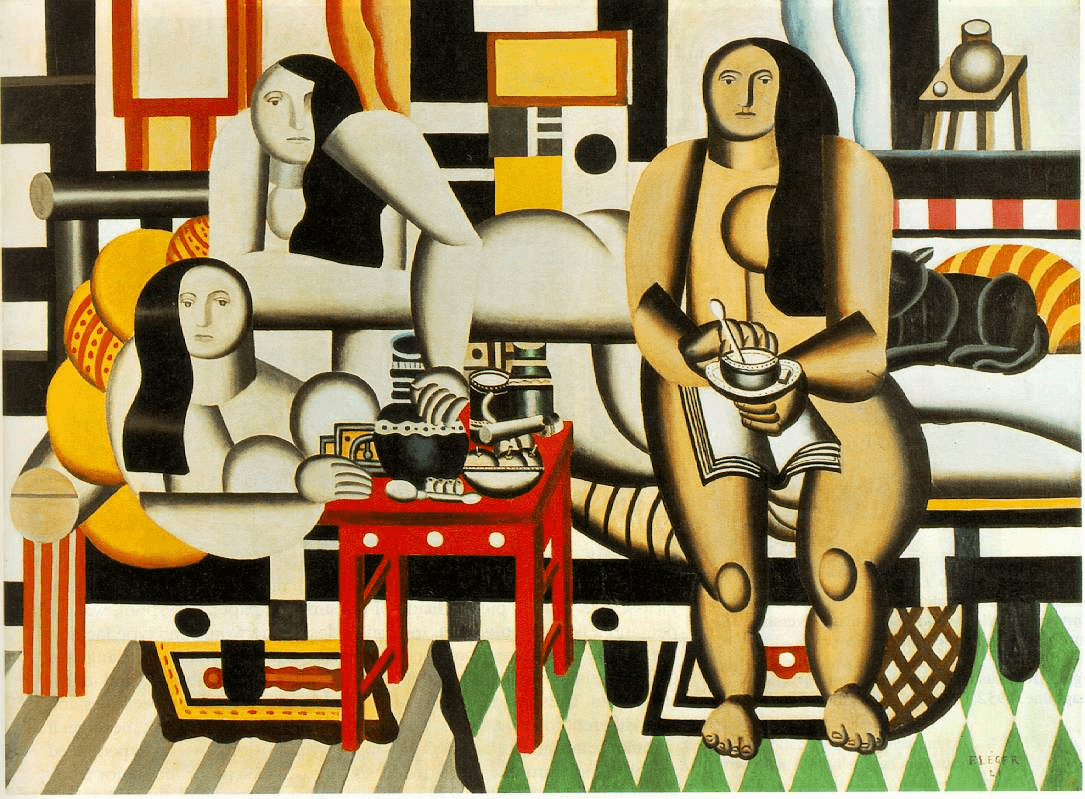
The City, 1919 / Three Women, 1921: The difference from Braque and Gris is immediately obvious — the scale is entirely different, the energy is entirely different. Léger’s pictures are industrial, public, almost like posters. In The City, buildings, figures, billboards, staircases — everything is treated as geometric components of equal weight, no hierarchy, like the interior of a machine. In Three Women the bodies are cylindrical, the skin has a metallic sheen, the expressions are robotic — but this is not coldness. It is Léger’s version of a solemn tribute to the collective laboring body of modernity.
Cubism and African Art: A Problem That Must Be Confronted
This is the most complex part of the Cubism narrative and the one most requiring a critical eye. Picasso drew fundamental inspiration from the visual language of African masks — he acknowledged this. For Cubism to happen at all, a precondition was that the European colonial system had brought African cultural objects to museums in Paris. Those masks were taken through colonial plunder; in their original cultures they had specific ritual functions and were not “art objects” — it was the European classificatory system that turned them into “primitive art.” Picasso never spoke publicly about this source, and never attempted to learn the cultural context behind the African sculpture. He took the visual language and left the cultural meaning behind on the museum label.
Art historians and post-colonial critics have pointed out: Cubism’s “revolution” was built on the uncompensated appropriation of African culture, and the cultures and artists who created that visual language received no credit and no compensation. This does not erase Cubism’s importance — but it changes how we understand what that importance means.
Beyond Cubism: Global Influence
Russian Constructivism: Malevich, Rodchenko — starting from Cubism and moving toward complete abstraction and politicization. Cubism gave them the tool for liberating form from content; they put that tool in service of revolution.
Futurism (Italy): Boccioni used Cubism’s multiple viewpoints to represent movement and speed — not presenting multiple spatial perspectives simultaneously but presenting consecutive time-frames simultaneously. This is closer to the logic of cinema.
Mexican Muralism: Diego Rivera studied Cubism deeply in Paris, then returned to Mexico and combined Cubist flat geometry with the pre-Columbian mural tradition to create a new public art language. Cubism moved from elite Parisian galleries onto the walls of Mexican public buildings.
Chinese Modern Art: In the 1920s and 1930s, large numbers of Chinese artists studied in Paris and brought Cubism back to China — Sanyu and Pan Yuliang (a woman — more on her separately) both had direct contact with this tradition.
Architecture and Design: Cubism’s influence on twentieth-century architecture was transmitted through the Bauhaus and Le Corbusier — reducing architecture to basic geometric form, treating facades with multi-angle logic, making space fluid. Part of the visual logic of the modern buildings you see today has its roots in Cubism.
The Philosophical Significance of Cubism
What Cubism did is structurally identical to several contemporaneous intellectual movements.
Henri Bergson’s philosophy of time: Real time is not clock time — it is the duration (durée) experienced by consciousness, in which past, present, and future coexist simultaneously. Cubism visualized this philosophy of time.
Phenomenology (Husserl): Knowledge is never a neutral recording of objective reality — it is the active construction of consciousness. The Cubist picture is the visible form of that construction process.
The linguistic turn: Saussure (a contemporary) argued that the relationship between a linguistic sign and what it refers to is not natural but arbitrary. Cubism did the same thing in painting: the connection between a visual sign and the object it represents was severed, and the sign began to operate independently.
🖼️
什么是立体主义?
一句话:同时从多个角度看一个对象,然后把所有视角压缩进同一个平面。
但这个定义太技术性了。更深的答案是:立体主义是第一次有艺术家说,绘画不应该模拟人眼看到的世界,而应该模拟人类认知世界的方式。你看一张脸,你的眼睛扫过它,你的记忆叠加上去,你的情感着色其上。你对一张脸的”认识”不是某一个瞬间单一视点的快照,是时间积累的复合体。立体主义想把这个复合体直接画出来。这是一个认识论的革命,不只是风格的革命。
历史背景:为什么1907年?
三件事同时发生:
1. 塞尚1906年去世,1907年回顾展
塞尚的多视点、几何简化、对透视的怀疑:这些种子1907年在巴黎爆炸性地开花。毕加索和布拉克在回顾展后立刻开始实验。
2. 非洲雕塑的冲击
1907年春,毕加索在巴黎人类学博物馆(特罗卡德罗宫)看到非洲和大洋洲的面具和雕塑。他后来描述那个夜晚是”启示”,他在那里待了很长时间,出来的时候《亚维农的少女》的构思已经形成。
非洲雕塑的视觉逻辑:同时呈现正面和侧面,不试图制造三维幻觉,直接用平面的几何形式处理人体。 这和塞尚的几何化是不同方向来的同一个问题的答案。
3. 爱因斯坦1905年发表狭义相对论
时间和空间不是绝对的,是相对于观察者的。没有”客观”的单一视点。这个物理学革命和立体主义的认识论是同构的——当然毕加索没有读过爱因斯坦的论文,但他们都是同一个时代精神的产物。
《亚维农的少女》(1907)
这幅画是立体主义的宣言,但它本身还不是立体主义——它是过渡,是爆炸发生前的裂缝。
画面: 五个裸体女性,正面对着观众。左边两个女性的脸是伊比利亚风格(西班牙古代雕塑的影响)。右边两个女性的脸是非洲面具——鼻子歪斜,眼睛不对称,完全不遵循西方肖像画的规则。毕加索画这幅画花了将近一年,留下了数百张草图。最初的构图里有男性人物(水手和医学生),后来全部删除——最终版本是纯粹的女性身体与观看者之间的直接对峙。
为什么叫”亚维农的少女”:这个标题不是毕加索起的,是他的朋友安德烈·萨尔蒙后来给的,亚维农街(Avignon Street)是巴塞罗那一条著名的妓院街。毕加索自己从不喜欢这个标题。
朋友们的反应:毕加索完成这幅画后,把它藏在工作室里很久。他让几个亲密的朋友看——马蒂斯认为毕加索是在嘲弄现代艺术运动。布拉克第一次看到时说感觉像毕加索在”叫他们喝煤油”。但布拉克是后来成为毕加索最重要合作者的那个人。这幅画在毕加索生前从未公开展出,直到1916年。
分析立体主义 Analytic Cubism(1908-1912)
毕加索 + 布拉克:立体主义最纯粹、最激进的阶段。
方法: 把对象(人、乐器、瓶子)分解成多个几何面,从多个角度同时呈现,然后重新组合在画面上。结果是画面表面上看起来像碎片的堆叠,但如果你长时间看,各个视角的碎片开始互相激活,你开始感受到空间在平面上的多重折叠。
颜色: 几乎完全放弃了颜色。画面是棕色、灰色、米色——接近单色。为什么?因为他们不想让颜色分散注意力——他们想把所有精力集中在形式和空间的问题上。颜色是感官的,他们要解决的是认识论的问题。
主题的重复: 他们反复画同样的主题——吉他、小提琴、酒瓶、报纸、人物。因为他们研究的不是主题,是视觉分析的方法,主题是被分析的对象,不是目的。
毕加索与布拉克的关系:这段合作是艺术史上最奇特的创作关系之一。1908-1914年间,他们的风格如此接近,有时候连他们自己都无法区分彼此的作品。他们把彼此的画不署名地放在一起,测试能不能看出谁画的:有时候不能。毕加索后来描述他们的关系像”登山的绳伴”:你信任这个人的判断,你们一起走到别人没走过的地方,你们在一根绳子上。一战爆发,布拉克应征入伍,头部受伤,几乎失明。两人的合作就此结束,再没有恢复那种密度。
综合立体主义 Synthetic Cubism(1912-1920s)
如果分析立体主义是把对象拆开,综合立体主义是把不同材料拼合成新的整体。
拼贴(Collage)的发明:1912年,布拉克第一个把报纸碎片、壁纸贴入画面。毕加索紧随其后,而且走得更远,绳子、油布、沙子、木屑都进入了画面。
这是艺术史上的重要时刻:绘画从”再现”变成了”建构”。画面不再是对现实的模仿,是用现实的碎片重新组织的一个新的现实。
报纸碎片贴入画面还有另一个意义:报纸上的文字(新闻标题、广告)带着现实世界的时间戳进入艺术,绘画和日常生活的边界再次被打破。
颜色回来了: 综合阶段的画面颜色更丰富,形式更装饰性,少了分析阶段的紧张的智识密度,多了一种视觉的愉悦感。
核心人物
巴勃罗·毕加索 Pablo Picasso(1881-1973)
立体主义的发动机。但毕加索是一个需要被全面理解的人物,不只是天才神话。
天才的事实: 他的技术能力是惊人的——他15岁的学院派素描达到了成熟大师的水准。他放弃写实不是因为不会,是因为选择不。这个选择的重量完全不同。他一生创作了约20000件作品,横跨立体主义、超现实主义、新古典主义、晚期表现主义——没有任何其他艺术家有这样的风格跨度和产量。
问题的事实: 毕加索与女性的关系是他生命的阴暗面,也是艺术史长期回避的问题。他的多段感情关系里,模式是重复的:找到一个年轻女性,她成为缪斯和模特,他的艺术在这段关系里爆发,然后他转向下一个,前一个陷入抑郁或崩溃。
玛丽-泰蕾兹·沃尔特:他在她17岁时开始与她交往,她不知道他是谁。她后来在他死后四年自杀。
朵拉·马尔:摄影师,智识上的对等者。他画了大量她哭泣的肖像,她后来精神崩溃。
弗朗索瓦丝·吉洛是唯一一个主动离开他的女人。她后来写了回忆录,把这一切写了出来。毕加索勃然大怒,试图阻止出版,失败了。
这些不是与他的艺术无关的私事。他对女性的凝视直接构成了他大量作品的内容,他利用了这些女性。
乔治·布拉克 Georges Braque(1882-1963)
立体主义的共同发明者,但在叙事里长期处于毕加索的阴影下。布拉克是更内敛的人。他不追求毕加索那种持续的风格变化,一战后他在立体主义的基础上发展出了自己更稳定、更沉静的风格——静物、室内,颜色丰富但克制,画面有一种深思熟虑的平静。他说过一句话值得记住:”真相存在于每个人都能发现它的地方。只有谎言是被发明的。”
《小提琴与烛台》1910 — 布拉克
分析立体主义的核心标本。注意颜色几乎完全消失:棕灰单色,因为他们要解决的是空间问题,不是颜色问题。小提琴被从多个角度同时分解,你能辨认出琴弦、琴身,但它们同时从三四个方向呈现。烛台和小提琴的边界互相渗透。这是布拉克和毕加索合作最密集时期的典型作品,风格紧张、智识密度极高。
《果盘与玻璃杯》1912 — 布拉克
这是布拉克发明拼贴的时期。他把仿木纹的印刷纸贴入画面——这是综合立体主义的起点。注意画面里开始出现文字碎片。现实的材料进入绘画,绘画开始”建构”而不是”再现”。
胡安·格里斯 Juan Gris(1887-1927)
西班牙人,在巴黎。他是把立体主义推向最清晰、最系统化的人。如果毕加索的立体主义是爆炸,格里斯的立体主义是精密仪器。他的画面构图极度严谨,颜色有一种内在的数学关系,物体的几何分解有一种几乎建筑性的稳定感。他说:”毕加索从对象出发,抵达绘画。我从绘画出发,抵达对象。”他40岁死于肺病,留下的作品量少但质量极高。
《百叶窗》1914 / 《毕加索肖像》1912 — 格里斯
看格里斯和布拉克/毕加索的区别立刻显现:颜色回来了,而且是经过计算的颜色关系。 他的画面有一种几何的优雅,每个色块都有明确的位置逻辑,不像毕加索那样爆炸性。《毕加索肖像》是他最著名的作品之一——你能看出一个人的轮廓,但脸被系统性地分解成几何面,每个面有自己独立的光源。这就是他说的”从绘画出发,抵达对象”——先建立系统,再让对象在系统里现形。
费尔南·莱热 Fernand Léger(1881-1955)
他把立体主义推向了工业和集体的方向。他的画里充满了管道、齿轮、机械部件,人体也被处理成圆柱形的机械构件。这不是对工业的批判,而是一种拥抱。他对工人阶级有真实的政治同情(他是共产党员),他想创造一种能够被普通工人理解和喜爱的艺术。他的风格叫管式立体主义(Tubism)——把立体主义的几何化推向了更粗壮、更工业性的方向。
《城市》1919 / 《三个女人》1921 — 莱热
和布拉克、格里斯的区别一眼就看出来:尺度完全不同,能量完全不同。 莱热的画面是工业性的、公共性的、几乎是海报式的。《城市》里建筑、人物、广告牌、楼梯——所有东西都被处理成同等重量的几何构件,没有主次,像一台机器的内部。《三个女人》里的人体是圆柱形的,皮肤有金属光泽,表情像机器人——但这不是冷漠,是莱热对现代集体劳动身体的某种庄严的致敬。
立体主义与非洲艺术:需要被正视的问题
这是立体主义叙事里最复杂、最需要批判性看待的部分。毕加索从非洲面具里获得了视觉语言的根本性启发,他承认这一点。立体主义能够发生,有一个前提是欧洲殖民体系把非洲文化对象带到了巴黎的博物馆。那些面具是被殖民掠夺来的,它们在原来的文化里有具体的仪式功能,不是”艺术品”——是欧洲分类系统把它们变成了”原始艺术”。毕加索从不公开谈论这个来源,也从不试图学习非洲雕塑背后的文化语境。他把视觉语言拿走了,把文化意义留在了博物馆的注释牌上。艺术史家诺克尔·西尔弗曼和其他后殖民批评者指出:立体主义的”革命”建立在对非洲文化的无偿借用上,而创造了那些视觉语言的文化和艺术家从未得到任何署名或补偿。这不消除立体主义的重要性,但它改变了我们理解这个重要性的方式。
立体主义之外:全球影响
俄国构成主义: 马列维奇、罗钦科,从立体主义出发,走向完全抽象和政治化。立体主义给了他们把形式从内容里解放出来的工具,他们把这个工具用于革命服务。
未来主义(意大利): 博丘尼把立体主义的多视点用于表现运动和速度——不是同时呈现多个空间视角,是同时呈现连续的时间帧。这更接近电影的原理。
墨西哥壁画运动: 迭戈·里维拉在巴黎深入学习了立体主义,回到墨西哥后,他把立体主义的平面几何和前哥伦布时代的墨西哥壁画传统结合,创造了一种新的公共艺术语言。立体主义从巴黎的精英画廊走进了墨西哥的公共建筑墙面。
中国现代艺术: 1920-30年代,大批中国艺术家在巴黎学习,把立体主义带回中国:常玉、潘玉良(女性,后面会单独讲)都与这个传统有直接接触。
建筑与设计: 立体主义对20世纪建筑的影响通过包豪斯和勒·柯布西耶传递——把建筑还原为几何基本形,立面的多角度处理,空间的流动性。你今天看到的现代建筑的视觉逻辑,有一部分根在立体主义。
立体主义的哲学意义
立体主义做的事,和同时代的几个思想运动是同构的:
亨利·柏格森的时间哲学: 真实的时间不是钟表上的时间,是意识体验到的绵延(durée)——过去、现在、未来在意识里同时存在。立体主义把这个时间哲学视觉化了。
现象学(胡塞尔): 认识从来不是对客观现实的中立记录,是意识的主动建构。立体主义的画面正是这个建构过程的可见形式。
语言学转向: 索绪尔(同时代)提出,语言符号和它所指的事物之间没有自然联系,是任意的。立体主义在绘画里做了同样的事:视觉符号和它所再现的对象之间的联系被切断了,符号开始自主运作。
🖼️