Created on
Updated on
1910s | 未来主义 Futurism
艺术家们学会写manifesto了
Preface: welcome to this very brief intro to modern art. Please feel free to use this as a guide for museum visits.
What is Futurism?
In one sentence: falling in love with speed, then falling in love with destruction. Futurism was not just an art style — it was a complete worldview, a radical set of claims about time, progress, violence, masculinity, and the state. It was the first avant-garde movement of the twentieth century to fully fuse art, politics, and lifestyle, and the first to end up inside fascism. That ending was not an accident. It was written into the first line of the manifesto.
The Futurist Manifesto, February 20, 1909
Filippo Tommaso Marinetti published this manifesto on the front page of Le Figaro. Publishing an art manifesto on a newspaper’s front page was itself a radical media strategy — he wasn’t talking to the art world, he was talking to all of society.
“We declare that the splendor of the world has been enriched by a new beauty — the beauty of speed. A racing car… is more beautiful than the Winged Victory of Samothrace.” The Winged Victory of Samothrace is one of the Louvre’s most famous pieces, a symbol of classical beauty. Saying a racing car is more beautiful than it — this is a direct declaration of war on the entire Western aesthetic tradition.
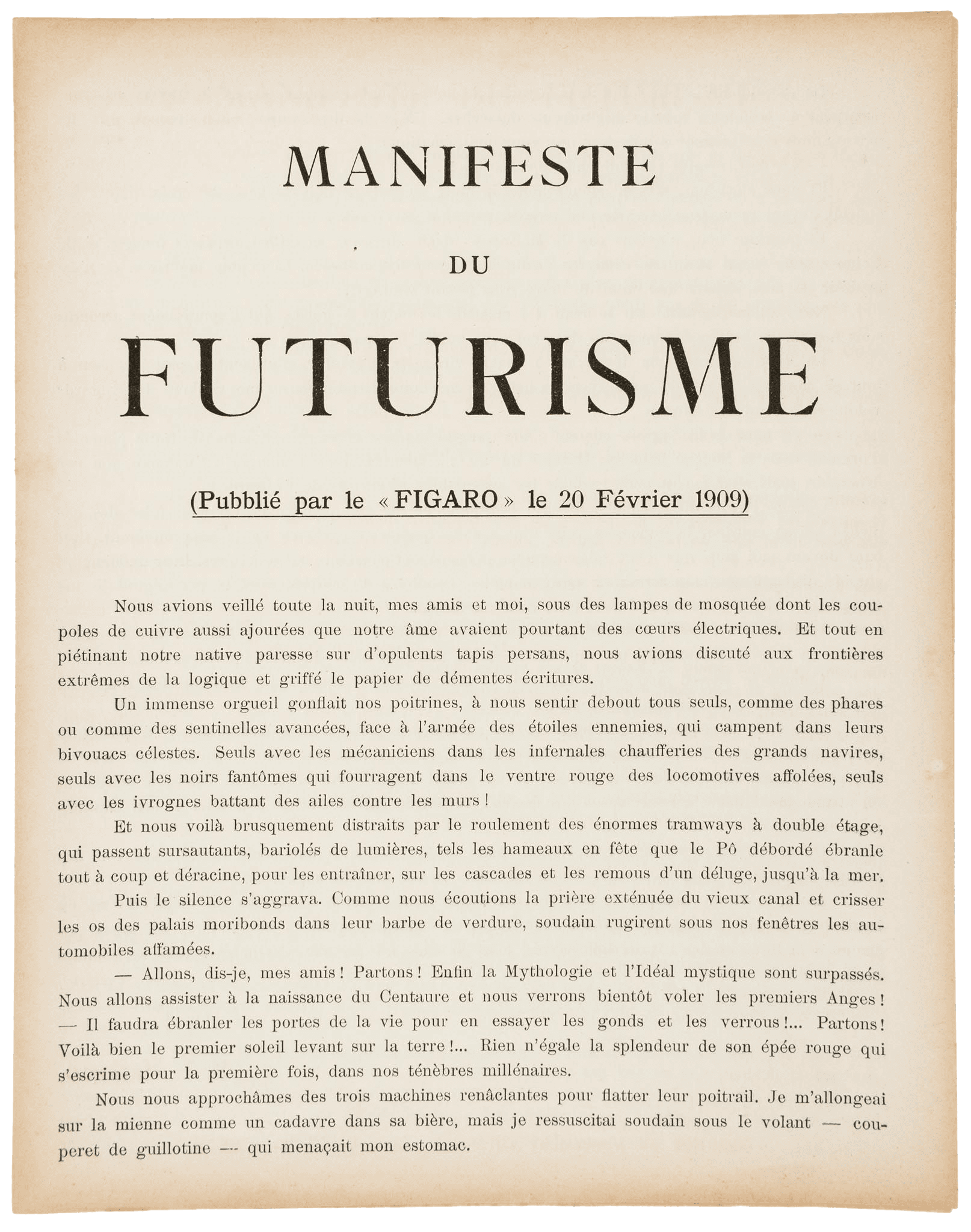
“We want to sing the love of danger, the habit of energy and rashness… the punch and the slap.” “We want to glorify war — the world’s only hygiene — militarism, patriotism, the destructive gesture of anarchists… and contempt for women.” Marinetti genuinely believed war was purification and that women were an obstacle to be overcome. “Museums? Cemeteries!… Going to a museum once a day is like going to a funeral.” “The oldest among us are thirty. We have at least ten years to accomplish our task. When we are forty, let younger and stronger men than we throw us in the wastebasket like useless manuscripts.”
Why Italy, Why 1909?
Italy only completed national unification in 1861 — the youngest of the great European powers. Yet it was simultaneously the cradle of Western civilization: the Roman Empire, the Renaissance, the Catholic Church — all of it born here. This contradiction produced a specific cultural psychology: a people crushed by the weight of their own glorious past, desperate to shed it entirely. The Renaissance masterworks in the museums were both pride and chains. Tourists came to Italy to see dead beauty, not living Italians. Marinetti’s generation of intellectuals was furious about this — they wanted to create a new Italy, not preserve the ancient one. At the same time, the Industrial Revolution was producing an entirely new urban landscape in northern Italy (Milan, Turin): factories, cars, electricity, telephones. These artists felt the force of speed and machines in the city for the first time, and felt something close to a religious experience.
Core Figures: Italian Futurism
Filippo Tommaso Marinetti (1876–1944)
He was primarily a poet and activist, not a painter. Futurism was his invention; he was its director. His personal myth: in 1908, driving at speed outside Milan, he swerved to avoid two cyclists and flipped his car into a ditch. He crawled out of the mud and described this “embrace with death” as his rebirth — from this moment he decided to write the Futurist Manifesto. The story’s accuracy is doubtful, but it perfectly encapsulates Futurism’s logic: danger, speed, intimate contact with death, then radical regeneration. He later became an early member of the Fascist Party, close friends with Mussolini, though their relationship frayed in his later years as the Fascist government turned toward conservative traditionalism, betraying Futurism’s anti-traditional spirit.
Umberto Boccioni (1882–1916)
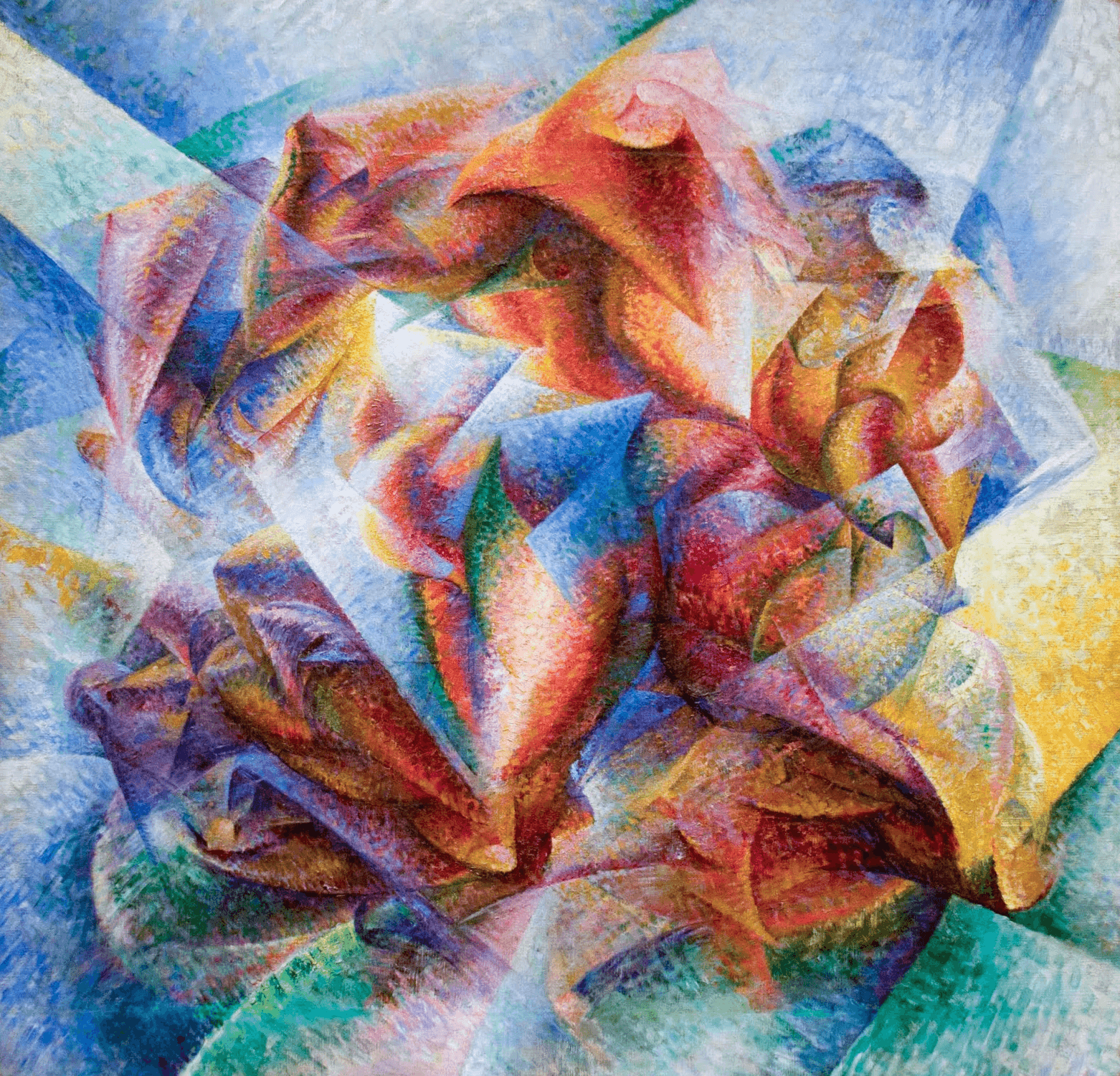
The most important visual artist of Futurism — the person who actually translated Futurist ideas into the language of painting and sculpture. His central question: how do you represent movement in a static image? His answer was not Cubism’s multiple viewpoints layered together, but compressing the continuous trajectory of movement into a single picture — similar to a long-exposure photograph, but more subjective, more emotional.
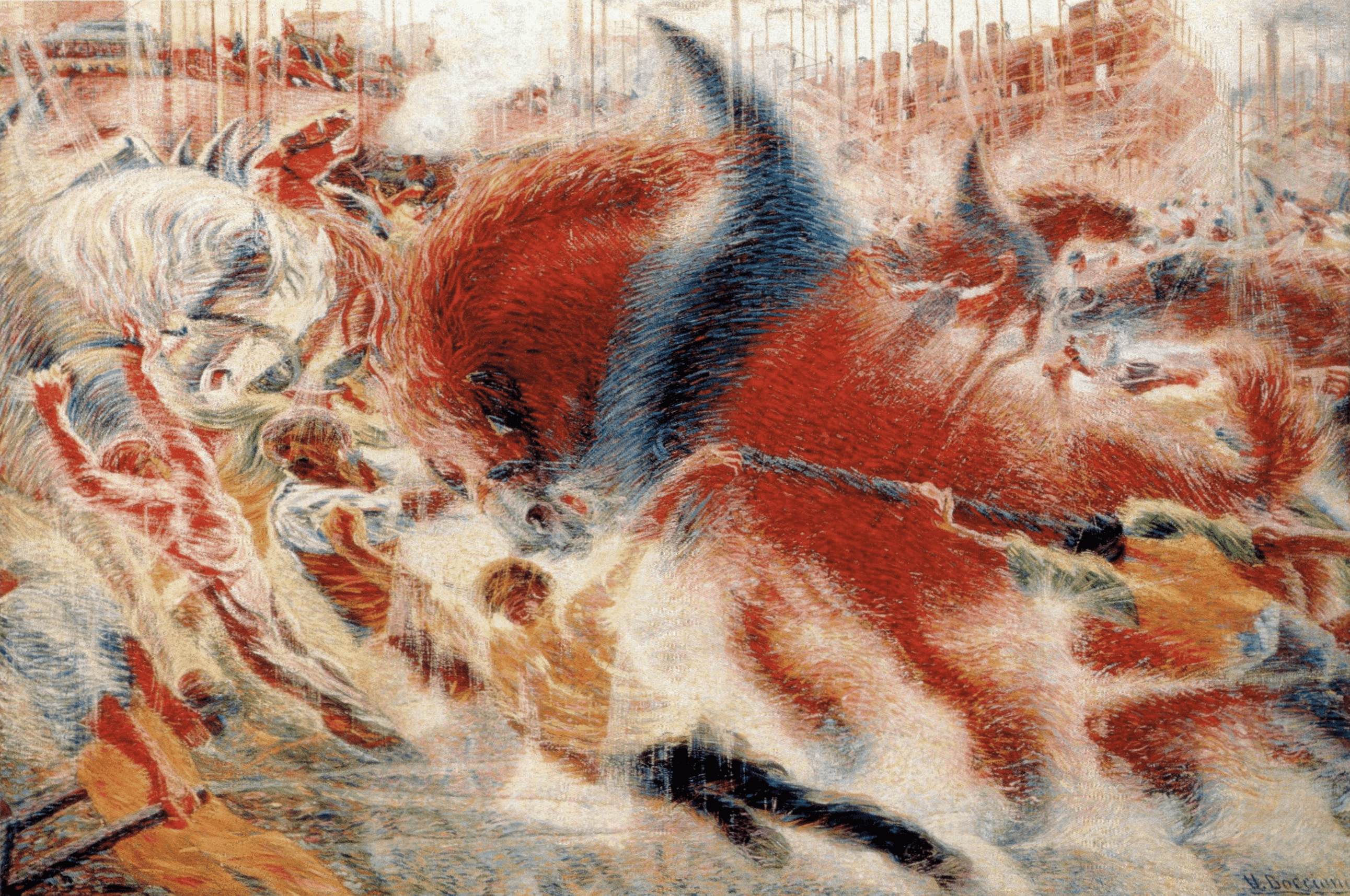
The City Rises, 1910–11: His first major work. Enormous (nearly 3 by 2 meters) — a construction site in Milan’s industrial district, workers, horses, scaffolding, all dissolving in movement, colors violent, brushwork vortex-like. Not a painting of a construction site — a painting of modern industrial energy itself, the force that sets everything in motion.
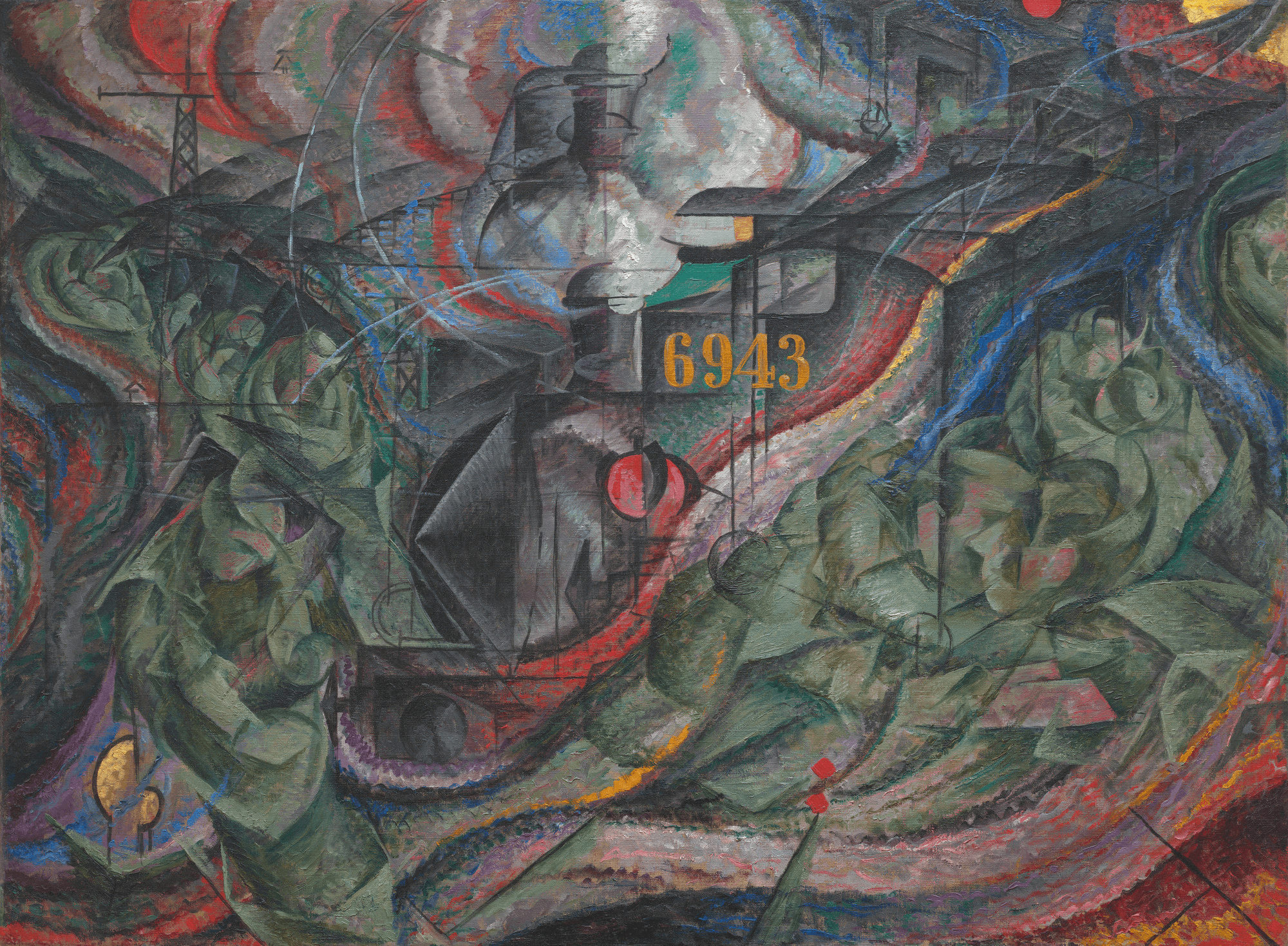
States of Mind triptych, 1911: His most complex series — three paintings titled The Farewells, Those Who Stay, Those Who Go. The scene is departure from a train station, but he doesn’t paint the external visual — he paints the visualization of emotion. In The Farewells, train and crowd dissolve in an emotional vortex. In Those Who Stay, figures become curved vertical lines — like rain, like gravity, like the material form of grief. In Those Who Go, horizontal lines of speed. These three paintings are the closest Futurism came to psychological realism.
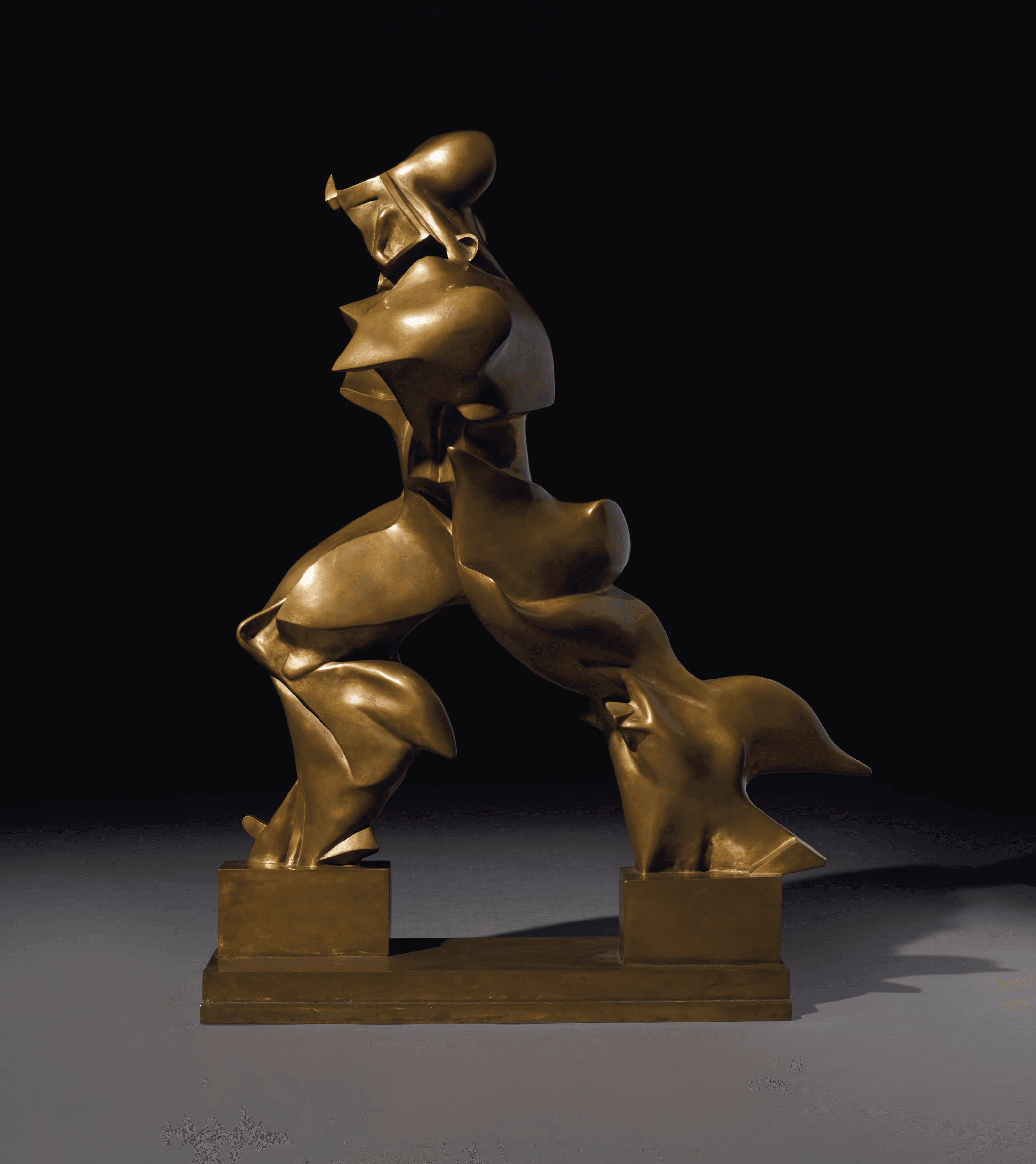
Unique Forms of Continuity in Space, 1913: His most famous sculpture. A walking human figure, but the form is flowing, explosive — the muscles are not anatomical, they are the traces speed leaves in air. The body and its movement are one thing; the boundary disappears. This sculpture now appears on the Italian 20-cent euro coin. Boccioni died in the First World War in 1916 — thrown from a horse, not a heroic battlefield death but an ordinary accident. He was 34.
Giacomo Balla (1871–1958)
The Futurist painter who most directly studied movement and light, directly influenced by photography — particularly Marey’s chronophotography.
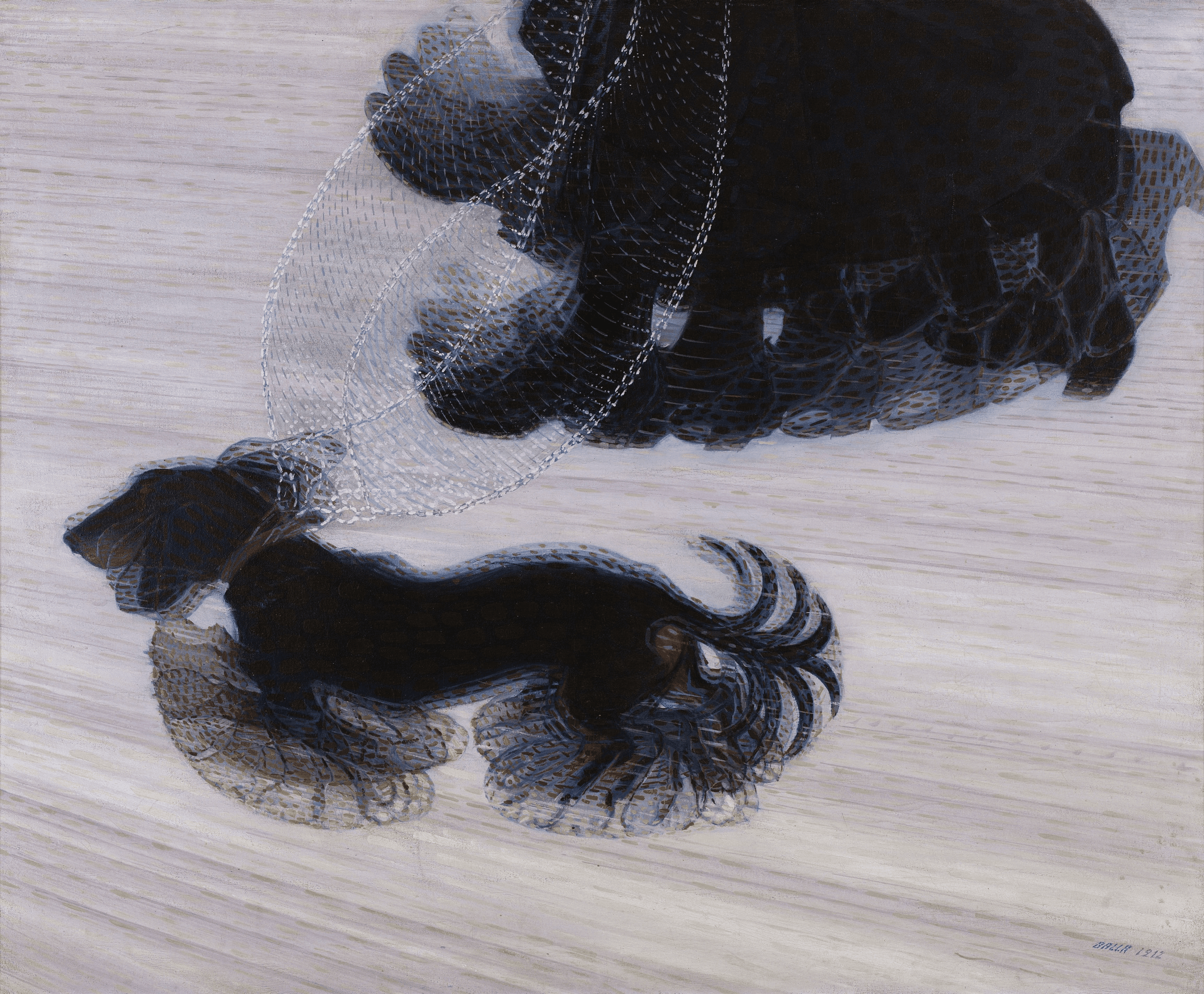
Dynamism of a Dog on a Leash, 1912: one of the most famous and accessible Futurist images — a woman walking a dog, the dog’s legs and tail and the woman’s feet and skirt hem painted as multiple overlapping shadows, like frames of a rapid sequence of photographs layered together. A direct attempt to translate photography’s logic of time-decomposition into painting.
His Abstract Speed + Sound series of 1913 goes further — almost completely abstract, light in motion decomposing into angular fragments of color. The closest Futurism came to pure abstraction.
Luigi Russolo (1885–1947)
The strangest figure in Futurism — not primarily a painter but the inventor of Noise Music. In 1913 he wrote The Art of Noises manifesto, declaring that the harmonious tones of traditional music were obsolete, and that the noises of the modern city — factories, cars, crowds — were the true music of modernity. He invented a series of mechanical devices called Intonarumori (noise intoners) and gave concerts of pure noise. The audience’s response: riots. Physical fights broke out at the performances — the Futurists considered this a success. Russolo is the ancestor of all experimental music traditions of the twentieth century: concrete music, noise music, industrial music. From John Cage to industrial music to contemporary noise art, the lineage traces back to him.
The Quantity of Futurist Manifestos
Marinetti was a fanatic of manifesto-writing. The movement produced manifestos covering almost every domain: Manifesto of Futurist Painters (1910), Manifesto of Futurist Musicians (1910), The Art of Noises (1913), Manifesto of Futurist Architecture (1914, Sant’Elia), The Futurist Woman (1912 — written by a woman, a complex feminist variant of Futurism), War, the World’s Only Hygiene (1915), The Futurist Cookbook (1930 — against pasta, which Marinetti claimed made people sluggish). That last one is real. Marinetti in his later years wrote a cookbook opposing pasta and advocating strange modern food combinations. Italians were extremely angry.
Futurist Architecture: Antonio Sant’Elia
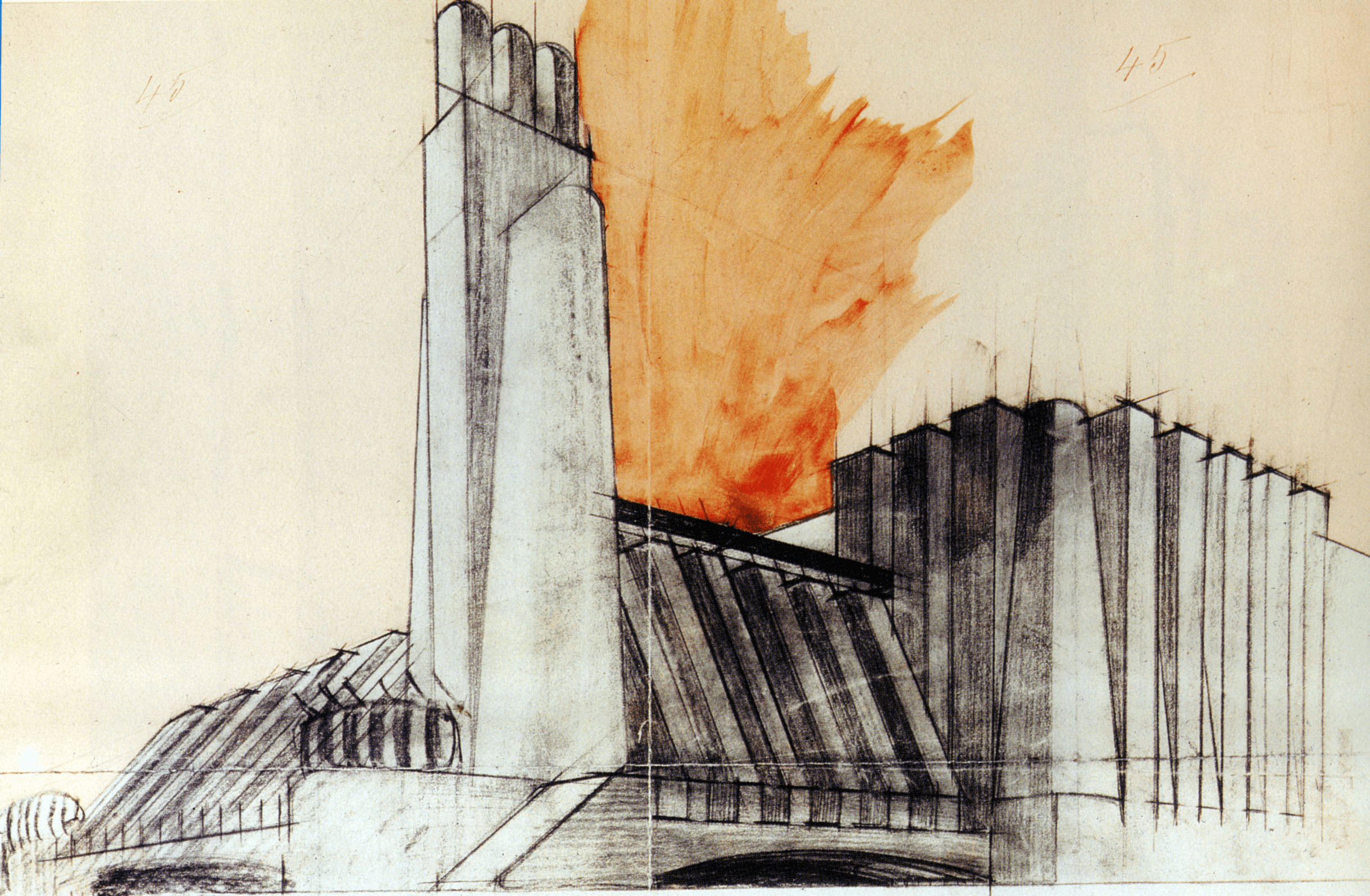
Sant’Elia (1888–1916) designed large numbers of radical future-city drawings — enormous skyscrapers, elevated roads, multi-level transport systems, humans moving through them as components of a machine. His designs were never built, but they directly shaped the visual imagination of the twentieth-century science fiction city. Metropolis (Fritz Lang, 1927) drew its cityscape directly from Sant’Elia’s drawings. Blade Runner, The Matrix — trace their urban visual language back far enough and it leads here. Sant’Elia died on the First World War front in 1916. He was 28.
Futurism and Fascism
The glorification of violence — the manifesto explicitly states that war is purification. Hatred of tradition — in tension with fascism’s myth of national rebirth, but the shared attack on “corrupt current conditions” was the common ground. Extreme masculinism — women as an obstacle to be overcome, the warrior body as the ideal form. Speed and action over thought — anti-intellectual, worshipping instinct and will. The worship of state power.
Marinetti co-founded the Fascist Party in 1919, standing beside Mussolini at the signing of the platform. Not under compulsion — voluntarily. He saw in Mussolini the political realization of Futurism. But they later fractured: Mussolini’s regime, to attract the Catholic Church and traditional elites, turned toward conservative classicism — solemn Roman colonnades rather than Boccioni’s flowing force-lines. This betrayed Futurism’s anti-traditional spirit. Futurism’s position in Fascist Italy was contradictory: it was fascism’s spiritual forerunner, but fascism’s official aesthetic was ultimately not Futurism but pseudo-classicism. This is the most extreme case in the twentieth century of the relationship between avant-garde art and political violence — one art movement’s internal logic sliding directly into state brutality.
Russian Futurism: The Other Path
Russian Futurism developed almost simultaneously with Italian Futurism, but moved in a completely different direction. Shared ground: anti-traditional, embracing the modern city and the machine, radical formal experiment. Fundamental difference: Italian Futurism moved toward nationalism and fascism; Russian Futurism moved toward internationalism and revolution.
Vladimir Mayakovsky (1893–1930):
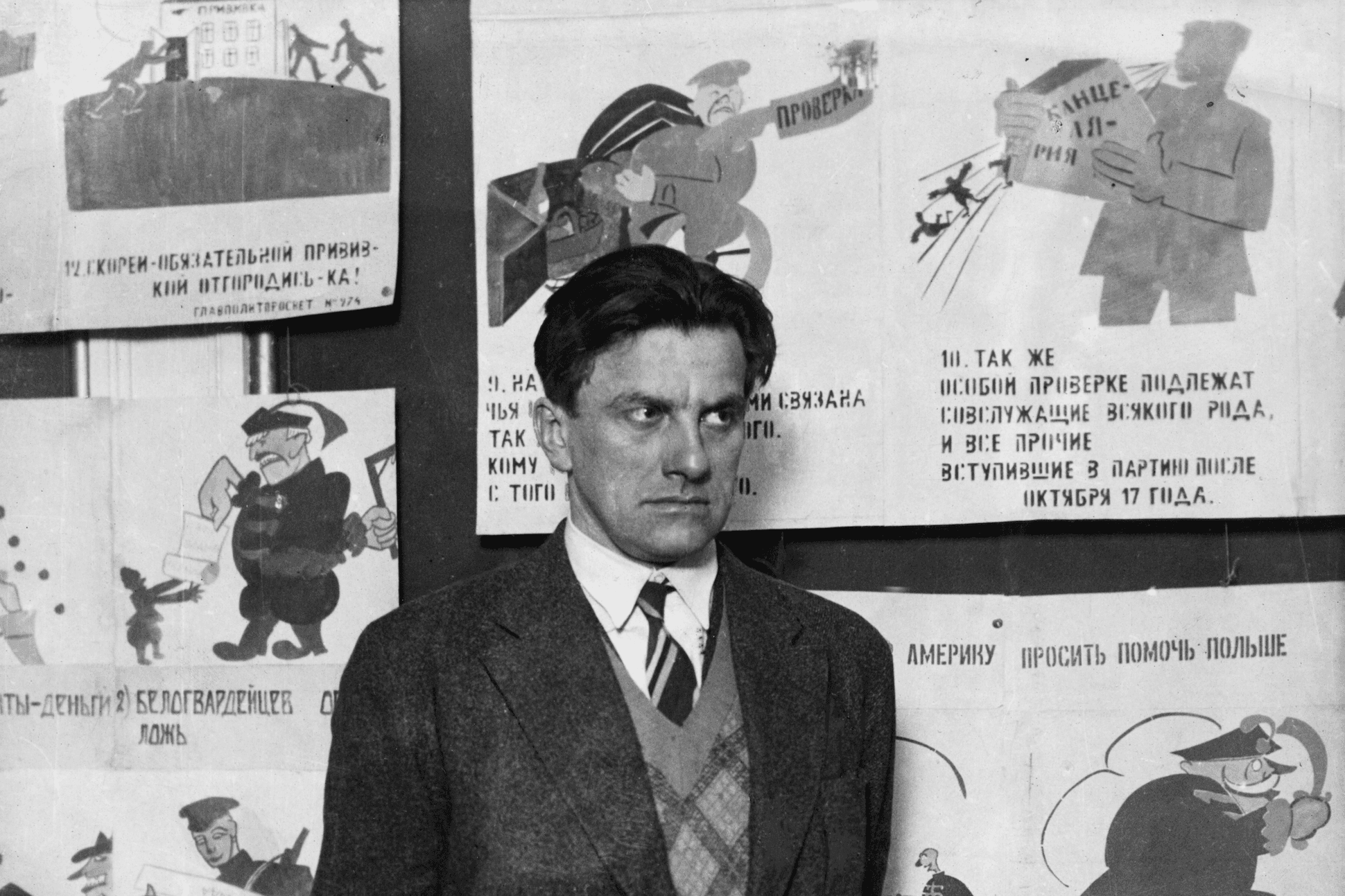
Poet first, then revolutionary, then the voice of official Soviet culture, then a suicide. His poetry was a linguistic explosion — breaking meter, inventing new words, bringing street language into verse. He pasted posters on Moscow streets, recited in public squares, turned poetry into a public event. When the October Revolution came in 1917 he immediately joined the Bolsheviks, designed revolutionary posters, wrote revolutionary poetry, poured all of Futurism’s formal energy into the service of revolution. But as the Soviet system became institutionalized, pressure mounted — his experimental style conflicted with the official demand for accessible mass propaganda. His late work carries an increasingly visible sense of disillusionment. In 1930 he shot himself. He was 37. The first line of the note he left: “Please don’t blame anyone.”
Velimir Khlebnikov (1885–1922):
The most radical language experimenter in Russian Futurism. He invented zaum — “transrational language,” pure sound poetry unattached to any conventional meaning. He believed a language existed that all humans could perceive, transcending the barriers between specific languages. His influence is visible to this day in linguistics, poetry theory, and the concrete poetry movement. He died of typhus in 1922, penniless, almost unknown. Rediscovered after his death, he became one of the most important avant-garde poets in the history of Russian literature.
Kazimir Malevich (1879–1935):
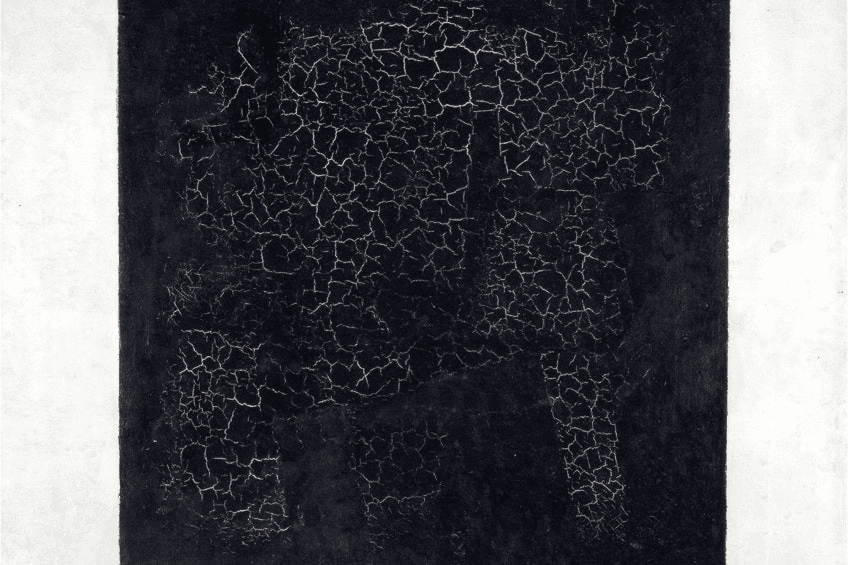
Starting from Cubo-Futurism, he ultimately invented Suprematism — pure geometric form, completely severed from any connection to the visible world. Black Square (1915): a black square on a white canvas. Nothing else. One of the most radical gestures in the history of painting. Its meaning: painting ends here, or rather, painting finds its purest starting point here. Malevich called it “zero form” — the zero degree of all expression, and the origin of all possibility. After Soviet institutionalization, abstract art was classified as “formalism,” incompatible with revolutionary goals. In his later years Malevich was forced back to figurative painting, painting peasant subjects, though retaining geometric stylistic characteristics. He died of cancer in 1935. Per his wishes, he was buried in a coffin he had designed himself in a Suprematist style, in a field outside Moscow. His gravestone bore a black square.
Futurism and Cinema
Futurism’s visual logic has deep resonance with the essential nature of cinema. Cinema is inherently an art of time and movement. What Boccioni tried to do in a static image — compress the continuity of time into a single instant — is exactly what cinema accomplishes automatically with 24 frames per second of film. Soviet montage theory (Eisenstein, Vertov) directly inherited the experimental spirit of Russian Futurism. Vertov’s Kino-Eye manifesto and Mayakovsky’s poetry manifestos were products of the same cultural field. The visual language of action sequences in modern film — high-speed chases, explosions, war scenes and their editing logic — has part of its root in Futurism’s visual experiments with speed and movement. Dziga Vertov’s Man with a Movie Camera (1929) is almost a visual manifesto of Russian Futurism: city, machine, movement, laboring bodies, the camera itself as protagonist, editing as the tool that constructs reality.
The Legacy of Futurism: The Good and the Bad
Good legacy: Noise music → concrete music → electronic music → industrial music. The visualization of speed and movement → motion graphic design → film visual effects. The manifesto as art form → Dada, Surrealism, Situationism, punk. Russian Futurism → Constructivism → Bauhaus → modern graphic design.
Bad legacy: The template for fusing art with political violence — Futurism proved that avant-garde art can become a cultural resource for totalitarianism. The systematic contempt for women written into the core texts of an influential art movement. The aestheticization of destruction — this aesthetic tradition was exploited repeatedly throughout the twentieth century by various political forces.🖼️
什么是未来主义?
一句话:爱上速度,然后爱上毁灭。未来主义不只是一个艺术风格,是一个完整的世界观,关于时间、进步、暴力、男性气概、国家的激进主张。它是20世纪第一个把艺术、政治、生活方式完全融合的前卫运动,也是第一个最终走进法西斯主义的前卫运动。这个结局不是意外。它从宣言的第一行就写在里面了。
《未来主义宣言》1909年2月20日
菲利波·托马索·马里内蒂在《费加罗报》头版发表了这篇宣言。在报纸头版发表艺术宣言,这本身就是一个激进的媒体策略,他不是在和艺术圈说话,他在和整个社会说话。“我们宣布,世界因一种新的美丽而变得更加丰富——速度的美丽。一辆赛车……比萨莫色雷斯的胜利女神更美丽。” 萨莫色雷斯的胜利女神是卢浮宫最著名的藏品之一,是古典美的象征。把一辆赛车说得比它更美——这是对整个西方美学传统的正面宣战。
“我们要歌颂进攻性的动作、发烧般的失眠、跑步的步伐、危险的跳跃、耳光和拳头。””我们要歌颂战争——世界唯一的卫生手段——军国主义、爱国主义、无政府主义者的破坏行动……以及对女性的蔑视。”马里内蒂认为战争是净化,女性是需要被超越的障碍。“博物馆?墓地!……每天一次,去博物馆就像去葬礼。””最老的人,40岁,应该被扔进垃圾桶。”
为什么是意大利,为什么是1909年?
意大利1861年才完成统一,是欧洲大国里最年轻的。但它同时是欧洲文明的母体——罗马帝国、文艺复兴、天主教会——全部在这里。这个矛盾制造了一种特殊的文化心理:一个被自己辉煌过去压垮的民族,渴望彻底摆脱那个重量。博物馆里的文艺复兴杰作是荣耀,也是枷锁。游客来意大利看的是死去的美,不是活着的意大利人。马里内蒂这一代知识分子对此愤怒——他们要创造新的意大利,不是守护古代的意大利。同时,工业革命在意大利北部(米兰、都灵)正在制造一个全新的现代城市景观:工厂、汽车、电力、电话。这批艺术家第一次在城市里感受到速度和机器的力量,感受到了某种接近宗教体验的东西。
核心人物:意大利未来主义
菲利波·托马索·马里内蒂 F.T. Marinetti(1876-1944)
他首先是个诗人和活动家,不是画家。未来主义是他的发明,他是这个运动的总导演。
他的个人神话: 1908年,他开着车在米兰郊外飙速,避让两个骑自行车的人,把车翻进了沟里。他从泥里爬出来,自称这次”死亡的拥抱”是他的重生——他从这个时刻起决定写《未来主义宣言》。这个故事的真实性存疑,但它完美地概括了未来主义的逻辑:危险、速度、与死亡的亲密接触、然后是激进的再生。
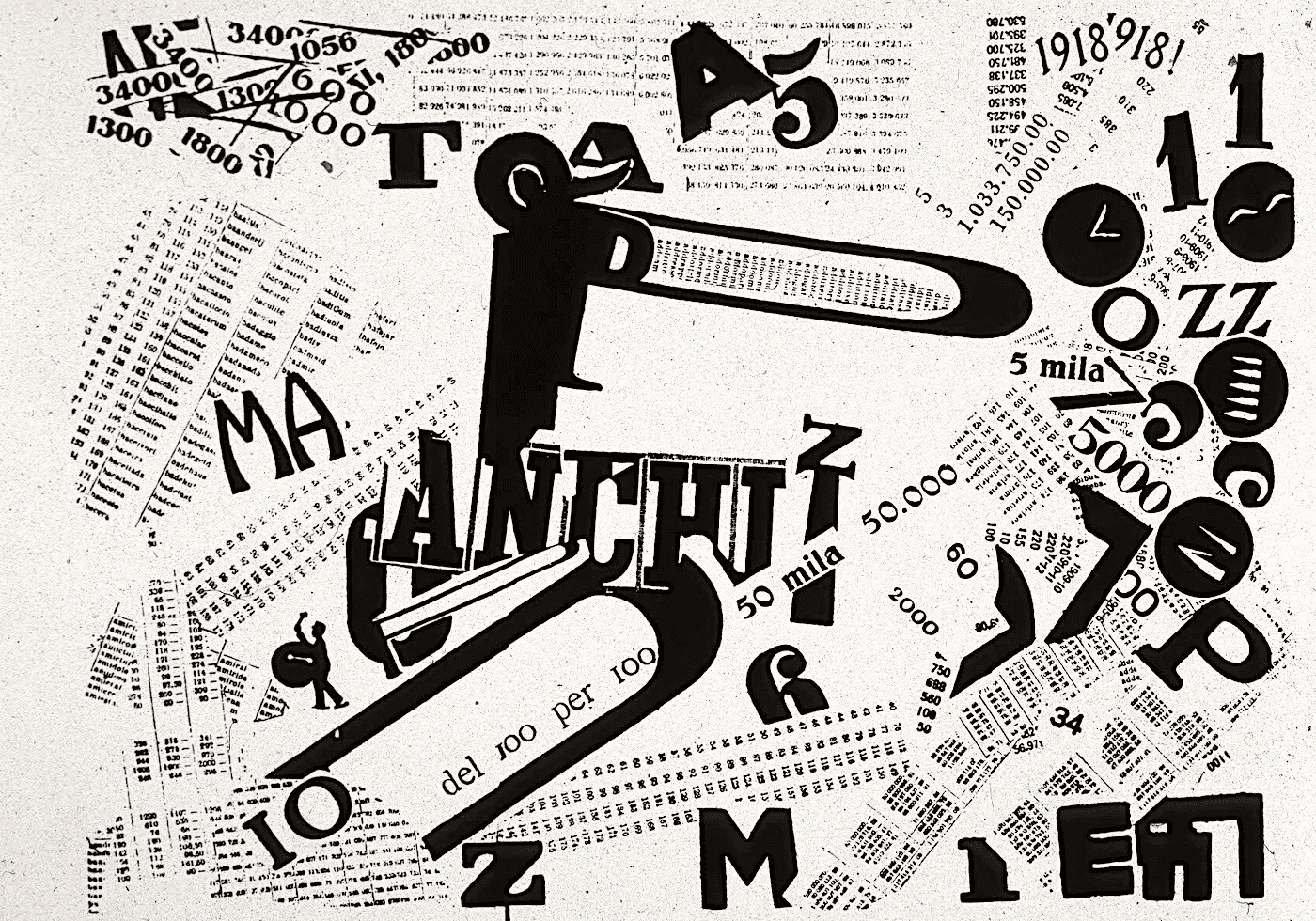
他后来成为法西斯党的早期成员,和墨索里尼私交甚好,但晚年和墨索里尼的关系也出现裂痕——因为法西斯政府转向保守的传统主义,背叛了未来主义的反传统精神。
翁贝托·波丘尼 Umberto Boccioni(1882-1916)
未来主义最重要的视觉艺术家。他是把未来主义的思想真正转化成绘画和雕塑语言的人。
核心问题:如何在静止的画面上表现运动?
他的答案不是立体主义那样的多视点叠加,而是把运动的连续轨迹同时压缩在一个画面里——类似于长曝光摄影的效果,但更主观,更情绪化。
《城市的兴起》1910-11: 他最早的重要作品。巨幅(近3米×2米),画面是米兰工业区的建设场景——工人、马、建筑工地,所有东西都在运动中溶解,颜色剧烈,笔触旋涡状。这不是在画一个建筑工地,是在画现代工业能量本身——那种使万物运动的力。
《心态》三联画 States of Mind,1911: 这是他最复杂的系列——三幅画,分别叫《告别》《留下的人》《走的人》。火车站的分离场景,但他不画外部视觉,画情绪的视觉化。《告别》里火车和人群在情绪的旋涡里溶解。《留下的人》里人物是弯曲的垂直线条,像雨,像重力,像悲伤的物质形式。《走的人》里是水平的速度线条。
《空间中连续的独特形式》1913: 他最著名的雕塑。一个行走的人体,但形式是流动的、爆炸的——肌肉不是解剖学的,是速度在空气中留下的痕迹。人体和运动是一体的,边界消失了。这件雕塑现在出现在意大利20分钱欧元硬币背面。波丘尼1916年死于一战——从马上摔下来,不是战场上的英雄死法,而是普通的事故。他34岁。
贾科莫·巴拉 Giacomo Balla(1871-1958)
巴拉是未来主义里最直接研究运动和光的画家,他受到摄影(特别是马雷的时间动态摄影)的直接影响。
《链上的狗的动态》1912: 这是未来主义最著名、最容易理解的画面之一。一个女人牵着狗走路——狗的腿、尾巴、女人的脚和裙摆被画成多重叠影,像快速连拍照片的叠加。这是把摄影的时间分解逻辑转化为绘画的直接尝试。
《光的抽象速度》系列1913: 更进一步,几乎完全抽象——光在运动中分解成角形的色彩碎片。这是未来主义最接近纯抽象的地方。
路易吉·鲁索洛 Luigi Russolo(1885-1947)
他是未来主义里最奇特的人物——他不主要是画家,他发明了噪音音乐(Noise Music)。
1913年他写了《噪音的艺术》宣言,宣称传统音乐的和谐音调是过时的,现代城市的噪音——工厂、汽车、人群——才是真正的现代音乐。他发明了一系列叫Intonarumori(噪音制造机)的机械装置,演奏纯噪音音乐会。观众的反应:暴动。演出现场爆发了肢体冲突——未来主义者认为这是成功。鲁索洛是20世纪具体音乐、噪音音乐、工业音乐所有实验传统的鼻祖。从约翰·凯奇到工业音乐到当代噪音艺术,都可以追溯到他。
未来主义宣言的数量
马里内蒂是宣言写作的狂热爱好者。未来主义运动期间发表了大量宣言,涵盖几乎所有领域:
《未来主义绘画宣言》1910
《未来主义音乐家宣言》1910
《噪音的艺术》1913
《未来主义建筑宣言》1914(桑泰利亚)
《未来主义妇女宣言》1912(这是一个女性写的,支持未来主义的女权变体——复杂)
《战争,世界唯一的卫生手段》1915
《未来主义烹饪宣言》1930(反对意大利面,认为它使人懒惰)
最后那个是真的。马里内蒂晚年写了《未来主义食谱》,反对意大利面,提倡吃奇怪的现代食物组合。意大利人对此极度愤怒。
未来主义建筑:安东尼奥·桑泰利亚
桑泰利亚(1888-1916)设计了大量激进的未来城市图纸——巨型摩天楼、高架道路、立体交通系统,人作为机器的一部分在其中运动。他的设计从未被建造,但这些图纸直接影响了20世纪科幻城市的视觉想象——《大都会》(弗里茨·朗1927)的城市景观直接来自桑泰利亚的图纸。《银翼杀手》、《黑客帝国》的城市,追溯到底都在这里。桑泰利亚1916年死于一战前线,28岁。
未来主义与法西斯主义
这是无法回避的问题。未来主义和法西斯主义之间的关系不是偶然的政治倾斜,是内在逻辑的必然结果:
对暴力的美化——宣言里直接写明战争是净化手段
对传统的仇恨——和法西斯的民族复兴叙事有矛盾,但对”腐败的现状”的攻击是共同的
极度男性化——女性是需要被超越的障碍,战士身体是理想形态
速度和行动优先于思考——反智识,崇尚本能和意志
对国家力量的崇拜
马里内蒂1919年参与创建法西斯党,与墨索里尼并排站在纲领签署仪式上。但他和墨索里尼后来产生裂痕:墨索里尼的法西斯政权为了拉拢天主教会和传统精英,转向保守主义和古典传统,这背叛了未来主义的反传统精神。
未来主义在法西斯意大利的地位是矛盾的:它是法西斯的精神先驱,但法西斯的官方美学最终不是未来主义,而是伪古典主义。这个矛盾是20世纪前卫艺术与政治关系的最极端案例——一个艺术运动的内在逻辑直接滑入了政治暴力。
俄国未来主义:另一条路
俄国未来主义和意大利未来主义几乎同时发展,但走向了完全不同的方向。
共同点: 反传统,拥抱现代城市和机器,激进的形式实验。
根本区别: 意大利未来主义走向了民族主义和法西斯,俄国未来主义走向了国际主义和革命。
关键人物
弗拉基米尔·马雅可夫斯基 Vladimir Mayakovsky(1893-1930)
他首先是诗人,然后是革命者,然后是苏联官方文化的代言人,然后是自杀者。他的诗歌是语言的爆炸——打破格律、发明新词、把街头语言带入诗歌。他在莫斯科街头贴海报,在广场上朗诵,把诗歌变成公共事件。1917年十月革命,他立刻投向布尔什维克。他设计革命海报,写革命诗歌,把未来主义的形式能量全部投入革命服务。但随着苏联体制化,他开始感受到压力——他的实验性风格与苏联官方要求的易于理解的大众宣传产生矛盾。他的晚期作品里有越来越明显的幻灭感。1930年,他开枪自杀。37岁。
韦利米尔·赫列布尼科夫 Velimir Khlebnikov(1885-1922)
俄国未来主义最激进的语言实验者。他发明了**”超理性语言”(zaum)**——纯粹的声音诗歌,不依附于任何现实意义的词语。他相信存在一种所有人类都能感知的语言,超越具体语言的藩篱。他的影响在语言学、诗歌理论、后来的具体诗歌运动里至今可见。他1922年死于斑疹伤寒,身无分文,几乎无人知晓。死后被重新发现,成为俄语文学史上最重要的前卫诗人之一。
卡西米尔·马列维奇 Kazimir Malevich(1879-1935)
他从立体-未来主义出发,最终发明了至上主义(Suprematism)——纯粹几何形体,彻底切断与现实世界的任何联系。《黑色方块》(1915):白色画布上一个黑色正方形。没有任何其他内容。这是绘画史上最激进的姿态之一。它的意思是:绘画到这里结束了,或者说,绘画在这里找到了它最纯粹的起点。马列维奇说,这是”零形式”——所有表现的零度,也是所有可能性的起点。苏联体制化之后,抽象艺术被定性为”形式主义”,与革命目标不符。马列维奇晚年被迫回到具象绘画,画农民主题,但在风格上仍然保留了几何化的特征。他1935年死于癌症,在他的遗愿里,他被装在一个他自己设计的至上主义风格的棺材里,葬在莫斯科郊外。墓碑上是一个黑色方块。
未来主义与电影
电影本来就是关于时间和运动的艺术。 波丘尼试图在静止画面上做的事——把时间的连续性压缩进一个瞬间——正是电影用胶片每秒24帧自动完成的事。
苏联蒙太奇理论(爱森斯坦、维尔托夫) 直接继承了俄国未来主义的实验精神。维尔托夫的《电影眼》宣言和马雅可夫斯基的诗歌宣言是同一个文化场域的产物。
动作场景的视觉语言: 现代电影里高速追逐、爆炸、战争场面的剪辑逻辑,有一部分根在未来主义对速度和运动的视觉化实验。
吉加·维尔托夫《持摄影机的人》(1929): 这部电影几乎是俄国未来主义的视觉宣言——城市、机器、运动、劳动身体,摄影机本身成为主角,剪辑成为创造现实的工具。
未来主义的遗产:好的和坏的
好的遗产:
噪音音乐→具体音乐→电子音乐→工业音乐
速度和运动的视觉化→动态图形设计→电影特效
宣言作为艺术形式→达达、超现实主义、情境主义、朋克
俄国未来主义→构成主义→包豪斯→现代平面设计
坏的遗产:
艺术与政治暴力结合的模板——未来主义证明了前卫艺术可以成为极权主义的文化资源
对女性的系统性蔑视写入了一个有影响力的艺术运动的核心文本
对破坏的美化——这个美学传统在20世纪反复被各种政治力量利用
🖼️