Created on
Updated on
1924 | 超现实主义 Surrealism
梦与意识
Preface: welcome to this very brief intro to modern art. Please feel free to use this as a guide for museum visits.
Why Surrealism Had to Exist
Dada said: meaning is a lie, nothing is real. Surrealism said: wait — there is a reality more real than the one we’re aware of, and it lies beneath us, in dreams, in the unconscious, in repressed desires and fears. This was a fundamental shift: from Dada’s nihilism to Surrealism’s search for a deeper truth.
Freud published The Interpretation of Dreams in 1900 and Three Essays on the Theory of Sexuality in 1905. His core argument: the true driving force of human behavior is not rational consciousness but the unconscious — that layer pressed down by civilization, morality, and social norms, filled with desire, the death drive, childhood trauma, and forbidden impulses. The Surrealists read Freud and concluded: if the unconscious is the more real reality, then art should come directly from the unconscious, unfiltered by reason. Bypass rational control and let the unconscious flow out directly — through automatic writing, dream recording, hypnosis, chance games, free association.
The Surrealist Manifesto, 1924
André Breton (1896–1966) was the movement’s founder and pope. His definition: “Surrealism, noun, masculine. Pure psychic automatism, by which one proposes to express, either verbally, in writing, or by any other manner, the actual functioning of thought. Dictation of thought in the absence of all control exercised by reason, outside of all aesthetic and moral preoccupation.”
Breton was a totalitarian movement leader. He set the rules, expelled members, and decided who was a true Surrealist. He expelled Dalí (too commercial), expelled Aragon (too loyal to Stalin), broke publicly with Tzara, and had conflicts with nearly everyone. A movement preaching the liberation of the unconscious and the breaking of all repression — managed by a leader of extreme controlling tendencies, whose attitude toward women was not fundamentally different from the civilization he claimed to be liberating people from.
On Breton’s attitude toward women: in his theory, women were the door through which male artists accessed mystery and the unconscious — she was inspiration, muse, la femme fatale. She was object, not subject. The movement’s male artists produced enormous quantities of paintings of female bodies — decomposed, gazed upon, eroticized. This is structurally the same thing as the Victorian-era sexual repression they claimed to be breaking — just pointed in the opposite direction. Victorian culture suppressed female sexuality; Surrealism put female sexuality on display. But neither asked women what they themselves wanted.
Core Techniques
Automatic Writing: Let the pen move across the page without conscious control, writing down whatever surfaces. No editing, no censoring, no judgment. The goal is to let the unconscious speak directly. Breton and Soupault experimented with automatic writing together in 1919 and published The Magnetic Fields — considered the first Surrealist literary work.
Dream Recording: Surrealists systematically recorded their dreams and translated dream images directly into pictures. Dalí’s method was the most extreme — he sat in a chair holding a spoon, and in the moment just before falling asleep (the hypnagogic state), the sound of the spoon dropping would jolt him awake, and he would immediately paint the image he had just seen. He believed this threshold state produced the purest unconscious images.
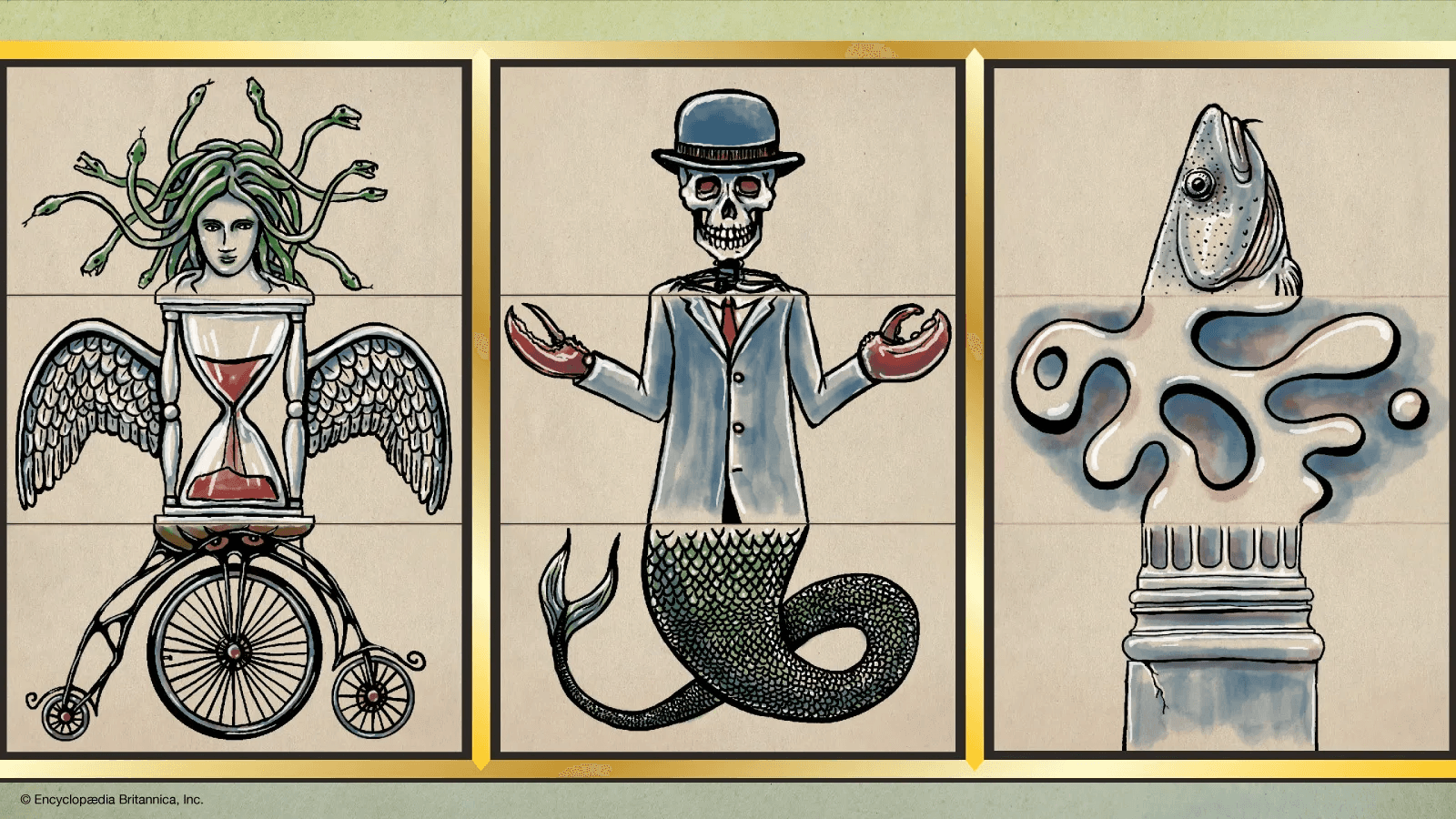
Exquisite Corpse: A group game — the first person draws or writes something on paper, folds it leaving only a small edge visible, and passes it to the next person, who continues without seeing what came before. The final result is unfolded and seen as a whole. The game’s name came from the sentence produced the first time it was played: “The exquisite corpse shall drink the new wine.” The images it produces are impossible for a single rational consciousness to have designed — and for this reason, the Surrealists believed these chance combinations revealed some deeper logic.
Defamiliarizing Juxtaposition: Placing two completely unrelated objects together, letting their juxtaposition produce a new and disturbing perception. The nineteenth-century poet Lautréamont was cited as Surrealism’s forerunner: “As beautiful as the chance encounter of a sewing machine and an umbrella on an operating table.” This is different from Cubism’s multiple viewpoints — Cubism is epistemological; Surrealism is psychological.
Core Artists
Salvador Dalí (1904–1989)
The most famous, the most complex, and the one most requiring a critical eye. His technique is contradictory: extremely refined academic realism used to depict completely illogical dream scenarios. He called this the Paranoiac-Critical Method: deliberately inducing a state of perception resembling paranoia, “seeing” nonexistent connections and images within reality, then painting them with a hyper-realist hand. Depicting the most irrational content with the most rational technique — this contradiction was intentional, producing a specific kind of discomfort: the picture is too real, which makes it more disturbing.
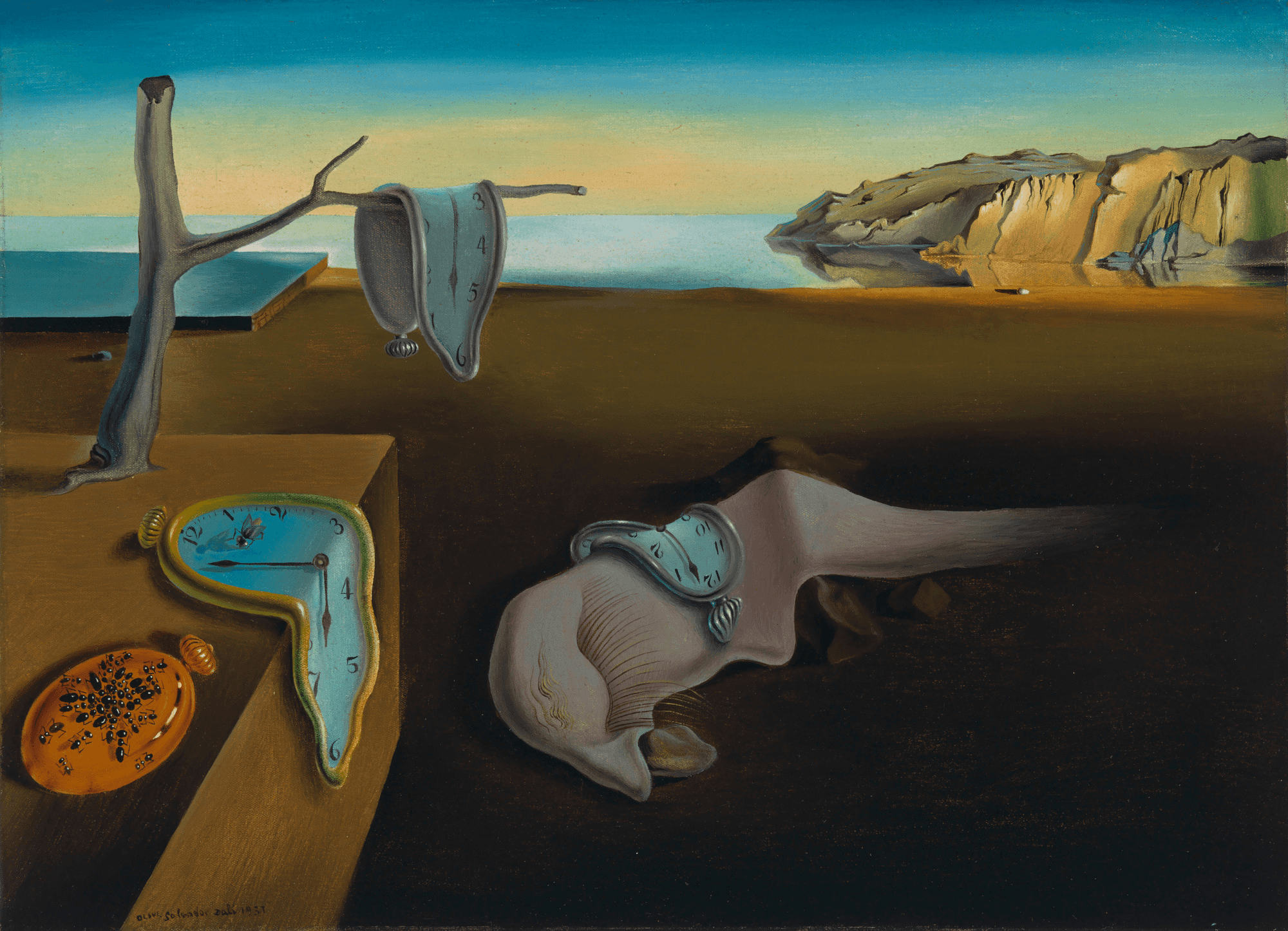
The Persistence of Memory, 1931: The Catalan coastal landscape — his homeland. A wooden platform, a dead tree, three melting watches, a soft fleshy form pressed down by another watch, distant cliffs. Melting clocks: time in dreams is not fixed or linear. Clocks are civilization’s symbol of control over time — but in dreams that control fails, time becomes soft, malleable, meaningless. He later said the image came to him while watching a piece of Camembert cheese melt in sunlight. He sat there, the picture appeared before him, and he completed the painting two hours later.
Premonition of Civil War, 1936: That year the Spanish Civil War broke out. This painting was made months before the war began — a vast human body tearing itself apart, soft tissue and bone exposed, on a barren landscape. No specific political message — a pure premonition of bodily violence.

His Symbolic Self-Portrait series and The Temptation of Saint Anthony are recurring explorations of desire, religion, death, and corruption.
Dalí was one of the most successful self-brand builders in all of modern art history. His upturned moustache, his bizarre public statements, his relationship with Gala (his wife and lifelong muse), his castle, his socializing in New York and Hollywood — all consciously constructed public image. He said: “The only difference between me and a madman is that I am not mad.” Breton ultimately expelled him from the Surrealist movement and gave him the nickname “Avida Dollars” — an anagram of his name meaning “eager for dollars.” The criticism had merit: Dalí did become a commercial artist, designing for perfume, chocolate, and television advertisements. But the irony is that Dalí’s commercialism didn’t completely contradict Surrealism’s core logic. If the boundary between dream and reality can dissolve, why can’t the boundary between high art and commercial art? Pop Art later answered this question in Andy Warhol’s terms.
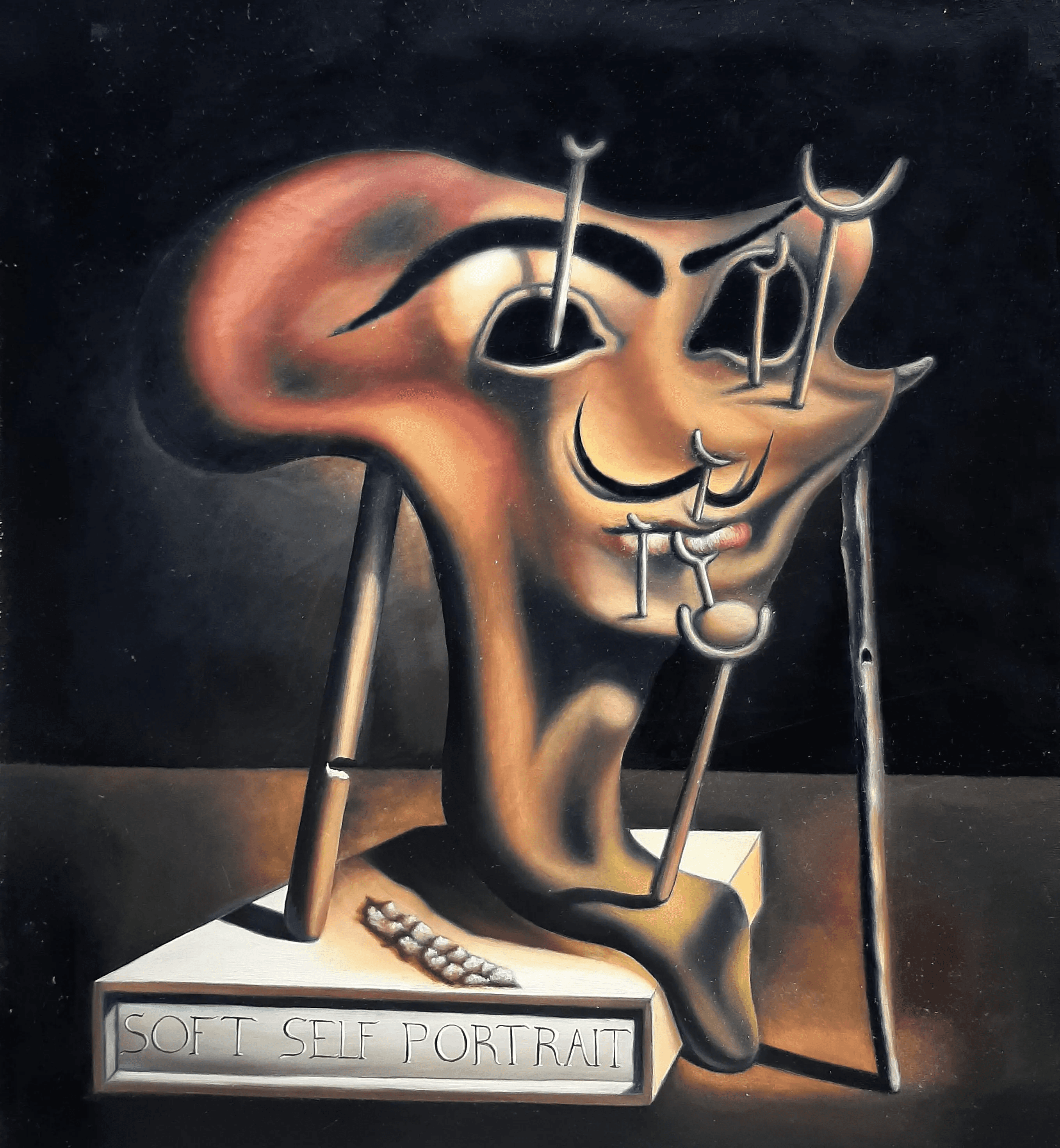
He designed the dream sequences for Hitchcock’s Spellbound (1945) — melting clocks, severed eyes, a playing-card estate. He collaborated with Disney on an animated short called Destino, begun in 1946, halted for financial reasons, and completed and released by Disney in 2003. One of the most direct contacts between Surrealism and Hollywood.
René Magritte (1898–1967)
The most philosophical, the most calm, the least theatrical of the Surrealists. He didn’t paint dreams — he painted logical errors within everyday reality. His pictures are completely clear, every detail realistic, but the whole violates some fundamental logic.
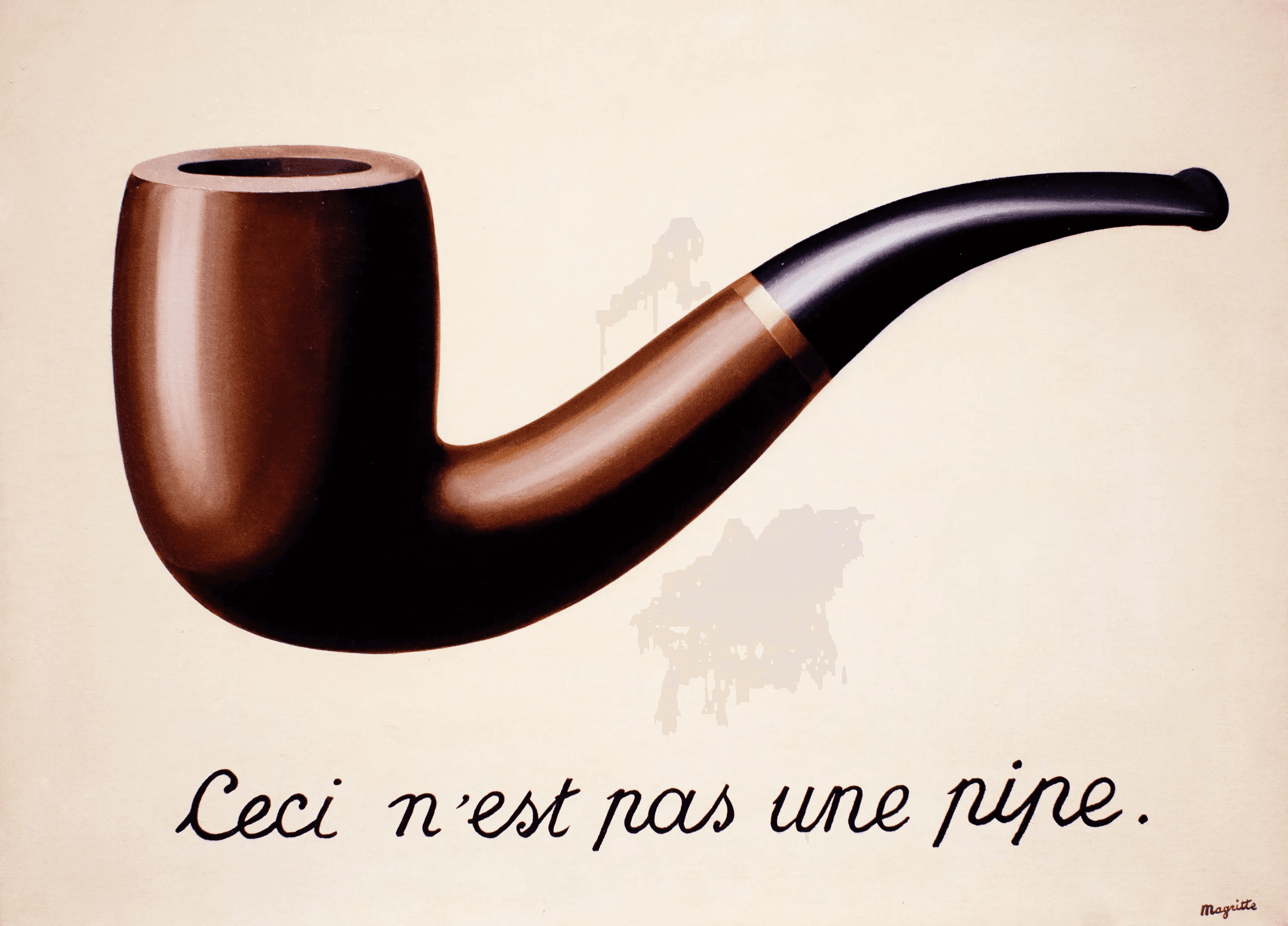
The Treachery of Images, 1929: A realistic pipe, with the words beneath it: “Ceci n’est pas une pipe” (This is not a pipe). The painting is a complete philosophical proposition: the pipe in the painting is indeed not a pipe — you cannot smoke it. It is paint on canvas, a visual representation of the concept “pipe,” a sign, not the object itself. This comes directly from Saussure’s linguistics: the relationship between a sign and what it refers to is not natural but arbitrary. The word “pipe” has no intrinsic relationship to an actual pipe; a picture of a pipe has no intrinsic relationship to an actual pipe. Magritte turned a linguistic theory into a painting that lets anyone feel the force of the philosophical proposition within thirty seconds.
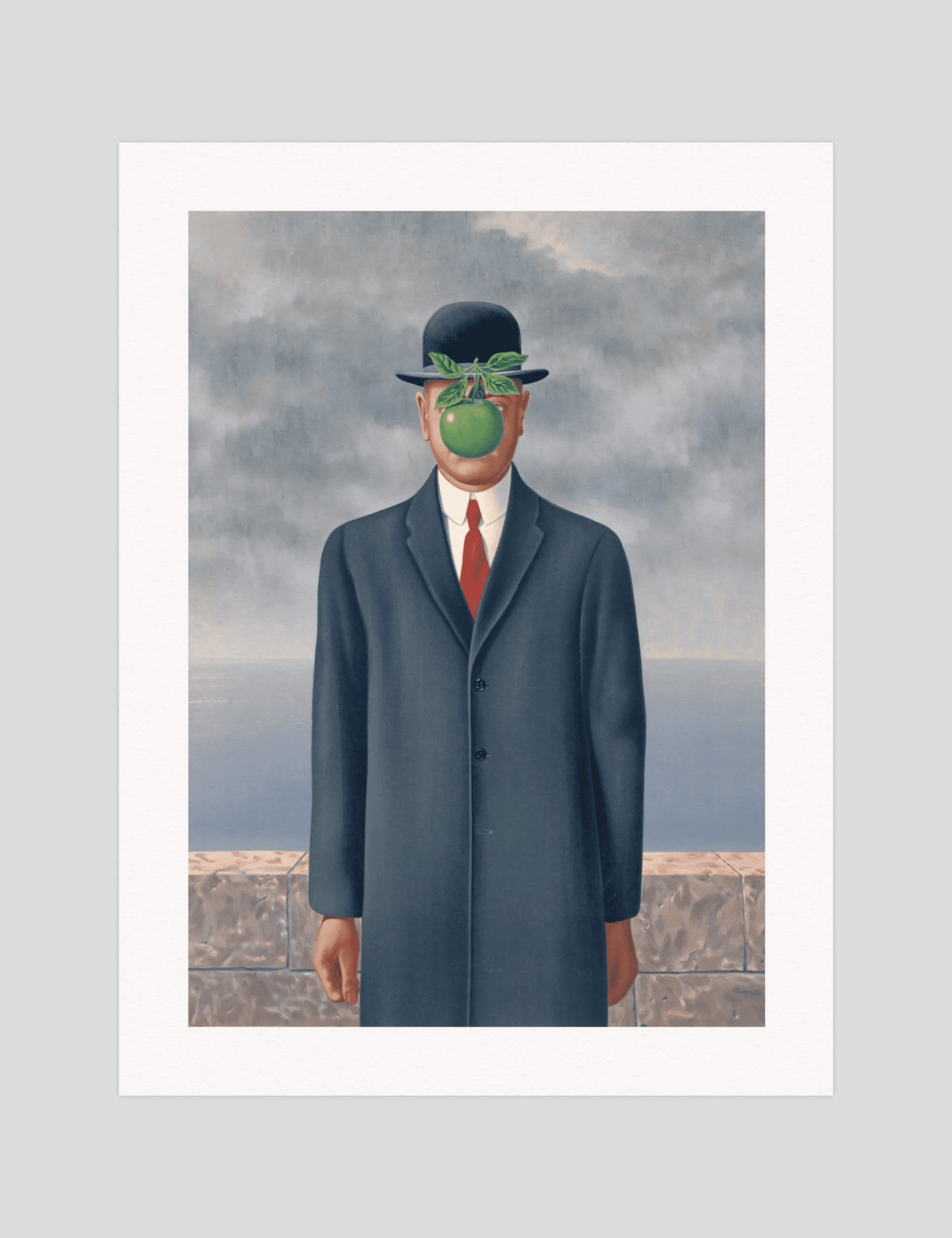
The Son of Man, 1964: A man in a dark suit and bowler hat stands before a low wall, his face entirely hidden by a green apple. He later explained: what is hidden makes us more interested in what is visible. You see the apple, but you know there is a face behind it — and you can never see it. This frustrated desire to see is stronger than seeing itself. This is also a self-portrait — he repeatedly painted this suited, bowler-hatted figure, which was his own image. He hid his own face and turned the identity of “the artist” into a mystery.
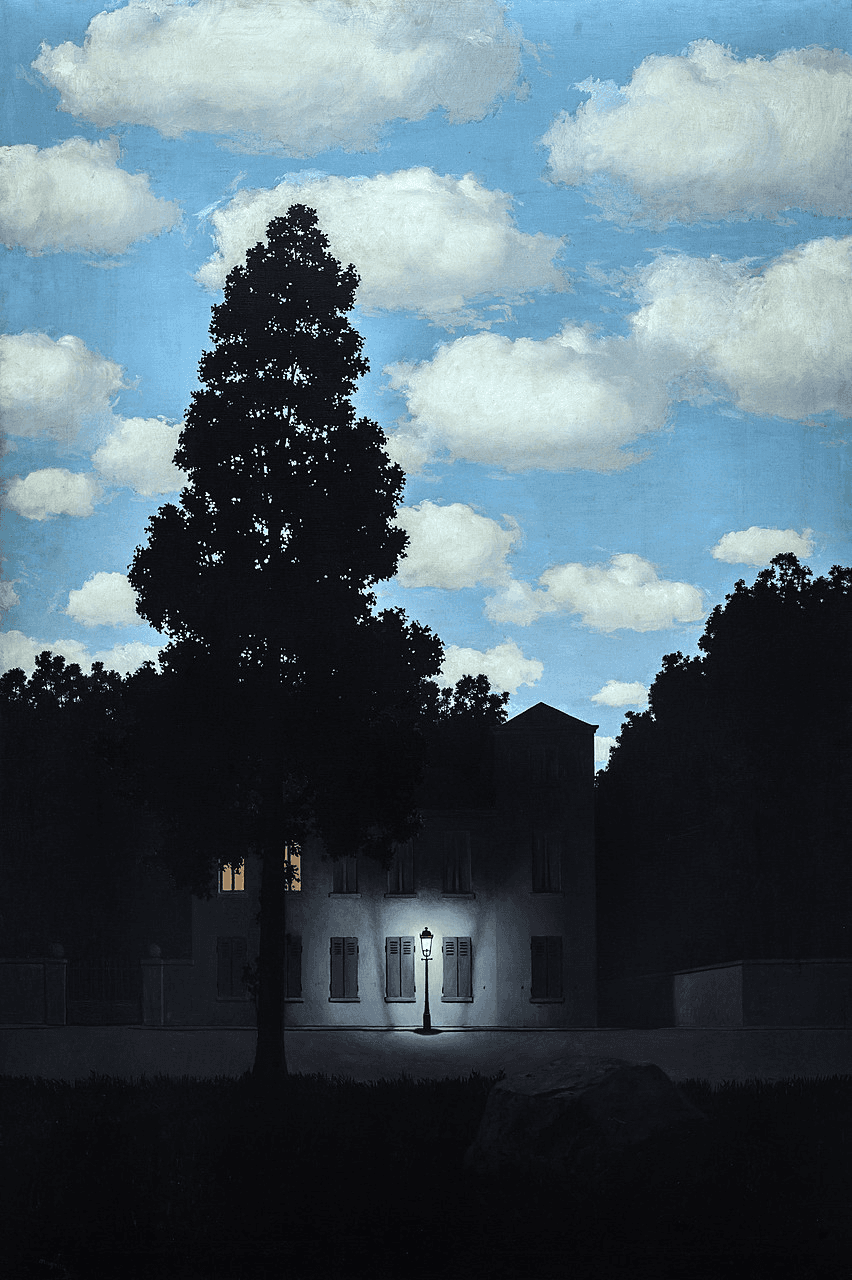
The Empire of Light series: a daytime sky, a nighttime street — day and night coexisting in the same picture. Visually calm, almost beautiful, but logically impossible. Magritte’s Surrealism doesn’t use the distortions and deformations of dream imagery — it uses the quiet failure of temporal logic.
He was the most “normal” liver of all the Surrealists — a middle-class Brussels street, regular working hours, a neat suit, dog-walking, card games, an uneventful daily life. He said he didn’t want his life to have any drama — drama belonged in the pictures. He and his wife Georgette married and loved each other for life. There was a brief relationship with another woman, quickly ended; he returned to Georgette. He never turned any of this into public myth. In his youth he experienced his mother’s suicide — she drowned herself in a river and was found with her face covered by her nightgown. Some say this explains the repeatedly covered faces in his paintings, but he personally rejected this kind of simple psychological analysis.
Max Ernst (1891–1976)
The most important bridge figure between Dada and Surrealism, and the most technically inventive artist in the movement.
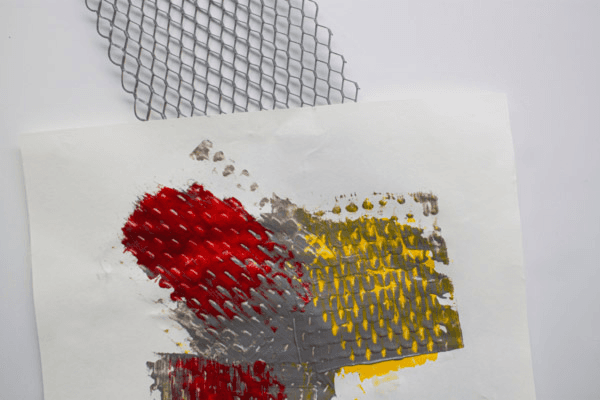
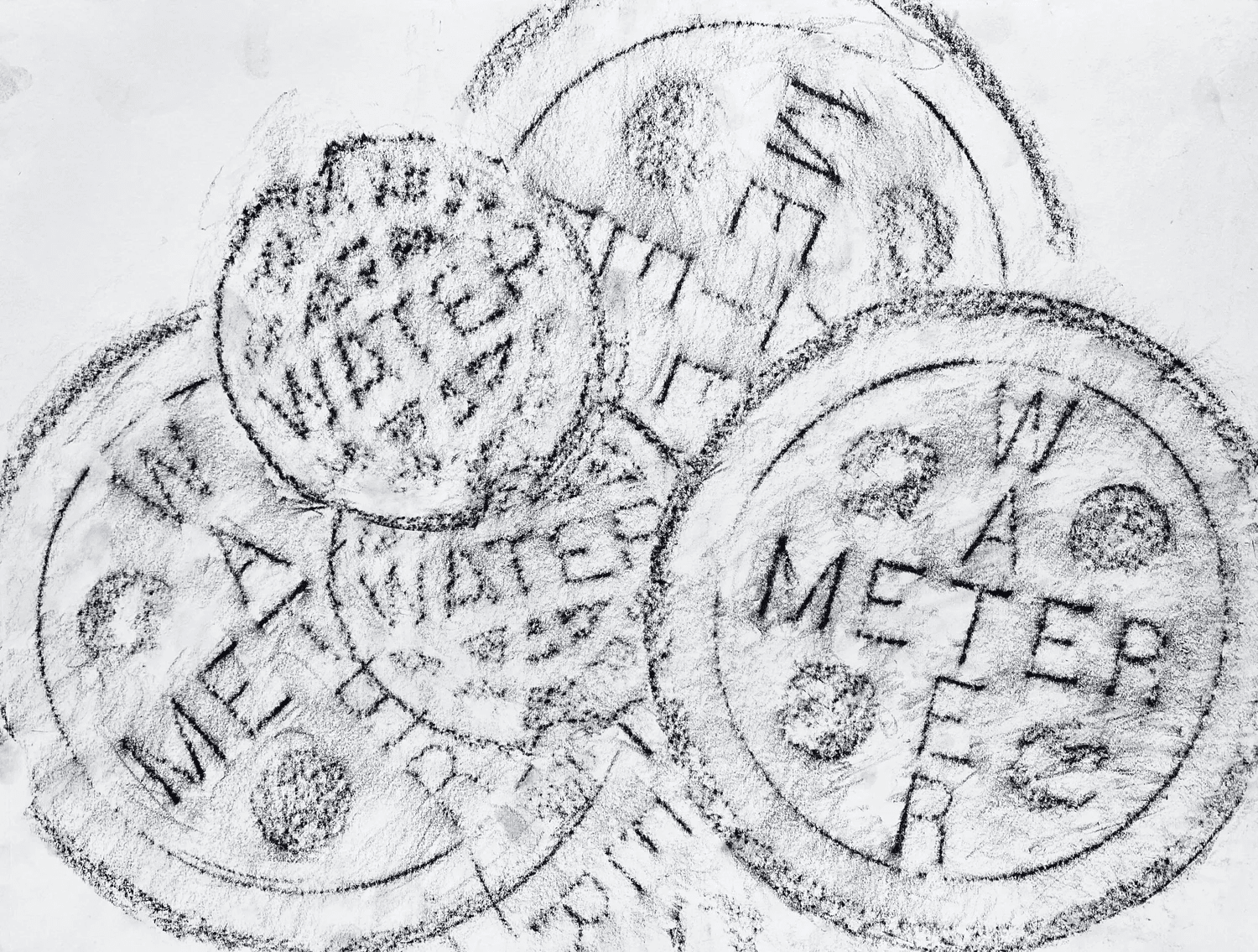
Frottage: placing paper on rough surfaces and rubbing with pencil, letting random textures trigger unconscious image associations. Grattage: covering canvas with paint, then scraping away portions with a palette knife to reveal random textures and patterns, then “discovering” images within them. The shared logic of both methods: the artist is not creating images but discovering images the unconscious has already placed there within random physical processes.
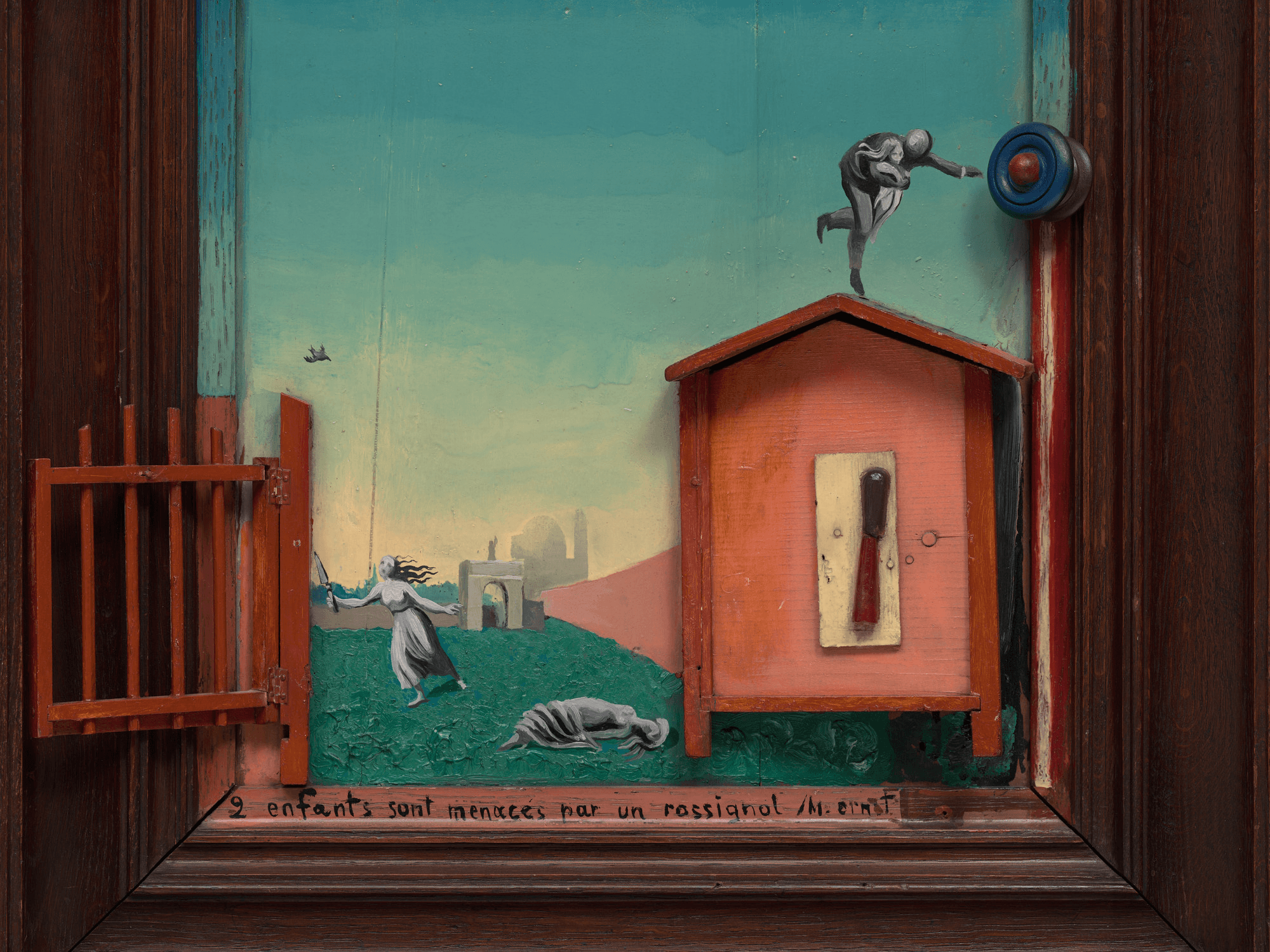
Two Children Are Threatened by a Nightingale, 1924: A painting with actual three-dimensional elements embedded — a small wooden house, a real door handle. Two children terrified by a nightingale in moonlight, but the scene’s scale is wrong: figures too small, buildings too large, moon too close. This scalar distortion produces the characteristic disproportion of dreams.
Europe After the Rain, 1940–42: Made after his escape from Nazi France, completed in America. A gray, fragment-filled landscape, broken forms. Not Dalí’s bright, almost pleasurable dream imagery — the image of a civilization in ruins.
He was conscripted by Nazi Germany and spent his youth on the First World War battlefield, an experience that directly produced his Dada stance. During the Second World War he was interned in France, escaped with the help of Peggy Guggenheim (the American art patron), and married her. He later married the artist Dorothea Tanning — one of the most important female artists in Surrealism, long obscured by the label “Ernst’s wife.”
Yves Tanguy (1900–1955)
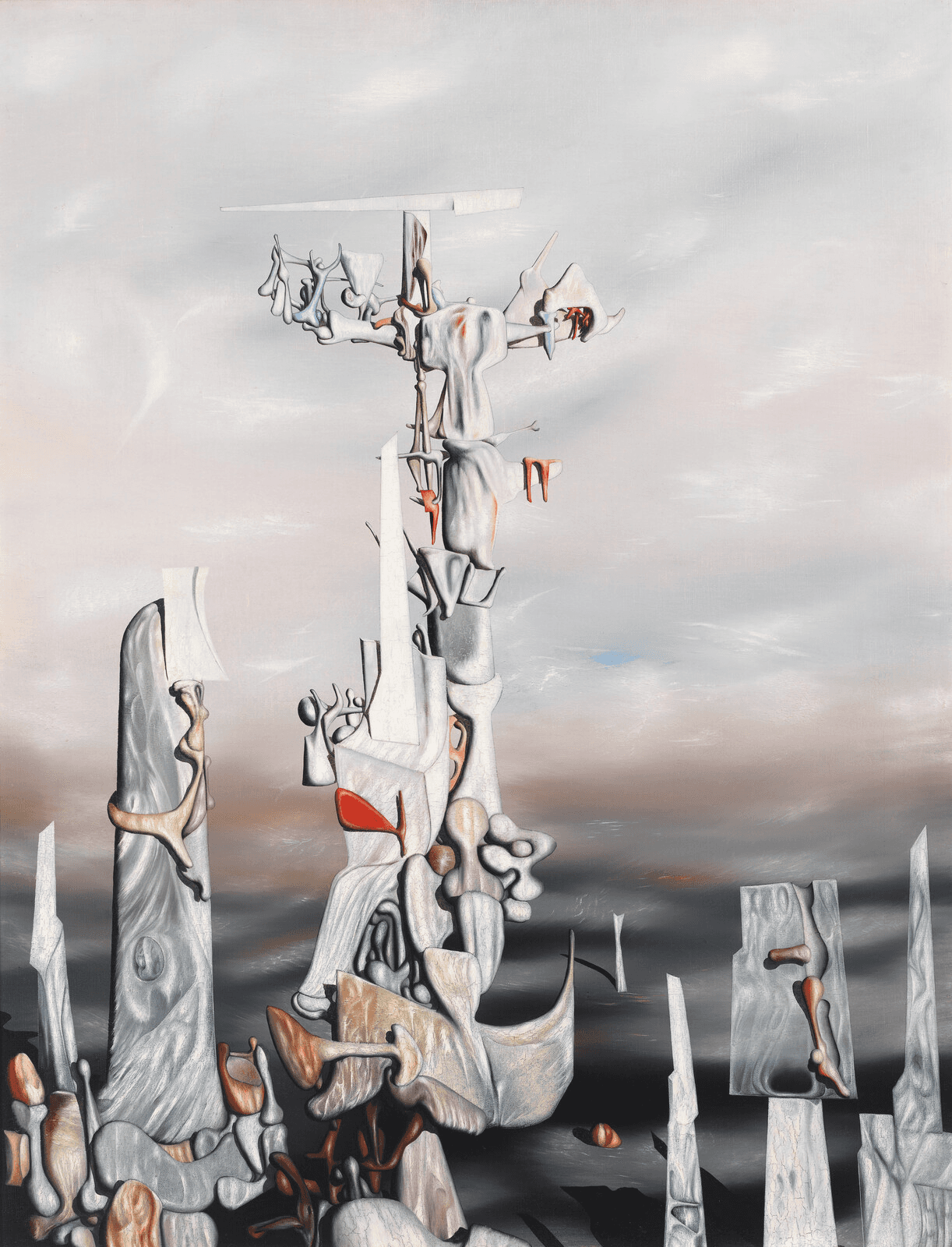
French, with no formal art training — he said he saw a painting by De Chirico on the street and decided on the spot to become a painter. His pictures are completely consistent: an infinitely extending desert or seabed, scattered with unidentifiable organic forms — simultaneously resembling stones, bones, deep-sea creatures, and architectural ruins. No horizon, no scale reference, no narrative. This is not any place on earth, nor any place in any dream — it is a purely interior geography, the spatial externalization of a psychological state. His pictures carry a disturbing quality of silence and permanence — not Dalí’s dramatic distortions, but a slower, more thorough strangeness.
Joan Miró (1893–1983)
Catalan (Spanish) — the most joyful and free visual language in Surrealism. He and Dalí were from the same region but temperamentally opposite. Dalí’s pictures are repressed, erotic, anxious; Miró’s are playful, instinctual, almost childlike.
What he wanted to do: he said he wanted to “murder painting” — not Dada’s nihilistic annihilation but a reduction of painting to its most primitive state, before any cultural norms formed, before children learned the “correct way to draw,” before painters were trained into being painters — that kind of free image-making.
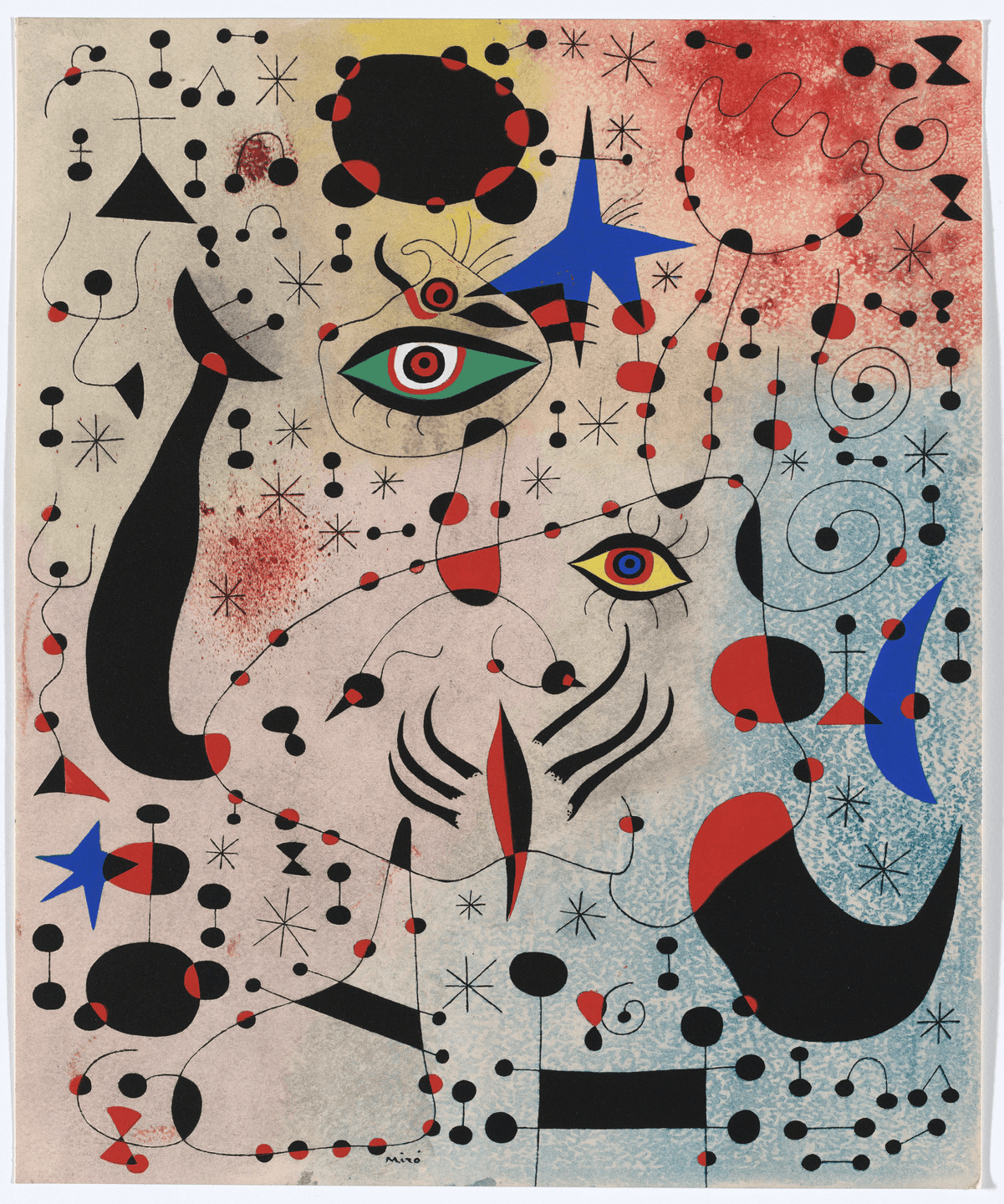
His visual language: organic, flowing shapes hovering between abstract and figurative — readable as eyes, moon, woman, bird, star, but with no fixed interpretation. Bright primary colors (red, yellow, blue, black). Lines thin and elastic, like living organisms. The picture has a quality of continuous motion, as if all the elements are slowly floating.
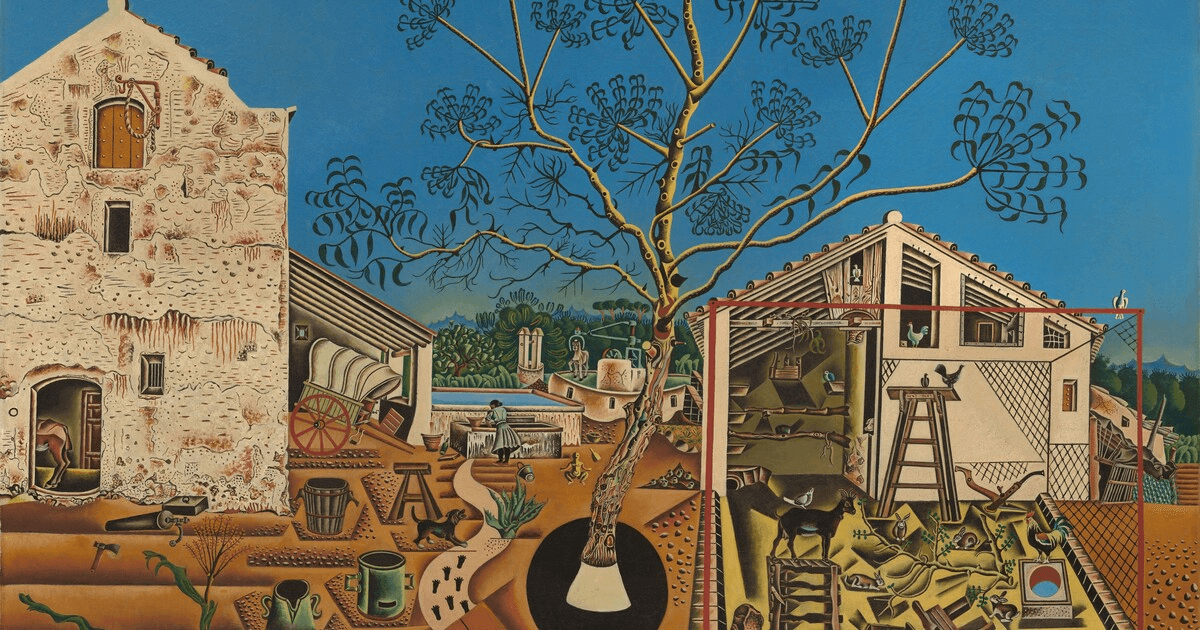
The Farm, 1921–22: His earliest important work, before entering Surrealism — a Catalan farmhouse, every detail described with extreme precision (a tree, a donkey, a dog, a bucket of water), but the whole is flat and un-perspectival, like an illustration from a child’s encyclopedia. Ernest Hemingway bought this painting and said he would trade anything he owned for it.
Constellations series, 1940–41: A group of works made during France’s fall, while he was in refuge on the island of Mallorca. Small scale, in watercolor and gouache, dense lines and shapes filling the surface — like a cosmic map, like a cipher system. His most important series, and the visual language of interior order he found in the darkest historical moment.
Paul Delvaux (1897–1994)
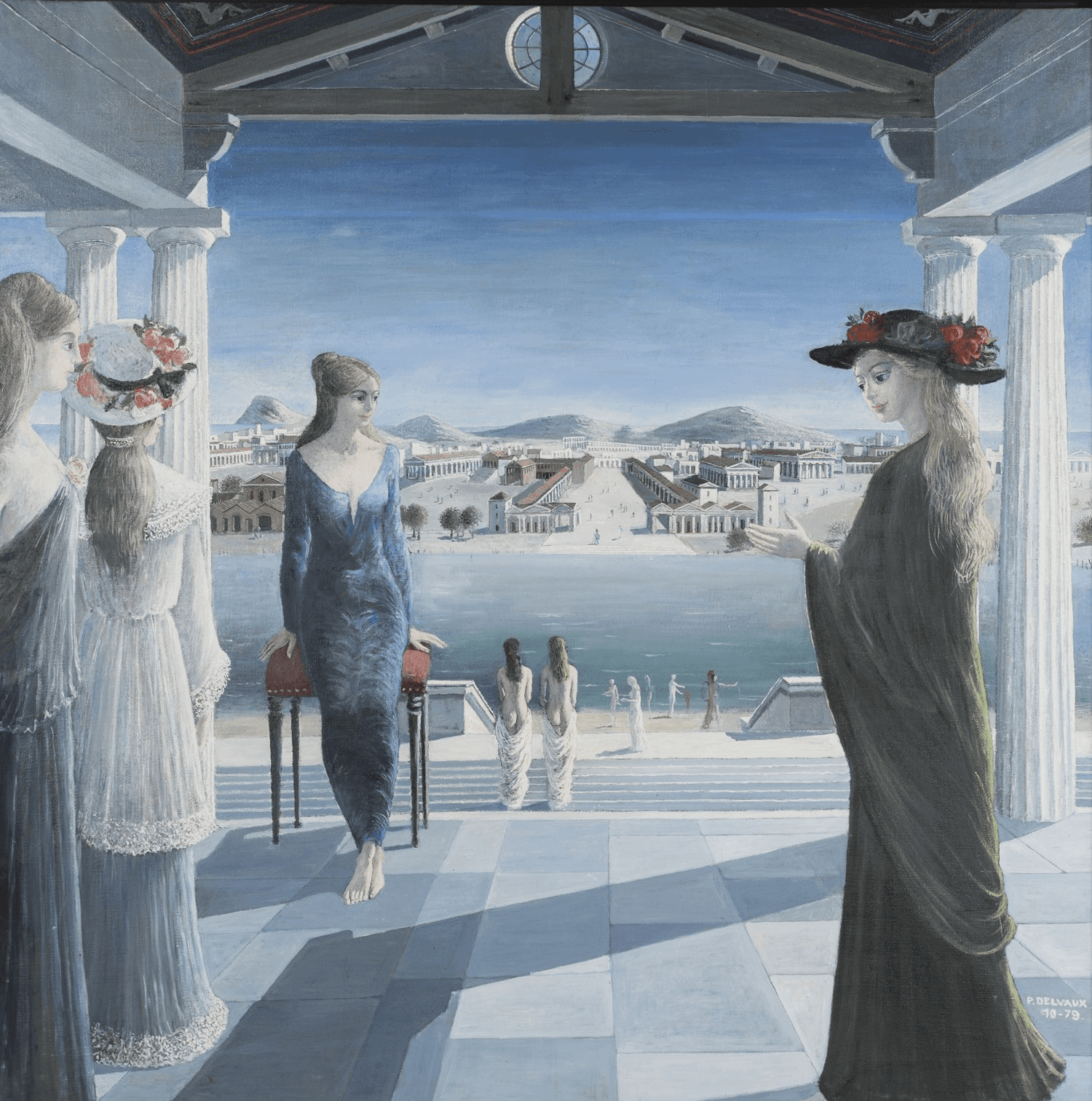
Belgian, often mentioned alongside Magritte but with a completely different style. His pictures: nighttime Greek temples, moonlight, torches, nude women wandering through them — their eyes vacant, moving in different directions, not looking at each other, like sleepwalkers. Male figures (when present) are usually in suits, and their juxtaposition with nude women creates a strange class and gender tension. His pictures carry a deep underlying loneliness — all the figures occupy the same space but are completely isolated from each other, incapable of communication. A visual metaphor for modern human isolation, wrapped in a surface of classical temples and nude women.
The Women Artists of Surrealism
Frida Kahlo (1907–1954):
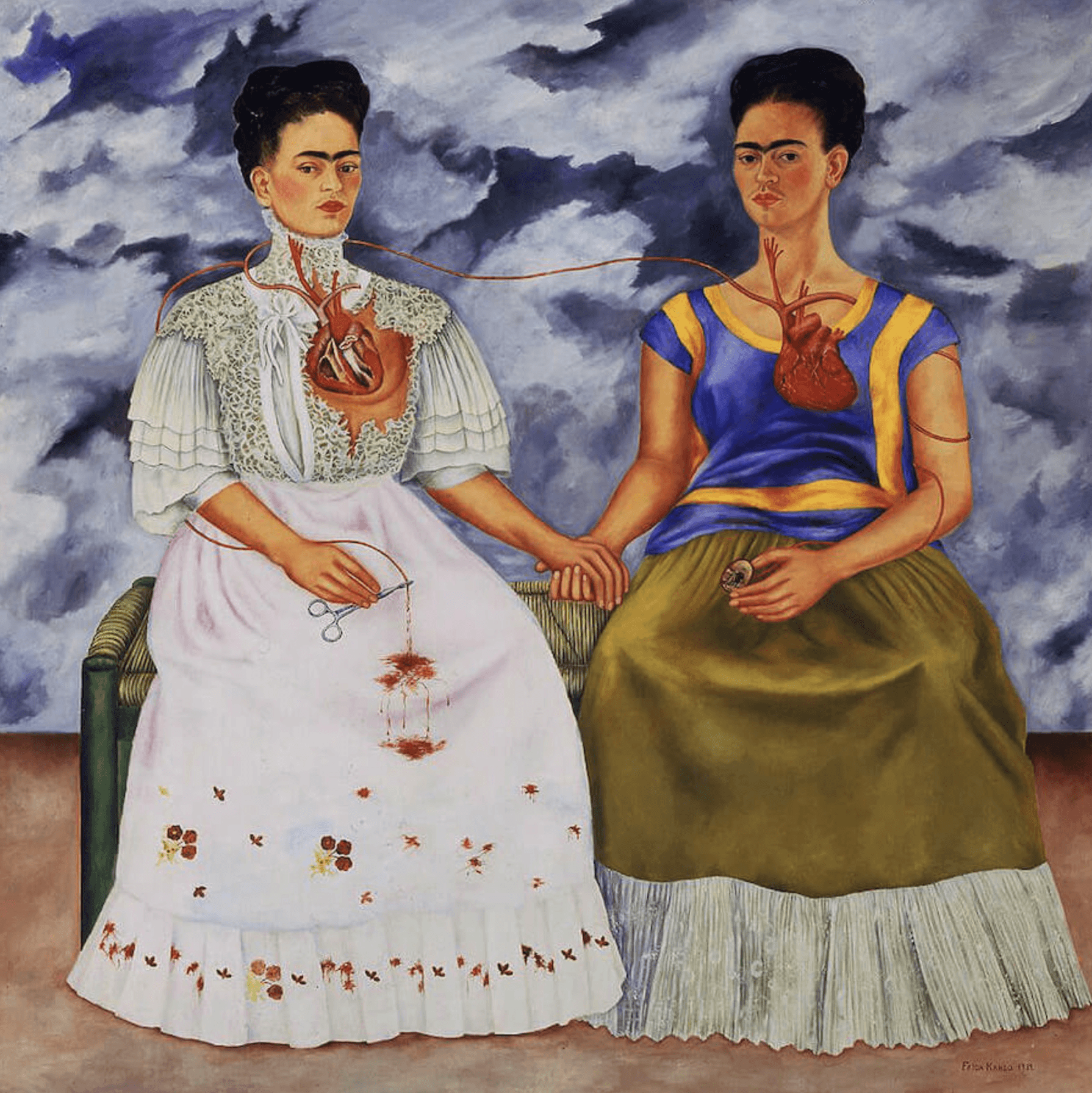
She refused the “Surrealist” label — “I never paint dreams or nightmares. I paint my own reality.” Her method was fundamentally different from the male Surrealists: they fled from the unconscious toward dream; she looked directly at reality through bodily pain. Her paintings are literal, not symbolic — miscarried fetuses, a broken spine, a husband’s infidelity. These are not dream images; they are documentary records.
Meret Oppenheim (1913–1985):
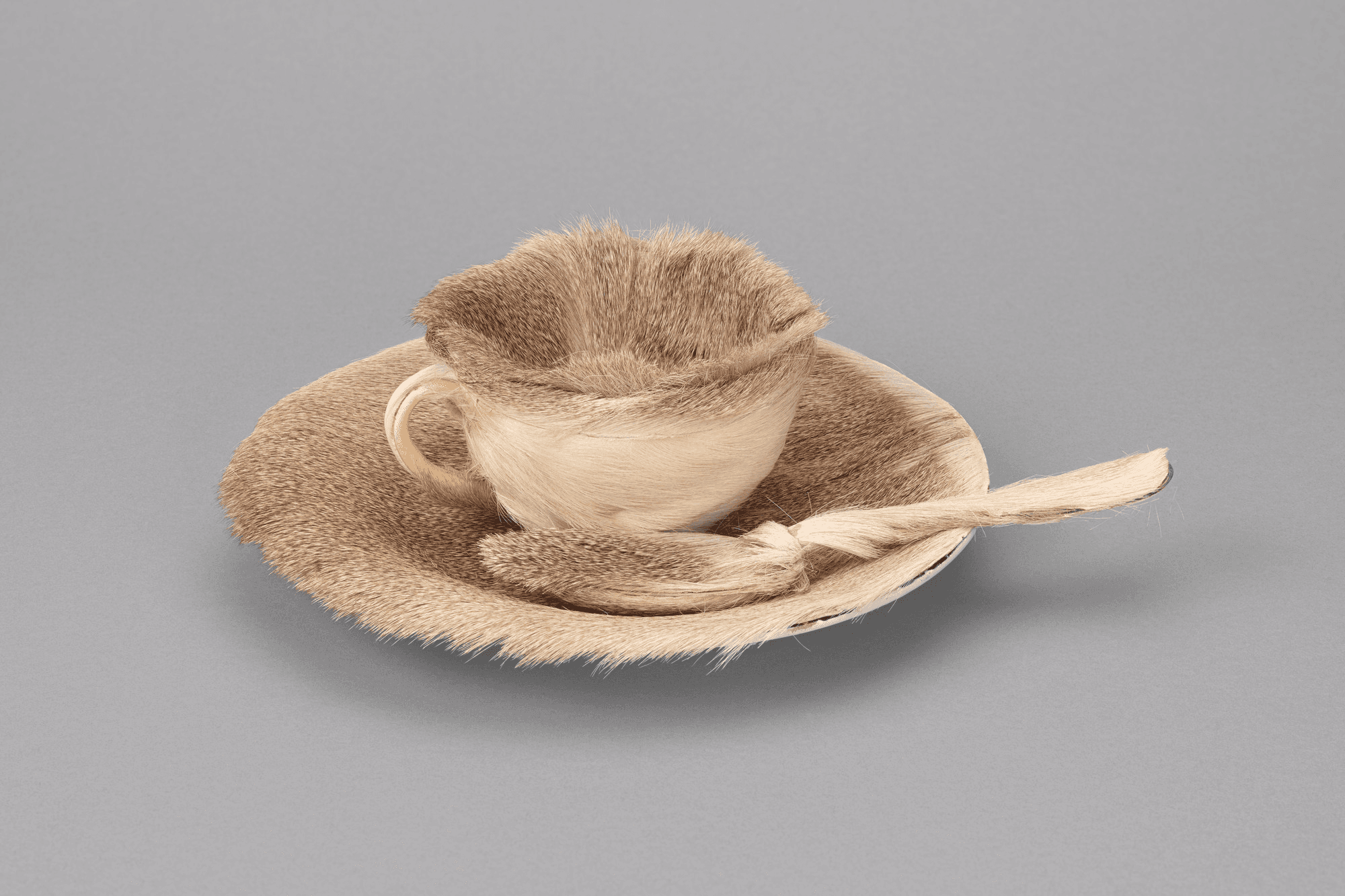
Object (Luncheon in Fur), 1936 — a teacup, saucer, and spoon covered in Chinese gazelle fur. Fur is animal, sensory, sexual; the teacup is civilized, domestic, feminine ritual. Their juxtaposition produces deep discomfort: using this cup means putting fur in the mouth, the boundary between body and civilized object dissolving in the oral cavity. The work also has a gender-political dimension: the teacup is a “feminine” object covered in animality — is this a deconstruction of the concept of “the civilized woman,” or a reinforcement of “woman as animal being”? The ambiguity is intentional. She completed this work at 26, MoMA purchased it immediately, she was famous overnight. Then came ten years of creative crisis — overnight success fixed her to an early work she could not surpass. She later said: “Don’t confuse success with freedom.”
Dorothea Tanning (1910–2012):
American. Her pictures carry a specifically female-perspective fear — not external monsters but internal, domestic, almost invisible threats.
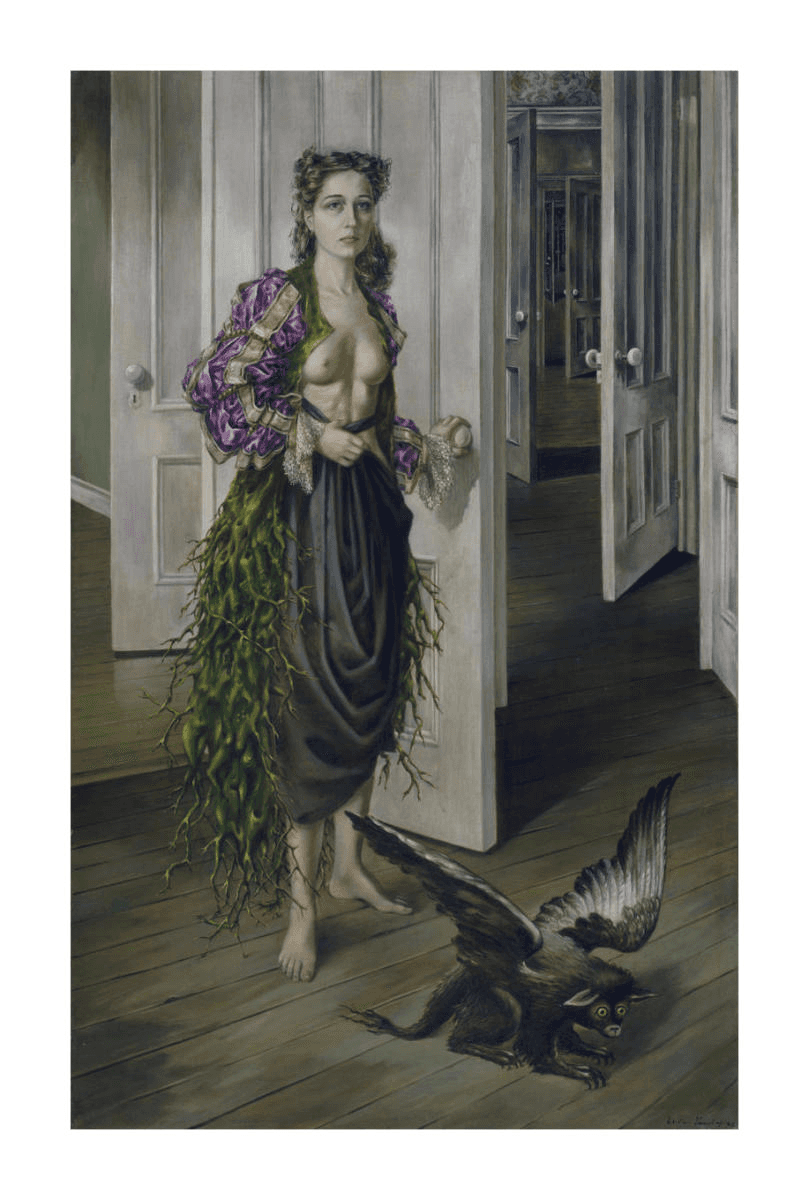
Birthday, 1942: she stands before an endless corridor of doors, wearing a torn skirt, legs exposed, a winged creature at her feet. A self-portrait, and an image of a woman’s situation in male cultural space: always a door, always another door behind it, never arriving, always in the corridor. Max Ernst saw this painting and fell in love with her (he was still married to Peggy Guggenheim). She later married Ernst, and for a long time was defined as “Ernst’s wife.” Her work only received full independent evaluation when she died at 101.
Leonora Carrington (1917–2011):
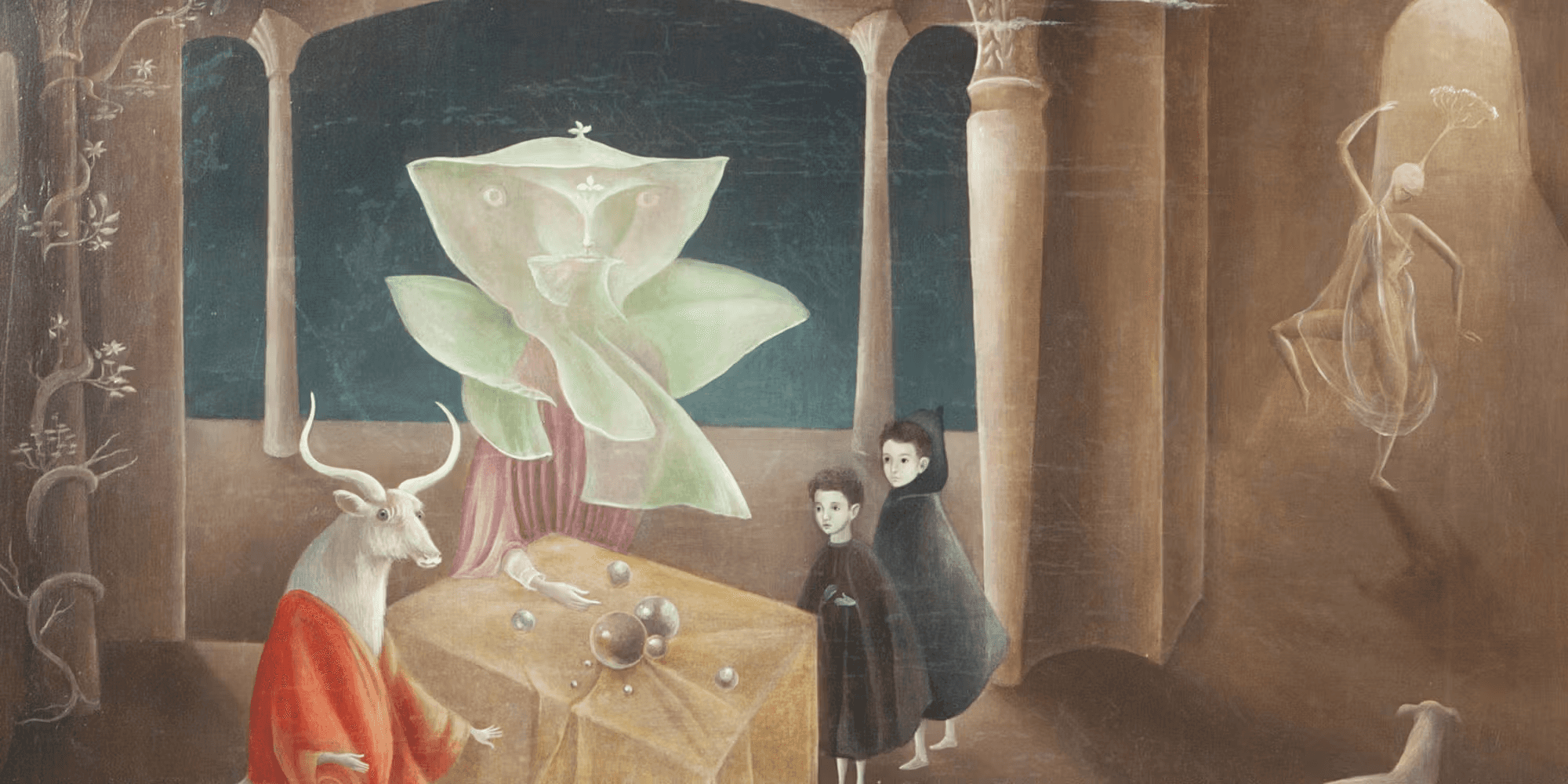
British, later moved to Mexico. The female Surrealist who most systematically developed her own distinct mythological world. Her pictures are full of alchemy, Hermeticism, Celtic mythology, and witch traditions — she took these “irrational” knowledge traditions as an alternative history of female wisdom, in resistance to male rationalism. Her relationship with Max Ernst: she was 19 when she and Ernst (then 47) were together. When Ernst was interned by the Nazis, she collapsed in France, was sent to a psychiatric institution in Spain, and received insulin shock treatment. She later wrote this experience into the novel Down Below — one of the most important female narratives in all of Surrealist literature. After fleeing to Mexico, she and fellow Surrealist artist Remedios Varo became close friends and creative partners.
Remedios Varo (1908–1963):
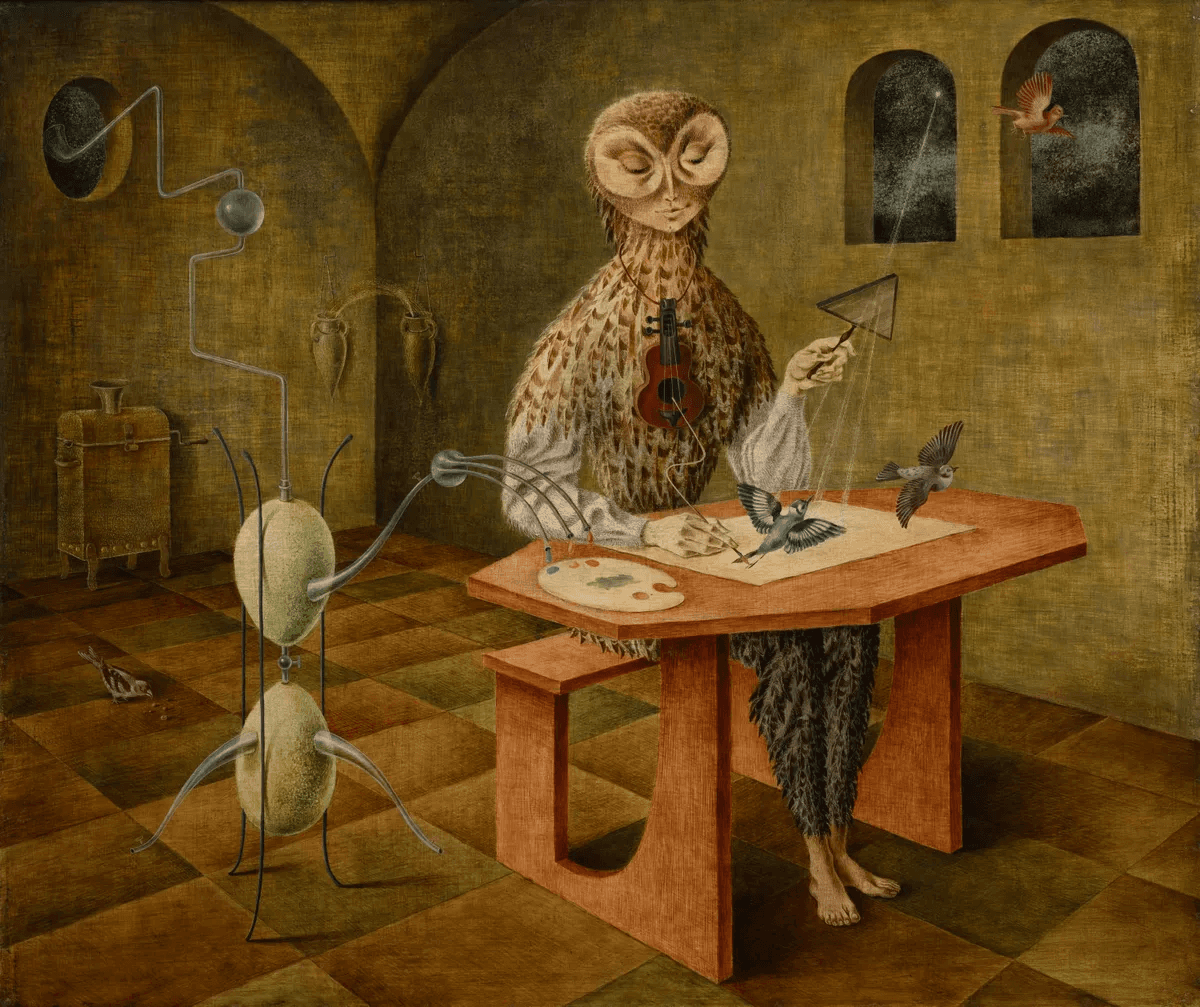
Spanish, also in exile in Mexico. Her pictures are precise, jewel-like — extremely fine lines, meticulous detail, imagery full of travel, alchemy, and cosmic exploration. Her figures are usually women traveling alone, crossing mysterious spaces in strange vessels. This is not the male Surrealist’s gazed-upon, eroticized female figure — it is an active, exploring, self-determining woman traveling independently through a universe of mystery. She and Carrington lived near each other in Mexico City, frequently shared meals, and exchanged ideas on their work. This creative friendship between female artists is almost entirely invisible in the male-dominated narrative of Surrealism.
Surrealism and Cinema
Luis Buñuel (1900–1983):
The director who most thoroughly translated Surrealism into cinematic language, and one of the most important directors of the entire twentieth century.
Un Chien Andalou, 1929 (with Dalí): The opening — a cloud crosses the moon, immediately followed by a close-up of a razor cutting through an eye — a real cow’s eye, cut open. This edit is pure Surrealist logic: forcing the viewer to look, while simultaneously attacking the act of looking in the most extreme possible way. The entire film has no linear narrative, no causal logic — only disturbing juxtapositions of images: a severed hand, ants emerging from a wound, a man dragging two grand pianos (with dead donkeys and priests tied to them). The editing logic of this film: every new shot must cause the narrative expectation set up by the previous shot to fail. You think you know what’s coming — then something completely different arrives. This logic causes the viewer’s rational expectation system to collapse repeatedly, forcing them into a perceptual state approaching dream.
L’Age d’Or, 1930: More overtly political — a direct attack on the Catholic Church and bourgeois morality. The French government banned it; right-wing groups stormed the screening venue and destroyed the exhibition.
Mexico and France (1940s–1970s): He left Spain (under Franco’s dictatorship) and spent his middle creative period in Mexico, then completed his most important late works in France. Viridiana (1961): a devout nun destroyed by reality; a Last Supper scene re-enacted by beggars, followed by chaos and sex. Won the Palme d’Or at Cannes; simultaneously condemned by the Vatican and the Franco government.
The Exterminating Angel (1962): a group of upper-class dinner guests discover after dinner that they cannot leave the room — no apparent reason, no external force, but they simply cannot walk out the door. Civilization gradually collapses in the enclosure.
The Discreet Charm of the Bourgeoisie (1972): six people attempt repeatedly to dine together; each attempt is interrupted by something different. Absurdist repetition, total deconstruction of middle-class ritual.
Buñuel’s contribution to cinematic language: he proved that Surrealism is not just a visual style but a narrative logic — a way of accessing the unconscious by breaking causality, breaking expectation, breaking linear time. His influence is clearly visible in David Lynch, Almodóvar, Pasolini, and Fellini.
Surrealism and Colonialism
This is the least discussed but most important problem within the movement. The Surrealists had a powerful fascination with “primitive” cultures (African, Oceanic, Latin American indigenous) — they believed these cultures had not been contaminated by Western rationalism and were closer to the truth of the unconscious. Breton collected African masks and Native American objects, displayed them in his studio, and called them “Surrealist objects” — completely divorced from their context and meaning within their original cultures.
On one hand: Surrealism was one of the first Western art movements to systematically oppose European colonialism. In 1925, the Surrealists collectively signed a manifesto opposing France’s colonial war in Morocco. On the other hand: their fascination with “primitive” cultures was itself colonial — abstracting real cultures and peoples into symbols of “an uncorrupted natural state” is another form of objectification. This is the Surrealist version of the same problem as Picasso’s borrowing from African sculpture.
Surrealism’s Political Trajectory
Breton was a supporter of Trotsky and visited the exiled Trotsky in Mexico in 1938; the two jointly signed the Manifesto for an Independent Revolutionary Art: art must be completely free, answerable to no political authority — including revolutionary governments. This caused a complete break between Surrealism and the Stalinist Communist Party — the Soviet Union demanded Socialist Realism, and Surrealism refused any political control over art. Simultaneously, they were in total opposition to fascism — Surrealism’s anti-rationalism, anti-nationalism, support for female liberation, and embrace of sexual minorities put it in direct conflict with every core fascist value. Surrealism’s unique political position: anti-Stalin, anti-fascist, anti-capitalist, in favor of revolution but refusing revolution’s control over art. This position kept it under attack from every direction, but also preserved a certain moral integrity.
Surrealism’s Legacy
On art: Abstract Expressionism — Pollock encountered exiled Surrealists in New York in his early years, and his “action painting” was partly a visualization of automatic writing. Pop Art — Surrealism’s defamiliarizing juxtaposition logic entered Pop’s deconstruction of advertising imagery. Contemporary installation art — Surrealism’s recontextualization of objects and dramatic use of exhibition space leads directly to the installation art tradition.
On cinema: Buñuel’s direct lineage; David Lynch; Fellini (8½‘s dream structure); Almodóvar’s gender politics; Hollywood horror’s dream logic (A Nightmare on Elm Street‘s unconscious monsters).
On advertising and design: Surrealist visual language was heavily borrowed by the advertising industry — defamiliarizing juxtaposition, illogical scenarios, the direct visualization of desire and fear. This is Surrealism’s most thorough commercialization, and its widest point of contact with twentieth-century visual culture as a whole.
On literature: Magical Realism — García Márquez, Vargas Llosa, Borges have complex relationships with Surrealism, but Surrealism was an important resource encountered by Latin American writers in exile in Paris, and its questioning of reality’s boundaries was absorbed into the Latin American literary tradition.🖼️
为什么超现实主义存在
达达说:意义是谎言,什么都不是真实的。超现实主义说:等等,有一个比我们意识到的现实更真实的现实,它就在我们的下面,在梦里,在潜意识里,在被压抑的欲望和恐惧里。这是一个根本性的转向:从达达的虚无,到超现实主义对更深层真实的追寻。弗洛伊德1900年出版《梦的解析》,1905年出版《性学三论》。他的核心主张是人类行为的真正驱动力不是理性意识,是潜意识——那个被文明、道德、社会规范压抑下去的层面,充满了欲望、死亡本能、童年创伤、被禁止的冲动。超现实主义者读了弗洛伊德,得出结论:如果潜意识是更真实的现实,那艺术应该直接来自潜意识,不经过理性的过滤。绕过理性控制,让潜意识直接流出,通过自动书写、梦境记录、催眠、偶然游戏、自由联想。
《超现实主义宣言》1924
安德烈·布勒东 André Breton(1896-1966) 是运动的创始人和教皇。他的定义:“超现实主义,名词,阳性。纯粹的心理自动主义,通过它,人们试图用语言、书写或其他任何方式来表达思想的真实运作。思想的口述,不受理性的任何控制,脱离一切审美或道德的关注。” 布勒东是一个极权式的运动领袖。他制定规则,他开除成员,他决定谁是真正的超现实主义者。他开除了达利(太商业化),开除了阿拉贡(太忠于斯大林),和查拉公开决裂,和几乎所有人都有过冲突。一个宣扬解放潜意识、打破一切压抑的运动,被一个控制欲极强的领袖管理,而这个领袖对女性的态度和他声称要解放的那个文明没有什么根本区别。
布勒东对女性的态度:在他的理论里,女性是男性艺术家通往神秘和潜意识的门——她是灵感,是缪斯,是”神奇女性”(la femme fatale)。她是对象,不是主体。运动里的男性艺术家大量画女性身体——被分解的、被凝视的、被欲望化的女性身体。这和他们声称要打破的维多利亚时代的性别压抑,在结构上是同一件事,只是方向反了:维多利亚时代把女性性欲压抑,超现实主义把女性性欲展示——但两者都没有问女性自己想要什么。
核心技术
自动书写(Automatic Writing):不经过意识控制,让笔在纸上移动,写下任何浮现的东西。不修改,不审查,不判断。目的是让潜意识直接说话。布勒东和苏波在1919年共同实验自动书写,出版了《磁场》,被认为是第一部超现实主义文学作品。
梦境记录:超现实主义者系统性地记录梦境,把梦境图像直接转化为画面。达利的方法最极端——他坐在椅子上,拿着一把勺子,在快要入睡的瞬间(催眠前状态),勺子掉落的声音会把他惊醒,他立刻把刚才看到的图像画下来。他相信这个边界状态产生最纯粹的潜意识图像。
机缘巧合游戏(Exquisite Corpse,精美尸体):多人游戏,第一个人在纸上画或写一些东西,折起来只留一点点边缘,传给下一个人,下一个人在不知道前面内容的情况下继续,以此类推。最后展开,看整体。这个游戏的名字来自第一次玩时产生的句子:”精美的尸体将喝新鲜的葡萄酒。”它产生的图像是不可能被单一理性意识设计出来的,正因为如此,超现实主义者认为这些偶然的组合揭示了某种更深的逻辑。
陌生化并置(Defamiliarization):把两个完全不相干的对象放在一起,让它们的并置制造一种新的、令人不安的感知。洛特雷阿蒙在19世纪的诗句被引用为超现实主义的先驱:”在解剖台上,缝纫机和雨伞的偶然相遇之美。”这和立体主义的多视点叠加不同,立体主义是认识论的,超现实主义是心理的。
核心艺术家
萨尔瓦多·达利 Salvador Dalí(1904-1989)
最著名,最复杂,最需要被批判性看待。他的技术是矛盾的:极度精细的学院派写实技巧,用来描绘完全不合逻辑的梦境场景。他叫这个”偏执狂批判方法”(Paranoiac-Critical Method):有意识地诱导一种类似偏执狂的感知状态,在现实里”看见”不存在的联系和图像,然后用极度写实的手法把它们画出来。用最理性的技术描绘最非理性的内容,这个矛盾是有意为之的,它制造了一种特殊的不适感:画面太真实,所以更令人不安。
《记忆的永恒》1931:加泰罗尼亚的海岸风景,他的故乡。一块木质平台,一棵枯树,三块融化的时钟,一个软塌塌的肉质形体(被另一块时钟压着),远处是悬崖。时间在梦里不是固定的、线性的。时钟是文明对时间的控制的象征,但在梦里,这个控制失效了,时间变得柔软、可塑、没有意义。他后来说,这个图像来自他看着一块卡门贝尔奶酪在阳光下融化的瞬间。他坐在那里,眼前出现了这个画面,两小时后完成这幅画。
《内战的预感》1936:同年,西班牙内战爆发。这幅画画于战争开始前几个月,一个巨大的人体自我撕裂,软组织和骨骼暴露,在荒凉的风景上。没有具体的政治信息,是一种纯粹的身体暴力的预感。
《象征性自画像》系列、《圣安东尼的诱惑》是他反复探索的主题:欲望、宗教、死亡、腐败。
达利是现代艺术史里最成功的自我品牌建造者之一。他的上翘胡须、他的怪异公开声明、他和加拉(他的妻子和终身缪斯)的关系、他的城堡、他在纽约和好莱坞的社交——这些都是有意识构建的公众形象。他说过:”唯一的区别是,我不疯,我只是疯狂。”布勒东最终把他开除出超现实主义运动,给他起了绰号”Avida Dollars”(”渴望美元”,他名字的字母重新排列)。这个批评有道理:达利后来确实变成了一个商业艺术家,为香水、巧克力、电视广告做设计。但讽刺在于:达利的商业化和超现实主义的核心逻辑并不完全矛盾。如果梦境和现实的边界可以消解,那高雅艺术和商业艺术的边界为什么不能消解?这个问题波普艺术后来用安迪·沃霍尔的方式回答了。
他为希区柯克的《爱德华大夫》(1945)设计了梦境场景,融化的钟、切断的眼球、扑克牌庄园。他和迪士尼合作了一部叫《命运》的动画短片,1946年开始制作,因为资金问题停止,2003年由迪士尼完成并发布。这是超现实主义和好莱坞最直接的接触之一。
勒内·马格利特 René Magritte(1898-1967)
超现实主义里最哲学性、最冷静、最没有达利那种戏剧性的艺术家。他画日常现实里的逻辑错误。他的画面是完全清晰的,每个细节都写实,但整体违反了某种基本的逻辑。
《图像的背叛》1929:一根写实的烟斗,下面写着:”Ceci n’est pas une pipe”(这不是烟斗)。这幅画是一个完整的哲学命题:画里的烟斗确实不是烟斗,你不能用它抽烟。它是颜料在画布上的组合,是”烟斗”这个概念的视觉再现,是一个符号,不是物体本身。这直接来自索绪尔的语言学,符号和它所指的事物之间没有自然联系,是任意的约定。”pipe”这个词和烟斗本身没有内在关系,”烟斗的图像”和烟斗本身也没有内在关系。马格利特把语言学理论变成了一幅画,让任何人都可以在三十秒内感受到这个哲学命题的力量。
《人之子》1964:一个穿着深色西装戴着圆顶礼帽的男人站在矮墙前,脸被一个绿色苹果完全遮住。他后来解释:被遮住的东西让我们对可见的东西更感兴趣。你看到苹果,但你知道苹果后面有一张脸,而你永远看不到它。这种被阻止的看的欲望,比看到本身更强烈。这也是一幅自画像,他反复画这个穿着西装戴圆顶礼帽的男人,那是他自己的形象。他把自己的脸遮住,把”艺术家”这个身份变成了一个谜。
《光明帝国》系列:白天的天空,夜晚的街道。同一幅画里,昼与夜同时存在。这在视觉上是平静的、几乎优美的,但在逻辑上是不可能的。马格利特的超现实主义不用梦境的扭曲和变形,用的是时间逻辑的悄悄失效。
他是所有超现实主义者里生活最”正常”的,住在布鲁塞尔的普通中产阶级街道上,每天规律工作,穿着整洁的西装,遛狗,打牌,过着无聊的日常生活。他说他不想让自己的生活有任何戏剧性,戏剧性应该留在画面里。他和妻子乔治特结婚,相爱一生。有一段短暂的与另一个女人的关系,很快结束,他回到乔治特。他从不把这些变成公开的神话。他年轻时经历了母亲的自杀。母亲投河,被发现时脸被睡衣包裹。有人说这解释了他画面里反复出现的被遮住的脸,但他本人拒绝这种简单的心理分析。
马克斯·恩斯特 Max Ernst(1891-1976)
他是达达和超现实主义之间最重要的桥梁,也是超现实主义里技术发明最多的艺术家。
拓印法:把纸放在粗糙表面涂擦,让随机纹理引发潜意识的图像联想。
刮擦法:在画布上涂满颜料,然后用刮刀刮去部分颜料,露出随机的纹理和图案,再从中”发现”图像。
这两种方法的共同逻辑:艺术家不是在创造图像,而是在从随机的物质过程里发现潜意识已经在那里的图像。
《被夜莺吓坏的两个孩子》1924:一幅画里嵌入了真实的三维元素——木制小屋、真实的门把手。画面描绘了两个在月光下被夜莺吓坏的孩子,但整个场景的规模是错误的,人物太小,建筑太大,月亮太近。这种规模错误制造了梦境特有的不合比例感。
《欧洲之后的雨》1940-42:他逃离纳粹法国后的作品,在美国完成。灰色的、充满碎片的风景,残破的形体。这不是达利那种明亮的、几乎愉悦的梦境,是一个文明废墟的图像。
他被纳粹德国征召,在一战战场上度过了他的青年时代,这个经历直接催生了他的达达立场。二战期间他在法国被关押,靠佩姬·古根海姆帮助逃到美国。他和佩姬·古根海姆结婚,后来又和艺术家多萝西亚·坦宁结婚,坦宁是超现实主义里最重要的女性艺术家之一,但长期被”恩斯特妻子”的标签遮蔽。
伊夫·唐吉 Yves Tanguy(1900-1955)
法国人,没有受过正式艺术训练,他说他在街上看到一幅德·基里科的画,当场决定成为画家。他的画面是完全一致的:一个无限延伸的荒漠或海床,散落着无法辨认的有机形体,既像石头,又像骨骼,又像某种深海生物,又像建筑废墟。没有地平线,没有规模参照,没有叙事。这不是地球上的任何地方,也不是任何梦境里的地方,它是一个纯粹的内心地理,一个心理状态的空间外化。他的画面有一种令人不安的寂静和永恒感,不像达利那样有戏剧性的变形,是一种更缓慢的、更彻底的陌生感。
胡安·米罗 Joan Miró(1893-1983)
加泰罗尼亚人(西班牙),超现实主义里最欢乐、最自由的视觉语言。他和达利是同乡,但气质完全不同。达利的画面是压抑的、性欲的、焦虑的;米罗的画面是游戏的、本能的、几乎儿童化的。他说他想”暗杀绘画”,不是达达那种虚无主义的消灭,而是把绘画还原到它最原始的状态,在任何文化规范形成之前,在儿童学会”正确画法”之前,在画家被训练成画家之前的那种自由的图像制作。他的视觉语言是有机的、流动的形状,介于抽象和具象之间,可以读成眼睛、月亮、女人、鸟、星星,但没有固定的解读。明亮的原色(红、黄、蓝、黑)。线条是细的、有弹性的,像活的生物。画面有一种持续运动的感觉,好像所有元素都在慢慢漂浮。
《农场》1921-22:他最早期的重要作品,在进入超现实主义之前,加泰罗尼亚的农场,极度精细地描绘每一个细节,一棵树、一头驴、一只狗、一桶水,但整体是平面化的、不合透视的,像一个儿童的百科全书图画。厄内斯特·海明威买了这幅画,说他愿意把自己任何拥有的东西换来它。
《星座》系列1940-41:他在法国沦陷、逃难到马约卡岛期间创作的一组作品。小幅,用水彩和水粉,密集的线条和形状布满画面,像一张宇宙地图,又像一个密码系统。这是他最重要的系列,也是他在最黑暗的历史时刻里找到的一种内心秩序的视觉语言。
保罗·德尔沃 Paul Delvaux(1897-1994)
比利时人,经常和马格利特一起被提及,但风格完全不同。
他的画面包括夜晚的希腊神庙,月光,火把,裸体女性在其中游走,她们的眼神空洞,方向不同,互不相视,像梦游者。男性人物(如果有的话)通常穿着西装,和裸体女性的并置制造一种奇特的阶级和性别张力。他的画面有一种深层的孤独感,所有人物都在同一个空间里,但彼此完全隔绝,无法沟通。这是一种关于现代人孤立处境的视觉隐喻,用古典神庙和裸体女性的表面来包裹。
超现实主义的女性艺术家
弗里达·卡洛 Frida Kahlo(1907-1954)
她拒绝”超现实主义者”标签,”我不画梦,我画我的现实。”她的方法和超现实主义男性艺术家根本不同:他们从潜意识逃向梦境,她从身体的痛苦直接看见现实。她的画是字面的,不是象征的,流产的胎儿、破碎的脊椎、出轨的丈夫,这些不是梦境意象,是文字记录。
梅雷特·奥本海姆 Meret Oppenheim(1913-1985)
《物件(皮草早餐)》1936:用中国瞪羚毛皮覆盖的茶杯、茶托和茶匙。毛皮是动物性的、感官的、性的;茶杯是文明的、家庭的、女性化的礼仪器具。两者的并置制造深层不适,使用这个茶杯意味着把毛皮放进嘴里,身体和文明之间的边界在口腔里消失。这件作品还有一个性别政治层面:茶杯是”女性的”器具,被动物性覆盖,是对”文明女性”这个概念的解构,还是对”女性是动物性存在”的强化?这个歧义是有意的。她26岁完成这件作品,MoMA立刻购买,她一夜成名。然后陷入十年创作危机,一夜成名把她固定在一个无法超越的早期作品上。她后来说:”不要把成功和自由混淆。”
多萝西亚·坦宁 Dorothea Tanning(1910-2012)
美国人。她的画面有一种特殊的女性视角的恐惧,不是外部的怪物,是内部的、家庭的、几乎不可见的威胁。
《生日》1942:她站在一条无尽的门的走廊前,穿着一件撕裂的裙子,露出腿,脚边有一只长着翅膀的奇怪生物。这是她的自画像,也是一个关于女性在男性文化空间里的处境的图像:永远有一扇门,门后面永远还有另一扇门,永远无法到达,永远在走廊里。马克斯·恩斯特看到这幅画,爱上了她(他当时还和佩姬·古根海姆结婚)。她后来和恩斯特结婚,在很长时间里被定义为”恩斯特的妻子”。直到她101岁去世,她的作品才获得充分的独立评价。
里奥诺拉·卡灵顿 Leonora Carrington(1917-2011)
英国人,后移居墨西哥。她是超现实主义里最系统性地发展出自己独特神话世界的女性艺术家。她的画面充满了炼金术、赫耳墨斯主义、凯尔特神话、女巫传统——她把这些”非理性”的知识传统作为女性智慧的另类历史,对抗男性理性主义。她和马克斯·恩斯特的关系:她19岁时和恩斯特(当时47岁)在一起,被他的前任妻子描述为”被偷走的”。恩斯特被纳粹关押,她在法国崩溃,被送进西班牙精神病院,接受胰岛素休克治疗。她后来把这段经历写成了小说《下面》,是整个超现实主义文学里最重要的女性叙事之一。她逃到墨西哥后,和另一位超现实主义女性艺术家雷梅迪奥斯·瓦罗成为亲密的朋友和创作伙伴。
雷梅迪奥斯·瓦罗 Remedios Varo(1908-1963)
西班牙人,同样流亡墨西哥。她的画面是精密的、宝石般的,极细的线条,精确的细节,画面里充满了旅行、炼金术、宇宙探索的意象。人物通常是独自旅行的女性,在奇异的载具里穿越神秘的空间。这不是男性超现实主义的那种被凝视的、被欲望化的女性形象,是主动行动的、探索的、具有主体性的女性,在一个充满神秘的宇宙里自主旅行。她和卡灵顿在墨西哥城住在附近,经常共进晚餐,互相交流创作。这段女性艺术家之间的创作友谊,在超现实主义的男性主导叙事里几乎完全不可见。
超现实主义与电影
路易斯·布努埃尔 Luis Buñuel(1900-1983):他是把超现实主义最彻底转化为电影语言的导演,也是整个20世纪最重要的导演之一。
《一条安达鲁狗》1929(与达利合作):
开场是月亮上划过一片云,紧接着是剃刀划过一只眼球的特写,真实的牛眼球被割开。这个剪辑是纯粹的超现实主义逻辑:强迫观众看,同时用最极端的方式攻击”看”这件事本身。整部电影没有线性叙事,没有因果逻辑,只有令人不安的图像并置:切断的手、蚂蚁从伤口爬出、男人拖着两架钢琴(钢琴上绑着两头死驴和两个神父)。这部电影的剪辑逻辑,是每一个新镜头都必须让前一个镜头的叙事预期失败。 你以为你知道接下来会发生什么,然后完全不同的东西出现了。这个逻辑让观众的理性预期系统不断崩溃,被迫进入一种接近梦境的感知状态。
《黄金时代》1930:政治化,直接攻击天主教和资产阶级道德。法国政府禁止了它,右翼团体冲进放映厅破坏展览。
墨西哥和法国时期(1940s-1970s),他离开西班牙(弗朗哥独裁),在墨西哥度过了创作中期,然后在法国完成了他最重要的晚期作品:
《维莉蒂亚娜》1961:一个虔诚的修女被现实粉碎,最后的晚餐的场景被乞丐重演,然后是混乱和性。获戛纳金棕榈奖,被梵蒂冈和弗朗哥政府同时谴责。
《泯灭天使》1962:一群上流社会的客人在晚餐后发现自己无法离开房间,原因不明,没有任何外部阻力,但他们就是无法走出那道门。文明在封闭里逐渐崩溃。
《资产阶级的审慎魅力》1972:六个人多次试图一起吃饭,每次都被各种打断。荒诞的重复,对中产阶级仪式的彻底解构。
布努埃尔对电影语言的贡献:
他证明了超现实主义不只是视觉风格,是一种叙事逻辑,一种通过打破因果、打破预期、打破线性时间来触及潜意识的方法。他的影响在大卫·林奇、阿莫多瓦、帕索里尼、费里尼的作品里清晰可见。
超现实主义与殖民主义
这是运动里最少被讨论但最重要的问题之一。超现实主义者对”原始”文化(非洲、大洋洲、拉丁美洲原住民)有强烈迷恋,他们认为这些文化未被西方理性污染,更接近潜意识的真实。布勒东收集非洲面具和美洲原住民文物,把它们陈列在工作室里,叫它们”超现实主义物件”,完全脱离了它们在原文化里的语境和意义。一方面, 超现实主义是最早系统性反对欧洲殖民主义的西方艺术运动之一。1925年,超现实主义者集体签署了反对法国殖民摩洛哥的宣言。另一方面, 他们对”原始”文化的迷恋本身是殖民性的,把真实的文化抽象成”未被污染的自然状态”的象征,是另一种客体化。这和毕加索对非洲雕塑的借用是同一个问题的超现实主义版本。
超现实主义的政治轨迹
布勒东是托洛茨基的支持者,1938年去墨西哥拜访流亡的托洛茨基,两人共同签署《独立革命艺术宣言》:艺术必须彻底自由,不服从任何政治权威,包括革命政权。这使超现实主义和斯大林主义共产党完全决裂,苏联要求社会主义现实主义,超现实主义拒绝任何对艺术的政治控制。同时,他们和法西斯也是完全的对立,超现实主义的反理性、反民族主义、支持女性解放、拥抱性少数,和法西斯的每一个核心价值都是正面冲突。超现实主义在政治上的独特位置:反斯大林,反法西斯,反资本主义,支持革命但拒绝革命对艺术的控制。 这个立场使它永远处于各方的攻击之下,但也使它在道德上保持了某种完整性。
超现实主义的遗产
对艺术的影响:
抽象表现主义:波洛克早期在纽约接触了流亡的超现实主义者,他的”行动绘画”部分来自自动书写的视觉化。
波普艺术:超现实主义的陌生化并置逻辑(把不相干的东西放在一起)进入了波普艺术的广告图像解构。
当代装置艺术:超现实主义对”物件”的重新语境化,对展览空间的戏剧性使用,直接导向了装置艺术传统。
对电影的影响:布努埃尔的直接传承;大卫·林奇;费里尼(《八部半》的梦境结构);阿莫多瓦的性别政治;好莱坞恐怖片的梦境逻辑(《猛鬼街》的潜意识怪物)。
对广告和设计的影响:超现实主义的视觉语言被广告业大量借用——陌生化并置、违反逻辑的场景、欲望和恐惧的直接视觉化。这是超现实主义最彻底的商业化,也是它和整个20世纪视觉文化最广泛的接触面。
对文学的影响:魔幻现实主义,马尔克斯、略萨、博尔赫斯和超现实主义的关系是复杂的,但超现实主义是拉丁美洲流亡作家在巴黎接触到的重要资源,它对”现实”边界的质疑被融入了拉丁美洲文学传统。
🖼️