Created on
Updated on
1405/ Seven Voyages
七下西洋

Preface: An alternative to the colonial age of exploration.
First Voyage · July 1405 – October 1407
July 1405 — Longjiang, Liujiagang, Changle. The fleet did not depart from a single port. It moved through a cascade of three staging points along the Yangtze and the southeast coast, each with a specific function.
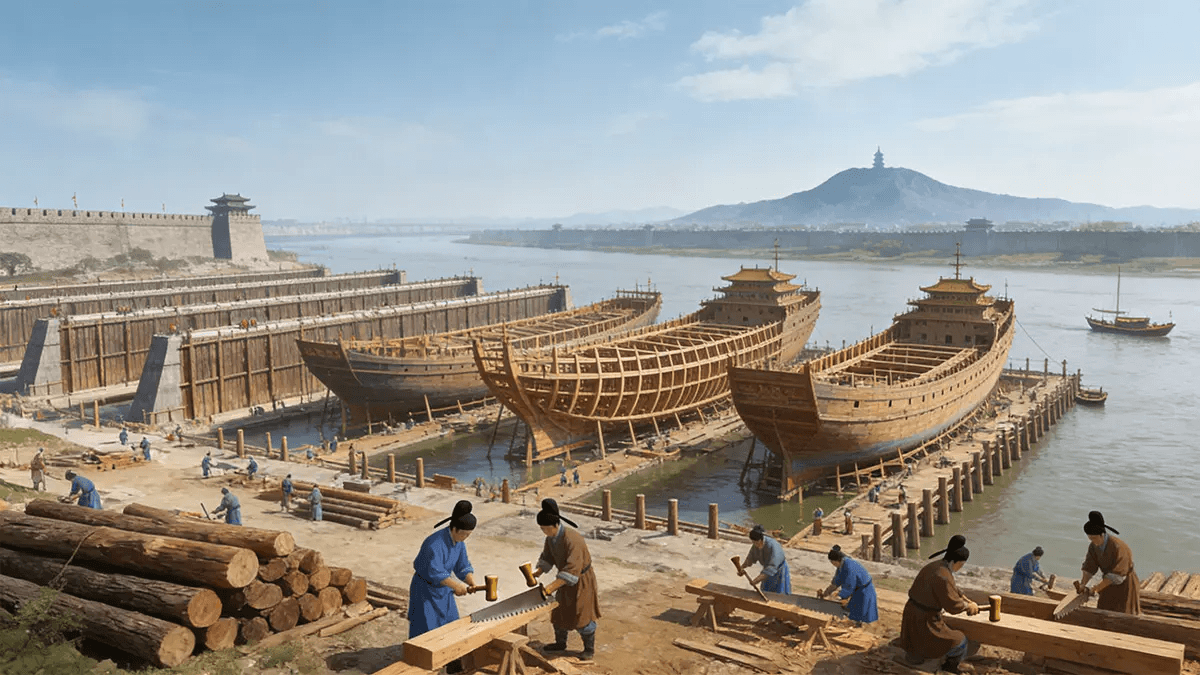
Construction had happened at Longjiang 龙江, the shipyards where the Qinhuai meets the Yangtze in Nanjing, over the previous two years. When the vessels were ready, they were floated down the Yangtze to Liujiagang 刘家港, the deep-water anchorage at the mouth of the river near modern Taicang, in Jiangsu. This is where the fleet was formally assembled. Zheng He held sacrifices to Tianfei 天妃 — the Divine Consort, the sea goddess whose cult would remain the ritual center of every voyage — at the Tianfei Palace at Liujiagang. On 11 July 1405, the fleet set out from Liujiagang. From there it worked its way down the coast to Changle 长乐 in Fujian, anchoring at Taiping Harbor and waiting through the autumn for the winter monsoon. The northeast winds arrived in December or January. Only then did the fleet actually put to sea, threading through the Wuhumen 五虎门 — the "Five Tigers Gate" at the mouth of the Min River — into open water.
There is this monsoon geometry structured every voyage that followed. The northeast winter monsoon carried you south and west, across the South China Sea, through the Malacca Strait, and out into the Indian Ocean. Six to eight months later, the southwest summer monsoon carried you back the same way. You did not choose the timing. The sky chose it. The staging cascade — Nanjing to Liujiagang to Changle to Wuhumen — was built around the wait. Somewhere between 250 and 317 ships, per the Ming Shi and the Veritable Records of the Ming Taizong. Both totals are defensible; the difference lies in whether supply vessels are counted alongside the combat and transport fleet. About 27,800 men aboard. The classes of ship, following the standard Ming naming:
The baochuan 宝船, the treasure ships — the flagship class, whatever their true dimensions turn out to have been.
The machuan 马船, horse ships, carrying cavalry mounts and provisions.
The liangchuan 粮船, grain ships.
The shuichuan 水船, water tankers, carrying fresh water for the fleet.
The zuochuan 坐船, troop transports.
The zhanchuan 战船, warships, small and fast, meant for combat.
The personnel included regular soldiers, officers, navigators, translators (many of them Muslim — Arabic and Persian were operational languages of the Indian Ocean), physicians, astronomers, cooks, cartographers, and merchants under state license. This was not a fleet. It was a floating city with a chain of command.
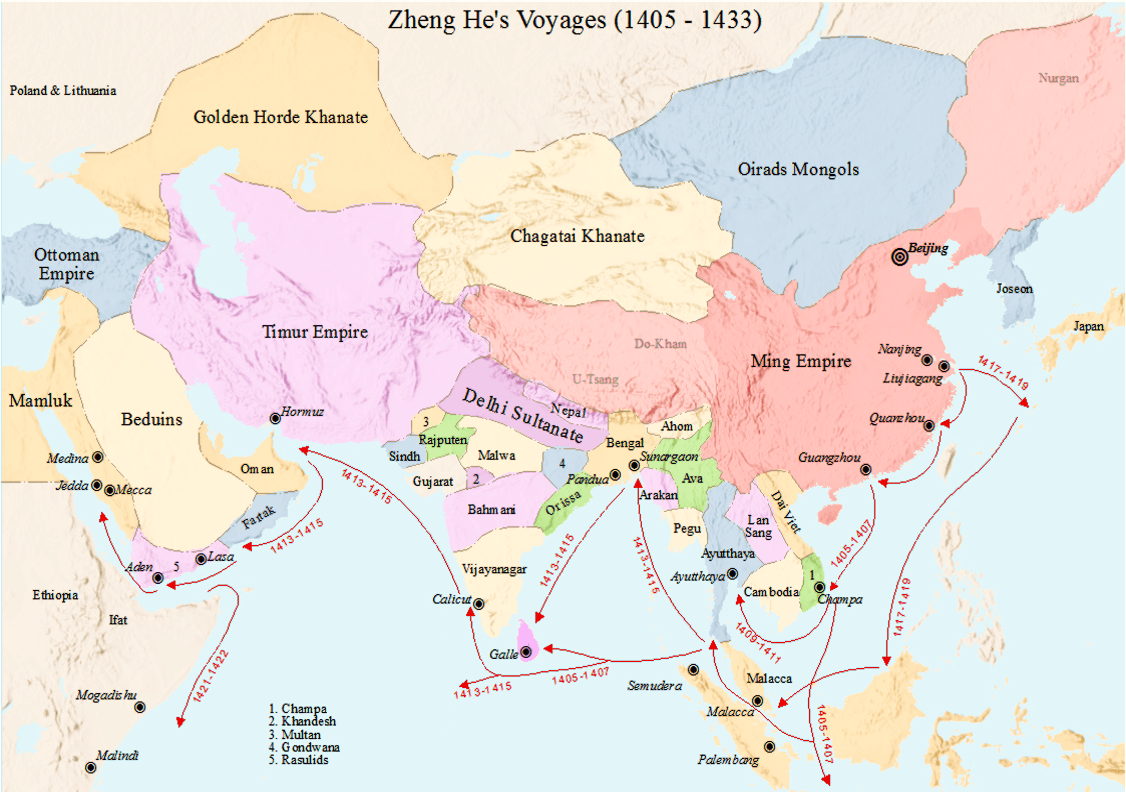
1406 — Champa, Java, Malacca, Sumatra. First landfall was Champa 占城, at the port of Qui Nhon on the central Vietnamese coast. This was standard for every subsequent voyage as well; Champa sat directly downwind of the winter monsoon out of Wuhumen, and the Ming had recently reasserted their tributary claim on the region. The fleet paused to take on supplies, present gifts, and demonstrate scale. From Champa the fleet worked south to Java, then west to Palembang 旧港 on the southern coast of Sumatra — the old capital of the Srivijaya thalassocracy, now a Chinese-pirate-controlled shadow port that would matter more on the return leg — then across the strait to Malacca 满剌加.
Malacca in 1406 was a very new city. Parameswara, a Srivijayan prince displaced by the Majapahit expansion, had founded it barely five years earlier. Zheng He's arrival treated it as a serious polity — established a warehouse, left a garrison detachment, and initiated the diplomatic relationship that would later formalize into Parameswara's investiture as King of Malacca on the second voyage. From this first contact forward, Malacca would function as the fleet's primary logistical hub in the South Seas for the next quarter century. From Malacca the fleet continued to the north coast of Sumatra — Semudera, near modern Banda Aceh — and then across the Bay of Bengal, past Ceylon, and around the southern tip of India to Calicut.
Calicut 古里, on the Malabar Coast of southwest India, was the objective of the first voyage. This was the premier pepper port of the Indian Ocean world — the destination Vasco da Gama would fight his way to ninety-two years later. Its ruler, the Samudri Raja — the "Zamorin" of European accounts — presided over a Hindu court with a large resident population of Muslim Arab and Gujarati merchants who ran most of the long-distance trade. Calicut in the early fifteenth century was already what Zheng He came looking for: a cosmopolitan hub inside an existing Indian Ocean trading system.
Zheng He formally invested the Samudri Raja with a silver seal and imperial titles. This was the Ming cefeng 册封 ritual — the emperor recognizing the foreign ruler, the foreign ruler acknowledging the emperor's ritual superiority, both parties conducting the exchange in the language of the tribute system. The fleet handed over silks, porcelain, gold. In return, envoys and gifts destined for Nanjing were loaded aboard. Zheng He erected a stele at Calicut, the westernmost inscribed marker of the voyage. Its central passage, as preserved in Ming sources:
"This country lies more than a hundred thousand li from China. Its people and things thrive, its custom lives at ease with ours. We inscribe this stone here to make it known through ten thousand generations."
It does not claim Chinese possession of Calicut. It does not describe the Samudri Raja as a subordinate. It reports distance, notes that the local society is functioning, and asserts a shared civilizational register — xihao tong feng 熙皞同风, "customs living at ease with ours." This is the language of a tributary relationship in the Ming vocabulary: mutual recognition inside a hierarchy the Ming considered self-evident. It is not the language of conquest.
On the return leg, the fleet stopped at Palembang. The stop was not incidental. A Cantonese pirate named Chen Zuyi 陈祖义 had made himself the effective ruler of the port over the previous several years, running a fleet estimated in Ming sources at around ten ships and several thousand men, and preying on merchant shipping in the Malacca Strait. He had disrupted the trade artery Zheng He's mission was built to reactivate. A local Chinese leader in Palembang — Shi Jinqing 施进卿, Hui Muslim, originally from Guangdong, a personal rival of Chen's — had informed Zheng He on the outbound leg about Chen's operations and delivered the details of a planned ambush.
Chen Zuyi feigned submission. He signaled his willingness to surrender to the Ming fleet, prepared a surprise attack, and had the plan betrayed by Shi Jinqing before he could execute it. In the battle that followed, Ming records report 5,000 of Chen's men killed, 10 ships burned, and 7 captured. The engagement was one-sided: the treasure fleet's disciplined formations and gunpowder weapons — fire lances, incendiary bombs, ceramic grenades — overwhelmed a pirate force built for opportunistic raiding, not naval combat against a state fleet. Chen was taken alive.
The fleet reached Nanjing on 2 October 1407. Chen Zuyi was brought before Yongle and publicly executed. The execution was diplomatic theater as much as it was punishment. Foreign envoys from Champa, Malacca, Calicut, and other polities were present at court to see what happened to a pirate who had disrupted the Ming trade routes. The message to every port the fleet had visited was: the trade artery is under Ming enforcement now.
Palembang was reorganized under Shi Jinqing. He was appointed Pacification Superintendent 宣慰使 — not king, since Palembang was still nominally under Majapahit sovereignty, but the ranking Ming-recognized authority in the port. This was the first time Ming China installed a proxy in Southeast Asia. The arrangement outlasted Shi Jinqing himself: after his death, his daughter Shi Erjie 施二姐 succeeded him and continued sending tribute missions to the Ming for years afterward. Malacca, elevated the following year, would follow this same template. The proxy model — take out the disruptive actor, install a friendly local, keep him inside the tribute system — became the operating pattern for the treasure voyages, and this first voyage established it.Yongle rewarded the participants heavily. Zheng He was given silver, silk, and titles. Within weeks, the emperor had already ordered the second voyage.
A staging cascade — Nanjing to Liujiagang to Changle to Wuhumen — synchronized to the monsoon calendar. A fleet composition — flagships, cavalry ships, grain ships, water tankers, warships — sized to project force at any port along the route. A diplomatic ritual — cefeng investiture, stele-cutting, exchange of envoys — that spoke the language of tribute rather than conquest. A military mode — overwhelming force against disruptors, capture of the leader, execution back at Nanjing before foreign witnesses — held in reserve for when the diplomatic mode failed. A proxy model — remove the uncooperative local, install a friendly one, keep him inside the tribute network — for reconstructing disrupted ports. All six subsequent voyages would run on this template. The next twenty-six years would extend its reach, refine its tools, and stretch its geography as far as Malindi and Aden and Mecca. They would not fundamentally change what the first voyage had built in twenty-seven months.
Second Voyage · 1407 – 1409
The first fleet reached Nanjing on 2 October 1407. On 5 October — three days — an order went out for another 249 sea transport ships to be refitted for a second voyage. It tells you something about how Yongle's court was already treating the treasure fleet program: not as an experiment that had succeeded, but as an ongoing operational system that needed to be kept in motion. The first voyage had brought back envoys from Calicut, Cochin, Champa, Java, Malacca, Semudera, Aden, and elsewhere. Those envoys now needed to be delivered home. A new voyage had to sail with the coming winter monsoon, which meant everything had to be ready by December.

On 23 October, Yongle issued the formal orders for the second voyage and, in the same edict, ordered the formal investiture of Parameswara 拜里迷苏剌 as King of Malacca. On 29 October, he distributed rewards to the officers and men of the first voyage. On the same day, he issued a demand for 60,000 taels of gold in compensation from Java for a killing that had happened during the outbound leg of the first voyage — West Javanese troops, in the middle of the Majapahit civil war between the western and eastern kings, had mistaken 170 members of Zheng He's landing party for reinforcements sent to the enemy side and killed them. The Ming response, according to Volume 59 of the Veritable Records of the Ming Taizong, was not military. It was a bill. The West Javanese king, Bhre Wirabhumi, had used those funds to prosecute his war against the eastern claimant; the Ming demand redirected the same funds into the imperial treasury and, in the process, defunded the war he was fighting. The Ming didn't land troops in Java. It sent an invoice. The invoice was enforceable because the treasure fleet was standing offshore.
The Veritable Records of the Ming Taizong — the imperial court's own record of Yongle's reign — collapsed the second and third voyages into a single continuous expedition. The Ming Shi 明史 of 1739 repeated the mistake. For centuries, standard Chinese historiography read voyages 2 and 3 as one voyage. What corrected the record was Zheng He's own hand: the stelae he raised at Liujiagang and Changle in 1431, before the seventh voyage, listed the previous six voyages by his own count and clearly separated the second (1407–1409) from the third (1409–1411). Modern scholarship now follows the stelae, not the imperial annals — because on this point Zheng He, writing in his own memorial, is a better source than the court archivists writing about him.
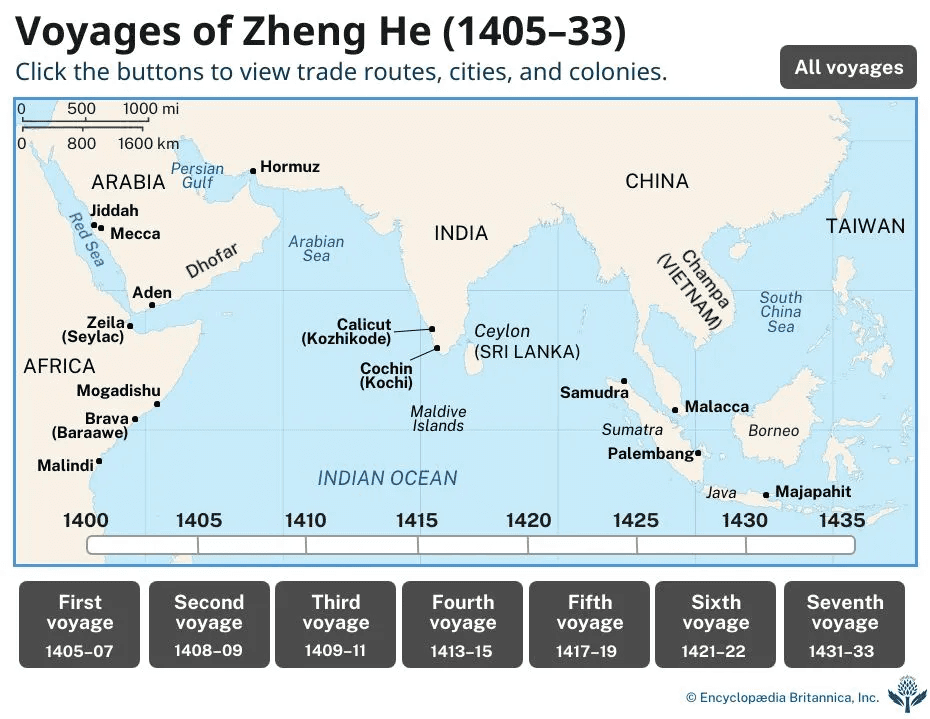
The consequence for us is that certain incidents traditionally attributed to the second voyage — the Ceylon clash with King Alakesvara, the abduction, the pardoning at court — actually belong to the third. Britannica still, as of writing, records the Alakesvara incident under the second voyage; it is following the older conflated tradition. Correcting this matters: without the separation, the second voyage looks like the violent one, and it wasn't.
Some Ming sources give the field command of the second voyage to his deputy, Wang Jinghong 王景弘, and place Zheng He in Nanjing for most of the interval, preparing the much larger third voyage. Louise Levathes reads him aboard. Edward Dreyer reserves judgment. The safest wording in any writing about this voyage is the passive one — "the second fleet sailed" — because the sources cannot bear the weight of a definitive statement. What is not in dispute is that whoever held field command reported to Zheng He, that the mission's brief was Zheng He's brief, and that the diplomatic outcomes credited to it are credited to him.
Yongle had given Zheng He an unusual instrument: blank scrolls pre-stamped with the imperial seal, which allowed the admiral to issue orders in the emperor's name from the deck of a ship six thousand miles from the palace. This was extraordinary delegation of authority — the sort of instrument usually reserved for frontier generals in active wartime. It meant that whether Zheng He himself was on the second voyage or not, the person who was on it was operating under Zheng He's authority, and Zheng He's authority was operating under Yongle's seal.
1408 — Siam, Java, Calicut. The fleet was smaller. The refit order specified 249 ships — down from the 250-plus of the first voyage, and stripped of the largest treasure ships, which stayed at Longjiang for maintenance and for the third voyage's build-out. It was still, in absolute terms, larger than any European fleet that would put to sea in the fifteenth century. The route added two new stops. Siam 暹罗 — the Ayutthaya kingdom in what is now Thailand — had a standing dispute with Malacca that would soon threaten the entire southern trade route. Zheng He's mission there was ambassadorial: to establish a working relationship with the Siamese court and, in the process, warn Ayutthaya off any move against Malacca. Popular memory in modern Thailand still refers to Zheng He as Sam Pao Kong — the Thai form of his eunuch nickname Sanbao — and preserves the visit as founding legend. The strategic effect at the time was that Malacca, which the fleet was on its way to formally invest, gained a protector before it had to face its most likely aggressor.
From Siam the fleet moved south to Java to collect the sixty thousand taels and then west across the strait toward Malacca. In Calicut, the fleet attended the investiture of a new Zamorin — the previous ruler had died, and Yongle had ordered the Ming to formally recognize the successor. Steles were erected at Cochin 柯枝 and, on the return leg, at Ceylon, declaring both kingdoms tributary states of the Ming. This was Ming diplomacy operating in an established mode: register the succession, extend imperial recognition, install a physical marker, load envoys for the return trip.
The most durable outcome of the second voyage was Malacca. Parameswara had founded the city as a refugee — a Srivijayan prince displaced by Majapahit expansion, effectively a warlord with a strategic port and no legal standing. The Ming investiture on the second voyage converted him from that into a legitimate sovereign. He received formal titles, a silver seal, and — critically — the guarantee of Ming protection against Siam. Ming records preserve the specific gifts: jade belts, saddles, hundreds of pieces of gold and silver, silks with dragon motifs, robes with gold thread woven through the sleeves. Later, in 1411, on the third voyage, Zheng He would bring Parameswara himself, along with his queen and 540 members of his court, to Nanjing for a personal audience with Yongle. By the time that entourage returned, Parameswara was, in every functional sense, a Ming client-king running the most important entrepôt between India and China.
In Malacca itself, the fleet built infrastructure. Zheng He constructed a walled warehouse complex known as the Guang Chang 官厂 — the "Official Establishment" — covering roughly ten acres. It held stores, gifts, and trade goods between voyages, functioned as a logistical staging post for detachments moving through the Malacca Strait, and gave the Ming a permanent physical presence on the ground. From the second voyage forward, every subsequent treasure voyage used Malacca as its primary logistical hub in the South Seas. For the next century, until Portuguese cannon took the city in 1511, Malacca would be a Ming-oriented port. Its founder would eventually adopt the name Sultan Iskandar Shah and convert to Islam, but the Ming relationship — the tribute missions, the diplomatic language, the cefeng framework — persisted intact across that religious change.
The fleet returned to Nanjing in the summer of 1409. The holds were full of tribute goods — spices, timber, copper, aromatics. Envoys from Malacca, Calicut, Cochin, Ceylon, Siam, and elsewhere were aboard for court audiences. Encyclopedia.com's summary of the second voyage, drawing on the Ming Shi, notes that the profits earned by the imperial government on this trip "more than justified" its cost. This is the only voyage of the seven for which such a statement can be made with any confidence, and even then only if the accounting excludes the underlying construction and mobilization costs that were already sunk. The finance minister Xia Yuanji, who would spend the next decade arguing that the voyages were a fiscal disaster, was already keeping a different set of books. The second voyage did not add new geography. It added no new lethal engagements. It produced no new stelae in radical new registers. What it did was demonstrate that the template established by the first voyage could be repeated on demand. The refit had taken three days to authorize and a winter to prepare. The mobilization system worked. The staging cascade worked. The monsoon calendar held. The tribute rituals rendered legitimate what had been improvised.Within weeks of the fleet's return, Yongle ordered the third voyage. By this point, no one at court was treating the treasure fleet as a novelty. It was infrastructure.
Third Voyage · October 1409 – July 1411
October 1409 — departure. The third fleet left Liujiagang in October 1409, wintered at Changle in Fujian, and put to sea in early 1410 through the Wuhumen. The staging cascade repeated. The monsoon geometry held. The route added two ports on the Malabar Coast. After the by-now-standard stops — Champa, Java, Palembang, Malacca, northern Sumatra — the fleet crossed to Ceylon and then, instead of moving directly to Calicut, worked its way up the southwest Indian coast through Quilon 小葛兰 (modern Kollam) and Cochin 柯枝 (modern Kochi) before reaching Calicut itself. These were the pepper ports south of Calicut, integrated into the same Arab and Gujarati trade network. The addition was diplomatic infill: bringing more Indian polities into the Ming tributary system, extending imperial recognition and the accompanying cefeng rituals to each successor king along the coast. Steles went up at Cochin and Ceylon declaring them Ming tributaries. Envoys were embarked for the return trip to Nanjing. The interesting event was on the way back through Ceylon.
Ceylon in 1410 — the situation. Alakesvara was a Tamil-origin usurper.The family — the Alagakkonara — had originally migrated to Ceylon from Tamil territory in south India, established themselves as feudatories under the Sinhalese Gampola kingdom, and risen through the wars against the northern Jaffna kingdom. Vira Alakesvara had come to power by ruling first through a puppet from the deposed Sinhalese royal dynasty, then in his own name after eliminating the pretense. When Zheng He arrived in Ceylon in 1410, the legitimate Sinhalese royal line was displaced but not extinguished, and there was a claimant with a plausible traditional pedigree: Prince Parakramabahu, of the house that would produce Parakramabahu VI.
There is a plausible reading, followed by Edward Dreyer in his 2007 monograph and by the Sinhalese historiographical tradition, that Parakramabahu VI or people acting on his behalf solicited Ming intervention to remove Alakesvara. This would explain the sharpness of the Ming response, which is otherwise disproportionate to any documented insult. It would also explain why the Chinese moved so decisively when the confrontation came. Alakesvara had already given Zheng He a reason to want him gone; on the first voyage back in 1406, according to some Ming accounts, Alakesvara had refused Zheng He permission to erect a Ming tablet on Sri Lankan soil and had driven the Chinese back to their ships in a brief skirmish. The trilingual stele the third fleet carried in its hold was, among other things, an object Alakesvara had personally blocked from being placed. Zheng He was going to place it.
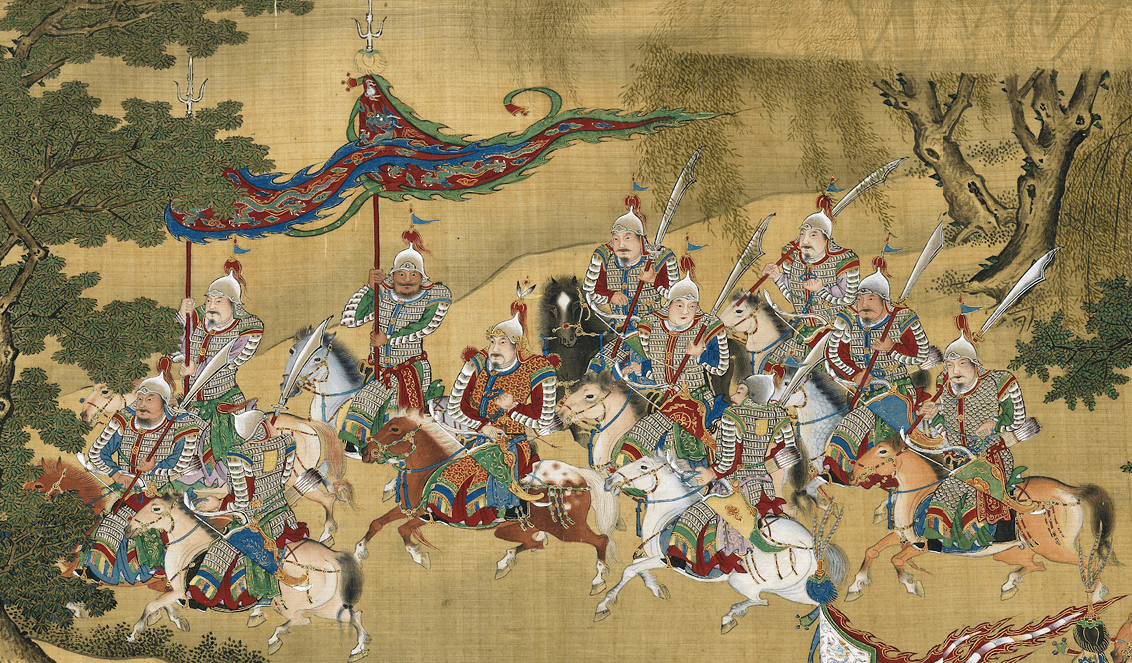
January 1411 — the Ming-Kotte War. The fleet anchored at Colombo, on the west coast. Zheng He and roughly two thousand of his marines moved inland — some sources say drawn by Alakesvara's own invitation, other sources say advancing on their own initiative — toward Kotte, the capital, ten miles east. The strategic bind was set once they were inland. Alakesvara moved his own army — estimated at fifty thousand — to seal the mountain passes behind them, cutting Zheng He off from the fleet and preparing to attack the ships stranded at Colombo. The Chinese detachment was outnumbered twenty-five to one and surrounded. Zheng He's response, as preserved in the Veritable Records of the Ming Taizong and quoted in the collected works of Yang Rong:
"The main body of the bandits has already come out, so the interior of the country must be empty."
He struck the capital. Two thousand men moved on Kotte itself and took the city. Alakesvara, his queen, his family, and the ranking officials were seized. The Sinhalese army marched back to relieve the capital and was defeated in a series of engagements outside its walls. Zheng He then fought his way back to the coast with his prisoners in tow, rejoined the fleet, and sailed. Some Ming accounts, and the later Grokipedia summary based on Sinhalese chronicle traditions, add one more item to the prisoner manifest: the Buddha's Tooth Relic — the Dalada — the most sacred object in Sinhalese Buddhism. Whether Zheng He actually seized the tooth is disputed and probably unlikely; the Tooth Relic had a well-documented custody chain that does not include a Chinese interregnum. But the report is worth naming because it captures how the seizure was remembered in the region: as an act that reached past political sovereignty into religious sovereignty.
6 July 1411 — Nanjing. The fleet reached Nanjing on 6 July 1411. Alakesvara and his family were presented to Yongle at court. The emperor did not execute them. He did not humiliate them publicly. He staged what was, in the vocabulary of the Ming court, a pardon — accepting the captured king's submission, sparing his life, and declaring that the disruption of the treasure fleet had been fully redressed. He then requested the Ministry of Rites 礼部 to recommend a new king of Ceylon. According to the record preserved in the Ming Shi, the Sinhalese envoys present at the Ming court nominated Parakramabahu VI. Yongle confirmed the nomination. A Ming embassy was dispatched to Ceylon to install him.
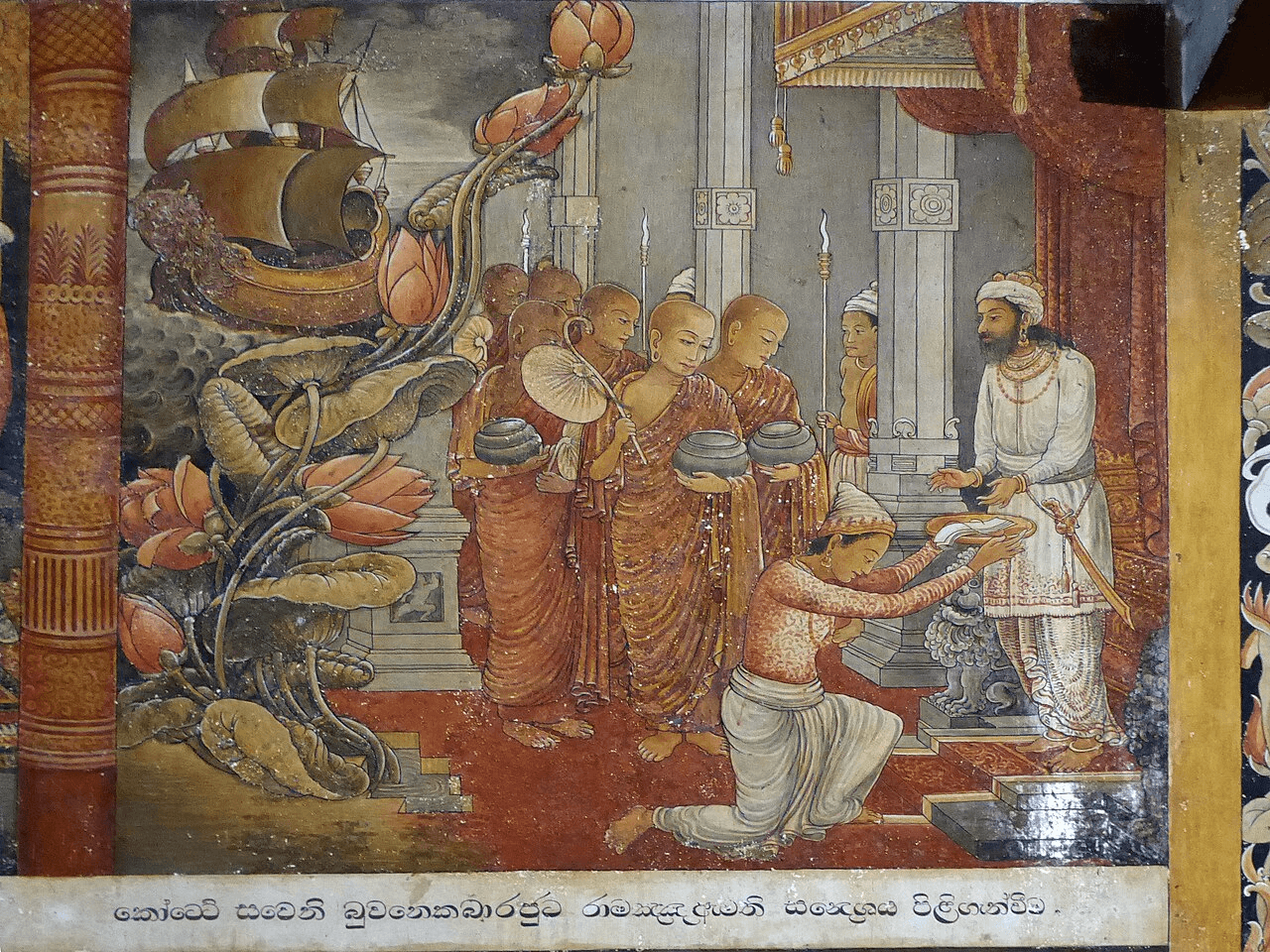
By the time that embassy arrived, the previous Sinhalese dynasty had already re-established itself on the ground in Kotte, and Parakramabahu VI was already the effective ruler. The Ming ratification was, functionally, an endorsement of a fait accompli — but the endorsement carried the weight of imperial recognition and the security guarantee that came with it. Parakramabahu VI would go on to reunify Ceylon under Sinhalese rule, defeat the Jaffna kingdom in the north, and preside over what the Sinhalese chronicle tradition treats as a late golden age. He is remembered in Sri Lankan history as one of the last great Sinhalese kings. The Ming intervention did not create his reign, but it consolidated it, and no treasure voyage after this one ran into hostilities in Ceylon again. Alakesvara was returned home in 1414. By some accounts he was quickly killed by the restored Sinhalese court. By others he lived out his life in obscurity. The Ming record does not follow him.
The stele and the abduction happened on the same voyage. The same commander who carried three religions on one stone across the Indian Ocean also led two thousand marines overland to remove a king who had blocked the stone from being placed. The multi-religious recognition and the military intervention were not in tension. They were two operating modes of the same imperial project, and the project did not experience them as contradictory. In the standard tribute-system framing, where a foreign polity acknowledges Ming ritual superiority and continues to govern itself, the Ming responds with elaborate recognition — silk, gold, silver, offerings to whatever gods the port worships, steles that acknowledge the local religious order in its own languages. Where the tribute framework is refused — where a ruler blocks the stele, kills an envoy, disrupts a trade artery, or otherwise steps outside the ritual grammar — the Ming responds with overwhelming military force, capture of the offending ruler, transport back to Nanjing, and installation of a replacement drawn from a locally legitimate lineage.
It is not colonization. No Ming garrison was left behind in Kotte. No Ming administrator ran Ceylon after Parakramabahu VI's investiture. The tribute system did not extract resources on the Portuguese or Spanish model. The trilingual stele was not a claim of sovereignty — it was an acknowledgment of the religious order already in place. It is not pure diplomacy either. Two thousand marines took a capital. A king was seized. The Buddha's Tooth Relic was, according to at least some traditions, hauled away. A replacement dynasty was installed by imperial edict. The fleet returned to Nanjing in July 1411. Yongle rewarded the officers. Within months, planning had begun for a fourth voyage that would push, for the first time, past Calicut into the Persian Gulf. More on this soon. 🇨🇳