Created on
Updated on
1371 / Zheng He
郑和

Preface: An alternative to the colonial age of exploration.
July 1405, Longjiang Port, Nanjing, Ming Dynasty, China. Somewhere between two hundred and fifty and three hundred and seventeen ships lay along the Yangtze that summer, depending on which set of Ming records you count. Twenty-seven thousand eight hundred men were aboard. The flagship class — the baochuan 宝船, "treasure ships" — carried up to nine masts. Smaller vessels ran supplies, water, cavalry, and troops. At the head of the fleet stood a thirty-four-year-old Muslim eunuch from Yunnan named Zheng He (郑和), and the biography that had put him there was already unusual enough to be worth stating plainly.
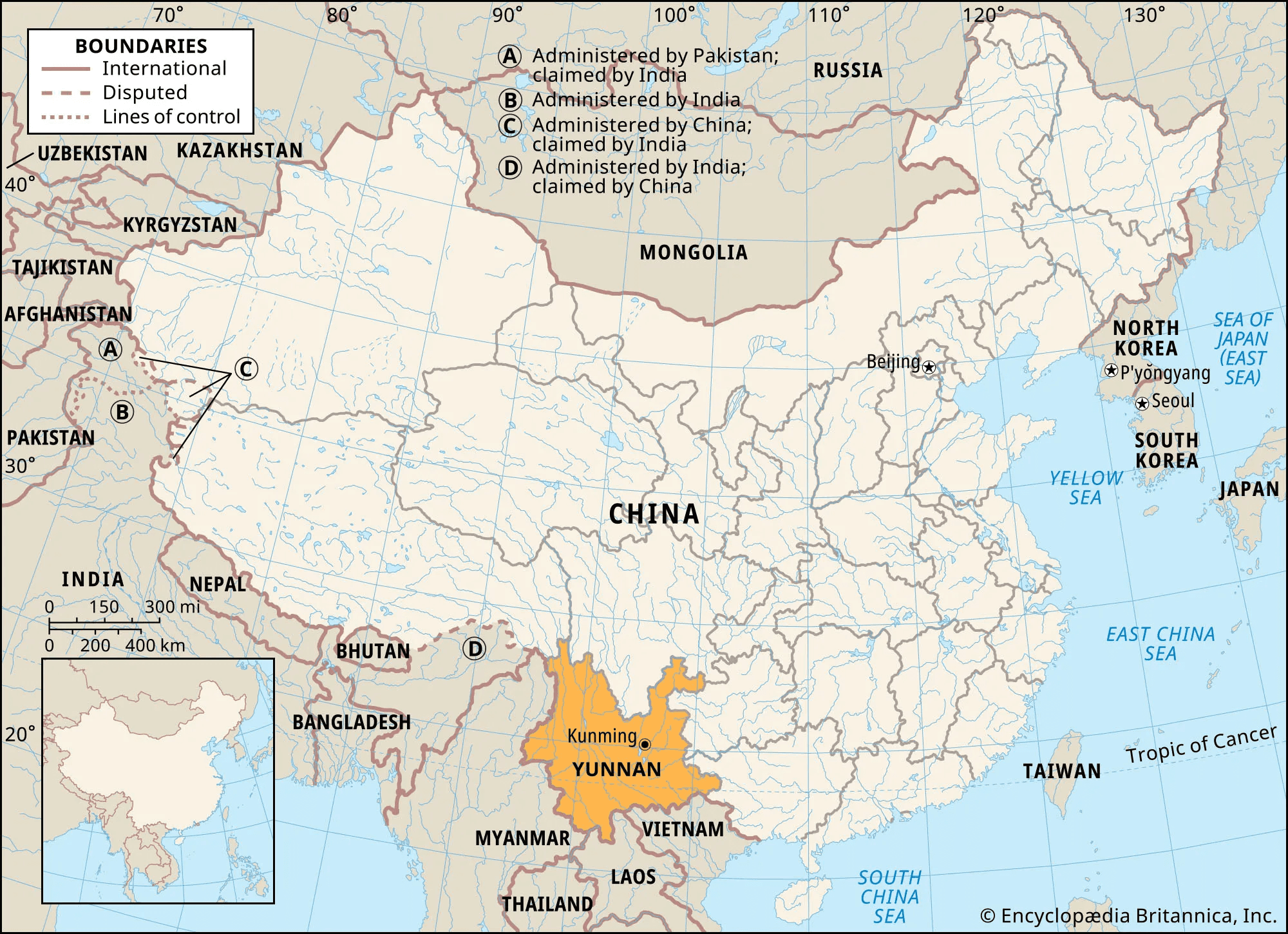
He was born Ma He in 1371 in Kunyang, near modern Kunming, into a Hui Muslim family that traced itself back six generations to Sayyid Ajjal Shams al-Din Omar, a Persian administrator from Bukhara who had governed Yunnan under the Mongols. His grandfather and his father both bore the title hajji, the honorific for a Muslim who had made the pilgrimage to Mecca. He grew up hearing about Arabia in Arabic before he spoke it in a public capacity. In the autumn of 1381, when he was around ten or eleven, a Ming army under General Fu Youde invaded Yunnan to break the last Mongol holdouts, and his father was killed in the fighting. His older brother buried the man outside Kunming. Ma He himself was taken north with a group of other captured boys, castrated en route, and delivered to the household of the fourth son of the Ming founder — Zhu Di, then Prince of Yan, later the Yongle Emperor.
He was raised inside that household. He was educated inside it — unusually for a Ming eunuch, since the Hongwu Emperor had ordered palace eunuchs kept illiterate, but the Prince of Yan operated far enough north to run his own establishment. He fought in the civil war that put his master on the throne between 1399 and 1402. On the day of the Chinese New Year of the second year of Yongle — 11 February 1404 — the new emperor gave him the surname Zheng and the rank of Grand Director of Palace Servants, the top position in the eunuch bureaucracy. Sixteen months later he was standing at the head of the largest fleet the world had ever seen. That summer in Portugal, Prince Henry — later called the Navigator — was eleven years old. Christopher Columbus would not be born for another forty-six years.
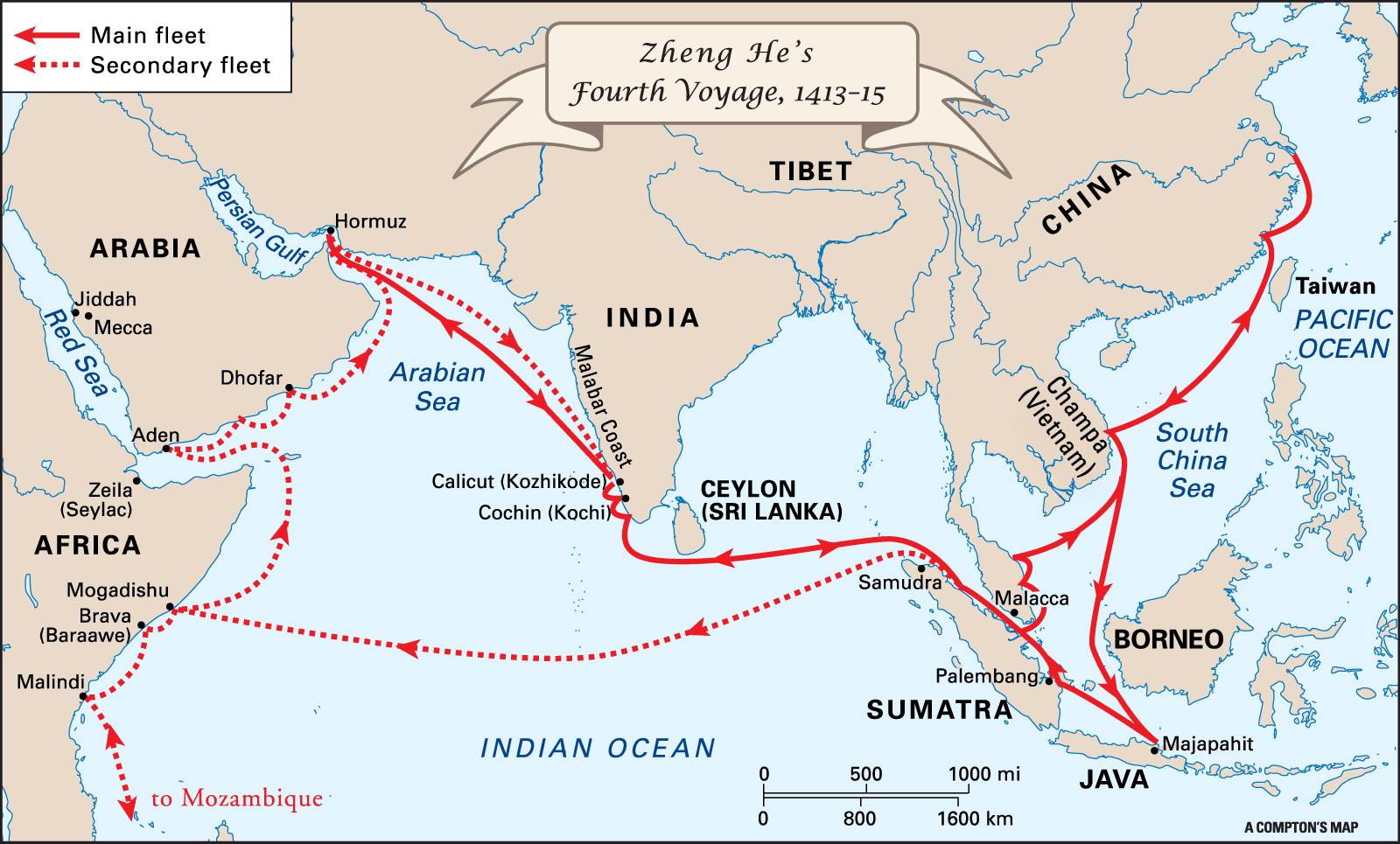
Zheng He's fleet would sail seven times between 1405 and 1433. It would reach the Persian Gulf, the Red Sea, and the East African coast as far south as Malindi in present-day Kenya. It would bring back giraffes, envoys, and captured kings. And then it would stop — abruptly, by choice, and while Zheng He himself was still alive — and China would begin dismantling the archives, ban the construction of oceangoing ships, and turn inland. By the time a Portuguese fleet under Vasco da Gama reached the Indian coast in 1498, the seas Zheng He had crossed had been effectively empty of Chinese state power for two generations.
In the world history textbooks some grew up reading, and in the ones still in use, Zheng He usually appears as a sidebar. A page and a half, sometimes two, wedged between the fall of Constantinople and Henry the Navigator's school of pilots at Sagres. The framing is almost always the same: China could have dominated the world, but chose not to; Europe, hungrier and poorer, went out and did it instead. History, on this account, was a race, and China stepped off the track. Everything after is the story of the people who stayed on it. This framing is not innocent. It presents European maritime expansion as historically necessary — as the inevitable next move for whoever was still willing to make it — and treats Zheng He as evidence that some civilizations simply lacked the will to become modern. The size of his fleets makes the point sharper: even with overwhelming material superiority, China withdrew. Therefore, the argument runs, the withdrawal must have been temperamental, cultural, or ideological. Confucian, insular, uncurious. Whatever word gets used, the function is the same. Zheng He becomes the cautionary tale that makes European expansion look like the natural response of a healthier civilization.
The Ships
In the 1950s, excavations at the site of the Longjiang shipyards in Nanjing — where the treasure fleet had been built under Yongle's direct order beginning in 1403 — pulled a wooden rudder post out of the ground. It was more than eleven meters long. If the standard proportions of a Chinese junk are applied to it, the ship it steered would have been enormous: possibly on the order of a hundred meters, possibly more.
The Ming Shi 明史, the official dynastic history compiled in the eighteenth century, gives the largest treasure ships as forty-four zhang 丈 long by eighteen zhang wide — roughly a hundred and thirty-seven meters by fifty-five. Joseph Needham, in Science and Civilisation in China, took the figure close to face value. Edward Dreyer, whose 2007 monograph is still the standard English-language military history of the voyages, cautiously accepted a comparable range. Others have not. Xin Yuan'ou, a naval architect at Shanghai Jiao Tong University, has argued on structural grounds that a wooden hull that large would have been impossible to keep watertight under ocean conditions. Sally K. Church, in a widely cited paper on the plausibility of 450-ft treasure ships, reached a similar conclusion: the plausible upper bound is closer to sixty or seventy meters, and the Ming Shi figures are probably later exaggerations.
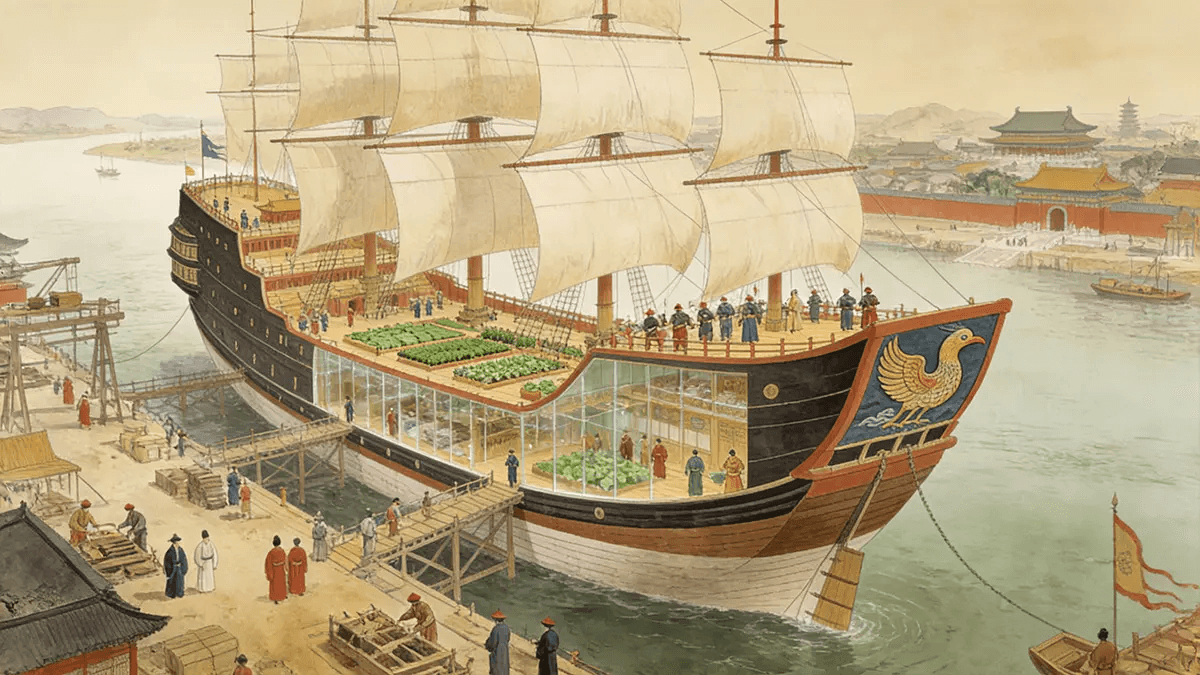
The debate has not been settled and probably will not be. What matters, for the purposes of this post, is that even the skeptics' number — a ship of sixty to seventy meters — is still three to four times the length of the Santa María, the largest vessel in Columbus's 1492 fleet, which the current scholarly consensus puts at around eighteen meters. Even at the low end of the possible range, Zheng He's flagships were the largest wooden ships anyone had built anywhere. Even at the low end, the fleet as a whole outweighed everything Portugal, Spain, and every other European kingdom combined could have put to sea for another century and a half.
"Peaceful" Ambassador
The opposite mistake, which is also common, is to romanticize Zheng He as a purely peaceful ambassador. This telling is often used, especially in Chinese state and popular media, as a moral contrast to European colonial violence. It is not entirely wrong — the difference between the treasure voyages and what the Portuguese would do in the Indian Ocean after 1498 is enormous and structural. Zheng He fought. Not incidentally, and not only in self-defense.
Palembang, 1407. On the return leg of the first voyage, the fleet stopped at Palembang on Sumatra, where a Cantonese pirate named Chen Zuyi 陈祖义 had made himself the effective ruler of the port. According to Ming sources, Chen feigned submission, planned an ambush, and was betrayed to Zheng He by a local Chinese informant named Shi Jinqing. In the battle that followed, Ming records report five thousand of Chen's men killed, ten ships burned, seven captured. Chen was taken alive to Nanjing and beheaded before the court. Shi Jinqing was installed as the new ruler of Palembang under Ming recognition.
Kotte, 1411. On the third voyage, the fleet landed at Galle in southern Sri Lanka. Before the trouble began, Zheng He erected a stone stele there in three languages — Chinese, Tamil, and Persian — with offerings to the Buddha, to the Hindu god Tenavarai Nayanar, and to Allah. That stele was rediscovered by a British engineer in 1911 and is now in the Colombo National Museum. It is the only physical trace of Zheng He that survives outside China. It matters here because it is evidence of a specific practice: the fleet arrived, acknowledged the existing religious order of the port, and left a permanent record of that acknowledgment. Then the same fleet, on the same voyage, marched roughly two thousand troops overland to the capital of the Kotte kingdom, took King Vira Alakesvara — Chinese sources call him Alagakkonara — captive along with his family, and brought them back to Nanjing. Yongle pardoned him, installed a pro-Ming successor in his place, and sent him home. The three-language stele and the abduction of the king were carried out by the same command in the same season.
Semudera, 1415. On the fourth voyage, the fleet intervened in a succession dispute in northern Sumatra. A claimant named Sekandar (蘇幹剌) had attacked the reigning king, who had recognized the Ming. Zheng He supported the king, defeated Sekandar's forces, took Sekandar to Nanjing, and had him executed.
The pattern is not incidental. It is the operating procedure. Where the tribute system met resistance, Zheng He converted it into a military problem and solved it — most often by removing the ruler, keeping him alive at the Ming court, and installing a replacement who would send envoys. And yet — this is the part the sidebar treatment cannot handle, and the part the pacifist myth cannot handle either — no colony was ever established. No plantation was planted. No population was enslaved and shipped. No mine was opened, no land was expropriated, no missionary was landed to convert the locals under threat. The kings taken to Nanjing were, with striking regularity, treated well at court and sent home. The purpose of the violence was to enforce recognition inside a chaogong 朝贡 tributary framework — a structure in which the Ming emperor claimed ritual superiority and the foreign ruler acknowledged it, exchanged gifts, and continued to govern his own kingdom. It was coercive. It was sometimes brutal. It was not colonial in the sense that would come to define the Atlantic world after 1500.
The Pseudohistory
Gavin Menzies, a retired British submarine officer with no formal training in history, published 1421: The Year China Discovered the World through Transworld in November 2002. Menzies's thesis was that between 1421 and 1423, squadrons of Zheng He's fleet had circled the globe — reaching the Americas seventy years before Columbus, Australia three centuries before Cook, Antarctica and Greenland along the way. The book claimed that Chinese cartographic knowledge had leaked into Portuguese hands and secretly powered the European Age of Discovery. It was a New York Times bestseller. A PBS documentary followed. A publishing empire — subsequent books extended the claim to a Chinese fleet sailing to Italy in 1434 and igniting the Renaissance — followed that.
The professional response was swift and unanimous. In June 2004, the historian Robert Finlay published a review of 1421 in the Journal of World History. His summary of the book: "The reasoning of 1421 is inexorably circular, its evidence spurious, its research derisory, its borrowings unacknowledged, its citations slipshod, and its assertions preposterous." Finlay walked through Menzies's misuse of sources page by page, showed that the "missing years" the theory depends on were nothing of the sort — Zheng He's fleet is well documented in Ming records for exactly the years Menzies claimed it was elsewhere — and concluded that the voyages described in 1421 never took place. Every serious historian working on the Ming maritime period has since either endorsed Finlay's assessment or declined to engage with Menzies at all. The book is pseudohistory. This is not a matter under discussion in the field.
But the fact that 1421 found the audience it did is worth thinking about. Menzies sold millions of copies to readers — many of them not academic, many of them Chinese diaspora, many of them simply people who had noticed that Zheng He was strangely small in the story they had been taught. The demand was real even where the supply was fraudulent. What Menzies gave those readers was a fantasy of vindication: the Chinese had done everything the Europeans had done, and more, and first. It was the sidebar's mirror image. Instead of erasing Zheng He, it inflated him to a size he was never meant to occupy. Both moves have the same underlying assumption — that global significance is measured by whether or not you got to the Americas.
1371 · 昆阳/ Kunyang, Yunnan
Kunyang Prefecture in Yunnan — modern Jinning, on the southern shore of Lake Dian. The Ma family. Ma He was the second son. He had an older brother, Wenming, and four sisters. On the surface this was an ordinary Muslim household in a frontier prefecture of the early Ming.
The Ma family traced its bloodline back six generations to a man who is rarely named in mainstream Chinese history but who effectively determined the shape of the Muslim community across the entire southwest: Sayyid Ajjal Shams al-Din Omar (赛典赤·瞻思丁). He was a Persian Muslim from Bukhara, in modern Uzbekistan, who submitted to the Mongols during their westward campaigns of the thirteenth century, entered the service of the Chinggisid family, and was eventually posted by Kublai Khan as pingzhang zhengshi 平章政事 — Grand Councillor — of Yunnan. He was the first person to establish a formal Yuan administration in the province. He died in office in 1279. His sons and grandsons continued to serve in Yunnan after him. The pattern of Hui Muslim settlement across the southwest that persists to this day begins with his tenure. Ma He descended from him in the sixth generation. The surname Ma — sinicized from Arabic Muhammad — passed down through the line of Sayyid Ajjal's fifth son, Masuh.
Both Ma He's grandfather and his father carried the title hajji 哈只 — the honorific for a Muslim who has completed the pilgrimage to Mecca. In the fourteenth century, the overland route from Yunnan to Mecca ran through the Western Regions, across Central Asia, through Persia. Thousands of miles each way. Round trips measured in years. This is not a journey a destitute family could undertake. The title carries an economic and social claim: the Ma family held land, held connections along the caravan routes, and moved inside a network of Muslim traders and clerics that stretched from Yunnan to the Hijaz. Ma Hajji himself was almost certainly literate, probably read Arabic, and passed down through the household an oral inheritance of geography, commerce, and religion from the Islamic world that most Chinese in the fourteenth century had no access to.
Zheng He grew up with working Arabic and with a working familiarity of Muslim ports and customs — hard operational knowledge, not symbolic capital. When his fleet reached Hormuz on the fourth voyage, Aden and Mogadishu on the fifth, the Arabian coast on the seventh, he was moving through territory his own family had already been describing to him for two generations. On the seventh voyage, a detachment sailed from Calicut to Mecca on a local vessel and completed the hajj — the first documented Chinese Muslims to do so under state auspices. That mission was possible because the network Zheng He personally belonged to made it possible.
1381 · 傅友德入滇/ Fu Youde Enters Yunnan
In the ninth month of the fourteenth year of Hongwu — autumn 1381 — a Ming army of three hundred thousand entered Yunnan. The commander was Fu Youde 傅友德. His deputies were Lan Yu 蓝玉 and Mu Ying 沐英. All three were old comrades from Zhu Yuanzhang's founding campaigns. Lan Yu was the younger brother-in-law of Chang Yuchun, one of the dynasty's founding generals. Mu Ying was Zhu Yuanzhang's own adopted son. This was an army setting out with the highest possible trust from the throne. Its objective was to eliminate the last Yuan holdout in the southwest: Basalawarmi 把匝剌瓦尔密, Prince of Liang, a direct descendant of Kublai Khan and the last standing symbol of Yuan legitimacy in southern China.
The campaign ran from that winter into the following spring. Encircled around Kunming, the Prince of Liang killed his entire household — he drove his wife and children into Lake Dian to drown, then walked in after them. Yunnan was pacified. The Ming framed this campaign as "sweeping away the last remnants of the Yuan barbarians." The actual consequence was that the entire mixed community of Muslims, Mongols, and semu 色目 peoples living across Yunnan — the Ma family among them — was pulled into a large-scale political purge.Ma Hajji died in this fighting, at around thirty-seven to thirty-nine years old. Whether he took up arms voluntarily, was conscripted into the Yuan defense, or was simply killed in the general slaughter is not settled. Louise Levathes, in When China Ruled the Seas, leans toward the first reading. Edward Dreyer's 2007 monograph reserves judgment. What is certain is that he died and that his oldest son, Ma Wenming, buried him outside Kunming. Twenty-four years later, in 1405, the man now known as Zheng He commissioned an epitaph for his father from Li Zhigang 李至刚, the Minister of Rites, and set the stone on the day of the Duanwu Festival — 1 June 1405. That stele is now housed at Zheng He Park in Jinning, Yunnan, and it is the most direct primary source we have on Zheng He's own background. Every family record that came after it is derivative.
That autumn, Ma He — around ten or eleven years old — was taken away by the Ming army. There is a scene attached to this moment that may be a later embellishment but is worth repeating: Fu Youde, riding along the road, saw the Yunnanese boy and asked him where the Prince of Liang had gone. Ma He is said to have answered, "He jumped into the lake" — the tone, in the received version, was defiant. Fu Youde took him prisoner. The reliability of this exchange is limited. What it reflects is how later generations chose to construct Zheng He as a figure: from the first moment, not a passive spoil of war, but someone who entered the victors' camp carrying hostility.
The Ma family was not extinguished by this campaign. Ma Wenming survived, remained in Yunnan, and continued the family's rites. More than twenty years later, he gave his own oldest son to his childless brother by adoption. That adopted son was named Zheng Enlai 郑恩来, and he became the founder of the Nanjing branch of the Zheng family. Zheng He was a eunuch, but his surname and his lineage have direct descendants in China to this day — over two hundred households, distributed mainly across Nanjing, Yunnan, and Thailand. Ma He himself, along with a group of other boys of the same age, was castrated somewhere on the road north and delivered — not to the imperial palace in Nanjing (Zhu Yuanzhang, the Hongwu Emperor, deeply distrusted eunuchs and had no shortage of them in his court) but to the Prince of Yan's residence in Beiping (modern Beijing), the household of Zhu Di. That assignment determined the trajectory of the next half-century of his life.
1382–1399 · 燕王府/ The Prince of Yan's Household
Beiping, where the Prince of Yan's residence stood, was the site of the former Yuan capital. When the Mongols retreated to the steppe, they left behind the city's foundations, its palace materials, its network of craftsmen, its military traditions. All of it was still there. Zhu Di held Beiping as an imperial prince, but in practice he commanded the most important piece of military ground in the northern Ming — the first defensive belt south of the Great Wall, facing the Mongols directly. Every winter and spring he took troops out to deal with raids from the Mongol remnants. The Prince of Yan's residence was not an ordinary princely household. It was a frontier military establishment.
Zhu Di's own character shaped the temperament of that establishment. He was raised in army camps. His father, Zhu Yuanzhang, held him in high regard but withheld the position of heir apparent from him, giving it instead to his soft-natured older brother, Zhu Biao. The knot that would define Zhu Di for the rest of his life — the conviction that he was the one who should have inherited — was tied here. He did not trust Confucian scholars. He did not trust civil officials. He preferred generals who could fight, monks and Daoists who could read omens, and eunuchs who could get things done. The Prince of Yan's household in Beiping filled up with people of that description.
On Ma He's specific military appointments during this period, the record is thin. What can be established is that he accompanied Zhu Di on campaigns against the Mongols. The best-documented instance was Zhu Di's northern expedition against Nayir Bukha around 1390, where Ma He rode along as a junior officer. The Ming Shi biography of Zheng He notes that he "was recognized for his talent as a commander" — meaning that his military ability had already been marked by Zhu Di by this stage. He was not a paper-pusher. He was a serving military officer who had been in real fights and led men.
His court name was "Sanbao" 三保. This was his eunuch nickname, not an office and not a private name — closer in register to "Third Young Master" or "Third Brother" in modern usage. When the treasure voyages later entered popular memory as Sanbao Taijian Xia Xiyang 三保太监下西洋, "Grand Eunuch Sanbao Sails to the Western Ocean," it was this nickname carried down through the vernacular. For twenty years, before he was given the surname Zheng, he was simply Sanbao.
The earliest surviving description of his appearance comes from a physiognomy record by Yuan Zhongche 袁忠彻. It reads: "Seven chi tall, waist ten spans around, four peaks of the face rising above a small nose, brows and eyes sharply drawn, ears white and set above the cheeks, teeth arrayed like strung shells, gait like a tiger's, voice booming like a bell." Seven chi by the Ming measure comes out to something over 1.9 meters. There is unavoidable exaggeration in the physiognomy genre, but the impression — tall, loud, capable of dominating a room — is one his contemporaries shared, and it is reliable. At Zhu Di's side he was not an invisible attendant. He was someone anyone walking into the same room noticed immediately.
1399–1402 · 靖难/ Jingnan Campaign
Zhu Yuanzhang died in June 1398. He had left the succession to Zhu Yunwen, the son of his own eldest son, Zhu Biao, who had predeceased him — the Jianwen Emperor. At this point Zhu Di was thirty-nine years old, the oldest surviving son of Zhu Yuanzhang and by a wide margin the one with the deepest military reserves. From Zhu Di's angle, the succession arrangement was the second time in his life his father had passed him over. The Jianwen Emperor began stripping the princely fiefs almost immediately. Between the last months of Hongwu and the first year of Jianwen — a stretch of ten months — five imperial uncles were removed from their titles on various pretexts, reduced to commoner status, or imprisoned. Three of them killed themselves. This was a political purge, and its target was the entire military aristocracy the founding emperor had installed as princes. By the time Zhu Di read the direction of the wind, Yao Guangxiao had already been telling him for years what a prince in his position should do.
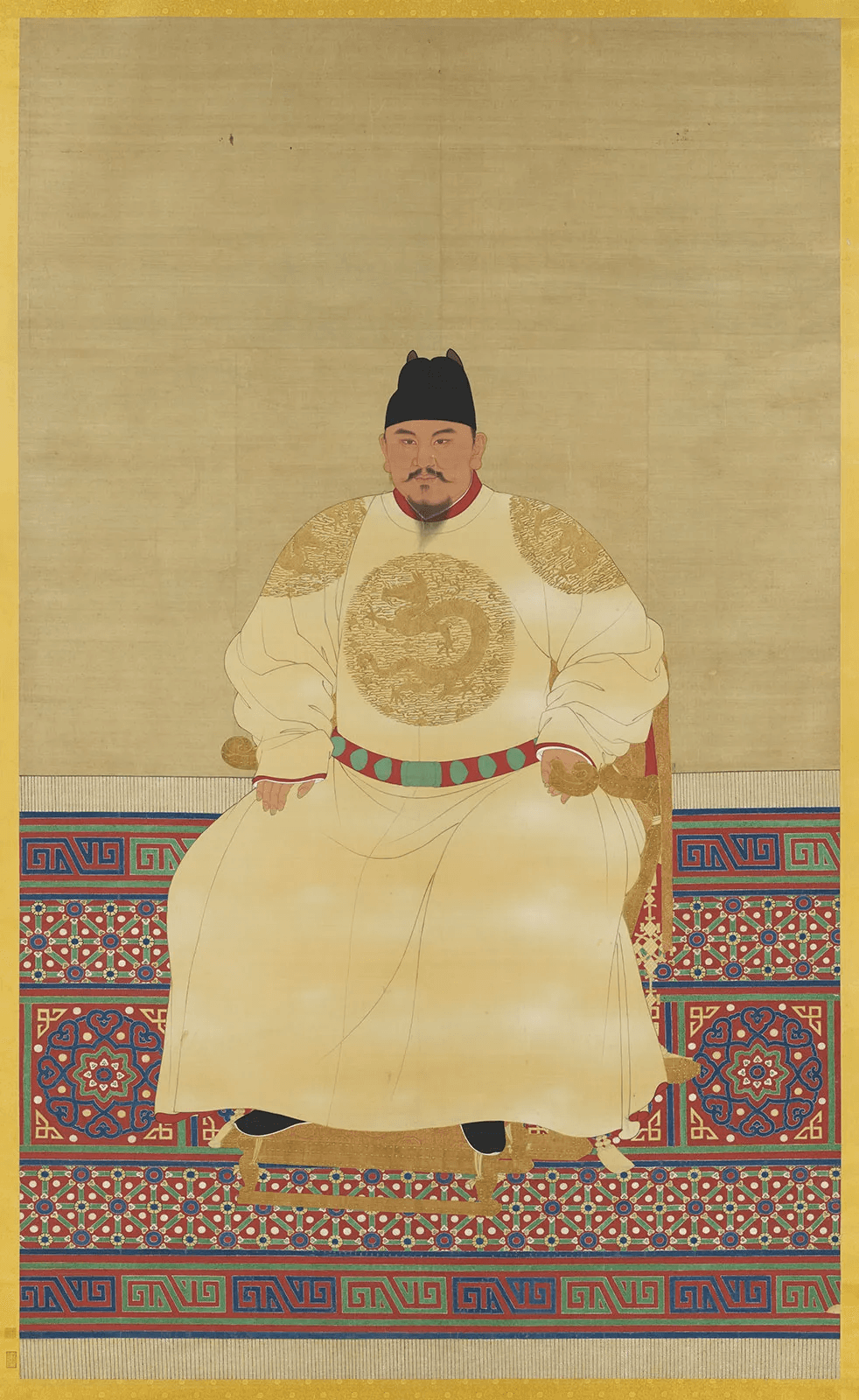
In the seventh month of 1399, Zhu Di raised troops on the pretext of "purging the emperor's evil advisors." This was the Jingnan Campaign 靖难之役. His formal targets were two Confucian scholars in Jianwen's inner circle — Qi Tai and Huang Zicheng — who were named as traitorous ministers who had to be removed. This was the standard formula for imperial rebellion going back to the Tang: you don't rebel against the emperor, you rebel against the people around him. Yao Guangxiao did two things in this war. First, before the uprising, he persuaded Zhu Di not to hesitate. Second, once the fighting began, he stayed in Beiping with Zhu Di's eldest son, Zhu Gaozhi — the future Hongxi Emperor — and held the home base through the several times the imperial army pushed north to try to take it. This was decisive. Zhu Di personally led the main force south more than once and came close to being wiped out more than once. Each time he could regroup because Beiping had not fallen. What Yao Guangxiao was doing in Beiping was, in effect, ensuring that a single lost battle would not end Zhu Di's rebellion.
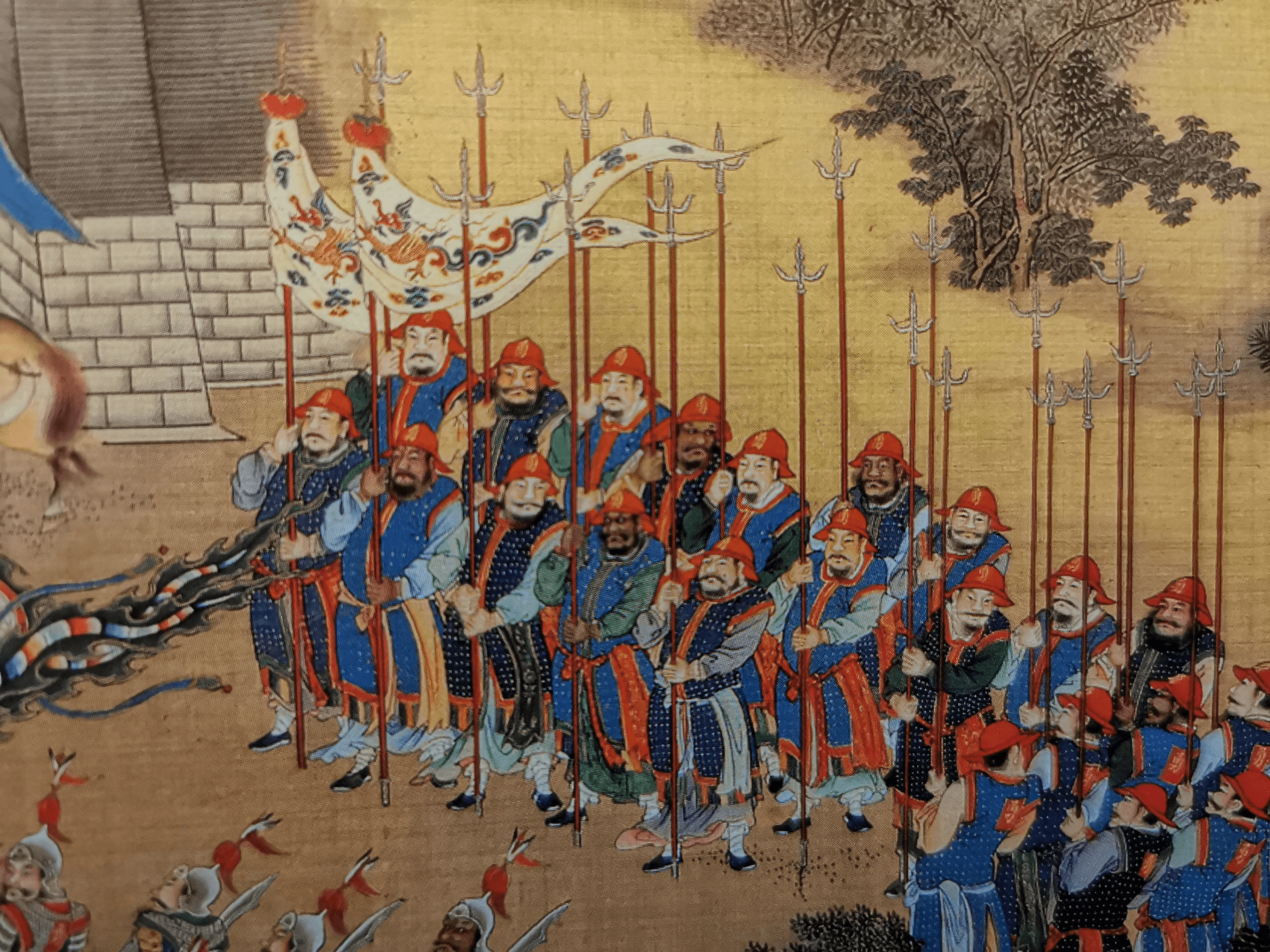
Ma He was one of the Prince of Yan's household guard commanders through the four years of this civil war. In the winter of 1399, at the Battle of Zhengcunba 郑村坝 — near what is now the Dongba district of Beijing — Zhu Di broke a large southern army in the field. This was the most important victory of the early Jingnan period. Ma He is said to have distinguished himself here. Some late Ming sources link Zheng He's surname to this place name — the argument being that Zhu Di, on taking the throne, awarded him the surname "Zheng" in commemoration of the battle. The etymology is contested; other readings hold that the surname was simply a routine imperial reward and had nothing to do with the location. But even if the place-name derivation is not strictly correct, the underlying military record is solid: Zheng He did not enter Yongle's inner circle through the paperwork side of court life. He fought his way in.
The turning point of the war came between the winter of 1401 and the spring of 1402. Yao Guangxiao delivered a decisive piece of advice to Zhu Di: stop grinding down against the southern army in the north, bypass their defensive line, and strike directly at Nanjing. Zhu Di took it. In the sixth month of 1402, the Yan army crossed the Yangtze. On 13 July, Zhu Hui, the Prince of Gu, and Li Jinglong, Duke of Cao, opened the Jinchuan Gate of Nanjing and surrendered the city. On the day Zhu Di entered the capital, the imperial palace caught fire.
The Jianwen Emperor's body was never found. One account says he died in the palace fire. Another says he escaped and lived out his life as a Buddhist monk. Another says he fled south to Yunnan. Another says he took to the sea. All four versions were kept alive across the following century, and the "escaped by sea" version was later used as one of the explanations for the treasure voyages: that Zheng He's fleet was, among other things, an ongoing search for the missing emperor. Whether that mission was actually part of the voyages' brief is something historians have never settled. On 17 July 1402, Zhu Di took the throne as the Yongle Emperor. Ma He was immediately appointed Grand Director of Palace Servants 内官监太监 — the highest position in the eunuch bureaucracy. He was thirty-one years old.
1404 · 赐姓/ The Surname
On the first day of the first month of the second year of Yongle — 11 February 1404, the Chinese New Year — Zhu Di formally conferred the surname Zheng, keeping the given name He. From that day, Ma He became Zheng He. This was not ceremonial. What Zhu Di meant by conferring a surname was: you belong to me now — you will stand at court, command troops, conduct business, and enter the historical record under the name I have given you. Ming emperors typically conferred surnames on ministers who had performed extraordinary service or on tributary rulers being drawn into the imperial family. Using this rite on a eunuch was extremely rare. It was a full identity reset — the Ma name, the Islamic bloodline, the Yunnanese origin, the captured-boy status, all of it papered over with a new narrative called "the Zheng family."
On the weight of the office of Grand Director of Palace Servants. The Ming eunuch bureaucracy was organized into the Twelve Directorates 十二监. The Directorate of Palace Servants was the most important of them, with authority over palace construction, ritual objects, weddings and funerals, and eunuch missions dispatched outside the court — effectively the administrative center of the entire eunuch system. The position controlled several thousand eunuchs, reported directly to the emperor, and bypassed the six ministries of the outer court. Every function Zheng He would perform over the next two decades — commanding the treasure fleet, supervising the construction of the Great Bao'en Temple, serving as Defender of Nanjing — rests on the legal foundation of this one appointment.
In the same year, the Yongle Emperor ordered the construction of great ships at the Longjiang Shipyards 龙江船厂 in Nanjing. The shipyards stood where the Qinhuai River meets the Yangtze. They had been operating as a state-run yard since the Yuan, and the early Ming expansion turned them into one of the largest shipbuilding facilities anywhere in the world. According to the Longjiang Chuanchang Zhi 龙江船厂志, a dedicated administrative record compiled in the mid-sixteenth century, the yard was organized into 82 specialized workshops with more than ten thousand craftsmen — carpenters, joiners, lacquerers, blacksmiths, bamboo-workers — on the rolls. A separate facility, the Baochuan Chang 宝船厂 — Treasure Ship Yard — handled the flagship class specifically. It was equipped with tidal dry docks whose gates opened and closed with the rise and fall of the Yangtze — an engineering feat of the fifteenth century that Europe would not match at comparable scale until the nineteenth. Timber came downriver from Fujian and Sichuan. The eleven-meter rudder post unearthed at the shipyard site in 1957 belonged to a ship built here.
The purpose of the construction was never publicly stated. Several explanations circulated inside the court: tracking down the missing Jianwen Emperor, reopening contact with the Western Regions, projecting Yongle's Mandate of Heaven, restoring the maritime tributary network that had been contracting since the late Yuan. All of these motives are plausible, and none of them is a complete explanation on its own. The most direct political motive was this: Yongle needed an immediate, high-output, era-defining project whose success would bind itself to his personal legitimacy — because he had taken the throne by usurpation, and he needed accomplishments large enough to wash out that original sin. From day one this determined that the treasure voyages were an emperor's personal project, not a state project. Moving the capital to Beijing, compiling the Yongle Dadian 永乐大典, the five northern campaigns against the Mongols, and sending Zheng He's fleet west — these four undertakings are four outlets of the same logic. More on this soon. 🇨🇳