芳草
Preface: Yerba Buena.
1) Yerba Buena
Before the Spanish arrived, the San Francisco Peninsula was home to the Ohlone. "Ohlone" is the collective name used today for the many Indigenous groups who lived between San Francisco Bay and Monterey Bay. The word comes from one of those groups, the Oljon (or Olhone), a tribelet on the San Mateo coast. The Spanish called the people of this coast costeños, "coast dwellers," which English-language scholars turned into "Costanoan." In the late twentieth century, descendants came to prefer "Ohlone" as a matter of self-definition, and scholars followed.
The Ohlone were never a single tribe. They lived in a network of some fifty to sixty independent tribelets, each with its own territory, its own leader, and often its own dialect. A small tribelet numbered a few dozen people, a large one several hundred. Most held a few permanent villages and a number of seasonal camps.
Each tribelet was led by a chief, who could be a man or a woman. The chief was less a ruler than a coordinator and distributor of resources. Authority rested on three things: lineage, since the office was often inherited; wealth, measured mainly in shell beads and access to hunting and gathering grounds; and prestige, earned by settling disputes and leading ceremonies. The chief controlled the communal stores of acorns and dried fish and decided how they were shared. Chiefs presided over weddings, funerals, and seasonal rituals, and represented the tribelet in trade, alliances, and marriage negotiations with its neighbors. Without any central government, this arrangement kept the peace across the region and kept the use of land in balance.
Nor did the Ohlone speak one language. Drawing on the work of the linguist Catherine Callaghan and the historian Randall Milliken, scholars generally divide Ohlone into eight related languages, each tied to a region. Karkin was spoken along the Carquinez Strait, around present-day Martinez and Benicia. Chochenyo belonged to the East Bay, from Oakland and Berkeley south to Fremont; it is the language the Muwekma Ohlone are working to revive today. Ramaytush was spoken on the San Francisco Peninsula, whose people were among the first drawn into Mission Dolores. Tamyen was the language of the Santa Clara Valley, around San José and Mission Santa Clara. Awaswas was spoken in the Santa Cruz Mountains and along the Santa Cruz coast. Mutsun belonged to the country around Gilroy, Hollister, and San Juan Bautista, and it is the best documented of the eight; it stands at the center of the Amah Mutsun Tribal Band's revival work. Rumsen was spoken around Monterey and Carmel, where Spanish contact came early, with the founding of Mission San Carlos in 1770. Chalon was spoken in the Salinas Valley, near Mission Soledad.
This was typical of Indigenous California: many languages, deeply local societies, and borders drawn by ecology. A tribelet's territory ran from a few square miles to a few dozen, usually bounded by rivers, ridgelines, or shoreline. Each tended to include oak woodland, wetland, grassland, and streams, so that food could be found year-round: acorns, fish, berries, and the deer that followed their seasonal routes. Neighbors visited one another, but entering another group's land meant observing protocol, through ceremony or gifts. The Yelamu of the northern San Francisco Peninsula fished the ocean and the bay. The Tuibun lived in the freshwater marshes of the East Bay shore, around today's Coyote Hills near Fremont. Groups like these traded and intermarried across the bay, but none could cross into another's land at will.
Trade and marriage tied the tribelets together. Shell beads, feather ornaments, salt, chert, and stone mortars moved from group to group, and obsidian from as far as the Sierra Nevada and beyond reached the Bay Area. People commonly married outside their own tribelet. This exogamy kept languages and customs circulating across the region, and each marriage carried economic obligations: gifts of food and crafts, and visits back and forth at festival time. Neighboring tribelets also held seasonal ceremonies together, including acorn harvest gatherings, healing rites, and dances.
The result was a decentralized, federated society: no empire and no common language, yet closely coordinated in its ecological and spiritual life. Many Ohlone descendants in the Bay Area today still identify with particular groups. The Muwekma Ohlone trace their roots to Chochenyo speakers and the Amah Mutsun to Mutsun speakers, while the Ohlone/Costanoan-Esselen Nation brings together Rumsen Ohlone and Esselen descendants, the Esselen being a neighboring people with a language of their own. These communities are reconstructing their languages from mission-era manuscripts and linguistic records, forming tribal councils and education programs, reviving ceremonial dance, and pressing for land return and the protection of shellmounds in urban planning.
The Spanish "Discovery"
At the end of the fifteenth century, the two Iberian sea powers divided the "New World" between them. The Treaty of Tordesillas (1494) split the globe and gave Spain most of the Americas. Spain's early aims were the gold and silver of Mexico and Peru and a Pacific trade route linking its American colonies to the Philippines. California was never the destination. It was an unknown northern edge.
The name itself came from fiction. Around 1510, the Spanish writer Garci Rodríguez de Montalvo published Las sergas de Esplandián (The Adventures of Esplandián), a romance about an island called California, rich in gold and ruled by a warrior queen named Calafia. When Spanish expeditions reached Baja California in the 1530s, they took it for an island, and the name stuck. Later voyages showed it was a peninsula, but the island reappeared on European maps in the seventeenth century and lingered there until the mid-eighteenth.
In the 1530s, Hernán Cortés, the conqueror of Mexico, sent expeditions to the northwest and led one himself. They reached Baja California, but a settlement at La Paz failed in the face of drought, scarce water, and harsh terrain. In 1542, Juan Rodríguez Cabrillo sailed up the coast of Alta California, the first European to do so. Sixty years later, in 1602, Sebastián Vizcaíno sailed north from Acapulco and charted the coast in far greater detail, naming San Diego, Santa Barbara, Carmel, and Monterey, the last in honor of the viceroy of New Spain, the Count of Monterrey. Vizcaíno praised Monterey Bay as a safe anchorage and recommended settling it. No one acted on his advice for more than a century and a half.
By the mid-eighteenth century, Spain saw its North American empire under threat. Russian fur traders were moving along the Pacific coast from Alaska, and Britain was extending its reach across the continent. Spain feared that if it did not occupy Alta California, another power would take the Pacific coast. Its answer was to hold the land chiefly with missionaries, backed by a thin line of soldiers. This was the origin of the California mission system.
Spain's formal arrival came in 1769. The governor, Gaspar de Portolá, and the Franciscan friar Junípero Serra led an expedition north from Baja California by land and sea, a few hundred people in all: soldiers, Christian Indians from the Baja missions, herders, and settlers. They founded outposts and churches as they went.
Where the Spanish built missions, they tried to control villages by drawing in their chiefs. Missionaries invited chiefs to be baptized and given Christian names, and many accepted under pressure. Baptism brought a chief's people into the mission and, in Spanish eyes, placed their land under the Church. Traditional leadership collapsed, and a society organized by territory gave way to the hierarchy of the mission. The first Native person baptized at Mission Dolores was Chamis, a twenty-year-old Yelamu man of standing, renamed Francisco Moraga. His family's marriages had helped make peace between the Yelamu and their neighbors. Within a generation, disease and the conditions of mission life had killed most of the peninsula's Native people; by 1800, roughly eight in ten were gone.
The missions existed to turn Indigenous people into Catholics and into a labor force. Tens of thousands of Ohlone, Tongva, Chumash, and others were drawn or forced into them, baptized, renamed, and forbidden to speak their own languages. They farmed, herded, and built by day and were confined within mission walls at night. Disease, malnutrition, and punishment drove death rates extremely high. For Indigenous people, the missions meant cultural and demographic catastrophe. For Spain, they stood for civilization and order.
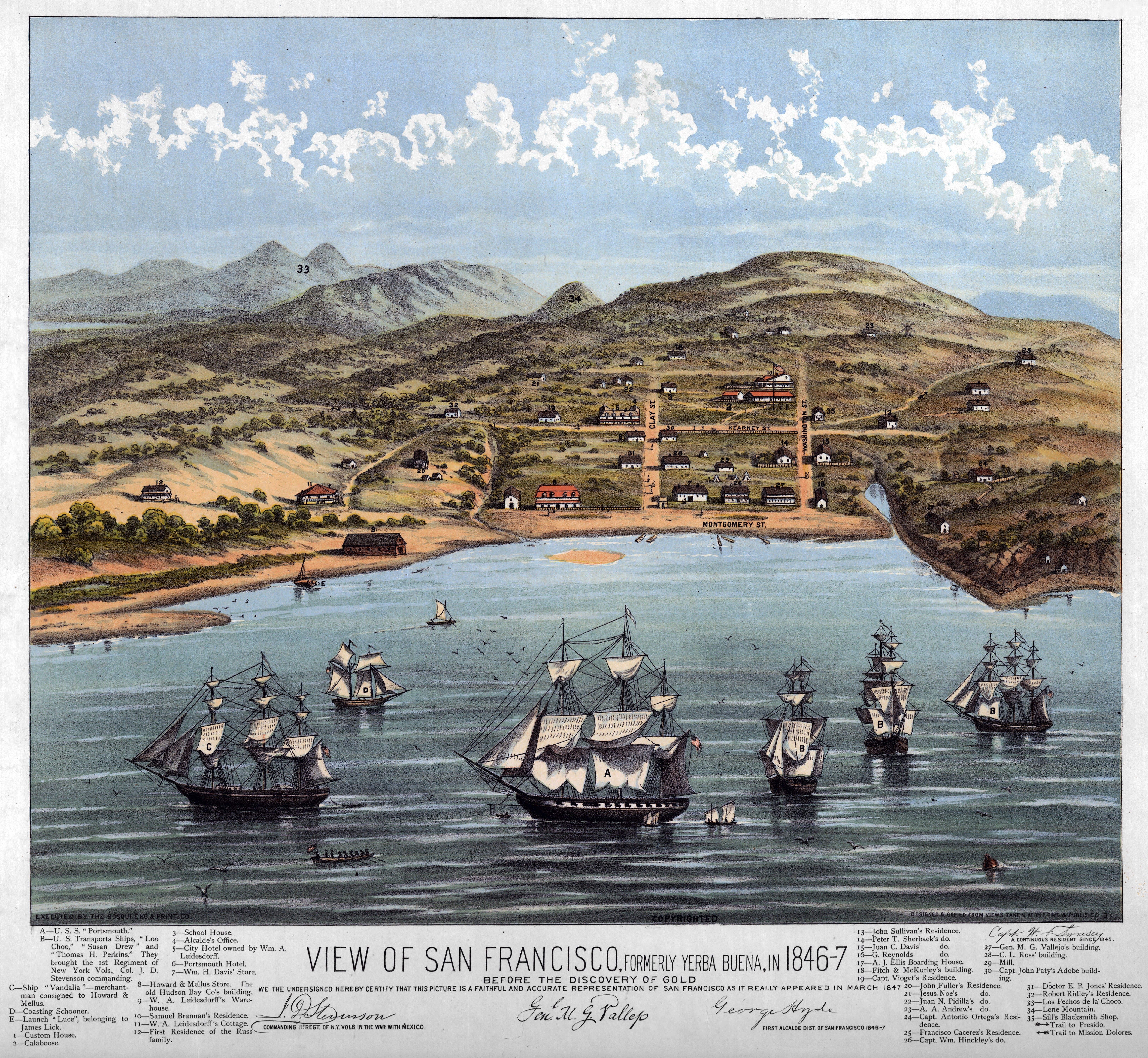
In 1776, the year of American independence, the Spanish founded their sixth California mission on the San Francisco Peninsula: Mission San Francisco de Asís, known as Mission Dolores. That same year they built the Presidio, a fort at the northern tip of the peninsula, to guard against the British and the Russians. The settlement that grew up beside the cove in the 1830s, under Mexican rule, was called Yerba Buena, "good herb," after a wild mint that grew on the hills. The United States seized it in 1846, and in 1847 it was renamed San Francisco. Then came the Gold Rush. In early 1848 the town had fewer than a thousand people. By the end of 1849 it had about 25,000 and had become an international port. Sailing ships, merchants, brothels, gambling halls, and theaters crowded the waterfront. From the start, the city carried an air of adventure, disorder, wildness, and openness.
2) The Gold Rush
The story starts simply. On January 24, 1848, at Coloma on the South Fork of the American River, the carpenter James W. Marshall was building a sawmill for the landowner John Sutter when he spotted flakes of gold in the tailrace. Sutter wanted it kept quiet. He planned to build a business in farming and lumber and did not want his land overrun by gold seekers. The news got out anyway, first by word of mouth. The first diggers were locals: mill hands, Mexicans, and Hawaiians. As newspapers and merchant ships carried the story, San Francisco boiled over. Merchants, sailors, and adventurers walked off their jobs and headed inland to dig.
Nine days after Marshall's discovery, California changed countries. To see how, we have to go back to Texas.
The Backdrop: Texas
When Mexico won independence from Spain in 1821, it inherited a vast northern territory that included Texas. Texas was thinly settled, mostly by Native peoples and a few Hispanic ranchers. To develop the frontier, the Mexican government in the 1820s let American settlers in, on condition that they become Catholic and obey Mexican law. Thousands of Anglo settlers came, bringing the English language, Protestantism, and slavery. By 1830 they outnumbered the Mexican residents.
Stephen F. Austin (1793–1836) led the way. Born in Virginia, he took over a colonization grant his father had received just before Mexican independence, had it confirmed by the new government, and in the early 1820s brought in the first three hundred families of American settlers. Known as the "Old Three Hundred," they became the earliest and most influential Anglo community in Texas. Austin is remembered as the "Father of Texas," and the state capital bears his name.
In 1829 Mexico abolished slavery, angering settlers who relied on enslaved labor to grow cotton. In 1830 it barred further American immigration into Texas. Tensions rose. Austin at first sought more autonomy for Texas within Mexico, not independence. He went to Mexico City in 1833 to press the case and was imprisoned for more than a year. By the time he was released, he had come around to independence.
The man in power in Mexico City was Antonio López de Santa Anna (1794–1876), among the most controversial figures in Mexican history. He began his career as a royalist officer fighting for Spain, switched sides in 1821, and became a national hero in 1829 by defeating a Spanish attempt to retake Mexico at Tampico. He held the presidency on and off, by most counts eleven times. In 1835 he moved to centralize power and abolish regional autonomy, provoking resistance from Anglo settlers and from Mexican-born Texans, the Tejanos, alike. That fall, armed rebellion broke out.
Santa Anna led an army north himself. On March 2, 1836, delegates declared Texas independent. Four days later his troops stormed the Alamo in San Antonio and killed nearly all of its roughly two hundred defenders; "Remember the Alamo!" became the Texans' battle cry. Weeks later at Goliad, on Santa Anna's orders, some four hundred Texan soldiers who had surrendered were executed. On April 21, at San Jacinto, Sam Houston's army caught Santa Anna's forces off guard and routed them in about eighteen minutes. Santa Anna was captured the next day and forced to sign treaties ending the fighting.
Houston (1793–1863), also born in Virginia, had fought in the War of 1812 and moved to Texas in 1832, where he quickly rose to command its army. He served twice as president of the Republic of Texas and, after annexation, as a U.S. senator and then governor. In 1861 he refused to swear loyalty to the Confederacy and was forced out of office. The city of Houston is named for him.
The Republic of Texas modeled its constitution closely on that of the United States, slavery included. The United States recognized Texas in 1837, but annexation stalled over the balance between slave and free states. Mexico never recognized Texas independence, and when the United States annexed Texas in 1845, the conflict came to a head. The United States claimed the border was the Rio Grande; Mexico insisted it was the Nueces River, farther north. Americans were in the grip of Manifest Destiny, the belief that the nation was destined to stretch to the Pacific, and Washington wanted not only Texas but California and New Mexico.
The Mexican-American War
In 1846, President James K. Polk sent troops into the disputed land along the Rio Grande, where they clashed with Mexican forces. Congress declared war in May. American forces soon held the key points in California and New Mexico. In March 1847 they landed at Veracruz and marched on Mexico City, which fell in September. Santa Anna, back in power, led Mexico's defense and lost again. Polk's envoy, Nicholas Trist, was recalled in the middle of negotiations but refused to leave and kept talking until he had a treaty.
It was signed on February 2, 1848, at Guadalupe Hidalgo, just outside Mexico City. Mexico accepted the loss of Texas, with the border at the Rio Grande, and ceded California, Nevada, Utah, most of Arizona, about half of New Mexico, and parts of Colorado and Wyoming. The United States paid $15 million and took over about $3.25 million in claims that American citizens held against Mexico. The country grew by nearly a third and gained a Pacific coast. Counting Texas, Mexico lost about half its territory, a trauma that shaped its politics for generations.
Who Was Already There
Because California had been Mexican, Mexicans were there when the gold appeared: rancheros, laborers, and miners. They were among the first to hear the news and the first to dig. Mexico had centuries of gold and silver mining behind it, in places like Zacatecas and Guanajuato, and many Mexican miners were far more skilled than the farmers and carpenters arriving from the eastern United States. Once the news reached Mexico, miners and merchants poured north, especially from Sonora. Sonoran miners founded the gold-country town that still bears the name Sonora, in Tuolumne County.
Hawaiians were there too. The Kingdom of Hawaii, then independent, was a waystation on the Pacific routes between North America and Asia, and many Hawaiians worked as sailors and laborers on whalers, merchant ships, and fur-trading vessels, so they reached California's ports with the ships. When the news reached Honolulu, some sailors jumped ship; others sailed to San Francisco and headed for the diggings on arrival. Early mining records often list "Kanakas," as Hawaiians were called, as a separate group.
In 1849 the news reached the eastern United States and the rest of the world, and people came by the tens of thousands. They became known as the Forty-Niners. Some went overland from Missouri on the Oregon and California Trails. Others went by sea, around Cape Horn, or by ship to Panama, across the isthmus, and north on another ship. Alongside the Americans came Chinese, Chileans, Peruvians, Mexicans, Australians, and Europeans. By 1852 about 20,000 Chinese had arrived, roughly a tenth of California's population.
In a few years San Francisco grew from a small port into the capital of the Gold Rush, and California became one of the places on earth where people were moving in the greatest numbers. The diggings had little law. Robbery, violence, and racial discrimination were everywhere, and Chinese, Latin American, and Native people were routinely driven off. With its population surging, California became the thirty-first state in 1850. The easy surface gold ran out quickly, and mining shifted to deep shafts and machinery that demanded capital and technical skill. Ordinary miners could not keep up, and many turned to farming, trade, or railroad work. Many Chinese, shut out of the mines, opened laundries, restaurants, and stores, laying the economic foundation of their community.
3) The Chinese
Word of the gold reached the East Coast slowly and was widely doubted. In the summer of 1848, Colonel Richard B. Mason, the military governor of California, toured the diggings and wrote a detailed report confirming the finds. An army lieutenant, Lucien Loeser, carried the report east along with a tea caddy holding about 230 ounces of gold. On December 5, 1848, President Polk told Congress that "the accounts of the abundance of gold in that territory are of such an extraordinary character as would scarcely command belief were they not corroborated by the authentic reports of officers in the public service." After that, no one doubted. In 1848 California's non-Native population was under 15,000. In 1849 alone some 90,000 people arrived, and by 1852 the population had passed 250,000.
How the Mining Changed
In the first years, 1848 and 1849, the tools were simple and almost anyone could use them. The gold pan was a shallow iron or tin pan swirled in a stream until sand and gravel washed away and the heavy flakes stayed behind. It cost almost nothing. The rocker, or cradle, named for its shape, was already in use in 1848: a wooden box that a miner rocked while pouring in water and gravel, with cleats and a cloth at the bottom to catch the gold. It could process far more gravel than a pan. The gold lay in shallow river deposits and was easy to find. Farmers, cooks, and tailors dropped everything to dig. It was the most romantic and open stage of the Gold Rush, when anyone might strike it rich.
Overwork exhausted the easy deposits quickly. From about 1850, miners turned to the long tom and then the sluice box, long wooden troughs fed by a steady stream of water; miners shoveled in gravel, and riffles along the bottom caught the gold. This took a team. Crews built wooden flumes to bring water from higher ground, and dozens of men might work a single claim, moving gravel by wheelbarrow. Mining was beginning to industrialize. Claim systems emerged under rules set by local mining districts, and whoever first worked a spot held the right to it. Competition sharpened and conflict became constant, and foreign miners, especially Mexicans, Chileans, and later the Chinese, were forced out. By the early 1850s, a man working alone could barely get by.
In 1853 hydraulic mining arrived. High-pressure water cannons called monitors blasted apart whole hillsides and washed the debris through long sluices to separate the gold. It was enormously productive and enormously expensive, requiring dams, ditches, flumes, and pipe. Hard-rock mining, which followed gold-bearing quartz veins underground, needed blasting powder, timbering, and hoisting machinery, and cost even more. Companies and investors bought up large stretches of mining land, and independent miners became wage laborers. Many Forty-Niners went home broke. Foreign miners, the Chinese above all, could not compete with capital and moved into service work: cooking, laundry, tailoring. Hydraulic mining choked rivers with silt and buried farmland downstream, damage serious enough that a federal court effectively shut it down in 1884. By around 1855 the fever had broken. What began as a dream open to everyone had become an industry run by capital.
The mining country had little law. Miners carrying gold dust back to town were often robbed on the road. Vigilante justice was common, and a theft or a debt dispute could end in a lynching. Ethnic conflict was bitter. White American miners used mining camp meetings to drive out Chinese and Mexican miners, and the state backed them with law. The Foreign Miners' Tax of 1850 charged $20 a month, a heavy sum at the time, and exempted white miners who could become citizens; in practice it fell mainly on Mexican and South American miners, since few Chinese had yet arrived. So many foreign miners left rather than pay that the tax damaged the mining economy. It was repealed in 1851, and in 1852 a new tax of $3 a month, later raised, was aimed squarely at the Chinese.
The Chinese Immigrant Experience
Most of the first Chinese who came for gold were from the Pearl River Delta in Guangdong: from the four counties of Siyi (Sze Yup), namely Taishan, Kaiping, Xinhui, and Enping; from the three counties of Sanyi (Sam Yup), namely Nanhai, Panyu, and Shunde; and from Xiangshan, today's Zhongshan. After the First Opium War (1839–1842), southern China's economy was in distress. Opium spread, taxes were heavy, and the land could not support the population. The Taiping Rebellion (1850–1864) brought war and upheaval on top of that. In the villages the legend of Gold Mountain took hold, and families spent everything they had to send a son across the Pacific.
To the Chinese of that time, San Francisco was Gold Mountain, Gam Saan (金山). After gold was found in Victoria, Australia, in 1851 and many Cantonese went there as well, Melbourne became the New Gold Mountain (新金山), and San Francisco became the Old Gold Mountain, Jiu Jin Shan (旧金山), the Chinese name the city still carries.
Most sailed from Hong Kong to San Francisco, usually on American or British ships. The crossing took two months or more. Disease, storms, and hunger were common, and some did not survive it. A ticket cost several years of a farmer's savings. Many traveled on the credit-ticket system: a merchant or broker advanced the fare, and the migrant repaid it out of his wages in California. This was debt, sometimes crushing debt, but it was distinct from the coolie trade that shipped contract laborers to Cuba and Peru on far more coercive terms. Almost all the migrants were men. Qing law formally forbade emigration, custom kept wives at home to care for their husbands' parents, and American law, above all the Page Act of 1875, later kept Chinese women out. For decades the Chinese community was overwhelmingly male.
San Francisco was the first stop. Newcomers usually stayed in Chinatown and then went to the mines through the district associations, the huiguan (会馆), organized by home county: the Ning Yeung Association for people from Taishan, the Kong Chow Association for people from Xinhui, and others. The associations provided lodging, loans, work, and protection. Most Chinese miners went to the Sierra Nevada foothills and the rivers of the Sacramento basin. Many avoided the rich claims that white miners fought over and worked instead the streams and tailings whites had abandoned, pulling gold out of ground others had given up on through patience and collective labor. They kept their costs low, lived frugally, and endured harsh conditions. Exclusion and violence drove many out of the mines and into towns and cities. There they opened laundries, a trade they came to dominate; restaurants serving stir-fries and pastries, first to Chinese customers and increasingly to whites; and tailor shops and grocery stores supplying the mining camps and towns. In leaving the mines for the urban economy, they laid the economic foundation of Chinatown. ⛰️
前言:耶尔瓦布埃纳
1)耶尔瓦布埃纳
西班牙人到来之前,旧金山半岛是奥隆尼人的家园。"奥隆尼人"是今天对生活在旧金山湾和蒙特雷湾之间的众多原住民族群的统称。这个词来自其中一个族群——奥尔洪人,一个生活在圣马特奥海岸的部落小酋邦。西班牙人把这片海岸的人民称为"海岸居民",英语学界将其转写为"科斯塔诺人"。二十世纪晚期,后裔们出于自我认同的需要,更倾向于使用"奥隆尼人"这一名称,学界也随之跟进。
奥隆尼人从来不是一个单一的部落。他们生活在一个由五十至六十个独立部落酋邦组成的网络中,每个酋邦都有自己的领地、自己的首领,通常还有自己的方言。小酋邦有几十人,大酋邦有几百人。大多数拥有几个固定村落和一些季节性营地。
每个酋邦由一位首领领导,首领可以是男性,也可以是女性。首领与其说是统治者,不如说是资源的协调者和分配者。权威建立在三件事之上:血统,因为这一职位常常世袭;财富,主要以贝壳珠饰和狩猎采集地的占有权来衡量;威望,通过调解纠纷和主持仪式赢得。首领掌管公共的橡子与鱼干储备,并决定如何分配。首领主持婚礼、葬礼和季节性仪式,并在贸易、结盟以及与邻族的通婚谈判中代表酋邦。在没有任何中央政府的情况下,这种安排维持了整个地区的和平,也使土地的使用保持平衡。
奥隆尼人也不说同一种语言。借鉴语言学家凯瑟琳·卡拉汉和历史学家兰德尔·米利肯的研究,学界一般把奥隆尼语分为八种相关的语言,每种对应一个地区。卡金语通行于卡基尼兹海峡沿岸,即今天的马丁内斯和贝尼西亚一带。乔切尼奥语属于东湾,从奥克兰、伯克利向南到弗里蒙特;这是穆维克马·奥隆尼人今天正在努力复兴的语言。拉马尤图什语通行于旧金山半岛,这里的原住民是最早被吸纳入多洛雷斯传教站的群体之一。塔米恩语是圣克拉拉谷的语言,即圣何塞和圣克拉拉传教站一带。阿瓦斯瓦斯语通行于圣克鲁斯山区和圣克鲁斯海岸。穆图孙语属于吉尔罗伊、霍利斯特和圣胡安包蒂斯塔一带的地区,是八种语言中文献记录最完备的一种,也是阿玛·穆图孙部落联盟语言复兴工作的核心。鲁姆森语通行于蒙特雷和卡梅尔一带,1770年圣卡洛斯传教站的建立使西班牙人的接触很早就到来。查隆语通行于萨利纳斯谷,靠近索莱达传教站。
这是加利福尼亚原住民社会的典型形态:语言众多,社会高度地方化,边界由生态划定。一个酋邦的领地从几平方英里到几十平方英里不等,通常以河流、山脊或海岸线为界。每片领地往往兼有橡树林、湿地、草原和溪流,以便全年都能找到食物:橡子、鱼、浆果,以及沿着季节性路线迁徙的鹿。邻族之间常有往来,但进入他族的土地必须遵守礼仪,或通过仪式,或赠送礼物。旧金山半岛北部的耶拉穆人在海洋和海湾中捕鱼。图伊本人生活在东湾海岸的淡水沼泽地,即今天弗里蒙特附近的郊狼丘一带。这样的族群在海湾两岸通商通婚,但谁也不能随意踏入他族的土地。
贸易和婚姻把各酋邦联结在一起。贝壳珠饰、羽饰、盐、燧石和石臼在族群之间流转,来自内华达山脉乃至更远地方的黑曜石也抵达了湾区。人们通常在本酋邦之外通婚。这种外婚制使语言和习俗在整个地区流通,每段婚姻都伴随着经济义务:赠送食物和手工艺品,节庆时节相互走访。相邻的酋邦还会一起举行季节性仪式,包括橡子收获集会、治愈仪式和舞蹈。
结果形成了一个分权的联邦式社会:没有帝国,没有通用语言,却在生态和精神生活上紧密协调。今天湾区的许多奥隆尼后裔仍认同特定的族群。穆维克马·奥隆尼人追溯其根源至说乔切尼奥语的人,阿玛·穆图孙则追溯至说穆图孙语的人,而奥隆尼/科斯塔诺-埃塞伦民族则汇聚了鲁姆森·奥隆尼人和埃塞伦人的后裔,埃塞伦人是一个有自己语言的邻族。这些社区正在从传教站时代的手稿和语言学记录中重建自己的语言,组建部落委员会和教育项目,复兴仪式舞蹈,并在城市规划中争取土地归还和贝壳丘的保护。
西班牙人的"发现"
十五世纪末,伊比利亚的两个海上强国瓜分了"新世界"。《托尔德西利亚斯条约》(1494年)划分了全球,把美洲的大部分给了西班牙。西班牙早期的目标是墨西哥和秘鲁的金银,以及连接其美洲殖民地与菲律宾的太平洋贸易航线。加利福尼亚从来不是目的地,而是一片未知的北方边缘。
这个地名本身来自虚构作品。大约1510年,西班牙作家加西亚·罗德里格斯·德·蒙塔尔沃出版了《埃斯普兰迪安历险记》,一部关于一座名叫加利福尼亚的岛屿的传奇小说,岛上盛产黄金,由一位名叫卡拉菲亚的女王统治。1530年代,西班牙远征队抵达下加利福尼亚,把它当成了一座岛屿,这个名字就此固定下来。后来的航行证明它是一个半岛,但十七世纪时,那座岛屿又出现在欧洲地图上,一直延续到十八世纪中叶。
1530年代,墨西哥的征服者埃尔南·科尔特斯派出远征队向西北进发,还亲自率领了一支。他们抵达了下加利福尼亚,但因干旱、缺水和地形恶劣,在拉巴斯的定居点失败了。1542年,胡安·罗德里格斯·卡布里略沿着上加利福尼亚海岸北上,成为第一位这样做的欧洲人。六十年后的1602年,塞巴斯蒂安·比斯卡伊诺从阿卡普尔科向北航行,更为详细地测绘了海岸,命名了圣迭戈、圣巴巴拉、卡梅尔和蒙特雷,最后一个是为纪念新西班牙总督蒙特雷伯爵。比斯卡伊诺称赞蒙特雷湾是安全的锚地,建议在此定居。一个半多世纪里,无人采纳他的建议。
到十八世纪中叶,西班牙感到其北美帝国受到威胁。俄国毛皮商人正沿着太平洋海岸从阿拉斯加南下,英国也在向大陆腹地扩张。西班牙担心,如果自己不占领上加利福尼亚,另一强国就会夺取太平洋海岸。它的应对方式是以传教士为主、少量士兵为辅来控制土地。这就是加利福尼亚传教站体系的起源。
西班牙的正式到来是在1769年。总督加斯帕尔·德·波托拉和方济各会修士胡尼佩罗·塞拉率领一支远征队,从下加利福尼亚出发,由陆路和海路北上,总共几百人:士兵、来自下加利福尼亚各传教站的归化印第安人、牧人,还有定居者。他们沿途建立前哨和教堂。
西班牙人在建立传教站的地方,试图通过拉拢各村首领来控制村落。传教士邀请首领受洗并取基督教名,许多人在压力之下接受了。受洗使首领的人民被纳入传教站,在西班牙人眼中,也把他们的土地置于教会之下。传统领导体制崩溃,以领地组织起来的社会让位于传教站的等级制度。在多洛雷斯传教站受洗的第一位原住民是查米斯,一位二十岁的耶拉穆人,颇有地位,取名弗朗西斯科·莫拉加。他家族的通婚曾帮助耶拉穆人与邻族化干戈为玉帛。一代人之内,疾病和传教站的生活条件杀死了半岛上大多数原住民;到1800年,约有八成已经死去。
传教站存在的目的,是把原住民变成天主教徒和劳动力。数以万计的奥隆尼人、通瓦人、丘马什人等被吸引或强迫进入传教站,受洗、改名,被禁止说自己的语言。他们白天种地、放牧、建房,夜晚被关在传教站的围墙之内。疾病、营养不良和惩罚使死亡率极高。对原住民来说,传教站意味着文化和人口的灾难;对西班牙来说,它们代表着文明与秩序。
1776年,美国独立的那一年,西班牙人在旧金山半岛上建立了第六座加利福尼亚传教站:圣方济各·德·阿西斯传教站,即多洛雷斯传教站。同年,他们在半岛北端修建了普雷西迪奥要塞,以防备英国和俄国。1830年代,在墨西哥统治下,海湾边的小聚落发展起来,被称为耶尔瓦布埃纳,即"好草药",得名于山上生长的一种野生薄荷。美国于1846年夺取了它,1847年将其改名为旧金山。随后淘金热到来。1848年初,这个镇子还不到一千人。到1849年底,已有约两万五千人,成为一个国际港口。帆船、商人、妓院、赌场和剧院挤满了码头区。从一开始,这座城市就带着冒险、无序、狂野与开放的气息。
2)淘金热
故事的开头很简单。1848年1月24日,在美国河的南叉流域的科洛马,木匠詹姆斯·W·马歇尔正在为地主约翰·萨特建造一座锯木厂,突然在尾水渠里发现了金片。萨特想把消息压下去。他计划经营农场和木材生意,不想让淘金者踏平自己的土地。消息还是走漏了,先是口耳相传。第一批淘金者是本地人:磨坊工人、墨西哥人、夏威夷人。随着报纸和商船把消息传开,旧金山沸腾了。商人、水手和冒险家丢下工作,涌向内陆淘金。
马歇尔发现金子九天之后,加利福尼亚换了主人。要明白其中原委,得先回到得克萨斯。
背景:得克萨斯
1821年墨西哥从西班牙独立时,继承了一片广大的北方领土,包括得克萨斯。得克萨斯人烟稀少,大多是原住民和少数西班牙裔牧场主。为开发边疆,墨西哥政府在1820年代允许美国定居者进入,条件是皈依天主教并遵守墨西哥法律。数以千计的盎格鲁定居者涌入,带来了英语、新教和奴隶制。到1830年,他们的人数超过了墨西哥居民。
斯蒂芬·F·奥斯汀(1793–1836)是领路人。他生于弗吉尼亚,接手了父亲在墨西哥独立前夕获得的一份殖民特许地,得到新政府的确认,于1820年代初带来了第一批三百个美国家庭,史称"老三百",成为得克萨斯最早也最有影响力的盎格鲁社区。奥斯汀被尊为"得克萨斯之父",州首府以他的名字命名。
1829年墨西哥废除奴隶制,激怒了依赖奴隶劳动种植棉花的定居者。1830年,墨西哥禁止美国人进一步移民得克萨斯。紧张局势加剧。奥斯汀最初为得克萨斯寻求的是在墨西哥框架内的更多自治,而非独立。1833年他前往墨西哥城交涉,被监禁了一年多。获释时,他已转向支持独立。
在墨西哥城掌权的是安东尼奥·洛佩斯·德·圣安娜(1794–1876),墨西哥历史上最具争议的人物之一。他早年是为西班牙作战的保王党军官,1821年倒戈,1829年在坦皮科击退西班牙重夺墨西哥的企图,成为民族英雄。他多次担任总统,多数统计为十一次。1835年,他着手集权,废除地方自治,同时激起了盎格鲁定居者和墨西哥裔得克萨斯人(特哈诺人)的反抗。那年秋天,武装叛乱爆发。
圣安娜亲自率军北上。1836年3月2日,代表们宣布得克萨斯独立。四天后,他的部队攻陷了圣安东尼奥的阿拉莫,杀死了近两百名守军中的几乎所有人;"记住阿拉莫!"成为得克萨斯人的战斗口号。几周后在戈利亚德,奉圣安娜之命,约四百名已投降的得克萨斯士兵被处决。4月21日,在圣哈辛托,山姆·休斯敦的军队打了圣安娜的部队一个措手不及,约十八分钟就将其击溃。圣安娜次日被俘,被迫签署条约结束战斗。
休斯敦(1793–1863)同样生于弗吉尼亚,参加过1812年战争,1832年移居得克萨斯,很快升任得克萨斯军队统帅。他两度担任得克萨斯共和国总统,合并后又任联邦参议员和州长。1861年,他拒绝向南部邦联宣誓效忠,被迫去职。休斯敦市以他的名字命名。
得克萨斯共和国宪法在很大程度上模仿了美国宪法,包括奴隶制。美国于1837年承认得克萨斯,但因奴隶州与自由州的平衡问题,合并一再搁浅。墨西哥从未承认得克萨斯独立;1845年美国吞并得克萨斯后,冲突激化。美国声称边界是格兰德河,墨西哥坚持是更北的努埃塞斯河。美国人正沉浸在"天命论"之中,相信这个国家注定要扩张到太平洋,华盛顿想要的不仅是得克萨斯,还有加利福尼亚和新墨西哥。
美墨战争
1846年,总统詹姆斯·K·波尔克把军队派进格兰德河沿岸的争议地带,与墨西哥军队发生冲突。国会于五月宣战。美军很快控制了加利福尼亚和新墨西哥的要地。1847年3月,美军在韦拉克鲁斯登陆,进军墨西哥城,九月攻陷。重新掌权的圣安娜领导墨西哥防御,再次战败。波尔克的特使尼古拉斯·特里斯特在谈判中途被召回,却拒绝离开,继续谈判直到达成条约。
条约于1848年2月2日在墨西哥城外的瓜达卢佩·伊达尔戈签署。墨西哥接受失去得克萨斯、以格兰德河为界,并割让加利福尼亚、内华达、犹他、亚利桑那的大部分、新墨西哥约一半,以及科罗拉多和怀俄明的一部分。美国支付一千五百万美元,并承担约三百二十五万美元的美国公民对墨西哥的索赔。美国国土增长了近三分之一,并获得了一条太平洋海岸。连同得克萨斯,墨西哥失去了约一半的领土,这一创伤影响了墨西哥此后几代人的政治。
当时已经在那里的人
因为加利福尼亚曾是墨西哥的领土,金子出现时墨西哥人就在那里:牧场主、劳工和矿工。他们最先听到消息,也最先开挖。墨西哥在萨卡特卡斯和瓜纳华托等地有数百年的金银开采经验,许多墨西哥矿工的技艺远胜从美国东部来的农民和木匠。消息传到墨西哥后,矿工和商人纷纷北上,尤其是从索诺拉来的。索诺拉矿工建立的淘金小镇至今仍叫索诺拉,位于图奥勒米县。
夏威夷人也在那里。当时独立的夏威夷王国是北美与亚洲之间太平洋航线的中转站,许多夏威夷人在捕鲸船、商船和毛皮贸易船上做水手和劳工,随船抵达加利福尼亚的港口。消息传到檀香山后,一些水手跳船逃走;另一些乘船到旧金山,上岸后直奔矿区。早期矿业记录常把"卡纳卡人"(当时对夏威夷人的称呼)列为单独的一类。
1849年,消息传到美国东部和世界各地,数以万计的人涌入。他们被称为"四九年淘金者"。有人从密苏里出发,沿俄勒冈小道和加利福尼亚小道陆路前往;有人乘船绕过合恩角,或乘船到巴拿马,穿过地峡,再换船北上。随美国人而来的,还有中国人、智利人、秘鲁人、墨西哥人、澳大利亚人和欧洲人。到1852年,约两万名中国人抵达,约占加利福尼亚人口的十分之一。
几年之内,旧金山从一个小港口成长为淘金热的中心,加利福尼亚成为地球上人口流入最多的地方之一。矿区几乎没有法律。抢劫、暴力和种族歧视无处不在,中国人、拉美人和原住民经常被驱赶。随着人口激增,加利福尼亚于1850年成为第三十一个州。容易开采的表层金很快耗尽,采矿转向需要资本和技术的深井与机械。普通矿工跟不上,只好转向务农、经商或修铁路。许多中国人被排挤出矿区后,开了洗衣店、餐馆和商店,奠定了社区的经济基础。
3)中国人
金子的消息传到东海岸很慢,也备受怀疑。1848年夏,加利福尼亚军事总督理查德·B·梅森上校巡视了矿区,写了一份确认发现的详细报告。陆军中尉卢西恩·勒泽尔带着这份报告和一罐约二百三十盎司的金子东行。1848年12月5日,波尔克总统告诉国会:"关于那片领土黄金之丰盛的报道,性质之非凡,若非经由公职军官的权威报告证实,简直难以置信。"此后,无人再怀疑。1848年,加利福尼亚的非原住民人口不到一万五千。仅1849年就有约九万人抵达,到1852年人口超过了二十五万。
采矿方式的变化
最初的几年,1848和1849年,工具简单,几乎人人会用。淘金盘是浅铁盘或马口铁盘,在溪流中旋转冲洗,直到沙砾被冲走、较重的金片留下来。几乎不花钱。摇床(或称摇篮,因形得名)1848年已在使用:一个木箱,矿工一边摇动一边倒入水和沙砾,箱底的挡板和布垫留住金子。它能处理的沙砾远多于淘金盘。金子埋在浅层河床沉积中,很容易找到。农民、厨师、裁缝都放下一切去淘金。这是淘金热最浪漫、最开放的阶段,人人都可能一夜暴富。
过度开采很快耗尽了容易得到的矿藏。大约从1850年起,矿工转向长溜槽,再到溜槽槽——由稳定的水流供水的长木槽;矿工把沙砾铲进去,槽底的挡板拦住金子。这需要团队协作。工人们修建木制引水槽从高处引水,几十人可能在同一矿点作业,用独轮车运沙砾。采矿开始工业化。各地矿区制定规则,形成了矿权制度,谁先开工谁就拥有该地的权利。竞争加剧,冲突不断,外国矿工——尤其是墨西哥人、智利人,后来还有中国人——被驱赶出去。到1850年代初,单干的人几乎难以糊口。
1853年,水力采矿出现。名为"水枪"的高压水炮轰开整座山坡,把碎屑冲过长溜槽分离金子。产量极高,成本也极高,需要水坝、水渠、引水槽和管道。追踪含金石英矿脉的硬岩采矿需要炸药、坑木和提升机械,成本更高。公司和投资者买下大片矿地,独立矿工沦为雇佣劳工。许多四九年淘金者破产回家。外国矿工,尤其是中国人,无法与资本竞争,转向服务业:做饭、洗衣、裁缝。水力采矿把河道淤满泥沙,掩埋了下游农田,危害严重到1884年联邦法院实际上叫停了它。到1855年左右,热潮退去。始于人人有梦的淘金,最终变成了资本主导的产业。
矿区几乎没有法律。带着金砂回城的矿工常在路上被抢。私刑司空见惯,一场盗窃或债务纠纷就可能以私刑收场。族群冲突激烈。白人美国矿工利用矿工营地会议驱赶中国和墨西哥矿工,州政府以法律为他们撑腰。1850年的《外国矿工税》每月收费二十美元,在当时是笔巨款,而能入籍的白人矿工免税;实际上它主要落在墨西哥和南美矿工身上,因为当时来的中国人还很少。太多外国矿工宁愿离开也不愿缴税,以致这项税损害了矿业经济。1851年废除,1852年又出台每月三美元的新税,后来还提高,直指中国人。
中国移民的经历
最早来淘金的中国人大都来自广东珠江三角洲:四邑的台山、开平、新会、恩平四县;三邑的南海、番禺、顺德三县;以及香山,即今天的中山。第一次鸦片战争(1839–1842年)之后,华南经济困顿。鸦片蔓延,赋税沉重,土地养不活人口。太平天国运动(1850–1864年)又带来战乱。在村子里,"金山"的传说流传开来,许多家庭倾尽所有送儿子漂洋过海。
对当时的中国人来说,旧金山就是金山。1851年澳大利亚维多利亚发现金矿,许多广东人也去了那里,墨尔本成了新金山,旧金山则成了旧金山——这座城市的中文名沿用至今。
大多数人从香港乘船到旧金山,通常坐美国或英国的船。横渡太平洋要两个多月。疾病、风暴和饥饿常见,有人没能活着抵达。一张船票要花掉农民几年积蓄。许多人通过"赊单"制度出行:商人或经纪人垫付船费,移民用在加利福尼亚的工资偿还。这是债务,有时是沉重的债务,但与把契约劳工运往古巴和秘鲁的、条件苛刻得多的"苦力贸易"不同。移民几乎全是男性。清朝法律明令禁止出洋,习俗要求妻子留在家中侍奉丈夫的父母,而美国法律——尤其是1875年的《佩奇法案》——后来把中国妇女挡在门外。几十年来,华人社区绝大多数是男性。
旧金山是第一站。新来者通常先住在唐人街,再通过按原籍县组织的会馆进入矿区:台山人的宁阳会馆、新会人的冈州会馆等等。会馆提供住宿、贷款、工作和保护。大多数中国矿工去了内华达山脉山麓和萨克拉门托盆地的河流地带。许多人避开白人矿工争夺的富矿,转而开采白人放弃的溪流和尾矿,凭耐心和集体劳动,从别人放弃的土地里淘出金子。他们把成本压得很低,生活节俭,忍受恶劣的条件。排斥和暴力把许多人赶出矿区,进入城镇。他们开了洗衣店——这个行业后来被他们主导;开了餐馆,卖炒菜和点心,先做中国人生意,渐渐也吸引白人顾客;还开了裁缝店和杂货店,为矿区和城镇供货。从矿区转向城市经济,他们奠定了唐人街的经济基础。⛰️
序文:イェルバ・ブエナ
1)イェルバ・ブエナ
スペイン人が到来する前、サンフランシスコ半島にはオローニ(族)が暮らしていた。「オローニ」は、サンフランシスコ湾からモントレー湾にかけて暮らした多くの先住民集団を総称する、今日使われている呼び名である。この言葉は、そのうちの一つであるサン・マテオ海岸のオルホン(またはオルホーン)という小部族に由来する。スペイン人はこの海岸の人々をコステーニョス、「海岸の住民」と呼び、英語圏の学者たちはそれを「コスタノアン」と言い換えた。20世紀後半になると、子孫たちは自己定義の問題として「オローニ」を好むようになり、学者もそれに倣った。
オローニは一つの部族ではなかった。50から60ほどの独立した小部族(トライブレット)からなるネットワークの中で暮らしており、それぞれが独自の領域、独自の首長、そしてしばしば独自の方言を持っていた。小さな小部族は数十人、大きなものでは数百人であった。多くは幾つかの定住村と幾つかの季節的キャンプを持っていた。
各小部族は首長によって率いられていたが、首長は男性の場合も女性の場合もあった。首長は支配者というより、資源の調整者・分配者であった。権威は三つのものに支えられていた。血統——役職はしばしば世襲だったこと、富——主に貝殻ビーズと狩猟・採集地へのアクセスによって測られたもの、そして威信——紛争の仲裁と儀式の主導によって得られたものである。首長はドングリと干し魚の共同備蓄を管理し、それらがどのように分け与えられるかを決めた。首長は結婚式、葬儀、季節の儀式を主催し、交易、同盟、婚姻交渉において隣接する小部族に対する代表を務めた。中央政府を持たないこの仕組みが、この地域の平和を保ち、土地利用の均衡を保っていた。
オローニが一つの言語を話したわけでもなかった。言語学者キャサリン・キャラハンの研究と歴史家ランドール・ミリケンの研究を基に、学者たちは一般にオローニ語を八つの関連言語に分けている。それぞれが地域に結びついている。カーキン語はカーキネズ海峡沿い、現在のマルティネズやベニシア周辺で話された。チョチェーニョ語はイーストベイに属し、オークランドとバークレーから南のフリーモントまで広がり、今日ムウェクマ・オローニが復活に取り組んでいる言語である。ラマイトゥシュ語はサンフランシスコ半島で話され、その人々は最初期にミッション・ドロレスに引き込まれた。タミエン語はサンタクララ・バレーの言語で、サン・ホセとミッション・サンタ・クララ周辺で話された。アワスワス語はサンタクルーズ山脈とサンタクルーズ海岸沿いで話された。ムツン語はギルロイ、ホリスター、サン・ファン・バウティスタ周辺の地域の言語であり、八つの中で最もよく記録されている。アマ・ムツン部族バンドの復活運動の中心となっている。ルムセン語はモントレーとカーメル周辺で話され、1770年のミッション・サン・カルロスの設立によりスペイン人との接触が早くからあった。チャロン語はミッション・ソレダード近くのサリナス・バレーで話された。
これは先住民カリフォルニアの典型であった。多くの言語、深く地域に根ざした社会、そして生態系によって引かれた境界線である。小部族の領域は数平方マイルから数十平方マイルまでで、通常は川、尾根、海岸線によって区切られていた。それぞれがオークの林地、湿地、草原、渓流を含み、一年中食料が得られるようになっていた。ドングリ、魚、ベリー、そして季節の移動路を辿るシカである。隣人たちは互いを訪ね合ったが、他の集団の土地に入ることは儀式や贈り物を通じた作法を守ることを意味した。サンフランシスコ半島北部のイェラムは海と湾で漁をした。トゥイブンは、今日のフリーモント近郊コヨーテ・ヒルズ周辺の、イーストベイ沿岸の淡水湿地に暮らしていた。こうした集団は湾を越えて交易し、通婚したが、誰も他の集団の土地に自由に立ち入ることはできなかった。
交易と婚姻が小部族を結びつけていた。貝殻ビーズ、羽毛の装飾品、塩、チャート、石臼が集団から集団へと移動し、シエラネバダ以遠からの黒曜石がベイエリアに届いた。人々は通例、自分の小部族の外で結婚した。この外婚制が言語と慣習を地域全体に循環させ、各婚姻は経済的義務を伴った。食料と工芸品の贈与、そして祭りの時期の往来である。隣接する小部族はまた季節の儀式を共に執り行い、ドングリ収穫の集い、治癒の儀式、踊りなどが含まれていた。
その結果は、分散的で連合的な社会であった。帝国も共通言語もないが、生態と精神の生活においては緊密に協調していた。今日のベイエリアの多くのオローニの子孫は、なお特定の集団に帰属意識を持っている。ムウェクマ・オローニはチョチェーニョ語話者に、アマ・ムツンはムツン語話者にそのルーツを辿り、オローニ/コスタノアン=エッセレン・ネイションはルムセン・オローニとエッセレンの子孫を結集している。エッセレンは独自の言語を持つ隣接民族である。これらのコミュニティはミッション時代の写本や言語記録から言語を再構築し、部族評議会や教育プログラムを組織し、儀式の踊りを復活させ、都市計画における土地の返還と貝塚の保護を求めている。
スペイン人の「発見」
15世紀末、二つのイベリアの海洋大国は「新世界」を分割した。トルデシリャス条約(1494年)は地球を分割し、スペインにアメリカ大陸の大半を与えた。スペインの初期の目的はメキシコとペルーの金銀と、アメリカ植民地とフィリピンを結ぶ太平洋貿易路であった。カリフォルニアは目的地では決してなかった。未知の北の果てだった。
名前自体はフィクションに由来した。1510年頃、スペインの作家ガルシ・ロドリゲス・デ・モンタルボは『エスプランディアンの武勲』(Las sergas de Esplandián)を出版した。金に富み、カラフィアという名の戦士の女王に治められるカリフォルニアという島についての恋愛譚である。1530年代にスペインの遠征隊がバハ・カリフォルニアに到達したとき、彼らはそれを島と取り違え、名前が定着した。後の航海でそれが半島であることが判明したが、島としてのカリフォルニアは17世紀にヨーロッパの地図に再登場し、18世紀半ばまで残り続けた。
1530年代、メキシコの征服者エルナン・コルテスは北西への遠征隊を送り、自らも一つを率いた。彼らはバハ・カリフォルニアに到達したが、ラパスでの入植は旱魃、水不足、厳しい地形のために失敗した。1542年、フアン・ロドリゲス・カブリーリョがアルタ・カリフォルニアの海岸を北上した。ヨーロッパ人として最初のことだった。その60年後の1602年、セバスティアン・ビスカイノがアカプルコから北上して海岸を遥かに詳細に測量し、サン・ディエゴ、サンタ・バーバラ、カーメル、モントレーに名を付けた。最後のモントレーはヌエバ・エスパーニャ副王モントレー伯爵に因む。ビスカイノはモントレー湾を安全な投錨地として称賛し、入植を推奨した。その助言が実行されるまでには1世紀半以上を要した。
18世紀半ば、スペインは北米帝国が脅威に晒されていると見た。ロシアの毛皮商人がアラスカから太平洋岸を南下し、イギリスが大陸を横断して勢力を伸ばしていた。スペインは、アルタ・カリフォルニアを占拠しなければ、他の列強が太平洋岸を奪うと恐れた。その答えは、宣教師を主軸とし、薄い兵士の線で支えながら土地を保持することだった。これがカリフォルニア・ミッション制度の起源である。
スペインの正式な到来は1769年であった。総督ガスパル・デ・ポルトーラとフランシスコ会修道士フニペロ・セラが、バハ・カリフォルニアから陸路と海路で北へ向かう遠征を率いた。総勢数百人。兵士、バハのミッション出身のキリスト教化された先住民、牧夫、入植者であった。彼らは進むにつれて拠点と教会を築いた。
スペイン人がミッションを建設したところでは、村の首長を引き込むことで村を支配しようとした。宣教師は首長に洗礼を受けてキリスト教名を与えられるよう招き、多くの者が圧力の下で受け入れた。洗礼は首長の人々をミッションに取り込み、スペインの目にはその土地を教会の支配下に置くことだった。伝統的な指導体制は崩壊し、領域によって組織されていた社会はミッションの階層制に取って代わられた。ミッション・ドロレスで最初に洗礼を受けた先住民はチャミスという、地位ある20歳のイェラムの青年で、フランシスコ・モラガと改名された。彼の家族の婚姻はイェラムとその隣人との間の平和に寄与していた。一世代のうちに、疫病とミッション生活の条件が半島の先住民のほとんどを殺した。1800年までには、およそ10人に8人がいなくなっていた。
ミッションは、先住民をカトリック教徒にし、労働力に変えるために存在した。数万人のオローニ、トングヴァ、チュマシュなどが引き込まれ、あるいは強制され、洗礼を受け、改名され、自分の言語を話すことを禁じられた。彼らは日中は農耕、牧畜、建設に従事し、夜はミッションの壁の中に閉じ込められた。疫病、栄養失調、体罰が死亡率を極めて高くした。先住民にとってミッションは文化と人口の破局を意味した。スペインにとっては文明と秩序の象徴だった。
1776年、アメリカ独立の年に、スペイン人はサンフランシスコ半島に六番目のカリフォルニア・ミッションを設立した。ミッション・サン・フランシスコ・デ・アシス、通称ミッション・ドロレスである。同年、彼らはプレシディオを建設した。半島の北端にある砦で、イギリスとロシアに備えた。1830年代、メキシコ統治下に、入り江のそばに成長した入植地はイェルバ・ブエナと呼ばれた。「良いハーブ」の意で、丘に生える野生のミントに因む。アメリカ合衆国は1846年にそれを奪取し、1847年にサンフランシスコと改名した。そしてゴールドラッシュがやってきた。1848年初め、町には千人にも満たない人々がいた。1849年末には約2万5千人に増え、国際港となっていた。帆船、商人、売春宿、賭博場、劇場が水辺にひしめいた。はじめから、この都市には冒険、無秩序、野性、そして開放の空気が漂っていた。
2)ゴールドラッシュ
物語は単純に始まる。1848年1月24日、アメリカン川南支流沿いのコロマで、大工のジェームズ・W・マーシャルが地主ジョン・サッターのために製材所を建設していたとき、放水路に金の粒を見つけた。サッターはそれを黙っていてほしかった。農業と材木業の事業を築く計画で、土地を金探しに蹂躙されたくなかった。ニュースはそれでも漏れた。最初は口伝えで。最初の掘り手は地元の者たちだった。製材所の労働者、メキシコ人、ハワイ人である。新聞と商船が話を運ぶにつれ、サンフランシスコは沸騰した。商人、船員、冒険家たちが仕事を投げ出して内陸へ掘りに向かった。
マーシャルの発見から9日後、カリフォルニアは国を変えた。どういうことか見るには、テキサスに遡らなければならない。
背景:テキサス
1821年にメキシコがスペインから独立を勝ち取ったとき、テキサスを含む広大な北部領土を継承した。テキサスは人口がまばらで、主に先住民と少数のヒスパニックの牧場主がいた。辺境を開拓するため、1820年代のメキシコ政府はアメリカ人入植者を、カトリックに改宗し、メキシコの法律に従うことを条件に受け入れた。数千人のアングロ入植者がやってきて、英語、プロテスタント、そして奴隷制を持ち込んだ。1830年までには、彼らはメキシコ系住民を上回った。
スティーブン・F・オースティン(1793–1836年)が先頭に立った。ヴァージニア生まれの彼は、父がメキシコ独立直前に受けていた植民付与を引き継ぎ、新政府に確認させて、1820年代初めに最初の300家族のアメリカ人入植者を連れてきた。「オールド・スリー・ハンドレッド」として知られる彼らは、テキサスで最初期かつ最も影響力のあるアングロ・コミュニティとなった。オースティンは「テキサスの父」として記憶され、州都は彼の名を冠している。
1829年にメキシコが奴隷制を廃止し、綿花栽培に奴隷労働を頼っていた入植者たちを怒らせた。1830年にはテキサスへのさらなるアメリカ人移民を禁じた。緊張が高まった。オースティンは当初、独立ではなくメキシコ内でのテキサスのより大きな自治を求めた。1833年にメキシコシティへ赴いてその訴えを押し、1年以上投獄された。釈放される頃には、独立を支持するに至っていた。
メキシコシティで権力を握っていたのはアントニオ・ロペス・デ・サンタ・アナ(1794–1876年)で、メキシコ史上最も議論の多い人物の一人である。彼はスペインのために戦う王党派将校として経歴を始め、1821年に寝返り、1829年にタンピコでメキシコ奪回を狙うスペイン軍を破って国民的英雄となった。大統領職を断続的に務め、数え方によっては11回に及ぶ。1835年には権力の集中化と地域自治の廃止に動き、アングロ入植者とメキシコ生まれのテキサス人、テハーノ双方の抵抗を招いた。その秋、武装反乱が勃発した。
サンタ・アナは自ら軍を率いて北上した。1836年3月2日、代表者たちがテキサスの独立を宣言した。その4日後、彼の軍はサン・アントニオのアラモ砦に突入し、約200人の守備兵のほぼ全員を殺害した。「アラモを忘れるな!」はテキサス人の戦いの叫びとなった。数週間後のゴリアドでは、サンタ・アナの命令により、降伏した約400人のテキサス兵が処刑された。4月21日、サン・ハシントで、サム・ヒューストンの軍がサンタ・アナ軍の不意を突き、約18分で壊滅させた。サンタ・アナは翌日捕らえられ、戦闘終結の条約への署名を強いられた。
ヒューストン(1793–1863年)もヴァージニア生まれで、1812年戦争で戦い、1832年にテキサスに移り、速やかにその軍の指揮官に上り詰めた。テキサス共和国大統領を二度務め、合併後は連邦上院議員、そして知事を務めた。1861年に南部連合への忠誠宣誓を拒否し、職を追われた。ヒューストンの市は彼に因む。
テキサス共和国は憲法をアメリカ合衆国のそれに密接に倣い、奴隷制も含めた。合衆国は1837年にテキサスを承認したが、奴隷州と自由州の均衡をめぐって合併は停滞した。メキシコはテキサスの独立を決して承認せず、1845年に合衆国がテキサスを合併すると対立は頂点に達した。合衆国は国境はリオ・グランデだと主張し、メキシコはさらに北のヌエセス川だと主張した。アメリカ人は明白な天命(マニフェスト・デスティニー)の信念、すなわち国家は太平洋まで広がる運命にあるという信念に取り憑かれており、ワシントンはテキサスのみならずカリフォルニアとニューメキシコをも欲した。
米墨戦争
1846年、ジェームズ・K・ポーク大統領は軍をリオ・グランデ沿いの係争地に送り、メキシコ軍と衝突した。議会は5月に宣戦布告した。アメリカ軍はまもなくカリフォルニアとニューメキシコの要衝を押さえた。1847年3月、彼らはベラクルスに上陸してメキシコシティに進軍し、9月に陥落した。復権していたサンタ・アナはメキシコの防衛を率いて再び敗れた。ポークの特使ニコラス・トリストは交渉中に召還されたが、立ち去ることを拒み、条約を得るまで交渉を続けた。
1848年2月2日、メキシコシティ郊外のグアダルーペ・イダルゴで調印された。メキシコはテキサスの喪失を受け入れ、国境はリオ・グランデとし、カリフォルニア、ネバダ、ユタ、アリゾナの大半、ニューメキシコの約半分、コロラドとワイオミングの一部を割譲した。合衆国は1500万ドルを支払い、アメリカ市民がメキシコに対して有していた約325万ドルの債権を引き受けた。国土は3分の1近く増え、太平洋岸を得た。テキサスを数えれば、メキシコは国土の約半分を失った。その衝撃は世代にわたってメキシコの政治を形作った。
既にそこにいた者たち
カリフォルニアはメキシコ領だったので、金が現れたときメキシコ人がそこにいた。ランチェロ(牧場主)、労働者、鉱夫である。彼らは最初にニュースを聞き、最初に掘った者たちの中にいた。メキシコにはサカテカスやグアナフアトといった場所での金銀採掘の数百年の歴史があり、多くのメキシコ人鉱夫はアメリカ東部から来た農民や大工より遥かに熟練していた。ニュースがメキシコに届くと、鉱夫や商人が北へ殺到した。特にソノラからである。ソノラの鉱夫たちは、トゥオルミ郡に今もその名を残す金鉱の町ソノラを築いた。
ハワイ人もそこにいた。当時独立していたハワイ王国は、北米とアジアを結ぶ太平洋航路の中継地であり、多くのハワイ人が捕鯨船、商船、毛皮交易船の船員や労働者として働き、船と共にカリフォルニアの港に到達した。ニュースがホノルルに届くと、船員の中には脱走する者もいれば、サンフランシスコへ航海して到着すると掘り場へ向かう者もいた。初期の採掘記録には「カナカ」と呼ばれたハワイ人がしばしば別集団として記載されている。
1849年、ニュースはアメリカ東部と世界の他の地域に届き、人々は数万の規模でやってきた。彼らはフォーティナイナーズ(49年組)として知られるようになった。ミズーリからオレゴン・トレイルとカリフォルニア・トレイルを陸路で行く者もいた。海路でホーン岬を回る者、船でパナマへ行き、地峡を越えて別の船で北上する者もいた。アメリカ人と共に、中国人、チリ人、ペルー人、メキシコ人、オーストラリア人、ヨーロッパ人がやってきた。1852年までには約2万人の中国人が到着し、カリフォルニア人口のおよそ1割を占めた。
数年のうちにサンフランシスコは小さな港からゴールドラッシュの首都へと成長し、カリフォルニアは地球上で人々が最も多く移動している場所の一つとなった。掘り場には法がほとんどなかった。強盗、暴力、人種差別が蔓延し、中国人、ラテンアメリカ人、先住民は日常的に追い出された。人口急増と共に、カリフォルニアは1850年に31番目の州となった。採取しやすい表層の金はすぐに尽き、採掘は深い竪坑と機械を要するものへ移り、資本と技術を必要とした。普通の鉱夫はついていけず、多くは農業、商業、鉄道労働に転じた。鉱山から締め出された多くの中国人は、洗濯屋、レストラン、商店を開き、コミュニティの経済的基盤を築いた。
3)中国人
金の知らせが東海岸に届くのは遅く、広く疑われていた。1848年の夏、カリフォルニア軍政長官リチャード・B・メイソン大佐が掘り場を視察し、発見を確認する詳細な報告書を書いた。陸軍中尉ルーシェン・ローサーが報告書を東へ運び、約230オンスの金を入れた茶筒も携えた。1848年12月5日、ポーク大統領は議会にこう語った。「その領土における金の豊富さについての報告は、公務員の真正な報告によって裏付けられていなければ信じがたいほどの並外れたものである」。その後、誰も疑わなかった。1848年、カリフォルニアの非先住民人口は1万5千人未満だった。1849年だけで約9万人が到着し、1852年までには人口は25万人を超えた。
採掘の変化
最初の数年、1848年と1849年は、道具は単純でほぼ誰でも使えた。金皿は浅い鉄製または錫製の皿で、渓流の中で回して砂や砂利を洗い流し、重い金の粒を残した。ほとんど金がかからなかった。ロッカー、またはクレードルはその形に因む名で、1848年には既に使われていた。木の箱を鉱夫が揺らしながら水と砂利を流し込み、底の桟と布で金を捕らえた。皿より遥かに多くの砂利を処理できた。金は浅い川の堆積物にあり、見つけやすかった。農民、料理人、仕立て屋がすべてを投げ出して掘った。ゴールドラッシュで最もロマンティックで開かれた段階であり、誰もが一攫千金を夢見られた。
過度の労働が採取しやすい鉱床を急速に枯渇させた。1850年頃から、鉱夫たちはロング・トム、次いでスルース・ボックスに転じた。水を安定して流す長い木の樋で、鉱夫が砂利をシャベルで入れ、底の突起が金を捕らえた。これはチームを要した。作業班は高所から水を引く木の樋を築き、数十人が一つの鉱区で働き、手押し車で砂利を運ぶこともあった。採掘は工業化し始めていた。地元の採掘区が定めた規則の下で鉱区制度が生まれ、最初にその場所を掘った者が権利を持った。競争は激化し、紛争は絶えず、外国人鉱夫、特にメキシコ人、チリ人、そして後の中国人は追い出された。1850年代初めまでには、単独で働く者はかろうじて生計を立てるだけだった。
1853年、水力採掘が登場した。モニターと呼ばれる高圧水砲が丘全体を吹き飛ばし、土砂を長い樋に流して金を分離した。極めて生産的で、極めて高価であり、ダム、水路、樋、パイプを要した。金を含む石英脈を地下で追う硬岩採掘は、爆薬、坑木、巻き上げ機械を要し、さらに高くついた。会社と投資家が広大な採掘地を買い占め、独立した鉱夫は賃金労働者となった。多くのフォーティナイナーズは無一文で帰郷した。外国人鉱夫、何よりも中国人は資本に太刀打ちできず、サービス業へ移った。料理、洗濯、仕立てである。水力採掘は川を土砂で詰まらせ、下流の農地を埋め、その被害は深刻で、1884年に連邦裁判所が事実上それを停止させた。1855年頃までには熱狂は冷めていた。誰にでも開かれた夢として始まったものは、資本が運営する産業となっていた。
採掘地には法がほとんどなかった。金粉を担いで町に戻る鉱夫は道中でしばしば強盗に遭った。自警団の裁きが横行し、窃盗や債務紛争がリンチで終わることもあった。民族対立は激しかった。白人のアメリカ人鉱夫は採掘キャンプの集会を使って中国人やメキシコ人の鉱夫を追い出し、州は法律で彼らを後押しした。1850年の外国人鉱夫税は月20ドルを課した。当時としては重い額で、市民になれる白人鉱夫は免除された。実際には主にメキシコ人と南米の鉱夫にのしかかった。中国人はまだほとんど到着していなかったからである。支払いを拒んで去る外国人鉱夫があまりに多く、税は採掘経済に打撃を与えた。1851年に廃止され、1852年には月3ドルの新税が、後に引き上げられ、中国人をまっすぐ狙った。
中国人移民の経験
金のために来た最初の中国人の多くは、広東の珠江デルタ出身だった。四邑(スーイアップ)の四県、すなわち台山、開平、新会、恩平、三邑(サーミアップ)の三県、すなわち南海、番禺、順徳、そして香山、今日の中山である。第一次アヘン戦争(1839–1842年)の後、華南の経済は困窮していた。アヘンが蔓延し、税は重く、土地は人口を支えられなかった。太平天国の乱(1850–1864年)がその上に戦争と動乱をもたらした。村々では金山の伝説が根付き、家族はありったけを費やして息子を太平洋の彼方へ送った。
当時の中国人にとって、サンフランシスコは金山(ゴールドマウンテン)、Gam Saan(金山)であった。1851年にオーストラリアのビクトリアで金が見つかり、多くの広東人がそちらにも向かうと、メルボルンは新金山となり、サンフランシスコは旧金山(キュウキンザン)、Jiu Jin Shan(旧金山)となった。今日も中国語でこの都市を呼ぶ名である。
多くは香港からサンフランシスコへ、通常アメリカかイギリスの船で渡った。航海は2か月以上かかった。疫病、嵐、飢えは珍しくなく、生き延びられない者もいた。切符代は農民の数年分の蓄えに相当した。多くはクレジット・チケット制度で旅した。商人やブローカーが船賃を前貸しし、移民はカリフォルニアでの賃金から返済した。これは借金であり、時に破滅的な借金だったが、はるかに強制的な条件で契約労働者をキューバやペルーに送った苦力貿易とは異なるものだった。移民のほぼすべては男性だった。清の法律は形式上は移民を禁じ、慣習は妻を夫の両親の世話のために家に留め、アメリカの法律、何よりも1875年のページ法が後に中国人女性を締め出した。何十年もの間、中国人コミュニティは圧倒的に男性が多かった。
サンフランシスコは最初の到着地だった。新来者は通常チャイナタウンに滞在し、その後、出身県別の同郷組織、会館(ホイグァン)を通じて鉱山へ向かった。台山出身者のための寧陽会館、新会出身者のための岡州会館などである。会館は宿泊、融資、仕事、保護を提供した。中国人鉱夫の多くはシエラネバダの丘陵とサクラメント盆地の川へ向かった。多くは白人鉱夫が争う豊かな鉱区を避け、代わりに白人が捨てた渓流や残土を掘り、忍耐と集団労働で他人が見捨てた地面から金を引き出した。彼らは経費を低く抑え、質素に暮らし、過酷な条件に耐えた。排斥と暴力が多くの者を鉱山から追い出し、町や都市へ向かわせた。そこで彼らは洗濯屋を開いた。やがて支配することになる商売である。炒め物や点心を出すレストラン、最初は中国人客相手に、次第に白人客にも広がった。仕立て屋や、採掘キャンプや町に物資を供給する食料品店も開いた。鉱山を離れて都市経済へ移る中で、彼らはチャイナタウンの経済的基盤を築いた。⛰️