Created on
Updated on
The Old World(VI): The Lucretia Case
旧世界 (VI): Lucretia事件
写在前面:本文由和ChatGPT合作完成。
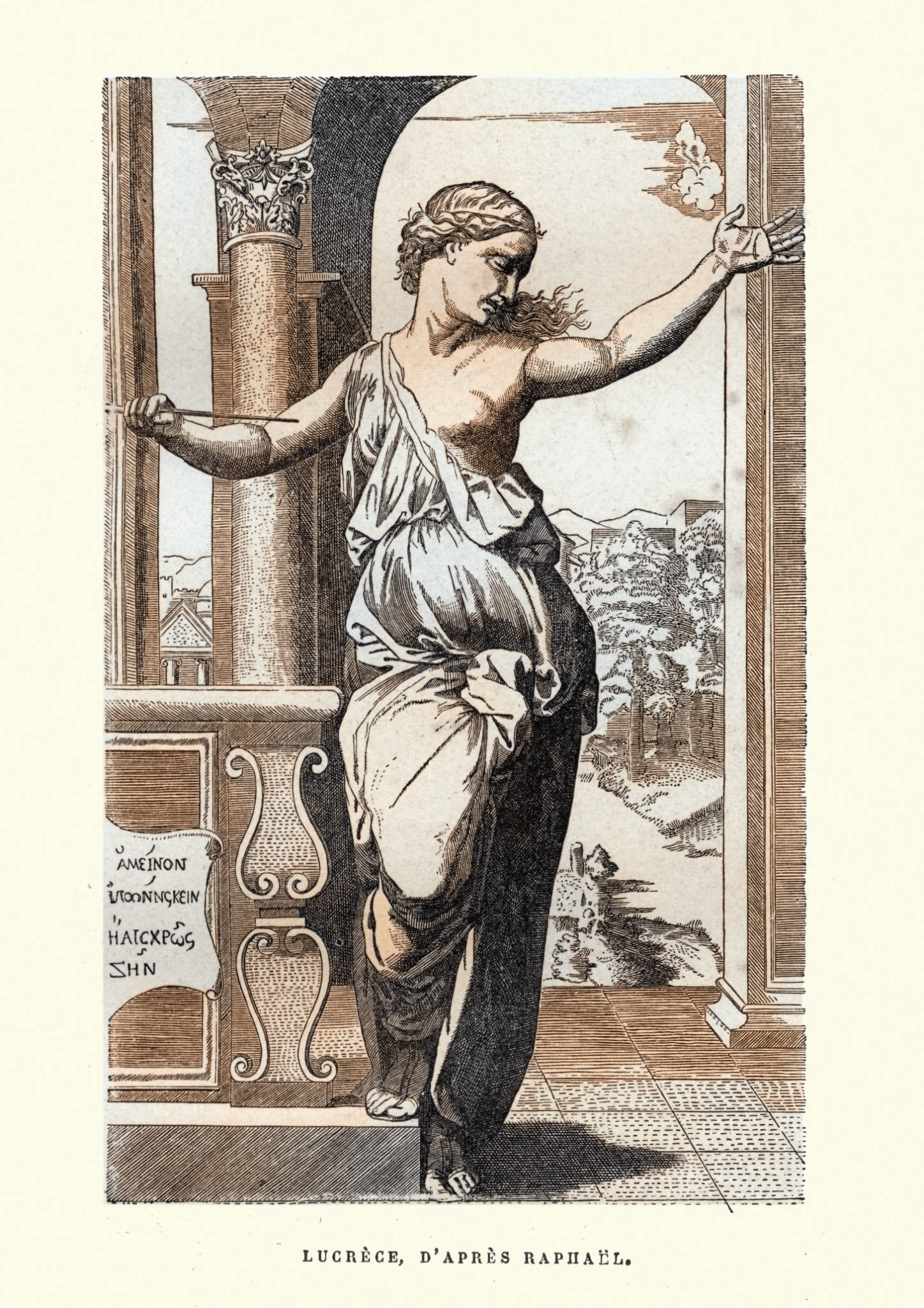
公元前 509 年,按传统叙事,发生了后来被反复讲述的 Lucretia 事件。
事件发生在王政末期,约公元前 509 年前后。当时罗马正对外作战,国王 Lucius Tarquinius Superbus 及其子随军在外。根据罗马传统叙事,贵族年轻男子之间流行比较妻子贤德的谈话,这类场景在古代史书中并不罕见,常被用作引出家庭伦理事件的起点。在这次谈话中,国王之子 Sextus Tarquinius 在场,有人提到贵族妇女 Lucretia 以贞洁、勤勉著称。
据李维记载,几名贵族随后夜间骑马回城,突访各自家中,以观察妻子是否守序。其他贵族妇女多在宴饮或休息,唯独 Lucretia 被发现仍在家中纺织、管理家务。不久之后,Sextus Tarquinius 单独返回 Lucretia 家中,以王子身份请求留宿。夜深时,他进入 Lucretia 的房间,以武力和明确的威胁迫使她屈服:若她拒绝,他将杀死她,并制造她与奴隶通奸的假象,使其在死后背负不可洗刷的耻辱。
事后,Lucretia 并未选择隐瞒。她立即派人召来丈夫与父亲,并请他们各自带一位可信赖的贵族作为见证。到场者中包括后来在共和国建立中占据核心地位的 Lucius Junius Brutus。在众人面前,Lucretia 详细叙述了事情经过,明确区分了“身体被迫”与“道德清白”,强调自己并非自愿。但在当时的伦理观念中,即便是被迫的失节,依然被视为家族难以承受的污点。叙述结束后,她当场自尽。
Lucretia 的遗体并未被私下处理,而是被公开展示。她的死亡迅速在贵族阶层中传播,并被理解为王权已经侵犯到最核心的家族边界。古代叙事对此表达得非常清楚:事件的重要性不在于它是一桩性暴力案件,而在于它发生在王室与贵族家庭之间,象征着王权越界。换句话说,它在叙事结构中被当作一个“阈值信号”:如果连最核心家族的身体与荣誉都无法受到保护,那么没有任何规则仍然有效。
同一年,在 Lucretia 的遗体前,Lucius Junius Brutus 当众宣誓,号召驱逐国王及其家族。这一誓言被描述为公开的、集体的、不可撤回的政治行动。随后,贵族阶层迅速协调行动,Tarquinius Superbus 被宣布放逐,王族被逐出罗马,王位也不再被保留以等待继任者。后世将这一年定为公元前 509 年,并将其视为罗马共和国的象征性起点。
因此,接下来的行动并非群众起义,而是精英主导的制度性切断。关键判断非常明确:问题不在“换一个更好的国王”,而在于国王这个职位本身已经与现有国家能力不相容。只要这个位置存在,任何继任者都将再次集齐同样的工具,并把系统推回同样的失控区间。唯一理性的解法,是把这个位置连根拔除。
在 Lucius Tarquinius Priscus 与 Servius Tullius 时期,罗马已经不再是部落城市,而是一个具备常设工程、军队动员、人口统计和分层政治结构的早期国家。税收、劳役、军役和政治资格开始被系统性管理。这一阶段的结果是:国家能力被建起来了,但没有刹车机制。权力仍然集中在国王身上,只是工具更强了。
首先是常设工程。此前的建设更多依赖一次性动员:修了就完,靠习俗维护。塔克文时期出现的工程(传统上最典型的,是大型排水与城市整治)要求长期规划、连续劳力、稳定资源输入和跨代维护。这意味着国家第一次需要一种持续性的组织能力:谁来干、干多久、怎么供养、谁负责监督。工程把权力从“发号施令”变成“流程控制”。从此,统治者是否被认可,不再完全决定于声望,而决定于能否让系统不断转动。
其次是军队动员的制度化。战争不再只是临时征召的共同体行为,而开始依托登记、分组、轮替和长期服役能力。军役开始与人口统计、财产分层挂钩。国家第一次能回答:我们有多少可动员的人、他们的装备层级如何、谁在战时承担哪一档风险。军队因此不再只是国王的随从,而成为一种可计算的国家资源。
第三是人口统计与分层政治结构。塞尔维乌斯的改革并不是民主化,而是治理理性:通过普查、财产分级、百人团编组,把社会拆解为可管理的层级。政治资格、军役义务和公共责任被系统性绑定。身份从“你是谁家的”,转向“你能承担什么功能”。这一步让国家第一次拥有抽象化的社会视图——它不需要认识每个人,只需要掌握分类。
第四是税收、劳役与资格的制度化绑定。一旦工程、军队和人口被制度化,财政就不可能再靠战利品维持。税收、强制劳役、公共义务开始成为常态,而不是例外。更重要的是,这些义务与政治资格被捆绑:你之所以有位置,是因为你被纳入这套系统。这不是权利扩张,而是责任的普遍化。
到这里,国家能力已经齐备:能修、能算、能征、能动员、能长期维持。但问题正出在你指出的那一句——没有刹车机制。这些能力仍然集中在国王一人身上。任期不受限、否决不存在、权力不可逆。工具越强,风险越大。此前国王的失误是“会惹怒人”;现在的失误,变成“能摧毁系统”。
因此,这一阶段的危险不在于统治者是否残暴,而在于国家机器第一次强到足以压倒社会,却还没有任何结构性约束。只要国王愿意,他可以持续征调、持续施工、持续动员,而社会没有制度性方式让他停下来。所有的制衡仍停留在道德、习俗或个人关系层面,而这些在国家化权力面前开始失效。
这正是为什么下一任 Lucius Tarquinius Superbus 会成为临界点。不是因为他“更坏”,而是因为他继承了一套已经完成国家化、却尚未被制度拆解的权力结构。罗马在这一刻第一次被迫面对一个现代意义上的问题:当国家已经成形,谁还能安全地坐在权力中心?工程与征调继续扩大,但缺乏明确的时间边界。司法裁断不再严格依循既有祖制,判决更多取决于王权意志。到公元前 6 世纪末,罗马精英阶层开始意识到,原本用于稳定行动节奏的协商、宗教与习俗,已经无法有效限制国王使用权力的方式。
贵族妇女 Lucretia 死亡后,其遗体被其家族成员抬至公共场所。到场者包括其丈夫、父亲以及多名贵族,其中有 Lucius Junius Brutus。在遗体前,Brutus 取出匕首,举起并当众宣誓。根据李维的记载,誓词内容大意为:他以血与钢铁起誓,将驱逐 Lucius Tarquinius Superbus 及其妻子、子女和全部家族;不再允许任何人以“国王”的身份统治罗马;凡试图恢复王政者,皆视为敌人。
誓言完成后,Brutus 将匕首传递给在场其他贵族。其余人依次重复誓言,使用相同或相近措辞。当场未记录反对者。宣誓结束后,Lucretia 的遗体被移出家中。宣誓者随后一同离开现场,前往城内活动。当时国王 Tarquinius Superbus 及其子并不在罗马城内。城中贵族开始集结。元老院成员陆续出现于公共场所。同年,Tarquinius Superbus 被宣布放逐,其家族成员被逐出罗马城。王位未再设立继任者。
这一年并没有造成政权真空,恰恰相反,立即进入制度重组。在 Lucius Tarquinius Superbus 被宣布放逐之后,罗马城内并未设立新的国王。原本由国王承担的最高行政、军事与司法事务,开始由多名贵族临时处理。
最早承担最高事务的人是 Lucius Junius Brutus 与 Lucius Tarquinius Collatinus。Lucius Junius Brutus 出身于罗马贵族家庭,属于 Junius 家族。按罗马传统叙事,他在王政末期长期表现得沉默寡言,未在公开政治中居于核心位置。在国王被宣布放逐后,Brutus 开始与他人共同处理罗马城内的最高行政与军事事务。随后,他成为最早承担这一职权的人之一。罗马传统将他列为第一任执政官之一。在之后的数年中,Brutus 继续参与军事行动。根据传统记载,他在与王政支持者的战斗中阵亡。
Lucius Tarquinius Collatinus 出身于 Tarquinius 家族,与被放逐的国王家族同姓。他是 Lucretia 的丈夫,事发时居住在 Collatia,因此得名 “Collatinus”。在 Lucretia 死亡后,Collatinus 与其父一同出现在现场,并参与随后发生的宣誓行动。在国王被宣布放逐后,Collatinus 与 Brutus 一同开始共同行使罗马城内的最高行政与军事职权。罗马传统同样将他列为最早的执政官之一。不久之后,由于其家族姓氏与被驱逐的王族相同,Collatinus 受到反对,被要求辞去职权并离开罗马。他随后退出政治中心,其职位由他人接替。
两人同时在位,共同行使指挥军队、主持城内事务和对外发布命令的权力。当时尚未出现固定的官职名称。在随后的实践中,这种“由两人同时承担最高职权”的做法被保留下来。每次任职都有明确的结束时间,任期届满后由他人接替。后来,这一职位被称为执政官。
在同一时期,Roman Senate 继续存在并召开会议。元老院成员并未因王政结束而整体更替,其成员多为长期在位的贵族。执政官更替频繁,而元老院成员保持连续。城内重大事务常在元老院讨论后执行,但元老院本身不直接发布行政命令。与此同时,城内的公民大会继续被召集。大会被用于选出承担最高职权的人选,并用于公开宣读和确认重要决定。大会并不负责日常行政事务,其作用集中在选举与确认程序上。
在随后几年中,上述做法被反复执行:最高职权始终由两人同时承担;任期结束后即更换人选;元老院保持成员连续;公民大会参与选举与公开确认。到公元前 5 世纪初,罗马城内不再出现“国王”这一职位名称,最高行政与军事事务由年度更替的官员承担,元老院与公民大会持续运作。
这一年成为共和国的象征性起点,并非因为它带来了更高的道德或更广的平等,而是因为它确立了一条冷酷而持久的底线:国家已经强大到可以压迫社会,因此任何人都不应再独占国家。罗马对“王”的病态警惕,正是从这一刻开始,被写进制度与记忆之中。
Preface: This article was written in collaboration with ChatGPT.
According to traditional accounts, the event later known and repeatedly retold as the Lucretia affair occurred in 509 BCE.
The incident took place at the very end of Rome’s monarchical period, around 509 BCE. At the time, Rome was engaged in external warfare, and King Lucius Tarquinius Superbus and his sons were away with the army. In Roman traditional narratives, it was common for young aristocratic men to engage in conversations comparing the virtue of their wives. Such scenes are not rare in ancient historiography and are often used as narrative entry points for domestic moral episodes. In one such conversation, the king’s son Sextus Tarquinius was present, and someone mentioned that the noblewoman Lucretia was renowned for her chastity and diligence.
According to Livy, several aristocrats then rode back to the city at night and unexpectedly visited their homes to observe whether their wives were behaving properly. While most noblewomen were found feasting or resting, Lucretia alone was discovered still at home, spinning wool and managing household affairs. Not long afterward, Sextus Tarquinius returned alone to Lucretia’s house and, invoking his status as a prince, requested hospitality. Late at night, he entered Lucretia’s chamber and used force and explicit threats to compel her submission: if she resisted, he would kill her and fabricate the appearance that she had committed adultery with a slave, ensuring that she would bear an indelible disgrace even after death.
Afterward, Lucretia did not choose to conceal the crime. She immediately sent for her husband and her father and asked each to bring a trusted nobleman as a witness. Among those who arrived was Lucius Junius Brutus, who would later play a central role in the founding of the Republic. Before them all, Lucretia recounted the events in detail, clearly distinguishing between bodily coercion and moral innocence, emphasizing that she had not acted willingly. Yet within the ethical framework of the time, even coerced sexual violation was still regarded as a stain unbearable for the family. After finishing her account, she took her own life on the spot.
Lucretia’s body was not dealt with privately but was publicly displayed. News of her death spread rapidly among the aristocracy and was understood as evidence that royal power had violated the most fundamental boundary of the family. Ancient narratives are explicit on this point: the significance of the event does not lie in the fact that it was an act of sexual violence, but in that it occurred between the royal house and an aristocratic family, symbolizing a transgression of royal authority. In other words, within the narrative structure it functioned as a “threshold signal”: if even the most protected bodies and honor of core families could not be safeguarded, then no rule remained intact.
That same year, before Lucretia’s body, Lucius Junius Brutus publicly swore an oath calling for the expulsion of the king and his family. The oath is described as a public, collective, and irrevocable political act. Soon afterward, the aristocracy coordinated their actions swiftly. Tarquinius Superbus was declared expelled, the royal family was driven out of Rome, and the kingship was not preserved to await a successor. Later tradition fixed this year as 509 BCE and treated it as the symbolic beginning of the Roman Republic.
Thus, what followed was not a popular uprising but an elite-led institutional rupture. The key judgment was explicit: the problem was not “finding a better king,” but that the position of king itself had become incompatible with the existing capacities of the state. As long as the position existed, any successor would inevitably reassemble the same tools and push the system back into the same zone of instability. The only rational solution was to remove the position entirely, root and branch.
By the reigns of Lucius Tarquinius Priscus and Servius Tullius, Rome was no longer a tribal city but an early state with permanent construction projects, organized military mobilization, population registration, and a stratified political structure. Taxation, corvée labor, military service, and political qualification began to be managed systematically. The result of this phase was clear: state capacity had been built, but there was no braking mechanism. Power remained concentrated in the king—only now with stronger tools.
First came permanent public works. Earlier construction relied largely on one-time mobilization: once completed, maintenance depended on custom. The projects associated with the Tarquin period—traditionally exemplified by large-scale drainage and urban works—required long-term planning, continuous labor, stable resource inputs, and intergenerational maintenance. This meant the state, for the first time, required sustained organizational capacity: who worked, for how long, how they were supplied, and who supervised them. Construction transformed power from issuing commands into controlling processes. From then on, a ruler’s legitimacy depended less on prestige than on the ability to keep systems running.
Second was the institutionalization of military mobilization. Warfare ceased to be merely a temporary communal effort and became grounded in registration, grouping, rotation, and long-term service capacity. Military obligation became linked to census data and property stratification. For the first time, the state could answer: how many people could be mobilized, what level of equipment they possessed, and who bore which level of risk in war. The army thus ceased to be merely the king’s retinue and became a calculable state resource.
Third came population registration and a stratified political structure. The reforms attributed to Servius Tullius were not democratization but administrative rationalization: through censuses, property classes, and centuriate organization, society was broken down into manageable layers. Political qualification, military obligation, and public responsibility were systematically bound together. Identity shifted from “whose family you belong to” to “what function you can perform.” This step gave the state its first abstract view of society—it no longer needed to know individuals, only categories.
Fourth was the institutional binding of taxation, labor, and qualification. Once construction, the army, and population management were institutionalized, finance could no longer rely on spoils of war. Taxation, compulsory labor, and public obligations became the norm rather than the exception. More importantly, these obligations were tied to political status: you had a place because you were incorporated into this system. This was not an expansion of rights but a universalization of responsibility.
At this point, state capacity was complete: the ability to build, calculate, levy, mobilize, and sustain long-term operations. The problem lay precisely where you pointed—to the absence of a braking mechanism. These capacities remained concentrated in a single individual. Terms were unlimited, vetoes nonexistent, power irreversible. The stronger the tools, the greater the risk. Previously, a king’s failures might merely “anger people”; now, failure could “destroy the system.”
Thus, the danger of this phase did not lie in whether rulers were cruel, but in the fact that the state had become powerful enough to overwhelm society without any structural constraint. If the king wished, he could continue requisitioning, building, and mobilizing indefinitely, while society had no institutional means to make him stop. All restraints remained moral, customary, or personal—and these began to fail in the face of state-level power.
This is why Lucius Tarquinius Superbus became the critical threshold. Not because he was “worse,” but because he inherited a power structure that had fully become state-like yet had not been institutionally dismantled. Rome was forced, for the first time, to confront a modern question: once the state exists, who can safely occupy its center? Construction and requisition continued to expand without clear temporal limits. Judicial decisions no longer strictly followed ancestral custom but increasingly reflected royal will. By the late sixth century BCE, Roman elites realized that the mechanisms that once stabilized political action—consultation, religion, and custom—could no longer effectively limit how royal power was exercised.
After Lucretia’s death, her body was carried by her family into a public space. Present were her husband, her father, and several nobles, including Lucius Junius Brutus. Before the body, Brutus drew a dagger, raised it, and swore publicly. According to Livy, the oath pledged—roughly—that he would, by blood and steel, expel Lucius Tarquinius Superbus, his wife, children, and entire family; that no one would ever again be allowed to rule Rome as king; and that anyone who attempted to restore monarchy would be treated as an enemy.
After the oath, Brutus passed the dagger to the other nobles present, who in turn repeated the oath using similar wording. No dissenters were recorded. When the oath was complete, Lucretia’s body was removed from the house. The oath-takers then departed together into the city. At the time, Tarquinius Superbus and his sons were not in Rome. Aristocrats within the city began to assemble. Members of the Senate appeared in public spaces. That same year, Tarquinius Superbus was declared expelled, his family driven out of Rome, and no successor to the throne was appointed.
There was no power vacuum. On the contrary, the city immediately entered a phase of institutional reorganization. After Tarquinius Superbus was expelled, no new king was installed. The supreme administrative, military, and judicial functions formerly held by the king were temporarily handled by multiple aristocrats.
The earliest to assume these supreme responsibilities were Lucius Junius Brutus and Lucius Tarquinius Collatinus. Brutus came from the patrician Junius family. In traditional Roman accounts, during the late monarchy he had long appeared taciturn and politically marginal. After the king’s expulsion, Brutus began jointly handling Rome’s highest administrative and military affairs and became one of the first to hold this authority. Roman tradition lists him as one of the first consuls. In subsequent years, he continued to participate in military campaigns and, according to tradition, was killed in battle against supporters of the monarchy.
Lucius Tarquinius Collatinus came from the Tarquinius family and shared the same nomen as the expelled royal house. He was Lucretia’s husband and lived in Collatia, hence the name “Collatinus.” After Lucretia’s death, he appeared at the scene with her father and participated in the oath. Following the king’s expulsion, Collatinus jointly exercised Rome’s highest administrative and military authority with Brutus and was likewise counted among the earliest consuls. Shortly thereafter, however, because of his family name’s association with the expelled monarchy, Collatinus faced opposition, was required to resign, and left Rome. His position was then filled by another.
The two held office simultaneously, jointly commanding the army, presiding over city affairs, and issuing orders. At this stage, there was no fixed title for the office. In later practice, this arrangement—two individuals simultaneously holding supreme authority—was retained. Each term had a clear end, after which successors were appointed. This office later came to be known as the consulship.
During the same period, the Roman Senate continued to exist and to meet. Its membership did not change wholesale with the end of monarchy; senators were largely long-standing aristocrats. While consuls rotated frequently, the Senate’s membership remained continuous. Major affairs were often discussed in the Senate before being carried out, though the Senate itself did not issue executive commands. Meanwhile, the popular assemblies continued to be convened, primarily to select those who would hold supreme authority and to publicly proclaim and confirm major decisions. The assemblies did not handle daily administration; their role was concentrated in election and confirmation.
In the following years, these practices were repeatedly carried out: supreme authority was always held jointly by two individuals; terms ended and successors were appointed; the Senate maintained continuity; and the assemblies participated in elections and public ratification. By the early fifth century BCE, the title of “king” no longer appeared in Rome, with supreme administrative and military affairs entrusted to annually rotating officials while the Senate and popular assemblies continued to operate.
This year became the symbolic starting point of the Republic not because it ushered in greater morality or broader equality, but because it established a harsh and enduring bottom line: the state had become powerful enough to oppress society, and therefore no individual should ever again monopolize it. Rome’s pathological suspicion of “kingship” begins here, written into both its institutions and its collective memory.