Created on

1

/

29

/

2026

,

20

:

34

Updated on

1

/

29

/

2026

,

21

:

25

Location

Oakland, CA

The Old World(V): Seven Kings of Rome

旧世界(V): 罗马七王
写在前面:本文和chatgpt合作完成。


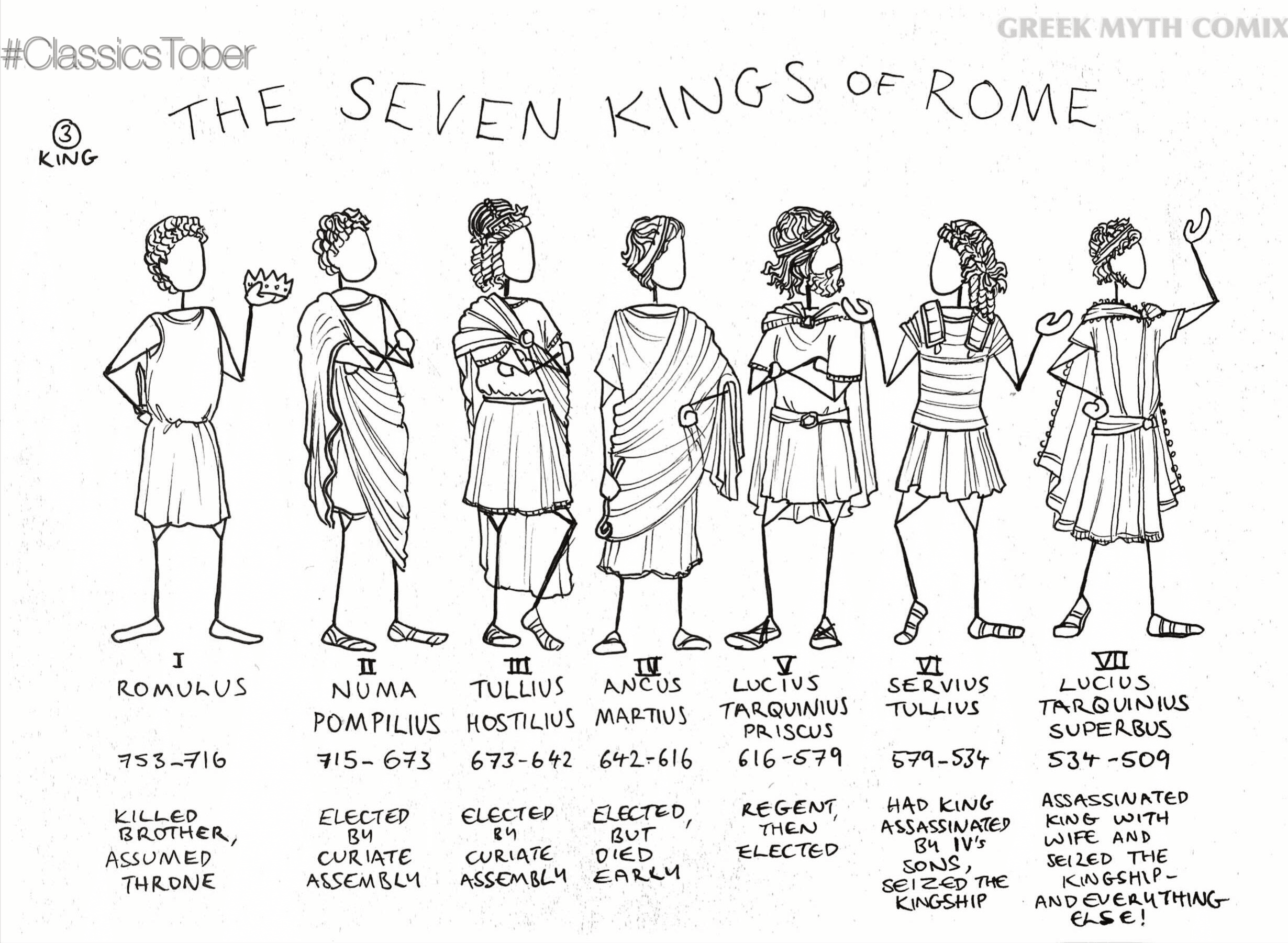
在努马·庞皮利乌斯(Numa Pompilius)之后,罗马传统叙事中的“王政时代”还剩下五位国王,加上罗慕路斯与努马,合称“罗马七王”。古代作者通常把这一时期放在约公元前753年至前509年之间。

但有一个前提必须先说清楚:这整段历史,并不是同时代留下的连续记录,而是罗马共和国乃至帝国时期的作者(例如李维)回头为早期罗马建构的一套起源叙事。具体年代、事件细节,很难用现代史学方法逐条验证。因此,更稳妥的读法不是把它当作精确的编年史,而是把它理解为:罗马后来如何解释“我们是怎么走到这一步的”——一种政治神话,也是一种制度自我说明。

在这套叙事结构中,努马代表的是“向内收束”的阶段。他用宗教、仪式与禁忌,把一个高度不稳定的早期共同体固定下来,让冲突不至于先在内部爆裂。紧接着登场的图鲁斯·霍斯提利乌斯(Tullus Hostilius),则被刻意塑造成对照人物:强调战争、动员与扩张。

但这里的重点,并不只是“好战”本身。叙事真正要回答的是另一个问题:当内部秩序已经被稳定住,一个正在增长的共同体接下来靠什么生存?在传统故事里,图鲁斯给出的答案是:有目标、有结构的对外战争。

图鲁斯故事中最核心的事件,是对阿尔巴隆加(Alba Longa)的战争。阿尔巴隆加在罗马传说里并非普通敌国,而是“同源的拉丁竞争者”,甚至被描绘为血统更古老、更具合法性的中心。李维等作者强调的结局,并不是简单的屠城:阿尔巴隆加作为独立政治实体被消灭,但它的居民,尤其是显贵家族,被整体迁入罗马,重新安置进罗马的社会与政治结构中;城市本身则被毁。

这一处理方式的重点,不在战术胜负,而在一个政治命题:你可以失去原先的城邦身份,但只要接受罗马的框架,就有可能在新的秩序中获得位置。罗马传统叙事中,这被反复用来说明一种自我形象——罗马不是靠彻底毁灭他者壮大的,而是靠“吸纳并重组”。这可以被视为后世罗马治下整合他者想象的早期母题,但不宜直接把它当作后来的行省制度或公民权扩张的真实制度起点。

从这个角度看,图鲁斯并不是努马的反面,而是他的补丁。努马解决的是“共同体如何不先内爆”,图鲁斯解决的是“共同体如何在外部竞争中继续增长”。这对组合本身,就是罗马神话留给后世的一条清晰政治逻辑:先把自己管住,再通过对外行动不断重画边界,并在胜利之后扩大“我们”的范围。

其后的安库斯·马尔基乌斯(Ancus Marcius),在传统叙事中常被描绘为在战争与宗教之间重新取得平衡的人物,并被归功于基础设施与对外接口的建设,例如奥斯提亚港的建立。这里同样需要保留“相传”“传统上归于”的措辞:这些故事更像是后世用来解释罗马为何能从城邦走向区域性力量的制度寓言。它们强调的,是道路、桥梁、港口与贸易接口如何让国家在非战争状态下也能持续运转,而不再完全依赖掠夺与临时动员。

从第五任卢基乌斯·塔克文·普里斯库斯(Lucius Tarquinius Priscus)开始,传统叙事明显把罗马写成一种更“国家化”的形态:大型公共工程、城市规划,以及更集中的王权。像马克西穆斯大下水道(Cloaca Maxima)这样的工程,常被统称为“塔克文时代”的成果。具体归属在古代来源之间并不完全一致,考古材料也难以精确对应到某一位国王,更稳妥的理解是:罗马传统借这些工程,象征性地说明王政后期行政动员与长期组织能力的跃升。

第六任塞尔维乌斯·图里乌斯(Servius Tullius),则在古代传统中被塑造成最重要的制度改革者。他被归功于按财产与服役能力,而非单纯血缘,重新组织公民,并与百人团集会(comitia centuriata)和人口财产登记(census)的形成联系在一起。这套改革在叙事上的意义很清楚:罗马的人口与财富结构已经复杂到,无法继续只靠旧贵族共识来运转,国家必须用可量化的义务与资源动员能力,来重写成员资格与政治位置。需要保留的限定是:这些改革“传统上归于塞尔维乌斯”,在现代研究中常被视为长期演变的结果,而非一次性的制度创制。

最后一任卢基乌斯·塔克文·苏佩布斯(Lucius Tarquinius Superbus),在传统叙事中以专制和无视贵族共识著称。他的统治及其相关故事(包括路克蕾提娅事件),被用来解释:为什么罗马必须终结王权本身。公元前509年“驱逐国王、建立共和国”的时间点,同样属于传统编年。把这一转变理解为一次以精英为主导的制度性断裂,是一种常见且合理的现代解读,但更稳妥的写法仍然是:从叙事所呈现的权力结构来看,后世史家通常如此理解。

在这套传统叙事中,共和国诞生的核心动机,可以被概括为一种“反国王的风险控制”。最高权力被拆分为任期有限、彼此牵制的职位(如双执政官),并辅以元老院与公民大会作为持续性的制衡结构。罗马人对“王”这个词的高度警惕,作为共和国政治文化的一部分,是清晰可见的。

但同样需要避免年代错置。罗马传统很早就用“吸纳他者”的故事来解释自身扩张,但真正成熟、可大规模复制的身份转换机制,是在共和国中后期到帝国时期,才逐步发展出来的。早期王政时代留下的,与其说是完整制度,不如说是一套后来反复被调用的政治想象与叙事模板。

Preface: This was written in collaboration with ChatGPT.


After Numa Pompilius, Roman tradition places five additional kings, forming the well-known sequence of the “Seven Kings of Rome.” Ancient authors usually date this period from around 753 BCE to 509 BCE.

One clarification needs to come first. This entire stretch of early Roman history is not a contemporaneous record. It was reconstructed retrospectively by writers of the Roman Republic and early Empire—most famously Livy—who were looking back several centuries. The dates and many specific details cannot be independently verified by modern historiography. A more reliable way to read this material is therefore not as a strictly factual chronology, but as Rome’s own explanation of how it understood its origins: a political myth and an institutional self-portrait rather than a fully checkable historical record.

Within this narrative framework, Numa represents a phase of inward consolidation. Through religion, ritual, and taboo, he stabilizes a fragile early community and prevents conflict from erupting internally. His successor, Tullus Hostilius, is deliberately cast as a contrast: the figure of war, mobilization, and expansion.

The point, however, is not simply to glorify violence. The deeper question the narrative is trying to answer is this: once internal order has been secured, how does a growing community continue to survive? In the traditional story, Tullus’s answer is deliberate, goal-oriented external war.

The central episode of his reign is the war against Alba Longa. In Roman legend, Alba Longa is not just another enemy city, but a kindred Latin rival, sometimes portrayed as older and even more legitimate than Rome itself. According to Livy and other sources, the outcome is not simple annihilation. Alba Longa is destroyed as an independent political entity, but its people—especially its leading families—are transferred to Rome and reinserted into Rome’s social and political structure. The city is erased; the people are reclassified.

The emphasis here is not military victory, but a political proposition: you may lose your original civic identity, yet still gain a place within a larger order—if you accept Rome’s framework. In Roman tradition, this episode becomes a foundational motif explaining Rome’s self-image as a power that grows through incorporation rather than sheer extermination. It can be read as an early template for how Romans later imagined integration under their rule, but it should not be treated as a verifiable institutional origin of provincial administration or citizenship policy.

From this perspective, Tullus is not the opposite of Numa, but his complement. Numa answers the question of how a community avoids self-destruction; Tullus answers how that stabilized community expands in a competitive external environment. Together, they form a clear narrative logic embedded in Roman myth: first impose order on yourself, then redraw boundaries through action, and after victory, enlarge the definition of “us.”

The next king, Ancus Marcius, is traditionally portrayed as restoring balance between religion and war and is credited with infrastructure and external interfaces—most notably the founding of Ostia, Rome’s port. Here again, phrases like “according to tradition” matter. These stories function less as verifiable history than as institutional allegory, explaining how Rome could transition from a city sustained by episodic mobilization and spoils into one supported by roads, bridges, ports, and trade—systems that allow a state to function even in peacetime.

With the fifth king, Lucius Tarquinius Priscus, Roman tradition depicts a more visibly “state-like” Rome: large public works, urban planning, and a more centralized kingship. Projects such as the Cloaca Maxima are commonly attributed to the “Tarquinian period,” though ancient sources disagree on specifics, and archaeology cannot securely assign them to a single reign. A safer reading is that Roman tradition uses these works symbolically to mark a rise in administrative and mobilizational capacity in the late monarchy.

The sixth king, Servius Tullius, is given the role of major institutional reformer. Tradition credits him with reorganizing the citizen body according to property and military obligation rather than lineage, linking his name to the census and the centuriate assembly (comitia centuriata). The narrative meaning of these reforms is clear: Rome’s population and wealth had become too diverse to be managed solely through aristocratic consensus. Political position is therefore rewritten in terms of measurable contribution and liability. It is important to retain the qualifier that these reforms are traditionally attributed to Servius; many modern scholars see them as the result of longer processes rather than a single legislative moment.

The final king, Lucius Tarquinius Superbus, is remembered as a tyrant whose rule explains why monarchy itself had to be abolished. His reign—and stories such as the rape of Lucretia—are used to justify the expulsion of the kings and the founding of the Republic in 509 BCE, another conventional date from the traditional chronology. Interpreting this transition as an elite-driven institutional rupture rather than a popular revolution is a common and plausible modern reading, but it remains an interpretation rather than a directly documented sequence of events.

Within Roman tradition, the core motivation of the Republic can thus be described as risk management against kingship. Power once concentrated in a single lifetime ruler is broken into offices that are time-limited and mutually constraining, most notably the dual annual consulship, supported by the Senate and popular assemblies. Roman hostility toward the very word “king” becomes a defining feature of Republican political culture.

At the same time, caution is needed to avoid chronological overreach. Roman narratives about incorporation and absorption appear very early, but the mature, large-scale, legally articulated systems that could reliably convert outsiders into Romans developed much later, during the middle and late Republic and were fully realized only under the Empire. What the early monarchy provides is not a finished institutional model, but a set of stories and political imaginaries that later Romans repeatedly drew upon to explain who they were and how they grew.

Artist Statement

My work is not about explaining the world; it’s about dismantling the emotional structures that everyday life tries to conceal. What I focus on is not “story,” but the dynamics between people—the pull and tension of intimacy, the quiet control embedded in family, the fractures that come with migration, and how an individual maintains their boundaries within these systems.

I grew up between shifting cultures and languages, often in environments where I was expected—needed—claimed by others. I was asked to understand, to accommodate, to take care, to adjust. Even the gentlest relationships carried an undercurrent of consumption. That tension became the foundation of my creative work.

The characters in my stories are not moral types. They each carry a kind of private conflict: they want closeness but fear being swallowed; they long to be seen but can’t fully expose themselves; they are asked again and again to give—to family, to love, to work—without knowing how to keep space for themselves. These aren’t inventions; they’re reflections of lived experience. Writing, for me, is a way to unearth the emotions that have been suppressed, ignored, or normalized—and let them speak again.

I gravitate toward rhythmic narrative structures: compressed scenes, quick shifts, intentional gaps, silences between characters. These spaces reveal more truth than dialogue ever could. The themes I explore—migration, family, identity, trauma, intimacy, female autonomy—ultimately point to a single question: how does a person protect their boundaries in a world that constantly pulls at them, demands from them, watches them?

Creating is neither escape nor self-soothing. It is a way of reclaiming authorship over my own narrative. When I write a character’s silence, resistance, hesitation, or departure, I’m answering one essential question:

When the world insists on defining me, how do I choose to define myself?

艺术家陈述

我的创作不是为了解释世界,是为了拆开被日常掩盖的情绪结构。我关注的核心不是“故事”,而是人与人之间的力量关系——亲密带来的拉扯、家庭带来的隐性控制、身份在迁徙中的断裂,以及一个人在这些结构里如何保持自己的边界。

出生在不断变化的文化与语言之间,长期处在“被期待—被需要—被占用”的环境里。很多时候,我被要求理解别人、照顾别人、顺着环境。那些看似温和的关系里,也潜藏着吞噬性的需求。这种张力成了我创作的源头。

在我的故事里,人物不是善恶分明的类型。他们都带着某种困境:他们想靠近别人,但又害怕被吞没;他们渴望被看见,却无法完全暴露自己;他们在家庭、爱情、工作里不断被要求付出,却不知道怎样为自己保留空间。这并不是虚构,是现实经验的折射。我写作,把那些长期被压抑、被忽略、被习惯化的情感重新挖出来,让它们重新发声。

我倾向于使用节奏性的叙事结构:压缩的篇幅、快速切换的场景、留白的空间、人物之间的静默。这些“空隙”比对白本身更能暴露一个人的真实状态。我处理的主题是移民、家庭、身份、创伤、亲密、女性的自主性,但它们都指向同一件事:一个人如何在被拉扯、被要求、被凝视的世界里,维护自己的边界。

创作不是逃避,也不是自我疗愈,是重新夺回叙事权的方式。当我写下一个人物的沉默、反抗、犹豫或离开,我其实是在回答一个核心问题:
当世界不断定义我时,我选择如何定义自己?

Artist Statement

My work is not about explaining the world; it’s about dismantling the emotional structures that everyday life tries to conceal. What I focus on is not “story,” but the dynamics between people—the pull and tension of intimacy, the quiet control embedded in family, the fractures that come with migration, and how an individual maintains their boundaries within these systems.

I grew up between shifting cultures and languages, often in environments where I was expected—needed—claimed by others. I was asked to understand, to accommodate, to take care, to adjust. Even the gentlest relationships carried an undercurrent of consumption. That tension became the foundation of my creative work.

The characters in my stories are not moral types. They each carry a kind of private conflict: they want closeness but fear being swallowed; they long to be seen but can’t fully expose themselves; they are asked again and again to give—to family, to love, to work—without knowing how to keep space for themselves. These aren’t inventions; they’re reflections of lived experience. Writing, for me, is a way to unearth the emotions that have been suppressed, ignored, or normalized—and let them speak again.

I gravitate toward rhythmic narrative structures: compressed scenes, quick shifts, intentional gaps, silences between characters. These spaces reveal more truth than dialogue ever could. The themes I explore—migration, family, identity, trauma, intimacy, female autonomy—ultimately point to a single question: how does a person protect their boundaries in a world that constantly pulls at them, demands from them, watches them?

Creating is neither escape nor self-soothing. It is a way of reclaiming authorship over my own narrative. When I write a character’s silence, resistance, hesitation, or departure, I’m answering one essential question:

When the world insists on defining me, how do I choose to define myself?

艺术家陈述

我的创作不是为了解释世界,是为了拆开被日常掩盖的情绪结构。我关注的核心不是“故事”,而是人与人之间的力量关系——亲密带来的拉扯、家庭带来的隐性控制、身份在迁徙中的断裂,以及一个人在这些结构里如何保持自己的边界。

出生在不断变化的文化与语言之间,长期处在“被期待—被需要—被占用”的环境里。很多时候,我被要求理解别人、照顾别人、顺着环境。那些看似温和的关系里,也潜藏着吞噬性的需求。这种张力成了我创作的源头。

在我的故事里,人物不是善恶分明的类型。他们都带着某种困境:他们想靠近别人,但又害怕被吞没;他们渴望被看见,却无法完全暴露自己;他们在家庭、爱情、工作里不断被要求付出,却不知道怎样为自己保留空间。这并不是虚构,是现实经验的折射。我写作,把那些长期被压抑、被忽略、被习惯化的情感重新挖出来,让它们重新发声。

我倾向于使用节奏性的叙事结构:压缩的篇幅、快速切换的场景、留白的空间、人物之间的静默。这些“空隙”比对白本身更能暴露一个人的真实状态。我处理的主题是移民、家庭、身份、创伤、亲密、女性的自主性,但它们都指向同一件事:一个人如何在被拉扯、被要求、被凝视的世界里,维护自己的边界。

创作不是逃避,也不是自我疗愈,是重新夺回叙事权的方式。当我写下一个人物的沉默、反抗、犹豫或离开,我其实是在回答一个核心问题:
当世界不断定义我时,我选择如何定义自己?

Artist Statement

My work is not about explaining the world; it’s about dismantling the emotional structures that everyday life tries to conceal. What I focus on is not “story,” but the dynamics between people—the pull and tension of intimacy, the quiet control embedded in family, the fractures that come with migration, and how an individual maintains their boundaries within these systems.

I grew up between shifting cultures and languages, often in environments where I was expected—needed—claimed by others. I was asked to understand, to accommodate, to take care, to adjust. Even the gentlest relationships carried an undercurrent of consumption. That tension became the foundation of my creative work.

The characters in my stories are not moral types. They each carry a kind of private conflict: they want closeness but fear being swallowed; they long to be seen but can’t fully expose themselves; they are asked again and again to give—to family, to love, to work—without knowing how to keep space for themselves. These aren’t inventions; they’re reflections of lived experience. Writing, for me, is a way to unearth the emotions that have been suppressed, ignored, or normalized—and let them speak again.

I gravitate toward rhythmic narrative structures: compressed scenes, quick shifts, intentional gaps, silences between characters. These spaces reveal more truth than dialogue ever could. The themes I explore—migration, family, identity, trauma, intimacy, female autonomy—ultimately point to a single question: how does a person protect their boundaries in a world that constantly pulls at them, demands from them, watches them?

Creating is neither escape nor self-soothing. It is a way of reclaiming authorship over my own narrative. When I write a character’s silence, resistance, hesitation, or departure, I’m answering one essential question:

When the world insists on defining me, how do I choose to define myself?

艺术家陈述

我的创作不是为了解释世界,是为了拆开被日常掩盖的情绪结构。我关注的核心不是“故事”,而是人与人之间的力量关系——亲密带来的拉扯、家庭带来的隐性控制、身份在迁徙中的断裂,以及一个人在这些结构里如何保持自己的边界。

出生在不断变化的文化与语言之间,长期处在“被期待—被需要—被占用”的环境里。很多时候,我被要求理解别人、照顾别人、顺着环境。那些看似温和的关系里,也潜藏着吞噬性的需求。这种张力成了我创作的源头。

在我的故事里,人物不是善恶分明的类型。他们都带着某种困境:他们想靠近别人,但又害怕被吞没;他们渴望被看见,却无法完全暴露自己;他们在家庭、爱情、工作里不断被要求付出,却不知道怎样为自己保留空间。这并不是虚构,是现实经验的折射。我写作,把那些长期被压抑、被忽略、被习惯化的情感重新挖出来,让它们重新发声。

我倾向于使用节奏性的叙事结构:压缩的篇幅、快速切换的场景、留白的空间、人物之间的静默。这些“空隙”比对白本身更能暴露一个人的真实状态。我处理的主题是移民、家庭、身份、创伤、亲密、女性的自主性,但它们都指向同一件事:一个人如何在被拉扯、被要求、被凝视的世界里,维护自己的边界。

创作不是逃避,也不是自我疗愈,是重新夺回叙事权的方式。当我写下一个人物的沉默、反抗、犹豫或离开,我其实是在回答一个核心问题:
当世界不断定义我时,我选择如何定义自己?

sunny.xiaoxin.sun@doubletakefilmllc.com

Sunny Xiaoxin Sun's IMDb


©2025 Double Take Film, All rights reserved

I’m an independent creator born in 1993 in Changsha, now based in California. My writing started from an urgent need to express. Back in school, I often felt overwhelmed by the chaos and complexity of the world—by the emotions and stories left unsaid. Writing became my way of organizing my thoughts, finding clarity, and gradually, connecting with the outside world.


Right now, I’m focused on writing and filmmaking. My blog is a “real writing experiment,” where I try to update daily, documenting my thoughts, emotional shifts, observations on relationships, and my creative process. It’s also a record of my journey to becoming a director. After returning to China in 2016, I entered the film industry and worked in the visual effects production department on projects like Creation of the Gods I, Creation of the Gods II, and Wakanda Forever, with experience in both China and Hollywood. Since 2024, I’ve shifted my focus to original storytelling.


I’m currently revising my first script. It’s not grand in scale, but it’s deeply personal—centered on memory, my father, and the city. I want to make films that belong to me, and to our generation: grounded yet profound, sensitive but resolute. I believe film is not only a form of artistic expression—it’s a way to intervene in reality.

我是93年出生于长沙的自由创作者。我的写作起点来自一种“必须表达”的冲动。学生时代,我常感受到世界的混乱与复杂,那些没有被说出来的情绪和故事让我感到不安。写作是我自我整理、自我清晰的方式,也逐渐成为我与外界建立连接的路径。


我目前专注于写作和电影。我的博客是一个“真实写作实验”,尽量每天更新,记录我的思考、情绪流动、人际观察和创作过程。我16年回国之后开始进入电影行业,曾在视效部门以制片的身份参与制作《封神1》《封神2》《Wankanda Forever》等,在中国和好莱坞都工作过,24年之后开始转入创作。


我正在重新回去修改我第一个剧本——它并不宏大,却非常个人,围绕记忆、父亲与城市展开。我想拍属于我、也属于我们这一代人的电影:贴地而深刻,敏感又笃定。我相信电影不只是艺术表达,它也是一种现实干预。

sunny.xiaoxin.sun@doubletakefilmllc.com

Sunny Xiaoxin Sun's IMDb


©2025 Double Take Film, All rights reserved

I’m an independent creator born in 1993 in Changsha, now based in California. My writing started from an urgent need to express. Back in school, I often felt overwhelmed by the chaos and complexity of the world—by the emotions and stories left unsaid. Writing became my way of organizing my thoughts, finding clarity, and gradually, connecting with the outside world.


Right now, I’m focused on writing and filmmaking. My blog is a “real writing experiment,” where I try to update daily, documenting my thoughts, emotional shifts, observations on relationships, and my creative process. It’s also a record of my journey to becoming a director. After returning to China in 2016, I entered the film industry and worked in the visual effects production department on projects like Creation of the Gods I, Creation of the Gods II, and Wakanda Forever, with experience in both China and Hollywood. Since 2024, I’ve shifted my focus to original storytelling.


I’m currently revising my first script. It’s not grand in scale, but it’s deeply personal—centered on memory, my father, and the city. I want to make films that belong to me, and to our generation: grounded yet profound, sensitive but resolute. I believe film is not only a form of artistic expression—it’s a way to intervene in reality.

我是93年出生于长沙的自由创作者。我的写作起点来自一种“必须表达”的冲动。学生时代,我常感受到世界的混乱与复杂,那些没有被说出来的情绪和故事让我感到不安。写作是我自我整理、自我清晰的方式,也逐渐成为我与外界建立连接的路径。


我目前专注于写作和电影。我的博客是一个“真实写作实验”,尽量每天更新,记录我的思考、情绪流动、人际观察和创作过程。我16年回国之后开始进入电影行业,曾在视效部门以制片的身份参与制作《封神1》《封神2》《Wankanda Forever》等,在中国和好莱坞都工作过,24年之后开始转入创作。


我正在重新回去修改我第一个剧本——它并不宏大,却非常个人,围绕记忆、父亲与城市展开。我想拍属于我、也属于我们这一代人的电影:贴地而深刻,敏感又笃定。我相信电影不只是艺术表达,它也是一种现实干预。

sunny.xiaoxin.sun@doubletakefilmllc.com

Sunny Xiaoxin Sun's IMDb


©2025 Double Take Film, All rights reserved

I’m an independent creator born in 1993 in Changsha, now based in California. My writing started from an urgent need to express. Back in school, I often felt overwhelmed by the chaos and complexity of the world—by the emotions and stories left unsaid. Writing became my way of organizing my thoughts, finding clarity, and gradually, connecting with the outside world.


Right now, I’m focused on writing and filmmaking. My blog is a “real writing experiment,” where I try to update daily, documenting my thoughts, emotional shifts, observations on relationships, and my creative process. It’s also a record of my journey to becoming a director. After returning to China in 2016, I entered the film industry and worked in the visual effects production department on projects like Creation of the Gods I, Creation of the Gods II, and Wakanda Forever, with experience in both China and Hollywood. Since 2024, I’ve shifted my focus to original storytelling.


I’m currently revising my first script. It’s not grand in scale, but it’s deeply personal—centered on memory, my father, and the city. I want to make films that belong to me, and to our generation: grounded yet profound, sensitive but resolute. I believe film is not only a form of artistic expression—it’s a way to intervene in reality.

我是93年出生于长沙的自由创作者。我的写作起点来自一种“必须表达”的冲动。学生时代,我常感受到世界的混乱与复杂,那些没有被说出来的情绪和故事让我感到不安。写作是我自我整理、自我清晰的方式,也逐渐成为我与外界建立连接的路径。


我目前专注于写作和电影。我的博客是一个“真实写作实验”,尽量每天更新,记录我的思考、情绪流动、人际观察和创作过程。我16年回国之后开始进入电影行业,曾在视效部门以制片的身份参与制作《封神1》《封神2》《Wankanda Forever》等,在中国和好莱坞都工作过,24年之后开始转入创作。


我正在重新回去修改我第一个剧本——它并不宏大,却非常个人,围绕记忆、父亲与城市展开。我想拍属于我、也属于我们这一代人的电影:贴地而深刻,敏感又笃定。我相信电影不只是艺术表达,它也是一种现实干预。

PRODUCT

Design

Content

Publish

RESOURCES

Blog

Careers

Docs

About