Created on
Updated on
How to Solve Virtual Lighting II
so how do you imitate real light?

Preface: Welcome to this very long series of filmmaking in the age of AI(2026).
Light types
A lighting artist's toolkit contains several distinct types of virtual light sources, each modeling a different physical configuration. Understanding what each one does — and what it's wrong for — is foundational to the job.
A point light is the simplest: an infinitely small source that emits light equally in all directions from a single position in space. It is an idealization that doesn't exist in nature — real light sources have physical size — but it is computationally cheap and useful for representing small, roughly omnidirectional sources like bare bulbs, candle flames, or anything where the source is small relative to the subject's distance from it. Its shadows are perfectly hard-edged because they originate from a single point. That hardness is its limitation: real light sources are never infinitely small, and real shadows are never perfectly hard.
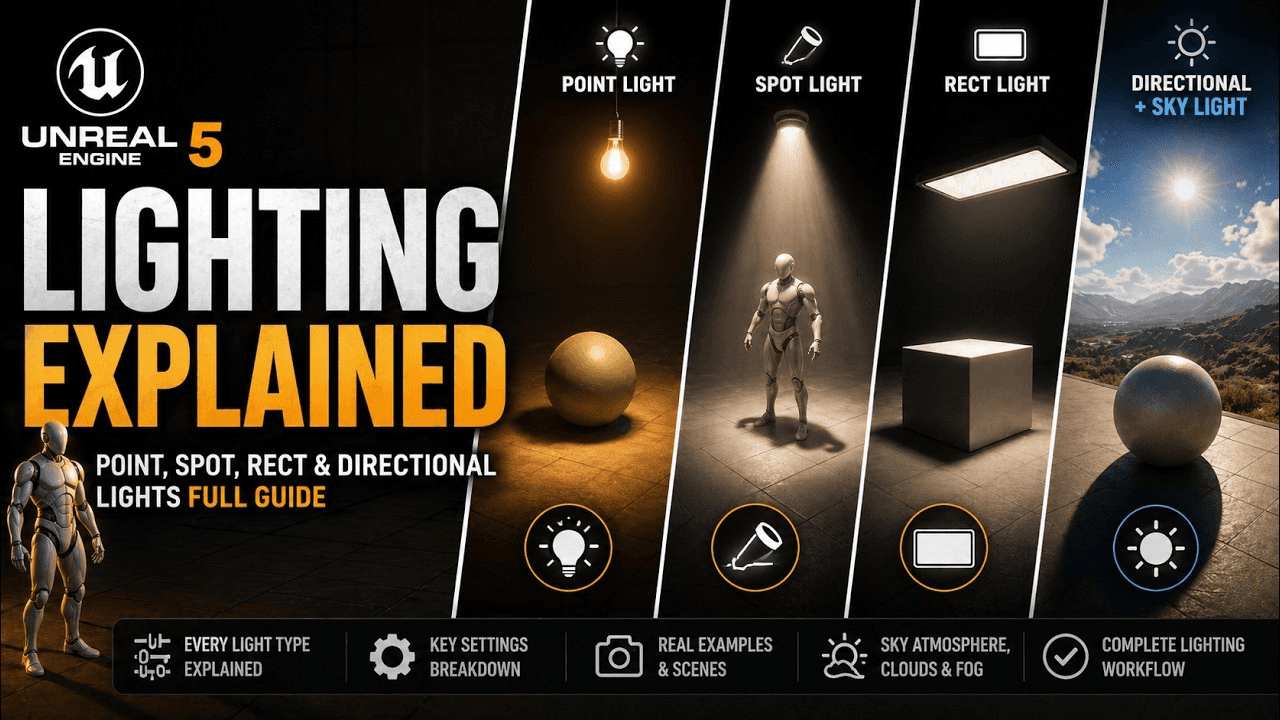
A directional light, sometimes called a distant light or parallel light, emits light in a single direction from infinitely far away. Every ray it produces is parallel. This models the sun accurately: the sun is so far from Earth that its rays arrive essentially parallel, producing consistent shadow angles across the entire scene. Changing the position of a directional light has no effect; only its angle matters. It is the correct type for sunlight, moonlight, and any light source at astronomical distance.
An area light has physical size — a rectangle, a disk, a sphere, or any defined shape that emits light from its entire surface. Because the source has extent, different points on a surface receive light from different parts of the area light, producing soft, graduated shadows whose hardness depends on the source's apparent size from the surface's perspective. A large area light close to the subject produces very soft shadows — like an overcast sky or a large softbox. A small area light at distance produces harder shadows. Area lights model the physical reality of most practical light sources: a window, a light panel, a fluorescent strip, a monitor. They are the default for almost everything in production lighting.
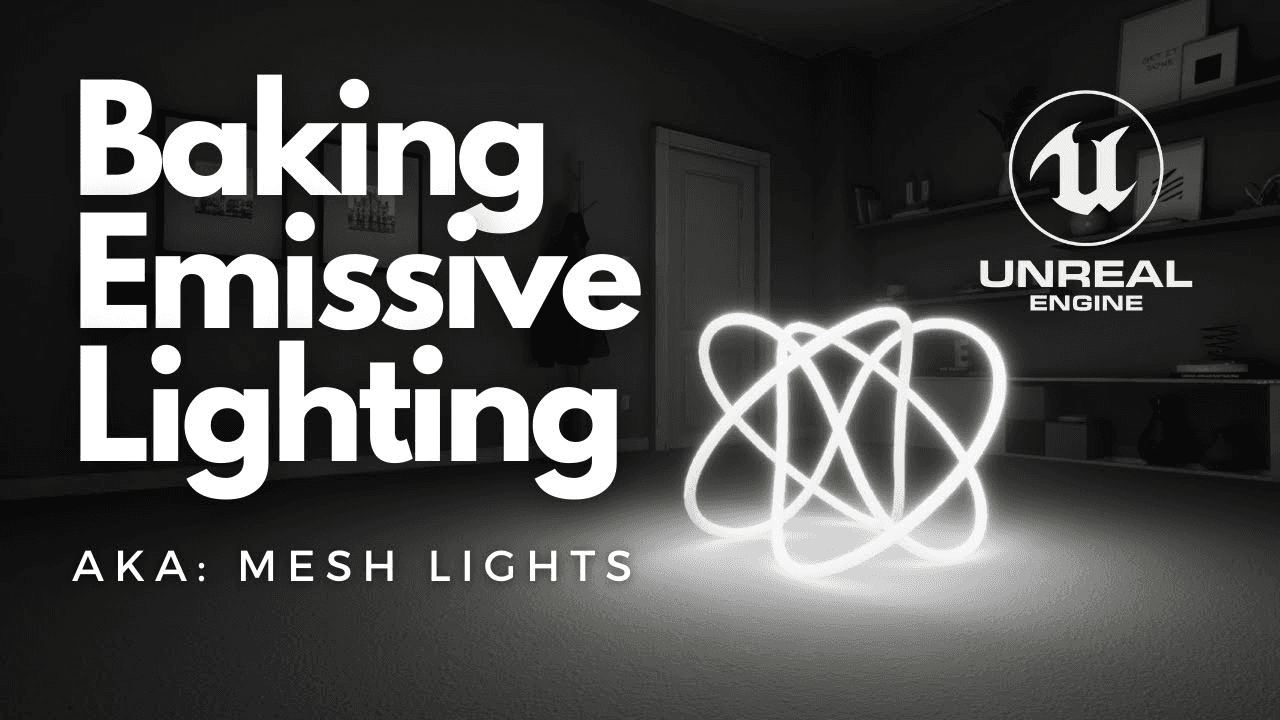
A mesh light, also called an emissive geometry light, takes a piece of 3D geometry and makes its surface emit light. This is how neon signs, computer screens, fire, glowing creatures, and any luminous object with a complex shape are lit in production. Instead of placing a separate light source near a glowing surface and hoping it approximates the effect, a mesh light makes the geometry itself the source, so the lighting has the exact shape and distribution of the physical object. A spaceship with glowing engine nacelles lights the surrounding environment by making the nacelle geometry emissive. The result is far more accurate than any placed light could produce.

An HDRI sky dome wraps an image around the entire scene, illuminating everything from the full 360-degree environment captured in the map. This was covered in the previous post, but it's worth noting here that most production lighting rigs combine an HDRI dome for the general environmental light with placed area lights and mesh lights for specific, controlled sources. The HDRI provides the ambient base — the sky, the bounce light from the ground, the overall color temperature of the environment — while the placed lights allow the artist to control contrast, directionality, and the specific behavior of key and fill light on the subject.
Volumetric lighting
Every light type discussed above assumes light travels through empty space. In reality, light travels through atmosphere — air that contains dust, moisture, smoke, fog, or any number of suspended particles that scatter light before it reaches a surface. This scattering is what makes shafts of light through windows visible, what makes distant mountains appear hazy and desaturated, what gives fog its quality of dimming and diffusing everything it envelops. Rendering this is called volumetric lighting, or participating media — the medium of the air itself is participating in the light transport.
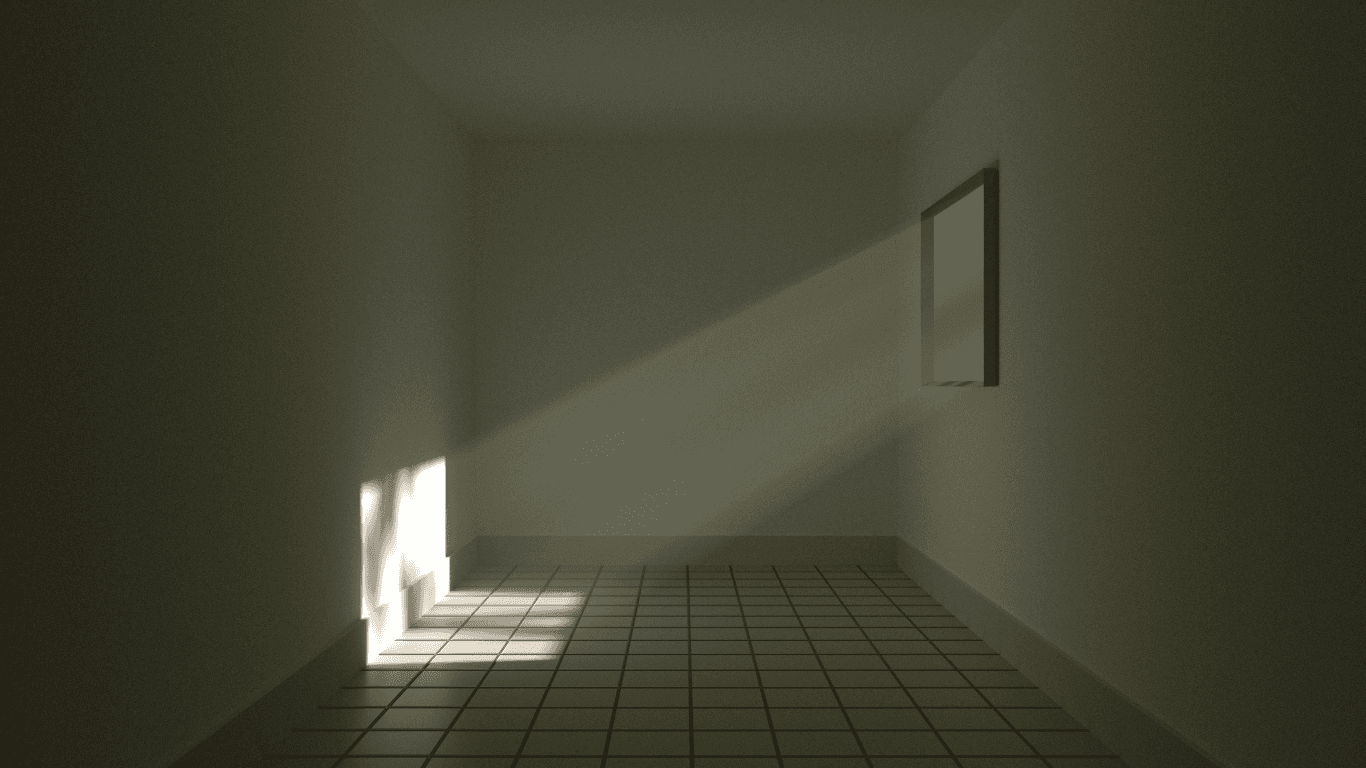
A volume is a three-dimensional region of space defined by density values — how thick or thin the medium is at each point. When a ray of light travels through a volume, the renderer calculates how much it scatters at each point along its path. A dense volume scatters more light toward the camera, producing a bright shaft. A thin volume is nearly invisible but gives the scene a soft atmospheric haze. The density values can be constant across the entire volume, or they can be defined by a VDB cache — a volumetric file format that stores arbitrary three-dimensional density fields, typically the output of a Houdini simulation. Fog, clouds, smoke, and fire are all represented as VDB volumes in the production pipeline.
The specific visual phenomenon known as a god ray — a visible shaft of light streaming through a gap in clouds, through a window, through trees — is a volumetric effect. Light scatters toward the camera from every point along the shaft, making the beam visible as a volume rather than just illuminating surfaces. Correctly rendered, it requires the path tracer to sample the volume along the light path, which is expensive but physically accurate. Incorrectly done — as it often was in early CG — it is composited as a flat, additive glow that sits on top of the image without integrating with the scene's depth, which is immediately recognizable as a post-production cheat.
Atmosphere is also the reason that objects in the real world desaturate and shift toward the ambient color as they recede into the distance. This is called atmospheric perspective, and it is present in every outdoor scene: the mountains in the background are not just smaller and lower-contrast, they are distinctly bluer than the foreground because the atmosphere has scattered their color information and replaced it with the blue of the sky. CG scenes without atmospheric depth have a flatness that reads as wrong even when nothing else is technically incorrect. Placing a low-density atmosphere volume across the entire environment — or approximating it with a depth-based fog curve — is one of the first things a lighting artist does when working on any outdoor or large-scale interior shot.
Light linking
In a physically accurate renderer, every light illuminates every object in the scene. This is correct behavior — it is how light works in reality. It is also frequently a problem.
Consider a character standing near a practical light source in the background of a shot. The practical light exists to motivate the scene's lighting — its presence on screen establishes why the environment is lit the way it is. But the character is positioned such that the practical would, if it obeyed physics, be the strongest light on the left side of their face. The director doesn't want that — they want a cleaner, more dramatic key light from the right. A strictly physically accurate render gives the wrong result for the story.
A practical light is any real, physical light source that's visible in the frame — a lamp on a table, a neon sign on a wall, a TV screen, a window. In cinematography, practicals do two things at once: they exist as objects in the scene (you can see them), and they're supposed to justify the lighting (their presence explains why the room is lit the way it is). The problem is that what a practical light actually does to the actors and objects near it doesn't always match what the story needs.
Here's the scenario concretely: a character is sitting at a desk. There's a floor lamp in the background on their left. The lamp is on screen — the audience can see it. Physics says that lamp should be the brightest light source affecting the left side of the character's face, because it's the closest light source visible in the frame. But the director wants the character to be lit dramatically from the right — a hard key light from that direction to make them look more intense, or more isolated, or whatever the scene calls for. If the renderer obeys physics, the floor lamp on the left wins and the face looks wrong for the scene.
In a real film shoot, the cinematographer solves this physically — they put a flag (a piece of black material) between the lamp and the actor to block its light from hitting the face, while leaving the lamp visible to the camera. The lamp still reads as the motivation for the lighting, but a separate, intentionally placed key light from the right is actually doing the work on the actor's face. The audience doesn't notice because the practical is still there and the lighting feels motivated.
Light linking does the exact same thing but in software. You tell the renderer: this floor lamp illuminates the background, the walls, the furniture — but not this character. A separate key light from the right illuminates only the character. The scene looks motivated and physically plausible because the practical is visible. The character looks exactly the way the director wants because the physics have been selectively overridden. The broader point is that film lighting has always been about creating the impression of physically motivated light, not reproducing physics exactly. Cinematographers have been cheating physics on set since the beginning of cinema. Light linking is just the digital version of the same craft.
Light linking is the application of cinematographic craft to a virtual environment. The goal is not to reproduce physics; it is to reproduce the result that a skilled cinematographer would produce through physical means if they had the same degree of control. The best production lighting rigs use light linking extensively, producing images that look entirely natural precisely because they have been carefully shaped by invisible constraints that no physical camera could impose.
Reading the plate
When a lighting artist opens a shot, the first thing they do is study the live-action plate — not for what it contains narratively, but for what it reveals about the physical lighting conditions on the day of the shoot.They are looking for several things simultaneously.
Shadow direction tells them where the key light was.
The hardness of shadow edges tells them how large the source was relative to the subject's distance from it — hard shadows mean a small, distant source; soft shadows mean a large or close one.
The color temperature of the brightest areas tells them what kind of light was dominant: warm tungsten practical lights, cool daylight from windows, the neutral output of a studio fixture.
The behavior of specular highlights on any shiny surface in the plate — a belt buckle, a glass on a table, the actor's eyes — reveals the shape and direction of the key light with particular precision, because specular highlights are small, sharp reflections of the source itself.
The actor's eyes are especially useful. The catchlight — the small highlight visible in the iris — is a direct reflection of the key light. Its shape, size, and position tell the lighting artist exactly where the dominant source was, how large it was, and at what height. A rectangular catchlight means an LED panel or window. A circular catchlight means a round softbox or practical. Its position in the iris indicates the vertical angle of the source. This information cannot be faked after the fact; it has to be matched by the virtual light rig.
The plate also reveals what is missing. If the production was shot under overcast natural light, there is no dominant directional key light — the illumination is soft and even from the whole sky. If it was shot under a single hard source, the fill side of the frame will be relatively dark and the transitions from light to shadow will be sharp. Neither of these is better or worse; both are choices the DP made. The lighting artist's job is to understand what that choice was and extend it into the CG elements without contradiction.
Cinematographers who work frequently with VFX have developed ways of communicating their intent precisely. Roger Deakins, whose work on Blade Runner 2049 required extensive VFX integration, is known for the consistency and legibility of his lighting language — a clearly established system of sources, directions, and color relationships that VFX teams can extend into the digital elements without guessing. Denis Villeneuve's productions document the lighting intent in detail because the ambition of the VFX work demands it: an image where the CG is inseparable from the plate requires that the lighting artist and the DP are working from the same understanding of the scene.
🫶🏼