Created on
Updated on
1916 | 达达主义 Dadaism
艺术是一场名为装逼的大型表演
Preface: welcome to this very brief intro to modern art. Please feel free to use this as a guide for museum visits.
Why Dada Had to Exist
In 1916, the First World War was in its second year. The Battle of Verdun: French and German forces, on a piece of land not even 300 square kilometers, over ten months, suffered more than 700,000 casualties. Nobody won anything. The front lines barely moved. The governments of Europe made deliberate decisions — sending generations of young men into poison gas and barbed wire in the name of nationalism, glory, civilization, and progress.
The Dada artists looked at all of this and reached a conclusion: “Civilization” produced this massacre. “Reason” designed the poison gas. “Progress” built the machine guns. Therefore civilization, reason, and progress — the most central values of Western culture — are lies. And if these are lies, then everything built on top of them is also a lie. Art is a lie. Meaning is a lie. Language is a lie.Dada was not an art style. It was a philosophical collapse and a radical act of honesty: saying out loud, while everyone else was pretending meaning still existed: no. Meaning is dead. We are here to hold its funeral.
Zurich: An Explosion in Neutral Territory
Switzerland was a neutral country. During the war, Zurich filled with people fleeing from every nation — draft evaders, exiles, political refugees, anarchists, artists. They came from Germany, Romania, France, Alsace, Russia. In this suspended, stateless space, they had no obligation to love any country, no obligation to sacrifice, no obligation to believe in anything. This condition of total rootlessness produced, paradoxically, total freedom. Lenin was also living in Zurich in 1916, on a street near the Cabaret Voltaire. The Dadaists and Lenin were aware of each other’s existence. The playwright Tom Stoppard imagined their encounter in his play Travesties — Lenin, the Dadaists, and James Joyce (who was also in Zurich at the time, writing Ulysses) all in the same city, each conducting their own experiments on language, meaning, and revolution, unknown to each other.
The Cabaret Voltaire: The Birth of Dada
February 5, 1916. Spiegelgasse 1.
Hugo Ball and his partner Emmy Hennings opened a small bar. Hennings was a poet, singer, and performer — the most underrated woman in Dada. She was not just Ball’s companion but the actual operator of the Cabaret Voltaire and the core of its performances, though history has almost always remembered only Ball’s name. They posted an advertisement on the door: artists invited to perform and exhibit.
Within weeks, the people who gathered included Tristan Tzara (Romanian, poet, Dada’s most active propagandist), Jean Arp (Alsatian, sculptor, moving between French and German culture), Richard Huelsenbeck (German, poet, who later brought Dada to Berlin), and Marcel Janco (Romanian, artist, maker of Dada masks).
What they did: simultaneously recited poetry in German, French, and English — not translated, simultaneously — producing noise and chaos. Assembled exhibition pieces from waste materials. Danced in strange costumes. Published manifestos and immediately mocked the manifestos. Deliberately enraged their audiences. The goal was not entertainment. It was philosophical argument: meaning is arbitrary, cultural authority is arbitrary, the boundaries of art are arbitrary.
The Word “Dada”
The origin of the word is itself a Dada joke — multiple versions exist, contradicting each other, no definitive answer. The most popular version: Ball and Huelsenbeck randomly opened a French-German dictionary and the knife point landed on “dada” — in French baby-talk it means hobby horse, in German it has no particular meaning, in Romanian “da da” means “yes, yes.” They chose it precisely because it meant nothing. A meaningless word naming a movement that refuses meaning — perfect consistency. Tzara later told many contradictory stories about the etymology of “Dada,” because he enjoyed the contradiction itself.
Core Figures
Hugo Ball (1886–1927)
The spiritual core of Dada, and the first to leave it. German, Catholic family, studied philosophy and theater. When the war broke out he tried to enlist, was rejected — heart condition. He watched his contemporaries go off to die while he couldn’t participate, a feeling that was complicated: both fortunate and carrying a strange kind of guilt.
Sound Poetry (Lautgedicht): On June 23, 1916, he walked onto the Cabaret Voltaire stage in a costume he had designed himself: tubular pants made of cardboard (impossible to walk in — he could only stand), a blue cylindrical cardboard jacket, a tall cardboard hat. He said the costume made him look like a magic bishop. He began to recite:
“gadji beri bimba glandridi lauli lonni cadori gadjama gramma berida bimbala glandridi glassala zingtata…”
None of these are words from any language. He invented pure sound sequences — he called it a “primordial language,” the state of language before meaning arises.
He participated in Dada for less than two years. Then he withdrew, went to the Swiss countryside, converted to Catholicism, and wrote a book on Catholic mysticism. He died of stomach cancer in 1927, aged 41.
Emmy Hennings (1885–1948)
Her role at the Cabaret Voltaire: singer, reciter, performer, actual program organizer. In Ball’s own notes he acknowledged that Hennings was the real driving force of the venue — she brought people in, she maintained the performances, she was Dada’s earliest public face. But her name disappears from most historical accounts of Dada, or appears only as “Ball’s companion.”
Her background: born in poverty, worked as a waitress, model, prostitute. Her poetry wrote about poverty, prison, exile — she had done time in jail (forged documents) and used drugs. Before she found Ball and Dada, she had already lived a real life on the social margins, not the margins intellectuals chose as a philosophical position. This background set her apart from the other Dadaists: for them, nihilism was a philosophical stance; for her, the absence of meaning was something she had actually lived.
Tristan Tzara (1896–1963)
Romanian, born Samy Rosenstock, Jewish. He renamed himself “Tzara” — meaning “country” or “land” in Romanian, but he was a person of deliberate rootlessness, so the name was an irony. He was Dada’s primary propagandist and media strategist — he knew how to create scandal, how to get press coverage, how to spread Dada from Zurich to Paris, Berlin, and New York.
His Dada poetry-generation method: “Cut a newspaper article into its individual words, put them in a bag, shake gently, take them out one by one, copy them down in the order they come. This poem will resemble you. This poem will be an infinitely original poem with charming sensibility, though the public will not understand it.” This was an attack on the concept of “the author.” If a poem can be randomly generated, what is an “author”? What is “genius”? What is “creation”?
In his manifestos he declared that Dada was against manifestos, against definitions, against all rules — including Dada’s own. He simultaneously proclaimed and mocked, declared and negated, making it impossible for anyone to systematize Dada without falling into logical contradiction.
He later had a very public argument with Breton (the founder of Surrealism), nearly coming to blows on a stage — the argument was about the boundary between Dada and Surrealism, and about who had the right to define what avant-garde art was. (Honestly, extremely pretentious.) In his later years he became a member of the French Communist Party and participated in the Resistance.
Jean Arp (1886–1966)
From Alsace — a region on the French-German border that has changed hands between the two countries repeatedly throughout history, so his mother tongues were simultaneously German and French, and he used both “Jean” (his French name) and “Hans” (his German name). His identity was double, borderline. He was Dada’s most enduring artist — unlike Ball, who left quickly, he continued developing after Dada and became an important figure in abstract sculpture.
The Law of Chance: He dropped pieces of paper from a height, let them fall randomly onto canvas, then glued them where they landed. He called the method “collage arranged according to the law of chance.” He said: I want to let the laws of nature — gravity, chance — make decisions instead of my will. The artist’s “creative will” is a fiction; we are only choosing within an existing culture, we have no true originality. Letting chance decide is more honest. This idea directly influenced John Cage’s later music — using random procedures (dice, the I Ching) to generate compositions, because the composer’s “intention” is a form of cultural bias.
Organic abstraction: His later sculptures have flowing forms like biological organs — simultaneously resembling parts of the human body and stones worn smooth by water, simultaneously abstract and sensory. He called these “Concrete Art” — not abstraction (which implies extracting from the figurative), but direct form itself.
Marcel Duchamp (1887–1968)
If Dada kept only one person, it would be Duchamp. He is the most important art thinker of the twentieth century, without exception. His early work was still within the painting tradition — Nude Descending a Staircase (1912), combining Cubism and Futurism’s time-decomposition, caused a sensation at the New York Armory Show. But he quickly lost interest in painting. His question became: what is painting? What is art? What makes an object an artwork?
Fountain, 1917 — One of the Most Important Artworks Ever Made
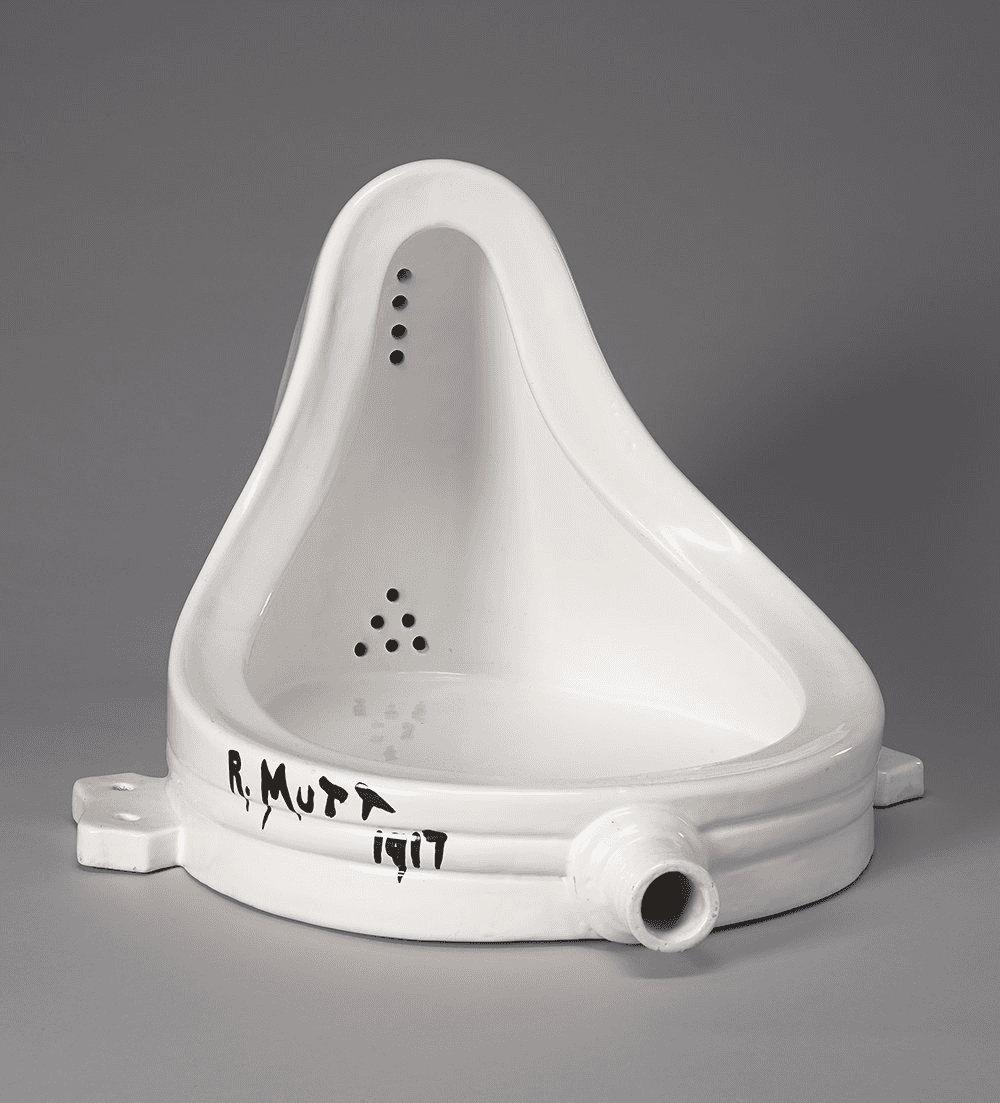
He took an ordinary ceramic urinal, placed it on its side, signed it with the pseudonym “R. Mutt” (a variation on the sanitary fixture brand “Mott Works”), and submitted it to the Society of Independent Artists exhibition in New York. The rules of this exhibition were: any artist who paid the $6 membership fee could submit any work, the exhibition accepted all submissions. The selection committee refused to exhibit Fountain. They said it was not art, it was a factory-produced mass-manufactured object; the artist had not “created” anything. This was exactly the reaction Duchamp wanted. He immediately used it as his point of attack: if the Independent Artists exhibition’s rule was to accept all work, but they refused this one — then the rule is false, the institution’s “neutrality” is false.
If they said the urinal was not art because the artist had not “made” anything then what is the definition of art? The skill of fabricating objects? But what’s the difference between Cézanne’s apple and Chardin’s apple (both were “painting apples”)? If they said occasion and context don’t constitute art, then why does the same object become art when it’s in a museum case?
Fountain‘s question: is art a quality of the object, or the act of choosing, or the frame of context? A hundred years later, there is still no consensus answer. The original disappeared during the exhibition. The existing versions are replicas Duchamp later authorized — with which he simultaneously asked another question: is there a difference between an original and a copy? What does uniqueness mean in art?
The Readymade: Fountain is his most famous “readymade” — an industrially manufactured mass-produced object, with the artist’s intervention consisting only of selection and recontextualization.
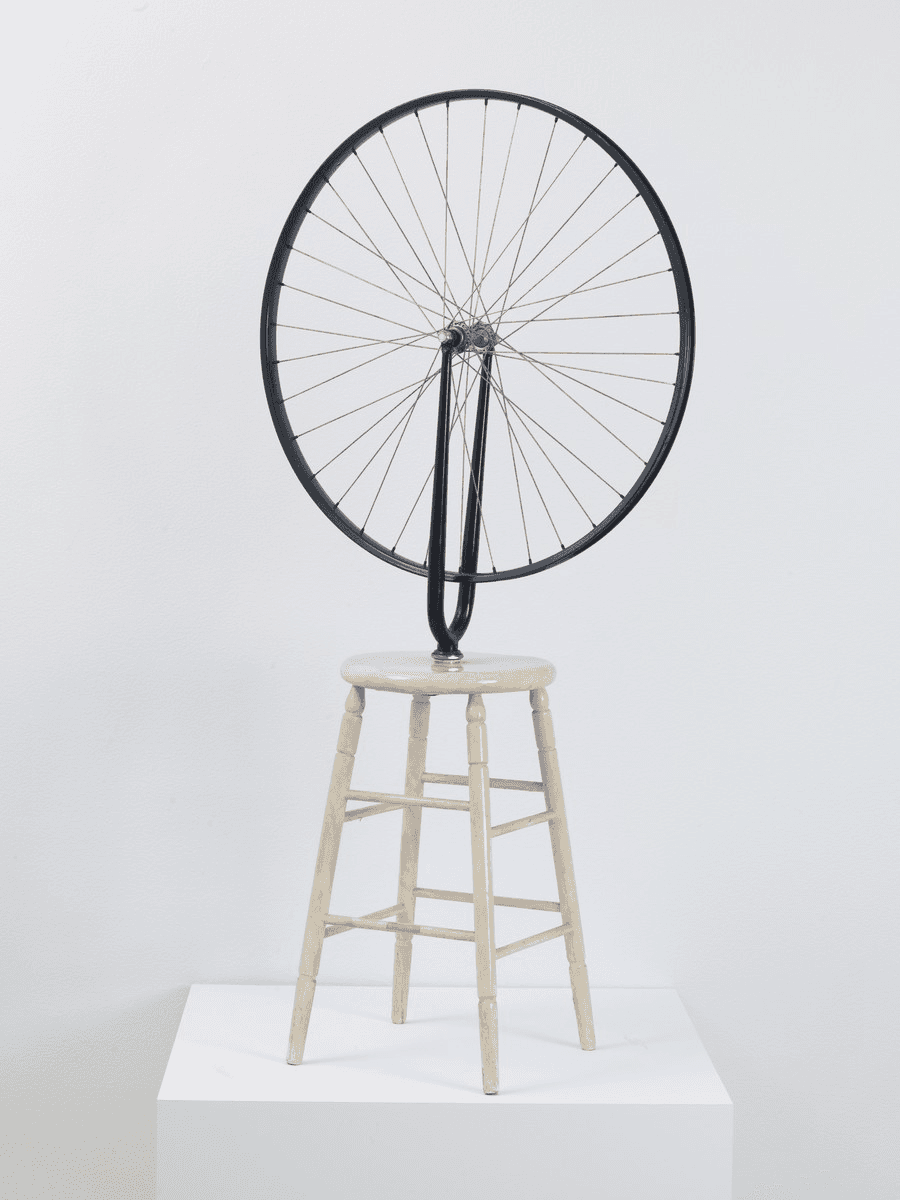
Other readymades: Bicycle Wheel (1913) — an inverted bicycle wheel mounted on a kitchen stool. The first readymade. He said he simply enjoyed watching it spin, like a fire in a fireplace. Bottle Rack (1914) — an ordinary wire bottle rack, submitted directly as an artwork. No modifications whatsoever. The philosophical core of the readymade: art is concept, not fabrication. The artist is a selector, not a maker. Anything in the right context can be art — which means either everything is art, or the word “art” has no meaning.
L.H.O.O.Q., 1919
He drew a moustache and goatee on a postcard reproduction of the Mona Lisa and wrote “L.H.O.O.Q.” These five letters, read aloud letter by letter in French, form a crude phrase meaning roughly “she’s got a hot ass.” This was a simultaneous attack on two things: the Western art canon (the Mona Lisa as ultimate symbol), and the earnest, gendered interpretations of her mysterious smile (who is she smiling at? why? countless male critics have sanctified that smile as a symbol of feminine mystery). With the simplest possible means — a pencil moustache, a crude phrase — he demolished centuries of artistic reverence.
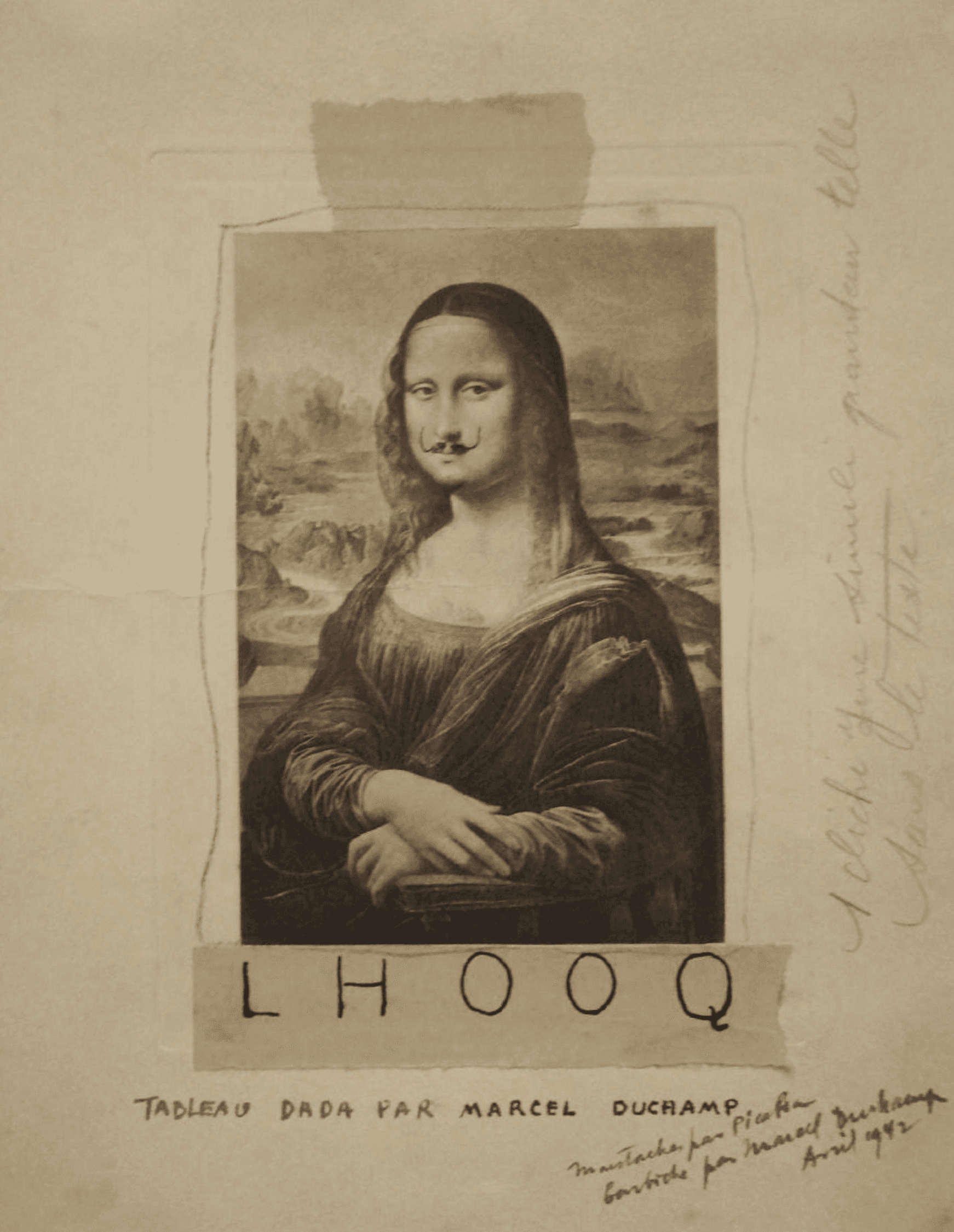
He later made another version: erased the moustache and called it “L.H.O.O.Q. Shaved.” Since a Mona Lisa without the moustache is just the original painting, the “shaved” version is identical to the original — but it is now a Duchamp. This logical game never stops mocking the concepts of “original,” “copyright,” and “creation.”
The Large Glass, 1915–1923 — full title: The Bride Stripped Bare by Her Bachelors, Even. Two large glass panels, with complex figures made from lead wire, oil paint, and foil — the upper half is “the Bride” (a mechanical-organic form), the lower half is the “Bachelor Machine” (nine uniformed figures surrounding a chocolate grinder). He had extensive notes on this work (later published as The Green Box), using pseudo-scientific symbols and deliberately ambiguous descriptions, but he always refused to offer any definitive interpretation. This is another performance art piece — pretending this is art, when it actually isn’t. But is it or isn’t it? You see. now you’re confused.
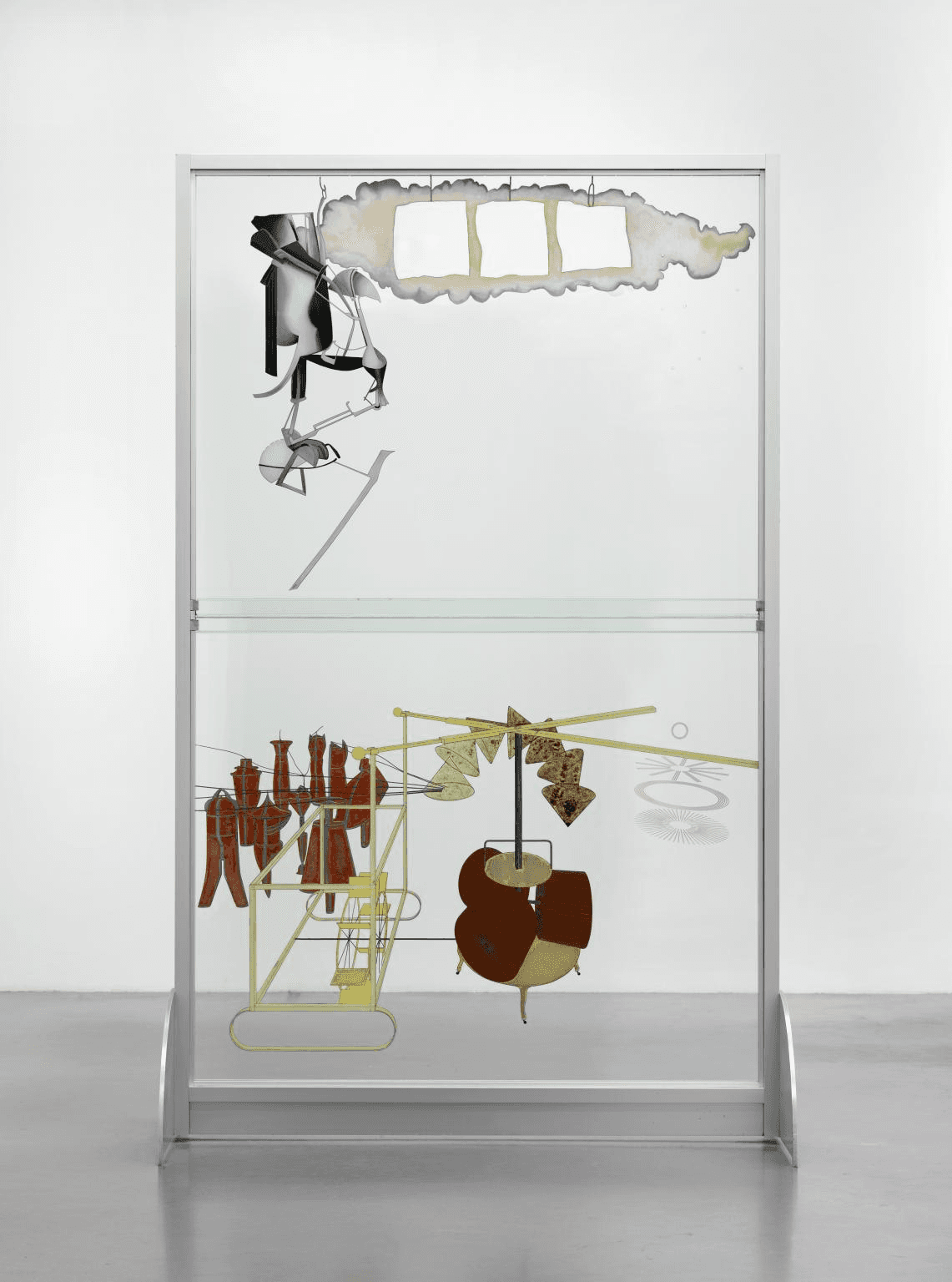
In 1926 it cracked during transport. Duchamp looked at the cracked state and decided not to repair it — he declared that the cracked version was the finished version. Chance had become the final step of creation.
Later life: chess and a secret work
After the 1920s, Duchamp almost entirely stopped public artistic creation, making chess his primary activity. He became a player of genuine competence and participated in international tournaments. The art world thought he had “retired.” After his death in 1968, a room in the Philadelphia Museum of Art was found to contain his final work, secretly made over twenty years: Étant donnés: 1° la chute d’eau, 2° le gaz d’éclairage (Given: 1. The Waterfall, 2. The Illuminating Gas). An old wooden door with two small holes. Peering through the holes: a nude female figure lying on a bed of twigs, holding a gas lamp, with a real waterfall video in the background.
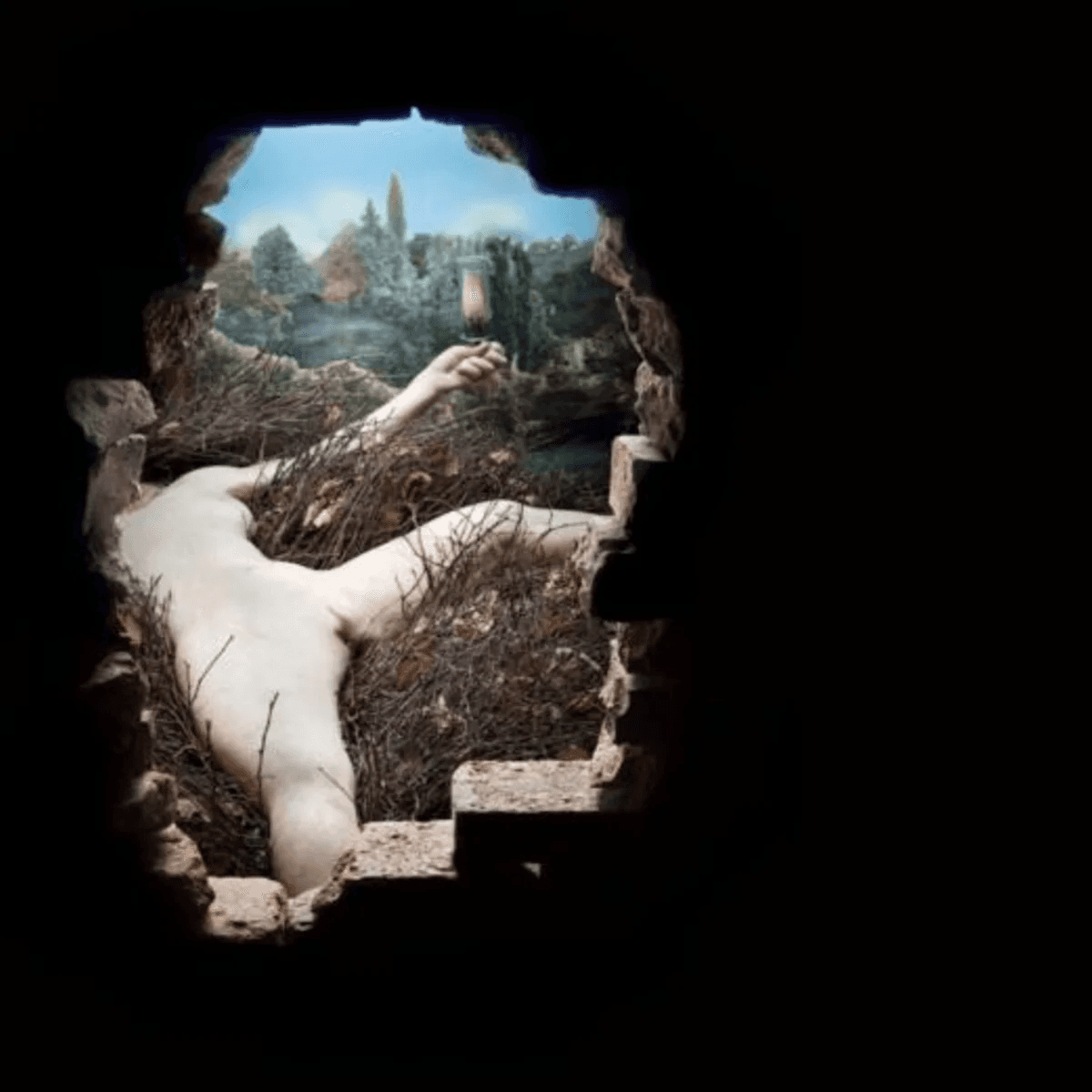
This work is completely unlike the intellectual games of his entire life — it is sensory, almost erotic, saturated with a voyeuristic tension. Those two small holes turn the viewer into a peeping tom, making the act of looking itself a moral predicament. He had been secretly making his most private work while everyone assumed he had abandoned art. This is his final statement about the relationship between art, the public, and true creation.
Dada Spreads: City Variations
Berlin Dada: The Most Political Branch
Postwar Berlin — the Weimar Republic, hyperinflation, political assassinations, armed clashes between left and right, failed revolution. Zurich Dada was philosophical experiment; Berlin Dada was political weapon.
John Heartfield (1891–1968): Born Helmut Herzfeld, he deliberately anglicized his surname to “Heartfield” during the First World War to protest German anti-English nationalism. He transformed Dada’s collage technique into political photomontage — reassembling fragments of real news photographs to create anti-Nazi, anti-capitalist propaganda images. These images were widely circulated in anti-fascist publications throughout the 1930s. After the Nazis came to power he fled to Prague, then to London, continuing to make anti-Nazi montages in exile. His technique influenced the entire century of political graphic design — from Soviet propaganda posters to punk album covers to today’s meme culture, all using the same logic: reassemble existing images to produce new meaning (or new meaninglessness).
George Grosz (1893–1959): His paintings were an anatomy of Weimar Germany — politicians, military officers, capitalists, clergy, all rendered in animalistic, corrupt forms. He used razor-sharp line and acidic color to transform a society’s moral rot into visual satirical literature. He was prosecuted multiple times by the German government for “insulting the honor of the military” and “blasphemy,” paid his fines each time, and kept painting. In 1932, the year before the Nazis came to power, he emigrated to the United States and taught painting in New York. His late American work lost the fury and precision of his Berlin period — he said that in America he couldn’t find the kind of specific, nameable enemy that could make him angry. American power is diffuse, unlike Weimar Germany’s, where it was concentrated in faces that could be drawn.
Hannah Höch (1889–1978): The most important woman in Berlin Dada, and the most systematic practitioner of photomontage. She lived with Dadaist Raoul Hausmann for years, but he always refused to divorce his wife. In her memoirs she described the contradiction in the relationship: the Dadaists preached liberation and opposition to all norms, but in their private lives still expected women to perform traditional roles — cooking, managing the household, providing emotional service to men.
After leaving Hausmann she built a nine-year partnership with a Dutch woman — an extremely marginal existence in the 1920s. During the Nazi period she was classified as a “degenerate artist,” quietly concealed herself in a farmhouse on the outskirts of Berlin, and hid large quantities of contemporary artists’ works in her vegetable garden and stable, protecting them from Nazi confiscation. She lived to 89 — one of the longest-lived of all the Dadaists.
New York Dada: Duchamp + Man Ray
Man Ray (1890–1976): American, born Emmanuel Radnitzky, Duchamp’s most important collaborator in New York. His most significant contribution was experimental photography — particularly the “Rayograph”: placing objects directly on photosensitive paper and exposing them to light without a camera, producing the direct shadow/trace of the object. This shares the logic of Duchamp’s readymades: the artist is not “creating” — they are recording a physical process. He later went to Paris and became a core figure in Surrealist photography, shooting Dalí, Picasso, Cocteau, Joyce, and several of his lovers (including the legendary Lee Miller, who became an important war photographer in her own right).
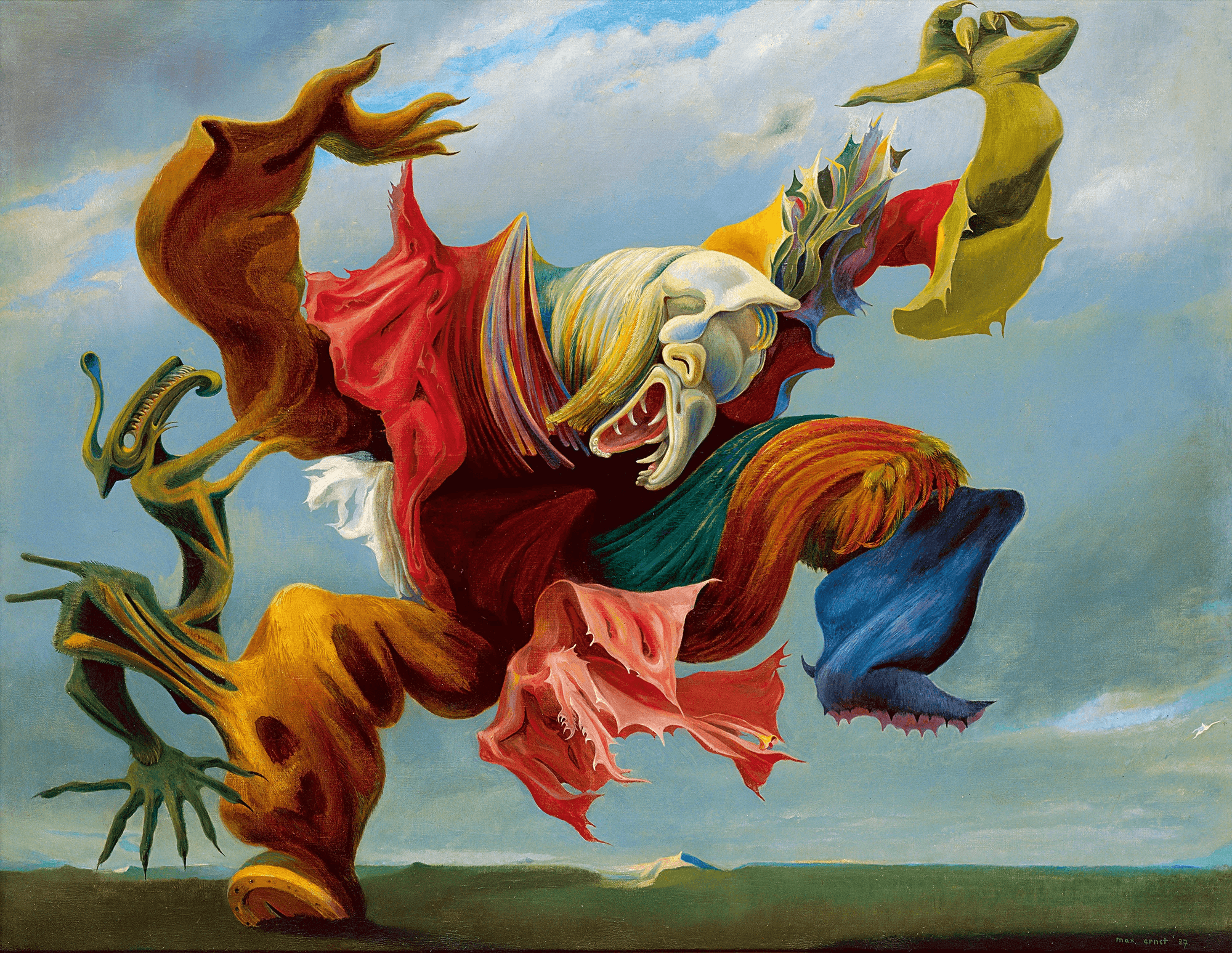
Max Ernst (1891–1976): The most important bridge figure between Dada and Surrealism. He invented Frottage: placing paper on rough surfaces (wood planks, leaves, fabric), rubbing with pencil to transfer the surface’s texture randomly to paper, then “discovering” images within these random patterns — a process he compared to Freudian free association, letting the unconscious find its own images within random visual stimuli. He also invented the collage novel — reassembling illustrations from cheap Victorian pulp fiction to create narratives interlacing absurdity, sex, and violence. These collage books are considered precursors of the graphic novel.
Dada’s Core Techniques and Philosophy
Collage: Reassembling existing images from different sources — newspapers, advertisements, photographs. Meaning emerges from juxtaposition, not from any single element. The technique came from Cubism, but Dada politicized and philosophized it completely.
Montage: More radical than collage — not just juxtaposition but conflicting juxtaposition, letting the collision of two images produce a third meaning (or a third meaninglessness). This is the same discovery as Eisenstein’s film montage theory, made simultaneously in different media.
Performance: Dada was the first movement to systematically use performance as an artistic medium. Body, time, audience response — all became components of the work. This leads directly to the performance art tradition of the 1960s and 70s.
Manifesto: They wrote enormous numbers of manifestos — including manifestos mocking the manifesto as a form. The manifesto as genre was completely deconstructed by Dada: if a manifesto opposing all definitions is itself a definition, what does the manifesto mean?
Chance: Letting random processes participate in creation — Arp’s falling paper fragments, Tzara’s bag of cut-up words, Duchamp’s Large Glass finally completed by its accidental shattering. This is a philosophical attack on “authorial intention” and “creative control,” and directly influenced later computer art and algorithmic art.
Dada’s Internal Contradiction and End
Dada faced an irresolvable paradox: it opposed all systems — but itself became a system. It opposed meaning — but its opposition acquired meaning. It opposed art — but its works became classics of art history. It mocked everything — but was itself studied seriously.
Tzara later said: “Dada knew on its first day that it would die. It just didn’t know which day.” Around 1922–23, Dada effectively dissolved. Several different exits: into Surrealism (Ernst, Arp, Man Ray) — finding a new theoretical framework in Freud, channeling Dada’s energy toward the exploration of the unconscious. Into politics (Tzara joined the Communist Party, Huelsenbeck returned to Germany to participate in political culture, Heartfield became an anti-Nazi propagandist) — finding a meaning system worth believing in. Personal routes (Ball converted to Catholicism, Duchamp played chess) — finding answers outside Dada, or choosing silence.
Dada’s Legacy
Direct influences: Surrealism absorbed Dada’s anti-rationalism and chance techniques and gave them a Freudian theoretical framework. Fluxus (1960s) — Yoko Ono, John Cage, directly inheriting Dada’s performance, chance, and anti-art stance. Conceptual art — Duchamp’s readymade leads directly to the full theorization of “art is concept, not object.” Punk (1970s) — DIY spirit, anti-establishment, deliberate roughness, the manifesto as media strategy. Punk poster design and Dada collage share the same visual logic. Internet culture and memes — reassembling existing images to produce new meaning (or new meaninglessness) is exactly what Heartfield and Höch were doing in 1919.
Deeper influence: Dada was the first movement to systematically pose this question: is the art institution — gallery, museum, critic, market — the precondition for art’s existence, or art’s obstacle? This question remains unanswered today. Every decade a new generation of artists rediscovers it, and is then absorbed by the art institution, becoming a chapter in art history. Dada itself is the best proof of this cycle.🖼️
为什么达达必须存在
1916年,第一次世界大战进行到第二年。凡尔登战役,法德双方在一块不到300平方公里的土地上,用了十个月,伤亡超过七十万人。没有人赢得任何东西。战线几乎没有移动。欧洲各国政府刻意的决策,用民族主义、荣耀、文明、进步的名义,把几代年轻人送进毒气和铁丝网。达达的艺术家们看着这一切,得出了一个结论:“文明”制造了这场屠杀。”理性”设计了毒气弹。”进步”建造了机关枪。那么文明、理性、进步,这些西方文化最核心的价值是谎言。如果这些是谎言,那建立在这些之上的一切也是谎言。艺术是谎言。意义是谎言。语言是谎言。达达不是一个艺术风格,是一个哲学上的崩溃和一个激进的诚实,在所有人都假装意义还存在的时候,大声说:不,意义已经死了,我们来为它举行葬礼。
苏黎世:中立地带的爆炸
瑞士是中立国。战时,苏黎世聚集了大量来自各国的逃亡者,逃避兵役的、流亡的、政治难民、无政府主义者、艺术家。他们来自德国、罗马尼亚、法国、阿尔萨斯、俄国。在这个悬浮的、不属于任何国家的空间里,他们没有义务爱国,没有义务牺牲,没有义务相信任何东西。这种彻底的无根感,反而制造了彻底的自由。列宁1916年也住在苏黎世,就在伏尔泰酒馆附近的街道上。达达主义者和列宁互相知道对方的存在。历史学家汤姆·斯托帕德在他的戏剧《特拉维斯塔》里想象了他们相遇的场景——列宁、达达主义者、詹姆斯·乔伊斯(当时也在苏黎世写《尤利西斯》)在同一个城市,各自进行着关于语言、意义、革命的实验,互不相知。
伏尔泰酒馆:达达的诞生
1916年2月5日,斯皮格尔街1号。雨果·鲍尔和他的伴侣埃米·亨宁斯开了一家小酒吧。亨宁斯是诗人、歌手、表演者,她是达达里最被低估的女性。她不只是鲍尔的伴侣,是伏尔泰酒馆的实际运营者和演出核心,但历史几乎总是只记住鲍尔的名字。他们在门口贴了广告:邀请艺术家来表演和展览。
几周内聚集的人:
特里斯坦·查拉(罗马尼亚,诗人,达达最活跃的传播者)
让·阿尔普(阿尔萨斯人,雕塑家,游走于法德两种文化之间)
理查德·胡尔森贝克(德国,诗人,后来把达达带到柏林)
马塞尔·扬科(罗马尼亚,艺术家,制作达达面具)
他们同时用德语、法语、英语朗诵诗歌,制造噪音和混乱。把废料拼贴成展览品。穿着奇怪的服装跳舞。出版宣言,立刻嘲笑宣言。故意把观众激怒。目标不是娱乐,是哲学论证: 意义是任意的,文化权威是任意的,艺术的边界是任意的。
“达达”这个词
这个词的来源本身是一个达达式的玩笑,有多个版本,互相矛盾,没有定论:最流行的版本:鲍尔和胡尔森贝克随机翻开法德词典,刀尖落在”dada”这个词上,在法语童语里是木马,在德语里没有特定意义,在罗马尼亚语里”da da”是”是的,是的”。他们选择这个词正是因为它没有意义。一个无意义的词命名一个拒绝意义的运动,这是完美的一致性。查拉后来说了很多关于”达达”词源的互相矛盾的故事,因为他享受矛盾本身。
核心人物
雨果·鲍尔 Hugo Ball(1886-1927)
达达的精神核心,也是最快离开达达的人。德国,天主教家庭,哲学和戏剧研究。一战爆发时他试图应征入伍,被拒绝——理由是心脏有问题。他看着同代人去死,自己无法参与,这种感觉是复杂的:既是幸运,也是一种奇特的罪恶感。
声音诗歌(Lautgedicht):1916年6月23日,他在伏尔泰酒馆穿着他自己设计的服装走上台:用纸板做成的管状裤子(无法走路,只能站立),蓝色纸板筒状上衣,纸板做的高礼帽。他说这身服装让他看起来像一个魔法主教。
他开始朗诵:
“gadji beri bimba
glandridi lauli lonni cadori
gadjama gramma berida
bimbala glandridi glassala zingtata…”
他只参与达达不到两年。然后他退出了,去了瑞士乡村,皈依天主教,写了关于天主教神秘主义的书。他1927年死于胃癌,41岁。
埃米·亨宁斯 Emmy Hennings(1885-1948)
她在伏尔泰酒馆的角色:歌手、朗诵者、表演者、实际的节目组织者。鲍尔的笔记里,他承认亨宁斯是酒馆真正的驱动力,她把人带来,她维持表演,她是达达最早期的公众面孔。但她的名字在大多数达达历史叙述里消失了,或者只作为”鲍尔的伴侣”出现。她本身出身贫困,做过服务员、模特、妓女。她的诗歌写贫困、监狱、流亡,她曾经坐过牢,也吸毒。她在找到鲍尔和达达之前经历的是真实的社会边缘生活,不是知识分子选择的边缘。这个背景使她和其他达达成员不同:对他们来说,虚无主义是哲学立场;对她来说,意义的缺失是她活过的现实。
特里斯坦·查拉 Tristan Tzara(1896-1963)
罗马尼亚人,原名萨米·罗森斯托克(Samy Rosenstock),犹太人。他改名”查拉”,在罗马尼亚语里意思是”国家/土地”,但他是一个蓄意无根的人,这个名字是反讽。他是达达的主要宣传者和媒体策略师。他懂得如何制造scandal,如何让媒体报道,如何把达达从苏黎世扩散到巴黎、柏林、纽约。
他的达达诗歌生成法:“剪下一篇报纸文章,然后剪开每个词,放进袋子,轻轻摇晃,一个一个取出,按取出的顺序抄下来。这首诗将像你一样,这首诗将是一首无限原创的、有可爱感性的诗,但公众不理解。”这是对”作者”这个概念的攻击。如果一首诗可以随机生成,”作者”是什么?”天才”是什么?”创作”是什么?他在宣言里宣布达达反对宣言,反对定义,反对一切规则,包括达达自己的规则。他同时宣告和嘲笑,宣告和否定,让任何试图系统化达达的人陷入逻辑困境。
后来他和布勒东(超现实主义的创始人)公开争吵,几乎在舞台上打起来,争论的核心是达达和超现实主义的边界,以及谁有权定义什么是前卫艺术(这真的太装逼了)。晚年他成为法国共产党员,参与抵抗运动。
让·阿尔普 Jean Arp(1886-1966)
阿尔萨斯人,阿尔萨斯是法德边界地区,历史上在两国之间反复易手,所以他的母语同时是德语和法语,他同时用”Jean”(法语名)和”Hans”(德语名)。他本人的身份是双重的、边界性的。他是达达里最持久的艺术家,不像鲍尔很快离开,他在达达之后继续发展,成为抽象雕塑的重要人物。
偶然法则:他把纸片从高处扔下,让它们随机落在画布上,然后按它们落下的位置粘贴。他把这个方法叫”依照偶然法则的拼贴”。他说:我想让自然法则,重力、偶然,代替我的意志做决定。艺术家的”创作意志”是虚构的,我们只是在已有的文化里选择,我们没有真正的原创性。让偶然决定,反而更诚实。这个想法直接影响了约翰·凯奇后来的音乐,用随机程序(掷骰子、《易经》)生成音乐,因为作曲家的”意图”是一种文化偏见。
有机抽象:他后来的雕塑是流动的、像生物器官的形状——既像人体的局部,又像石头被水磨光滑的形状,既抽象又感官。他叫这些”具体艺术”——不是抽象(抽象意味着从具象中提取),是直接的形式本身。
马塞尔·杜尚 Marcel Duchamp(1887-1968)
如果达达只留下一个人,是杜尚。他的早期作品还在绘画传统里:《下楼梯的裸女》1912,把立体主义和未来主义的时间分解结合,在纽约军械库展览引起轰动。但他很快对绘画失去兴趣。他的问题变成了:绘画是什么?艺术是什么?是什么使一个物体成为艺术品?
《泉》1917 — 最重要的艺术品之一
他用一个普通的陶瓷小便池,侧放,签上假名”R. Mutt”(来自当时一个卫生洁具品牌”Mott Works”的变体),提交给纽约独立艺术家协会的展览。这个展览的规则是:交了6美元会费的艺术家可以提交任何作品,展览接受所有提交。评审委员会拒绝展出《泉》。他们认为它不是艺术,它是一个工厂生产的量产品,艺术家没有”创作”任何东西。杜尚立刻以此为攻击点:这正是他想揭示的矛盾。如果独立艺术展的规则是接受所有作品,但他们拒绝了这件,那规则是假的,机构的”中立”是假的。如果他们说小便池不是艺术,因为艺术家没有”做”任何东西,那艺术的定义是什么?是制作物件的技艺?但那塞尚的苹果和夏尔丹的苹果有什么区别?如果他们说场合和语境不构成艺术,那为什么同样的物体在博物馆展柜里就变成了艺术?《泉》的问题是:艺术是物体的特质,还是选择的行为,还是语境的框架?一百年后,这个问题仍然没有共识答案。原作在展览期间神秘消失。现存的版本是杜尚后来授权制作的复制品。他同时又用这个”复制品”问了另一个问题:原作和复制有区别吗?在艺术里唯一性是什么意思?
现成品(Readymade):《泉》是他最著名的”现成品”,工业制造的量产物件,艺术家的介入只是选择和重新语境化。
其他现成品:《自行车轮》1913,把一个自行车轮倒置安装在厨房凳子上。第一件现成品。他说他只是享受看它转动,像壁炉的火。
《瓶架》1914,一个普通的铁丝瓶架,直接提交为艺术品。没有任何改动。
现成品的哲学核心: 艺术是概念,不是制作。艺术家是选择者,不是制造者。任何东西在正确的语境下可以是艺术。这意味着要么一切都是艺术,要么”艺术”这个词没有意义。
《带胡须的蒙娜丽莎》1919
他在明信片印刷的蒙娜丽莎上画了胡须和山羊胡,写上”L.H.O.O.Q.”。这五个字母在法语里逐字母发音是一句粗口,大意是”她的屁股很火辣哟”。这是对两件事的同时攻击:西方艺术经典(蒙娜丽莎是终极象征),以及对蒙娜丽莎神秘微笑的那种严肃的性别化解读(她在对谁微笑?为什么微笑?无数男性评论者把这个微笑神圣化为女性神秘的象征)。他用最简单的手段,铅笔画胡须,写一句粗口,来摧毁几百年的艺术崇拜。后来他又做了一个版本:把胡须擦掉,叫”剃毛的L.H.O.O.Q.”。因为没有胡须的蒙娜丽莎就是原画,所以”剃毛的”版本和原画一模一样,但它现在是杜尚的作品。这个逻辑游戏永远在嘲笑”原作”和”版权”和”创作”的概念。
《大玻璃》1915-1923,全名《新娘甚至被她的单身汉们剥光了衣服》。
两块大型玻璃板,上面用铅丝、油彩、箔片制作了复杂的图形,上半部分是”新娘”(一个机械性的有机形体),下半部分是”单身汉机器”(九个制服形体围绕一个巧克力研磨机)。他有大量关于这件作品的笔记(后来出版为《绿盒子》),用了大量伪科学符号和故意模糊的描述,但他始终拒绝给出任何确定的解释。这又是一场行为艺术,假装这是艺术,其实根本不是。但到底是不是呢?你看,你困惑了。1926年运输时意外碎裂。杜尚看到碎裂的状态,决定不修复,他声明碎裂的版本才是完成的版本。 偶然成为创作的最后一步。
晚年:象棋与秘密作品
1920年代之后,杜尚几乎停止了公开的艺术创作,以下棋为主要活动,成为有一定水准的棋手,参加国际比赛。艺术界认为他”退休”了。1968年他去世后,人们在费城艺术博物馆的一个房间里发现了他秘密工作了二十年的最后作品:《给定:1. 瀑布,2. 燃气灯》。
一扇旧木门,上面有两个小孔。从小孔向里看:一个裸体女性躺在干草地上,举着一盏煤气灯,背景是一个真实的瀑布录像。这件作品和他一生的智识游戏完全不同,它是感官的,几乎是色情的,充满了一种偷窥的张力。那两个小孔把观看者变成窥视者,把”看”这个行为变成了一种道德困境。他在所有人都以为他已经放弃艺术的时候,秘密地做了他最隐私的作品。这本身就是一个关于艺术、公众、真实创作之间关系的最后陈述。
达达扩散:各城市的变体
柏林达达:最政治化
战后柏林,魏玛共和国,通货膨胀,政治暗杀,左右翼武装冲突,革命失败。苏黎世达达是哲学实验,柏林达达是政治武器。
约翰·哈特菲尔德 John Heartfield(1891-1968)
原名赫尔穆特·赫茨费尔德,一战期间故意把姓氏英语化为”Heartfield”,以抗议德国的反英民族主义。他把达达的拼贴技术转化为政治摄影蒙太奇,把真实的新闻照片碎片重新组合,制造反纳粹、反资本主义的宣传图像。
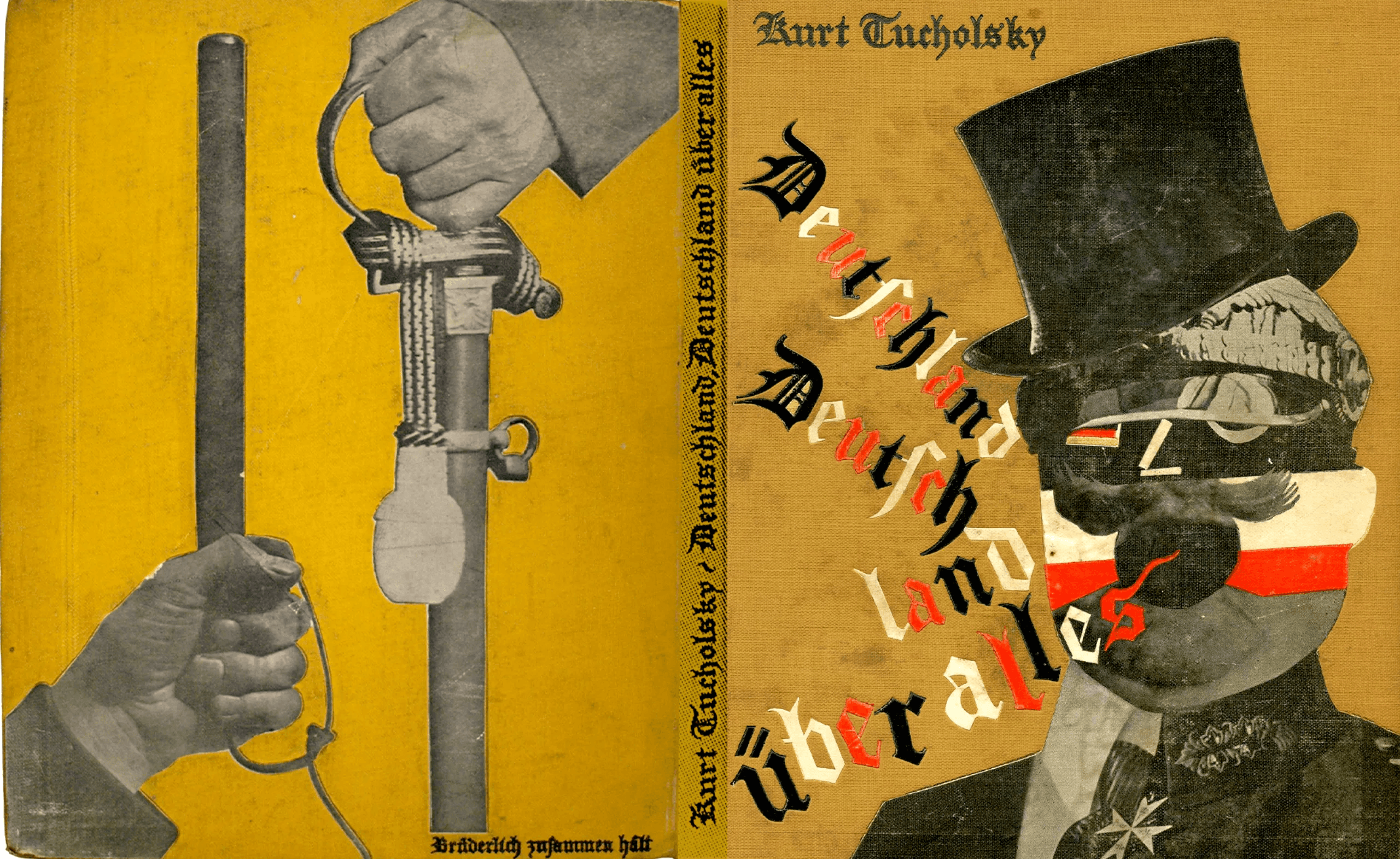
这些图像在1930年代的反法西斯刊物里被广泛传播。纳粹上台后,他逃往布拉格,再逃往伦敦,1933-38年在流亡中继续制作反纳粹蒙太奇。他的技术影响了整个20世纪的政治平面设计,从苏联宣传画到朋克唱片封面到今天的meme文化,都在用同样的逻辑:把已有的图像重新组合,制造新的意义(或新的无意义)。
格奥尔格·格罗斯 George Grosz(1893-1959)
他的画是对魏玛德国的解剖,政客、军官、资本家、神职人员,全部以动物性的、腐败的形象出现。他用尖刻的线条和酸性的颜色,把一个社会的道德败坏变成视觉的讽刺文学。他被德国政府以”侮辱军人荣誉”和”亵渎宗教”起诉多次,每次都付罚款,继续画。
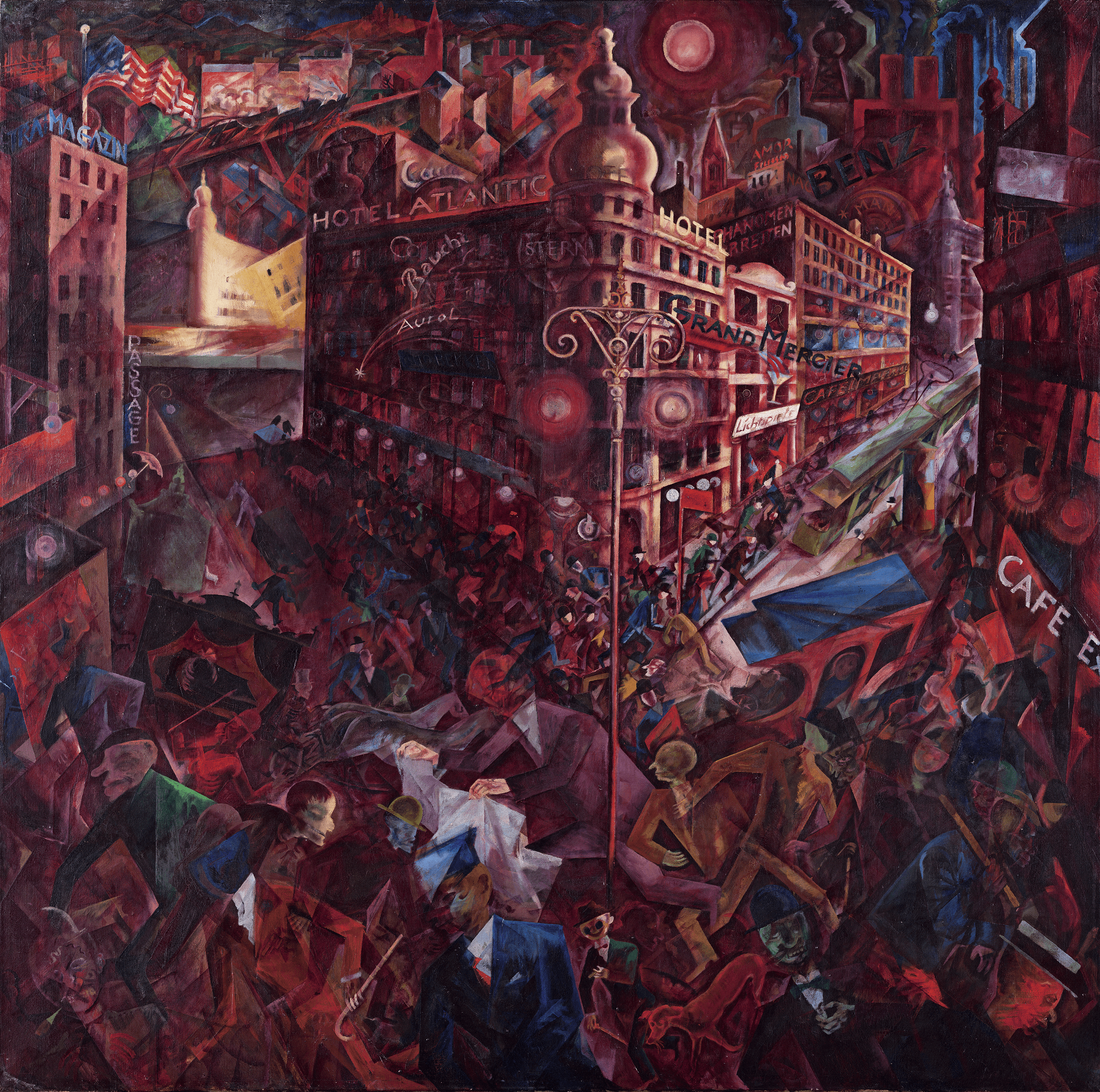
1932年,就在纳粹上台前一年,他移民美国,在纽约教画画。他在美国的晚期作品失去了柏林时期的愤怒和精准,他说,在美国,他找不到那种可以让他愤怒的具体的、可命名的敌人。美国的权力是弥散的,不像魏玛德国那样凝聚在一张张可以被画出来的脸上。
汉娜·霍希 Hannah Höch(1889-1978)
她是柏林达达里最重要的女性,也是摄影蒙太奇最系统化的实践者。她和达达主义者劳尔·豪斯曼同居多年,但他一直拒绝和妻子离婚。她后来在回忆里描述这段关系里的矛盾:达达主义者们宣扬解放、反对一切规范,但他们在私人关系里仍然期待女性做传统的角色,做饭、打理家务、在情感上服务男性。
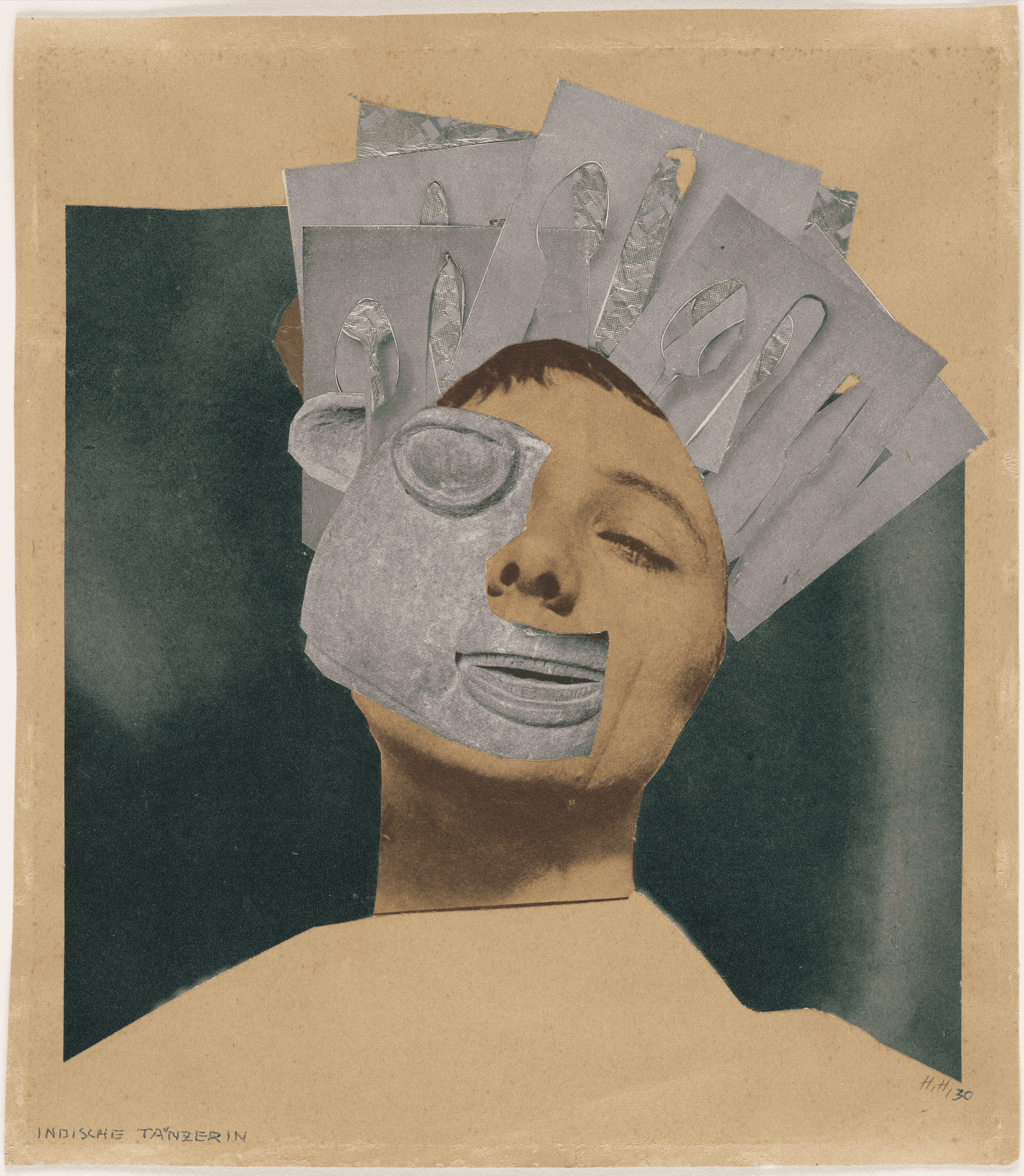
她离开豪斯曼后,和一个荷兰女性建立了长达九年的伴侣关系,这在1920年代是极度边缘的存在。纳粹时期,她被定性为”堕落艺术家”,低调藏在柏林郊区的农舍里,把大量同代艺术家的作品藏在菜园和马厩里,躲过了纳粹的没收。她活到89岁,是达达主义者里活得最长的人之一。
纽约达达:杜尚 + 曼·雷
曼·雷 Man Ray(1890-1976)
美国人(本名伊曼纽尔·拉德尼茨基),是杜尚在纽约最重要的合作者。他最重要的贡献是实验摄影——特别是”光影照片”(Rayograph):把物件直接放在感光纸上曝光,不用相机,制造物件的直接痕迹/阴影。这和杜尚的现成品逻辑类似:艺术家不是在”创作”,是在记录物理过程。他后来去了巴黎,成为超现实主义摄影的核心人物,拍摄了达利、毕加索、科克托、乔伊斯,以及他的多位情人(其中包括传奇人物李·米勒,后者自己成为重要的战地摄影师)。
科隆达达:马克斯·恩斯特
马克斯·恩斯特 Max Ernst(1891-1976)
他是达达和超现实主义之间最重要的桥梁人物。他发明了拓印法(Frottage):把纸放在粗糙表面(木板、叶子、布),用铅笔涂擦,让表面的纹理随机转印到纸上,然后从这些随机图案里”发现”图像——他说这个过程类似于弗洛伊德的自由联想,让潜意识在随机的视觉刺激里找到自己的图像。他还发明了拼贴小说,把维多利亚时代的廉价小说插图拼接重组,制造荒诞、性、暴力交织的叙事。这些拼贴书被认为是图像小说的先驱。
达达的核心技术和哲学
拼贴(Collage): 把不同来源的现成图像重新组合——报纸、广告、照片。意义来自并置,不来自任何单一元素。这个技术来自立体主义,但达达把它彻底政治化和哲学化。
蒙太奇(Montage): 比拼贴更激进,不只是并置,是冲突性的并置,让两个图像的碰撞制造第三个意义(或者第三个无意义)。这和爱森斯坦的电影蒙太奇理论是同时代的不同媒介里的同一个发现。
表演(Performance): 达达是最早系统性使用表演作为艺术媒介的运动。身体、时间、观众的反应,这些都成为作品的一部分。这直接导向了1960-70年代的行为艺术传统。
宣言(Manifesto): 他们写了大量宣言,包括嘲笑宣言本身的宣言。宣言作为文体被达达彻底解构:如果一份反对一切定义的宣言本身就是一种定义,那宣言的意义是什么?
偶然(Chance): 让随机过程参与创作,阿尔普的扔纸片,查拉的剪词袋,杜尚的《大玻璃》最终被偶然的破裂完成。这是对”作者意图”和”创作控制”的哲学攻击,也直接影响了后来的计算机艺术和算法艺术。
达达的内在矛盾与终结
达达面临一个无法解决的悖论:它反对所有系统,但它本身成了一个系统。 它反对意义,但它的反对有了意义。 它反对艺术,但它的作品成了艺术史的经典。 它嘲笑一切,但它自己被严肃地研究。查拉后来说:”达达在第一天就知道它会死,它只是不知道会在哪天。”1922-23年前后,达达实际上解散了。几条不同的出路:进入超现实主义(恩斯特、阿尔普、曼·雷),找到了一个新的理论框架(弗洛伊德),把达达的能量引导向潜意识的探索。进入政治(查拉加入共产党,胡尔森贝克回到德国参与政治文化,哈特菲尔德变成反纳粹宣传员),找到了一个可以相信的意义系统。个人路线(鲍尔皈依天主教,杜尚打象棋),在达达之外找到了自己的答案,或者选择了沉默。
达达的遗产
直接影响:
超现实主义吸收了达达的反理性和偶然技术,但给它加上了弗洛伊德的理论框架。
激浪派Fluxus(1960s):小野洋子、约翰·凯奇,直接继承达达的表演、偶然、反艺术姿态。
概念艺术:杜尚的现成品直接导向了”艺术是概念,不是物件”的完整理论化。
朋克(1970s):DIY精神、反建制、故意的粗糙、宣言作为媒体策略。朋克海报设计和达达拼贴的视觉逻辑直接相关。
网络文化/meme:把现成图像重新组合制造新意义(或新无意义),这是哈特菲尔德和霍希1919年在做的事。
深层影响:达达是第一个系统性地提出这个问题的运动:艺术机构,画廊、博物馆、批评家、市场是艺术存在的前提,还是艺术的障碍?这个问题在今天仍然没有解答,每隔十年就有一代艺术家重新发现这个问题,然后被艺术机构吸收,成为艺术史的一章。达达本身就是这个循环最好的证明。
🖼️