Created on
Updated on
1890s, Russia | The Wanderers
the impressionists of Russia? not style, but spirit
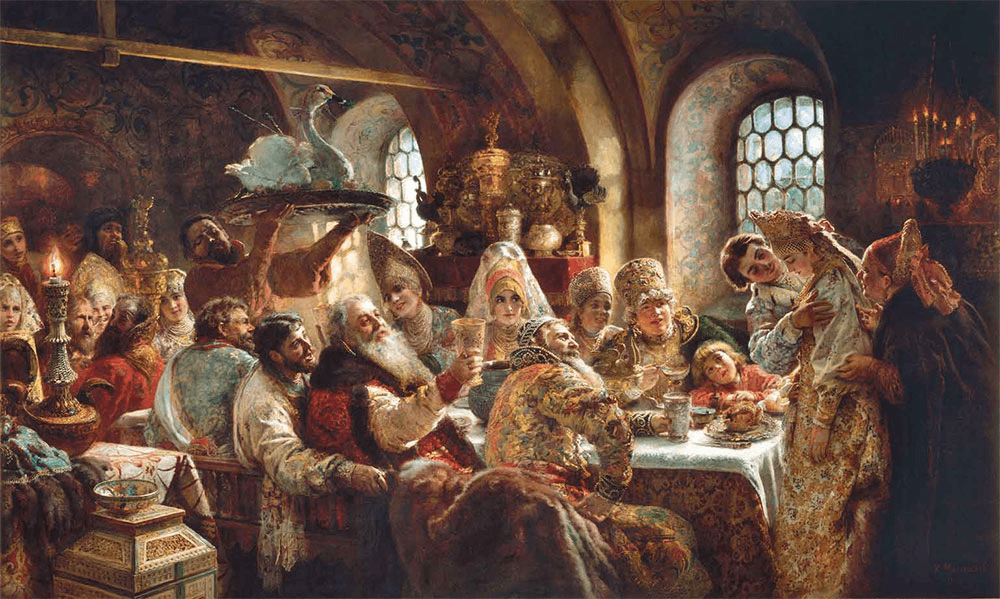
Preface: welcome to this very brief intro to modern art. Please feel free to use this as a guide for museum visits.
Imperial Academy of Fine Arts in St. Petersburg
By the 19th century, European art was controlled by academies — state-sponsored institutions that defined what art was, trained artists, and controlled access to exhibitions, commissions, and careers. The French Academy in Paris was the model everyone copied. Russia's Imperial Academy of Fine Arts in St. Petersburg was founded in 1757 by Catherine the Great, explicitly modeled on the French and Italian academies.The Academy wasn't just a school. It was a complete gatekeeping apparatus. It determined the hierarchy of subject matter — history painting (scenes from ancient history, mythology, the Bible) ranked highest because it was considered the most intellectually demanding and morally elevating. Portrait, landscape, genre scenes (everyday life), still life — each ranked below the one above it. An artist who painted peasants was, by definition, doing lesser work than an artist who painted gods and emperors. This wasn't informal opinion. It was codified doctrine.To graduate, students had to produce a "program painting" — a prescribed historical or mythological subject, assigned by the Academy. There was no choosing your own subject. The institution decided what serious art looked like, and you either produced it or you didn't graduate, which meant you didn't get access to the patronage networks, the state commissions, the exhibition spaces the Academy controlled. This system had real teeth. Without Academy credentials, an artist in 19th century Russia had almost no path to a professional career. The nobility and the state were the primary patrons, and they bought what the Academy endorsed.
Russia had a particular version of this problem. Peter the Great had forcibly Westernized Russian culture in the early 18th century — the Academy, like so much of Russian elite culture, was a deliberate import, a statement that Russia belonged to European civilization. This meant the dominant aesthetic was European academic painting: Italian Renaissance technique, French compositional logic, subjects drawn from Western classical tradition. For an artist who wanted to paint Russia — Russian peasants, Russian Orthodox religion, Russian landscape, Russian social conditions — the Academy framework was actively hostile. These weren't just aesthetically unfashionable subjects. They were low-ranked by the Academy's own hierarchy. Painting a serf was, in institutional terms, less serious than painting Achilles. Moscow and St. Petersburg were where the Academy, the galleries, the collectors, and the patronage were. The rest of Russia — which meant most Russians — had essentially no access to visual art at all. Art was a capital city phenomenon, for educated elites.
The 1863 walkout
The immediate trigger was an 1863 competition. The Academy assigned the graduating class a mythological subject from Scandinavian legend — Odin in Valhalla — and the students requested permission to choose their own subjects instead. The Academy refused. Fourteen students submitted a formal petition, were denied, and resigned collectively. This became known as the "Revolt of the Fourteen." They couldn't exhibit independently because the Academy controlled exhibition spaces. They couldn't easily sell because the Academy controlled access to collectors. What they could do was organize their own shows and take them places the Academy had never bothered to reach.
The first Wanderers exhibition toured in 1871 — St. Petersburg, Moscow, Kyiv, Kharkov. Over the following decades they reached dozens of cities. The exhibitions were ticketed, affordable, and drew audiences who had genuinely never stood in front of a painting before. The act of taking art to provincial Russia implicitly argued several things at once: that people outside the capitals deserved access to culture, that Russian subjects were as worthy as classical ones, and that art's audience shouldn't be defined by class or geography. The subject matter was Russia as it actually existed: peasants, serfs, the rural poor, Orthodox clergy, merchants, the Volga boatmen straining under their harnesses. Ilya Repin is the name most associated with this — his Barge Haulers on the Volga (1873) is the canonical image, ten figures dragging a boat upriver, faces individualized, bodies exhausted, rendered with a documentary directness that the Academy would have found beneath contempt.
Ilya Repin (1844–1930)
Repin came from Chuguev, a military settlement in Kharkov province — now Ukraine — the son of a soldier. Before he got to St. Petersburg he trained with local icon painters, which meant his first serious technical education was in a tradition the Academy considered folk craft rather than fine art. He arrived at the Imperial Academy in 1864, a year after the walkout, and was technically inside the system — he even won the Academy's Grand Gold Medal in 1871 for a history painting. But the Academy's logic never took hold of him the way it was supposed to. He kept looking at the wrong things.
Barge Haulers
The origin of Barge Haulers is a specific moment of discomfort. Around 1868, Repin was on a recreational outing along the Neva with fellow students — the kind of pleasant Sunday excursion that young Academy men went on. He saw barge haulers working the riverbank and was struck by the juxtaposition: well-dressed people enjoying the afternoon twenty meters from men in harnesses doing brutal physical labor. Not as a political abstraction. As a visual fact that he couldn't stop looking at. He made preliminary sketches. Two years later he traveled to the Volga specifically to study the barge haulers properly — spending extended time among them, making individual studies of specific men, learning their names, their histories, the mechanics of what they were doing and how it felt in the body. The painting that resulted in 1873 was built on that accumulated direct observation. It is not a painting made from a distance.
Eleven men move in a diagonal procession across a wide, sandy Volga shore, harnessed together by a long towline attached to a barge. The light is strong and summery, almost beautiful, which creates a tension the painting never releases: the setting has the visual qualities of a landscape painting, the content has the qualities of a labor document. The figures are rendered as distinct individuals, which was the point. Repin had spent enough time with actual barge haulers to paint specific people rather than a generalized mass of suffering. Each man has a different body, a different face, a different way of carrying the weight. The range of type is deliberate — different ages, different physiognomies, different degrees of exhaustion and endurance. The youngest figure, a boy near the right side, is trying to adjust his harness while walking, a detail that takes a moment to read and then doesn't leave you.
The figure that Repin himself wrote about most was a man he called Kanin — positioned second from left, the one who turns to look directly at the viewer. Repin described him as a former priest, educated, reduced to this work. The directness of the gaze is not confrontational exactly. It's something harder to categorize. He's looking at you with full awareness of being looked at, and the painting doesn't tell you what to do with that. In the middle distance, barely visible, is a steamboat. This detail matters. The industrial machinery that is beginning to make barge haulers obsolete is already present in the landscape. These men are being hauled out of history along with the barge.
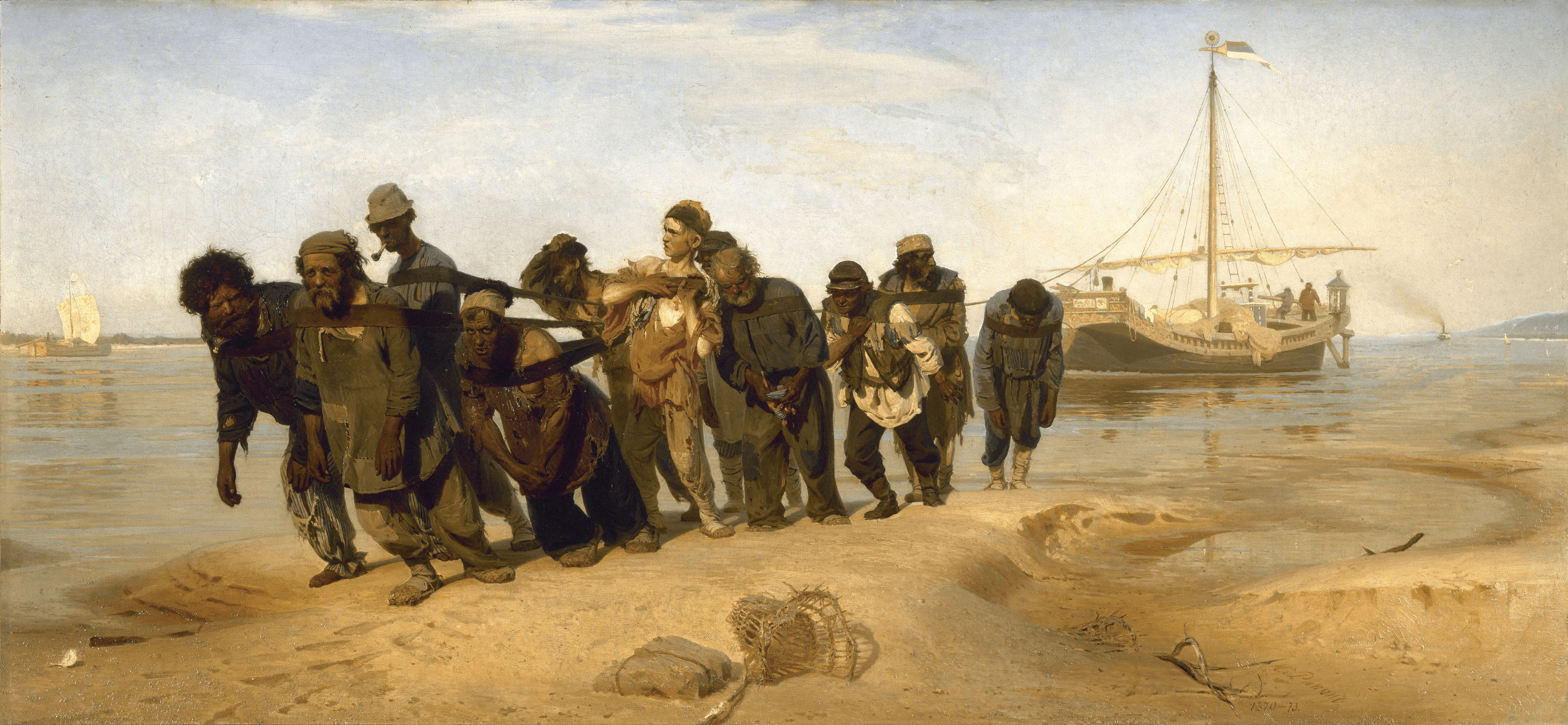
To an Academy-trained eye evaluating this painting in 1873, the problem wasn't primarily political. The problem was that Repin had spent his technical resources on the wrong subjects(wow). Academic figure painting required demonstrating mastery through idealized human form — bodies that showed knowledge of classical sculpture, faces that expressed noble emotions in legible ways, compositions that organized figures into clear hierarchies and relationships. All of this required choosing subjects where idealization was appropriate. You couldn't idealize barge haulers without falsifying them, and Repin wasn't trying to idealize them. The formal choices the painting demands — the loose, immediate handling of skin and cloth, the refusal to organize the figures into a compositional statement, the documentary specificity of each face — were, from the Academy's perspective, a waste of capacity. You were technically capable of painting gods. Why are you painting this? This is the logic Kramskoi had been arguing against, and Repin's painting made the argument visually. The individuation of the figures — the decision to make eleven distinct people rather than an allegory of labor — was the formal statement. It said: these specific men are as worthy of this level of attention as any classical subject. The painting's seriousness is inseparable from its refusal to generalize.
When it showed at the Vienna World Exhibition in 1873, it drew significant international attention. The future Tsar Alexander III purchased it — which created an odd situation where the painting most associated with social radicalism in Russian art became imperial property. Dostoyevsky's response is worth noting because it captures the ambivalence the painting produced even among people sympathetic to its intentions. He worried it was too dark. Not that it was false — he accepted the truth of what Repin showed — but that it offered no redemption, no transcendence, nothing that would allow the viewer to place the suffering in a larger frame that gave it meaning. For Dostoyevsky, art that simply showed suffering without providing a way through it left the viewer nowhere to go. Repin's answer, implicitly, was that providing a way through it would have been a lie. The critic Vladimir Stasov, who was the Wanderers' most important public advocate, pushed back hard in the other direction and championed the painting without reservation. Stasov is the reason the Wanderers had a coherent public identity — he wrote about them consistently and forcefully, turning individual paintings into episodes in a larger argument about what Russian art should be.
Religious Procession in Kursk Province (1883)
Barge Haulers established his method and he applied it to increasingly ambitious subjects. Religious Procession in Kursk Province (1883) is a vast crowd scene — a complete cross-section of Russian society organized around a religious procession, every class and type present, observed with the same refusal to idealize or condemn. The subject is a krestny khod — a Russian Orthodox tradition in which a sacred icon is carried in procession through the countryside, sometimes between villages, sometimes around a parish boundary.
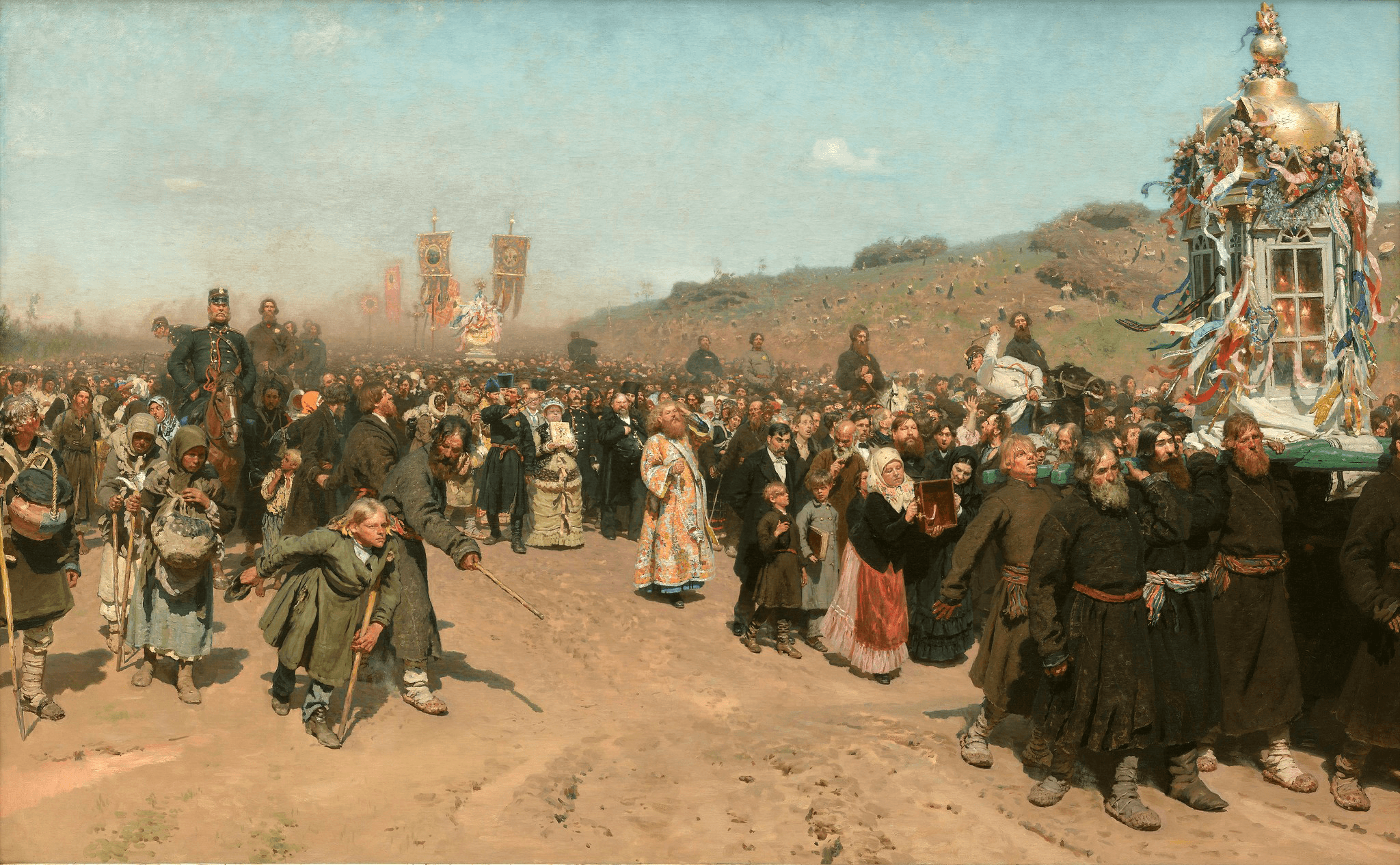
These were major communal events, drawing crowds from across a region, often in summer heat. They were simultaneously religious ceremonies, social occasions, and demonstrations of the Church's presence in everyday rural life. Repin spent roughly three years working on this painting, doing preparatory studies on location in Kursk before assembling the final canvas.The finished work is large — 175 by 280 centimeters — and it needs to be, because the subject is a crowd of perhaps a hundred figures rendered with individual specificity across a wide, dry, dusty landscape. The terrain is unglamorous: pale earth, scrubby trees, a bleached summer sky. There is no picturesque Russia here, no romantic landscape tradition. This is central Russia as it actually looked.
At the center, elevated on a portable platform, is the icon in its gilded reliquary — the object that has drawn everyone here. Immediately surrounding it are the clergy: priests in vestments, deacons swinging censers, church officials who by function and rank are closest to the sacred object. Around them, in the privileged inner circle of the procession, are wealthy merchants and their wives, dressed in silk and fine cloth. They are here because money and status have bought them proximity to the icon. Their faces are composed, self-satisfied, conscious of their position. Running along the edges of the procession are mounted Cossacks and police — the state apparatus embedded within the religious ceremony, keeping order, which in practice means keeping the wrong people at the appropriate distance. They carry sticks. They use them. Behind and to the sides: the ordinary crowd, peasants, common people, the mass of believers who have traveled to participate and who are experiencing the procession from whatever distance their station permits. The further from the icon, the less fine the clothing, the more weathered the faces, the more the bodies show the physical cost of daily labor.
Vladimir Stasov — the critic who had been the Wanderers' most consistent public advocate since their first exhibitions — treated this as the movement's crowning achievement. His argument was that Repin had done what Russian art had been building toward since the 1860s: produced a work of complete social truth at the scale the subject demanded. The painting showed Russia to itself, without flattery, without condemnation, simply with total clarity about how the country organized itself around the things it claimed to hold sacred. Stasov's enthusiasm was not universally shared. Conservative critics found the painting anti-religious, anti-clerical — which it isn't, quite, but the discomfort is understandable.
They Did Not Expect Him (1884)
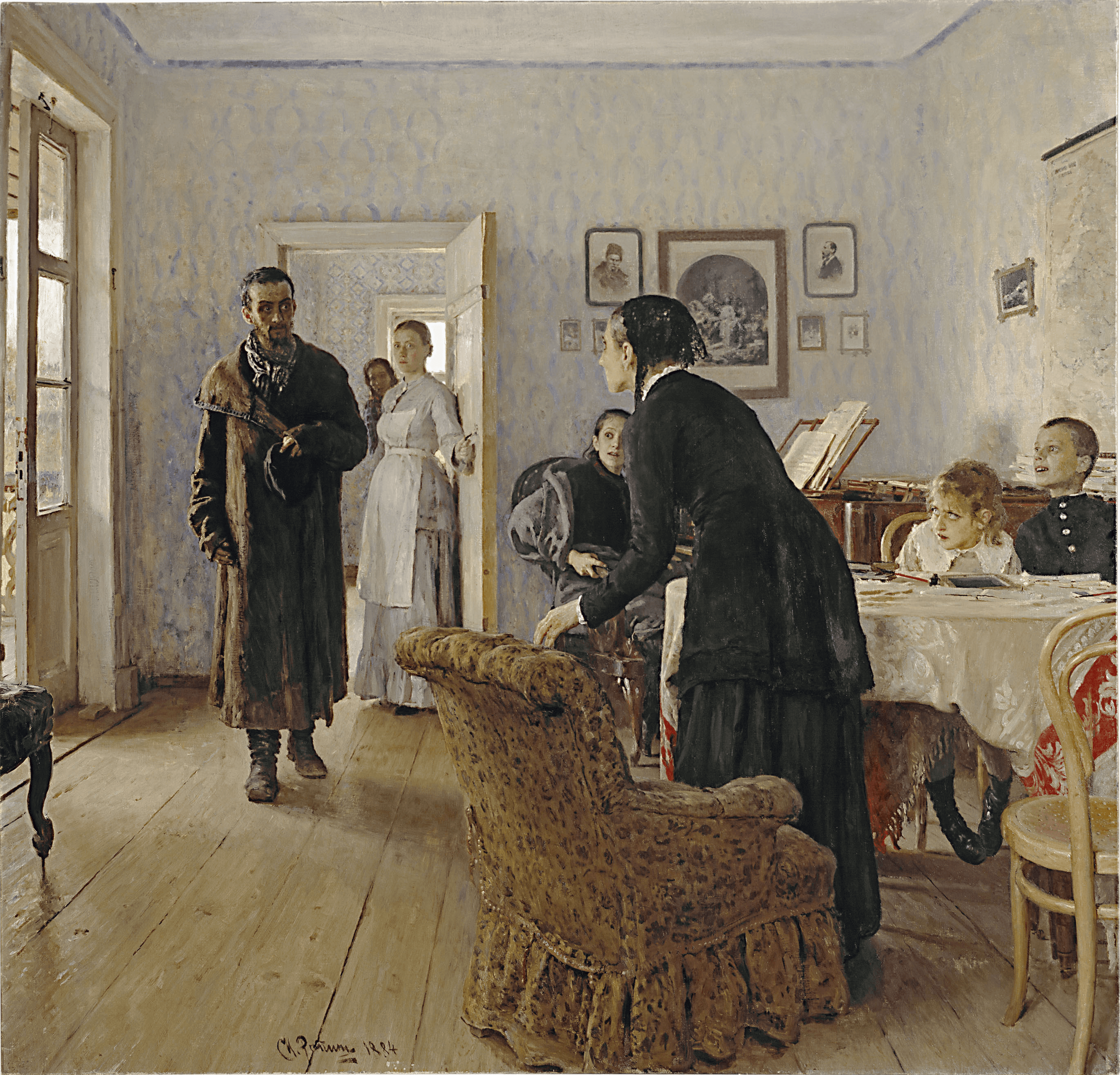
They Did Not Expect Him (1884) shows a political exile returning home unexpectedly, the family's reactions caught in the instant before anyone has composed themselves. The title is literal. He has walked through the door and nobody knew he was coming. That is the entire situation, and Repin understood that this single fact — the unexpectedness — was the painting's engine. It's a middle-class intelligentsia interior — comfortable but not wealthy, lived-in, the kind of space that belongs to educated people of modest means. A piano. Books. Worn upholstery. Nothing ostentatious.
On the walls are portraits. Repin placed them deliberately. One is identifiable as Taras Shevchenko — the Ukrainian poet who spent ten years in Tsarist military exile for his writing, forbidden to paint or write during his sentence. Another is Nikolai Nekrasov — the poet most associated with championing the peasantry, whose work was a touchstone for the radical intelligentsia. There are other images: a religious print, possibly a portrait of another political figure. The walls tell you exactly who lives here. This is a family that hung portraits of exiled writers in their home. The connection between that choice and the man now standing in the doorway is not stated — it doesn't need to be. The light comes from a window to the left, crossing the room toward the door where he's standing. The space is ordinary, specific, fully inhabited. Repin spent considerable effort making it feel like a place people actually lived in rather than a stage set. The ordinariness is load-bearing: the extraordinary thing that is happening is happening inside a completely ordinary afternoon.
The face is hollow, the skin pulled tight, the body thin in a way that isn't natural thinness but the result of years of inadequate food and physical hardship. His clothes are rough and worn — the clothes of someone who has been in Siberian exile or labor camp, not the clothes of a man who left from this house. He holds his hat. He has a walking stick. He has aged well beyond whatever years he was actually gone. He has crossed the threshold but only just. He's standing in the doorway, not yet in the room. This positioning is exact. He is technically inside the house but he hasn't committed to entering — and the painting captures the reason: he doesn't know what his welcome is. He is not arriving in triumph. He is arriving uncertain, reading the room as fast as he can, trying to determine whether he has come home or whether home has become something he no longer has a claim to. Repin repainted his face multiple times over the four years he worked on the canvas. The final version lands somewhere between all of them: not triumphant, not broken, not simply relieved. The seated woman in the middle distance — the mother, or mother-in-law — is in the process of standing up or has already begun to. Her body is between sitting and rising, caught in the motion of recognition. Her face carries something more complex than straightforward joy: relief and grief arriving simultaneously, the kind of emotion that has been held in suspension for years and is now releasing faster than it can be processed.
The woman closer to the foreground — likely the wife — has turned toward him. Her reaction is the painting's most psychologically dense moment. It is not uncomplicated happiness. There is fear in it, or something adjacent to fear — the terror of something you thought might be permanently lost suddenly being returned. People who have experienced that specific kind of reversal describe it as almost indistinguishable from grief in the first instant. The body doesn't know the difference between a sudden loss and a sudden return. She is not yet sure she can trust what she's seeing.
Then the children. The older child — a boy of perhaps ten or eleven — is looking at the man with an expression that contains recognition. He knows who this is. His face is cautious, feeling its way toward something, not yet given over to it. He remembers. The younger child, a girl, is looking at the man with an expression closer to uncertainty or apprehension. She may have been very small when he left. She may have been born after he left. She does not recognize him. Her father is a stranger. This is the detail that makes the painting unbearable if you sit with it. The exile has been gone long enough that his own child looks at him the way a child looks at someone she hasn't met. Whatever he imagined coming home to — the version of home he carried through the years of prison or Siberian labor — included children who knew him.
Behind him, in the doorway, is the maid who presumably opened the door and let him in. Her expression is pure surprise, unfiltered, nothing complicated about it — she has no history with this man, no years of waiting, no accumulated emotion. She's just startled. Repin put her there partly for compositional reasons, but she also functions as a calibration point. Her uncomplicated surprise shows you what the reaction would look like without all the weight the family is carrying. Everything the family's faces contain beyond simple surprise is the weight.
The painting was made in the immediate aftermath of the assassination of Tsar Alexander II in 1881. The Narodnik revolutionary movement — populists who had been working for a decade toward political change — had been dismantled through mass arrests, executions, and Siberian exile following the assassination. Thousands of families were living with an absent political prisoner. The figure in the doorway was not an abstraction. He was a recognizable social type, and the audience for the Wanderers exhibitions would have known people who lived inside this situation or lived inside it themselves. Repin was not a revolutionary. But he refused to look away from what the political repression had produced in human terms — not the ideology, not the policy, but what it actually looked like in a room when someone came back from it. The family in this painting is not heroic. They are just people trying to locate themselves in relation to something that shouldn't have happened and has.
Ivan the Terrible and His Son Ivan on November 16, 1581 (1885)
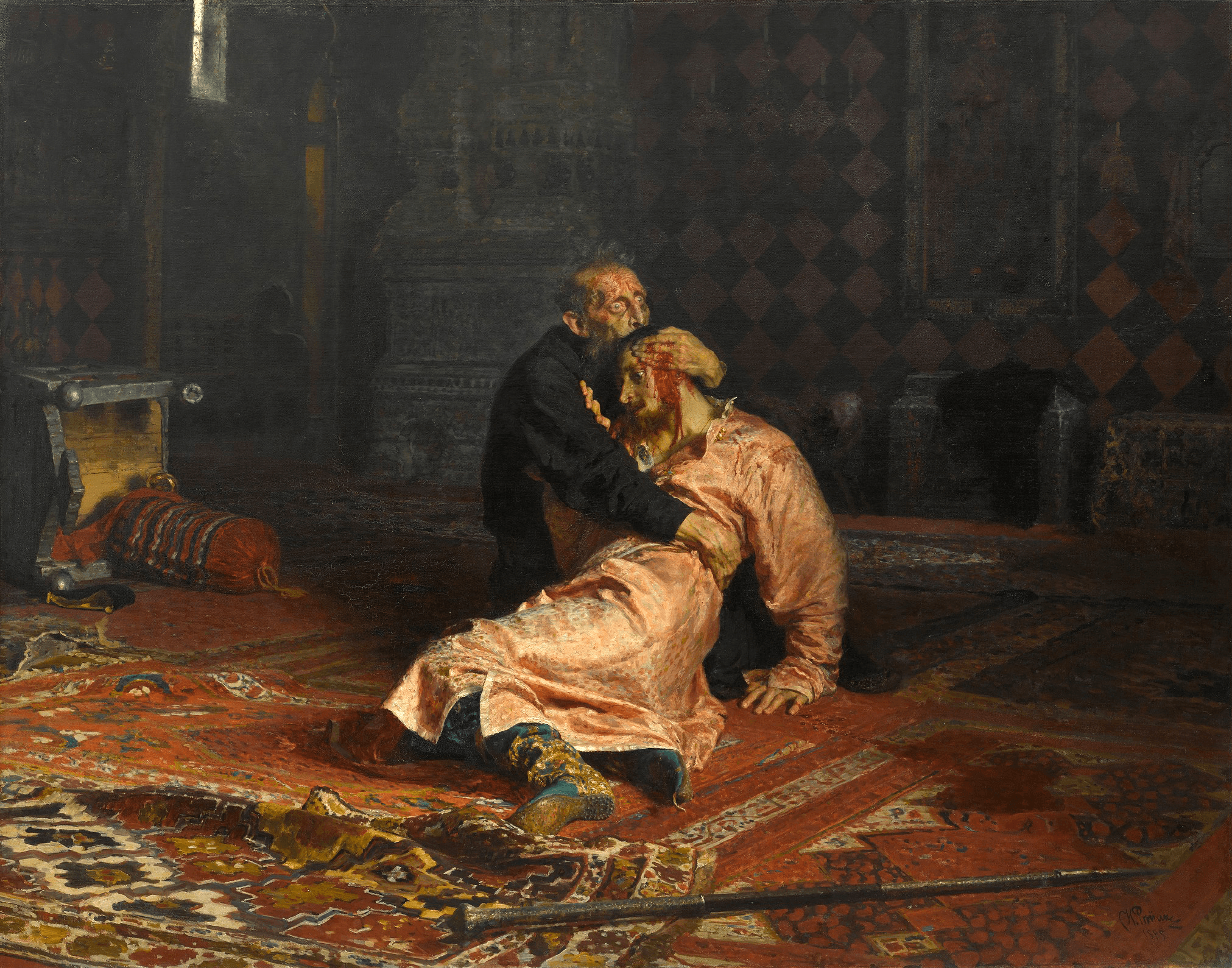
Ivan the Terrible and His Son Ivan on November 16, 1581 (1885)— Ivan cradling his dying son whom he has just murdered in a rage — is so viscerally specific about the horror of what has happened that the Tsarist censors eventually banned it from public display. Ivan IV had struck his son and heir, Tsarevich Ivan Ivanovich, in the head with an iron-tipped staff during a quarrel. The cause of the quarrel is disputed — some accounts say Ivan had beaten his pregnant daughter-in-law for what he considered improper dress, and his son confronted him about it; others suggest a political argument about military strategy. The specifics of the trigger barely matter against what happened next. The blow landed on the Tsarevich's temple. He died of the wound several days later.
The two figures are on the floor. Ivan is not standing over his son in authority or grief — he has collapsed down to him, is on his knees, has gathered the dying man into his arms. The son's head is cradled against Ivan's chest. The posture is the posture of someone trying to physically hold a life inside a body that is already leaving. The son's face is turned toward the viewer. He is still alive — the eyes are open, slightly unfocused, the expression neither pain nor peace but something between them, the face of someone in the process of departing. One hand is raised slightly, barely, the gesture of a man whose body is still making small involuntary movements. There is blood at his temple, on his collar, on the floor beneath them. The blood has spread into the carpet. It is specific, rendered with the same documentary precision Repin brought to everything — not theatrical gore, not symbolic red, but the actual color and quantity and spread pattern of blood from a head wound on a carpeted floor.
The painting was shown at the 13th Wanderers exhibition in 1885 and almost immediately attracted the attention of Konstantin Pobedonostsev — the Chief Procurator of the Holy Synod, effectively the most powerful conservative ideological voice in the Tsarist government under Alexander III. Pobedonostsev wrote to the Tsar calling the painting demoralizing and harmful, arguing it should not be on public display. Alexander III banned it. The specific grounds were aesthetic and moral — the painting was deemed too disturbing, too focused on horror, inappropriate for public exhibition. But the political subtext was not hidden. The painting showed a Russian Tsar committing an act of irrational, catastrophic violence against a member of his own family. It showed Tsarist power not as divine order but as a force capable of destroying the things it was supposed to protect, driven by rage that bypassed judgment entirely. This was four years after Alexander II's assassination, in a political climate of extreme repression under Alexander III. The reading of the painting as a comment on Tsarist violence — on what absolute power looks like when it loses control of itself — was not forced. It was obvious, and Pobedonostsev was not wrong to identify it. The ban was eventually lifted, but the painting spent time in storage before returning to public view.
Barge Haulers showed what labor extracted from bodies. Religious Procession showed how social hierarchy organized itself around the sacred. They Did Not Expect Him showed what political repression did to families over time. Ivan the Terrible shows what power does to itself when it acts without constraint — the Tsar on the floor with his son's blood on his hands, the empire's future bleeding out on a carpet. The progression across Repin's major works is toward increasingly direct confrontation with where violence originates. More on Wanderers in the next post.
🖼️