Created on
Updated on
VFX Producers

Preface: Welcome to this very long series of filmmaking in the age of AI(2026).
The VFX supervisor is responsible for what the work looks like. The VFX producer is responsible for whether the work gets done at all — on time, within budget, and without the production collapsing under the weight of its own complexity. These are two different jobs that require two different kinds of intelligence, and on any serious VFX production both roles need to be filled by people who are genuinely good at them.
VFX breakdown
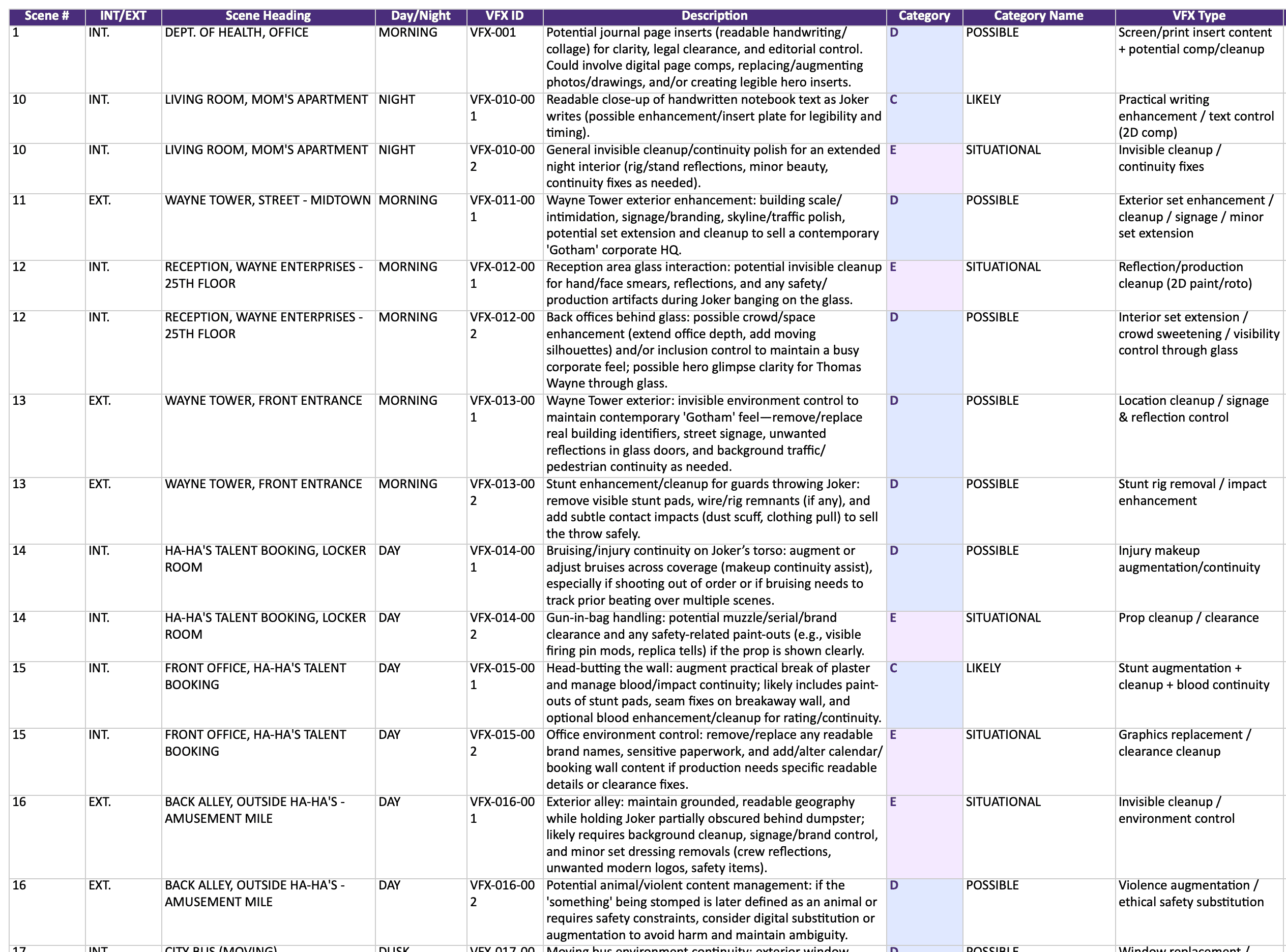
The VFX producer’s first major task is getting the work bid. Once the VFX breakdown is complete — every shot identified, categorized, and described — the VFX producer packages that information into a bid package and sends it to VFX vendors. Usually a VFX breakdown is completed with VFX supervisors, basically we’d sit in a room, going through dailies, with all the shots we currently have added in as a sequence, with all CG shots being represented as by previz as a place holder. We play the sequence, and we call out what needs to be done with VFX, compile all of that into an excel sheet, as a master guide so the VFX vendors that will be working on these sequences know what exactly it is that we need from them. A VFX breakdown looks like something like this.
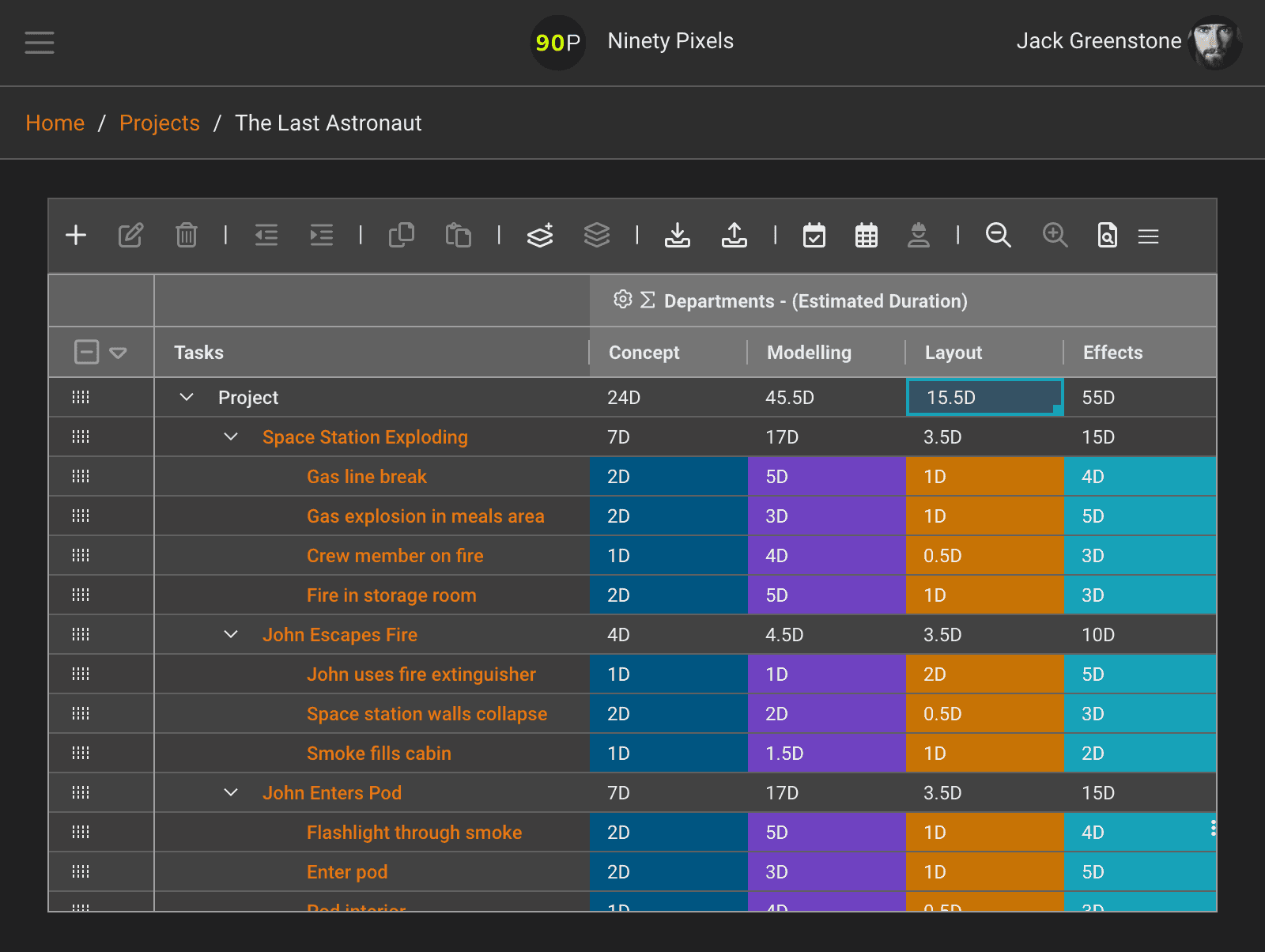
According to this breakdown, a bid package is put together, that includes shot descriptions, reference material, storyboards or previs where available, and technical specifications. This is where we put all the references, HDRI, witness cam, elements etc etc, in a folder, and send this to vendors. Vendors review the package and return bids: detailed cost estimates broken down by shot, department, and labor hours. I’m trying to find a sample for this, it looks something like this. It has the mandays, how much it costs etc etc, though in the picture below there’s no cost, since such information is usually only shared between the producer and the vendor. It wouldn’t be out in the open on the internet, but you get the idea.
The VFX producer reads those bids, compares them across vendors, identifies where estimates seem high or low, and negotiates. A vendor who bids a creature animation sequence at twice the rate of another vendor isn’t necessarily overpriced — they may have a stronger track record with that specific type of work, or their pipeline may be better suited to the schedule. The VFX producer has to understand what they’re buying, not just what it costs. Choosing the cheapest vendor for the wrong shot is how productions end up with reshoots and emergency replacements six months into post. Sometimes, directors are admanet about which studio they want for which sequence, which also needs to be taken into consideration. For example, one director had to get WETA in New Zealand, but we were unable to, since the studio was overcapacity with other projects.
Work gets split across multiple vendors based on specialty, capacity, and cost. A single film might have six or eight different VFX houses working on different sequences simultaneously. Each one gets a contract that defines scope, deliverables, schedule, and payment terms. The VFX producer negotiates and manages all of those contracts. Some studios are better at creatures, hair, while others are better at compositing, or set extension, special effects, digital doubles, that sort of thing. So the producer has to know, who does what the best, at the best time, that also has a track record of delivering shots on time, with precision, within budget. It’s a lot of decisions the producer has to make. However, a good producer can do this effortlessly, as these information are ingrained in her/his brain. This means staying on top of what each studio is up to is also part of a producer’s job, just so the producer can stay ahead of each studio’s capacity and operations to know what to give to whom. Even gossip helps with making a decision, like so-and-so studio is having personnel change, they might not have time etc etc. Information is key.
On the production side, the VFX producer hires and manages the in-house VFX team — the VFX editor, the production coordinators, the on-set production assistants who work under the VFX supervisor during the shoot. They are responsible for making sure the internal team has what it needs to function: software licenses, hardware, communication systems, access to editorial. They also have significant input into the hiring of the VFX supervisor, and on some productions lead that search. The VFX supervisor and VFX producer have to work together effectively for the entire duration of the production. A mismatch in working style or communication approach between those two roles causes problems that ripple across every department and every vendor relationship.
Time is Money
The VFX budget is the VFX producer’s document. They build it, defend it, and maintain it across the entire production. On a large studio film, a VFX budget can run into the tens or hundreds of millions of dollars. Every shot has a cost. Every change to a shot has a cost. Every new shot added after the original breakdown has a cost.
The VFX producer tracks all of it. When the director decides in post that a sequence needs three additional shots that weren’t in the original breakdown, the VFX producer calculates the cost, documents the change order, and brings it to the line producer and the studio. Nothing gets added without that accounting being done first. Productions that don’t maintain rigorous change control on VFX spend find themselves in trouble because digital work can expand almost without limit — there’s no physical constraint, no set that runs out of space, no crew that runs out of hours on a given day. The constraint is money, and the VFX producer is the person enforcing it, along with her/his production team. A producer can get some help from her assistants and coordinators in terms of tracking these shots, this stage means a lot of excel sheets. Everyday the sheets are updated, which ones are done, which ones are still being worked on, what are some of the blockers, how do we get vendors, vfx supervisors and directors on set to move things along.
VFX post on a large film runs for a year or more. The VFX producer builds and maintains the master VFX schedule — when each vendor starts on each sequence, when internal reviews happen, when shots need to be approved to make the delivery date, how many revision rounds are built into each shot’s timeline. This schedule has to account for the fact that editorial is still changing upstream, that vendors will hit technical problems that cause delays, and that the director will request changes at every review. The schedule is a living document that gets updated constantly. The VFX producer’s job is to know at all times where every shot in the film is in the pipeline, what the current risk is to the delivery date, and what needs to be escalated or accelerated to keep the train on the tracks.
Once vendors are working, the VFX producer manages those relationships on a daily basis. They run the review sessions — internal reviews where the VFX supervisor and director give notes on shots in progress, and vendor reviews where those notes get communicated and turnaround times are agreed. They track rounds of revisions against the contracted scope. They escalate problems — a vendor falling behind schedule, a technical approach that isn’t working, a shot that has gone through too many revision rounds and needs to be reassigned or renegotiated. The VFX producer is the production’s point of contact for every vendor. The director and VFX supervisor give creative direction. The VFX producer translates that direction into instructions that vendors can execute within the constraints of the contract, the budget, and the schedule. When a director’s note would require a vendor to rebuild a shot from scratch rather than revise it, the VFX producer is the person who identifies that, quantifies it, and brings it back to the director with the cost attached.
Every shot in the film has a status at all times: not started, in progress, internal review, approved internally, at vendor, in revision, approved for delivery, delivered. The VFX producer maintains the shot tracking system — usually a purpose-built production management platform — that records the current status of every shot, the history of every note given on it, and every version that has been submitted. On a film with eight hundred VFX shots across eight vendors, this system is how the production maintains any coherent understanding of where things stand. Shot tracking is also how the VFX producer identifies problems before they become crises. A shot that has been in revision for six rounds without resolution is a problem. A vendor that is consistently submitting work late is a problem. A sequence where every shot is behind schedule by the same amount suggests a systemic issue rather than individual delays. The VFX producer reads the tracking data and acts on what it tells them.
The director and VFX supervisor care about what the work looks like. The studio and line producer care about cost and schedule. The VFX producer sits between those two sets of concerns and translates between them. When the director wants something that will cost more than the budget allows, the VFX producer brings that conflict to the surface and facilitates the decision — either the budget gets adjusted, the creative approach gets modified to fit the existing budget, or something else in the VFX budget gets cut to make room. That conversation has to happen explicitly and on the record. Productions that avoid it — where the director keeps requesting changes and the VFX producer keeps absorbing the cost without escalating — end up with a budget crisis in the final weeks of post when the overage can no longer be hidden. When a vendor has a problem — a technical failure, a key artist leaving mid-production, a pipeline issue affecting an entire sequence — the VFX producer manages that problem without involving the director unless the creative outcome is at risk. The director’s job is to make the film. The VFX producer’s job is to make sure the infrastructure for making the film doesn’t become the director’s problem.
Data
The VFX producer makes or heavily influences the technology decisions for the production. Which production tracking software the team uses. Whether shots get rendered on a local render farm, a cloud farm, or a vendor’s infrastructure. What file formats and resolution specifications get standardized across all vendors so that assets can move between houses without conversion errors. What color pipeline the production runs — which color space, which transfer functions, which LUTs — and making sure every vendor is operating within that same framework. These decisions sound technical but their consequences are practical. A production that doesn’t standardize its color pipeline ends up with shots from different vendors that don’t match each other, and the compositing and grading work to reconcile them is expensive. A production that doesn’t plan its data infrastructure ends up with terabytes of footage and renders with no coherent organization system, which slows every department down for the entire length of post.
A large VFX production generates enormous volumes of data — camera original footage, renders, simulation caches, texture libraries, shot deliveries, review files. The VFX producer oversees the data management system that keeps all of it organized, backed up, and accessible to the people who need it. This includes working with the digital imaging technician during the shoot to make sure camera data is being ingested and archived correctly, and working with vendors to establish secure delivery protocols for assets moving in and out of the production. Data loss on a VFX production is catastrophic in a way that has no equivalent in live-action production. A lost day of shooting can be reshot. A lost render cache for a complex simulation that took weeks to calculate may be effectively irreplaceable within the schedule. I’ve heard of the stories of people going to happy hours and coming back to work to accidentally delete a few weeks of work while being drunk before, don’t let that happen to you.
Before final VFX shots are delivered, the edit needs something in those frames for screenings, studio reviews, and sound work. Temp VFX — rough placeholder shots built quickly and cheaply to approximate the final result — gets produced throughout post so the film can be screened and evaluated as a complete work rather than a series of holes. The VFX producer manages the temp VFX process, balancing the cost of building temp against how much information the production needs from screenings at any given stage.
Temp VFX is politically complicated. Directors sometimes become attached to temp shots and resist changes in the final version. Studio executives give notes based on temp that may not apply to the final approach. The VFX producer has to manage those expectations — being clear about what temp represents and what it doesn’t — while still delivering something useful enough to serve its purpose.
Trailers are almost always cut and released before the film’s VFX are finished. The marketing department needs shots that don’t exist yet, often at a stage when vendors are still in early production. The VFX producer manages the trailer VFX pipeline — a separate, accelerated track that prioritizes certain shots for early completion specifically to serve marketing, independent of the main delivery schedule. This requires negotiating with vendors to front-load work on specific shots, and sometimes commissioning additional shots that will appear in the trailer but not in the film. Trailer VFX is a production within the production, and it runs on a different timeline with different pressures.
Tax and credits
VFX work qualifies for tax incentives in a number of jurisdictions — the United Kingdom, Canada, New Zealand, Australia, and others offer significant rebates on qualifying VFX expenditure. On a large production, the choice of where to place work is partly creative and partly financial. The VFX producer understands the incentive landscape and structures vendor agreements to maximize qualifying expenditure. A decision to move a significant portion of work to a UK vendor rather than a US vendor might be driven primarily by the ability to access a 25 to 40 percent rebate on that spend. Over the course of a large film’s VFX budget, those decisions are worth tens of millions of dollars.
The VFX producer reports regularly to the studio’s physical production and post-production executives on budget status, schedule status, and risk. Studios have their own VFX oversight teams whose job is to monitor exactly what the VFX producer is managing internally. That relationship needs to be functional — transparent enough that the studio has genuine visibility into the production’s status, but managed carefully enough that normal production turbulence doesn’t trigger unnecessary intervention.
On productions with a completion bond — a financial instrument that guarantees the film will be completed and delivered — the completion guarantor has audit rights over the budget and schedule. The VFX producer manages that relationship alongside the line producer, making sure the guarantor has accurate information and that any significant overages or schedule risks are disclosed and addressed proactively rather than discovered.
VFX credits are negotiated, not automatic. Which vendors get a card, what the card says, where it appears in the end credits, whether individual artists are listed — all of this gets managed by the VFX producer in coordination with the studio and the vendors’ contracts. On a large production with many vendors, the end credits VFX section can run for several minutes and involve hundreds of individual names. The VFX producer is responsible for making sure those credits are accurate and that contractual obligations to vendors are fulfilled. Let’s go little bit deeper into previz next.🫶🏼