Created on
Updated on
Minneapolis (II): Class Stratification
明尼阿波利斯(ii): 阶级分层
写在前面:本文和chatgpt合作完成。
19世纪末至20世纪初,随着东欧移民与北欧移民持续涌入,Minneapolis 的白人工人阶层内部已经出现清晰分化。较早定居、文化资本更高、与本地商业和政治网络联系更紧密的群体,逐步试图在居住空间上与被视为“更不稳定”的劳动力人口拉开距离。这种分化并非一开始就通过明确的法律条文完成,而是先在住房市场与社区实践中被反复执行,最终固化为制度。
Minneapolis 的族群与阶级切割,最初并不是立法行为,而是一套“看似私人、实际上高度一致”的日常选择所累积的结果。房东决定租给谁、地产经纪决定带谁看房、邻里决定欢迎谁进入社区,这些行为在当时通常被理解为个人偏好或社区自治,但在长期重复中,形成了稳定而排他的空间模式。
其中最常见、也最有效的机制,是房东的选择性出租。许多房东并不需要公开宣称歧视,只需在看房阶段以“已有人申请”“不太合适”等理由拒绝特定人群,便足以将非白人或被视为“不稳定”的移民排除在外。这类做法几乎不留下书面记录,却在城市尺度上表现出高度一致性。结果是,一些街区在实践中迅速“变白”,而另一些街区则被默认成为所有被拒绝者的去处。
与此同时,社区层面的排他性规范开始成形。“体面社区”“安全社区”等表述并非中性描述,而是一种编码语言,用来界定谁被视为可接受的邻居。邻里协会、教会网络与本地商业圈层,通过非正式压力阻止房屋转售给被视为“外来者”的家庭。在一些案例中,新搬入的少数族裔家庭会遭遇集体冷处理、持续骚扰,甚至直接威胁。这些行为往往无需警察介入便能奏效,其目的并非惩罚,而是劝退。
随着房地产行业的组织化,这些原本分散的偏好迅速被标准化。当地产经纪、银行与开发商逐渐形成行业规范,族群构成被系统性地纳入房产评估与投资判断之中。“族群混合”被视为潜在的贬值风险,这一逻辑并非以道德语言出现,而是以“投资安全”的名义被反复确认。排斥由此从个人选择,转化为一种被视为合理、甚至负责任的职业实践。
在此基础上,制度化开始加速。限制性契约被写入地契,把原本模糊的社区共识转化为可执行的法律文本;银行在审批贷款时,将街区的族群结构作为风险判断的重要依据;城市规划部门在道路、学校与公共设施布局上,顺着既成的空间分布进行所谓“技术性优化”。这些决策看似中立,却在实践中不断确认并固化既有边界。到20世纪前半叶,Minneapolis 大量住宅地契已被纳入这种限制性安排之中,族群空间的基本格局由此被锁定。
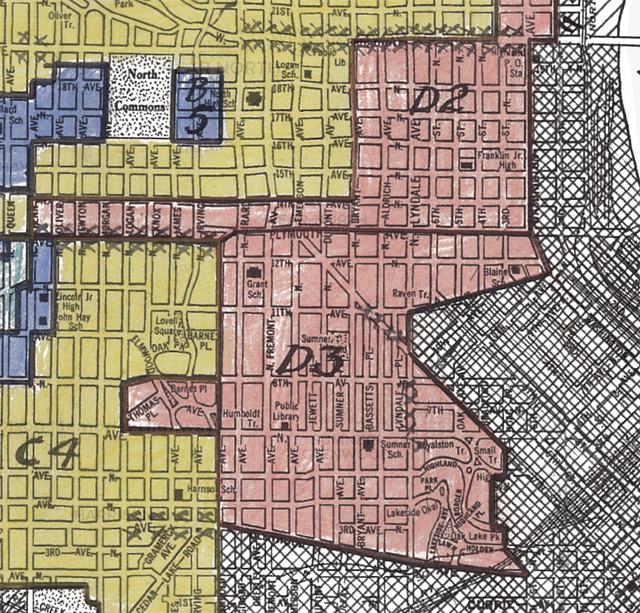
进入1930年代,金融系统的全面介入进一步强化了这一结构。新政时期,联邦政府通过住房评估体系,对城市街区进行风险分级。Home Owners’ Loan Corporation 在为 Minneapolis 制作的评估地图中,将黑人或族群混合社区系统性地标记为“高风险”。这一标记并非源自房屋质量的突然恶化,而是基于对居住者身份的判断。银行据此拒绝贷款或提高利率,保险公司同步撤出,私人投资随之停滞。社区由此被切断了通过正规金融渠道改善住房和积累资产的可能性。
北 Minneapolis 逐渐成为黑人被“允许”进入的少数区域之一,但这种“进入”并不意味着资源的获得,而意味着被集中安置在一个金融、教育与基础设施同时被抽空的空间中。房屋老化、学校经费不足、公共服务薄弱,并非治理失误,而是风险逻辑持续运转的直接结果。
这三者并不是彼此独立的问题,而是一条连续运转的因果链。当一个街区被金融和政策体系认定为“低价值”或“高风险”,资源便会系统性撤离,而这种撤离又会在时间中不断自我强化。
房屋老化往往最先显现。信贷歧视切断了正常的贷款与翻修资金来源,即便居民拥有稳定收入,也难以通过银行获得改善住房的资本。房东在这种环境下同样缺乏长期投资动力,因为房产的升值路径已被制度性封死。住房因此只被维持在最低可用状态,结构性问题不断累积。老化并非“无人管理”,而是“不被允许好好管理”。
住房状况的下降直接传导至学校系统。尽管明尼苏达的教育经费并非完全依赖地方房产税,但地方税基与公投能力仍在学校资源分配中起到关键作用。空间隔离使这种差距在一代人内被迅速放大。北区学校长期面临设施老旧、师资流动率高、课程资源受限的问题,而南区及郊区学校则持续获得更新校舍、扩充项目和强化升学通道的能力。这种差距并不需要任何明文歧视,只要“按既有规则分配”,结果便会自动出现。
公共服务的配置进一步锁定了这一结构。当一个区域被视为“问题街区”,基础设施维护、商业投资和公共空间建设往往被推迟甚至取消;与此同时,警力却常以“维持秩序”为由高度集中。居民感受到的公共存在,更多是监管而非支持。
这些因素在实践中相互验证。住房老化压低房价,削弱税基;学校资源不足削弱下一代的社会流动能力;公共服务缺位抬高日常生活成本。外界再回头看这些社区时,往往将其描述为“本来就问题重重”,从而为最初的资源撤离提供事后合理化。结构性不平等,便以“现实反馈”的形式被自然化。
与此同时,Minneapolis 的南区与新兴郊区被持续塑造成白人中产与富裕阶层的空间。低密度住宅、学区优势、交通便利与“安全感”成为规划重点,公共投资与基础设施建设长期向这些区域倾斜。一个家庭是否能够通过购房实现财富积累,在很大程度上早已被空间位置所预先决定。
因此,北 Minneapolis 成为黑人社区,并非源于自由选择,而是因为选择被系统性地取消;南区和郊区成为白人中产空间,也并非单纯因为能力或偏好,而是因为长期叠加的住房、信贷与规划决策为其持续托底。
Preface: This article was co-created with ChatGPT.
From the late nineteenth to the early twentieth century, as immigrants from Eastern and Northern Europe continued to arrive, clear internal stratification emerged within Minneapolis’s white working class. Earlier-settled groups with higher levels of cultural capital and stronger ties to local commercial and political networks gradually sought to create spatial distance between themselves and populations perceived as a more “unstable” labor force. This differentiation was not initially produced through explicit legal statutes, but first took shape through repeated practices in the housing market and at the community level, eventually hardening into formal institutions.
In Minneapolis, racial and class segregation did not begin as a legislative project. It emerged through a set of everyday decisions that appeared private but were highly consistent in their effects. Landlords deciding whom to rent to, real estate agents deciding whom to show homes to, neighbors deciding whom to welcome into a community—these actions were typically framed as personal preference or local autonomy. Yet through repetition, they produced stable and exclusionary spatial patterns.
The most common and effective mechanism was selective renting by landlords. Many did not need to openly declare discrimination. Simply refusing certain applicants during the viewing stage—citing reasons such as “another applicant has already been approved” or “this may not be a good fit”—was enough to exclude nonwhite residents or immigrants deemed “unstable.” These practices left little written evidence, yet displayed striking consistency at the citywide scale. The result was that some neighborhoods rapidly became white in practice, while others were implicitly designated to absorb those who had been rejected elsewhere.
At the same time, exclusionary community norms began to solidify. Terms such as “respectable neighborhood” or “safe community” functioned not as neutral descriptions, but as coded language defining who counted as an acceptable neighbor. Neighborhood associations, church networks, and local business circles exerted informal pressure to prevent homes from being sold to those considered outsiders. In some cases, newly arrived minority families faced collective coldness, sustained harassment, or direct threats. These actions rarely required police involvement to be effective, because their purpose was not punishment but deterrence.
As the real estate industry became more organized, these dispersed preferences were rapidly standardized. With the consolidation of professional norms among real estate agents, banks, and developers, racial composition was systematically incorporated into property valuation and investment decisions. “Racial mixing” came to be treated as a depreciation risk. This logic was articulated not in moral terms, but through the language of investment security. Exclusion thus shifted from individual choice to a practice understood as reasonable, even responsible, professional behavior.
On this foundation, formal institutionalization accelerated. Racially restrictive covenants were written directly into property deeds, transforming informal community consensus into enforceable legal text. Banks incorporated neighborhood racial composition into loan approval and risk assessment. City planning departments, in turn, aligned roads, schools, and public facilities with these established spatial patterns under the banner of technical optimization. Though presented as neutral, these decisions repeatedly confirmed and solidified existing boundaries. By the first half of the twentieth century, large numbers of residential deeds in Minneapolis were subject to such restrictions, effectively locking in the city’s racial geography.
In the 1930s, the full involvement of the financial system further entrenched this structure. During the New Deal, the federal government introduced neighborhood risk-rating systems. In maps produced by the Home Owners’ Loan Corporation for Minneapolis, Black or racially mixed neighborhoods were systematically labeled “high risk.” These designations did not reflect sudden declines in housing quality, but rather judgments about the identity of residents themselves. Banks responded by denying loans or charging higher interest rates; insurance companies withdrew; private investment ceased. Communities were thus cut off from the financial channels necessary to improve housing or accumulate assets.
North Minneapolis gradually became one of the few areas where Black residents were effectively “allowed” to live. But entry did not mean access to resources. It meant concentration in spaces from which financial capital, educational investment, and infrastructure funding were simultaneously withdrawn. Housing deterioration, underfunded schools, and weak public services were not administrative failures, but the predictable outcomes of a risk-based logic operating over time.
These conditions were not separate problems but links in a continuous causal chain. Once a neighborhood was designated “low value” or “high risk” by financial and policy systems, resources were systematically pulled out. That withdrawal then reinforced itself across time.
Housing deterioration was usually the first visible effect. Credit discrimination cut off access to standard loans and renovation financing. Even residents with stable incomes struggled to secure capital for repairs or improvements. Landlords, likewise, lacked incentives for long-term investment, since property appreciation had been structurally foreclosed. Housing was therefore maintained only at a minimal level of functionality. Structural problems accumulated. Deterioration was not the result of neglect, but of being denied the ability to care properly.
This housing condition directly affected the school system. Although Minnesota’s education funding does not rely exclusively on local property taxes, local tax base and voter-approved levies still play a significant role in determining school resources. Spatial segregation allowed disparities to widen rapidly within a single generation. Schools in the North Side faced persistent challenges: aging facilities, high teacher turnover, and limited curricular offerings. Schools in the South Side and suburbs, by contrast, continued to upgrade facilities, expand programs, and strengthen college-preparatory pathways. No explicit discrimination was required; allocation according to existing rules was sufficient to reproduce inequality.
Public service provision further locked in these outcomes. Areas labeled as “problem neighborhoods” often experienced delayed or canceled infrastructure maintenance, reduced commercial investment, and the scaling back of public spaces. At the same time, police presence was frequently intensified under the justification of “maintaining order.” For residents, the most visible form of public authority became surveillance rather than support.
These factors reinforced one another in practice. Housing deterioration suppressed property values and weakened the tax base. Under-resourced schools limited intergenerational mobility. Gaps in public services increased the daily costs of living. When outside observers later characterized these neighborhoods as “naturally troubled,” such descriptions retroactively justified the initial withdrawal of resources. Structural inequality was thus reframed as empirical reality.
Meanwhile, South Minneapolis and emerging suburban areas were consistently shaped as spaces for white middle-class and affluent residents. Low-density housing, school quality, transportation access, and a sense of “safety” were prioritized in planning decisions. Public investment and infrastructure spending flowed disproportionately toward these areas. Whether a family could accumulate wealth through homeownership was, to a significant extent, determined in advance by geographic placement.
North Minneapolis did not become a Black community through free choice, just as the South Side and suburbs did not become white middle-class spaces purely through merit or preference. Both outcomes were produced by long-term, overlapping decisions in housing, finance, and planning that systematically removed options for some while continuously backstopping others. This was not the result of a single policy or institution, but of a path-dependent process in which market practices, institutional rules, and public decisions repeatedly reinforced one another.