Created on
Updated on
The Old World(VII): Around The Same Time
旧世界(VII): 同期世界文明
写在前面:本文和chatgpt合作完成。
罗马“七王时期”大致在公元前753年至公元前509年之间。把它放进希腊时间轴里,对应的是希腊从几何时期后段,进入古风时期的全过程,也就是从城邦刚成形到制度、艺术和殖民全面展开的那段时间。
几何时期,是现代考古学对古希腊早期一个文化阶段的称呼,通常叫“希腊几何时期”,大致在公元前900年至前700年之间,紧接在迈锡尼文明崩溃之后、古风时期之前。几何”指的不是数学文明,而是视觉语言。陶器、器皿、陪葬品上大量使用直线、折线、三角形、锯齿纹、回纹(meander),人物如果出现,也被压缩成三角身体、线条四肢的高度抽象形态。公元前12世纪左右,迈锡尼宫殿体系崩溃,书写消失,长距离贸易断裂,希腊世界进入所谓“黑暗时代”。
几何时期就是在这个真空里长出来的文化形态。没有国家级官僚、没有成文法、没有宏大建筑,社会以家族和小型共同体为单位运作。艺术不再为王权服务,而是回到日常、仪式和墓葬。几何时期正是城邦出现之前的“预备阶段”。土地分配、战士阶层、公共仪式、首领权威都已经存在,但还没有被固定成成文法律或稳定的政治机构。荷马史诗所描绘的世界——贵族议事、酋长竞争、靠声望而非职位统治——本质上就是几何时期社会的口述记忆结晶,只是后来才被文字定型。
在罗马这边,这一时期仍然是一个尚未完成“城市到国家”转化的社会。罗马早期王政社会,在结构上非常接近希腊几何时期:重仪式、重祖先、重军事共同体,权威来自传统与个人威望,而不是抽象制度。最早几位王(传统上如罗慕路斯、努玛)活动的时代,罗马还只是拉丁/萨宾/伊特鲁里亚文化交叠区中的一个小聚落联合体,政治、宗教和军事权威高度个人化,制度主要通过习俗与宗教仪式维系。到后期王政,尤其是在伊特鲁里亚王影响下,城市形态、公共工程、宗教官职和军事组织明显成型,但权力仍然集中在王与其家族网络中。
同期的希腊,正经历一个结构性跃迁。公元前8世纪,几何时期后段,城邦(polis)开始稳定出现,荷马史诗定型,贵族战争伦理与公共记忆被反复讲述。进入公元前7—6世纪的古风时期,希腊世界发生了几件关键事情:城邦制度普遍化;成文法开始出现;对外殖民席卷地中海和黑海沿岸;雕塑从几何抽象转向人体比例与理想化形式;政治上,僭主制在多个城邦短暂出现,作为贵族寡头与更广泛公民参与之间的过渡形态。雅典的梭伦改革、斯巴达制度定型,都发生在罗马王政后期。
如果把视野放到地中海与欧亚大陆,罗马七王时期并不孤立。东地中海的腓尼基人正处在贸易与殖民网络的高峰期,字母书写体系通过他们向希腊、再向西传播。近东地区,新亚述帝国在公元前9—7世纪迅速扩张,形成第一个真正意义上的军事—官僚型帝国,其统治逻辑对后来的波斯和地中海世界都有示范意义。此时的新亚述帝国,在规模、组织和暴力投射能力上,远超同时期的希腊与罗马城邦。腓尼基人的贸易—殖民网络,与新亚述帝国的军事—官僚扩张——代表的是同一时代里两种完全不同、但同样高度成熟的“组织世界”的方式。
腓尼基人不是一个统一国家,而是一串沿地中海东岸分布的港口城邦网络,核心城市包括泰尔、西顿、比布鲁斯。这些城邦土地狭小、腹地贫乏,几乎不可能靠农业扩张生存。他们选择把“航海、贸易、信息流通”做到极致。到公元前9—8世纪,腓尼基船只已经系统性地覆盖了整个地中海,从黎凡特出发,经过塞浦路斯、爱琴海、北非、西西里、伊比利亚,甚至进入大西洋。字母书写体系正是在这个结构中传播的。腓尼基字母极度简化,只记录辅音,学习成本低,书写速度快,非常适合商人、船长、仓库管理和跨语言交流。希腊人在与腓尼基贸易的过程中,直接吸收了这套系统,并做了一个关键改造:引入元音。结果是,一种既适合记账、又适合记录口述诗歌和法律的文字系统诞生了。再往西,这套系统被伊特鲁里亚人、拉丁人继承,最终变成拉丁字母。
而公元前9—7世纪的新亚述,不是靠贸易维系影响力,而是靠持续、制度化、规模化的军事行动,强行把不同地区压进同一统治框架中。战争不再是偶发行为,而是国家机器的常态输出。常备军、标准化武器、攻城技术、情报系统、道路网络、行省管理,这些要素被整合成一个可长期运转的整体。战争结束不是目的,战争本身就是治理手段。通过恐怖制造确定性。浮雕、铭文和公开展示的残酷惩罚不是失控的暴力,而是政策的一部分。城市被围攻、人口被大规模强制迁徙、地方精英被替换,这些操作的目标不是灭绝对方,而是打断其社会连续性,使其无法再次组织反抗。在规模和能力上,新亚述对同时期希腊与罗马是碾压性的。希腊城邦的军队是季节性公民兵,罗马早期甚至还停留在部落—氏族动员阶段,而新亚述已经能在数千公里范围内调动军团、粮草、工程人员,并维持多年连续作战。希腊人把这种力量称为“东方专制”。
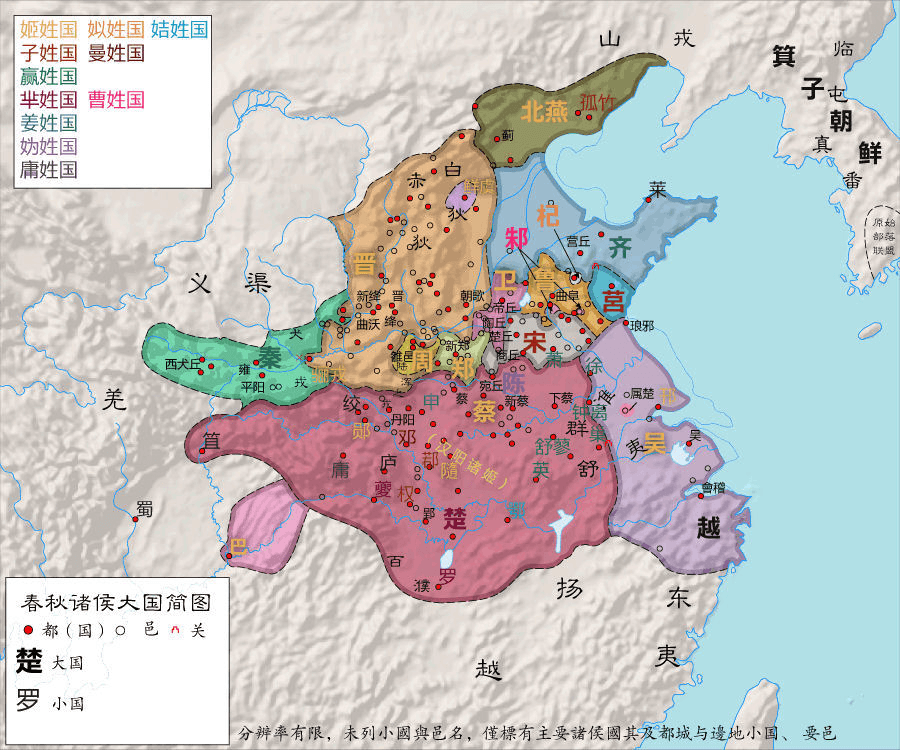
在更东方,东周已经开始。公元前770年以后,中国进入春秋时期,诸侯国林立,礼制仍在,但政治现实不断侵蚀旧秩序,思想与制度创新正在酝酿之中。周王室依然存在,天命、宗法、礼乐并没有被否定。诸侯仍然要“朝周”“尊王”,重大仪式仍以周礼为模板,政治语言仍然是血缘、分封、等级与名分。但现实已经变了。周天子失去军事与财政控制力,只剩象征性中心;诸侯国在名义臣属的外壳下,开始自行征战、结盟、吞并。礼制还在,但它不再能自动约束行动,只能被选择性调用。诸侯打仗时仍然讲“师出有名”,会先通告、会盟、讨罪,战场上也强调仪式与节制;但这些并没有阻止战争升级,而只是把战争包装在熟悉的语言中。礼不再是规则,而变成政治工具。
在社会结构上,一个重要变化正在发生。早期周制下,政治与军事高度绑定于宗族贵族身份,而到了春秋中后期,这套结构开始松动。战争规模扩大,战车与步兵体系需要更稳定、更专业的组织;治理疆域扩大,单靠宗族分封已经不够。于是,卿大夫势力膨胀,士这一层开始浮出水面。士不完全靠血统,而靠才能、忠诚与技术进入政治与军事核心。这是后来战国“官僚化”的前奏。
思想层面的变化,并不是先于政治发生,而是被政治现实逼出来的。旧礼仍然被尊重,但人们越来越清楚:只靠“按礼行事”,已经无法解释为什么世界失序。于是问题从“怎么守礼”转向“礼到底是什么、为何有效、何时失效”。这正是孔子出现的背景。与此同时,另一条思考路径也在酝酿。面对不断强化的政治竞争与人力动员,有人开始怀疑:是不是正因为人为设计过多,世界才如此紧绷?这种对“人为秩序”的反思,最终会在老子式的思想中成型。
孔子稍晚出生,但他所回应的问题,正是这一时期结构性失序的结果。孔子一般被认为出生于公元前551年,地点在鲁国陬邑(今山东曲阜一带)。这个时间来自《史记·孔子世家》以及鲁国纪年体系的换算,在中国古代人物中算是相当可靠的。他生活的年代横跨春秋中晚期,正好处在“礼仍在、但已失效”的临界点:周王室名存实亡,诸侯争霸,卿大夫僭越,士阶层开始流动。孔子的一生,几乎完整地压在这个结构张力之上。
孔子生于公元前551年,卒于公元前479年,一生横跨春秋中晚期最动荡的阶段。孔子年轻时并非“隐士”或“学者”,而是明确想进入现实政治。他在鲁国做过基层官职,最高做到司寇(相当于司法与治安高官),短暂推动过整顿贵族僭越、恢复礼制边界的改革。但现实是,诸侯国的权力已经不可能按周礼运行,真正起作用的是家族、武力和利益结盟,而不是名分与道德。他被边缘化,最终离开鲁国。
孔子带着弟子周游列国,进行了长达十余年的“政治流亡式游说”。试图说服不同诸侯采纳他的治国理念。他不是写书等后世评价,而是面对现实权力,测试自己的方案是否还能落地。结果几乎是全面失败。在竞争环境下,“讲仁义、重礼制、约束强者”意味着自我削弱。在确认政治路径行不通之后,孔子把重心完全转移到“人”身上。
他把“礼”从血缘和贵族身份中拆解出来,重新定义为一套可以通过学习获得的行为规范。礼不再只是“你是谁所以你该怎么做”,而是“你如何行动,决定你成为什么样的人”。他承认并培养“士”这一流动阶层。孔子收弟子不看出身,只看是否愿意学习、能否自我约束。这在当时是非常激进的:他事实上在为一个即将到来的官僚化世界,提前训练人格模型。他重新定义了“君子”。君子不再等同于贵族,而是一种内在标准:克制、自省、守序、知分寸、在失序世界中不彻底变形。这一点,决定了儒家思想后来能在不同朝代、不同制度下被反复调用。
老子的出生时间没有可靠定论,传统说法多集中在公元前6世纪前后,常见的估计是比孔子年长,可能出生在公元前570—560年之间。但这些说法主要来自后世文献的拼接与传说化叙述,尤其是《史记·老子韩非列传》,其本身就明确呈现出多种相互矛盾的版本。老子,若存在其人,其活动时间应略早或大致同时于孔子,但其思想成型明显超出了单一生平的时间尺度。
传统叙述中,老子被描述为周王室的史官,年长于孔子,甚至与孔子有过会面。这种说法最早系统化出现在《史记·老子韩非列传》,但司马迁本人就明确承认材料彼此矛盾。现代研究普遍认为,如果“老子其人”存在,他的活动时间大致不早于公元前6世纪,也不晚于公元前5世纪,确实可能与孔子同时或略早。但问题在于:《道德经》所呈现的思想层次,很难在一个人的单一人生经验中完成。
孔子面对的问题意识高度情境化,直接针对春秋政治的失灵,因此他的语言具体、对话式、带着明显的现实摩擦痕迹。而《道德经》处理的问题更抽象:它讨论的不是“如何恢复秩序”,而是为什么任何被过度设计的秩序,最终都会反噬自身。《道德经》中对“无为”“反者道之动”“弱者道之用”的反复强调,并不是消极,而是一种对高强度政治动员社会的结构性批评。它预设了这样一个现实:人被持续征用,社会被不断拉紧,制度被过度优化,结果是系统脆化。这种判断,更符合春秋向战国过渡时的长期经验积累,而不是某一年、某一段仕途的即时反应。
“无为”几乎是被误解得最严重的概念。它从来不等于什么都不做,而是不以主观设计强行替代系统自身的调节能力。在《道德经》的语境里,问题不在于行动本身,而在于一种特定类型的行动:过度规划、过度干预、过度纠偏。春秋—战国正是一个人人都在“用力”的时代:君主用力集权,官僚用力治理,士人用力献策,军队用力扩张。结果不是更稳定,而是更脆弱。无为的提出,本质上是一句系统诊断:当每一层都在加码控制,整体反而更容易失控。无为不是放弃责任,而是承认复杂系统存在一个“超过就崩”的阈值,并在接近阈值时选择减力而不是加力。
而“反者道之动”,是非常冷酷的结构判断:任何被推到极端的状态,都会触发反向运动。强到极点,会引发反抗;满到极点,会走向枯竭;紧到极点,会突然断裂。在一个持续动员、持续增长、持续扩张的社会里,崩溃不是偶然事件,而是被内嵌在运行逻辑里的结果。老子思想不鼓励你参与高潮,而是提醒你高潮本身就是危险信号。
“弱者道之用”的“弱”是指结构上的可变性与弹性。弱者之所以“有用”,是因为它不与系统正面硬抗,而是通过让步、变形、延迟、吸收冲击来继续存在。水是老子最常用的比喻,因为水不和任何形态竞争,却能穿过一切形态。“强”者依赖结构稳定性,一旦结构被破坏就会崩溃;“弱”者依赖适应能力,结构变化反而成为生存空间。这句话真正指向的不是个人处世,而是文明形态,即能够长期存续的秩序,往往不是最强的,而是最不僵化的。
由此看来,《道德经》很可能经历了一个漫长的生成过程:早期的反礼、反名、反强制思想,在春秋后期开始出现;到战国早期,这些思想被不断重述、提炼、压缩,最终形成高度凝练的文本形态。《道德经》的语言极度压缩、去情境化、去人称,很少出现具体历史指涉,几乎不讲人物故事,也不回应某一国的具体制度。这种写作方式,非常适合在不同时间、不同政治环境中被反复调用和编辑,也非常不适合被还原为一部自传性作品。
因此,“老子”在思想史上的位置,更接近一个思想标签或作者函数。他把一整类对文明过度用力的怀疑,聚拢成一个名字,使之可以被传承、讨论、对抗儒家,也被后世反复激活。是否存在这样一个具体的人,反而变成了次要问题。
与此同时,亚洲的另外一个国家,印度次大陆进入后期吠陀时代,城镇化和国家雏形出现,为后来的佛教与耆那教提供社会土壤。
“吠陀时代”这个名称直接来自梵文 Veda。词根是 √vid,意思是“知道、认识、洞见”,不是日常经验的“知道”,而是带有权威性、宗教性和启示性的“真知”。因此 Veda 在原义上并不是“书”,而是“被正确知晓、被传承的神圣知识”。“吠陀时代”之所以这样命名,并不是因为当时的人自称处在某个“时代”,而是后世学者用“以吠陀为核心权威文本的历史阶段”来做概括。
它不是以王朝、城市或技术命名,而是以“哪一套知识被视为最高合法性来源”来命名。所以,吠陀时代,指的是宗教仪式、社会秩序、语言规范与宇宙观主要围绕吠陀传统运作的时期。吠陀并非单一文本,而是一组在长期口述传统中形成并被不断校准的经典体系,后世将其整理为四部核心吠陀,经常被并称为“吠陀文献群”,例如《Rigveda》《Yajurveda》《Samaveda》和《Atharvaveda》。
早期吠陀时代的世界很小。社会围绕游牧—半农耕部落运作,权威集中在祭司与部族首领,核心活动是祭火、献牲、诵咒。《梨俱吠陀》所反映的正是这种结构:人与神的关系是交易式的,通过正确仪式换取雨水、牲畜和胜利。后期吠陀时代的变化,从物质条件开始。铁器使用扩大,恒河流域被系统性开垦,农业稳定下来,人口密度上升,定居村落与城镇出现。土地不再只是放牧空间,而变成可继承、可争夺、可征税的资源。
结果是,原本松散的部族结构开始承受压力。王权出现并强化,刹帝利(武士—统治者)地位上升;婆罗门(祭司)仍然重要,但不再是唯一权威;社会被系统性地分层,种姓(varna)结构开始固化。祭祀变得越来越复杂、成本越来越高、解释权越来越集中。
《奥义书》开始成形。《奥义书》的名称来源于梵文 Upaniṣad。这个词由 upa(近)、ni(下)、sad(坐)构成,字面意思是“在旁边、在脚下坐着”。它指的不是一本书的体裁,而是一种场景:弟子在师者身旁近坐,接受只对合格者口授的核心教义。因此,《奥义书》这个名字本身就说明了它的性质——秘密的、内传的、非公共的知识。
《奥义书》出现在吠陀文献的末端,常被称为“吠陀的终结”(Vedānta),从如何正确祭祀、如何取悦诸神,转向“祭祀是否还有更深的意义”“仪式背后是否存在统一的本体”。也正因为如此,《奥义书》通常与婆罗门书、森林书连成一条谱系,被视为对早期祭祀宗教的内在反思,而不是对它的否定。
需要明确的是,《奥义书》不是一部书,而是一组在不同地区、不同时期形成的文本集合。它们后来被统称为《Upanishads》,是后世分类与整理的结果,而非当时的统一工程。正因为来源分散、语境多样,它们在思想上并不完全一致,但共享一个根本立场:真正重要的知识,不在外在仪式之中,而在对“自我”“本体”“存在”的直接洞见之中。
《奥义书》所说的自我,即 Ātman,并不是心理学意义上的人格、自我意识或主观体验的集合。。相反,它恰恰通过否定这些东西来被界定。在许多文本中,自我被一层层剥离:身体不是,因为身体会老会死;呼吸不是,因为呼吸有来有去;感受、意志、思维也不是,因为它们变化、不稳定、可被观察。剩下的不是某个“东西”,而是那个始终在、却从不被当作对象出现的觉知立场本身。它不是“我有某种经验”,而是“经验得以发生的那个不动点”。这句话有点深奥,但仔细想想,可以理解。我们的经验并不定义我们,然而观测经验的那个自洽的本体,才是自我。至少这是《奥义书》的观点。
而“本体”,所谓 Brahman,在《奥义书》中并不是一个人格神,也不是一个宇宙创造者的形象,而是“一切之所以为一切”的最终实在。它不是世界背后的某个隐藏物,而是世界之所以显现、变化、消失的根本条件。这看起来很深奥,但似乎是在追溯万物的起源,也许是其他宗教体系里所谓的”神“。同时,《奥义书》不把 Brahman 当作一个客体来讨论,而是提出一个极具破坏力的等式:Ātman = Brahman。当你真正看清“自我”的时候,你发现它并不是一个局部的、个人的东西,而是与“存在本身”在结构上完全同一。这让我想到calvin宗里,所说的神与我们同在。
而关于“存在”的洞见更加深刻,我不禁佩服,思想家还是古代的好。在一切变化、生成、毁灭之中,什么从未改变?答案不是某个实体,而是“存在作为存在”。因此,存在不是“有东西在那里”,而是“显现得以显现”。即,一切即是某些内容的外化,就好像”自我“也是”本体“的外化和一种表现形式。在一些文本中,这被表达为“纯有”“纯知”“纯喜”,不是情绪意义的喜悦,而是没有缺失、没有分裂的圆满状态。在这个层面上,生与死、我与他、主体与客体的区分被视为经验层面的构造,而非终极真实。
“直接洞见”之所以强调“直接”,是因为《奥义书》对中介极度不信任。语言会制造概念,概念会制造对象,而对象会制造分离感。因此文本大量使用否定、悖论和比喻,不是为了晦涩,而是为了防止读者把真理当成“一个可以掌握的东西”。著名的“非此,非彼”(neti neti)策略,正是在不断拆除错误认同,而不是给出一个正面定义。在《Brihadaranyaka Upanishad》和《Chandogya Upanishad》中,这种方法尤为彻底:真理不是被教给你的,而是你在错误全部被耗尽之后,发现它从未离开。我对这段解释尤其感兴趣,改天写一篇研究研究。《奥义书》的洞见不是告诉你“你是什么”,而是让你看到:当一切“你以为你是的东西”都被看穿之后,那个仍然在的,不是个人的自我,而是存在本身在你这里显现。它不是被获得的,而是被认出;不是经验到的,而是一直如此。
综上,观察同时期的各国文化,出现了一致的趋势:人们从听从安排,到了开始质疑权威的安排和灌输,产生了民众自己的理解和洞见,并对传统叙事提出的质疑。虽然不能称为文艺复兴,但我远程之为对世界理解的自我驱动力的强势上升。由此产生的各school of though,也是百家争鸣,非常有意思。
注解如下:
罗马“七王时期”(约前 753–509 年)的年代主要来自后世史学传统,而非同时代记录;考古证据表明前 8–6 世纪罗马经历城市化,但“七王连续统治”更像是对漫长过程的叙事压缩。
希腊“几何时期”“古风时期”是现代考古学基于物质文化(尤以陶器)建立的分期,并非古人自我认知;与罗马政治分期的并置属于分析性对齐。
几何时期(约前 900–700 年)内部存在阶段差异,前 8 世纪后期社会复杂度逐步上升,而非突然转型。
所谓“黑暗时代”指宫殿行政体系与线形文字 B 的中断,并不等同于文明消失;考古显示存在连续性与区域复苏。
几何时期希腊社会缺乏中央官僚与成文法,权威主要依赖亲族、仪式与个人声望。
Polis 既指城市形态,也指公民政治共同体;几何时期被视为城邦形成的“前期阶段”。
荷马史诗大致于前 8 世纪定型,反映晚期几何时期的贵族社会,而非迈锡尼宫廷世界。
将早期罗马与几何时期希腊并比,强调的是结构相似性(个人化权威、宗教—军事共同体),而非经济或扩张规模。
早期罗马更像是拉丁、萨宾与伊特鲁里亚文化交汇的多聚落区,而非正式政治联邦。
罗马王政后期的城市化传统叙事与考古趋势大体一致,但难以精确归因至具体国王。
希腊殖民(apoikia)多为相对独立的新城邦,通过宗教与亲缘联系母城,而非行政隶属。
梭伦改革(前 594/3 年)与斯巴达制度定型(前 7–6 世纪)在此用于比较参照,而非严格年代对齐。
字母书写体系由腓尼基向希腊、伊特鲁里亚、拉丁传播,过程多点接触、长期演化。
新亚述帝国是古代最成熟的军事—官僚扩张型国家之一,其规模与动员能力远超同期希腊与早期罗马。
新亚述对恐怖的运用是制度化治理策略的一部分,并与基础设施、税制和行政体系并行。
“东方专制”是希腊人在后期形成的对比性概念,并非当时即时理论。
东周时期的“礼”是一整套政治与社会操作规范;春秋时期仍存,但逐渐工具化。
春秋中后期“士”阶层趋向技能与流动性导向,但出身仍具影响。
关于政治变迁先于思想变迁的判断,属于分析立场,而非否认思想自身演化。
孔子担任“司寇”的具体职权与任期在文献中存在差异,此处采用通行叙述。
将“老子”视为作者功能,强调《道德经》的复合形成史,而非否认其历史深度。
文末的跨文明比较指出的是结构性压力下的思想回应,并非全球同步或因果演进论。
Prefatory Note: This article was produced in collaboration with ChatGPT.
Rome’s so-called “Period of the Seven Kings” is conventionally dated from roughly 753 BCE to 509 BCE. When placed on the Greek chronological axis, it corresponds to the entire span from the later phase of the Greek Geometric period into the Archaic period—that is, from the moment when the polis was just beginning to take shape to the phase in which institutions, art, and overseas colonization fully unfolded.
The Geometric period is a term used in modern archaeology to describe an early cultural phase of ancient Greece, generally dated to about 900–700 BCE, following the collapse of Mycenaean civilization and preceding the Archaic period. “Geometric” does not refer to mathematics but to a visual language. Pottery, vessels, and grave goods are decorated with straight lines, zigzags, triangles, serrated patterns, and meanders. When human figures appear, they are reduced to highly abstract forms—triangular torsos and linear limbs. Around the twelfth century BCE, the Mycenaean palace system collapsed; writing disappeared, long-distance trade networks broke down, and the Greek world entered what is often called the “Dark Age.”
The Geometric period emerged from this vacuum. There was no state-level bureaucracy, no written law, and no monumental architecture. Society operated through families and small communities. Art no longer served royal power but returned to everyday life, ritual, and burial. The Geometric period functioned as a “preparatory stage” before the emergence of the polis. Land distribution, warrior groups, public rituals, and chieftainly authority already existed, but none had yet been fixed into written law or stable political institutions. The world depicted in the Homeric epics—aristocratic councils, competing chieftains, rule based on prestige rather than office—is essentially a crystallization of the oral memory of Geometric-period society, only later fixed in written form.
On the Roman side, this was likewise a society that had not yet completed the transition “from city to state.” Early Roman kingship was structurally very close to the Greek Geometric world: strong emphasis on ritual, ancestors, and the military community; authority derived from tradition and personal prestige rather than abstract institutions. In the era of the earliest kings (traditionally Romulus and Numa), Rome was little more than a federation of small settlements in a zone of overlap among Latin, Sabine, and Etruscan cultures. Political, religious, and military authority was highly personalized, and institutions were maintained mainly through custom and religious practice. In the later monarchy, especially under Etruscan influence, urban form, public works, priestly offices, and military organization became more clearly defined, but power remained concentrated in the king and his familial network.
Meanwhile, Greece was undergoing a structural leap. In the eighth century BCE, during the later Geometric period, poleis began to stabilize, the Homeric epics took fixed form, and aristocratic martial ethics and collective memory were repeatedly articulated. In the seventh and sixth centuries BCE, the Archaic period brought several decisive developments: the generalization of the polis system; the appearance of written law; large-scale overseas colonization across the Mediterranean and Black Sea; sculpture shifting from geometric abstraction toward proportional and idealized human forms; and, politically, the temporary emergence of tyrannies in many poleis as transitional regimes between aristocratic oligarchy and broader civic participation. Solon’s reforms in Athens and the institutional consolidation of Sparta both occurred during the later phase of Roman kingship.
Seen within the wider Mediterranean and Eurasian context, the Roman Seven Kings period was not isolated. In the eastern Mediterranean, the Phoenicians were at the height of their trading and colonial networks, through which alphabetic writing spread first to Greece and then westward. In the Near East, the Neo-Assyrian Empire expanded rapidly between the ninth and seventh centuries BCE, forming the first truly military-bureaucratic empire. Its logic of rule provided a model for later Persia and, indirectly, for the Mediterranean world. In terms of scale, organization, and capacity for projecting violence, the Neo-Assyrian Empire far surpassed contemporary Greek and Roman city-states. The Phoenician trade-colonial network and the Neo-Assyrian military-bureaucratic expansion thus represent two radically different yet equally mature ways of “organizing the world” within the same era.
The Phoenicians were not a unified state but a chain of port city-states along the eastern Mediterranean coast, with core centers such as Tyre, Sidon, and Byblos. With limited land and poor hinterlands, they could not survive through agricultural expansion. Instead, they perfected navigation, trade, and information circulation. By the ninth to eighth centuries BCE, Phoenician ships systematically covered the entire Mediterranean, from the Levant through Cyprus, the Aegean, North Africa, Sicily, and Iberia, and even into the Atlantic. Alphabetic writing spread through this structure. The Phoenician alphabet was highly simplified, recording only consonants, cheap to learn and fast to write—ideal for merchants, ship captains, warehouse management, and cross-linguistic communication. The Greeks adopted this system through trade and made one decisive modification: the introduction of vowels. The result was a writing system suitable both for accounting and for recording oral poetry and law. Further west, this system was adopted by the Etruscans and the Latins, eventually becoming the Latin alphabet.
The Neo-Assyrian Empire of the ninth to seventh centuries BCE, by contrast, did not sustain its influence through trade but through continuous, institutionalized, large-scale military action that forcibly integrated disparate regions into a single ruling framework. War was no longer episodic; it became the routine output of the state machine. Standing armies, standardized weaponry, siege technology, intelligence systems, road networks, and provincial administration were integrated into a system capable of long-term operation. The end of war was not the goal—war itself was a mode of governance. Terror was used to manufacture certainty. Reliefs, inscriptions, and the public display of brutal punishments were not uncontrolled violence but elements of policy. Cities were besieged, populations forcibly deported on a massive scale, and local elites replaced—not to annihilate opponents, but to break social continuity and prevent renewed resistance. In scale and capability, Neo-Assyria was overwhelming compared with Greece and Rome. Greek armies were seasonal citizen militias; early Rome still relied on tribal and clan-based mobilization. Neo-Assyria, by contrast, could move troops, supplies, and engineers across thousands of kilometers and sustain multi-year campaigns. The Greeks later described this kind of power as “Eastern despotism.”
Further east, the Eastern Zhou period had already begun. After 770 BCE, China entered the Spring and Autumn period, characterized by a multitude of feudal states. Ritual norms remained in place, but political reality increasingly eroded the old order, and intellectual and institutional innovation was beginning to gestate. The Zhou royal house still existed, and concepts such as the Mandate of Heaven, kinship order, and ritual music were not rejected. Feudal lords still “paid court to Zhou” and “honored the king,” major ceremonies still followed Zhou ritual models, and political language remained grounded in bloodline, enfeoffment, rank, and status. Yet reality had changed. The Zhou king lost military and fiscal control and became little more than a symbolic center. Under the nominal shell of vassalage, states waged their own wars, formed alliances, and annexed one another. Ritual persisted, but it no longer automatically constrained action; it was selectively invoked. Even in war, lords insisted on just causes, issued prior announcements, convened alliances, and emphasized ritual restraint on the battlefield. These practices did not halt escalation; they merely packaged warfare in familiar language. Ritual ceased to be a rule and became a political instrument.
At the level of social structure, a major shift was underway. Under the early Zhou system, political and military authority was tightly bound to aristocratic lineage. By the middle and late Spring and Autumn period, this structure began to loosen. As warfare expanded in scale and chariot-and-infantry systems demanded more stable and professional organization, and as territorial governance widened beyond what kin-based enfeoffment could sustain, the power of the great ministers (qing dafu) grew, and the shi class emerged. Shi were no longer defined purely by birth but entered political and military cores through skill, loyalty, and technical competence—foreshadowing the bureaucratization of the Warring States period.
Intellectual change did not precede political change; it was forced into being by political reality. Ritual was still respected, but it was increasingly clear that “acting according to ritual” could no longer explain why the world had fallen into disorder. The question shifted from “how to observe ritual” to “what ritual actually is, why it works, and when it fails.” This was the context in which Confucius emerged. At the same time, another line of thought was taking shape. Confronted with ever-intensifying political competition and human mobilization, some thinkers began to suspect that the world was tense precisely because of excessive human design. This reflection on “artificial order” would crystallize in ideas associated with Laozi.
Confucius was born somewhat later, but the problems he addressed were direct products of this structural disintegration. He is generally believed to have been born in 551 BCE in Zouyi of the state of Lu (near modern Qufu, Shandong). This date, derived from the Records of the Grand Historian and Lu calendrical reckoning, is relatively reliable by ancient standards. His lifetime spanned the most turbulent middle and late phases of the Spring and Autumn period, precisely at the threshold where ritual still existed but had lost effectiveness: the Zhou royal house was hollowed out, feudal states contended for dominance, great ministers overstepped bounds, and the shi class became mobile. His entire life was pressed beneath this structural tension.
Confucius lived from 551 to 479 BCE. In his youth, he was not a recluse or mere scholar but explicitly sought participation in practical politics. He held minor offices in Lu and eventually rose to the position of Minister of Justice, briefly attempting reforms aimed at curbing aristocratic usurpation and restoring ritual boundaries. In reality, however, feudal power could no longer operate according to Zhou ritual norms; kinship, force, and interest-based alliances determined outcomes, not moral status or titles. Confucius was marginalized and ultimately left Lu.
He then traveled among the states with his disciples for more than a decade in what can be described as a form of political exile, attempting to persuade rulers to adopt his principles of governance. He was not writing for posterity but repeatedly confronting real power to test whether his ideas could still function. The result was near total failure. In a competitive environment, advocating benevolence, ritual restraint, and limits on the strong amounted to self-weakening. After recognizing that the political path was blocked, Confucius shifted his focus entirely to the human level.
He detached ritual from bloodline and aristocratic status, redefining it as a set of behavioral norms that could be learned. Ritual was no longer “because of who you are, this is how you act,” but “how you act determines who you become.” He recognized and cultivated the shi as a mobile social stratum, accepting students regardless of birth so long as they were willing to learn and practice self-discipline. This was radical for its time: he was effectively training a personality model in advance for an emerging bureaucratic world. He also redefined the “gentleman” (junzi), no longer as an aristocrat but as an inner standard—restraint, self-reflection, respect for order, a sense of proportion, and the ability not to become deformed by a disordered world. This redefinition explains why Confucianism could later be repeatedly redeployed under different dynasties and institutional forms.
Laozi’s birth date, by contrast, has no reliable determination. Traditional accounts cluster around the sixth century BCE, often placing him earlier than Confucius, perhaps around 570–560 BCE, but these claims are based largely on later textual compilations and legendary accretions, especially in the Records of the Grand Historian, which itself presents multiple contradictory versions. If Laozi existed as a historical individual, his activity likely occurred slightly earlier than or roughly contemporaneous with Confucius. The problem is that the level of thought reflected in the Dao De Jing is difficult to compress into the experience of a single lifetime.
Confucius’s problem consciousness was highly contextual, directly addressing the malfunction of Spring and Autumn politics; his language is concrete, dialogical, and marked by friction with reality. The Dao De Jing, by contrast, addresses a more abstract question: not how to restore order, but why any over-engineered order ultimately turns against itself. Its repeated emphasis on “non-action,” “reversal as the movement of the Way,” and “weakness as the function of the Way” is not passive resignation but a structural critique of high-intensity political mobilization. It presupposes a world in which people are continuously conscripted, society is constantly tightened, and institutions are excessively optimized, resulting in systemic brittleness. Such judgment aligns more closely with the long accumulation of experience from the Spring and Autumn to the early Warring States period than with any single episode of official career.
“Non-action” is among the most misunderstood of concepts. It never means doing nothing; it means not allowing subjective design to forcibly replace a system’s own regulatory capacity. In the Dao De Jing, the problem is not action per se, but a specific kind of action: over-planning, over-intervention, over-correction. The Spring and Autumn–Warring States era was a time when everyone was exerting effort—rulers centralizing, officials governing, scholars advising, armies expanding. The result was not greater stability but greater fragility. “Non-action” is thus a systemic diagnosis: when every layer intensifies control, the whole becomes more prone to collapse. It is not abdication of responsibility, but recognition that complex systems have a threshold beyond which they break, and that near this threshold, reducing force is wiser than adding it.
“Reversal is the movement of the Way” is an unsentimental structural judgment: any state pushed to its extreme triggers a counter-movement. Strength at its limit provokes resistance; fullness at its limit leads to depletion; tightness at its limit snaps. In a society of continuous mobilization, growth, and expansion, collapse is not accidental but embedded in the operating logic itself. Laozi’s thought does not encourage participation in the peak of interest (高潮) but warns that the peak itself is the danger signal.
In “weakness is the function of the Way,” “weakness” refers to structural flexibility and elasticity, not moral virtue or personality softness. The weak are “useful” because they do not confront the system head-on; they survive by yielding, reshaping, delaying, and absorbing shock. Water is Laozi’s favored metaphor because it competes with no form yet passes through all forms. The strong depend on structural stability and collapse once that structure fails; the weak depend on adaptability, turning change itself into space for survival. This insight concerns not personal conduct but civilizational form: systems that endure are often not the strongest, but the least rigid.
From this perspective, the Dao De Jing likely underwent a long process of formation. Early critiques of ritual, naming, and coercion appeared in the late Spring and Autumn period; in the early Warring States period they were repeatedly reformulated, distilled, and compressed into a highly condensed textual form. Its language is stripped down, decontextualized, and impersonal, with few concrete historical references, little narrative, and no engagement with specific state institutions. This makes it ideal for reuse and editing across different eras and political settings—and ill-suited to reconstruction as an autobiographical work.
Accordingly, “Laozi” occupies a position in intellectual history closer to that of a conceptual label or author-function. The name gathers a whole category of skepticism toward civilizational overexertion, enabling it to be transmitted, debated, positioned against Confucianism, and repeatedly reactivated by later generations. Whether a single historical individual ever existed becomes a secondary issue.
At the same time, elsewhere in Asia, the Indian subcontinent was entering the Late Vedic period. Urbanization and proto-state formations emerged, providing the social soil for the later rise of Buddhism and Jainism.
Meanwhile, elsewhere in Asia, the Indian subcontinent entered the Late Vedic period. Urbanization and proto-state formations began to emerge, providing the social conditions that would later give rise to Buddhism and Jainism.
The term “Vedic period” comes directly from the Sanskrit word Veda. Its root is √vid, meaning “to know,” “to recognize,” or “to have insight”—not ordinary, everyday knowing, but an authoritative, religious, and revelatory form of true knowledge. In its original sense, Veda does not mean a “book,” but rather “sacred knowledge that has been correctly known and transmitted.” The period is called the “Vedic period” not because people at the time identified themselves as living in a particular “age,” but because later scholars used the term to summarize a historical phase in which the Vedas functioned as the central source of authority.
This period is not named after a dynasty, a city, or a technology, but after which body of knowledge was regarded as the highest source of legitimacy. The Vedic period therefore refers to a time when religious ritual, social order, linguistic norms, and cosmology were primarily organized around the Vedic tradition. The Vedas are not a single text, but a corpus of classics formed through a long oral tradition and continuously refined over time. Later generations organized them into four core Vedas, often collectively referred to as the “Vedic corpus”: the Rigveda, Yajurveda, Samaveda, and Atharvaveda.
The world of the early Vedic period was small in scale. Society revolved around nomadic or semi-agricultural tribes, with authority concentrated in priests and tribal leaders. Central activities included fire sacrifices, animal offerings, and ritual recitation. This structure is precisely what the Rigveda reflects: the relationship between humans and gods is transactional, with correct ritual performed in exchange for rain, livestock, and victory. The transformation in the later Vedic period began with material conditions. The expanded use of iron tools, systematic cultivation of the Ganges basin, stabilization of agriculture, rising population density, and the emergence of permanent villages and towns all reshaped society. Land was no longer merely pasture, but became an inheritable, contestable, and taxable resource.
As a result, the previously loose tribal structure came under pressure. Kingship emerged and strengthened, and the status of the Kshatriyas (warrior-rulers) rose. The Brahmins (priests) remained important but were no longer the sole authority. Society became systematically stratified, and the varna (caste) structure began to solidify. Rituals grew increasingly complex, costly, and centralized in terms of interpretive control.
It is in this context that the Upanishads began to take shape. The term Upaniṣad comes from Sanskrit, composed of upa (“near”), ni (“down”), and sad (“to sit”), literally meaning “to sit near” or “to sit at the feet.” It refers not to a literary genre, but to a setting: a disciple sitting close to a teacher, receiving core teachings transmitted orally only to those deemed qualified. The name itself thus reveals the nature of the Upanishads—secret, inward, and non-public knowledge.
The Upanishads appear at the end of the Vedic corpus and are often called the “end of the Vedas” (Vedānta). They mark a shift from questions of how to perform rituals correctly and how to please the gods, toward deeper inquiries such as whether ritual has an underlying meaning and whether there exists a unified reality behind ritual practice. For this reason, the Upanishads are usually linked with the Brahmanas and the Aranyakas as part of a continuous lineage, and are seen as an internal reflection on early ritual religion rather than a rejection of it.
It is important to be clear that the Upanishads are not a single book, but a collection of texts formed in different regions and at different times. They were later grouped together under the collective name Upanishads through retrospective classification and organization, not as a unified project of their own era. Because their origins are dispersed and their contexts diverse, their ideas are not entirely consistent. Yet they share a fundamental stance: what truly matters is not external ritual, but direct insight into “the self,” “ultimate reality,” and “existence.”
The self spoken of in the Upanishads—Ātman—is not a personality, an ego, or a collection of subjective experiences in the psychological sense. On the contrary, it is defined precisely through the negation of such things. In many texts, the self is stripped away layer by layer: the body is not the self, because it ages and dies; breath is not the self, because it comes and goes; sensations, intentions, and thoughts are not the self, because they change, are unstable, and can be observed. What remains is not a “thing,” but the standpoint of awareness itself—always present, yet never appearing as an object. It is not “I have an experience,” but “that unmoving point by which experience is possible.” This may sound abstract, but on reflection it becomes intelligible. Our experiences do not define us; rather, the coherent ground that observes experience is the self—at least, this is the Upanishadic position.
As for “ultimate reality,” or Brahman, it is not a personal god nor an anthropomorphic creator figure in the Upanishads. It is the final reality by which everything is what it is. It is not something hidden behind the world, but the fundamental condition that allows the world to appear, change, and disappear. This may seem abstruse, but it resembles an attempt to trace the origin of all things, perhaps analogous to what other religious systems call “God.” Crucially, however, the Upanishads do not treat Brahman as an object of discussion. Instead, they advance a radically disruptive equation: Ātman = Brahman. When one truly sees the self, one discovers that it is not something partial or personal, but structurally identical with existence itself. This reminds me of Calvinist thought, where God is said to be present with us.
The insight into “existence” goes even deeper, and I cannot help but admire the ancient thinkers for it. Amid all change, becoming, and destruction, what has never changed? The answer is not a particular entity, but “existence as such.” Existence, then, is not “something being there,” but “the fact that manifestation manifests.” Everything is an externalization of something, much as the “self” is also an externalization and expression of “ultimate reality.” In some texts, this is described as “pure being,” “pure knowing,” or “pure bliss”—not bliss as an emotion, but as a state of completeness without lack or division. At this level, distinctions between life and death, self and other, subject and object are regarded as constructions of experience rather than ultimate reality.
The emphasis on “direct” insight arises from the Upanishads’ deep distrust of intermediaries. Language creates concepts, concepts create objects, and objects create a sense of separation. For this reason, the texts make extensive use of negation, paradox, and metaphor—not to be obscure, but to prevent readers from treating truth as something that can be grasped and possessed. The famous strategy of “not this, not that” (neti neti) continuously dismantles false identifications rather than offering a positive definition. In the Brihadaranyaka Upanishad and the Chandogya Upanishad, this method is especially thorough: truth is not something taught to you, but something you realize has never left once all errors have been exhausted. I am particularly interested in this explanation and plan to write a separate study on it someday. The insight of the Upanishads is not to tell you “what you are,” but to show you that when everything you think you are has been seen through, what remains is not the personal self, but existence itself manifesting here. It is not acquired, but recognized; not experienced, but always already the case.
Taken together, when we observe the cultures of different regions during the same period, a shared trend emerges: people move from passively accepting prescribed arrangements to questioning authoritative structures and indoctrination, developing their own understanding and insight, and challenging traditional narratives. While this cannot quite be called a Renaissance, I would describe it as a strong rise in humanity’s self-driven impulse to understand the world. The various schools of thought that emerged from this process—diverse and competing—are akin to a “hundred schools contending,” and are deeply fascinating.
Footnotes:
The traditional dating of Rome’s “Seven Kings” (c. 753–509 BCE) derives from later Roman historiography rather than contemporary records; archaeology supports urbanization in the 8th–6th centuries BCE, but the seven-king schema is a retrospective narrative compression.
Greek “Geometric” and “Archaic” periods are modern archaeological classifications based on material culture (especially pottery), not ancient self-periodization; their alignment with Roman political phases is analytical, not institutional.
The Geometric period (c. 900–700 BCE) includes internal phases; the late 8th century BCE shows gradual increases in settlement size, exchange, and social complexity rather than an abrupt transition.
The post-Mycenaean “Dark Age” reflects the collapse of palace administration and Linear B usage, not civilizational disappearance; recent archaeology indicates continuity and regional recovery.
Geometric Greek society lacked centralized bureaucracy and codified law, relying instead on kinship, ritual, and personal authority rather than formal institutions.
Polis denotes both urban form and political community; the Geometric period is considered “preparatory” insofar as key elements existed without institutional stabilization.
The Homeric epics took shape around the 8th century BCE, reflecting late Geometric aristocratic society rather than Mycenaean palace culture, following a long oral tradition.
The comparison between early Rome and Geometric Greece concerns structural features (personal authority, ritual–military community), not economic scale or imperial capacity.
Early Rome functioned as a multi-settlement cultural overlap zone (Latin, Sabine, Etruscan), not a formal political federation.
Urban development traditionally attributed to Rome’s late monarchy aligns broadly with archaeological evidence, though attribution to specific kings remains uncertain.
Greek colonization (apoikia) involved independent city foundations linked by ritual and kinship, not direct political control by a metropolis.
Solon’s reforms (594/3 BCE) and Sparta’s institutional consolidation (7th–6th c. BCE) are juxtaposed with late Roman monarchy for comparative, not exact chronological, purposes.
Alphabetic writing spread broadly from Phoenician to Greek, then to Etruscan and Latin contexts through multiple contacts and adaptations, not a single linear transmission.
The Neo-Assyrian Empire represents one of the most developed ancient military-bureaucratic states, exceeding Greek and early Roman polities in scale and logistical capacity.
Neo-Assyrian use of terror was a deliberate policy embedded in governance, alongside infrastructure, taxation, and administrative control.
“Eastern despotism” is a later Greek conceptual contrast, crystallized especially after the Persian Wars, rather than a contemporaneous analytical category.
In Eastern Zhou China, ritual (li) comprised concrete political and social procedures; during the Spring and Autumn period it persisted but became increasingly instrumentalized.
The shi class gradually shifted toward greater mobility and skill-based recruitment, though birth status remained relevant.
The claim that political change preceded intellectual transformation reflects an analytical emphasis on structural pressure rather than denial of intellectual autonomy.
Confucius’s office as Sikou (“judicial official”) is variably described in sources; the account follows conventional narrative usage.
Treating “Laozi” as an author-function highlights the composite formation of the Dao De Jing rather than denying its historical depth.
Cross-civilizational comparison here identifies parallel structural pressures and reflective responses, not a synchronized or causal global progression.