Created on
Updated on
United States (V): Boston Tea Party
美国 (V):波士顿倾茶事件
写在前面:本文和chatgpt合作完成。
1767 年,是在《印花税法》于 1766 年被废除之后,英国财政大臣 查尔斯·汤森主导推出了一整套立法方案,叫《汤森法案》。议会对进入北美殖民地的特定商品征收关税,包括玻璃、铅、纸张、油漆、茶叶等。这些税被刻意界定为“贸易关税”而非内部税,以回避《印花税法》引发的宪制争议。但这些关税的用途被明确规定:收入将直接用于支付殖民地总督、法官等官员的薪酬。
同时,汤森法案扩大了海关权力,强化了对走私的搜查、扣押和惩罚机制,并显著提升了无陪审团的副海事法庭在关税案件中的适用范围。无陪审团的副海事法庭直接绕开了殖民地社会的本地陪审团和地方司法的独立法庭,自行裁决。与此同时,英国还在波士顿设立了新的海关委员会总部,使执法从“零散驻点”升级为常态化、集中化的存在。通过让官员工资“脱钩”于殖民地议会,通过强化中央执法力量,伦敦试图把殖民地从一种高度依赖地方协商的治理模式,推回到一种更接近直接统治的状态。
到 1770 年,在持续的经济压力和社会冲突下,英国被迫撤销除茶税之外的所有汤森关税。但1773 年英国议会通过的《茶叶法案》(Tea Act),却重提了《汤森法案》的茶税。如果只看价格,这是一项“降价”措施:法案允许英国东印度公司绕过伦敦拍卖体系和殖民地本地商人,直接将茶叶销售到北美殖民地,其价格甚至可以低于长期存在的走私茶。但从司法角度来看,这是再一次绕过绕过地方司法、税收,直接向殖民地征税的尝试。
1773 年,东印度公司的茶船陆续驶向北美主要港口。纽约、费城、查尔斯顿的反应非常明确:不让茶卸货,迫使船只掉头,或者让茶被存放但不出售。波士顿的处境却不同。马萨诸塞总督托马斯·哈钦森不仅拒绝让茶船原路返回,还坚持按照法律要求:要么卸货并缴税,要么在期限后没收货物。波士顿城镇会议反复召开,讨论的焦点始终不是“要不要反抗”,而是“如何避免承认这条权力线”。
在最初几次会议上,占主导的思路是把问题维持在程序层面。也就是说,只要茶不被卸下、税不被缴纳、交易不完成,那么殖民地就没有“承认”任何新权力。哪怕茶在港口停着,只要它仍然是“未完成交易的货物”,原则上就还有回旋空间。但这套策略很快撞上了一个硬点:马萨诸塞总督 托马斯·哈钦森。他坚持执行法律条文,拒绝给予任何例外。按照规定,茶船在港口停留超过期限后,必须卸货并缴税,否则货物将被官方没收。更关键的是,哈钦森本人在茶叶贸易中有直接利益关联,这使得谈判空间进一步压缩。
哈钦森本人及其直系家族,在东印度公司茶叶的殖民地分销体系中有明确、可计算的经济利益。具体来说,波士顿接收的那批茶,其指定收货人与代理人中,就包括哈钦森的亲属。城镇会议表面上是在和“总督办公室”谈判,实际上是在和一个个人收益与政策执行高度绑定的人谈判。任何允许茶退回、延期、或不缴税的方案,都会直接损害哈钦森及其家族的经济利益。
哈钦森反复强调自己“只是执行法律”,拒绝任何例外处理。但在殖民地社会看来,这种坚持已经无法被理解为中立的法治立场,而更像是用法律掩护私人获利。如果总督只是一个没有直接利益关联的执行者,哪怕立场强硬,也可能通过延迟、技术性解释或暂缓执行来降低冲突强度。但一旦他本人是交易链条的一部分,任何延迟都会被视为对自身利益的不确定暴露。因此,哈钦森的立场只能是:要么卸货、缴税、完成交易;要么在期限到达后,由官方强制没收。这两个选择,都会在事实层面完成对议会征税权的承认。请愿、拖延、谈判都已经用尽。于是1773 年 12 月的那个夜晚,行动者换装登船,把整船茶一箱箱扔进海里。
波士顿倾茶事件的参与者,主要来自“自由之子”(Sons of Liberty)这一长期存在的行动网络。他们大多来自波士顿本地的商人圈、码头工人、船员、工匠以及与城镇会议高度重叠的政治网络。其中不少人,白天就在港口、仓库、航运或贸易体系里工作,非常清楚这批茶意味着什么、会怎么走完流程、最后谁会获利。他们并不是被情绪动员上街,而是在会议、协商和分工之后执行行动。正因如此,这次行动从一开始就被设计为一次高度可控的政治事件,而非即兴的破坏行为。
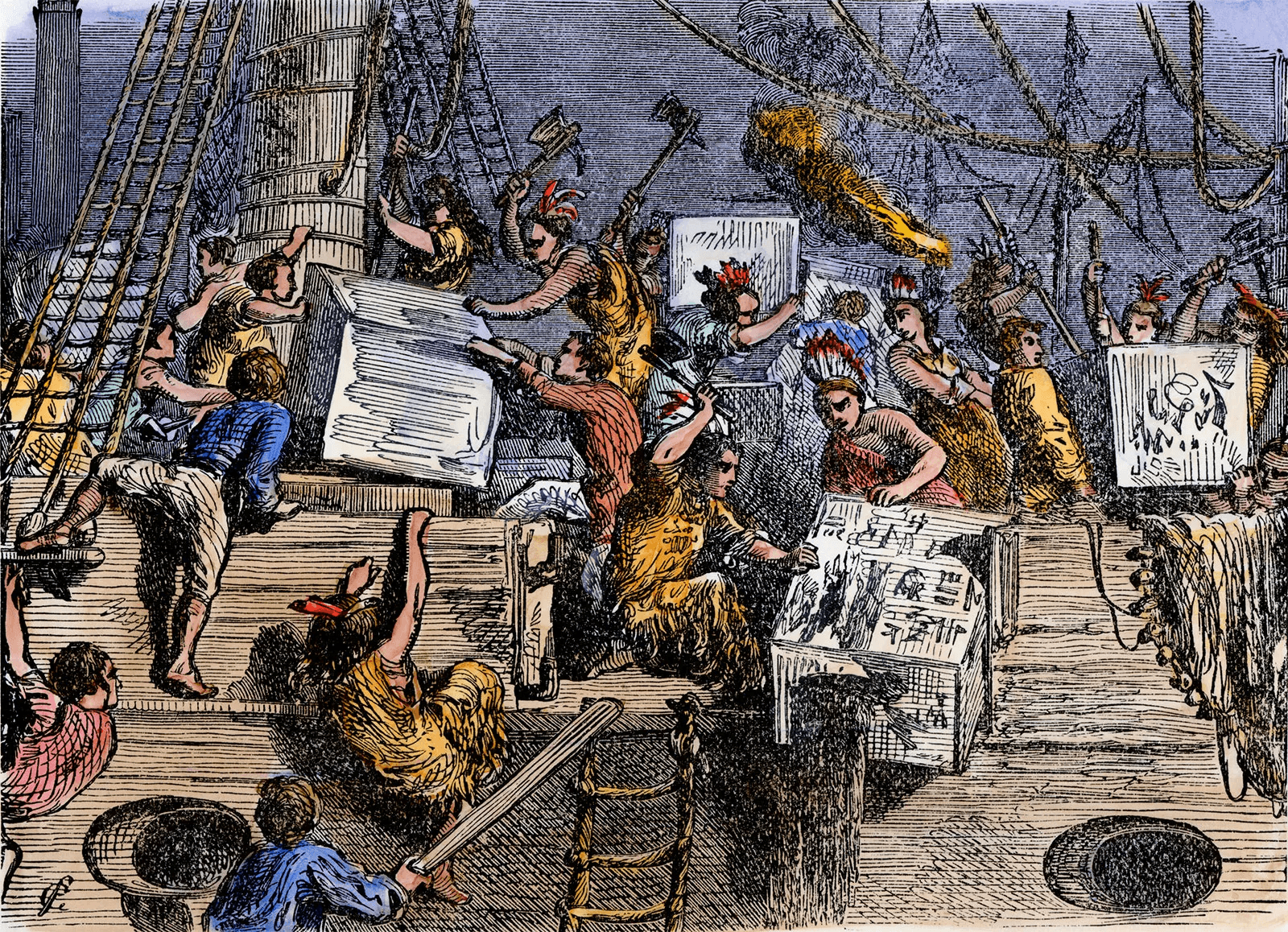
当晚,参与者乔装成莫霍克原住民。最直接的原因是实用性的匿名保护:公开毁坏帝国财产在法律上属于重罪,伪装有助于降低个人被精准追责的风险。但在历史研究中,这种“印第安伪装”通常也被解读为具有象征意义。它不仅是一种面具,更是一种政治姿态——在公共空间中暂时否认英国臣民身份,借用“北美原住者”的形象,指向一种正在形成的、扎根于美洲土地的共同体想象。
纪律性,是这次行动最容易被低估、却最具政治分量的部分。参与者没有抢夺船员的私人财物,没有破坏船只结构,也没有攻击任何个人。他们唯一处理的对象,是属于英国东印度公司的茶叶。这种克制并非道德表演,而是一种清晰的策略选择:通过只破坏“象征性权力资产”,将责任指向制度和垄断本身,而不是让事件被重新定义为治安问题或无差别暴乱。
1773 年 12 月 16 日傍晚,在完成最后一次动员与分工后,参与者分批前往波士顿的格里芬码头。夜色本身就是行动的一部分,它降低了外部干预的可能性,也减少了普通市民被卷入的风险。到达码头后,参与者迅速登上三艘停泊的货船——达特茅斯号、埃莉诺号和比弗号——这三艘船正装载着英国东印度公司的茶叶,也是此次行动的唯一目标。
登船后,行动迅速而有序。货舱被打开,木箱被撬开,茶叶被倾倒入海。有记录表明,箱体被刻意破坏,使茶叶吸水沉没,防止被事后打捞回收。这显示出参与者对“结果不可逆”的高度重视。
整个过程中,船员未遭攻击,个人财物未被动用,船体与其他货物也未被破坏。若有人试图私藏茶叶,往往会被当场制止,甚至被迫将藏匿的茶重新丢入海中。这种内部约束清楚表明,参与者意识到:一旦出现私人获利或失控破坏,事件的政治性质就会被迅速稀释。
抛茶过程持续了大约三个小时。342 箱茶叶全部被投入海中后,参与者迅速撤离码头,没有留下继续对抗的痕迹。次日清晨,波士顿港水面仍漂浮着被浸湿的茶叶,气味弥漫。这种“可见的后果”本身就是行动的一部分,使任何人都无法否认事件已经发生。
从规模上看,342 箱茶叶所代表的经济损失巨大,无法被公司或政府悄然吸收,也无法用保险或内部调整掩盖。同时,其规模又足够清晰,使“少数极端分子行为”的叙事难以成立。这是一项刻意制造的政治事实,迫使英国政府必须公开回应,也迫使其他殖民地必须表态。
这是一种不可逆的信号。一旦帝国财产被有组织地、以政治理由公开摧毁,妥协空间便被压缩,模糊地带被清空。英国政府随后推出的《强制法案》(殖民地称“不可容忍法案”)——包括关闭波士顿港、削弱马萨诸塞自治权和加强军事管制——并未孤立波士顿,反而促成了殖民地间的联合。波士顿倾茶事件是一场成功的政治升级实验。它的关键不在于暴力,而在于高度聚焦的目标、去个人英雄主义的集体行动,以及对升级后果的主动承担。
而此次行动的主力,“自由之子”后来却将自身制度化。恰恰相反,它的存在逻辑是:只在冲突需要时显形,在合法政治暂时失效时补位。这也解释了为何几乎不存在一份明确的“成立宣言”或“组织章程”。它更像是一种在殖民地城市中自然生长出来的政治技术,而非一个以永续存在为目标的正式组织。这一网络并未作为一个整体延续下去,但它的人、关系与行动逻辑,几乎完整地流入了后来美国的政治与精英结构之中。其核心成员在独立战争爆发后,分别进入大陆会议、州议会、地方行政体系或大陆军,承担筹款、情报、补给与地方动员等角色。以 Samuel Adams 为代表的路径尤为典型:从组织非法行动的人,转变为参与制定新规则的人。
在这一过程中,“自由之子”与共济会(Freemasons)之间存在显著的成员重叠,尤其是在波士顿、费城和纽约等港口城市。但这种重叠并不意味着组织继承关系。18 世纪的共济会并非“阴谋集团”,而是一种强调兄弟关系、仪式、保密与互信的跨职业社交网络。它为殖民地精英提供的,是信任机制、跨殖民地联系,以及一种超越帝国框架的身份语言。
Preface: This essay was produced in collaboration with ChatGPT.
In 1767, after the Stamp Act had been repealed in 1766, Britain’s chancellor of the exchequer Charles Townshend introduced a comprehensive legislative package known as the Townshend Acts. Parliament imposed customs duties on specific goods entering the North American colonies, including glass, lead, paper, paint, and tea. These taxes were deliberately defined as “trade duties” rather than internal taxes, in order to sidestep the constitutional controversy triggered by the Stamp Act. At the same time, the legislation explicitly stipulated the use of the revenue: it would be applied directly to the salaries of colonial governors, judges, and other officials.
Alongside this, the Townshend Acts expanded the powers of customs officials, strengthened search, seizure, and punishment mechanisms against smuggling, and significantly increased the use of jury-less vice-admiralty courts for customs cases. These courts bypassed local juries and independent colonial courts, issuing judgments on their own authority. Britain also established a new Customs Board headquarters in Boston, transforming enforcement from scattered posts into a permanent, centralized presence. By decoupling officials’ salaries from colonial assemblies and reinforcing centralized enforcement, London attempted to push the colonies away from a governance model heavily dependent on local negotiation and back toward something closer to direct rule.
By 1770, under sustained economic pressure and escalating social conflict, Britain was forced to repeal all the Townshend duties except the tax on tea. However, the Tea Act of 1773, passed by Parliament, effectively revived the Townshend tea duty. Judged solely by price, it appeared to be a “price-cutting” measure: the Act allowed the British East India Company to bypass the London auction system and colonial middlemen and sell tea directly to North American colonies, at prices even lower than long-standing smuggled tea. From a legal perspective, however, it was another attempt to bypass local judicial and fiscal structures and impose taxation directly on colonial society.
In 1773, East India Company tea ships began arriving at major North American ports. The responses in New York, Philadelphia, and Charleston were straightforward: the tea was not allowed to be unloaded, ships were forced to turn back, or the tea was stored but not sold. Boston’s situation was different. Massachusetts governor Thomas Hutchinson not only refused to allow the ships to return but insisted on strict legal enforcement: either the tea would be unloaded and the tax paid, or the cargo would be confiscated after the deadline. Boston town meetings were convened repeatedly, and their focus was never “whether to resist,” but rather “how to avoid acknowledging this line of authority.”
In the initial meetings, the dominant approach was to keep the issue at the procedural level. As long as the tea was not unloaded, the tax not paid, and the transaction not completed, the colonies would not have “acknowledged” any new authority. Even if the tea remained in the harbor, as long as it was still an “unfinished transaction,” room for maneuver theoretically remained. This strategy soon ran into a hard wall: Governor Thomas Hutchinson himself. He insisted on enforcing the law without exception. Under the regulations, ships that remained in port beyond the deadline had to unload and pay the tax or face official seizure. More critically, Hutchinson himself had direct financial interests in the tea trade, which further compressed the space for negotiation.
Hutchinson and his immediate family held clear, quantifiable economic interests in the East India Company’s colonial tea distribution network. Specifically, among the designated consignees and agents for the tea arriving in Boston were Hutchinson’s relatives. On the surface, the town meetings were negotiating with the “governor’s office”; in reality, they were negotiating with a man whose personal profits were tightly bound to policy enforcement. Any proposal allowing the tea to be returned, delayed, or untaxed would have directly harmed Hutchinson’s family interests.
Hutchinson repeatedly insisted that he was “merely executing the law” and refused any exceptions. In colonial society, however, this stance could no longer be understood as neutral rule-of-law fidelity; it appeared instead as the use of law to shield private gain. Had the governor been an executor without direct personal stakes, even a hard-line position might have allowed for delay, technical reinterpretation, or temporary suspension to reduce tensions. But once he was part of the transaction chain, any delay became an exposure of personal financial risk. His position therefore narrowed to two options only: unload the tea, pay the tax, and complete the transaction; or allow official seizure after the deadline. Both outcomes would, in practice, amount to acknowledging Parliament’s right to tax. Petitions, delays, and negotiations had been exhausted. Thus, on a night in December 1773, participants disguised themselves, boarded the ships, and dumped the tea into the harbor, crate by crate.
The participants in the Boston Tea Party largely came from the long-standing activist network known as the Sons of Liberty. They were drawn mainly from Boston’s merchant circles, dockworkers, sailors, artisans, and political networks closely overlapping with town meetings. Many of them worked daily in ports, warehouses, shipping, or trade and understood exactly what this tea represented, how the process would unfold, and who would ultimately profit. They were not mobilized by raw emotion but acted after meetings, coordination, and division of labor. For that reason, the action was designed from the outset as a tightly controlled political event rather than spontaneous vandalism.
That night, participants disguised themselves as Mohawk Indians. The most immediate reason was practical anonymity: the destruction of imperial property was a serious crime, and disguise reduced the risk of targeted prosecution. Historically, this “Indian disguise” has also been read symbolically—not merely as a mask, but as a political gesture: a temporary rejection of British subjecthood and an invocation of an emerging community imagined as rooted in American soil.
Discipline was the most underestimated yet politically significant feature of the action. Participants did not seize sailors’ personal property, damage ships, or assault individuals. Their sole target was the East India Company’s tea. This restraint was not moral theater but a deliberate strategy: by destroying only “symbolic assets of power,” responsibility was directed toward the system and monopoly itself, preventing the event from being reframed as a public-order issue or indiscriminate riot.
On the evening of December 16, 1773, after final mobilization and task allocation, participants moved in groups to Griffin’s Wharf. Darkness was part of the operation, reducing the risk of outside intervention and limiting civilian involvement. They boarded three ships—the Dartmouth, the Eleanor, and the Beaver—all carrying East India Company tea and constituting the sole targets of the action.
Once aboard, the operation proceeded swiftly and methodically. Cargo holds were opened, crates broken, and tea dumped into the water. Records indicate that crates were deliberately damaged so the tea would absorb water and sink, preventing later recovery. This demonstrated a clear concern for irreversibility.
Throughout the action, no crew members were harmed, no personal belongings were taken, and ships and other cargo were left intact. Anyone attempting to pocket tea was stopped and forced to throw it overboard. This internal discipline underscored the participants’ awareness that any private gain or uncontrolled destruction would quickly dilute the political meaning of the act.
The dumping lasted roughly three hours. After all 342 chests of tea had been thrown into the harbor, participants withdrew without further confrontation. The next morning, soaked tea leaves floated across Boston Harbor, the smell lingering—this visible aftermath itself part of the action, ensuring that the event could not be denied.
In scale, the destruction of 342 chests represented an enormous economic loss that could not be quietly absorbed by the company or government, nor concealed through insurance or internal adjustment. At the same time, the scale was clear enough to undermine any narrative of “isolated extremist behavior.” It was a deliberately manufactured political fact, forcing the British government to respond publicly and compelling other colonies to take a position.
This was an irreversible signal. Once imperial property was openly destroyed in an organized, politically articulated manner, space for compromise collapsed and ambiguity disappeared. Britain’s subsequent response—the Coercive Acts (called the “Intolerable Acts” in the colonies), including the closure of Boston Harbor, the curtailment of Massachusetts self-government, and intensified military control—did not isolate Boston but instead accelerated intercolonial unity. The Boston Tea Party was a successful experiment in political escalation. Its significance lay not in violence, but in its tightly focused objective, collective action without individual heroism, and the participants’ willingness to bear the consequences of escalation.
The Sons of Liberty themselves were not institutionalized afterward. On the contrary, their operating logic was to appear only when conflict demanded it, stepping in when legal politics temporarily failed. This explains the absence of a formal founding declaration or organizational charter. They functioned more as a political technique that emerged organically in colonial cities than as a permanent organization. The network did not persist as a unified body, but its people, relationships, and methods flowed almost intact into the later American political and elite structure. Core members entered the Continental Congress, colonial and state legislatures, local administrations, or the Continental Army, taking on roles in fundraising, intelligence, logistics, and local mobilization. The trajectory exemplified by Samuel Adams is especially telling: from organizing illegal actions to helping draft new rules.
During this process, there was significant overlap in membership between the Sons of Liberty and the Freemasons, particularly in port cities such as Boston, Philadelphia, and New York. This overlap does not imply organizational inheritance. Eighteenth-century Freemasonry was not a “conspiracy society,” but a cross-professional social network emphasizing fraternity, ritual, secrecy, and mutual trust. What it provided colonial elites were trust mechanisms, intercolonial connections, and a language of identity that transcended the imperial framework.